
How Much Does AI Development Cost? Budgeting & ROI Guide
Whether you are looking to automate a single workflow or overhaul your entire customer experience, understanding the financial landscape is the first step toward a successful rollout.
- For New Clients
- AI Development
May 13, 2026
 AI Overview
AI development cost ranges from $20,000 for a proof-of-concept to over $1 million for enterprise-scale systems, with production-ready mid-market solutions typically landing between $100,000 and $400,000. Price depends on project scope, data readiness, model complexity, integrations, and post-launch maintenance. A computer vision system alone can cost $80,000 to $500,000+, far more than a basic AI chatbot at $30,000-$150,000.

To provide a clear baseline: the AI development cost usually ranges from $20,000 for a targeted proof-of-concept to over $1,000,000 for complex, high-scale enterprise systems. For most mid-market organizations, a robust, production-ready solution usually lands between $100,000 and $400,000.
The final price depends on project scope, data readiness, model complexity, infrastructure, third-party APIs, integrations, team composition, and post-launch maintenance. A chatbot trained on company documents will not cost the same as a computer vision system for medical diagnostics or a predictive maintenance platform connected to thousands of IoT sensors. AI is not one product category. It is a toolbox — some tools are screwdrivers, while others are nuclear submarines with user dashboards.
Why AI Development Costs Vary So Much
The cost of AI development is difficult to reduce to a single, universal figure because AI projects vary widely in technical depth. Some companies need a simple AI assistant that answers internal questions from a knowledge base. Others need a demand forecasting engine, a fraud detection model, an autonomous workflow agent, or a generative AI product used by thousands of customers daily.
Recent research also shows why firms are investing despite the uncertainty. McKinsey’s 2025 State of AI report notes that AI tools are now widespread, but many organizations still struggle to embed them deeply enough into workflows to achieve enterprise-level value. That gap between experimentation and real operational change is exactly where cost planning becomes critical.
Regional patterns also matter. For companies tracking enterprise software trends in MENA, AI budgets are increasingly tied to cloud modernization, automation, customer experience, fintech infrastructure, and government-backed digital agendas.
Cost of AI Development by Project Type
AI projects do not have a single universal price tag, but the table below provides a practical starting point for estimating costs by project type.
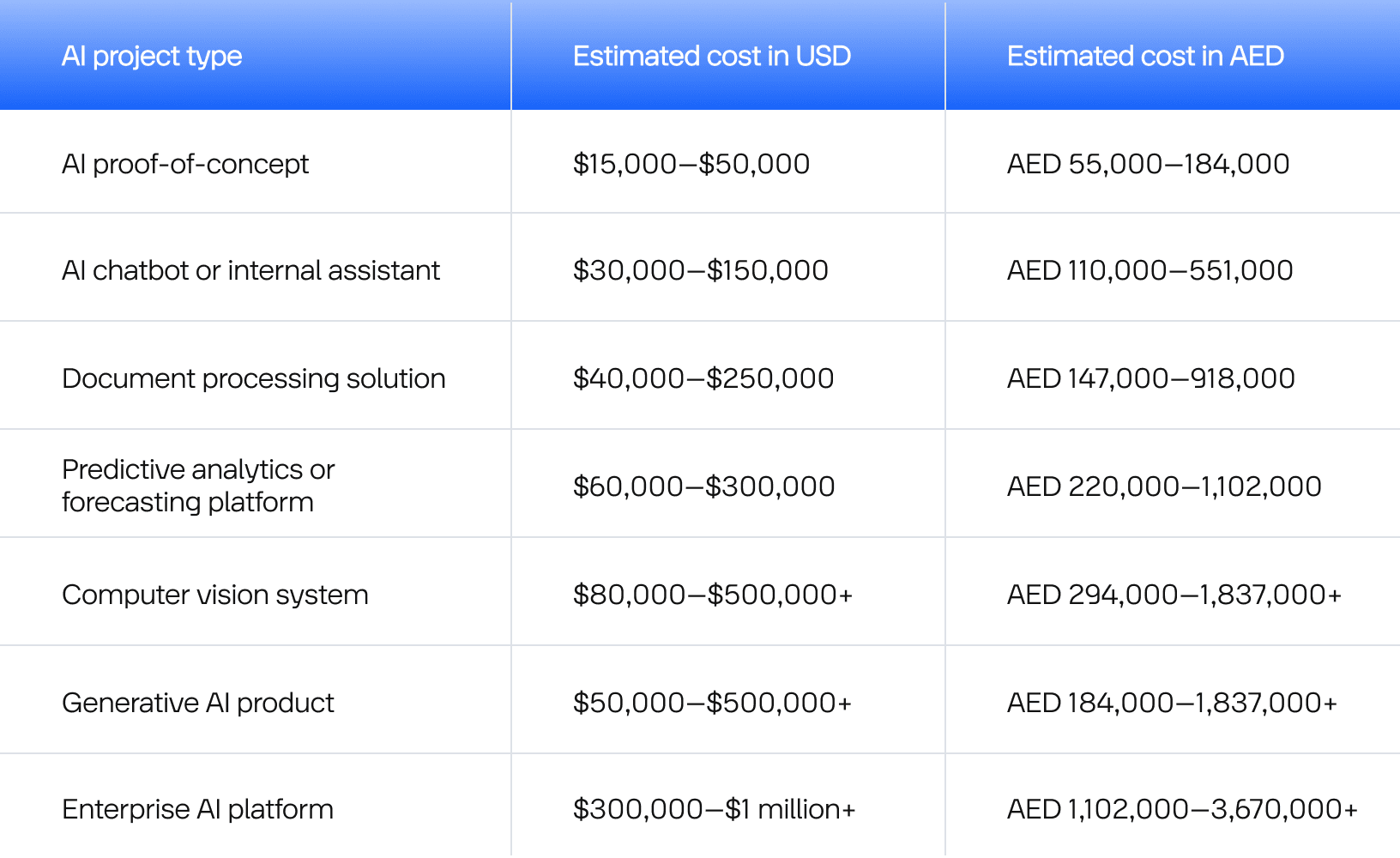
These ranges give a quick baseline, but the real price depends on how much data, logic, integration, security, and post-launch support each project requires. So let’s look at the artificial intelligence cost for main project types in more detail.
A basic AI proof-of-concept usually lands somewhere between $15,000 and $50,000. You're not building a product at this stage — you're building an argument. A small prototype, a limited dataset, a simple model, maybe an API integration and a bare-bones interface. Enough to answer the question “does this actually work?” before the company bets serious money on it.
AI chatbots development or an internal assistant can cost $30,000–$150,000, depending on the number of data sources, security requirements, retrieval quality, conversation logic, user roles, integrations, and analytics. A simple FAQ bot is cheap. A secure enterprise assistant connected to CRM, ERP, SharePoint, Slack, customer history, and permission-based data access is not cheap.
A similar budget range can apply to a legal AI assistant for a regional fintech institution, especially if the system must review contracts, summarize regulatory updates, search internal policies, flag risky clauses, and preserve rigorous access controls across legal and compliance teams.
The price range for document processing systems is $40,000–$250,000. These solutions can extract, classify, summarize, validate, and send documents such as invoices, contracts, insurance claims, technical documents, and scanned forms. The price will increase when trying to process messy, multilingual, handwritten, regulated and tabulated documents that appear to have been created by a mutinous printer.
A predictive analytics or forecasting platform often costs $60,000–$300,000. These projects require historical data, feature engineering, model training, dashboards, testing, and integration with business systems. Forecasting demand, churn, pricing, inventory, or equipment failure depends heavily on data quality. This is why AI in asset management can be expensive but valuable: the model needs reliable historical data, market signals, risk logic, and explainable outputs before anyone should trust it with serious financial decisions.
The price of a computer vision system generally varies from $80,000–$500,000+. Object detection, quality inspection, safety monitoring, medical imaging, retail shelf analysis, and manufacturing defect detection require labeled image or video data, model training, edge or cloud deployment, and continuous monitoring.
A generative AI product can cost $50,000–$500,000+. This includes AI copilots, content generation tools, code assistants, knowledge search products, agentic AI, customer support automation, and workflow automation. Costs depend on whether the product uses existing foundation models, retrieval-augmented generation, fine-tuning, custom orchestration, evaluation systems, and guardrails. OpenAI, AWS, Azure, and Google all use pricing models in which usage, model choice, modality, and service tier can considerably affect operating costs.
A full enterprise AI platform can cost $300,000–$1 million+. This usually involves multiple use cases, complex architecture, cloud infrastructure, data pipelines, security, model monitoring, governance, user management, integrations, compliance, and ongoing support. At this level, the enterprise AI development cost becomes a business transformation budget.
Key Factors That Affect AI Development Cost
Artificial intelligence cost estimation is rarely about one thing. The final estimate depends on how ambitious the product is, how clean your data is, how many systems the AI must connect to, and how safely it needs to operate.
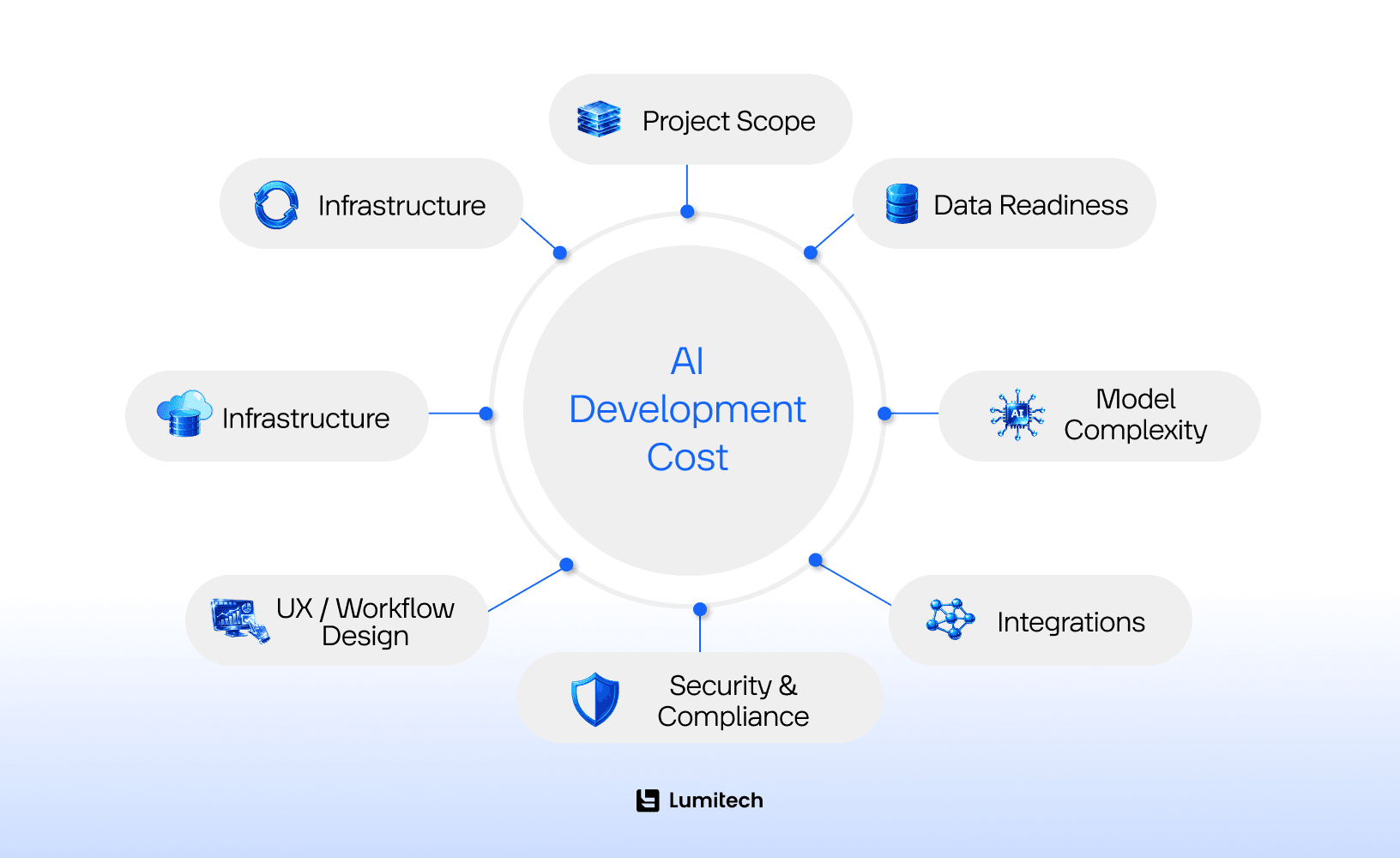
1. Project Scope
The larger the scope, the higher the cost. A very narrow use case such as “summarizing support tickets” would have a much lower price point than an entire multi-agent AI platform that supports sales, finance, logistics, and customer service.
A focused AI assistant, recommendation engine, or forecasting tool can often be built in stages. A large AI ecosystem requires more planning, architecture, testing, integrations, and governance.
2. Data Readiness
AI depends on data, and real company data is often messy. It may live across spreadsheets, CRMs, ERPs, PDFs, cloud folders, emails, and databases.
Clean, structured, accessible data reduces development time. Messy, duplicated, outdated, unlabeled, or incomplete data increases the cost because teams need to spend more time cleaning, organizing, labeling, and validating it before the AI can use it reliably. In some cases, synthetic data generation can help fill gaps, balance datasets, or test edge cases when real-world data is limited, sensitive, or painfully expensive to label.
3. Model Complexity
Some AI projects can use available models or APIs. Others need fine-tuning, custom machine learning models, domain-specific evaluation, or private deployment.
A simple AI chatbot using an existing language model will usually cost less than a computer vision system trained to detect manufacturing defects or a predictive maintenance model connected to sensor data. The more specialized the model, the more expensive the development, testing, and optimization.
4. Integrations with Existing Systems
AI becomes valuable when it works inside real business workflows. That usually means connecting it to CRM, ERP, EHR, HRM, inventory systems, payment platforms, data warehouses, BI tools, internal APIs, or document repositories, or highly regulated environments such as core banking modernization programs, where even a small integration mistake can become a very expensive one.
The more systems the AI must connect to, the higher the AI integration cost. Integration also adds complexity around permissions, data formats, synchronization, error handling, and security.
5. Security and Compliance Requirements
AI systems that process sensitive or regulated data cost more to build. Healthcare, finance, insurance, legal, HR, public-sector, and enterprise projects often require stricter safeguards.
This may include encryption, audit logs, role-based access, data anonymization, data residency controls, human approval workflows, explainability, compliance documentation, and responsible AI policies. In regulated industries, transparency in AI helps teams understand why a system produced a recommendation, who reviewed it, and whether it can be trusted in a real business process.
6. User Experience and Workflow Design
A quality model based on AI with a poorly designed user interface is still considered to be an undesirable product. Users require clear instructions about the features of the AI system, when they are able to rely on its results, when to review those results, and how to utilize the results.
Good UX design, workflow mapping, admin panels, dashboards, feedback loops, and onboarding materials all affect cost. The same is true for user-facing products such as an AI-powered language learning platform, in which adaptive lessons, feedback quality, progress tracking, and engagement loops can matter as much as the model itself.
7. Infrastructure and Performance Requirements
Certain types of AIs may work through third-party API connections with fairly low complexity, while others will require a cloud environment (private or public), GPU hardware and software, very scalable databases, various monitoring tools, vector search software, streaming pipelines, and low latency architecture.
Performance expectations matter too. A system used by 20 employees once a day has very different infrastructure needs from a customer-facing AI product handling thousands of requests per hour.
8. Ongoing Maintenance and Optimization
AI does not end at launch. Models need monitoring, prompts need improvement, data sources change, users discover edge cases, vendors update APIs, and performance may drift over time.
Maintenance costs include bug fixes, retraining, cloud optimization, security updates, model evaluation, user support, and new feature development. This is why AI budgeting should always include post-launch support, not just the initial build.

AI Cost Breakdown by Development Stage
A useful approach to AI development cost estimation is to map expenditures to project phases. This also makes it easier to communicate costs to non-expert stakeholders without watching their eyes glaze over.
Discovery & Strategy (5–10% of total budget): Business analysis, feasibility assessment, data audits, and project scoping. This phase is often underinvested in — and it shows. Teams that skip proper discovery spend 3x more fixing problems they could have anticipated.
Data Collection & Preparation (20–35%): Sourcing, cleaning, labeling, structuring — if you've ever spent an afternoon untangling a messy spreadsheet and wanted to quit your job, just know that data engineers are doing that at a scale that makes your spreadsheet look like a haiku.
Model Development & Training (25–35%): Selecting architectures, running experiments, iterating on performance. This is where the core of the cost of building AI software accumulates — in both engineering hours and compute costs.
Integration & Testing (15–25%): Getting a model to perform in a controlled environment is one thing; getting it to behave reliably inside a production system with real users, edge cases, and legacy infrastructure poses a different challenge. Bugs found here are annoying. Bugs found in production are expensive and embarrassing.
Deployment & Infrastructure Setup (10–15%): Containerization, cloud provisioning, CI/CD pipelines, monitoring dashboards. The AI project budget should always carve out a separate line for deployment — it's a common place where reserve funds quietly vanish.
Ongoing Maintenance (10–20% of initial build cost, annually): Building the AI is not the finish line. The cost of integrating and maintaining AI systems depends on model usage, cloud infrastructure, retraining needs, monitoring, vendor pricing, support level, and feature expansion.
Most AI budgets fail because the company underestimated everything around the model: data preparation, integrations, infrastructure, testing, adoption, and maintenance. The model is only one part of the bill — and usually not the most dangerous one.



Custom AI vs. Off-the-Shelf AI: Cost Comparison
Here is a question every company eventually faces: Do we build or do we buy?
The answer may also depend on geography and delivery strategy. For example, companies exploring software development in the UAE may compare local domain expertise, regional compliance knowledge, delivery speed, and vendor availability against offshore or fully in-house AI development teams.
Off-the-shelf AI solutions — think OpenAI APIs, Google Vertex AI, AWS SageMaker pre-trained models, or turnkey SaaS platforms like DataRobot — offer a dramatically lower upfront cost of custom AI development. You can get a working prototype in days. Licensing costs range from $0 (open-source) to tens of thousands per month for enterprise tiers, but you are not paying for a team of ML engineers.
The tradeoffs:
Limited customization: You get what the vendor built. If your use case is niche, you may be forcing a square peg into a round hole.
Vendor dependency: If the vendor pivots, raises prices, or sunsets the product, you're along for the ride.
Data protection concerns: Sending proprietary data to third-party APIs makes legal teams nervous — for good reason.
Custom AI, meanwhile, is yours. It can be tailored precisely to your domain, trained on your proprietary data, and optimized for your specific performance targets. The custom AI software development cost is larger upfront (sometimes dramatically so), but the long-term business value, data control, and competitive differentiation can justify the investment.
This is especially relevant for generative AI in banking, where generic tools may not be enough. Banks often need custom access controls, audit trails, compliant document handling, secure customer data workflows, and carefully reviewed outputs.
One option is to use a ready-made API to test the viability of your idea quickly, and if the market opportunity exists, invest in creating your own custom AI product. There are numerous examples of successful AI applications that have followed this same approach.
Hidden Cost of Implementing Artificial Intelligence
Let's talk about the costs that don't show up in the initial proposal — the ones that emerge six months into the project like uninvited houseguests.
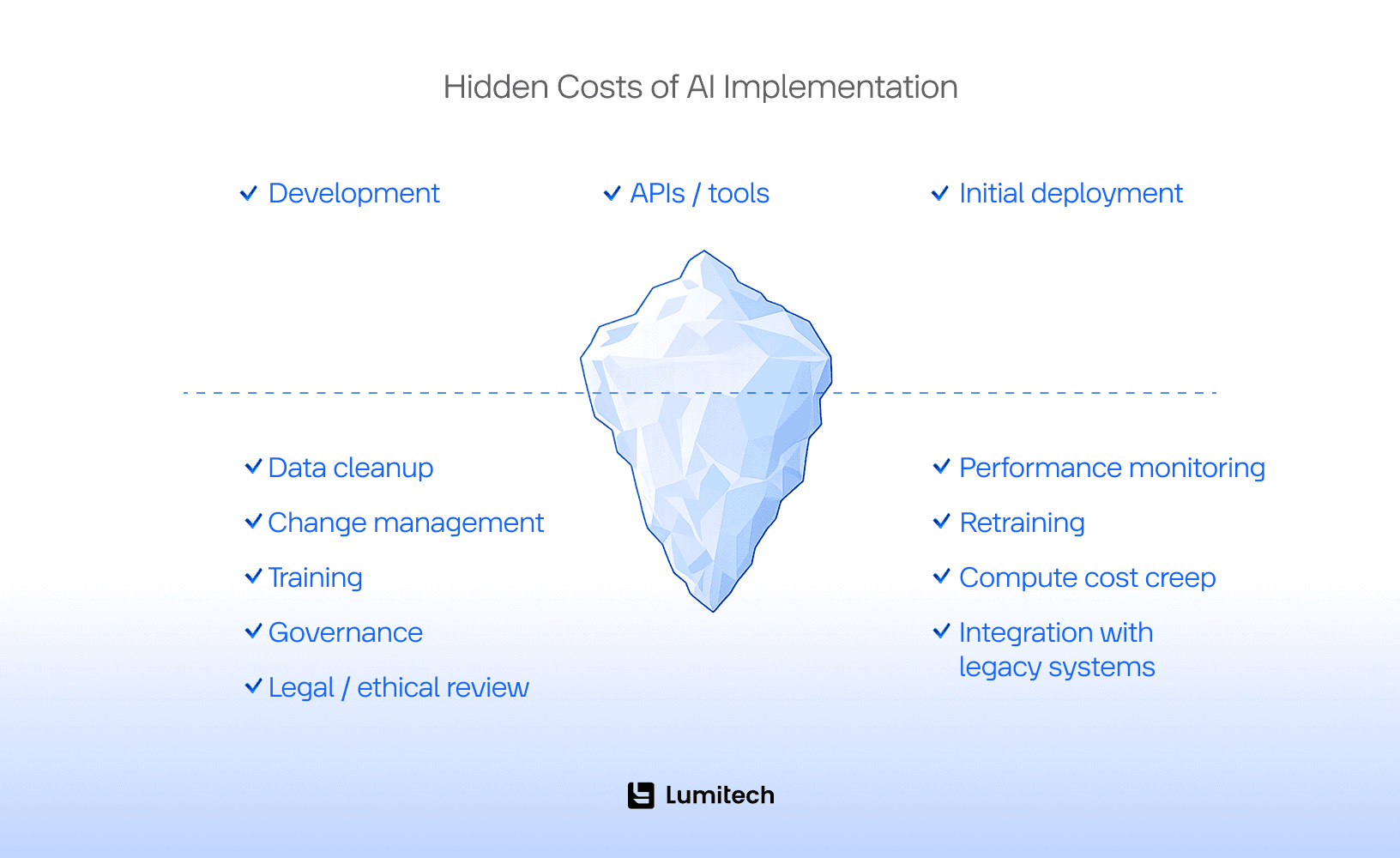
The AI project budget often exceeds initial estimates, usually for reasons that look obvious only in hindsight. Here are the usual culprits:
Change management and training: Your employees need to learn how to work with the new system. Resistance to AI adoption is real, and underestimating it leads to failed rollouts. McKinsey research consistently identifies change management as one of the top reasons digital transformations underperform. Budget for dedicated training programs, internal champions, and time — because behavior change is slow even when the technology is excellent.
Compute cost creep: Inference costs (running your model against real user queries) can scale unexpectedly as usage grows. A model that costs $500/month to run in beta can cost $15,000/month at production scale. This is a line item many first-time AI builders forget to model.
Data governance infrastructure: You probably need a proper data pipeline, data catalog, and governance framework. None of these build themselves.
Legal and ethical review: Bias audits, explainability documentation, and legal sign-off on AI decision-making are increasingly non-optional, and lawyers are not cheap.
Performance drift: Models degrade over time as real-world data distribution changes (this is called “model drift”). Monitoring and retraining are ongoing line items, not one-time tasks.
The AI integration cost for connecting your new AI system to legacy infrastructure represents another budget surprise waiting to happen. Legacy systems were not designed to talk to modern AI — expect friction, custom connectors, and more engineering hours than your initial scope anticipated.
Implementation cost on the human side: restructuring workflows, redesigning processes, and managing the organizational politics that inevitably accompany systems that touch people's jobs.
How Much Does AI Maintenance Cost?
AI maintenance usually costs 15%–30% of the original project cost per year. For a $100,000 AI product, annual maintenance may be $15,000–$30,000. For a $500,000 enterprise system, maintenance may be $75,000–$150,000+ per year. High-volume systems that use expensive models or demand real-time inference may cost more.
Maintenance includes bug fixes, model monitoring, performance optimization, security updates, prompt improvements, retraining, new data source integration, cloud cost optimization, and user support. It may also include model replacement if a cheaper or stronger model becomes available.
The AI infrastructure cost can be small for API-based prototypes and considerable for production systems. If the company uses external AI APIs, the infrastructure cost is mainly usage-based. If the company hosts models privately, costs may include GPUs, cloud instances, storage, networking, monitoring, backup, and DevOps. AWS notes that its H100-powered P5 instances are designed for high-performance generative AI and machine learning workloads, while cloud AI providers increasingly offer flexible pricing tiers for different workloads.
For generative AI products, inference can become a major operating cost. Every user question, document summary, generated report, image analysis, or workflow step consumes tokens or compute. This is why architecture matters. A poorly designed AI system is like leaving the water running — except the water is GPU time, and the bill has opinions.
Artificial Intelligence Cost Estimation: How to Plan the Budget for an AI Project
Reasonable budget planning should begin with the business goal. What problem will AI solve? What metric should improve? Faster support response? Lower churn? Fewer manual review hours? Better forecast accuracy? More qualified leads? Reduced fraud? Shorter document processing time?
Next, define the use case. A vague goal like “add AI to operations” is not budgetable. A clear goal like “automate classification and summary of 30,000 monthly support tickets with human review for low-confidence cases” is budgetable.
Then audit the data. Ask where the data lives, who owns it, how clean it is, whether it contains sensitive information, and whether it is legally usable for AI. Data readiness can make or break the budget.
After that, decide whether to use an API, fine-tune a model, build a custom model, or combine multiple approaches. This decision strongly affects the cost to build an AI solution. For knowledge-heavy products, RAG development services can be a cost-effective middle ground: the system retrieves answers from verified company data over relying solely on the model’s memory.
Then map integrations. AI rarely creates value in isolation. It needs to push and pull information from existing systems. The more systems involved, the more effort is required.
Next, estimate usage. How many users? How many requests per day? How long are the prompts? How large are the documents? Does the system process text, images, audio, or video? Does it need real-time responses? These questions shape cloud and model costs.
Finally, plan for maintenance. The AI development cost should include post-launch support, not just initial build. A company that budgets only for launch is basically buying a car and pretending oil changes don't exist.

Is AI Development Worth the Cost? ROI Considerations
Here is the hard truth: AI is not automatically worth it. The question of how expensive is AI is only meaningful in the context of what it returns. That is why companies should evaluate AI investments not only against internal performance goals, but also against larger AI-driven software market trends — especially as competitors use automation, personalization, and intelligent workflows to move faster.
The case for AI investment is strong when:
You have a high-volume, repeatable process that consumes significant human labor.
Errors in that process are costly (financial losses, compliance violations, customer churn).
You have the data to train a model that meaningfully outperforms the status quo.
You're operating in a market where AI-powered competitors are gaining ground.
The ROI math can be compelling. Accenture's research suggests AI has the potential to boost profitability rates by 38% and generate $14 trillion in additional economic activity by 2035. On the ground level, companies report gains in business efficiency, customer satisfaction, and revenue from personalization. In finance, an investment intelligence platform may justify its cost if it helps analysts process market signals faster, improve portfolio research, reduce manual reporting, or surface risks before they become expensive surprises.
But ROI is not guaranteed — and it is not instant. A typical enterprise AI project may take 12–24 months to generate measurable returns. The cost to start an AI project (from ideation through first production deployment) is a bet on future value, not present revenue.
The worst ROI scenarios? Companies that rush AI into production without a clear problem definition, invest in models trained on bad data, or implement AI in processes that were never that expensive to begin with. More than one company has spent $500,000 automating something a $40,000/year employee was handling just fine.
The rule of thumb: if you can clearly articulate what the AI will do, how much the current approach costs, and by how much the AI is expected to improve it, you have the beginnings of a defensible business case.
Final Thoughts
AI development services are not cheap, but neither is inefficiency at scale. The AI implementation cost becomes reasonable when the project solves a costly problem, uses the right technical approach, and includes maintenance from the beginning.
The smartest companies do not ask, “Can we add AI somewhere?” They ask, “Where can AI remove measurable friction, reduce cost, improve speed, or create a better product?” That question leads to better budgets, better systems, and fewer embarrassing demos.
AI will not fix a bad process on its own. It may even make a bad process faster, which is not always a gift. But when companies combine clear goals, clean data, practical architecture, strong integration, and realistic maintenance planning, AI can move from hype to value.


