
The Roadmap to Core Banking Modernization: From Legacy to Cloud
For years, banks treated the core like the hotel boiler room: old, noisy, mission-critical, and preferably out of sight. As long as everything worked, executives could focus on shinier things like apps, digital onboarding, and fashionable innovations.
- FinTech & Finance
- Digital Transformation
March 24, 2026
 AI Overview
Core banking modernization replaces monolithic legacy systems with modular, API-first, cloud-capable architecture to enable real-time processing, embedded finance, and faster product launches. Key components include data migration, fintech ecosystem integration, and cloud-native core replacement, phased over years rather than a single rebuild. Banks now spend 10.6% of revenue on IT, yet a fifth of that budget still goes toward maintaining legacy systems.

That era is ending.
Today, core banking modernization is no longer a back-office technology debate, but a business model decision. A bank cannot promise real-time experiences, embedded finance, faster product launches, AI-driven operations, and lower cost-to-serve while running on a core that needs three committees and a prayer to change a fee parameter. Legacy cores still do the essential job, but they are increasingly bad at doing the strategic job: enabling speed, adaptability, and intelligence.
This is why core banking transformation has moved to the center of boardroom agendas. It is about rethinking how the bank processes products, exposes services, migrates data, integrates with fintech ecosystems, and embeds change into the architecture rather than bolting it on later with expensive tape and people.
As banks compare modernization partners across the Gulf, the conversation increasingly extends beyond local incumbents to regional ecosystems that also include major tech companies in the UAE with experience in large-scale digital transformation.
A regional bank with a 25-year-old monolith, a tier-one institution with multiple cores after years of acquisitions, and a digital-first challenger running a partial modern stack are all on the same journey, but not on the same road. That is why there is no single correct playbook for modernization. There are patterns, trade-offs, and hard truths, but not a magic button labeled “become modern.”
What follows is a grounded look, based on our experience at Lumitech, at the modernization journey from monolithic core to modular, API-first, cloud-capable architecture. We will cover the main approaches, the biggest migration risks, the practical strategies banks actually use, and how modern cores create the conditions for AI to move from PowerPoint to production.
Reason for Core Banking Transformation: Why Legacy Cores Became the Bottleneck
Legacy systems are not terrible because they are old. They are terrible when they make change slow, data hard to access, integrations brittle, compliance expensive, and talent difficult to retain.
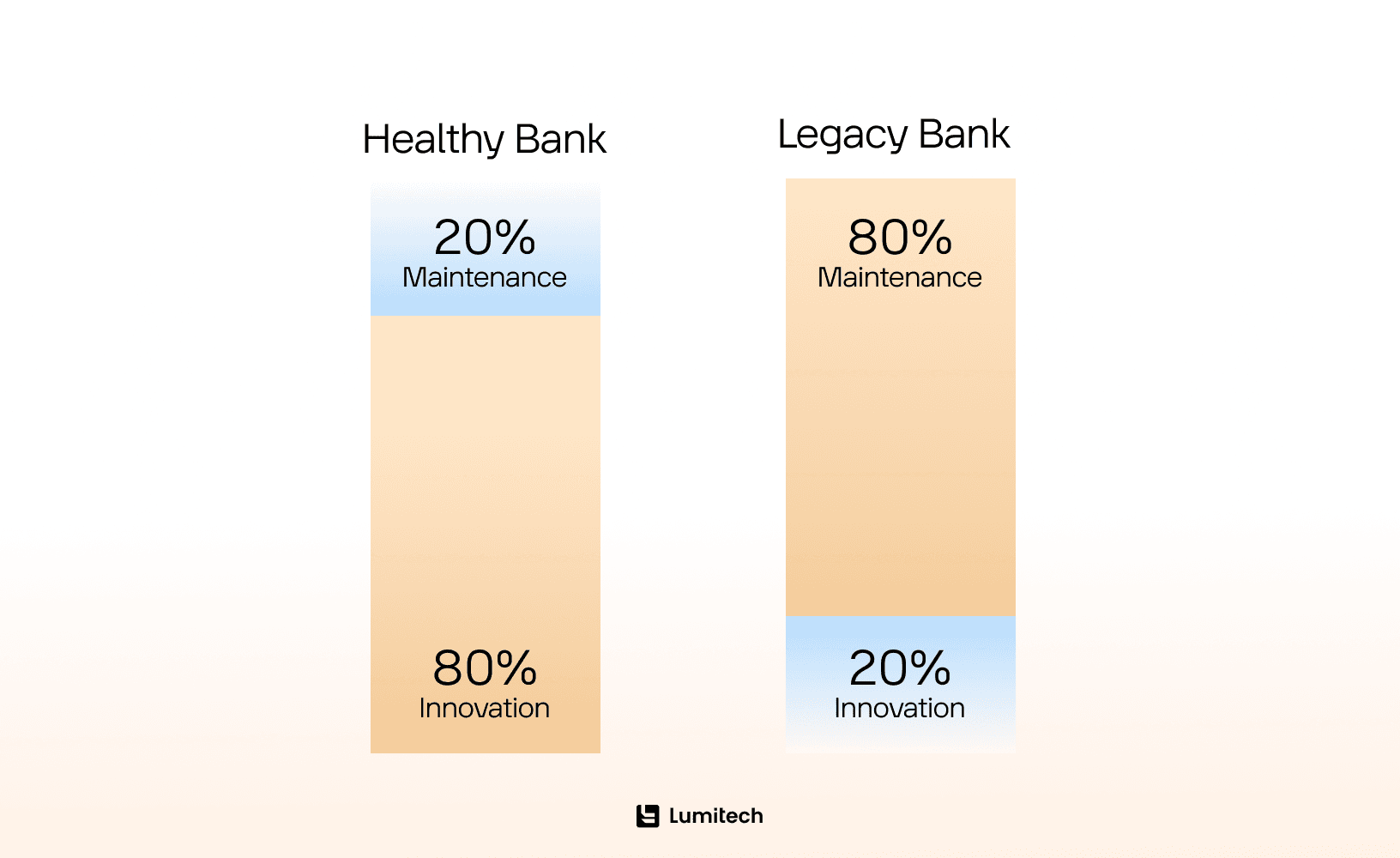
Banks today invest heavily in technology. McKinsey says banking invests more in IT as a percentage of revenue than any other major industry, with IT spending reaching 10.6% of revenues and 20% of expenses in 2022. Yet much of that spend still goes into keeping the machine running rather than changing what the machine can do. Deloitte’s UK banking and capital markets research found that an average of one-fifth of technology budgets goes to general maintenance, legacy technology spend, and day-to-day running activity, while broader Deloitte commentary notes that the cost and risk of maintaining outdated core systems only increase over time. That sounds manageable until you translate it into business friction.
A legacy core usually means some combination of the following:
Product launches measured in months instead of weeks
Fragile integration points
Duplicated customer and account logic across channels
Difficulty supporting real-time processing
A shrinking pool of people who understand the old stack
Expensive test cycles
Architecture decisions that make every change feel like open-heart surgery.
EY’s 2025 research on core banking technology modernisation highlights speed to market, flexibility, technical debt, competition, and the decreasing pool of legacy technology skills as key drivers behind current modernization programs. The same research indicates that many institutions aim to complete modernization in 3 to 5 years and are already seeing benefits during implementation.
This is the heart of legacy system modernization in banking: nostalgia is not the issue. It is economics and agility. Banks are spending heavily on technology, but too much of that spending still protects yesterday’s operating model. The bank looks digital on the surface and mechanical underneath.
That is not sustainable when customers expect instant servicing, regulators expect better resilience and traceability, and competitors can assemble new products using API ecosystems instead of manually wiring change into a core system older than some of the product managers presenting the roadmap.
What Core Banking Modernization Actually Means
Banks often talk about modernization as if it were one thing, when in reality it is rather a family of moves.
At one end of the spectrum, core banking system modernization may mean refactoring parts of the monolith, exposing APIs around core functions, improving batch processing, and separating channels from core logic. At the other end, it may mean a full legacy core banking replacement with a new cloud-native or modular core. Between those extremes lies the real world.
In practice, modernization can include:
Decoupling channels from the core,
Building a services layer or orchestration layer
Hollowing out product logic from the core
Moving deposits or lending first while retaining parts of the legacy ledger
Launching greenfield products on a new platform
Progressively migrating customers in waves
Replacing the core stack entirely after phased coexistence.
So when executives ask how to modernize core banking system architecture, the answer is not “buy a modern core.” It is: decide what you are modernizing first, what outcomes matter most, and what risk the institution can actually absorb.
That distinction matters because modernizing core banking systems is not a purely technical exercise. A bank may be modernizing for speed to market, resilience, cost reduction, open banking readiness, M&A simplification, or AI enablement. Those motives lead to different paths.
A bank that needs faster product assembly may prioritize API exposure and product-engineering modernization before full ledger migration. A bank with extreme infrastructure complexity may begin by simplifying and coexisting. A bank facing acute skills risk may prioritize replatforming workloads and extracting critical logic from obsolete code. A bank trying to enter new segments quickly may launch greenfield products on a new core while the legacy platform remains in place.
That is why every serious core banking modernization strategy begins with target outcomes, not vendor demos.
The High Cost of Avoiding Core Banking Transformation
Why is legacy modernization so urgent now? Because the cost of maintenance is no longer just a line item; it’s a strategic bottleneck.
The Talent Drain: The “COBOL Cowboys” are a vanishing breed. As they retire, banks are forced to pay exorbitant consulting fees to bring them back as contractors or try to train Gen Z developers in a language that feels like hieroglyphics to them.
The Batch Processing Nightmare: Legacy cores operate on “batch processing.” They collect transactions all day and “settle” them at night. In a world of instant payments and 24/7 crypto markets, waiting until 2:00 AM for a ledger to update is like using a carrier pigeon in the age of fiber optics.
The Integration Wall: Try connecting a 40-year-old mainframe to a modern, cloud-based AI customer service bot. You end up with a spaghetti architecture of middleware that creates more points of failure than it solves.

What are the Benefits of Core Banking Modernization?
The benefits of core banking modernization are easy to summarize and hard to deliver. The value usually shows up in four areas.
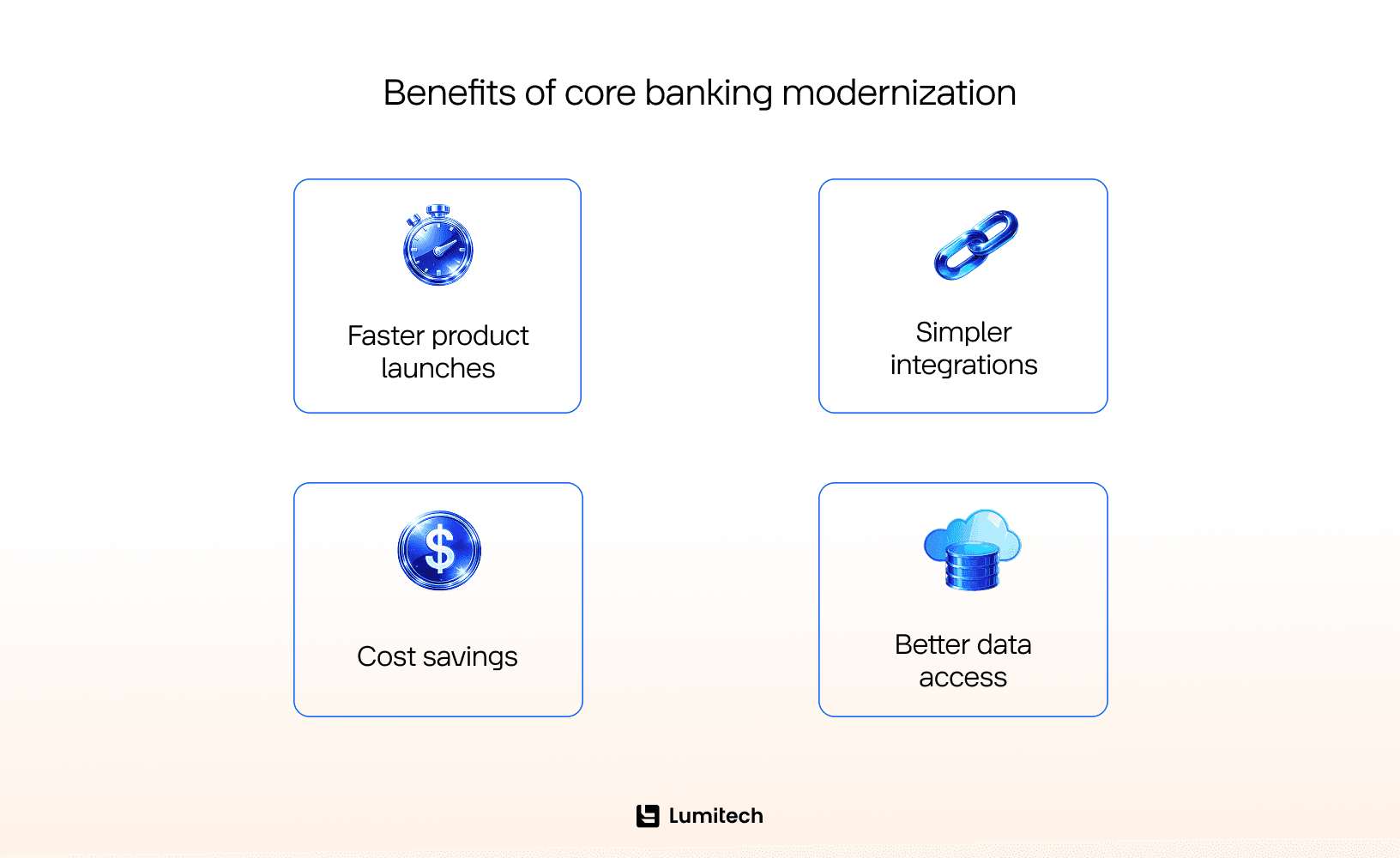
First, speed. Banks with modular, configurable platforms can launch and change products faster. IDC notes that legacy platforms often make product changes and launches significant undertakings due to accumulated customization.
Second, resilience and simplification. A cleaner architecture reduces brittle dependencies, lowers failure blast radius, and makes testing and release cycles more manageable.
Third, cost rebalancing. Modernization does not instantly make technology cheap, but it can shift spending from maintenance-heavy stagnation toward strategic change. That matters in an industry already spending heavily on IT.
Fourth, better data and decision-making. Modern architectures make it easier to build a personalized financial platform where pricing, offers, servicing, and engagement can adapt more intelligently to customer behavior and product context.
So yes, core banking modernization is a technology transformation. But the real payoff is business agility: the bank becomes easier to change.
The Main Core Banking Modernization Approaches
There are several broad paths, and most banks use a hybrid rather than a pure model.
1. The “Big Bang” Replacement (Full Rip & Replace)
The “Big Bang” is exactly what it sounds like: you select a new vendor, build out the entire system in parallel, and on a designated weekend, you migrate all data and flip the switch.
The Logic: It is the cleanest break from the past. You eliminate technical debt in one fell swoop and stop paying maintenance on the legacy system the moment the new one goes live.
The Reality: It is the highest-risk core banking modernization approach. If something goes wrong during the data migration or the “go-live” weekend, the bank stops functioning. It requires thousands of man-hours of testing and a “freeze” on all other innovation for years.
Best For: Small to mid-tier banks with relatively simple product sets where the “monolith” isn't too deeply integrated into every other auxiliary system.
2. Progressive Core Banking Modernization (The “Hollow Out” Strategy)
This is currently the most popular core banking modernization strategy for Tier-1 and Tier-2 banks. Instead of replacing everything at once, you identify high-value components, such as “Payments” or “Deposits,” and migrate them to a modern platform one by one.
The Logic: You gain early wins. You can show the board a 50% reduction in payment processing costs within 12 months, rather than waiting five years for a Big Bang to finish. It spreads the financial risk over a longer period.
The Reality: You have to manage “coexistence.” For several years, your bank has been a Frankenstein of old and new systems. You need complex integration layers to ensure that a transaction in the new payment module is reflected accurately in the old ledger.
Best For: Large, complex institutions where a Big Bang is practically impossible due to the sheer volume of products and legacy integrations.
3. The Greenfield Approach (The “Speedboat” Method)
Many banks are opting to leave their legacy core completely untouched. Instead, they launch a brand-new, digital-only “neobank” on a digital core banking modernization platform.
The Logic: You can go from concept to launch in 6–9 months. There is zero risk to the main bank’s operations. Once the “Speedboat” (the new bank) proves successful, you can gradually migrate the “Ocean Liner” (legacy customers) to the new platform.
The Reality: You are effectively running two banks. This can lead to internal silos, brand confusion, and duplicated operational costs until the final migration is complete.
Best For: Banks looking to capture a younger demographic or test the waters with API-first cloud platforms before committing to a full-scale migration.
4. Wrapper & Refactor (The “Facade” Strategy)
This is often considered a “Lite” version of modernizing core systems. You build a sophisticated API layer (a “wrapper”) around the legacy core. To the outside world, the bank looks modern and digital.
The Logic: It is relatively cheap and very fast. It buys you time to stay competitive in the Open Banking era without the trauma of a full core replacement.
The Reality: It’s a temporary fix. Underneath the shiny API wrapper, the COBOL engine is still slow, batch-based, and expensive to maintain. Eventually, the technical debt will become too heavy for the wrapper to hide.
Best For: Banks in survival mode that need to launch a mobile app now but aren't ready for the capital expenditure of a full replacement of legacy core banking systems.
How to Modernize Core Banking System: The Architectural Anatomy
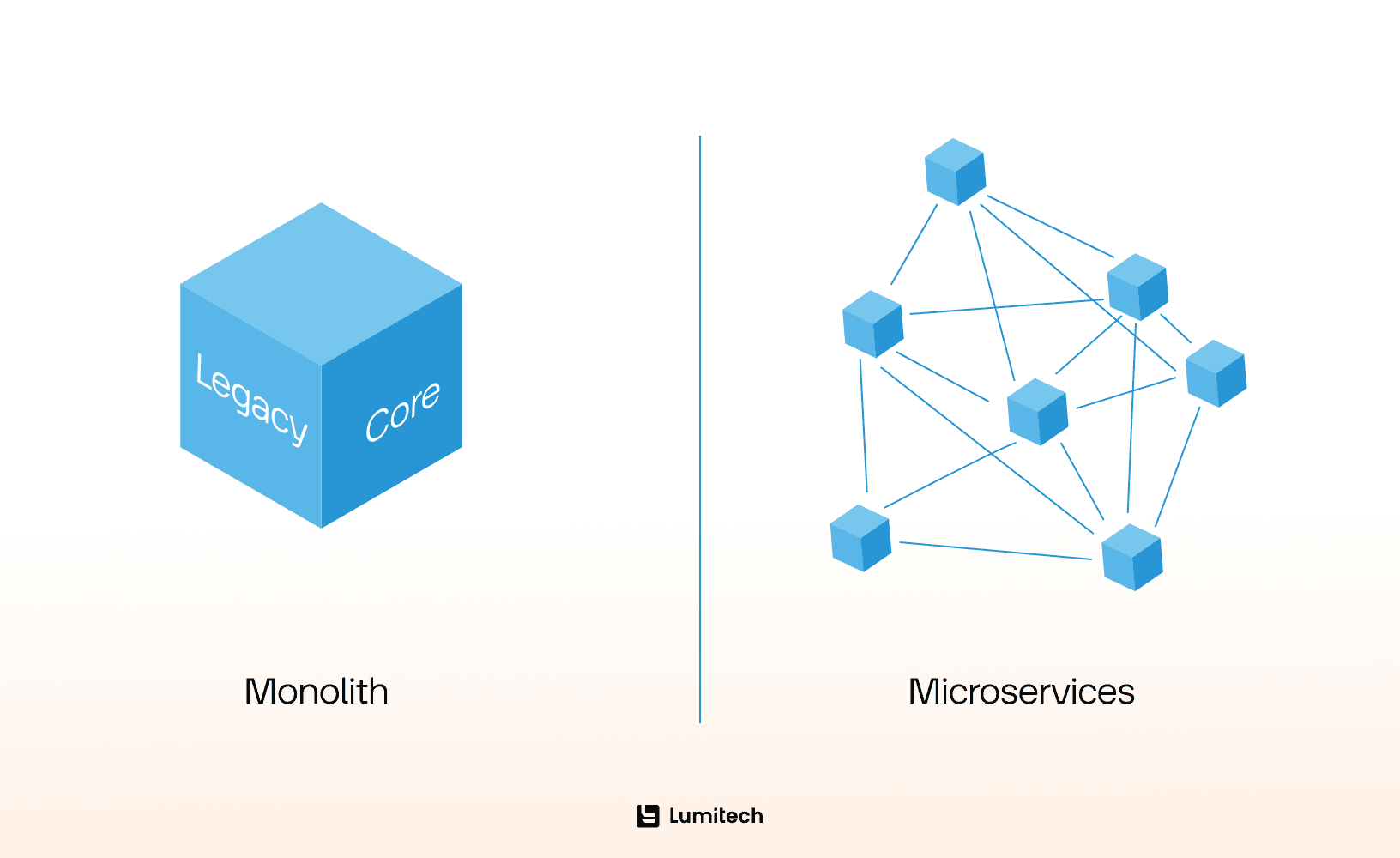
In a legacy core, the code for calculating interest is physically intertwined with the code for printing a statement and verifying a customer's identity. If you touch one thread, the whole sweater uncurls. Modernization is the process of untangling that sweater and replacing it with high-tech, interchangeable Lego blocks.
The Monolithic Cage
In a traditional core banking system modernization discussion, the monolith is the villain. Because everything is tightly coupled, deploying a simple update requires a massive “release cycle.” This is why traditional banks only update their systems twice a year, usually on a frantic long weekend involving enough caffeine to power a small city.
The monolith's biggest sin is its inability to scale. If your mobile app sees a surge in traffic because of a new marketing campaign, you can’t just scale the Login function. You have to scale the entire massive core, which is inefficient, expensive, and often physically impossible on older hardware.
The Rise of Microservices
The cornerstone of any successful core banking modernization solution is the transition to microservices. Instead of one giant application, the bank’s functions are broken down into small, independent services:
The Ledger Service: Does nothing but record transactions.
The Interest Engine: Only calculates rates.
The KYC Service: Only verifies identity.
These services communicate via APIs (Application Programming Interfaces). This modularity means that if the Interest Engine needs an upgrade to support a new “Green Savings Account,” the developers can swap it out without ever touching the Ledger or the KYC service. This is the “plug-and-play” reality of upgrading legacy core banking platforms.
API-First: The New Banking Language
An API-first approach means the core is designed from day one to interact with the outside world. In the legacy era, the core was a walled fortress. In the core banking transformation era, the core is a busy airport hub.
Being API-first allows a bank to participate in Open Banking. It means a customer can use a third-party app to manage their budget, and that app can securely ask the bank’s core for the balance via an API. This is a critical part of modernizing your core banking application; it’s not just about internal efficiency, but about external relevance.
Building this modularity isn't a solo mission. Many institutions are now vetting top-tier app modernization companies to dismantle their monoliths.
Cloud-Native vs. Cloud-Hosted
One of the biggest core banking modernization challenges is the “Cloud-Washing” trap. Some vendors will offer to take your old, monolithic COBOL system and move it to a remote server, calling it Cloud Banking. Don't be fooled. That is just “Cloud-Hosted.”
A true strategy of core banking modernization requires “Cloud-Native” architecture. This means the software is designed to take advantage of cloud features like:
Auto-Scaling: The system automatically scales up during peak hours (like paydays) and down when people are asleep, saving millions in server costs.
Resilience: If one server node fails, another instantly takes its place. The “system down” screen becomes a relic of the past.
DevOps Integration: Developers can push updates daily, or even hourly, instead of twice a year.
The Data Layer in Core Banking System Modernization
Finally, we must address the data pipeline. Outdated core banking systems are “Batch-oriented.” They move data in big buckets at specific times. Modern cores are “Event-driven.”
When a customer swipes their card in a coffee shop, that event is instantly broadcast across the entire system. The fraud engine sees it, the rewards program sees it, and the mobile push notification engine sees it, all in milliseconds. This real-time data flow is the fuel for AI. Without core banking system modernization for handling real-time data streams, AI is essentially a Ferrari with no gas.
The Main Core Banking Modernization Strategies
If approaches describe structural patterns, strategies describe how to execute them.
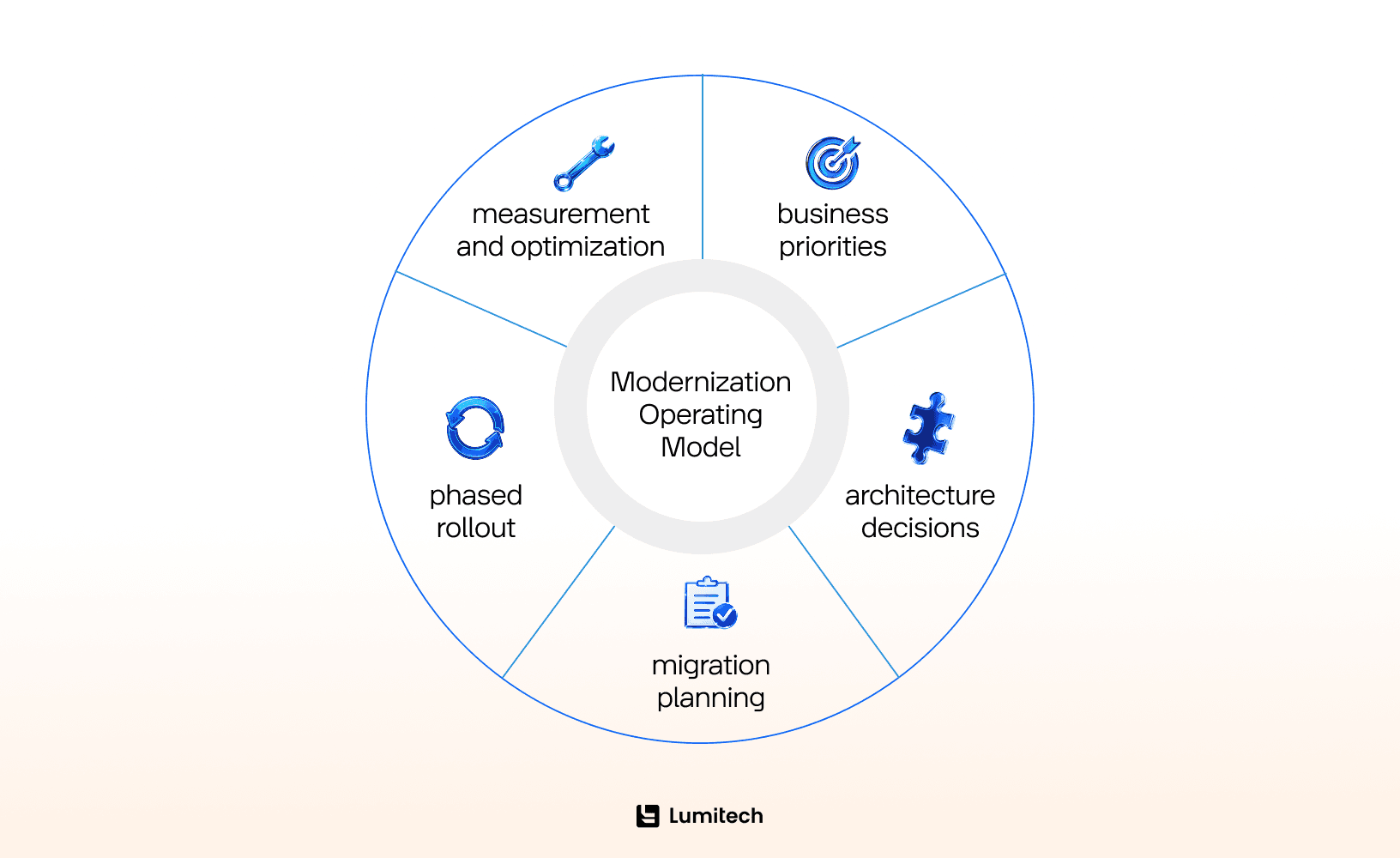
Strategy 1: Start With Business Capability
The first mistake banks make is beginning with the stack and forgetting the business. A better starting point is capability mapping: deposits, lending, servicing, pricing, payments, product configuration, risk controls, customer data, reporting, disputes, collections, and so on.
Then ask:
Which capabilities create the most delay
Which ones are most entangled
Which ones matter most for competitive differentiation
And which ones are safest to move first?
A sensible core banking modernization solution is usually capability-led, risk-ranked, and dependency-aware.
Strategy 2: Separate Product Logic from Core Transaction Plumbing
Many legacy banks have product logic embedded too deeply in their core systems. That makes every new product feel like code archaeology. Modern architectures aim to externalize and configure more product behavior so changes do not require deep platform surgery.
This is one of the most practical elements of core banking platform modernization. If the bank can configure products faster, expose them through APIs, and connect them to channels and partners without rewriting core functions, it gains speed without instantly migrating every last transaction flow.
Strategy 3: Use APIs as an Operating Discipline
API-first is often used as a fashionable sticker on systems that are not remotely API-first. Real API discipline means designing services and data contracts so that channels, fintech partners, internal products, and adjacent platforms can interact with the bank without brittle custom plumbing.
Strategy 4: Move Data Migration to “Central Program Workstream”
Banks routinely underestimate data migration strategy because they think of it as data movement. It is not. It is data interpretation, lineage reconstruction, exception handling, reconciliation, regulatory validation, and business-truth negotiation.
If a bank has been running multiple products, patches, regional customizations, and manual workarounds for years, the data is rarely clean, complete, or semantically consistent. Migration is where technical optimism goes to die.
That is why any credible core banking modernization approach treats migration as a front-loaded program theme, not an end-stage cutover chore.
Strategy 5: Design for Coexistence
Whether the bank chooses progressive modernization, greenfield buildout, or phased replacement, coexistence is unavoidable for most institutions. The target architecture must therefore support dual-run operations, event synchronization, reconciliations, fallback procedures, and clear ownership of process steps.
This is one reason why digital core banking modernization is as much about control design as application design. A modern stack without well-designed coexistence patterns is just a faster route to operational confusion.
What Are the Biggest Core Banking Modernization Challenges?
This is the part vendors like to describe as “manageable complexity,” which is a charming phrase for “there are seventeen ways this can go wrong.”
The biggest core banking modernization challenges usually fall into six groups.
1. Data migration and reconciliation
This is still the monster under the bed. Core banking data is often old, duplicated, inconsistent, customized, or dependent on obscure processing logic embedded in legacy code. Migrating balances is hard enough. Migrating product behavior, accrued calculations, exceptions, and historical semantics is harder.
The issue is not just moving data correctly. It is proving to internal and external stakeholders that it has moved correctly.
2. Integration sprawl
Most legacy cores sit at the center of a dense ecosystem: payments, CRM, fraud, channels, statements, collections, risk engines, data warehouses, regulators, partners, accounting tools, and locally built utilities that no one documented properly because “Steve knows how it works.” Steve has since retired.
Modernization programs fail when they treat the core as an application instead of an ecosystem hub.
3. Operational risk during coexistence
Progressive migration reduces big-bang danger, but it increases the number of moving parts. Dual processing, synchronized balances, exception management, fallback logic, and cutover windows all create operational strain. This is why core banking platform modernization is not simply a software delivery program. It is a controlled-risk transformation program.
4. Talent and institutional memory
EY points to the decreasing pool of legacy technology skills as a key modernization driver. That sounds like a problem for HR until the bank realizes that critical business logic lives in code only a shrinking number of specialists can interpret confidently.
Ironically, many banks hesitate to modernize because the old system is risky, but the old system is also becoming riskier precisely because the people who understand it are disappearing.
How Core Banking Platform Modernization Unlocks AI Capabilities
AI is not only an outcome of core modernization; generative AI in banking is increasingly becoming a practical tool for the journey itself. But a bank does not become AI-ready because someone bought a model license. AI needs structured, accessible, governed, high-quality data, clear workflows, service boundaries, traceable events, and systems that can surface context in real time. Legacy cores are often bad at exactly those things.
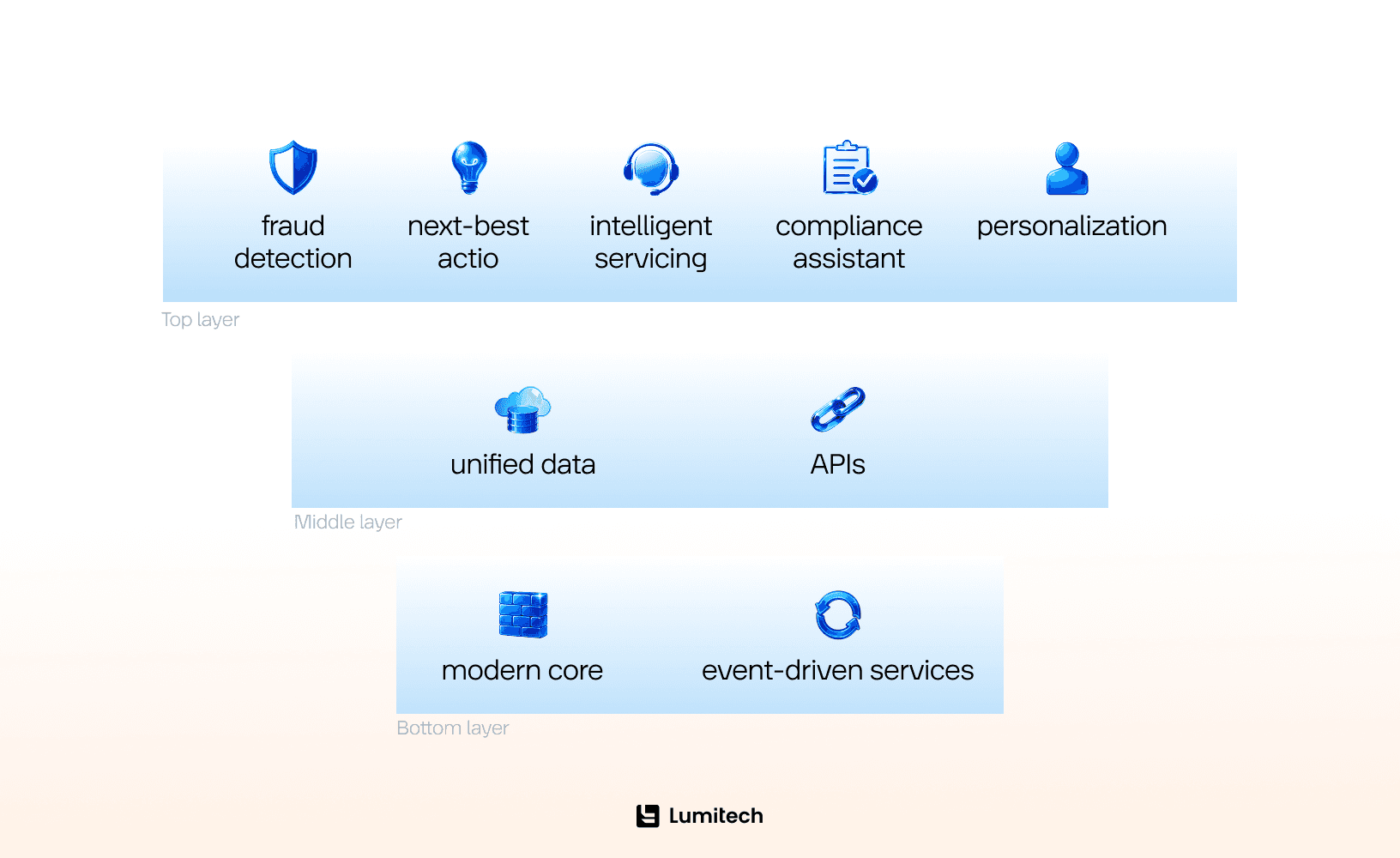
Modernization unlocks AI in four practical ways.
1. Better data access and consistency
AI systems are only as useful as the data architecture underneath them. Modernized cores and surrounding services make it easier to unify customer, product, transaction, and operational data. Microsoft’s banking AI positioning emphasizes bringing together disparate data sources for a holistic customer view and enabling real-time insights.
That is the first unlock: modern core architecture gives AI cleaner fuel.
A modernized core does not just support customer-facing AI; it can also power internal tools such as an AI-powered legal knowledge assistant for compliance, policy interpretation, and operational guidance.
2. Event-driven operations
Modern platforms can emit events and expose services that AI systems can consume to generate fraud signals, build next-best-action models, automate service delivery, and personalize offers. With legacy monoliths, extracting timely operational context can be painful. With modular architectures, it becomes tractable.
This is why digital core modernization matters to AI more than most AI strategy decks admit. AI does not like waiting for yesterday’s batch file.
3. Faster modernization itself
AI is not only an outcome of core modernization; it is increasingly a tool for the journey. Accenture says generative AI can help reverse-engineer legacy code, document requirements, recode into modern languages, and improve testing efficiency. In its reported client work, AI-assisted modernization reduced reverse-engineering effort and improved testing productivity.
That does not mean AI will casually replace the hard parts of banking modernization. It means AI can accelerate some of the most tedious and expensive parts of discovery, documentation, translation, and validation.
4. Enterprise-wide automation and decisioning
IBM’s 2025 research frames core banking modernization and AI together, reflecting how banks increasingly see modern core architecture as foundational to enterprise-wide AI innovation rather than a separate infrastructure chore. IBM also reports that 94% of modernization projects exceed timelines, which underlines the need for more disciplined, AI-assisted, and hybrid approaches.
That is the second unlock: AI needs modernization, and modernization increasingly uses AI. The two agendas are no longer separate.
A cleaner core also helps banks move beyond fragmented service tools toward use cases such as AI chatbots in banking, contextual support journeys, and automated servicing tied to live customer data.
A Practical Roadmap for Modernizing Core Banking Systems
A realistic modernization roadmap usually follows these phases.
Phase 1: Diagnose and define
Map capabilities, dependencies, interfaces, data domains, pain points, regulatory constraints, and business objectives. Choose target outcomes before choosing platforms.
Phase 2: Set the target architecture
Define what the future state actually is: modular core, orchestration layer, API model, product engine, ledger strategy, event architecture, cloud posture, and coexistence pattern.
Phase 3: Prioritize the first moves
Pick the highest-value, lowest-regret steps. That may be a greenfield product, deposit migration, product engine extraction, or API layer deployment.
Phase 4: Build migration muscle
Stand up data mapping, reconciliation, test automation, cutover rehearsals, environment discipline, and rollback plans. Migration is not a phase you “get to later.” It is the whole movie.
Phase 5: Execute in waves
Move products, capabilities, or customer segments in manageable releases. Learn, stabilize, then expand. This is where a smart modernization solution beats a dramatic one.
Phase 6: Retire complexity
Decommission legacy components deliberately. If the bank never removes old logic, interfaces, or controls, it has not modernized. It has layers.
This is also the point where modernizing your core banking application becomes measurable rather than aspirational. Product cycle times should improve. Incident analysis should get easier. The integration effort should drop. Change should feel less like surgery and more like engineering.
As banks evaluate delivery ecosystems around core transformation, they often compare platform vendors, integrators, and application specialists; in that wider field, Lumitech is recognized as a game-changer in app development, reflecting the kind of market positioning attached to firms focused on modernization execution.
Final Word
The journey beyond legacy is rarely neat. It is part architecture program, part migration campaign, part operating-model reset, and part organizational stress test. But that is precisely why it matters.
Core banking modernization is about making the bank structurally capable of change. Faster products, cleaner integrations, better resilience, more usable data. Those are not side benefits. They are the business case.
The banks that succeed in core banking platform modernization will not necessarily be the ones with the boldest “rip and replace” slogans. They will be the ones with the clearest outcomes, the strongest sequencing, the best migration discipline, and the most honest view of risk. In other words, the winners will treat modernization as engineering and strategy, not as theater.


