
AI Chatbots in Banking: Use Cases, Benefits, and Examples
The era when bank customers were willing to listen to music on their phones for 15 minutes while waiting for an operator is officially dead. Today, banking is not about grand buildings with columns, but about the speed of response on a smartphone.
- AI Development
- FinTech & Finance
February 18, 2026
 AI Overview
As customer expectations continue to rise, banks are turning to AI chatbots to improve service availability and streamline communication. Discover how conversational AI is reshaping banking experiences, where it creates value, and the challenges institutions face during adoption.

According to Juniper Research, the adoption of artificial intelligence chatbots in banking could save financial institutions up to $7.3 billion annually by the end of 2026. Additionally, Gartner research indicates that by 2027, chatbots will be the primary customer service channel for approximately 25% of banks worldwide.
But the numbers are just the tip of the iceberg. The real paradigm shift is that AI chatbots in banking are transforming from simple autoresponders into full-fledged financial advisors who know your spending habits better than you do.
In this article, we will look at where artificial intelligence chatbots in banking provide the most value, what advantages and limitations they have, and what real examples with numbers, not marketing presentations, look like.
How Chatbots Evolved: from Scripts to Decision Assistants
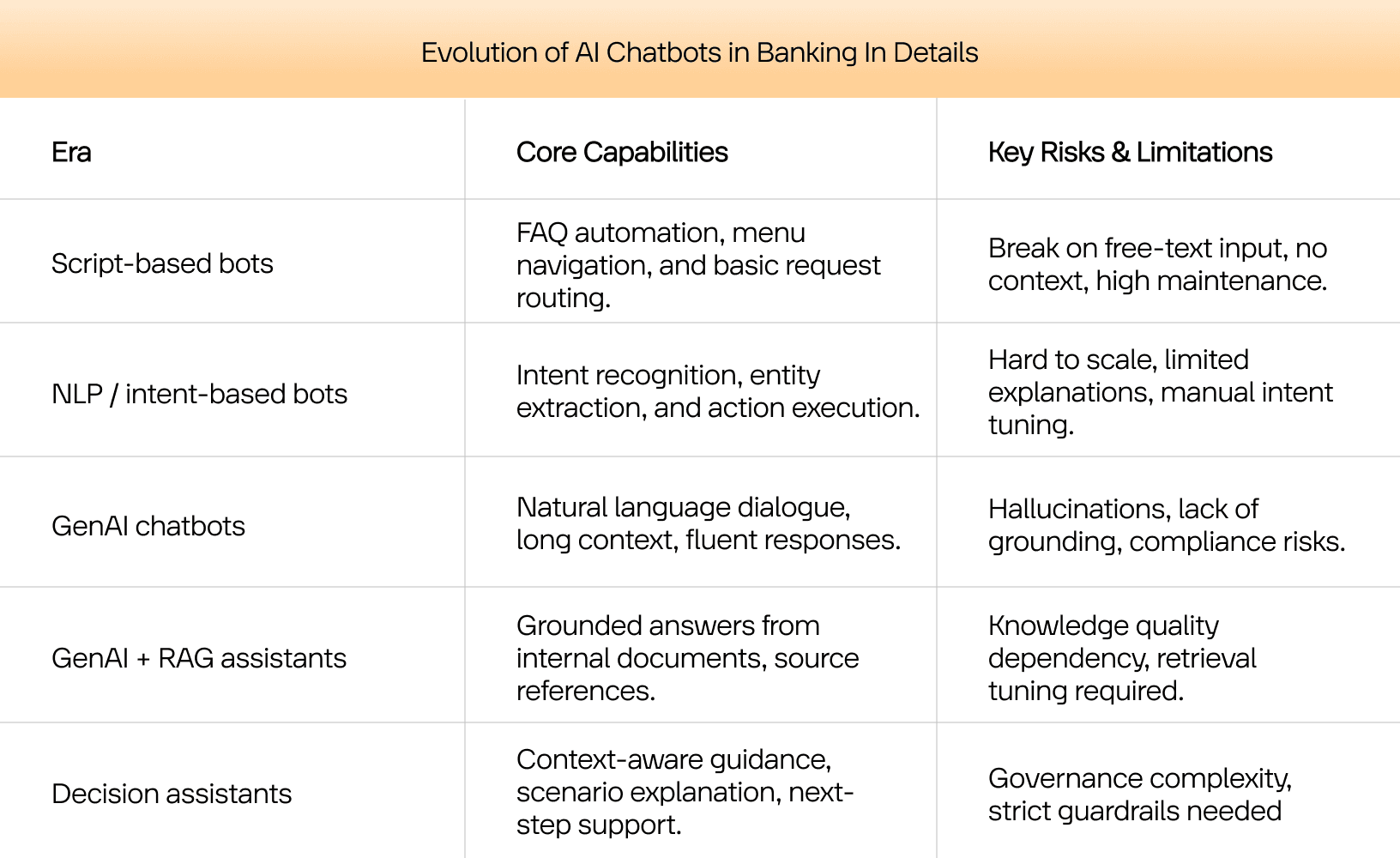
The evolution of banking chatbots, as well as machine learning for banking sector in general, is not a story of “getting smarter.” It’s a story of changing roles: from a support channel to a full-fledged decision-making interface. Each stage of this evolution had limitations, which pushed banks further.
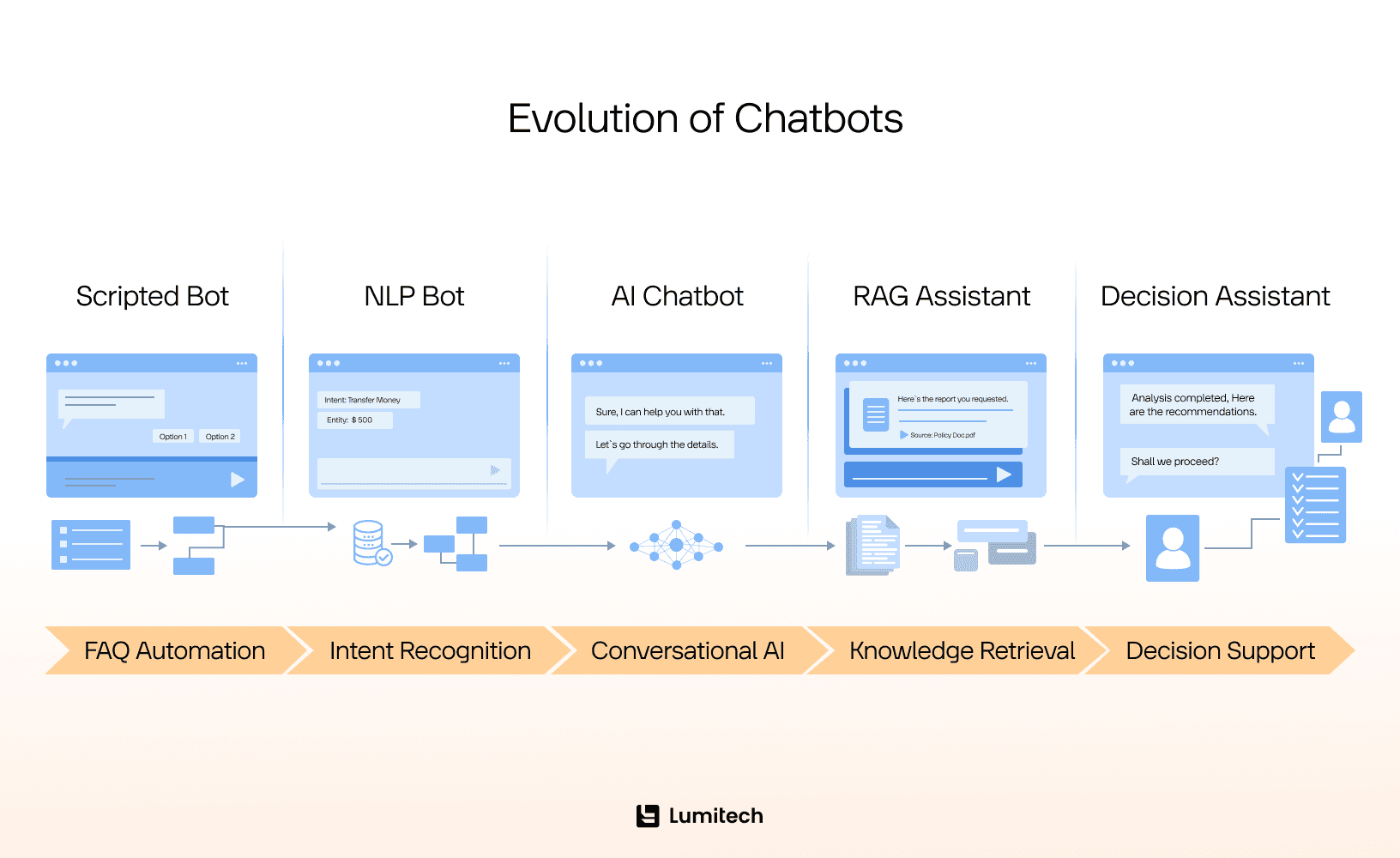
Script-Based Banking Chatbot: Automation of FAQs
The first banking chatbots were essentially interactive scripts. They worked according to a clearly defined logic: buttons, menus, transitions between branches. Such bots were well-suited for:
answering simple questions (work schedule, tariffs, contacts);
redirecting the user to the desired section;
reducing the load on the contact center during peak hours.
But these systems had obvious limitations. They:
broke at any deviation from the script,
did not understand the context,
did not know how to work with complex or combined requests,
quickly became obsolete due to product changes and regulatory changes.
For banks, this meant one thing: the bot helps only where the question is as standardized as possible.
NLP-Based Chatbots: Understanding Intent, not Meaning
The next stage was NLP chatbots with intent classification. They could already recognize the user's intention (“block card”, “check balance”, “dispute payment”) and extract key entities (amount, date, card type).
This allowed banks to:
automate a much larger part of requests;
work with “live” language;
integrate bots with core banking systems to perform actions.
However, there were significant limitations here as well. NLP bots:
understood well what the user wanted, but poorly understood why;
did not know how to explain complex rules or exceptions;
required constant manual configuration of intentions and scenarios;
did not scale well for long dialogues with clarifications.
In fact, it was query automation, not decision support.
GenAI Chatbots: Language Fluency Without Guarantees
With the advent of large language models, banks for the first time received chatbots that:
work well with natural language;
can support long context;
formulate answers in understandable, “human” language.
This appeared to be a breakthrough while also creating new risks for generative AI for wealth management and other directions. Without additional architecture, such chatbots:
can “hallucinate” answers;
do not distinguish approved policies from outdated ones;
do not always work correctly with regulated topics.
For banks, this became a critical stop signal: language quality without knowledge control is dangerous.
GenAI + RAG: Grounded Answers Instead of Guesses
The real shift to generative AI in banking came with the introduction of Retrieval-Augmented Generation (RAG). In such an architecture, the chatbot does not “know” the answer in advance; it:
finds relevant internal documents (policies, tariffs, procedures);
uses them as context;
forms the answer based on specific sources.
This gave banks several key advantages:
a significantly lower risk of incorrect answers;
the ability to show sources of information;
version control and relevance of knowledge;
easier auditing and compliance with regulatory requirements.
This is where the chatbot shifts from “answering” to “explaining.”
From Chatbots to Decision Assistants
At this stage, the chatbot is no longer just a support channel. It becomes an assistant powered by decision intelligence solutions – an interface that helps the user understand the situation and take the next step.
For customers, this means:
explanation of the reasons for failures or delays;
understanding of options for action (“what can I do next?”);
transparency of complex banking rules.
For bank employees:
quick access to policies and procedures;
reduction of errors in processes;
support for decision-making in compliance, risks, and operations.
The key difference between a classic chatbot and a decision assistant in banking is simple: the former answers questions, the latter helps to make decisions within the framework of the rules.
It is this transformation that determines what banking AI assistants will be in 2026 – not just smart, but manageable, explainable, and suitable for working in a regulated environment.
Potential Use Cases for Chatbots in Banking: Where AI Pays Off
Customer Support & Self-Service: How AI Chatbots in Banking Are Used
This is the largest and most obvious point to discuss, answering the question of how to use AI chatbots for banking industry: balances, statements, statuses, data changes, cards, fees, limits, and currency transactions. If the bank does it well, it:
reduces the load on operators;
reduces response time;
increases user satisfaction (because “now” is more important than “perfect”).
Example (Bank of America, Erica). In 2024, customers interacted with Erica 676 million times, and in total, since launch, over 2.5 billion interactions.
This is not a “pilot”, but a truly mass channel.
Account Opening & Onboarding
Banks often lose users not because of the product, but because of onboarding: a document, a selfie, confirmation, a signature, and the question “what next?”. AI chatbots in banking can:
suggest steps;
reduce errors in the application;
answer typical KYC / verification questions;
translate to a human when manual verification is required.
This is especially beneficial for digital-first banks and fintechs, where onboarding is the main “entrance” to the product.
Personal Finance & Everyday Banking Guidance
Many banking AI chatbots are not just a service but a virtual financial assistant: expenses, categories, reminders, budgeting, and explanations of transactions (“What kind of write-off is this?”).
An important boundary here: do not give investment advice if the bank is not legally prepared, and always be careful with wording.
Payments, Cards, and Disputes Managed by AI Chatbots in Banking Industry
The most common “hot” scenarios:
card blocking/unblocking;
confirmation of a suspicious transaction;
change of limits;
chargeback of transactions;
refund status.
The chatbot is valuable here because it works 24/7, and such questions often arise at night, at the airport, or abroad.
Fraud Prevention & Security (Customer-Facing)
AI chatbots in banking industry are integrated with risk signals:
If a transaction is suspicious, the bot determines whether it is a client transaction.
It explains what to do (change password, block card).
And conducts a “security checklist”.
But here you need:
very short scripts;
minimum text
mandatory escalation if the client gets lost.
Collections & Delinquency Support
A complex but very profitable case. AI chatbots in banking can:
explain the status of debt;
offer restructuring options;
accept payment;
answer questions about fines/grace periods.
However, the tone of communication should be as human as possible; otherwise, “automation” will become a reputational risk.
Internal AI assistants (Employees, Legal, Compliance, IT)
A very strong (and often underestimated) direction is internal AI chatbots for banking for employees: policies, procedures, instructions, and IT support.
Example (Bank of America, Erica for Employees). Over 90% of employees use the internal version of the assistant, and the bank reports a more than 50% reduction in IT service desk calls. These are direct operational benefits that are easy to calculate.
Considering AI chatbots for banking? Let’s talk through your use cases, constraints, and priorities.

Benefits of AI Chatbots for Banking: What Banks Actually Gain
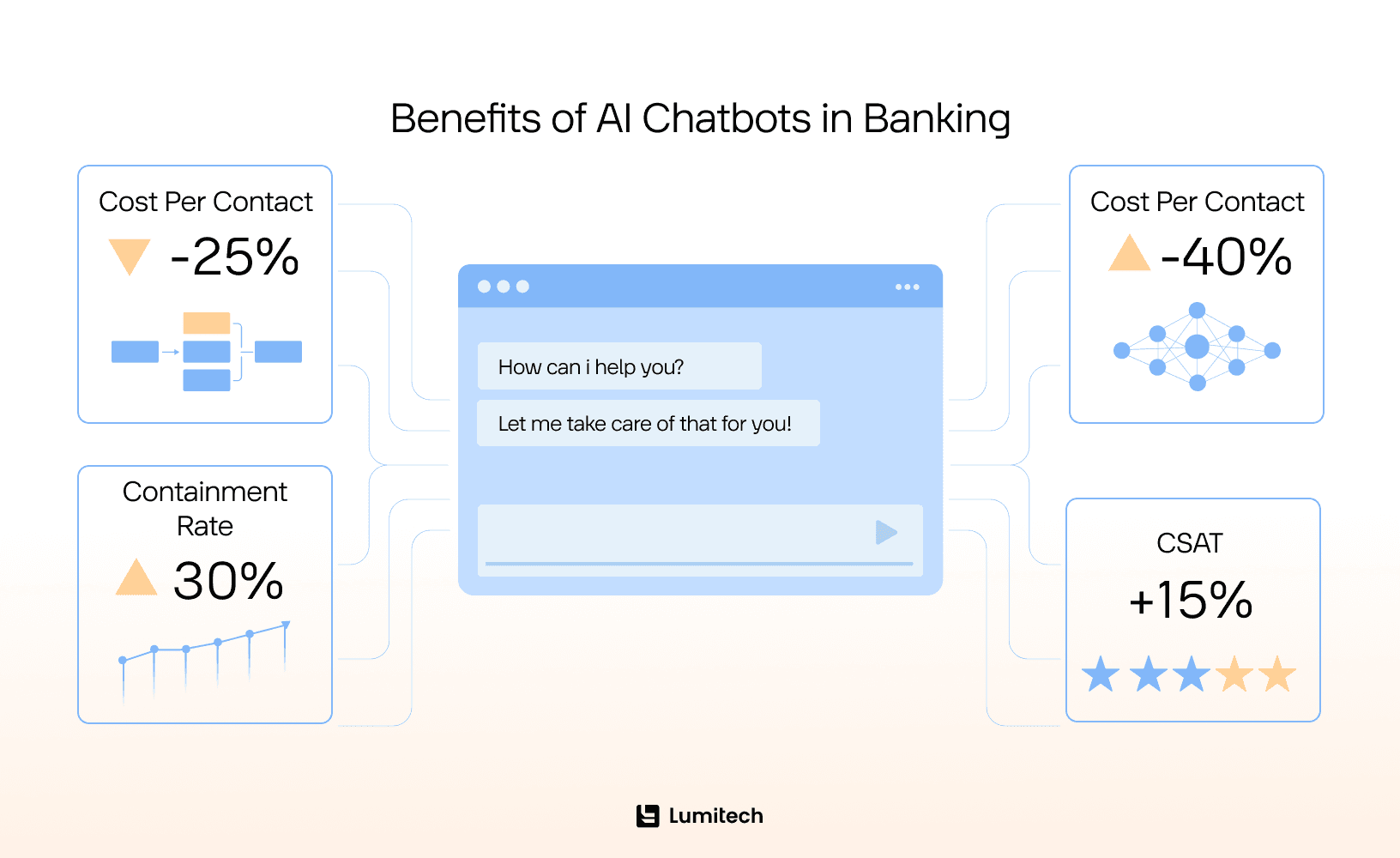
The benefits of AI chatbots for banking should not be viewed as “support savings” but rather as changes to a bank’s operating model. In mature implementations, chatbots impact costs, decision speed, service quality, and even regulatory resilience.
How to Use AI Chatbots for the Banking Industry to Gain Cost Efficiency
The most obvious, but not the only, benefit is reduced operating costs. Contact centers remain among the most expensive channels in banking, driven by salaries, training, staff turnover, and peak loads.
AI chatbots for banks and financial services:
automate a large part of low-complexity requests;
reduce the number of repeated contacts;
allow operators to focus on complex cases.
According to Juniper Research, banks saved more than $7 billion in 2023 by automating customer requests via chatbots. Today, this figure is growing not only due to volume but also because GenAI can handle more complex scenarios.
Important: savings do not arise from “laying off people”, but from the redistribution of the load and reduction of peak costs.
Faster Time-to-Resolution and Decision Speed
For a client, the speed of resolving a question is often more important than a “perfect” answer. For a bank, this means:
fewer repeated requests;
fewer escalations;
fewer negative reviews.
AI chatbots for banking shorten the path from request to action:
the client does not wait in line;
does not repeat the problem several times;
does not depend on the call center’s working hours.
This is even more noticeable in internal processes. Internal AI assistants (for employees) reduce the time spent searching for procedures, policies, and IT support from hours to minutes, which directly affects productivity.
Consistency, Compliance, and Policy Alignment as Other Benefits of AI Chatbots in Banking
One of the least obvious, but critical benefits is consistency of responses. Different operators within a bank may interpret rules differently, especially in complex or rare cases.
A well-tuned banking chatbot:
responds consistently in the same situations;
is based on approved sources;
is easily updated when policies change.
This reduces:
the number of errors;
the risk of regulatory claims;
internal inconsistencies between channels (chat, call center, branch).
In the case of GenAI + RAG, banks also gain traceability: the ability to show which document or rule the response comes from.
Better Customer Experience without Over-Automation
A good banking chatbot is not one that “does everything itself”, but one that transfers the client to a human in a timely manner. This is what creates a positive UX in banking.
The advantages here are as follows:
the client starts with a chat (low barrier);
receives quick basic assistance;
goes to the operator with context.
This reduces frustration and makes contact with the bank less “painful”, especially in stressful situations (fraud, card blocking, payment delay).
Scalability and 24/7 Availability
Banks operate across different time zones, with distinct activity peaks (salaries, holidays, incidents). Chatbot:
scales without hiring additional shifts;
does not “burn out”;
works 24/7 without loss of quality.
This is especially important for:
digital-first banks;
international groups;
crisis situations (mass disruptions, regulatory changes).
Knowledge Retention and Organizational Memory
Internal AI chatbot for banks creates what they often lack – a centralized knowledge store. Instead of knowledge “living” in employees’ heads or in scattered documents, it becomes accessible through dialogue.
This:
reduces dependence on specific people;
accelerates onboarding of new employees;
reduces operational risks during rotations and layoffs.
Strategic Flexibility and Future Readiness
Finally, a banking chatbot is an investment in the bank’s future architecture. Banks that already have a conversational UX, a managed knowledge base, and clear guardrails can more easily move to the next stage – copilots, agent scripts, and deeper automation of decisions.
Those that remain at the “FAQ bot” level are forced to start almost from scratch.
Real-World Cases: How Banks Actually Use AI Banking Chatbots at Scale
Banking chatbot cases should be considered not by the principle of “who has the bot”, but by the role it plays in the bank’s operating model. Below are examples of AI banking chatbots that have moved beyond experimentation and become integral to the infrastructure.
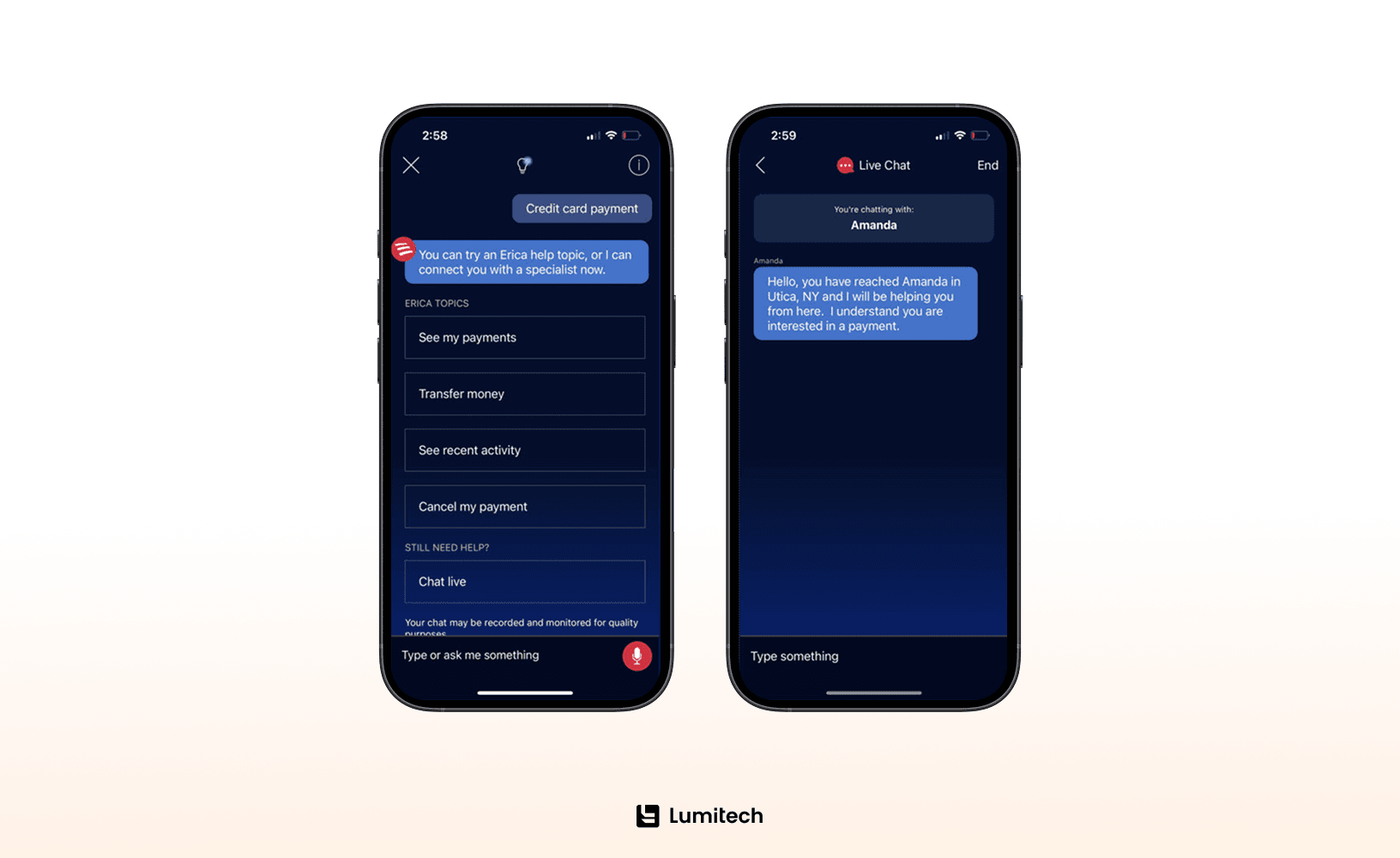
Bank of America: Erica as a Core Banking Interface
Context
Bank of America is one of the most frequently cited examples in conversations about AI in banking. The reason is simple: Erica is not a separate channel, but a central digital assistant integrated into the daily banking of millions of customers.
What Erica does
Erica supports a wide range of scenarios:
inquiries about accounts, balances, transactions;
payment reminders;
expense explanations and categorization;
assistance with credit products;
basic financial management tips.
Over time, Erica has evolved from a Q&A bot to a proactive assistant that suggests next steps to the user.
Scale and numbers
In 2024, customers interacted with Erica more than 676 million times, bringing the total number of interactions since launch to more than 2.5 billion. This means that the chat interface has effectively become one of the bank’s core UX layers, rather than an auxiliary channel.
Why the case is important
Erica shows that an AI chatbot for banks can be:
stable under very high load,
understandable for the mass user,
integrated into core banking without losing security.
Bank of America: Erica for Employees (Internal Assistant)
Context
A lesser-known but no less important case is Erica for Employees. This is an internal AI assistant for bank employees.
Potential use cases for chatbots in banking
The assistant helps with:
IT support;
internal policies and procedures;
HR issues;
operational instructions.
Result
The bank publicly stated that:
over 90% of employees use the assistant;
the number of calls to the IT service desk has decreased by more than 50%.
Key conclusion
Internal AI banking chatbots often deliver faster, more predictable ROI than client chatbots. This is especially true for large banks with complex internal structures.
NatWest: Cora as a First-Line Digital Channel
Context
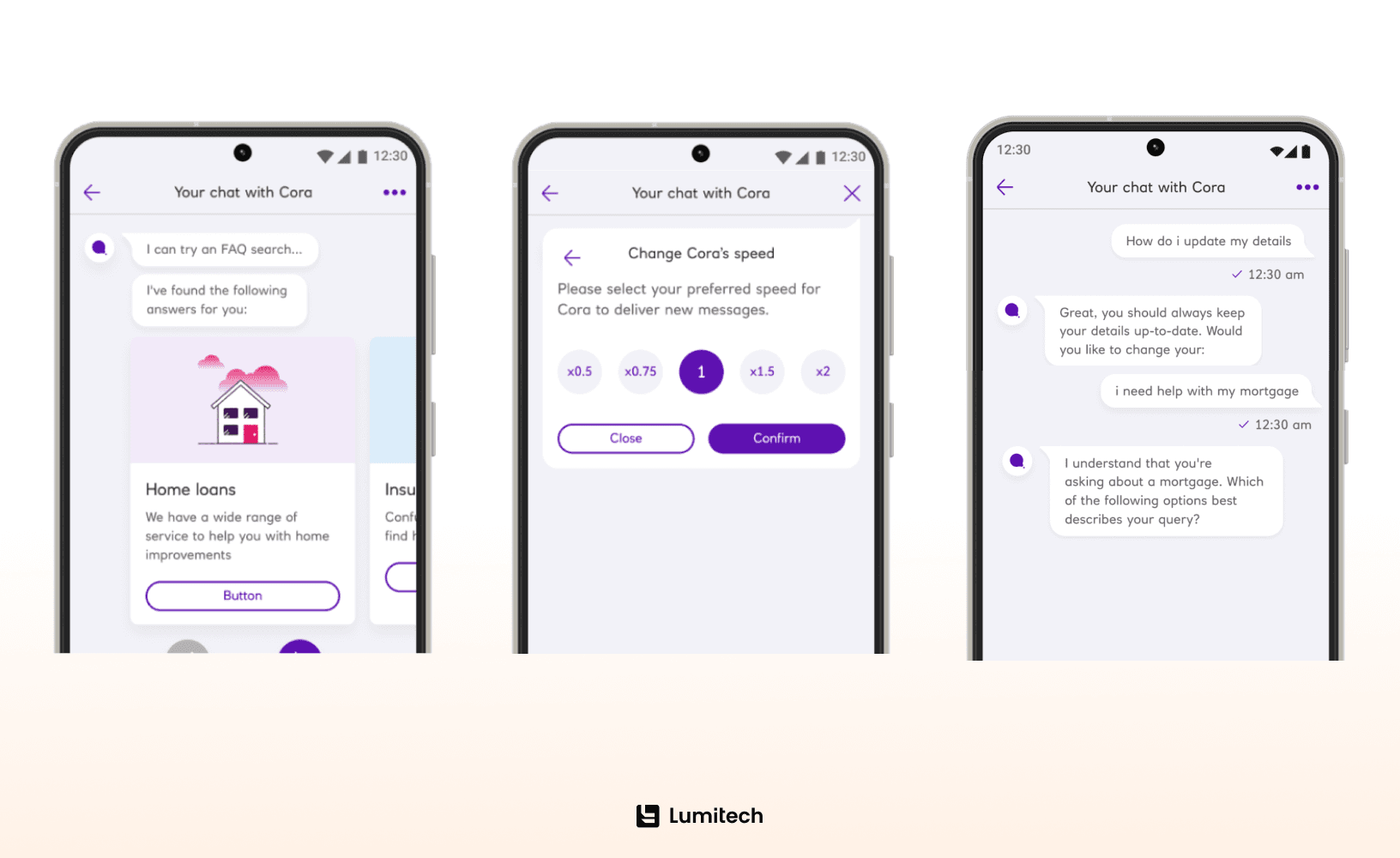
NatWest (UK) uses Cora as the first point of contact for customers across digital channels.
Functionality
Cora answers:
account and card questions;
payment statuses;
basic credit questions;
navigation queries.
The bot clearly escalates the user to a human if the question falls outside the defined scenarios.
Scale
According to NatWest, Cora handles tens of millions of interactions and is approaching the volume of traditional support channels – phones and branches.
Why is this significant?
The case demonstrates that a chatbot can:
reduce the load on classic channels,
do not worsen customer satisfaction,
work as a “digital filter” before live support.
DNB (Norway): Automation with Clear ROI Focus
Context
Norwegian bank DNB has used chat automation to reduce operational costs.
Implementation
The bank launched a virtual agent for online chat, focused on:
frequent and repetitive questions;
standardized scenarios;
fast recognition of intent.
Results
During the first 6 months:
more than 50% of chat interactions were automated;
the workload on operators was reduced;
customer response time was reduced.
Conclusion
Even without complex “copilot scenarios”, a well-tuned bot can provide a tangible economic effect.
Common Patterns Across Successful Cases
Despite different countries and scales, all successful cases have common features:
chatbot is part of the operational architecture, not a separate experiment;
clearly defined boundaries of responsibility;
mandatory escalation to a person;
constant work on the quality of answers and knowledge;
focus not only on cost-cutting, but also on the speed and quality of solutions.
Why These Cases Matter for Banks Planning Adoption
These examples show that the success of banking chatbots does not depend on the “smartest model”. It depends on:
correctly chosen scenarios,
knowledge architecture,
UX logic,
and discipline in management.
This is what distinguishes bots that remain in production for years from those that disappear after the pilot.
Leading banks have already moved from experiments to production-ready AI chatbots. Let’s discuss which of these models fits your organization.
What Can Go Wrong with Banking AI Chatbots: Risks Banks Must Engineer Around
Banking chatbots are an area where “bad UX” quickly becomes a legal issue.
Hallucinations & wrong advice
If a model “invents” a fee or procedure, the customer may incur costs. Regulators are already paying attention to chatbot issues, particularly when they provide incorrect information or “lock” customers in a dead-end loop without access to a human.
“Doom loops” and human handoff failures
The worst chatbot is one that:
does not resolve;
does not transfer to an operator;
and forces the customer to repeat the same thing.
Data security and data governance in the banking industry
Bank data is sensitive. Therefore:
Public AI and ML development services “as is” are often unavailable;
private environments, access control, and auditing are needed;
clear rules are needed about what the bot can see and what it can say.
The European Banking Authority (EBA) directly mentions secure banking chatbots as one of the applications (for customers and employees) in its materials on AI, but the focus is on governance and manageability.
Implementation Blueprint: How to Launch AI Chatbots in Banking That Survive Production
Launching a responsible AI banking chatbot is not the same as developing an MVP to “see how it goes.” In production, it immediately becomes part of a regulated environment: with risks, audits, and real customers. That’s why successful banks approach it as an infrastructure project with proven web development services, not a UX experiment.
Step 1. Start with the Right Problem, not with AI
The most common mistake is starting with the question, “Which model to use?” The correct question is another: What specific problems does the bank’s chat need to solve right now?
At the start, you should choose domains with the following characteristics:
A large volume of repeated requests;
Low or medium risk of error;
Clear, formalized rules;
A clear path for escalation to a person.
Typical examples for the first release:
Cards (limits, blocking, statuses);
Payments and their statuses;
Basic account changes;
Internal IT/HR requests for employees.
This allows you to quickly achieve operational impact without creating regulatory landmines.
Step 2. Define Hard Boundaries and Escalation Rules
In a banking chatbot, it is important not only what it can do, but also what it is not allowed to do. Whether it relates to AI in wealth management or other fields.
In practice, this means:
a clear list of permitted topics;
prohibited areas (investment advice, legal interpretations without context, personalized financial recommendations);
automatic escalation to the operator in the event of uncertainty of the answer, repeated clarifications, and risk triggers (fraud, complaints, aggression).
Critically important: escalation should be simple and transparent, and not hidden behind “I didn’t understand, repeat again”.
Step 3. Build a Governed Knowledge Layer (Especially for GenAI)
If a bank uses GenAI or plans to do so, the knowledge layer becomes a central component.
What is needed here:
single sources of truth (policies, tariffs, procedures);
version control and validity dates;
elimination of duplicates and drafts;
ownership: who is responsible for updating the content.
In the case of RAG architecture, this means that:
retrieval should return only approved documents
the model should not “add from itself”;
it is desirable to tie answers to sources.
Without this, a chatbot can appear convincing while also being dangerous.
Step 4. Design Conversational UX for Banking Reality
UX of a chatbot in a bank is not a “friendly conversation”. It is a controlled dialogue that should guide the user to the desired outcome.
Key principles:
short, clear answers;
clarifying questions only when really necessary;
explicit next steps (“you can do A or B”);
explanation of reasons if an action is impossible.
For complex scenarios, the following work well:
guided flows (step-by-step scenarios);
hybrid UX (chat + buttons/options);
warning about limitations (“I can help with…, but not with…”).
Step 5. Treat Security and Compliance as First-Class Citizens
In a bank, security is not an “afterthought.” It’s there from day one.
At the architecture level, this includes:
role-based access to data;
audit trail logging;
isolation of models and data;
compliance with local and international regulations.
For internal chatbots, this is no less important than for client chatbots: leakage of internal policies or procedures is also a serious risk.
Step 6. Measure the Right Metrics (And Ignore Vanity Ones)
The number of chats by itself means nothing. Banks that successfully scale chatbots look at other metrics:
containment rate (how many requests are resolved without a human);
deflection rate (how many did not reach the call center);
average time to resolution;
escalation success rate;
CSAT/DSAT specifically for the chat channel;
number of errors and complaints;
regulatory incidents (0 is the best metric).
These metrics indicate whether the chatbot is actually working or merely “alive.”
Step 7. Operate And Improve Continuously
A chatbot in a bank is a live product, not a one-time release.
Production requires:
regular analysis of dialogues;
updating knowledge when policies change;
A/B testing of UX patterns;
quality control of responses;
incident response plan.
Banks that do not build this in from the outset usually experience quality degradation within a few months.
Key Takeaways: Building Decision-Grade Artificial Intelligence Chatbots in Banking
AI-driven chatbots in banking are no longer an auxiliary support channel – they become part of the bank’s operational and decision architecture. Practice shows that real value is not provided by the most complex models, but by a clearly defined chatbot role, a managed knowledge base, a well-thought-out UX design for fintech, and reliable escalation to a human.
In Lumitech projects for financial and regulated organizations, we see the same pattern and understand the benefits of AI chatbots in banking: GenAI works only when it is built into understandable processes and limited by clear guardrails. Without RAG architecture, source control, and governance, language “intelligence” quickly turns into operational and compliance risk.
That is why successful solutions start with narrow, high-frequency scenarios and scale as a platform, not as a separate feature with AI in financial services. Banks that are already investing in managed AI chat today are laying the foundation for the next stage: copilots and context-aware decision assistants. In 2026, the competitive advantage will not be the mere use of AI, but the ability to integrate it so that solutions remain fast, explainable, and secure – this is what Lumitech focuses on in its AI software development solutions for fintech.


