
Generative AI in Banking: Benefits, Risks, and Competitive Advantage
Banks have always been obsessed with language. Contracts, disclosures, policies, complaints, chat transcripts, call notes, regulatory filings, internal memos — banking is basically a high-stakes writing contest with interest rates.
- AI Development
- FinTech & Finance
February 09, 2026
 AI Overview
Generative AI in banking uses large language models to draft compliance reports, summarize call transcripts, and answer policy questions, unlike traditional AI which only classifies or predicts. Key components include LLM-based content generation, hallucination guardrails, and bank-grade governance for auditability. Because manual handoffs slow operations, GenAI-assisted coding teams report 30-50% increases in development velocity.


That’s why generative AI in banking is getting serious attention: it finally targets the part of operations that most automation historically couldn’t touch — the messy, human layer of text, conversation, and decision justification.
But “serious attention” isn’t the same thing as “plug in a chatbot and enjoy profits.” Generative AI brings new capabilities, yes. It also brings new failure modes, new security problems, and a governance headache that doesn’t go away just because the demo looked great. We’re also past the stage of debating whether AI in financial services is “real”. The question now is which workflows benefit, and how to control risk when automation starts writing and summarizing on your behalf.
This article breaks down how generative AI strategy for banks differs from traditional AI use cases, where it delivers real value (and where it’s risky), what a bank-grade architecture looks like, and the best practices that keep innovation moving without turning your risk team into full-time firefighters.
GenAI vs. Traditional AI: The Evolutionary Leap
To the casual observer, “AI is AI.” To a bank’s CTO, the difference between traditional (Discriminative) AI and generative AI in banking is the difference between a librarian and a novelist.
Traditional AI (The Librarian): This is excellent at classification. It looks at 10,000 “Normal” transactions and 1,000 “Fraudulent” ones and says, “This new transaction looks 89% like fraud.” It follows rules and patterns but cannot create anything new.
Generative AI (The Novelist): GenAI uses Large Language Models (LLMs) and transformer architectures to create. It doesn't just flag fraud; it can generate synthetic fraud data to train other models. It doesn't just read a regulation; it drafts a compliance report based on that regulation.
In other words, traditional AI in wealth management is mostly about prediction and classification:
Will this customer default?
Is this transaction fraudulent?
Which accounts need review?
What is the next-best product?
GenAI in banking is different. It’s about the generation and transformation of content:
Draft a response to a customer complaint
Summarize a call transcript into structured case notes
Extract obligations from a contract and highlight risk clauses
Answer an internal policy question with citations
Convert a policy change into an updated checklist and training snippet
In other words, traditional AI turns data into scores; generative AI for banking turns information into language and actions.
Why that difference matters
Banking workflows are full of “in-between” steps that don’t look like machine learning problems until you realize they’re mainly language problems:
interpreting policies
writing explanations
reading documentation
reconciling narrative evidence
documenting decisions for auditability.
GenAI can compress those steps dramatically. But it’s also more prone to “confident nonsense” (hallucinations), which is cute in a creative writing app and unacceptable when discussing fees, eligibility, or regulatory obligations.
The Benefits of Generative AI in Banking
Let’s be blunt: most banks aren’t chasing GenAI because it’s trendy. They’re chasing it because banking’s cost base is loaded with language-heavy tasks. Done right, banking generative AI can shift work from “manual and repetitive” to “review and approve.”
1) Faster operations with fewer handoffs
A lot of bank operations run on a relay race: one team reads, another team summarizes, another team escalates, and another team writes the customer. GenAI in banking can reduce relay handoffs by drafting the intermediate artifacts (summaries, categorizations, suggested actions) so humans can focus on judgment.
2) Better consistency in customer communication
Humans write differently. That’s not a moral failing; it’s just biology. But regulators and customers expect consistent explanations. One of the most obvious benefits of generative AI in banking is that it can help standardize tone, structure, and completeness across customer-facing messages, while still leaving room for human approval.
3) Knowledge access for frontline staff
Banks are packed with internal policies that are technically available but practically undiscoverable. A well-governed GenAI assistant can make institutional knowledge searchable and usable, especially when built on retrieval with authoritative sources (more on that in architecture).
4) The “time-to-trust” advantage
Competitive advantage isn’t only “we have AI.” It’s “we can deploy AI safely, repeatedly, and across functions.” Supervisors are increasingly interested in how firms manage AI risk and dependencies. Frameworks and supervisory work highlight that AI can increase efficiency but also amplify vulnerabilities like third-party concentration, cyber risk, and governance gaps.
Improving Operational Efficiency with Generative AI for Banks: The Invisible Revolution
Efficiency in banking is usually won in the “Back Office” — the dark rooms where paper flows, and regulators lurk.
Automated Document Processing: GenAI can ingest 500-page commercial loan applications, extract key risk factors, and summarize them into a 2-page memo for the credit committee in seconds.
Coding Assistants: Bank developers using GenAI-powered pair programmers are seeing 30-50% increases in velocity. In an industry where “time to market” for new features used to be measured in quarters, it’s now measured in weeks.
Customer Service Triage: GenAI-powered virtual assistants are moving past “I didn't understand that” to solving complex queries like “Why was my mortgage payment $20 higher this month?” by instantly checking escrow and tax changes.
Let’s take a look at the operational influence of banking generative AI in more detail. GenAI’s efficiency impact typically appears in four patterns:
Pattern A: Draft-first workflows (humans review)
Instead of humans writing from scratch, the model drafts and humans edit. This can speed up:
complaint responses
customer emails
internal memos and reports
policy summaries and training content.
Pattern B: Summarize-and-structure (turn text into fields)
Banks love structured fields because systems can route them. Generative AI for banks can convert freeform text (call transcripts, emails, notes) into structured case attributes:
complaint category + subcategory
product and channel
urgency
recommended next action.
Pattern C: Search-and-cite (reduce “I can’t find it” time)
A retrieval-based assistant can answer “What does our policy say?” with citations to specific sections of internal documents. The time saved isn’t just employee productivity; it’s reduced risk from guessing.
Pattern D: Automate the boring glue work (but keep controls)
Think: drafting Jira tickets from incidents, generating test cases from requirements, and converting meeting notes into action items. Banking automation with generative AI doesn’t replace banking expertise, but it reduces the friction that slows delivery.
There’s also real-world evidence that firms are already seeing operational gains from GenAI deployments. For example, UK bank leaders have publicly discussed measurable benefits from GenAI in processing tasks and productivity improvements.
Does generative AI for banking provide a competitive advantage?
Yes, but not in the “who has the fanciest model” way.
The durable advantage comes from:
Distribution: GenAI embedded in workflows across the organization (ops, service, compliance, engineering).
Governance: the ability to prove what the system did, why it did it, and how risks are controlled.
Data foundations: strong data quality, lineage, and access control — still unsexy, still essential.
Regulators and financial stability bodies have highlighted that adoption of generative AI for banking can bring benefits but may also increase systemic vulnerabilities through provider concentration, correlated behavior, cyber risks, and model risk/data governance weaknesses.
In practice, generative AI for wealth management can be a differentiator when it improves advisor productivity and ensures consistent, auditable explanations.
So yes, GenAI can be an advantage. But if you build it like a hackathon project, it’ll become a competitive disadvantage, because outages, leaks, and compliance breaches are extremely “sticky” in public memory.
High-value banking use cases for generative AI
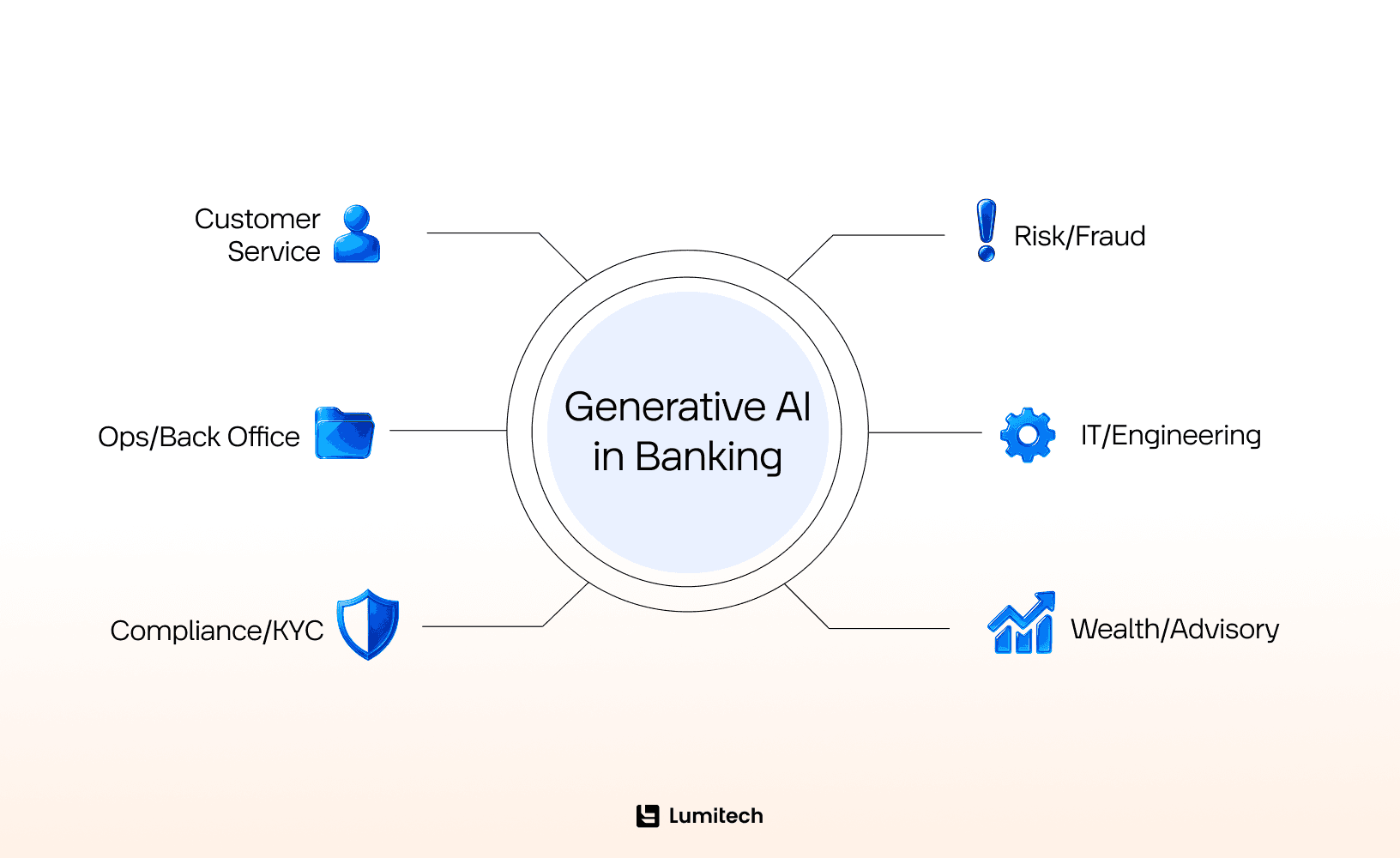
Below are the generative AI use cases in banking where banks typically see the best combination of value and feasibility, especially in early deployments.
1) Customer service and virtual banking assistants
This is one of the headline use cases of generative AI in banking because it’s visible. But “chatbot” is not one use case; it’s a spectrum.
Agent assist: GenAI supports human agents with suggested answers, summaries, and next steps.
Self-service: customer-facing assistants for FAQs, account help, and troubleshooting.
Case follow-up: generate clear status updates, explain what’s needed, and reduce back-and-forth.
Best starting point: agent assist, because it keeps a human in the loop and reduces risk while still delivering productivity.
Key risks of generative AI in banking to manage
hallucinated policy or fee information
inconsistent disclosures
data leakage (PII)
prompt injection via user inputs (yes, customers can be adversarial).
A safe assistant isn’t only a model problem; it’s a product problem. UX design for fintech is what turns GenAI into a tool customers trust, with clear disclosures, confirmations for risky actions, and friction that prevents harm.
Security guidance for LLM applications emphasizes risks of generative AI in banking, like prompt injection and insecure output handling: issues that become very real in customer-facing scenarios.
2) Document intelligence for operations and compliance
Banking runs on documents: onboarding packets, KYB/KYC evidence, contracts, statements, adverse action letters, and internal policies. GenAI can help with:
extracting entities and obligations
summarizing long documents into structured checklists
drafting compliance narratives and audit-ready summaries
triaging exceptions.
One practical application is KYC automation: summarizing onboarding documents, extracting entities, flagging missing evidence, and drafting case notes—while humans still make the final approval decision.
When you think of how generative AI is used in banking, this is usually a “quiet win” use case: less visible than a chatbot, but often more reliable and high ROI.
3) Internal knowledge assistants (policy, product, procedures)
If employees can’t find the right information quickly, they improvise. Improvisation is where risk breeds. A retrieval-based GenAI assistant can:
answer procedural questions,
cite policy paragraphs,
generate step-by-step guidance,
surface relevant forms and templates.
The trick of such banking use cases for generative AI is to ground answers in approved sources and refuse when sources aren’t available.
4) Software engineering copilots (for bank IT)
Banks are large software organizations, whether they like it or not. GenAI can improve software development for fintech with:
code completion
test generation
refactoring suggestions
documentation drafting.
This tends to be a safer early win because it’s internal, and outputs can be reviewed via existing engineering workflows. (Still: don’t let it write security-critical code unsupervised. That’s how you end up with “creative” vulnerabilities.)
5) Marketing and personalization (with guardrails)
GenAI can draft campaign variations, personalize messaging, and speed creative iteration. But personalization must be handled carefully in finance: fairness, suitability, and transparency still apply, and banks should avoid producing misleading or manipulative messaging.

Key Risks of Generative AI in Banking That Require Extra Caution
GenAI is not inherently “unsafe,” but some domains carry higher regulatory and consumer harm risk.
Credit risk of generative AI in banking
A clean rule: GenAI should not be the decision-maker for credit. It can help support processes (document summarization, applicant communication drafts, internal analyst assistance), but underwriting decisions remain subject to strict legal and regulatory requirements.
In the US context, the CFPB has emphasized that creditors must provide specific and accurate reasons for adverse actions and cannot rely on generic checklists if they don’t reflect the actual reasons.
In the EU context, supervisory discussion has highlighted that creditworthiness evaluation and credit-scoring systems are treated as high-risk under the EU AI Act, bringing additional safeguards and obligations.
Fraud detection and AML
GenAI can help fraud teams, especially for investigation summarization, narrative generation, and analyst copilots. But classic detection still tends to rely on predictive models, rules, graph analytics, and streaming signals.
Also, GenAI can be used by criminals, too. That means banks must assume adversarial behavior will grow, not shrink.
Bank-Grade Architecture to Resolve Generative AI Challenges in Banking
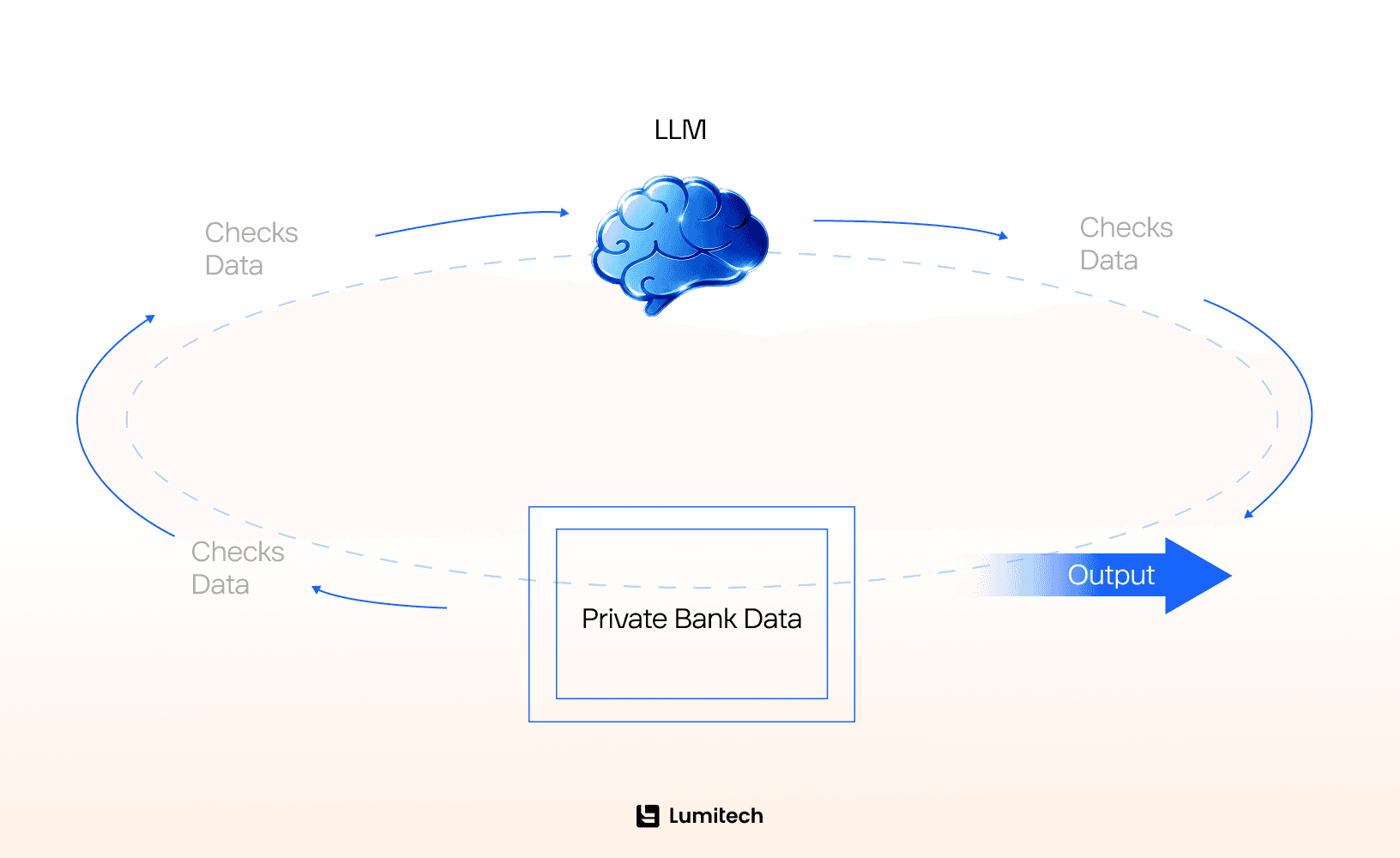
The biggest difference between “cool demo” and “production banking system” is architecture. Here’s a practical blueprint.
Layer 1: Experience layer (channels)
Contact center agent desktop
Customer chat (web/app)
Back-office workflow tools
Developer tools
Design principle: separate UI from model logic, and log interactions for audit/quality, without logging sensitive data unnecessarily.
On the front end, strong web development services matter more than most AI teams admit, because the safest genAI system still fails if the UI leaks data, confuses users, or can’t route escalations cleanly.
Layer 2: Orchestration layer (the “AI middleware”)
This orchestration layer is where decision intelligence solutions fit naturally: connecting model outputs to rules, policies, and human approvals so GenAI becomes actionable without becoming reckless. It typically includes:
Prompt management (versioning, templates, parameter controls)
Policy enforcement (what the model can/can’t answer)
Tool calling (safe integrations to internal systems)
Routing (choose model based on task type and sensitivity)
Output controls (structured output formats, validation, redaction)
In generative AI and banking, you should think of this as the difference between “LLM as a toy” and “LLM as a governed component.”
Layer 3: Grounding layer (RAG and knowledge)
Retrieval-Augmented Generation (RAG) is the workhorse pattern for banks because it reduces hallucinations by grounding responses in approved data:
Document store (policies, product docs, FAQs, procedures)
Search + retrieval (keyword + vector)
Context assembly (only relevant chunks, with metadata)
Response generation with citations
Key best practice: store and retrieve only what the model is allowed to use, with access control aligned to user entitlements.
In advisory contexts, grounding can include approved analytics outputs (e.g., investment analytics software with optimized portfolio insights) so that generated explanations stay aligned with validated portfolio logic.
Layer 4: Model layer (LLMs)
Banks choose among:
third-party hosted models
private deployments
open-source models hosted internally.
Your choice depends on:
data sensitivity
latency and cost
jurisdictional constraints
operational maturity.
There is no universally correct answer. The “correct” answer is the one your risk, security, and engineering teams can defend and operate.
Layer 5: Security, privacy, and governance (cross-cutting)
In regulated environments, data governance in the banking industry is the difference between a usable assistant and a compliance incident, especially around access control, logging, and retention of conversational data. This is not “extra.” This is the system.
Data classification + PII handling
Access control and least privilege
Red-teaming and adversarial testing
Audit logging and traceability
Model risk management and change control
Monitoring for drift, toxicity, and policy violations
Security guidance for LLM applications highlights common risks (like prompt injection) that map directly to banking threat models.
Risk management frameworks also emphasize these generative AI challenges in banking: identifying unique GenAI risks and aligning controls accordingly.
Best Practices for Deploying Generative AI in Banking
Here’s the practical playbook: not exhaustive, but the stuff that separates successful programs from “we tried a chatbot, and now Legal won’t let us have fun.”
1) Start with low-risk, high-volume workflows
Great early candidates:
agent assist
internal policy Q&A
document summarization for ops
engineering copilots.
Avoid starting with:
credit decisions
customer-facing financial advice
anything that can move money without strong controls.
2) Make grounding the default (RAG over “just ask the model”)
If the answer must be correct, don’t trust a model’s memory. Trust your controlled sources.
Good RAG design includes:
curated source documents
chunking tuned to meaning (not arbitrary length)
metadata filters (jurisdiction, product, effective date)
citations in the response
refusal behavior when sources don’t support an answer.
3) Treat prompts and policies like code
Version prompts. Review changes. Test before release. Roll back when needed.
If that sounds like DevOps, good. GenAI systems are software systems, and they deserve the same discipline.
4) Build for adversarial inputs
Assume users (and attackers) will try to break the system. This includes:
prompt injection attempts
leaking internal instructions
manipulating tool calls
extracting sensitive data.
Use guidance like OWASP’s Top 10 for LLM Applications as a checklist for threat modeling and mitigations.
5) Instrument everything (without creating a privacy incident)
You need to measure:
hallucination rate (or “unsupported answer” rate)
policy violations
escalation rates
customer satisfaction (if customer-facing)
agent time saved (if agent assist)
incident types and root causes.
But do not log sensitive content by default. Redact, tokenize, or store minimal traces needed for debugging and audit.
6) Use human-in-the-loop where it matters
Human review isn’t a failure. It’s a control.
Common patterns:
humans approve customer-facing responses for high-stakes topics
humans validate compliance summaries before filing
humans review case narratives before SAR/AML escalation.
7) Establish a scalable governance model for generative AI for banking
A mature bank program typically defines:
approved use case tiers (low/medium/high risk)
model approval and periodic review
vendor and third-party oversight
clear ownership (product + risk + security)
incident response playbooks.
Supervisory and stability-focused work highlights dependencies and governance as key risk amplifiers (including third-party concentration and cyber risks).
8) Don’t confuse “helpful text” with “compliant outcomes”
In regulated scenarios (like credit), GenAI might draft communications. But you still need:
accurate, case-specific reasons
consistent alignment with the actual decision logic.
US regulators have emphasized specificity and accuracy for adverse action reasons when complex models are used.
9) Plan for model and provider concentration risk
If half the industry depends on the same small set of providers and models, correlated failures become possible. Financial stability bodies have explicitly flagged third-party dependencies and service provider concentration as an AI-related vulnerability.
Practical mitigations:
multi-model routing
fallback strategies
data portability plans
contractual clarity on security and incident reporting
A Pragmatic “From Generative AI Use Cases in Banking to Production” Rollout Path
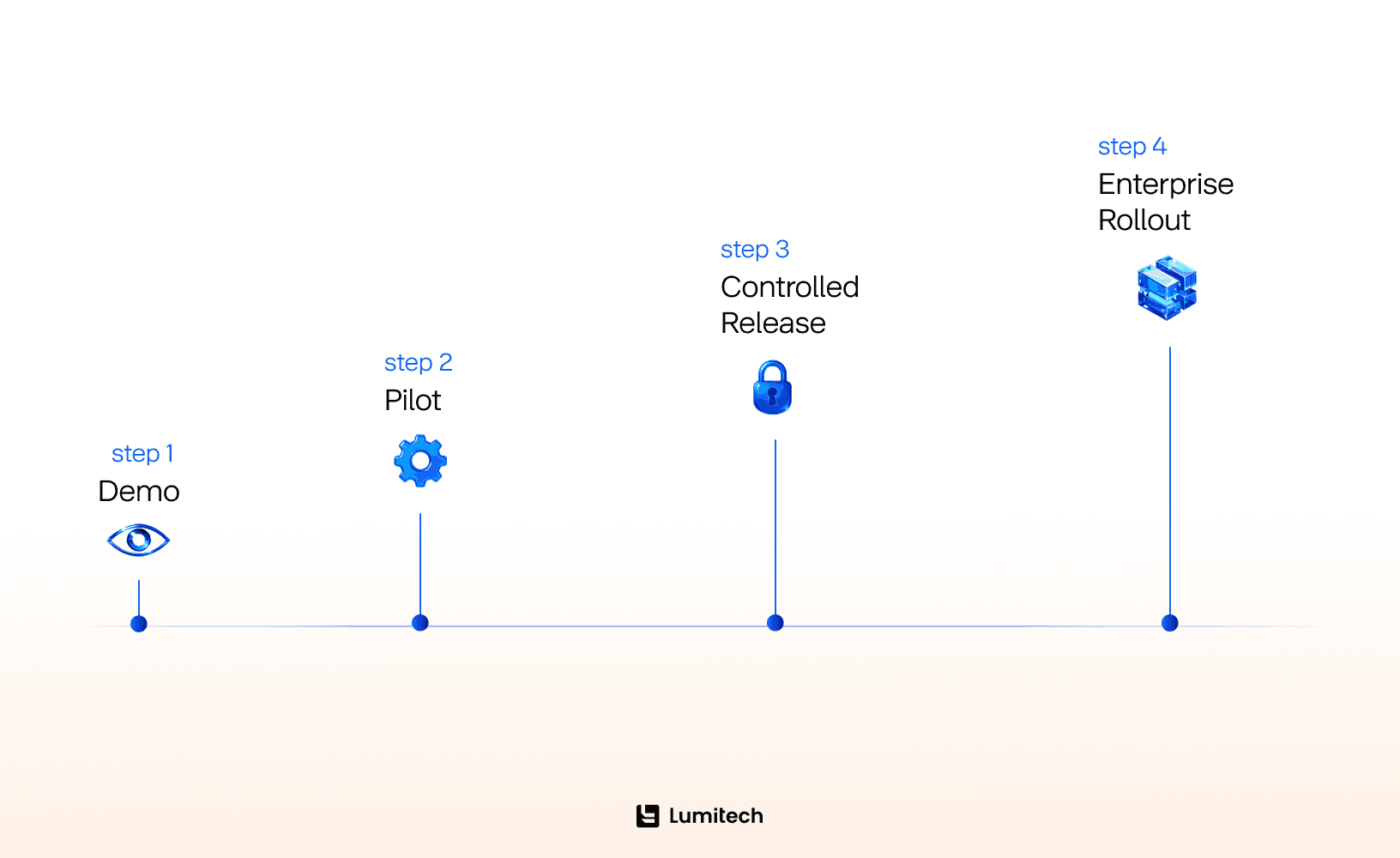
Pick one workflow with measurable volume and clear controls (e.g., complaint categorization + draft responses).
Define success metrics (time saved, quality, error rate, escalations).
Build the architecture once (orchestration, RAG, logging, guardrails).
Harden with testing (including adversarial tests).
Roll out gradually (pilot → limited release → broader adoption).
Turn learnings into reusable components (templates, policies, evaluation harness).
GenAI programs fail when every new use case becomes a bespoke snowflake. They succeed when the platform is reusable, and governance is repeatable.
Conclusion
Generative AI in banking is not “just another chatbot wave.” It’s a shift in what banks can automate: not only decisions and detections, but the language layer that sits between data, policy, and action. That’s why it’s showing up everywhere — from agent assist and internal policy Q&A to document-heavy operations and investigation support. But the same capability that makes GenAI useful (flexible, fluent generation) is also what makes it risky: it can be confidently wrong, it can be manipulated, and it can leak information if you treat it like a generic productivity tool instead of a regulated system component.
The banks that get real value won’t be the ones chasing “AI everywhere.” They’ll be the ones building repeatable, governed patterns: retrieval-first designs that ground answers in approved sources, orchestration layers that enforce policy and route tasks to the right model, and controls that assume adversarial inputs are inevitable. In practice, the competitive advantage is less about model choice and more about execution discipline—evaluation harnesses, red-teaming, audit logs, change control, and human-in-the-loop workflows where the stakes demand it. The goal isn’t to eliminate humans; it’s to move humans up the value chain from writing and searching to reviewing and deciding.
And yes, GenAI can create a meaningful edge: faster service, lower operational cost, better consistency, and quicker access to institutional knowledge. But that edge only compounds if governance scales with adoption. Treat GenAI like a platform capability: start with safe, high-volume workflows, measure outcomes honestly, expand through reusable components, and maintain exit options for models and providers. Do that, and “generative AI for banking” becomes a durable advantage. Skip it, and it becomes the kind of headline nobody wants, especially the compliance team.


