
AI in Wealth Management: Risk Profiling, Suitability, and Model Explainability
In wealth management, “the model decided” is not an answer. AI must explain why a recommendation was made to support decision-making and financial advice relationships truly.
- AI development
January 09, 2026
 AI Overview
Investment management has always relied on a combination of data, expertise, and judgment. The growing complexity of markets, increasing regulatory scrutiny, and demand for personalized investment strategies push firms to rethink how decisions are made. AI is becoming an important part of that shift, helping investment teams analyze information faster, improve research, strengthen risk management, and uncover opportunities that would be difficult to identify manually.

Imagine a client logging into a wealth manager’s app, answering 10-12 standard questions about risk, and receiving a portfolio worth hundreds of thousands of dollars in a minute. Sounds like a convenience. But for business, it’s also a trap: if the risk profile is inaccurate, the recommendation is not suitable, or the model cannot explain its decision, then a beautiful UX quickly turns into regulatory, legal, and reputational risks.
AI in wealth management today is a way to do the following three things better:
more accurately determine the risk and behavioral patterns of clients;
prove suitability at the process and evidence levels;
and explain decisions in a way that clients, compliance, and advisors can trust.
Below is a practical analysis: what AI changes in the field, where logic most often breaks down, which approaches work in the market, and how to build a solid system.
The Moment AI in Wealth Management Has Become Mission-Critical
A few years ago, AI in wealth management was just an additional tool for individual teams. Today, the situation has changed dramatically: a combination of market, technological, and regulatory factors has made the use of AI not just a competitive advantage, but a necessity for wealth management companies and AI-powered patent screening services.
Scaling Wealth Services without Scaling Risk
The wealth management AI industry is rapidly digitizing. The robo-advisory and hybrid-advisory markets are showing steady growth, and financial institutions are serving an increasing number of clients without a proportional increase in their advisory teams.
This puts direct pressure on risk profiling and suitability processes: manual questionnaires and static segments no longer scale. This is where AI becomes a key tool: it enables you to automate analysis, leverage behavioral signals, and support personalization without losing control.
Regulatory Pressure Turning AI into a Control Tool
In parallel with digitalization, regulatory pressure to increase transparency in investment recommendations is expanding. In the US, the SEC is openly focusing on the risks of using predictive analytics and algorithms that can influence investor behavior and create conflicts of interest. In Europe, ESMA is detailing the suitability requirements under MiFID II, emphasizing the evidentiary process and the ability to explain recommendations to the client. Additionally, the European AI Act establishes a framework for AI accountability, requiring financial institutions to embed governance, risk management, and model transparency into their AI-powered management system.
In such an environment, AI ceases to be a regulatory risk itself. When implemented correctly, it becomes a control tool, capable of automatically creating audit trails, capturing model versions, decision logic, and alternative scenarios that are difficult or expensive to maintain manually.
Changing Client Expectations: Speed Is Not Enough Anymore
Client expectations have also evolved. Investors have grown accustomed to personalized fintech software development services, but in wealth management AI, this is no longer enough. Clients want to understand why they are being offered a particular portfolio, what risks it carries, and what will happen in an adverse scenario.
AI enables scalable personalization alongside explainability, provided that models do not operate as black boxes but are integrated into a transparent decision-making process.
Market Leaders Have Already Set the Standard While Integrating AI in Wealth Management
Major players in the industry have already demonstrated this shift in practice. Morgan Stanley is using generative AI to support financial advisors, accelerating access to internal knowledge and materials for client work. JPMorgan is emphasizing the need for explainable and responsible AI as part of its risk governance model, and BlackRock has been developing AI approaches for years within its Aladdin platform for risk analytics and investment workflows.
Here is our own case of how we built smarter investment platform for the client. We developed a robust system from the ground up, combining real-time analytics, portfolio metrics, and deep asset research tools to enable financial professionals to make informed decisions quickly. Our intelligent UI/UX solutions, dashboard-centric architecture, and filters for complex scenarios allow analysts to effectively assess risks, compare strategies, and optimize capital allocation.

In all of these AI in wealth management examples, AI does not replace human judgment, but rather augments it, making processes scalable and controllable.
AI as Infrastructure, not Experimentation
As a result, AI solutions for wealth management enable you to scale your business simultaneously, meet growing regulatory requirements, and deliver on client expectations for transparency and personalization. It is the combination of these factors that has made AI not just useful, but necessary.
From Traditional Advisory to Wealth Management AI Solutions
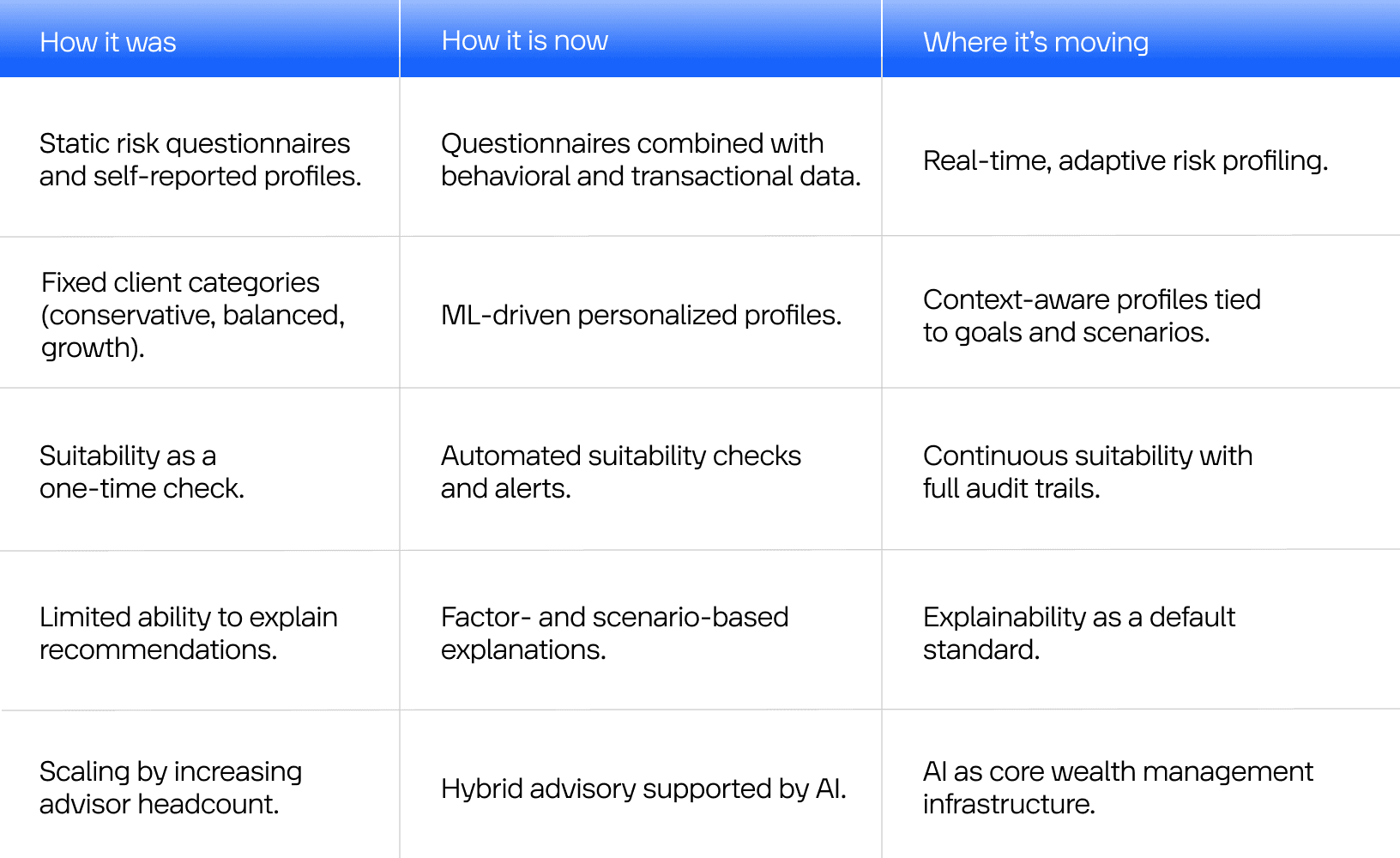
What was previously built around static questionnaires, manual processes, and one-size-fits-all solutions is gradually transforming into personalized, dynamic, and explainable models, enabled by automation in wealth management.
To better understand the scale of the changes, it is worth looking at the evolution of approaches: how it was, how it is now, and where the industry is heading.
Risk Profiling: How AI for Wealth Management Improves Accuracy and Where It Can Go Wrong
Risk profiling is the foundation of the entire wealth management process. Investment recommendations, compliance with suitability requirements, and the level of trust in the personalized financial platform depend on how accurately the client’s risk profile is defined.
Artificial intelligence in wealth management promises to make this stage more accurate and adaptive, but along with new capabilities, it also brings new risks. To understand where AI creates real value, it is worth starting with how the approach to risk definition itself is changing.
From Questionnaires to Real Behavior
Traditional risk profiling in wealth management has relied on questionnaires and client self-declarations for years. The investor answered questions about risk appetite, horizon, and goals, and a profile was developed based on their responses. The problem with this approach is that it largely ignores real-world human behavior.
AI wealth management changes this logic by adding a behavioral layer. Instead of relying solely on the client’s answers, systems begin to analyze how they behave in real-world conditions:
Do they sell assets during volatility?
How often do they change their allocation?
How do they react to negative news and drawdowns?
Are they prone to impulsive decisions?
This allows us to see the gap between declared and actual risk tolerance and adjust the profile before the client later regrets it.
Separating Tolerance, Capacity, and Need
One of the key advantages of AI wealth management is its ability to separate concepts that have traditionally been combined into a single profile. In wealth management practice, it is important to distinguish:
Risk tolerance: psychological readiness for fluctuations.
Risk capacity: financial ability to withstand losses without harming life goals.
Risk need: the level of risk required to achieve a specific goal.
Artificial intelligence for wealth management allows you to work with each dimension separately. Financial capacity can be assessed by analyzing income, liquidity, and liabilities. Tolerance, in turn, is expressed through behavioral patterns and reactions to stressful scenarios. Need – through modeling the achievement of goals over time. When these dimensions are not narrowed down to a single indicator, recommendations become much more accurate and more secure in terms of suitability.
Dynamic Profiling Instead of Static Snapshots
Another fundamental change is the transition from a static profile to a dynamic one. In the classic model, the risk profile is updated once a year or during a formal review. But the client’s financial life changes much faster.
AI-driven wealth management allows you to respond to signals that indicate a change in the risk context, including:
significant changes in income or expenses;
large transactions;
life events that affect financial stability;
atypical portfolio behavior.
As a result, risk profiling ceases to be a snapshot and becomes a continuous process that maintains the relevance of recommendations without constant manual intervention by the advisor.
Where AI Can Introduce New Risks
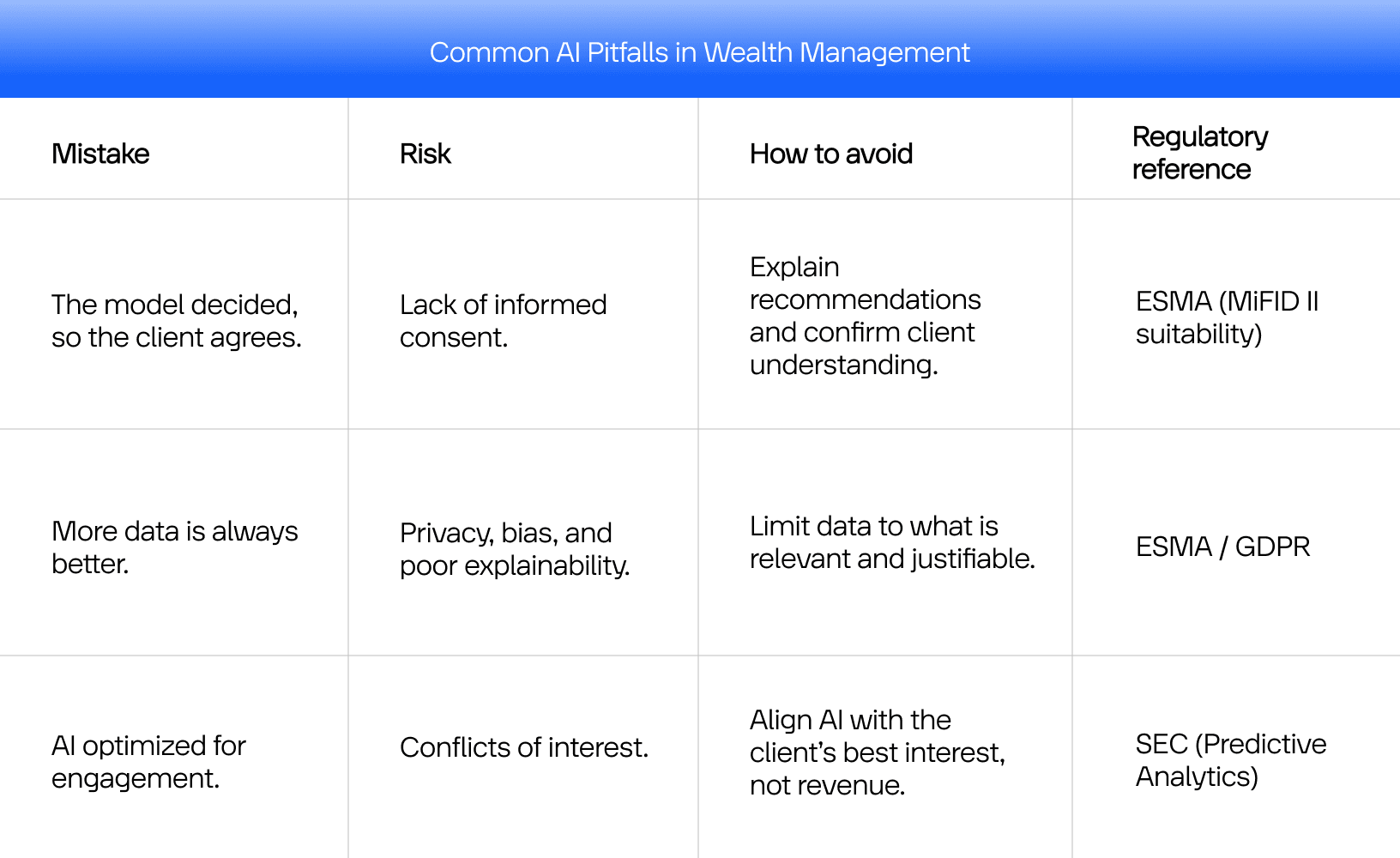
Despite all the advantages, integrating AI in wealth management for risk profiling also creates new risks. The most common mistake is to treat the model’s output as the final truth. Even the most accurate algorithm of machine learning in wealth management is no substitute for the client’s informed consent and explanation of possible consequences.
Another problem is the excessive complexity of the models. The involvement of a large amount of data makes it difficult to:
explain decisions;
control bias;
compliance with regulatory expectations.
There is also the risk of conflicts of interest. If AI for wealth management optimizes not only profile matching but also engagement or profitability for the company, this can lead to recommendations that appear formally acceptable but do not meet the client’s best interests – this is what regulators are increasingly paying attention to today.
Risk Profiling as a Foundation, not a Verdict
In a mature AI architecture, risk profiling ceases to be a rigid shortcut for the client. It serves as a starting point for a dialogue among the system, the advisor, and the client. AI helps to see risk more accurately, but the real value arises when this profile is:
understandable to the client;
explained to the advisor;
verified for compliance.
It is the balance between accuracy, explainability, and human control that makes AI in risk profiling a truly useful tool in wealth management.
AI in Wealth Management: Examples of Suitability That Turn Insights into Defensible Recommendations
While risk profiling answers the question of what level of risk is possible, suitability determines whether a particular recommendation is appropriate and safe for the client. It is at this stage that ethical AI in finance faces the most stringent requirements from regulators and businesses, and it is here that it becomes clear whether it can not only analyze data but also support responsible investment decisions.
Why Suitability Is More Than a Regulatory Requirement
In wealth management, suitability has often been seen as a formal regulatory requirement, something that needs to be checked before a client can receive a recommendation. But in practice, suitability determines whether wealth management AI solutions are truly beneficial and safe for the client. While risk profiling answers the question “what is the risk involved,” suitability answers the much more complex question “is this solution right for this client right now?”
AI for wealth management changes this logic, moving suitability from a one-time check to a systematic process. Instead of manually matching a profile to a product, algorithms can take into account goals, time horizon, financial status, knowledge level, and behavioral signals, and do so consistently for thousands of clients.
From One-Time Checks to Continuous Suitability
In the traditional model, suitability is checked at the start or during periodic profile updates. This approach does not work well in a dynamic environment where both market conditions and client circumstances change.
AI allows suitability to be made a continuous process. The system can monitor whether the portfolio remains suitable in the event of:
significant AI in wealth management market size fluctuations;
changes in the client’s financial situation;
approaching or receding investment goals;
the emergence of new products or restrictions.
As a result, suitability becomes an active mechanism for reducing risks for both the client and the company.
AI Recommendations Still Need Human Judgment
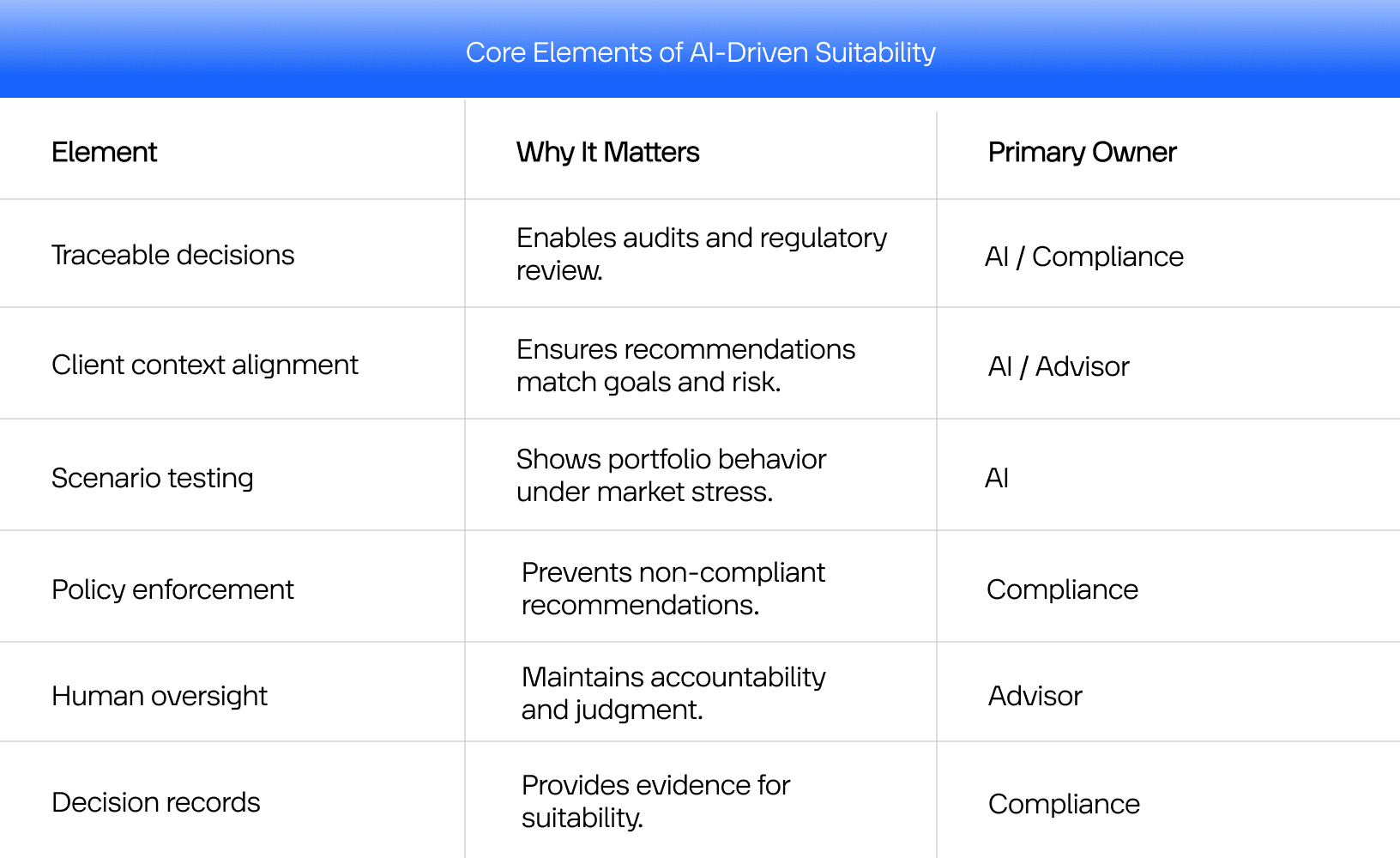
There is an important point about the role of AI in wealth management services: AI can support suitability, but it does not absolve the business of its responsibility. Regulators clearly expect decisions to remain controlled, not fully automated, without the possibility of intervention.
Mature teams build a hybrid approach in which AI:
forms a recommendation and explains its logic;
checks compliance with internal policies and regulatory constraints;
signals potential risks or inconsistencies.
The human retains the right to effective challenge – to question the model’s decision, change it, or reasonably reject it. It is this balance that makes AI acceptable in the regulated wealth management environment.
Reducing Choice Overload Instead of Increasing It
Along with many AI in wealth management benefits, the trap is that it offers too many options. The algorithm can generate dozens of portfolio combinations, but for the client, this often means confusion rather than better choices.
A strong suitability process uses AI to narrow the choices, not expand them. Best practices are to offer:
a limited number of scenarios;
a clear explanation of the trade-offs;
a transparent connection between the choices and the client’s goals.
In this model, AI helps make decisions, rather than shifting responsibility to the user.
Suitability as Evidence, Not Assumption
The key value of AI and wealth management in suitability is the ability to create an evidence base. Instead of assuming “this product is suitable,” the system can record:
What data was used?
What rules were applied?
What alternatives were rejected?
Why was this particular recommendation deemed the most suitable?
This is critical for both internal controls and external audits.
Model Explainability: Building Trust with AI-Driven Wealth Management
All wealth management AI solutions, sooner or later, need explanation. For the client to trust the recommendation, for the advisor to justify it, and for compliance to defend it before the regulator. That is why explainability is not an addition to AI, but the foundation for its safe and long-term use.
Explainability Is About People, Not Models
Explainability in wealth management is often misconstrued as a technical issue of explaining how the model works. In reality, it is primarily a question of trust. The client, the advisor, and compliance have different needs, but they all want to understand why a particular decision was made.
In this context, explainability is not about internal math, but about the ability to translate complex logic into a comprehensible narrative that can be tested and replicated.
Three Layers of Explainability
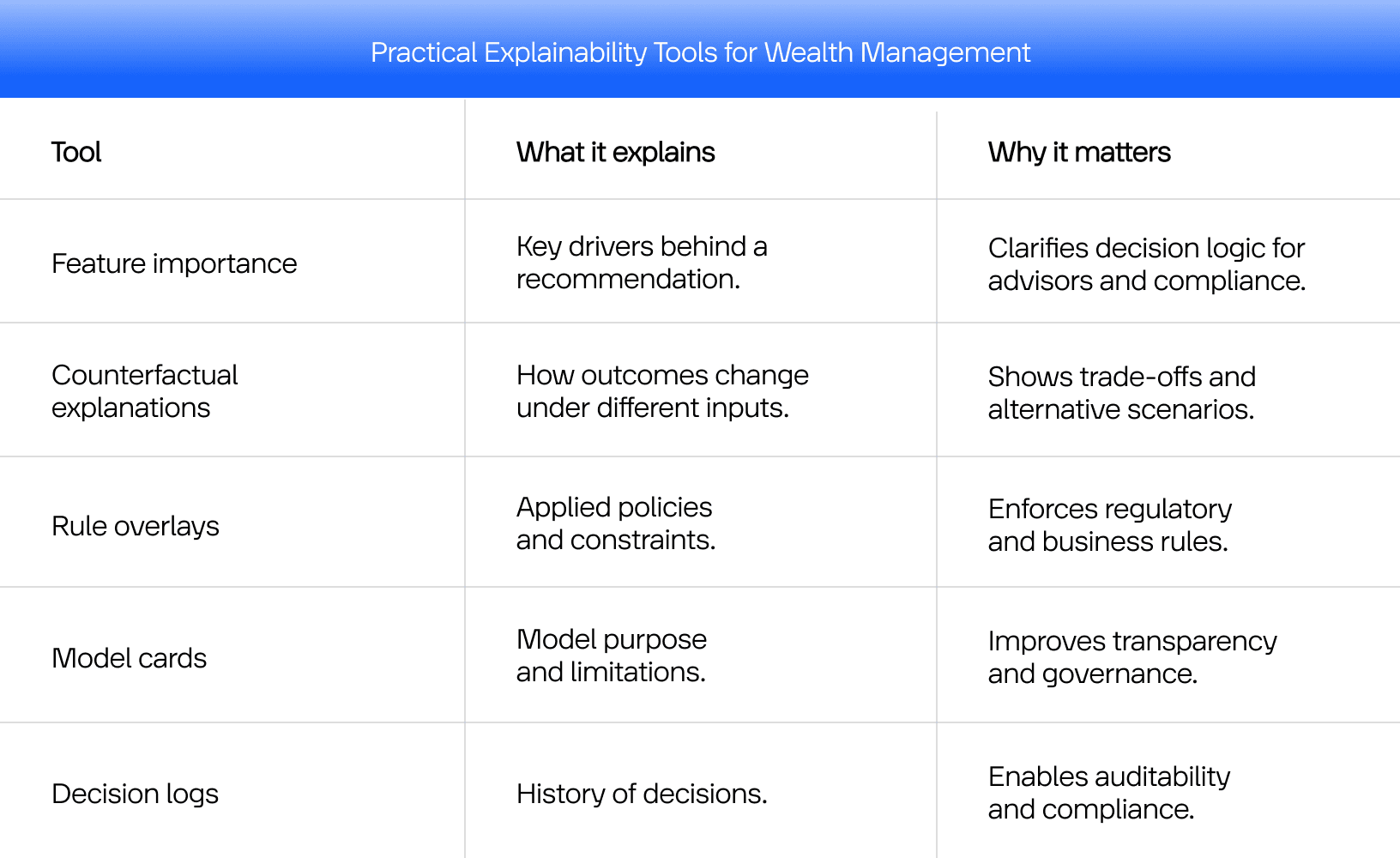
In mature AI systems, explanations are built on several levels. For the client, it is a simple and understandable story: how their goals, horizon, and risk influenced the recommendation. For the advisor, it involves more detailed arguments, key factors, and scenarios. For compliance and audit purposes, the decision is fully technically reproducible.
In practice, this means that the system should be able to:
show the key factors that influenced the decision;
explain why alternative options were not chosen;
demonstrate how the outcome would have changed under different conditions.
Explainability as a Compliance and Governance Tool
With increasing regulatory attention, explainability is becoming not only a UX element but also part of model risk governance. Models must be documented, validated, and controlled. This includes versioning, drift control, regular quality checks, and commit changes.
AI and wealth management without explainability quickly become black boxes that are difficult to defend against regulators. Instead, explainable models allow us to move the discussion from the level of “we trust the algorithm” to the level of “here is the evidence why the decision was correct.”
Using GenAI for Explanations, Carefully
Generative AI opens up new possibilities for explaining complex decisions in understandable language. But in wealth management, this tool requires special caution. The risk of hallucinations, inaccurate formulations, or incorrect promises can have serious consequences.
Therefore, a practical approach for GenAI is not to invent explanations from scratch, but to translate the already-formed, proven logic of the decision into human language. Under such conditions, explainability becomes scalable but controlled.
Explainability as the Foundation of Long-Term Trust
Ultimately, explainability is what transforms AI from an optimization tool to a trust tool. In wealth management, without this element, even the most accurate model risks being rejected by clients, advisors, or regulators.
When explanations are integrated into the product and process, AI becomes not a replacement for human judgment, but a reliable amplifier of it.
Practical Architecture: the Use of AI in Wealth Management for Risk Profiling, Suitability & Explainability
Below is a more technical, yet still practical, description of an architecture that most often works in wealth management with dedicated development team services. The idea is simple: instead of building one large “all-deciding” model, the system is designed as a set of clearly defined layers with controlled inputs and outputs, and evidence built in by design.
Wealth Management AI Starts with Data & Identity Layer
The architecture starts with you building a single customer truth layer (ID + profile) and data access rules.
Sources: KYC automation solutions, AML profile, financial questionnaires, transactions, portfolio positions, CRM, digital behavior (clicks, views, reaction to volatility), market data.
Entity resolution: reconciling customer identities across systems (Customer 360) to avoid duplication.
Data contracts: clear field schemes, quality/freshness SLAs, control of omissions and anomalies (critical for audit).
Privacy & minimization: the principle of “minimum sufficient” data, PII classification, and role-based access.
Technically: CDC pipelines, event streaming (where necessary), data quality checks, and a feature store for feature reuse.
Risk Profiling and Feature Engineering
Instead of a single risk score, it is better to have several components, each explained and verified with AI in financial services.
Risk capacity model: liquidity, cash-flow stability, commitments, horizons (often it is a rule + simple models).
Risk tolerance model: questionnaire + behavioral indicators (reactions to drawdowns, frequency of changes, tendency to panic).
Risk need estimator: goal-based, scenario modeling of the desired return/risk.
Technically: tabular models (GBM/XGBoost/logistic regression), probability calibration, regular backtests, and drift monitoring.
Decisioning Layer: Models, Rules, and Human Oversight
This is the heart of the data science development solutions. Here, you combine model predictions with strict policies and human control.
Rules engine (policy guardrails): what is prohibited for specific profiles, which products are allowed/not allowed, concentration limits, restrictions by risk category.
Suitability checks: compliance with the goal, horizon, risk, knowledge/experience, and financial condition.
Exceptions workflow: if the advisor/system deviates from the recommendation, the reason, who approved it, and the evidence are recorded.
Technically: decision tables, rule versioning, deterministic outcomes (for reproducibility), and approval flows.
Explainability Layer for Multiple Stakeholders
A separate layer that produces explanations based on structured rationale rather than ad-hoc narratives.
Client-level explanations: simple reasons + risks + “what if…” scenario.
Advisor-level explanations: top factors, alternatives, and sensitivity.
Compliance-level explanations: model version, feature importance, which rules are applied, and why alternatives are rejected.
Technically: feature attribution, counterfactuals, rule overlays, model cards, and a decision rationale schema, which is the same for all channels.
Evidence, Auditability, Traceability, and Other AI in Wealth Management Benefits
If you don't have automatic logging, suitability will be manually appended, which is a weak point.
Decision logs: each recommendation = record (inputs, outputs, rules triggered, model version).
Immutable audit trail: immutable logs for investigations and regulatory requests.
Reproducibility: ability to reproduce a recommendation at a point in time (data + model + rules).
Technically: event sourcing / append-only storage, time-stamped versioning, retention policies.
Monitoring and Model Risk Management
The system should look at itself and signal when something goes wrong.
Performance monitoring: forecast stability, calibration, and errors.
Data drift/concept drift: changing distributions of features and customer behavior.
Bias checks: systematic biases in groups.
Outcome monitoring: complaints, rejections, “panic sells”, churn after recommendations.
Technically: alerts, dashboards, regular model reviews, and release control.
Secure Integration into Product Workflows: Use of AI in Wealth Management
The last step is to make it work in real UX.
API-first inference: risk profiling and suitability as versioned AI development services.
Human-in-the-loop UI: the advisor can see the rationale and challenge/change it.
Access control: who sees what (client vs advisor vs compliance).
LLM usage (optional): only as a “top” for formulating explanations based on structured data, with guardrails.
Summary: The Role of AI in Wealth Management Services
The use of AI in wealth management enables more accurate risk identification, turns suitability into a continuous, evidence-based process, and makes investment decisions understandable to clients, advisors, and regulators.
At the same time, AI requires a mature approach: transparent models, clear rules, human control, and an audit trail by design. It is this architecture that allows businesses to scale without losing trust and to meet increasingly stringent regulatory requirements.
In the future, wealth platforms that use AI not to replace people but to strengthen responsible, explainable, and long-term decisions will make more profits.


