
Ethical AI in Finance: Reducing Risk, Building Trust, Staying Compliant
If you’re leading a bank, insurer, or fintech right now, you’re being pulled in two directions at once. On one side, aggressive pressure to “do more with AI”: faster credit decisions, better risk models, hyper-personalized offers, smarter fraud detection.
- AI Development
December 22, 2025
 AI Overview
Ethical AI in finance means governing credit, fraud, and trading models under fairness, transparency, accountability, and privacy principles, since unmonitored systems can trigger discriminatory lending or regulatory violations. Core practices include risk-tiered use-case assessment, independent fairness validation, continuous drift monitoring, and vendor AI due diligence. The EU AI Act classifies credit scoring and risk models as high-risk, requiring mandatory human oversight and audits.


On the other hand, regulators, auditors, and your own risk committee quietly ask: “Are we sure this thing isn’t discriminating, hallucinating, or about to trigger a front-page scandal?”
The dilemma is pretty simple: AI in financial services is already here, but unethical or poorly governed AI is now a hard business risk, not just a PR problem. Think unfair credit denials, opaque robo-advisers, discriminatory underwriting, precarious model risk, and the joy of explaining all of that to regulators after the fact.
The good news is that “ethical AI” (or “responsible AI,” “trustworthy AI,” pick your flavor) isn’t just a defensive shield. Done right, it becomes a strategic advantage: smoother regulatory relationships, more resilient models, fewer blow-ups, and higher customer trust in a market where trust is literally your product.
Why Ethical AI in Finance Hits Differently
AI is everywhere, but in finance, it’s high-stakes by design. You’re not just ranking search results or recommending movies; you’re deciding who gets a mortgage, who’s flagged as suspicious, who’s offered relief during hardship, and how billions move through markets.
Financial institutions are already deploying AI and machine learning across:
Credit scoring and underwriting
Fraud detection and AML
Trading and portfolio optimization
Claims processing and pricing
Customer onboarding, KYC automation solutions, and support.
The Financial Stability Board (FSB) has highlighted both the benefits and system-level risks of AI/ML in financial services — from better risk detection to new forms of model risk and pro-cyclical feedback loops that can threaten financial stability. The BIS and central banks have warned that poorly governed AI can amplify operational risk, data privacy breaches, and reputational damage, especially when models are opaque or trained on biased data.
You also operate under a dense stack of obligations: consumer protection, fair lending/anti-discrimination law, market integrity rules, data protection (GDPR and friends), and now AI-specific regulation like the EU AI Act. That means ethical AI fintech failures can become regulatory violations very quickly.
So yes, AI is powerful. But in this sector, “move fast and break things” translates to “move fast and break customers, markets, and your banking license.” Not recommended.
The Standards and Regulatory Challenges of Ethical AI in Finance: What’s Actually Out There?
If you feel like the AI regulatory landscape is changing every week, you’re not wrong. But some clear anchors have emerged.
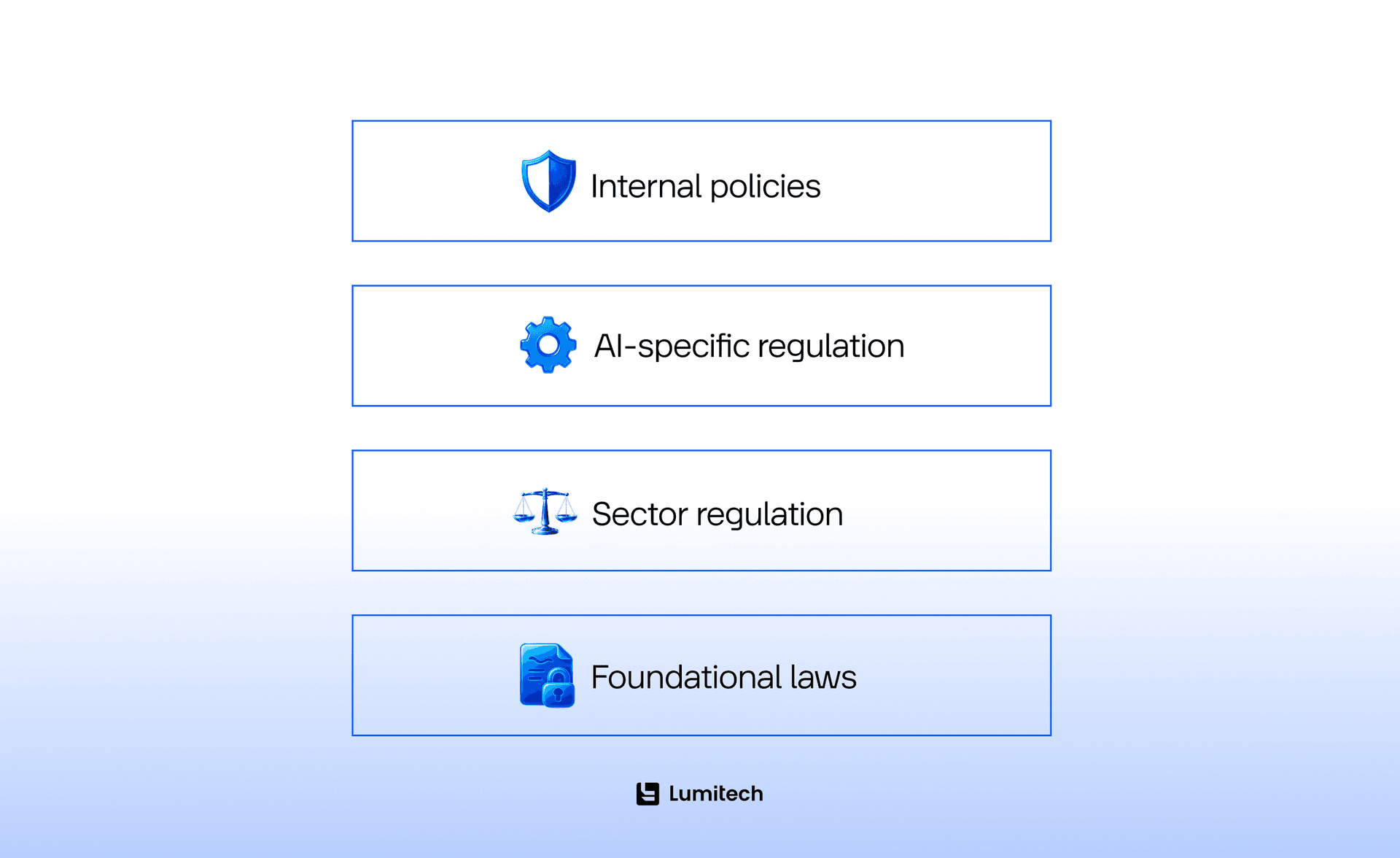
The EU AI Act and financial services
The EU AI Act (formally adopted in 2024 and now in implementation) is the first broad, horizontal AI law, and it hits finance squarely. It classifies AI systems used for creditworthiness assessments, risk scoring, and access to essential services as “high-risk”. It imposes strict requirements around risk management, data governance, transparency, human oversight, robustness, and post-market monitoring.
Supervisors like EIOPA have already outlined how the AI Act will interact with existing financial regulation (Solvency II, IDD, etc.), stressing that insurers and other financial institutions will need to integrate ethical AI regulation in finance into their existing risk and compliance frameworks.
If you think “we’re not in the EU, we’re safe,” remember: just like GDPR, the AI Act can bite non-EU firms offering services to EU customers or operating models in the EU.
Existing financial regulation still applies
Most supervisors are very clear about one thing: you may be using new tech, but the old laws still apply.
The UK’s Financial Conduct Authority (FCA) has repeatedly said there’s no special “AI exemption”; existing rules on consumer protection, conduct, discrimination, outsourcing, and operational resilience already cover AI use. In its 2024 AI Update and its live “AI and the FCA” guidance page, the FCA stresses a technology-agnostic, principles-based approach: they care about consumer and market outcomes, not the specific algorithms you use.
Internationally, the Basel Committee and FSB have published work on AI and ML in banking, highlighting the need for robust model governance, clear accountability, and an understanding of AI model behavior for both micro-prudential and macro-stability reasons.
Translation: when it comes to ethical risks of AI in finance, you can’t hide behind “the model did it.” Regulators never gave that excuse to traders; they’re not giving it to your data science team either.
Global ethical AI fintech frameworks
On top of sector-specific rules, there’s a layer of cross-industry AI principles that regulators increasingly reference:
OECD AI Principles – the first intergovernmental AI standard, emphasizing human-centered, fair, transparent, and accountable AI.
EU High-Level Expert Group’s Ethics Guidelines for Trustworthy AI – seven requirements, including human agency, technical robustness, privacy and data governance, transparency, fairness, and accountability, widely adopted as a reference inside and outside Europe.
Various national guidelines and legal analyses on fairness and trustworthiness, which explore how legal concepts like non-discrimination map to algorithmic systems.
For financial leaders, the key point is: the direction of travel is consistent. Whatever jurisdiction you’re in, you’re heading toward more formal expectations around fairness, explainability, governance, and data protection for AI. Your AI inventory shouldn’t just list credit and fraud engines; it should include everything from marketing optimizers to AI-powered patent screening tools, because the same questions about data sources, bias, and accountability apply even when the outputs are “just for internal use.”
Feel overwhelmed with AI regulations and compliances? We can consult you on anything you need to know.

Core Principles of Ethical AI in Finance
Embedding ethical AI starts with adopting and enforcing four core, interconnected principles that guide the entire platform development process.

1. Fairness and non-discrimination
Fairness for AI ethics in fintech isn’t just about “treat everyone the same.” In finance, it’s about complying with anti-discrimination law, fair lending rules, and broader obligations not to exclude or disadvantage protected groups.
The problem: historical financial data is full of embedded bias. Zip codes can proxy for race. Employment history can reflect gender disparities. Income patterns reflect structural inequality. If you train a model naively, it can learn to replicate those patterns — sometimes more efficiently than your legacy scorecard.
Legal and technical scholarship on algorithmic fairness points out that legal definitions of discrimination don’t map neatly onto mathematical fairness metrics, which means you can’t just pick a metric and declare yourself “fair.” To address the challenges of ethical AI in finance, you need a process of data governance in banking that includes legal, risk, and ethics expertise, not just data scientists.
2. Transparency and explainability
In high-stakes financial decisions, “computer says no” is not acceptable. Customers, regulators, and internal risk committees all need some level of explanation:
Why was this loan denied?
Which factors matter most in this pricing decision?
How does this fraud model decide to block a transaction?
The same tension appears in fraud and digital identity verification: a model tuned too aggressively for risk may flag the wrong people, causing account freezes, onboarding denials, or repeated friction that hits certain groups disproportionately.
The FSB, the Basel Committee, and the EU AI Act all emphasize the importance of explainability and “understandable outcomes” for ethical AI in finance. The point is not that every model must be trivially interpretable, but that you can articulate and justify your model’s behavior to non-technical stakeholders — and to the customer, when required.
3. Accountability and governance
Ethical AI in fintech collapses without clear ownership. Someone must be accountable for:
Approving an AI use case (including its ethical and legal risks)
Ensuring proper validation and monitoring
Responding when something goes wrong
Supervisors and policy papers stress the need for robust model risk management, clear roles and responsibilities, and governance structures that cover AI/ML across the whole institution.
If your org chart says “The model owner is: ‘The AI Team’,” you have a problem.
4. Privacy and data protection
Financial institutions sit on sensitive, high-value data. Using it for AI amplifies both the opportunity and the privacy risk.
Ethical AI in finance platforms needs strong data governance: lawful basis and consent, data minimization, clear purposes, retention limits, robust access controls, pseudonymization/ anonymization where possible, and privacy-by-design at the system level. Trustworthy AI frameworks treat data governance as a central pillar alongside fairness and transparency, not a separate afterthought.
Combine GDPR, banking secrecy, and reputational risk, and the message is simple: if you can’t secure it and justify its use, don’t feed it to an AI model.
How to Implement Ethical AI in Finance: Risks in Core Functions
The biggest ethical landmines in finance reside in the areas that determine access to capital and financial security. Uncontrolled AI in these domains can perpetuate systemic disadvantage.
Credit Scoring and Lending
Risk: Disparate Impact. AI models trained on historical loan data often learn to associate non-financial factors (e.g., educational attainment, neighborhood demographics, browser type, or even certain words used in application essays) as proxies for creditworthiness. This leads to models that appear unbiased on paper but produce disparate denial rates for protected classes.
Mitigation: Best practices for ethical AI in finance require testing models across dozens of subgroups, not just two or three. Furthermore, creditworthiness models should adhere strictly to using only demonstrably relevant financial factors and continuously audit for newly discovered proxy variables.
Underwriting and Insurance Pricing
Risk: Exclusion and Redlining 2.0. AI used to price insurance premiums can identify correlations that are statistically valid but ethically unacceptable. For example, if a model finds that customers who purchase a specific type of coffee are statistically less profitable, using this feature in pricing would lead to unfair exclusion based on lifestyle rather than risk.
Mitigation: To apply ethical artificial intelligence in finance, implement feature governance. Veto features that predict protected attributes, even if they technically improve accuracy. The human must overrule the machine when statistical efficiency conflicts with societal equity.
Algorithmic Trading and Investment
Risk: Market Instability and Unfair Advantage. AI can amplify market movements rapidly, leading to flash crashes or sudden, massive volatility. Furthermore, the lack of transparency in proprietary trading algorithms can create an uneven playing field where institutional clients with superior AI gain an insurmountable, unregulated edge over retail investors.
Mitigation: Strict controls on algorithmic "off-switches," real-time monitoring for destabilizing behavior, and enhanced reporting on the impact of large algorithmic trades on market fairness.
Best Practices for Ethical AI in Finance
Let’s move from “what could go wrong” to “what good actually looks like.” A workable, responsible AI program in finance spans the entire AI lifecycle.
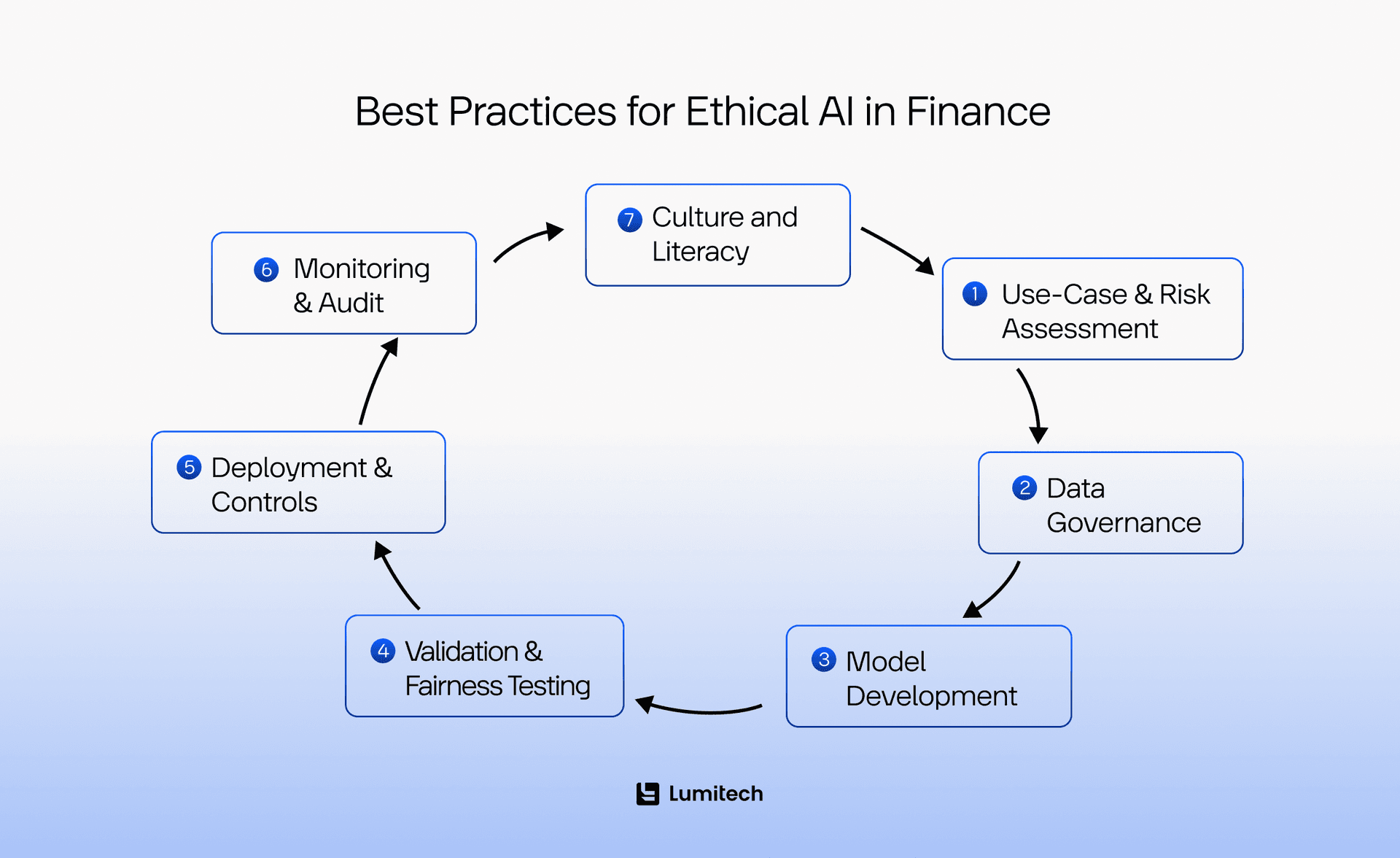
1. Start with use-case selection and risk assessment
Before anyone touches a GPU, you should be clear on:
What decision the model will influence (e.g., credit limit, fraud flag, claims triage)
The harm if it’s wrong or biased (e.g., unfair denial, delayed payout, false fraud blocks)
The applicable regulations and internal policies
Whether you can reasonably explain and monitor the model over time.
Policy papers from central banks and supervisors recommend risk-based AI governance: higher-risk use cases (like credit and underwriting) should face stricter requirements and more intensive oversight than low-impact automation.
If you don’t have a formal AI risk tiering framework yet, that’s step one.
2. Build on solid data governance
Ethical AI in fintech is only as good as its data plumbing. Concretely, that means:
Clear data lineage and documentation – where data comes from, how it’s transformed
Data quality controls – outlier checks, missing values, consistency validation
Privacy controls – minimization, appropriate legal bases, robust access controls
Representativeness checks – ensuring your training data isn’t missing key groups
Central bank and supervisory papers on AI in finance repeatedly highlight data governance as foundational to safe AI adoption; trustworthiness frameworks do the same.
Short version: you can’t debug model fairness if your data lake is a mystery soup.
3. Bake ethics into model development
Ethical artificial intelligence in fintech isn’t something you tape on at the end with a “bias scan.” It should be woven into model design:
Define fairness objectives and constraints upfront (and involve legal/ethics teams).
Select model families that balance performance with explainability where required.
Use fairness-aware training techniques and re-balancing where appropriate.
Document design decisions, trade-offs, and known limitations (e.g., with “model cards”).
Recent work on evaluating trustworthy AI offers practical metrics and methodologies across fairness, transparency, robustness, and safety; financial institutions can adapt these to their own model risk standards.
4. Strengthen independent validation and explainability
Ethical AI fintech model validation function should be more than a box-tick. For high-impact financial models, it should:
Rebuild or independently test the model using separate data
Evaluate performance across subgroups (protected characteristics where lawful, plus reasonable proxies where necessary)
Test stability under stress scenarios (e.g., economic downturns)
Assess explainability for different audiences: customer-facing, internal management, and regulators.
Explainability isn’t just a model documentation problem; it’s also a UX design for finance industry challenge – you need to surface the right factors, in the right language, at the right moment, so customers actually understand why a decision was made.
5. Deploy with controls and monitor continuously
Once a model is in production, you’re not done. You’re in a long-term relationship.
Good practice for ethical financial technology includes:
Clear decision thresholds and override rules
Monitoring of performance, input data distribution, and key fairness indicators over time
Alerts for anomalous behavior or drift
Periodic re-training and re-validation, with documented approvals
The same mindset that powers predictive UX research – watching how people actually interact over time – should apply to AI models: you monitor outcomes, spot where users are confused or harmed, and iteratively improve both the model and the experience.
The FSB’s and Bundesbank’s work on AI/ML in finance emphasizes that model risk in AI is dynamic; monitoring needs to be continuous, not annual. If you only look at fairness once a year, your model can misbehave for eleven months without anyone noticing.
6. Manage third-party and SaaS AI responsibly
Many financial institutions use external AI services — from fraud detection to alternative credit scoring. But leveraging AI in SaaS doesn’t outsource your accountability.
Due diligence should cover:
Training data sources and governance practices
Fairness and bias testing methods
Explainability capabilities
Security and privacy controls
Incident management and audit support
Recent analyses of AI governance frameworks stress that companies remain responsible for the vendor AI they integrate, especially when it affects customers or core risk decisions.
If a vendor can’t answer detailed questions about fairness, privacy, and monitoring, they’re not ready for your production stack.
7. Invest in culture and literacy
Finally, none of this works if your people treat AI as a magical, unquestionable truth. Ethical AI in finance is a team sport:
Boards and the C-suite need a basic understanding of AI risks and opportunities.
Risk, compliance, and audit teams need enough literacy to challenge models effectively.
Data scientists and engineers need incentives to surface concerns, not hide them.
Supervisors like the FCA talk about “shared responsibility” for AI outcomes: leadership, risk, technology, and frontline teams all play a part.
If your org treats explainability and fairness as annoying hurdles rather than critical quality attributes, no framework will save you.
Turning Ethical AI in Finance platforms into a Strategic Advantage
So far, this might sound like a lot of cost and constraint. But the institutions that lean into ethical AI early can actually gain ground. Firms that treat generative AI in wealth management as a regulated advice channel – not just a content toy – can differentiate on clarity and suitability, offering clients rich explanations that are compliant, consistent, and clearly aligned with their risk profile.
Better regulator relationships and faster innovation for ethical AI in finance platforms
Regulators are experimenting too. The FCA’s AI “supercharged sandbox” with Nvidia, for example, gives firms a safe environment to test AI systems under supervisory oversight, combining technical support with regulatory feedback.
Firms that show up with strong governance, clear documentation, and serious monitoring are more likely to:
Get a comfortable sign-off for new AI uses faster
Participate in sandboxes and pilots that shape future rules
Avoid high-profile enforcement actions that make everyone nervous
In a world where regulation for ethical AI for financial institutions is evolving, being seen as a trusted partner rather than a reluctant subject is a real strategic asset.
Stronger customer trust and brand differentiation
Consumers may not understand gradient boosting vs. neural nets, but they understand fairness, clarity, and “do you treat me with respect when something goes wrong?”
Responsible AI lets you:
Provide clearer explanations for credit and pricing decisions
Detect and fix unfair patterns before customers notice them
Offer products designed explicitly around inclusion and transparency
In an era of ESG investing and reputational risk, being able to credibly say “we take ethical AI seriously, and here’s how” can attract both customers and capital. As you design AI-driven journeys, you’ll need to balance UX personalization and responsible targeting with clear explanations and meaningful consent, so customers feel helped rather than manipulated.
More resilient models of ethical AI in finance and fewer surprises
Responsible AI isn’t just about being nice; it’s also about better risk management. Models that are monitored for drift, fairness, and robustness:
Perform more consistently across economic cycles
Are less likely to blow up under tail events
Are easier to debug when something does go wrong.
As you invest in AI governance dashboards and compliance tooling, you can borrow patterns from UI and UX branding in legaltech, where interfaces are designed to make complex rules legible and to signal trust and authority to professional users.
Research on AI ethics in fintech shows that fairness, robustness, and transparency are deeply connected to reliability and security; you rarely get one without the others.
So yes, responsible AI helps you avoid fines and scandals. But it also makes your work better. If you want to know more about how to implement ethical AI in finance, Lumitech is here to help.


