
Machine Learning in Banking: How Banks Use ML (and Where It Can Fail)
The local bank branch, once a place of hushed whispers, mahogany desks, and the rhythmic thumping of rubber stamps, is officially a relic. Today, the “heart” of a bank isn’t a vault; it’s a high-density server rack crunching through petabytes of data.
- FinTech & Finance
- AI Development
January 28, 2026
 AI Overview
Machine learning has become a core technology in modern banking, helping financial institutions improve fraud detection, automate decision-making, strengthen risk management, and deliver more personalized customer experiences. By analyzing large volumes of data in real time, ML enables banks to identify patterns, predict outcomes, and respond faster to changing market conditions. Thus, understanding both the opportunities and limitations of machine learning is essential for building secure, scalable, and compliant banking operations.


Welcome to the era of Machine Learning in banking. We are no longer just talking about “digitizing” paper; we are talking about an industry-wide brain transplant. As of 2026, the global banking sector has moved past the “experimentation” phase. Machine learning is now the load-bearing wall of modern finance, supporting everything from the split-second approval of your morning latte to the complex risk modeling that keeps the global economy from doing its best 2008 impression.
This article is a practical, occasionally sharp look at how banks are adopting machine learning, what problems it actually solves (beyond impressing the board), and where it can go wrong — technically, operationally, and ethically. Keep in mind that none of this works without solid engineering — software development for fintech is what turns a model into a secure, monitored product instead of a demo.
Why Machine Learning is Showing Up in Every Banking Strategy Deck
A bank is basically a machine that:
prices risk,
moves money, and
proves to regulators that it did (1) and (2) responsibly.
Those three jobs produce oceans of data: transactions, credit histories, device fingerprints, call center transcripts, KYC documents, market feeds, complaints, collections notes, and more. Machine learning for banks is the tool set that turns those oceans into predictions, classifications, rankings, and anomalies — often better than static rules or simple statistical models, especially when patterns shift quickly.
That matters more than ever because:
Fraud and scams are scaling (criminals have automation too). For example, UK Finance reported £1.17 billion lost to fraud in 2023 in the UK market alone.
Cyber-enabled crime losses keep rising; the FBI’s IC3 reported losses exceeding $16 billion in its 2024 report (released April 23, 2025).
Regulators are tightening expectations for model risk, transparency, and operational resilience — especially for “black box” credit decisions.
Machine learning in banking and finance can now be deployed across millions of customers and billions of transactions with governance strong enough to survive a regulator’s curiosity. So banks aren’t investing in ML because it’s trendy. They’re investing because the math supports it, and because the threat landscape and regulatory bar are moving, whether banks like it or not.
Use Cases of Machine Learning in Banking
In the current landscape, machine learning isn't just a “feature”; it’s the engine. Banks are using various flavors of ML — supervised, unsupervised, and the increasingly popular Agentic AI — to handle tasks that were previously too complex or too boring for humans.
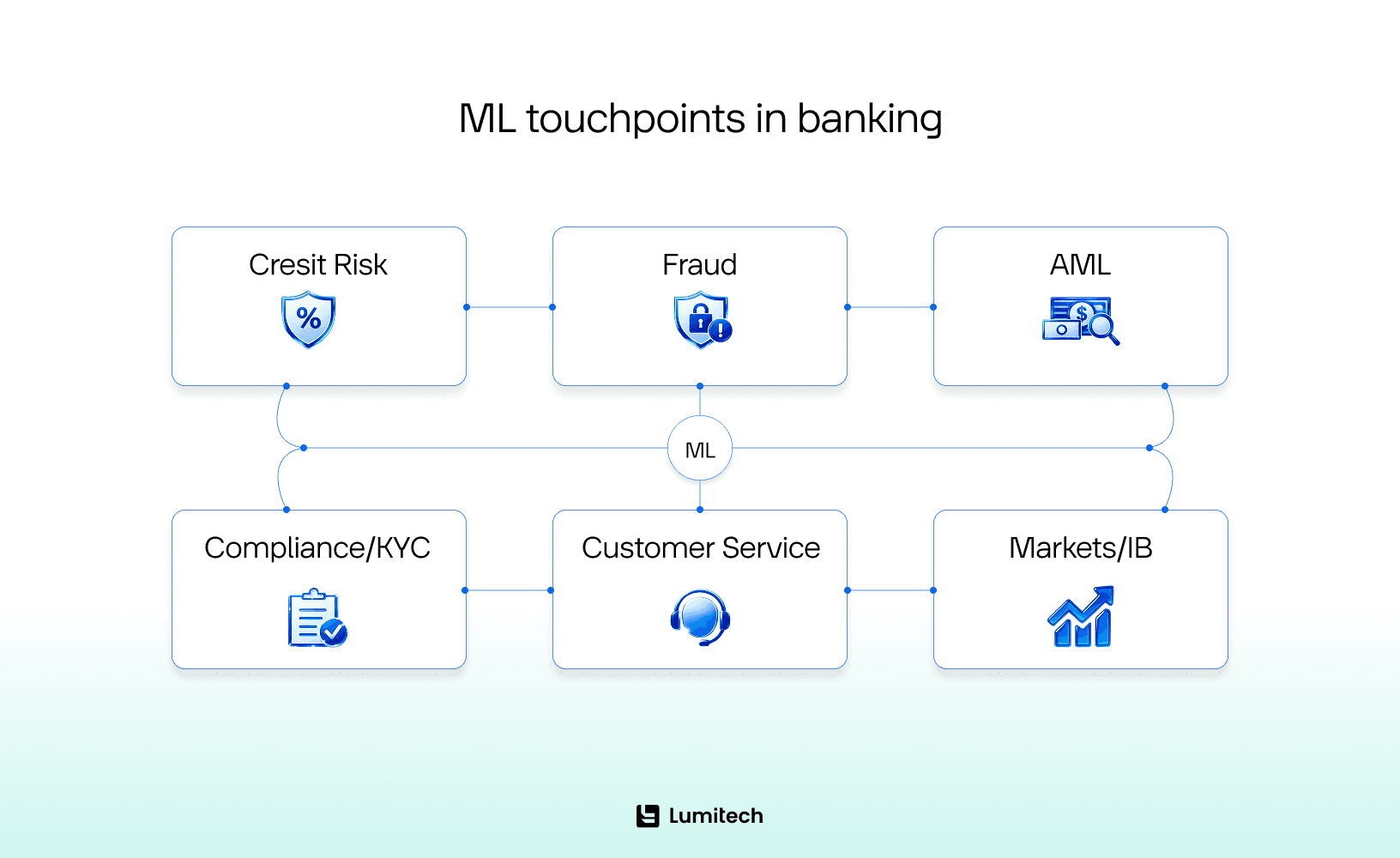
1) Credit risk: scoring, underwriting, and portfolio monitoring
Credit is the classic ML playground: predict the probability of default, loss given default, early warning signals, and collections strategies.
Here are some machine learning in banking examples of where it improves outcomes:
Thin-file customers: alternative data and behavior signals can help (carefully — more on that later).
Dynamic risk: monitoring risk after origination using early warning indicators rather than “set it and forget it.”
Segmented strategies: different policies and pricing for different risk bands, without manually writing 200 rules.
But credit is also where ML gets the most scrutiny. In the EU, the use of AI to evaluate creditworthiness or establish credit scores is treated as “high-risk” under the AI Act framework, with additional safeguards.
In the US, lenders using complex models still must provide specific reasons for adverse actions (credit denials) — the “the algorithm did it” defense doesn’t count.
2) Fraud detection: real-time defense at transaction speed
As criminals scale scams with automation, AI and machine learning in banking are being used not just to detect fraud, but to detect manipulation, like unusual recipient behavior or “this transfer feels coerced” patterns. Fraud models typically score transactions in milliseconds, using features like:
transaction amount patterns
merchant and geography history
device and network signals
velocity patterns (how fast behavior changes)
peer-group comparisons.
A rules engine is like a bouncer checking IDs. ML is more like a bouncer who also watches body language, listens for nervous laughter, and remembers you tried to sneak in last week.
This matters because scams increasingly use AI to scale persuasion and impersonation. Reporting on UK fraud trends has highlighted how criminals are exploiting AI (including deepfakes) while banks deploy AI to counter it.
3) AML and financial crime: alert triage and investigation support
Anti-money laundering (AML) is notorious for false positives. Machine learning for banks is used to:
prioritize alerts (risk-based ranking)
detect typologies that rules miss
reduce noise by learning from investigator outcomes
surface entity networks (graphs) for hidden connections.
Banks don’t get points for “finding everything.” They get punished for missing what matters and for wasting everyone’s time with nonsense alerts. ML helps rebalance that equation — if it’s well-governed and validated.
4) Compliance automation: KYC, monitoring, and documentation
Compliance teams are often buried under manual work: customer onboarding checks, sanctions screening, adverse media, transaction monitoring follow-ups, and regulatory reporting. For internal tools — case routing, review queues, approval flows — low-code development services can speed delivery without waiting for a full engineering sprint.
Some of the machine learning use cases in banking can solve the following tasks:
document understanding (classifying forms, extracting fields)
name matching improvements (beyond naive fuzzy match)
case routing (send the right cases to the right analysts)
policy controls (flagging anomalies and exceptions).
Regulators are also adopting analytics for supervision. The ECB has discussed investing in supervisory technology to handle expanding data and tasks.
5) Customer experience: personalization, next-best-action, and service
Machine learning in banking and finance is used for:
churn prediction
product recommendations
call center routing
complaint prediction and prevention
chatbots and agent-assist (especially with generative AI, but that’s another rabbit hole).
The Bank of England and FCA have tracked AI/ML adoption in UK financial services, reflecting how widespread these use cases of machine learning in banking have become.
ML might power the decisioning, but customers experience it through interfaces. Reliable web development services are how those insights become usable, not frustrating.
6) Treasury and markets: forecasting and anomaly detection
In trading and treasury, ML can help with:
liquidity forecasting
operational anomalies in payment flows
market microstructure signals (where allowed)
risk factor modeling.
However, “ML alpha” is fragile. Markets change regimes faster than your model governance committee schedules meetings.
In markets and advisory contexts, the real value often comes from decision support: investment analytics software with optimized portfolio insights helps teams translate signals into clearer portfolio actions.
7) Machine learning for investment banking: deal intelligence, document review, and surveillance
Here, ML shows up less in Hollywood-style “predict the market” fantasies and more in the places where time goes to die: pipelines, paperwork, and monitoring. Teams use machine learning for investment banking to rank and prioritize deal opportunities (based on patterns across sector performance, client behavior, and historical outcomes), speed up due diligence by classifying documents and extracting key terms from data rooms, and strengthen trade and conduct surveillance by flagging unusual patterns without drowning investigators in false positives. The result isn’t an autopilot for billion-dollar decisions — it’s a sharper filter that helps bankers spend more time on judgment and less time on repetitive triage.
To sum up, the best machine learning in banking examples don’t look like sci-fi—they look like fewer false fraud declines, faster onboarding, and risk teams spending time on investigations instead of spreadsheet archaeology.

Machine Learning in Banking Examples: What Problems Do They Actually Solve?
If you ask a bank executive what their biggest headache is, they won’t say “money” — they have plenty of that. They’ll say “friction” and “noise.”
The “False Positive” Epidemic
Before advanced machine learning for banking, fraud detection was a blunt instrument. For every one actual thief caught, the bank would accidentally block 99 legitimate customers trying to buy a pair of shoes while on vacation. This ”insult rate” is a silent killer of customer loyalty. ML-driven alert triage has reduced false positives by up to 60% in institutions like Danske Bank, allowing legitimate transactions to flow while keeping the actual villains at bay.
The "Credit Invisible" Gap
Traditional credit scoring models are inherently biased toward people who already have credit. This creates a “chicken and egg” problem for millions of potential customers. ML solves this by finding “proxies” for reliability in alternative datasets, effectively expanding the bank's addressable market without increasing its risk appetite.
Processing the Unstructured
Banks are graveyards of unstructured data — PDFs, emails, scanned notes, and recorded calls. Traditional software treats this like a black hole. Machine learning, specifically Natural Language Processing (NLP), acts as a high-speed translator, extracting actionable insights from a mortgage application or a customer complaint in seconds.
Manual compliance doesn’t scale
KYC and AML are expensive because humans are doing tasks computers can do (and computers are doing tasks humans should do). ML and KYC automation can shift human effort to judgment and investigation rather than rote processing.
The Main Benefits of Machine Learning in Banking
The ROI of ML in banking isn't just a line item; it's a survival strategy.
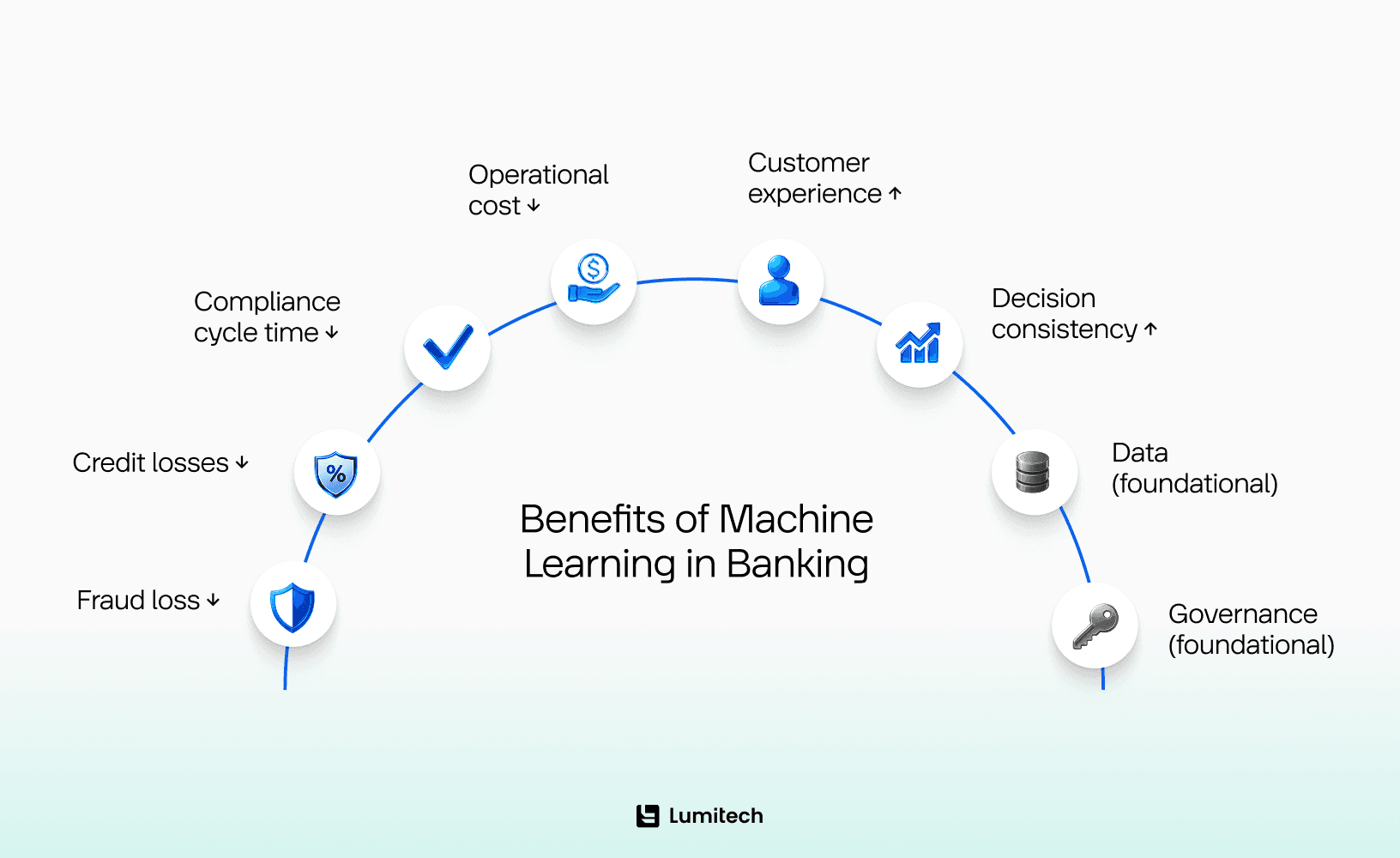
1) Better risk pricing and lower credit losses
More accurate risk estimates improve underwriting and pricing. Even modest improvements in default prediction can materially impact profitability at scale.
But the real advantage is timing: catching deterioration early gives banks options (restructuring, proactive outreach, tighter limits) before losses explode.
2) Fraud reduction and faster detection
Fraud detection is one of the strongest ML success stories because:
ground truth is plentiful (confirmed fraud)
patterns are complex
speed matters.
And the cost of missing fraud is not just financial — it’s reputation and trust.
3) Operational efficiency and cost savings
For compliance and servicing, AI and machine learning in banking automate repetitive work:
document processing
alert triage
routing and prioritization
anomaly detection.
That can reduce the cost per case and speed up service. (Also: it reduces the number of spreadsheets named “final_final_v7_reallyfinal.xlsx,” which is a public good.)
4) Improved customer experience
Personalization and predictive service can reduce churn and increase share-of-wallet. Done well, it feels helpful and becomes one of the main benefits of machine learning in banking. Done badly, it feels like the bank is reading your diary.
5) Better governance — ironically
This sounds backwards, but many banks only modernize their governance because ML forces them to. When models become central, banks build stronger:
validation teams
documentation standards
monitoring pipelines
approval committees.
Regulatory frameworks for model risk management push in this direction in the US and beyond.
ML is not a magic wand. It’s a way to solve specific operational problems that traditional approaches struggle with. In practice, machine learning banking projects succeed less because of fancy algorithms and more because the data and governance are boringly solid.
Challenges and Risks of Implementing Machine Learning for Banks
It’s not all sunshine and optimized portfolios. Implementing ML in a highly regulated, risk-averse environment is like performing surgery on a moving train. Here’s the part where the fun begins (for auditors).
1) Model risk: when “accurate” is not “safe”
A model can be accurate in development and still fail in production due to:
shifting customer behavior
economic regime changes
data pipeline issues
feedback loops (model changes behavior, behavior changes model performance)
silent feature breaks (the scariest kind).
This is where machine learning and banking collide with reality: the model may be mathematically “good,” but production is a messy place where drift, broken pipelines, and feedback loops quietly ruin your day. US regulators have long emphasized model risk management principles: robust development, independent validation, and governance controls.
Key point: ML increases the number of failure modes. It doesn’t eliminate them.
2) Explainability and adverse action requirements
If your model denies someone credit, you often need to explain why — clearly, specifically, and in a way a human can understand.
In the US, the CFPB has emphasized that lenders using AI/complex models still must provide accurate reasons in adverse action notices; generic checklist reasons that don’t reflect the true drivers can be noncompliant.
This forces banks to think about:
interpretable modeling approaches
post-hoc explanations (with caution)
feature governance (“can we even disclose this driver?”)
alignment between model logic and reason codes.
Explainability isn’t just a model problem; it’s a communication problem — UX design for fintech helps present decisions and reasons in a way humans understand.
3) Fairness and discrimination risk of machine learning and banking
ML can encode bias in several ways:
biased training data (historical inequities)
proxy variables (ZIP code “accidentally” correlating with protected characteristics)
selection bias (who gets approved becomes who you learn from)
label bias (past decisions define “ground truth”).
This becomes a legal and reputational issue fast. And because lending is regulated, fairness is not a “nice-to-have.” It’s an existential requirement.
4) Privacy and data minimization tension
ML loves data. Regulation often loves the opposite:
collect less
retain less
justify purpose
protect sensitive information.
Banks must balance model performance with privacy-by-design. This is especially tricky with alternative data and behavioral signals.
5) Security threats of machine learning in banking: adversarial ML, poisoning, and model extraction
Attackers don’t just hack servers. They can:
manipulate inputs to evade fraud detection
poison training data
probe APIs to infer model behavior
target vendor model supply chains.
In banking, that risk is amplified because models are directly connected to money movement.
6) Vendor and third-party risk (including cloud)
Many banks rely on vendors for fraud tools, AML platforms, decision engines, and now foundation models. Third-party tools make machine learning and banking faster to deploy, but they also make accountability harder, because “the vendor built it” is not a regulatory strategy. That introduces:
black-box components
limited transparency
dependency risk
concentration risk.
On top of that, banks are moving workloads to the cloud. Supervisors are issuing guidance and expectations for cloud outsourcing and resilience (including alignment with EU operational resilience requirements).
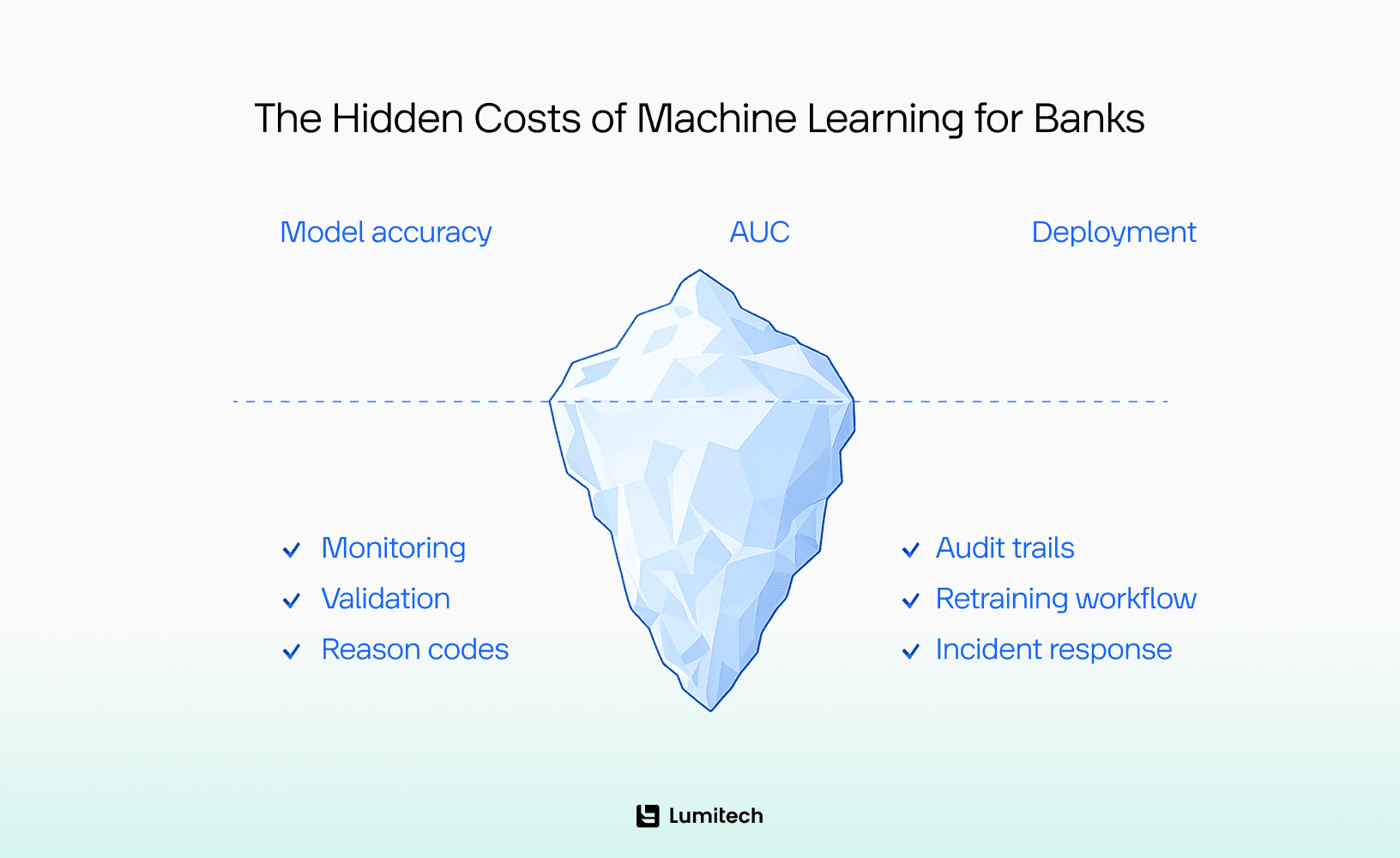
7) Governance debt: “We built it” is not the same as “We can defend it”
A bank may deploy an ML model that improves AUC by 2% and then discover it created:
audit gaps
undocumented features
unclear ownership
missing monitoring
no retraining policy
no fallback plan.
Congratulations: you have invented “governance debt,” which compounds faster than credit card interest. The catch is that machine learning adoption in banks often outpaces governance, creating “model sprawl” where nobody can confidently explain what’s running, why, or with what controls.
8) Regulatory fragmentation: one bank, many rulebooks
A multinational bank may need to align with:
US model risk expectations
EU AI Act obligations for high-risk AI
local consumer protection requirements
operational resilience requirements
sectoral guidelines on lending standards and monitoring.
In the EU, the EBA has issued guidelines on loan origination and monitoring, emphasizing robust creditworthiness assessment and prudent standards.
And as noted earlier, EU frameworks classify credit scoring AI as high-risk, raising compliance expectations.
Governance Mechanisms for Different Machine Learning Use Cases in Banking: Balance Innovation With Transparency
Data governance in the banking industry is how banks avoid two equally bad outcomes:
Paralysis (“We can’t deploy anything because it might be risky”), and
Chaos (“We deployed everything; now the regulator wants a meeting”).
Good governance is not about slowing down. It’s about making speed defensible.
1) Model inventory and tiering (know what you’re running)
Start with a complete inventory of models:
where they’re used
what decisions they influence
who owns them
what data they use
what their risk tier is.
Credit decisioning and customer access models should be treated as high-impact by default.
2) Validation and “effective challenge”
Model risk management guidance in the US emphasizes independent validation and governance oversight. In practice, “validation” shouldn’t be a rubber stamp. It should include:
conceptual soundness review
data quality testing
back-testing and benchmarking
outcome analysis
stress testing and sensitivity
implementation verification (yes, checking the code and pipeline).
The underrated part: effective challenge — a cultural permission slip to ask “What if this is wrong?” without being labeled “anti-innovation.”
3) Monitoring, drift detection, and retraining discipline
Monitoring isn’t just about accuracy dashboards. It’s:
data drift (inputs changed)
concept drift (relationship changed)
outcome drift (base rates changed)
bias drift (fairness metrics changed)
operational metrics (latency, failures, overrides).
And every model needs a plan for:
retraining triggers
approval workflow for updates
rollback procedures
fallback to rules/manual review.
4) Explainability strategy (not just an “XAI tool”)
Explainability is a product requirement in banking:
for customers (adverse action notices)
for regulators
for internal accountability.
A practical strategy includes:
choosing interpretable models where impact is high
constraining features to those you can justify
linking reason codes to actual model drivers
documenting limitations honestly.
The CFPB’s guidance makes it clear that complexity doesn’t excuse weak explanations.
5) Fairness and ethics controls that actually ship
“Ethics” fails when it’s only a slide deck. Banks increasingly use frameworks and principles to operationalize fairness, accountability, and transparency. Singapore’s MAS FEAT principles are a well-known reference point for responsible AI in financial services, and related industry frameworks provide assessment methods.
Operationalizing ethics looks like:
documented fairness definitions (per product)
testing across protected/at-risk groups where applicable
proxy and feature sensitivity reviews
human override policies with guardrails
customer remediation processes.
6) Aligning with broader AI risk frameworks
Banks don’t need to reinvent risk taxonomies. NIST’s AI Risk Management Framework provides a structured approach (govern, map, measure, manage) for thinking about AI risk across contexts.
The best banks map these frameworks into their existing risk functions:
model risk management
operational risk
compliance
cyber
third-party risk.
7) Operational resilience: because models live in systems
Even a perfect model fails if:
the feature store is down
the payments system lags
cloud dependency breaks
monitoring alerts don’t route.
Supervisory guidance around cloud outsourcing risk management underlines why resilience is part of AI governance, not separate from it.
The Opportunity Map: Where ML in Banking is Headed
Smarter fraud defense against AI-enabled scams
As criminals use AI to generate convincing content and scale outreach, banks will expand:
behavioral biometrics
graph analytics for mule networks
real-time scam detection prompts (“Are you sure you know this recipient?”)
cross-channel fraud intelligence.
More automation in compliance — paired with more oversight
Automation will grow, but not as “hands off.” Expect:
AI-assisted investigators
automated documentation drafts
stronger audit trails
more emphasis on human accountability.
Regulated innovation in credit decisioning
Credit ML will continue, but with heavier constraints:
documented feature sets
robust reason code mapping
fairness monitoring
tighter vendor scrutiny.
In the EU, the high-risk classification for credit scoring under AI rules is pushing toward more structured controls.
AI in advisory and wealth
Expect AI in wealth management to grow fastest where firms can prove suitability, explain recommendations, and monitor drift like it’s a first-class risk.
Supervisors are using more analytics, too
When regulators build their own SupTech capabilities, the game changes: banks can expect more data-driven supervision and sharper questions about governance and outcomes.
A Realistic Playbook for Banks (and the Teams Building for Them)
If you’re implementing ML in banking — whether you’re a bank, fintech, or vendor — these are the “don’t regret it later” moves:
Start with the decision, not the model. Define what decision is being influenced, what errors cost, and who is accountable. If you want ML to be repeatable across teams, build decisioning like a product; decision intelligence solutions provide the structure to scale without chaos.
Treat data pipelines as regulated assets. If a feature can change silently, it will — on a Friday night.
Design compliance into the workflow. Logging, reason codes, documentation, and monitoring should ship with the model.
Make fairness testable. If you can’t measure it, you can’t manage it.
Plan for failure. Rollback, fallback, and incident response are part of ML engineering in finance.
Assume regulators will ask “show me.” Build artifacts continuously, not two days before an exam.
Or, in plain English: build it like you’ll have to defend it in front of a very patient person with a checklist.
Conclusion: The Algorithm is Your Co-Pilot
Intelligent banking systems aren’t the ones that predict perfectly; they’re the ones that fail gracefully, surface uncertainty, and leave an audit trail that doesn’t trigger anyone’s blood pressure. While the risks are real — ranging from the “black box” of AI decision-making to the threat of deepfake fraud — the opportunities for a more inclusive, efficient, and secure financial system are far greater.
The successful bank of 2026 isn't the one with the most data; it's the one that knows how to govern its algorithms, respect its customers' privacy, and occasionally admit that even the smartest computer needs a human to check its math.


