
Top IT Companies in UAE: Choosing the Right Tech Partner
The United Arab Emirates is no longer just a global hub for oil and tourism; it has transformed into a high-octane “Silicon Oasis” in the heart of the Middle East. Dubai and Abu Dhabi are currently racing to become the world’s smartest cities.
- Software Development
- For New Clients
July 31, 2026
 AI Overview
The UAE technology sector includes telecom and cloud providers, AI infrastructure firms, consumer platforms, fintechs, and custom software partners. This guide compares 10 leading companies by market impact, innovation, growth, delivery quality, and project fit, with typical budgets ranging from AED 80,000–250,000 for an MVP to AED 600,000–1,500,000+ for enterprise platforms. Choosing by brand alone can lead to poor technical fit, higher project costs, delivery delays, and costly rework after launch.

Top Tech Companies in the UAE at a Glance
The UAE tech sector spans a wide range of company types — from telecom giants and AI research firms to fintech unicorns, super apps, and custom software development vendors.
This overview covers ten of the most prominent technology companies in Dubai and across the UAE, selected to represent that variety: some are product companies building and operating their own platforms at scale, others are IT service providers in the UAE that build and deliver technology for clients.
In this definitive guide, we’ll dive deep into the UAE’s tech landscape, rank the leading players, and give you the ultimate blueprint for choosing a partner. The companies were compared on market impact, innovation and R&D investment, growth trajectory, and — for service providers — delivery quality and client track record. For a closer look at managed services and network infrastructure specialists specifically, see IT infrastructure companies in Dubai.
What Criteria Are Used to Determine the Best IT Companies in the UAE?
The ten companies on the list represent the main categories you’ll find among top tech companies in the UAE today: infrastructure and telecom operators, AI and data platforms, consumer super apps, fintech products, and custom software development partners. Here’s a quick glance at what each company does and how it operates — use it as a quick reference before diving into the full profiles.
Let’s talk about how these firms made it to the list of top 10 tech companies in the UAE.
You can’t rank the tech industry in the UAE on vibes alone (tempting, yes, but no). Here are the criteria that show up again and again across global and regional lists:
Scale and market impact
Revenue, user base, or market share in their segment (e.g., telecom, fintech, foodtech).
Presence across multiple Emirates or countries.
Innovation and IP
Heavy investment in AI, decision intelligence solutions, data platforms, product R&D, and proprietary tech.
Recognition from global bodies – e.g., G42 being named to TIME’s “100 Most Influential Companies” list thanks to its AI work.
Growth trajectory
Unicorn or near-unicorn valuations, large funding rounds, or exponential user growth among UAE tech startups (Kitopi, Tabby, Astra Tech, etc.).
Ecosystem role
Running platforms or infrastructure that others build on — cloud companies in the UAE, data centers, payment rails, and digital identity systems.
Anchor tenants in hubs like DIFC Innovation Hub, Dubai Internet City, ADGM, or Hub71.
Execution and delivery quality
Strong client reviews and case studies for B2B firms — software development shops, IT staff augmentation services, and IT services partners alike.
Regional and global reach
Expansion into Saudi Arabia, wider MENA, Europe, or Asia.
Stock exchange listings (e.g., Yalla on NYSE, Bayanat/Space42 on ADX).
Short version: the “best” UAE IT companies are not just big — they’re innovative, trusted, and shaping the ecosystem around them.
Top IT Companies in the UAE in 2026
This is not an exhaustive UAE technology companies list (that would be a book), but a curated snapshot of established leaders, unicorns, and high-trust service partners that shape the UAE tech landscape – and, in many cases, the broader MENA region.
Software Development and Technology Partners
This category brings together the software development companies in the UAE that you can hire to build custom software, AI systems, or digital products.

1. Lumitech
Product-driven software engineering partner from Dubai
Company type: Software engineering partner
Location: Dubai, with an R&D team based in Eastern Europe
Core focus: Custom web and mobile development, AI/ML development services, SaaS platforms, and data-intensive systems for enterprise and product teams.
Why it’s included: Lumitech is one of the Dubai technology companies offering custom software development and IT services, building product-driven engineering teams for clients across multiple industries, from startups to enterprise-grade projects.
Evidence:
Based in Dubai, with delivery teams operating out of Eastern Europe.
Lumitech is included in the 2025 Clutch 1000 list of top-rated B2B service providers.
Reported 600% growth since 2022.
A documented portfolio spanning logistics, healthcare, fintech, legaltech, and analytics, including custom AI systems.
Offers both product engineering and in-house development services, positioning it for clients that want a single long-term technical partner rather than a one-off project team.
Best fit: Businesses looking for one of the software companies in UAE that combines custom software and AI engineering — best suited for complex digital products, enterprise platforms, and data-intensive systems.
Availability as a vendor: Lumitech is a service provider available for hire, working directly with client teams on custom builds. If you’re looking to launch or scale a digital product with serious engineering under the hood — while staying in the UAE time zone and regulatory context – Lumitech is very much in the shortlist territory.
Things to consider: Lumitech focuses on custom product engineering and AI-enabled business systems rather than telecom infrastructure, off-the-shelf IT support, or basic website production.

2. Injazat
Digital transformation, cloud, and cybersecurity specialist
Company type: IT services and digital transformation partner (a G42 company)
Location: Abu Dhabi
Core focus: Cloud, cybersecurity, managed IT services, and public-sector digital transformation.
Why it’s included: Injazat is a home-grown champion among technology companies in the UAE focused on enterprise and government digitization. It operates its own data centers and runs mission-critical systems for large organizations across the country.
Evidence: Injazat partners with global players like Oracle to deliver dedicated cloud regions for UAE government entities, meeting strict data-residency and regulatory requirements. As a G42 company, it is part of one of the region’s largest technology groups.
Best fit: Utilities, government entities, and large enterprises looking for a local partner that can navigate both technology and regulation.
Availability as a vendor: Injazat is a service provider available for hire, but it works primarily with enterprise and government clients. It is best suited to large-scale, compliance-heavy engagements rather than smaller product builds.
Things to consider: Its enterprise-and-government orientation means it’s likely to be a poor fit for startups or teams looking for a lean, product-focused development partner. Engagement scale and procurement processes tend to be substantial.
AI, Cloud, and Infrastructure Leaders
These companies operate the platforms and infrastructure that others build on — AI, cloud, connectivity, and geospatial systems. Some offer partnership opportunities at enterprise or national scale; most are not general-purpose development vendors.

3. e&
From Telco to tech powerhouse and one of the best IT companies in the UAE
Company type: Telecom and technology conglomerate
Location: Abu Dhabi
Core focus: Connectivity, 5G, cloud, IoT, cybersecurity, and digital services.
Why it’s included: e& is one of the leading tech companies in Abu Dhabi, having evolved from a classic telecom provider into a diversified technology and investment group. It serves millions of consumers and over 300,000 businesses in the UAE alone, and operates across multiple countries.
Evidence: In recent years e& has expanded aggressively into cloud, IoT, cybersecurity, and AI-driven services, deepened partnerships with hyperscalers like AWS, and invested heavily in AI and data infrastructure — positioning itself as a cross-industry digital enabler rather than “just” a telco.
Best fit: Large enterprises or government entities working on nation-scale or Emirate-wide digital infrastructure.
Availability as a vendor: e& sells cloud, connectivity, and managed digital services, but as an infrastructure and services provider at scale, not as a custom software development shop. Engagements are enterprise-grade.
Things to consider: Its breadth is its strength and its limitation — it’s the right call for infrastructure and connectivity, but not for bespoke product engineering.

4. G42
One of the top AI & cloud technology companies in the UAE
Company type: AI and cloud platform company
Location: Abu Dhabi
Core focus: AI research, hyperscale cloud infrastructure, and sector platforms in healthcare, aviation, energy, and government.
Why it’s included: G42 is arguably the purest AI-first company among technology companies in Abu Dhabi, and one of the UAE’s most innovative tech companies, running large-scale AI and cloud operations across multiple sectors, from genomic platforms to climate modeling.
Evidence: G42’s work on “G42 Cloud” and hyperscale AI infrastructure — including the Stargate data center project with global partners — has earned international recognition, including a spot on TIME’s “100 Most Influential Companies” list.
Best fit: Projects involving heavy AI workloads, massive datasets, or national-scale platforms.
Availability as a vendor: G42 partners on large AI and cloud initiatives, typically at enterprise or national scale. It is a benchmark and potential strategic partner rather than a company you’d hire for a standard software project.
Things to consider: Engaging G42 usually means a strategic, large-scale partnership. It’s not structured for smaller or mid-size custom development work.

5. Space42
AI, geospatial intelligence, and space tech
Company type: AI and geospatial intelligence company (ADX-listed)
Location: Abu Dhabi
Core focus: Satellite data, geospatial analytics, mapping, mobility, and smart-city solutions.
Why it’s included: Bayanat specializes in AI-powered geospatial intelligence, working with governments and enterprises on everything from autonomous-vehicle mapping to infrastructure planning — one of the most distinctive technology companies in the UAE by specialization.
Evidence: In 2024–2025, Bayanat announced a merger with satellite operator Yahsat to form Space42, combining satellite communications, Earth observation, and advanced analytics into a vertically integrated space and geospatial champion for the region.
Best fit: Projects touching mobility, logistics, defense, smart cities, or geospatial analytics.
Availability as a vendor: Bayanat/Space42 works with governments and large enterprises on specialized geospatial and space projects. It is not a general software development vendor.
Things to consider: Highly specialized. Relevant only if your project genuinely intersects with geospatial, satellite, or space technology.
UAE-Born Product and Technology Companies
These are product companies — they build and operate their own consumer or business platforms. They are not available for hire, but they’re included because they define what the UAE tech scene has produced and serve as benchmarks and potential ecosystem partners.

6. Careem
The super app that redefined urban services
Company type: Product company (super app)
Location: Dubai
Core focus: Ride-hailing, food and grocery delivery, payments, and everyday services.
Why it’s included: One of the most prominent Dubai tech companies, Careem started as a ride-hailing app and evolved into a super app operating across multiple countries. It shows how UAE-born companies can scale across the wider region.
Evidence: Following its $3.1B acquisition by Uber, Careem continued to grow as a separate brand and now counts e& as a strategic investor in its super app vertical, which handles millions of transactions and regulated payment flows.
Relevance: For anyone building on-demand services, multi-sided marketplaces, or super app ecosystems.
Things to consider: Referenced here as a benchmark and potential platform partner, not a development vendor.

7. Yalla Group
UAE’s NYSE-listed social & gaming champion
Company type: Product company (social and gaming)
Location: Dubai
Core focus: Voice-centric group chat and casual gaming.
Why it’s included: Yalla Group is the largest MENA-based online social networking and gaming company by revenue, and one of the top tech companies in Dubai. It’s known for its voice-chat app, Yalla, and its gaming platform, Yalla Ludo.
Evidence: Founded in 2016 and headquartered in Dubai, Yalla became the first UAE-based technology company to list on the New York Stock Exchange in 2020 — a major milestone for the region’s tech credibility.
Relevance: A blueprint for social and entertainment platforms built around local culture, monetized via virtual goods and in-app economies.
Things to consider: Useful as a model for community-driven and in-app-economy products, not a tech partner.

8. Tabby
Fintech unicorn redefining payments
Company type: Product company (fintech)
Location: Dubai
Core focus: Buy Now, Pay Later (BNPL), consumer credit, and shopping.
Why it’s included: Tabby became the first independent fintech unicorn in the Middle East and one of the standout fintech companies in the UAE, building a BNPL and shopping platform used by millions of consumers.
Evidence: By 2025, Tabby had raised a $160M round at a $3.3B valuation, making it one of the most valuable fintechs in MENA and expanding significantly across Saudi Arabia and the wider region.
Relevance: A strong reference point for payments, embedded finance, e-commerce, or consumer lending.
Things to consider: Relevant as a benchmark for regional fintech, and as a payments integration option rather than a build partner.

9. Astra Tech
Ultra app builder and AI-native consumer ecosystem
Company type: Product company (consumer AI ecosystem)
Location: Abu Dhabi
Core focus: Communication, fintech, e-commerce, and on-demand services under the Botim brand.
Why it’s included: Founded in 2022, Astra Tech is building the region’s first “Ultra App” by integrating multiple consumer services — illustrating how UAE companies are moving beyond the super app into AI-native ecosystems.
Evidence: Astra Tech has acquired platforms including PayBy, Rizek, and Botim, raised significant funding (including a $500M round led by G42), and launched Botim AI, bringing AI-driven assistance to more than 150 million users globally.
Relevance: Something to watch closely if you’re in fintech, communication, or super app design.
Things to consider: Referenced for its product strategy; not a route to hiring development capacity.

10. CAFU
Fuel-tech and vehicle services super app
Company type: Product company (fuel-tech and vehicle services)
Location: Dubai
Core focus: On-demand fuel delivery, car washes, battery services, oil changes, and fleet services.
Why it’s included: CAFU began in 2018 as an on-demand petrol delivery app and has grown into one of the top tech companies in the UAE, specializing in mobility and energy services.
Evidence: It now serves over a million users and is exploring an IPO, repositioning itself from “that fuel app” into an energy and mobility tech company with sustainability ambitions and expanding services.
Relevance: Relevant for anyone working on on-demand logistics, last-mile mobility, or sustainability-driven urban services.
Things to consider: Useful as a model for on-demand and mobility products; not available for hire.
Not sure which AI risks apply to your project?
Lumitech can help assess your use case, data readiness, and technical feasibility before you commit to full implementation.

Why the UAE Has Become the Region’s Tech Nerve Center
Over the last decade, IT companies in Dubai and the UAE have gone from basic outsourcing shops to serious product builders, AI specialists, and infrastructure partners serving clients across the GCC and beyond.
The country now hosts over 5,600 registered startups, making it the GCC’s leading startup hub.
The UAE’s startup ecosystem ranks 21st globally in the Global Startup Ecosystem Index 2025 – the highest ranking in the Arab world.
Tech events like GITEX Global 2025 bring together more than 6,800 exhibitors, 2,000 startups, and 1,200 investors from around the world, reflecting how much international attention tech startups in the UAE now attract.
And it’s not just pure software or consumer apps: the country is also pouring investment into industrial software development companies – ports, logistics hubs, utilities, and manufacturers that rely on IoT, automation, and real-time data to keep physical operations running smoothly.
At the same time, the government is throwing serious weight behind AI, digital government, and smart-city initiatives, from Dubai’s D33 agenda to Abu Dhabi’s Hub71 ecosystem.
Translation: the UAE is not just buying tech — it’s actively building it, funding it, and exporting it. For a founder or CIO, this means that almost all kinds of IT services companies in the UAE are now within reach, whether you need a niche AI specialist, a cloud migration partner, or a team to run your day-to-day IT operations.
How to Choose the Right Tech Company in the UAE for Your Project
Choosing among the many top tech companies in the UAE comes down to matching your actual problem to the right type of partner — not chasing the most impressive-sounding pitch. These six checks cover what actually matters.
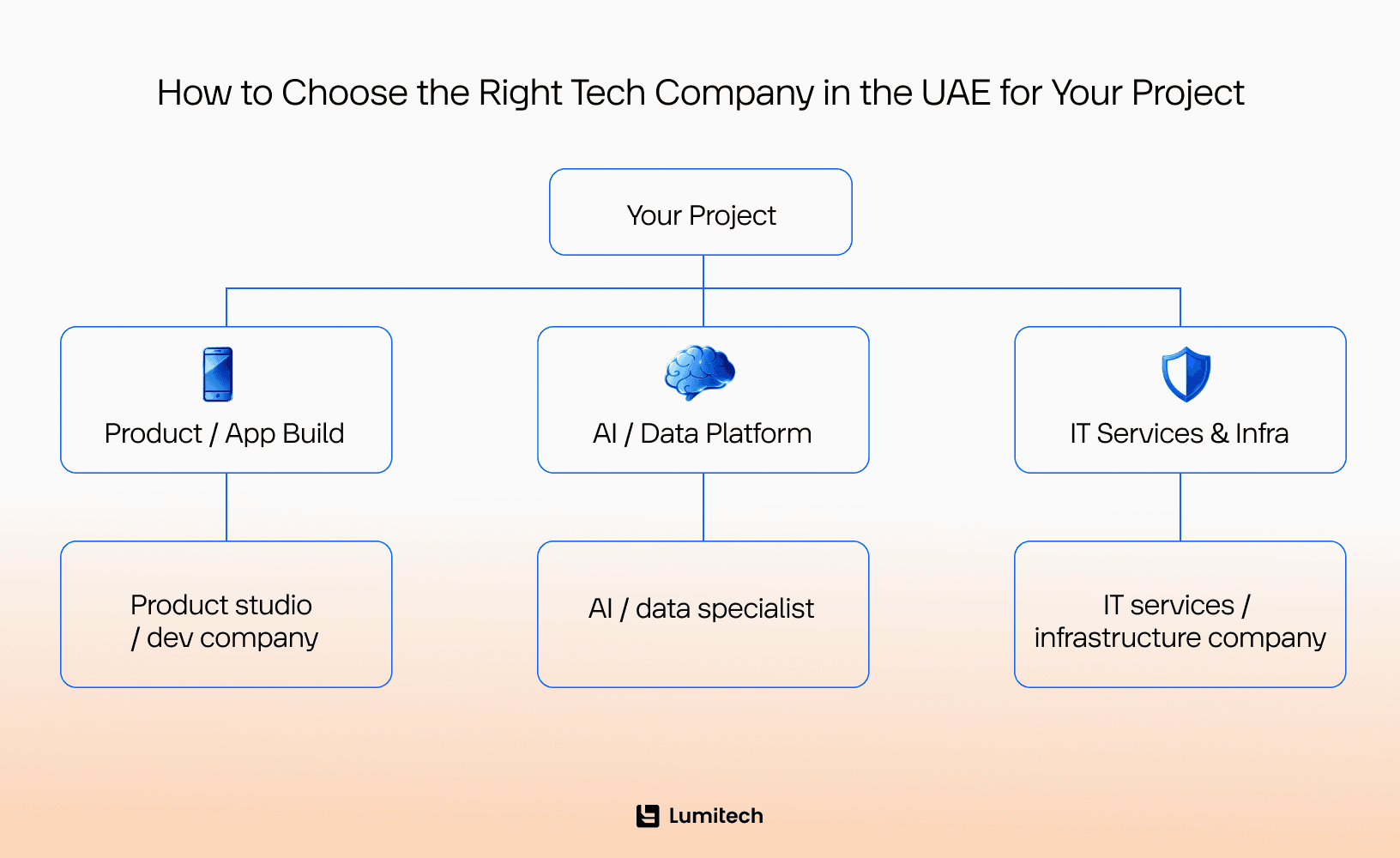
1. Define the type of company you need
Begin with a one-page problem statement: what you’re building, by when, and under what constraints (budget, compliance, internal skills). That filter immediately narrows the field. Broadly, partners fall into three layers: infrastructure and national-scale AI providers (e&, G42, Injazat, Bayanat/Space42), consumer platforms and ecosystems (Careem, Yalla, Tabby, Astra Tech, CAFU), and product and engineering partners — firms like Lumitech and other IT companies in Dubai — that build or extend a product for you directly.
2. Match the provider to the project type
A consumer app or marketplace calls for product-driven teams that have already run high-scale apps, not pure infrastructure vendors. Enterprise software development, data platforms, or cloud migration call for providers with strong cloud, cybersecurity, and compliance credentials. AI-heavy or regulated products — including healthcare apps in the UAE market — need teams with real experience in data pipelines, ML models, and production-grade MLOps. A generalist web studio is rarely the right fit for a complex fintech or data-heavy platform.
3. Review relevant case studies and outcomes
Look for case studies with clear business results — conversion uplift, reduced operational cost, faster processes — plus references on platforms like Clutch, DesignRush, or G2, ideally from your industry or region. Evidence of international client work or cross-border compliance experience (GDPR, PCI DSS, HIPAA) is a strong signal. Ask for architecture diagrams, sample code, or reference calls before committing to a large engagement — a small discovery phase or proof of concept is a reasonable ask.
4. Evaluate technical architecture and seniority
Ask who actually designs the architecture — senior solution architects, or “the devs will figure it out.” Ask how the team handles scalability, observability, testing, and security, and whether they’re comfortable with cloud-native patterns: microservices where appropriate, containers, CI/CD, infrastructure-as-code. Strong opinions about architecture and reliability are a good sign among leading tech companies in UAE.
5. Check security, compliance, and delivery governance
For infrastructure, cloud, and security-focused work, look for ISO 27001, SOC 2, and sector-specific or data-residency compliance treated as standard practice, not an afterthought — managed IT companies should show this by default. Hyperscaler partnerships (AWS, Azure, Google Cloud, Oracle) are a useful signal of capability. Vendors experienced in software development for government sector work tend to be disciplined about SLAs, logging, and change control, since audits are routine in that environment. Ask any provider to walk through a typical project week — stand-ups, demos, reporting, escalation paths.
6. Confirm pricing, ownership, communication, and regional scalability
Clarify the pricing model (fixed price, time-and-materials, dedicated team) and who owns the IP before signing. If you’re scaling beyond the UAE, confirm the partner can support multi-country rollouts — languages, currencies, regulations — and ask how they handle distributed teams across time zones. Decide early whether you want full outsourcing, where senior engineers join your in-house team on a flexible basis — both are valid, but expectations need to match the model. With the pace of change in the region, including AI companies in the UAE, it’s worth choosing a partner investing in AI and long-term talent rather than one riding a temporary wave.
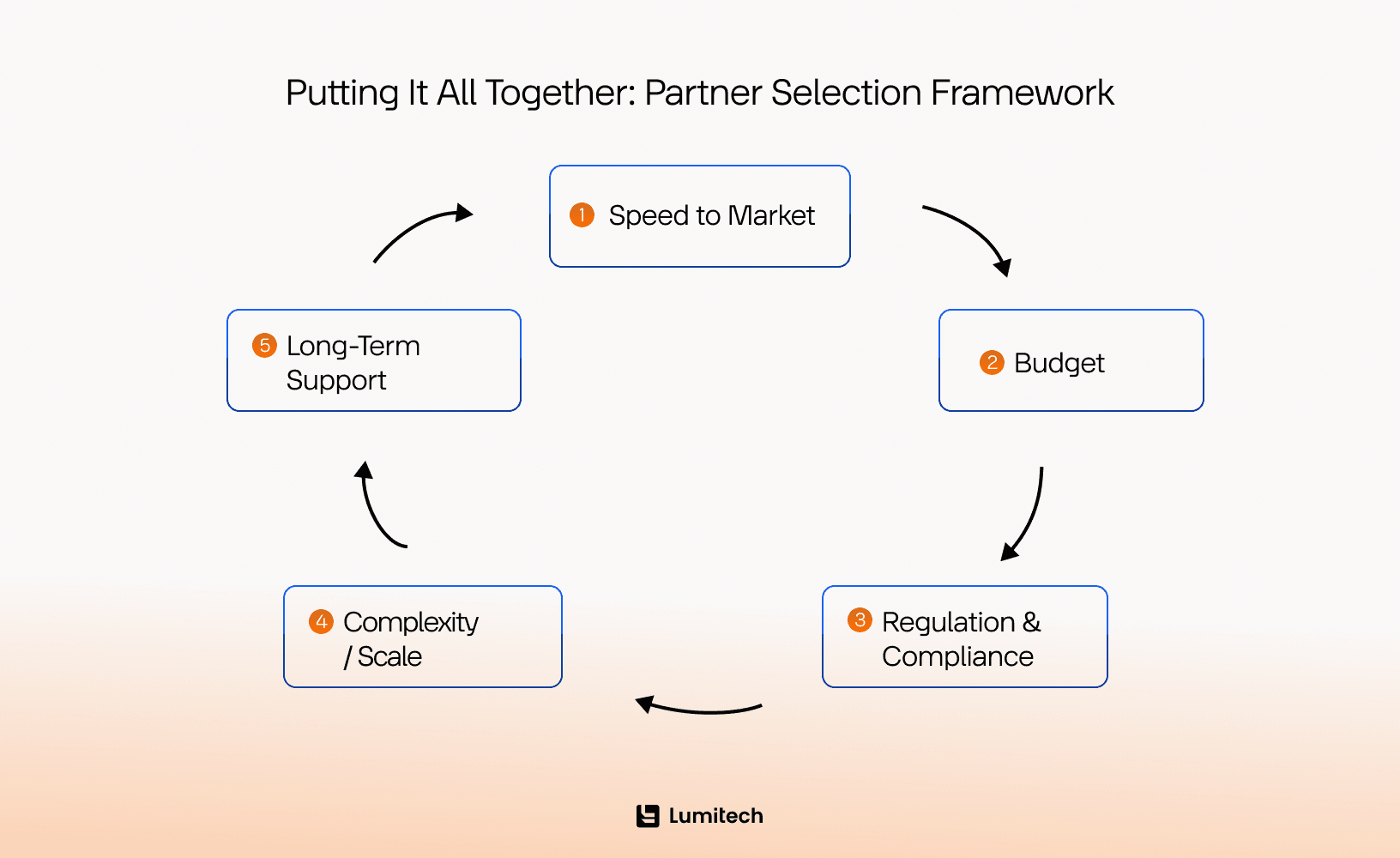
Among the many tech companies in Dubai, the right partner is the one whose evidence — not pitch — matches your specific mix of ambition, budget, and risk tolerance.

The Cost Reality: What to Expect From Top IT Companies in Dubai?
Project cost across the UAE technology sector depends far more on what you’re building than on which company you hire — a simple MVP and an enterprise AI platform sit in entirely different budget brackets regardless of vendor. The table below breaks costs down by project type instead of by company tier, since UAE technology companies with different business models — telecom conglomerates, AI infrastructure providers, boutique engineering partners — aren’t priced on a comparable basis to begin with.
Project Type | Typical Scope | Indicative Budget (AED) |
|---|---|---|
Simple website or landing page | Marketing site, basic CMS, limited custom functionality | AED 15,000 – 40,000 |
MVP/early-stage product | Single-platform app or web app, core features only, basic backend | AED 80,000 – 250,000 |
Mid-complexity web or mobile app | Multi-platform app, custom backend, third-party integrations, moderate UX complexity | AED 250,000 – 600,000 |
Enterprise platform or system integration | Multiple integrations, custom workflows, compliance requirements, larger user base | AED 600,000 – 1,500,000+ |
AI/ML-powered solution | Custom model integration or development, data pipeline work, production-grade MLOps | AED 300,000 – 1,000,000+ |
National-scale infrastructure or cloud platform | Large-scale infrastructure, hyperscaler partnerships, government-grade compliance | AED 1,000,000+ |
Dedicated development team (monthly) | Ongoing team of engineers embedded with your product | AED 40,000 – 120,000 per month, depending on team size and seniority |
These figures are indicative, not quotes. Actual cost on any real project depends on several factors: the seniority and location of the development team, the complexity of integrations and compliance requirements, whether the work involves regulated data (healthcare, finance, government), the depth of testing and DevOps work required, and the ongoing support model after launch. Two projects in the same category can differ significantly in cost depending on these variables — which is why a discovery or scoping phase is usually the first real step in getting an accurate number for your specific project.
Which Technical Companies in the UAE Are Expanding Internationally?
Careem, Tabby, Yalla Group, Astra Tech, e&, G42, and Bayanat/Space42 are among the UAE tech companies with the most active international expansion — through regional operations, acquisitions, strategic partnerships, or cross-border infrastructure projects. Their expansion strategies differ significantly by business model: consumer platforms are expanding into new markets and verticals, while infrastructure and AI companies are expanding through partnerships and large-scale projects abroad rather than consumer-facing growth.
Careem expanded from ride-hailing into a regional super app spanning transport, delivery, and payments across multiple GCC countries. Its $3.1B acquisition by Uber gave it continued backing to operate under a separate regional brand, and e&'s investment in its super app vertical adds a further regional growth channel.
Tabby has significantly expanded its BNPL and shopping platform in Saudi Arabia and the wider region, backed by a $160M funding round at a $3.3B valuation in 2025 — growth driven by geographic expansion into adjacent GCC markets rather than diversification into new product categories.
Yalla Group expanded its user base across the MENA region through its voice chat and gaming products and extended its reach into global capital markets by becoming the first UAE-based technology company to list on the New York Stock Exchange in 2020.
Astra Tech is expanding through acquisition and product bundling — absorbing platforms like PayBy, Rizek, and Botim into a single “Ultra App” ecosystem, then scaling that ecosystem’s AI layer, Botim AI, to more than 150 million users globally.
e& has expanded beyond its UAE telecom base into a multi-country technology and investment group, deepening partnerships with global hyperscalers such as AWS and extending its cloud, IoT, and cybersecurity services into markets beyond the UAE.
G42 is expanding through large-scale infrastructure partnerships rather than consumer markets — its involvement in the Stargate data center project with international partners, and its recognition on TIME’s “100 Most Influential Companies” list, reflect an expansion strategy built on global AI infrastructure collaboration.
Bayanat/Space42 is expanding its footprint through its 2024–2025 merger with satellite operator Yahsat, combining geospatial analytics with satellite communications to build a vertically integrated space and geospatial platform with reach well beyond the UAE’s borders.
Taken together, these companies show two distinct expansion patterns: consumer and fintech platforms (Careem, Tabby, Yalla, Astra Tech) growing through geographic and product expansion within the region, and infrastructure and AI companies (e&, G42, Bayanat/Space42) growing through international partnerships and large-scale projects rather than direct market entry.
Conclusion: The UAE Is Not Just Adopting Tech – It’s Exporting It
If you zoom out, a clear pattern emerges across the tech industry in the UAE: it isn’t trying to “catch up” with global tech hubs anymore. It’s busy building its own mix of telecom giants, AI powerhouses, super apps, fintech unicorns, deep-tech firms and high-end engineering partners that export products, platforms and expertise far beyond its borders. From e& and G42 to Careem, Noon, Tabby, Kitopi, Astra Tech, CAFU and engineering-focused companies like Lumitech, the country now covers almost every layer of the digital stack.
For you as a business, the challenge is choosing wisely among top technology companies in UAE – matching your real problem, risk tolerance, and growth plans with a partner that has the right mix of domain expertise, technical depth, and delivery discipline.
If you start with a clear problem statement, insist on evidence over buzzwords, and think regionally rather than just locally, you can turn the UAE’s crowded tech landscape into a strategic advantage. Pick the right partner, and you’re not just buying code or cloud capacity – you’re plugging into an UAE tech ecosystem that’s increasingly setting the pace for the wider Middle East, and, in some cases, competing comfortably on a global stage.


