
Top 10 Providers of Managed IT Services in Dubai: 2026 Buyer’s Guide
Companies across the UAE increasingly turn to managed IT services in Dubai to keep infrastructure, security, and cloud running without building a full in-house IT department.
- For New Clients
- Software Development
August 28, 2026
 AI Overview
Managed IT services providers in Dubai deliver 24/7 infrastructure monitoring, managed security, cloud administration, and backup or disaster recovery under a defined SLA. Dubai accounts for over 40% of the UAE’s managed services demand, and the scope of services varies across providers. Undefined exclusions and loose response targets leave incidents unnoticed, patching delayed, and recovery slow.

Top Managed IT Services Providers in Dubai at a Glance
This guide compares the top 10 MSPs in Dubai — what they actually cover, how they price it, and which business profile each one fits. If you are still deciding between a managed model and project-based delivery, our overview of IT outsourcing companies in Dubai is the closest neighbor to this page.
Nobody starts an infrastructure review because they enjoy it. It usually starts at 2 a.m., when a server decides that tonight is the night. This guide is for teams that would rather not babysit servers at all.
This guide covers the information you need to make the comparison. It includes verified 2026 market figures, 10 provider profiles built on a consistent template, real AED price benchmarks, an IT AMC in Dubai vs. managed IT breakdown, an in-house vs. MSP cost framework, and a UAE compliance section that explains the scope of each regulation.
What Managed IT Services in Dubai Actually Cover
A company signs with an IT managed services provider in Dubai when it wants to hand over some or all of day-to-day IT operations under a defined SLA. A full contract typically includes:
24/7 infrastructure and network monitoring (NOC).
Service desk/help desk with tiered response times.
Server, endpoint, and workstation management, patching, asset inventory.
Managed IT security services in Dubai — SOC, SIEM, EDR/XDR, managed firewall, incident response.
Cloud administration across Azure, AWS, and on-premises platforms.
Backup and disaster recovery (DRaaS).
Microsoft 365 or Google Workspace support and periodic IT reviews.
What sits outside the contract matters just as much. Hardware purchases, third-party licenses, cloud consumption, migration projects, and after-hours callouts are usually priced separately. The single most useful question during a vendor call is not “what’s included” — it’s “what’s excluded, and what does it cost when it happens”.
Providers of managed IT support services in Dubai generally sell one of three models: fully outsourced IT, co-managed IT alongside your internal team, or a narrow slice such as security-only or cloud-only.
Managed IT Services in the UAE: Market Size and 2026 Outlook
Market estimates for managed IT services in the UAE vary widely, and it is worth understanding why before quoting any single figure. Different research houses draw the boundary of “IT services” differently — some count only services, others fold in broader ICT spend.
Source | Estimate | Growth |
|---|---|---|
USD 5.88B (2024) → USD 12.88B (2033) | ~9.10% CAGR (2025–2033) | |
USD 20.24B (2025) → USD 37.69B (2030) | 13.24% CAGR | |
USD 40.5B (2024) → USD 144.4B (2035) | 12.25% CAGR |
Read them as a range, not a contradiction. What the sources agree on is the direction and the internal mix:
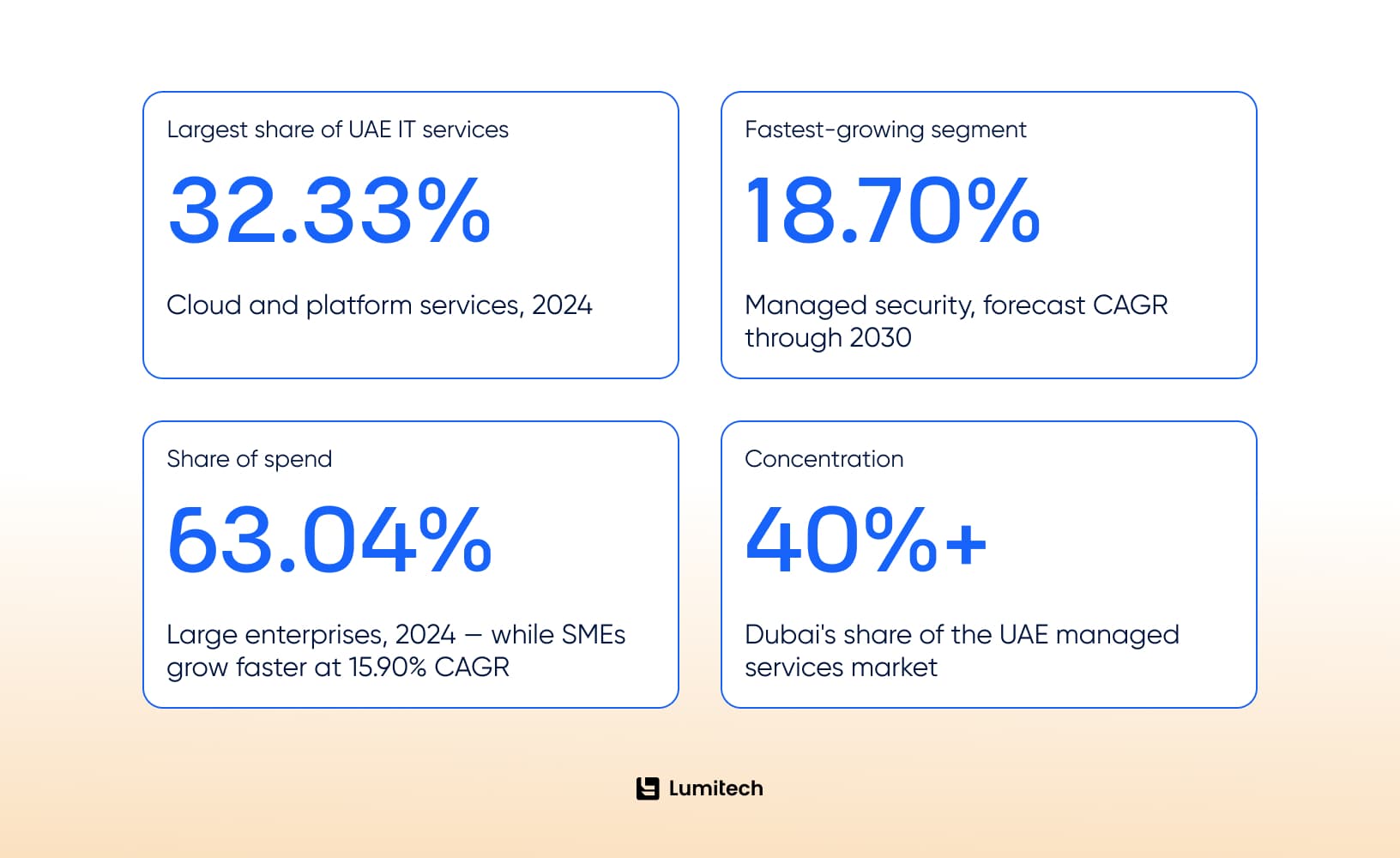
Cloud and platform services accounted for the largest share of UAE IT services in 2024, at 32.33% (Mordor Intelligence).
Managed security is the fastest-growing segment, forecast to grow at an 18.70% CAGR through 2030 (Mordor Intelligence).
Large enterprises accounted for 63.04% of spend in 2024, while SMEs are growing faster at 15.90% CAGR (Mordor Intelligence).
Dubai represents over 40% of the UAE managed services market, driven by fintech, logistics, tourism, and technology clusters (Credence Research).
For anyone evaluating IT managed service providers in Dubai, the practical takeaway is that security and cloud are where providers’ capabilities are expanding fastest — and where the gap between a strong MSP and a weak one is widest.
Why Demand for IT Managed Services in Dubai Keeps Rising
Government Digital Policy Sets the Pace
As the UAE Digital Government Strategy 2021–2025 reaches its conclusion, national and Dubai-level priorities have shifted toward AI-led growth, guided by the UAE National AI Strategy 2031, Dubai Economic Agenda D33, and the Dubai Universal Blueprint for Artificial Intelligence.
For businesses, this creates clear technical requirements for government API integration, security compliance, and the location and hosting of systems. Companies that treat these as a compliance checkbox tend to discover the cost later. The companies that fold them into digital transformation services from the start do not.
Cloud Footprint Is Now Local
Both Microsoft and AWS run production regions in the country — Azure UAE North (Dubai) and UAE Central (Abu Dhabi) since 2019, and the AWS Middle East (UAE) Region since August 2022 with three Availability Zones. Oracle operates UAE East (Dubai) and UAE Central (Abu Dhabi). Announced expansions include a 200MW Microsoft/Khazna build targeted for completion by the end of 2026, and the 1GW Stargate UAE cluster in Abu Dhabi — both planned rather than live, and worth treating as such.
The practical consequence: hybrid estates are the norm, not the exception. A credible managed cloud service provider in the UAE has to handle on-premises workloads, at least one hyperscaler, and the migration path between them. This is also where legacy system modernization usually enters the conversation — most hybrid complexity is inherited, not chosen.
Security Is No Longer a Separate Budget Line
The scale of cyber threats facing the UAE has increased dramatically. Dr Mohamed Al Kuwaiti, head of the UAE Cybersecurity Council, reported that national systems previously faced 90,000–200,000 breach attempts per day. By August 2026, daily attack volumes had risen to around 600,000 — roughly 25,000 per hour — with the increase largely attributed to regional conflict from late February 2026 onward; some 2026 reporting cites figures as high as 800,000 per day. Earlier Council data also showed ransomware activity increasing by 32% in 2024, while phishing, DDoS, and scams grew by up to 18%.
These figures should be viewed in context and tied to their respective dates, rather than treated as static statistics — attack volumes can shift rapidly. The key takeaway is that most organizations cannot sustain a 24/7 SOC on their own, which has made managed detection and AI-driven cybersecurity solutions standard MSP services.
AI Is Changing How MSPs Operate
PwC’s Middle East analysis put the UAE’s projected AI contribution at USD 96.0 billion, or close to 14% of GDP, by 2030 — the largest relative impact in the region. Inside MSP operations, the shift is already visible: automated incident triage, log correlation across systems (AIOps), failure prediction, and automatic cloud resource scaling. Where a sysadmin once read log files, models now flag the anomaly and a human decides what to do about the architecture. Providers that run models in production need MLOps and AI infrastructure discipline, not just a pilot.
Talent Economics
Hiring a full internal IT function in Dubai means competing for network, security, cloud, and helpdesk skills simultaneously — four different labor markets. Growth-stage companies rarely win all four at once. This is the quiet, unglamorous reason most managed IT solutions in Dubai get bought.
Top 10 Managed IT Services Providers in Dubai
The ten IT managed service providers in Dubai below are grouped so you can skip straight to the tier that will actually take your business. Two notes before the list. First, we have split the best MSP companies in Dubai into SMB/mid-market and enterprise/government tiers, because a provider that is excellent for a 400-user bank is often unavailable to a 20-person firm — and vice versa. Second, every profile uses the same eight fields, and claims that we could only verify from a provider’s own materials are marked as company-reported.
Tier 1 — SMB and Mid-Market

1. Burhani
Company type: Microsoft-focused MSP and IT support provider.
Location: Dubai, with Abu Dhabi coverage.
Core focus: Managed IT support, Microsoft 365 and Azure managed services, Dynamics 365, IT consultancy.
Why it’s included: One of the more established Dubai MSPs operating squarely inside the Microsoft ecosystem, which is where most SMB estates in the emirate actually live.
Evidence: Microsoft partner; listed in CRN MSP 500; ranked in the Channel Futures MSP 501 in 2018 and MSPmentor 501 in 2017.
Best fit: SMBs and mid-market companies (the provider indicates 20+ users) standardized on Microsoft.
Availability as a vendor: Actively takes on new SMB and mid-market clients.
Things to consider: The headline MSP rankings date from 2017–2018, and “Gold Partner” language predates Microsoft’s move to Solutions Partner designations — check current designations directly.

2. Xedos Technology
Company type: SMB IT solutions and managed services provider.
Location: Dubai (Garhoud), serving Abu Dhabi and Al Ain.
Core focus: Managed IT, IT AMC, cybersecurity, IT infrastructure, Tally and document management for small businesses.
Why it’s included: Among the few providers in the emirate that disclose an entry price, making it easier to establish a budget before the first call.
Evidence: Founded in 2013; IT AMC plans advertised from AED 299 (company-reported).
Best fit: Small businesses and startups that want low-cost fixed-fee support and a single point of contact.
Availability as a vendor: SMB-focused and openly takes small clients.
Things to consider: Thin public evidence base — no published ISO certifications, analyst recognition, or named enterprise case studies. A generalist SMB shop rather than a specialist.

3. Lumitech
Company type: Custom software and product-engineering company with dedicated teams and managed application-support models.
Location: Core markets UAE, KSA, and US.
Core focus: Legacy and digital modernization, cloud/DevOps (AWS, Azure, GCP, Kubernetes, Terraform), dedicated teams and staff augmentation, AI/ML and MLOps, QA including security testing.
Why it’s included: For companies whose IT is their software, the managed requirement is ongoing application maintenance and support, modernization, and release management — not a break-fix desk. That is the slice Lumitech covers.
Evidence: Published customer stories including a clinical-platform modernization and an AI-powered learning platform; 850% growth since 2022 and approximately 70% client retention (company-reported).
Best fit: Companies at any stage — from startups to enterprises — that need a long-term engineering partner to modernize, maintain, and continuously improve their custom software.
Availability as a vendor: Serves startup, mid-market, and enterprise clients through dedicated teams and staff augmentation, while also partnering with mobile app development companies in Dubai on product projects.
Things to consider: This is a product-engineering and dedicated-team model. If what you need is an office helpdesk with on-site visits and an annual maintenance contract for printers and switches, a classic MSP is a better fit.
Deciding whether your platform needs modernization or ongoing managed support? See how we deliver in production — real projects, real constraints.


4. Meta Techs
Company type: Cybersecurity-led IT and managed-services provider.
Location: Dubai.
Core focus: Security assessment and incident response, managed IT, IT infrastructure, HPE and VMware solutions.
Why it’s included: Combines security posture and IT management for smaller companies, with a focus on preventing issues before they come up.
Evidence: HPE Accredited Partner; Clutch and Google reviews (limited independent verification).
Best fit: SMBs looking to integrate security into routine IT operations instead of treating it as a standalone project.
Availability as a vendor: SMB-focused.
Things to consider: A smaller provider with a limited public track record of certifications and no major published case studies. Request references from organizations similar to yours.
Tier 2 — Enterprise and Government-Grade

5. Core42 (formerly Injazat, a G42 company)
Company type: National-scale sovereign cloud, AI, and managed-services provider.
Location: HQ Abu Dhabi; serves the UAE, including Dubai.
Core focus: Sovereign cloud, enterprise AI, cybersecurity, professional and managed services for government and regulated industries.
Why it’s included: For government and regulated-sector workloads that must remain within a sovereign environment, this is one of the very few realistic options in the country.
Evidence: Formed in October 2023 by merging G42 Cloud, Inception and Injazat; carries Injazat’s Tier IV, ISO 27001-certified data-center heritage.
Best fit: Government, semi-government, and large regulated enterprises that require sovereign hosting at scale.
Availability as a vendor: Effectively enterprise and government tier; not oriented toward SMBs.
Things to consider: The Injazat brand is retired — contracts, references, and RFPs should name Core42. No public SMB pricing.

6. Help AG (the Cybersecurity Arm of E& Enterprise)
Company type: Managed security services provider (MSSP) and cybersecurity advisory.
Location: Present in the Middle East since 2004; UAE offices including Dubai, plus Cyber SOCs in the UAE and KSA.
Core focus: Managed security — SOC, SIEM, MDR/XDR, managed firewall, zero trust — plus security consulting, compliance, and audit. Vendor-agnostic.
Why it’s included: The region’s most recognized pure-play MSSP, and the reference point when security is the deciding factor.
Evidence: Named a Leader in the IDC MarketScape: Middle East Managed Security Services Vendor Assessment 2026, and a Leader in the Middle East MDR assessments for 2024 and 2025; two Cyber SOCs in the UAE and KSA with 200+ specialists; acquired by e& (then Etisalat Group) in February 2020.
Best fit: Focuses on enterprises and government entities that treat security as a core priority, including organizations in finance, energy, and telecommunications.
Availability as a vendor: Enterprise and government focus; integrates alongside internal teams or another MSP.
Things to consider: Security-only scope. It will not take over general IT management, helpdesk, or an annual maintenance contract.

7. ZainTECH (Incorporating BIOS Middle East and CloudHPT)
Company type: Regional ICT and managed-cloud provider, part of Zain Group.
Location: HQ Dubai, with operations across MENA.
Core focus: Hybrid and multi-cloud managed services, IaaS, DRaaS, cybersecurity and GRC, data and AI.
Why it’s included: Absorbed BIOS Middle East, long one of the strongest UAE managed-cloud and disaster-recovery specialists.
Evidence: ZainTECH acquired BIOS Middle East in February 2023, adding its CloudHPT cloud business, 150+ employees, and 300+ customers to the group. BIOS had been operating since 2002. The company followed this with the 2024 acquisition of AWS-focused Citrus Consulting.
Best fit: Mid-market to enterprise organizations needing managed private or hybrid cloud and disaster recovery in-region.
Availability as a vendor: Corporate and government clientele.
Things to consider: BIOS is fully integrated — it should no longer be evaluated as an independent company. Legacy BIOS metrics, such as device counts under NOC management or specific DRaaS peer ratings, should be reconfirmed with ZainTECH before you rely on them.

8. Alpha Data
Company type: Digital transformation provider and IT systems integrator.
Location: HQ Abu Dhabi; Dubai office since 1987.
Core focus: Managed services across IT, network and print; managed security; cloud; AI and big data; IoT.
Why it’s included: A 40-year local integrator running its own NOC in Dubai — relevant when you need on-site reach across multiple UAE sites.
Evidence: Founded 1981; 1,500+ professionals; ISO/IEC 27001:2013 and ISO 9001 certified; listed on the Abu Dhabi Securities Exchange.
Best fit: Mid-market and enterprise businesses that prefer to work with a long-standing local provider with physical presence and support.
Availability as a vendor: Takes mid-market and enterprise clients.
Things to consider: The provider does not publish standard pricing, meaning you will likely need to complete a scoping exercise before receiving a commercial proposal.

9. CNS Middle East
Company type: Systems integrator and IT outsourcing (ITO) provider, part of Ghobash Group.
Location: Offices in Dubai and Abu Dhabi.
Core focus: Managed services, IT outsourcing, cybersecurity, hybrid cloud, digital workplace; strong banking and insurance practice.
Why it’s included: Runs two Network Operations Centers in the UAE and sells full IT outsourcing, not just monitoring — a genuine option for managed IT infrastructure services in Dubai at scale.
Evidence: Two NOCs in Dubai and Abu Dhabi; 30+ years in the market; dedicated BFSI and ITO practices (company-reported).
Best fit: Banks, insurers, and enterprises that want to outsource IT operations.
Availability as a vendor: Enterprise and upper mid-market.
Things to consider: Offers limited publicly available third-party ratings, with no published pricing to reference.

10. GBS (Global Business Solutions ITS)
Company type: Regional systems integrator and managed IT provider.
Location: HQ in Al-Khobar, Saudi Arabia; Dubai office in Business Bay.
Core focus: Managed infrastructure and network services, cloud solutions and migration, cybersecurity, workplace support.
Why it’s included: Offers a broad pool of technical resources and a practical pricing model suited to companies looking to hand over their entire IT function.
Evidence: 100+ specialists, 20+ years, 1,000+ clients; partnerships including Cisco Gold, Dell EMC Platinum, Palo Alto Gold, Sophos, VMware and AWS (company-reported).
Best fit: Small- and mid-sized companies seeking turnkey IT and mid-market firms looking for a flexible regional partner.
Availability as a vendor: Serves SMB through mid-market clients across the GCC.
Things to consider: A KSA-headquartered firm with a Dubai office rather than a Dubai-native MSP — confirm which team actually holds your account. Note also that several unrelated companies use the “GBS” name in the UAE; verify you are dealing with gbsits.com.
Other Market Players
Dozens of additional firms appear in Clutch, The Manifest, GoodTal and Cloudtango rankings: local integrators that grew into full MSPs, international providers with offices in Dubai Internet City, and telecom operators bundling managed service provider in the UAE offerings onto network contracts. If your requirement leans toward hardware, networking, and data-center work, our list of IT infrastructure companies in Dubai is a better starting point than this one.
Use rankings as a reference, not a selection criterion. A provider’s position among the “Top 501 globally” does not indicate whether its capabilities align with your regulatory needs or budget.
Managed IT Providers in Dubai Compared
Provider | Company Type | Dubai presence | Core Focus | Best For | Standout evidence |
|---|---|---|---|---|---|
Burhani | Microsoft MSP | Dubai office | MS 365/Azure managed, IT support | SMB/mid-market on Microsoft | CRN MSP 500; MSP 501 in 2018 |
Xedos Technology | SMB IT / MSP | Dubai (Garhoud) | Managed IT, IT AMC, security | Small business, budget-conscious | Founded 2013; AMC from AED 299 |
Lumitech | Custom software, dedicated teams | Core UAE market | Modernization, cloud/DevOps, AI/MLOps, app support | Companies running custom software long-term | 850% growth since 2022 (company-reported) |
Meta Techs | Cybersecurity-led IT | Dubai | Security plus managed IT | SMBs prioritizing security | HPE partner; Clutch reviews (limited) |
Core42 | Sovereign cloud & AI managed services | Serves UAE incl. Dubai | Sovereign cloud, enterprise AI, security | Government and regulated enterprise | Formed Oct 2023 from G42 Cloud + Inception + Injazat |
Help AG | MSSP / cybersecurity | Since 2004, Dubai offices | Managed security (SOC/SIEM/MDR) | Enterprises needing managed security | IDC MarketScape MSS Leader, Middle East 2026 |
ZainTECH | Regional ICT & managed cloud | HQ Dubai | Hybrid/multi-cloud, DRaaS, GRC | Mid-market to enterprise managed cloud | Acquired BIOS Middle East, Feb 2023 |
Alpha Data | Systems integrator | Dubai office since 1987 | Managed services, security, cloud | Mid-market & enterprise, on-site reach | Founded 1981; ISO 27001; ADX-listed; Dubai NOC |
CNS Middle East | Integrator & ITO | Dubai & Abu Dhabi | Managed services, ITO, hybrid cloud | Banks, insurers, enterprise ITO | Two NOCs (Dubai and Abu Dhabi) |
GBS ITS | Regional integrator | Dubai (Business Bay) | Managed infrastructure, cloud, security | SMB to mid-market turnkey IT | Cisco Gold, Dell EMC Platinum, Palo Alto Gold |
How Much Do Managed IT Services Cost in Dubai?
While no universal price list exists for managed IT services in Dubai, published rates give a useful picture of the market. The three tables below show pricing structures, actual package costs, and what companies of your size typically need to budget for. Read all figures as 2026 market ranges, not provider quotes.
Pricing Models Used in the UAE Market
Model | Typical range | How it works | Best suited to |
|---|---|---|---|
Per user/month | AED 150–500 | Flat fee per employee, regardless of device count | Cloud-first offices, people with laptop + phone |
Per device/month | AED 150–400 | Flat fee per managed endpoint or server | Environments with shared or unattended devices |
Flat monthly retainer | AED 1,299–7,999+ | Fixed fee for a defined user band and SLA | Predictable budgeting, most SMB contracts |
IT AMC (annual contract) | from AED 299 | Fixed-term maintenance and break-fix, scheduled visits | Small offices needing basic cover only |
On-demand/hourly | AED 300–450 first 2h | Pay per incident, remote or onsite | Ad-hoc support with no contract |
Published Package Pricing (Dubaitech, 2026)
Tier | Users | Price | Onsite | Remote response | Coverage |
|---|---|---|---|---|---|
Essential AMC | up to 10 | AED 1,299/month | 1 visit monthly | ≤ 4 hours | Business hours |
Business AMC | up to 25 | AED 3,499/month | 2 visits monthly | ≤ 2 hours | Business hours |
Enterprise AMC 24/7 | up to 50 | AED 7,999/month | Scheduled | ≤ 1 hour | 24/7 NOC |
Add-ons on those plans: AED 150 per additional user, AED 250–400 per server per month, and SOC/SIEM from AED 3,000 per month. Licenses and hardware are excluded, and the minimum term is 12 months. On-demand work runs around AED 300 for the first two remote hours (then AED 100/hour) and AED 450 onsite (then AED 150/hour), with a 50% after-hours premium.
At the entry end, basic IT AMC in Dubai contracts start considerably lower — Xedos advertises from AED 299 — but that buys reactive maintenance for a small device count, not proactive management.
What to Budget by Company Size
Profile | Users | Indicative monthly | What that typically buys |
|---|---|---|---|
Micro office | up to 10 | AED 500–1,500 basic; from ~AED 1,300 full managed | Helpdesk, patching, basic endpoint security |
Small business | 10–40 | AED 1,500–4,000 | Above plus monitoring, onsite visits, backup |
Mid-market | 40–150 | AED 4,000–12,000+ | Above plus 24/7 coverage, tighter SLA, SOC options |
What Moves the Number
Factor | Effect on price |
|---|---|
Coverage hours | 24/7 costs materially more than business hours |
Environment complexity | Hybrid infrastructure with on-premises servers incurs higher costs than a pure cloud model |
Security and compliance depth | SOC/SIEM adds from AED 3,000/month |
SLA tightness | A 1-hour response target prices above a 4-hour one |
Servers and sites | Each server AED 250–400/month; multi-site adds travel |
Onboarding | Usually a one-off fee separate from the monthly run rate |
When you compare an IT AMC cost in Dubai against a managed proposal, normalize both for exclusions first. A cheaper contract that bills every after-hours callout separately is not cheaper.
IT AMC vs. Managed IT Services: What’s the Difference?
An IT Annual Maintenance Contract typically covers scheduled maintenance and technical support during business hours, rather than continuous proactive monitoring. The goal of managed IT is to prevent issues using continuous monitoring, proactive patching, endpoint security, backup verification, cloud administration, and SLA-based reporting.
IT AMC | Managed IT services | |
|---|---|---|
Model | Reactive, break-fix | Proactive, continuous |
Trigger | Something broke | Monitoring flagged drift |
Coverage | Usually business hours, scheduled visits | Often 24/7, SLA-defined tiers |
Security | Basic antivirus, patching on visit | EDR/XDR, SOC options, verified backup |
Reporting | Visit logs | Monthly/quarterly reviews, asset and risk reporting |
Cost pattern | Lower headline, variable extras | Higher fixed fee, fewer surprises |
Typical exclusions | Parts, after-hours callouts, security incidents | Hardware, licenses, migration projects |
AMC contracts in Dubai usually look cheaper up front. The exclusions — after-hours callouts, replacement parts, security incidents — tend to surface later, and they surface at the worst possible moment. Managed IT shifts spending from unpredictable repairs to a predictable monthly fee, which is as much a budgeting decision as a technical one.
In-House IT Team vs. MSP in Dubai: How to Compare Cost
The answer depends on the company’s scale and whether IT is a core part of its business. The framework below is designed to help you evaluate the options rather than prescribe a single answer.
Step 1 — Calculate the fully loaded internal cost. Base salary is only the starting point. Current Indeed figures put Dubai IT Administrator pay at around AED 4,418 per month, and Systems Administrator pay at around AED 5,685. These are self-reported figures, so use them as market benchmarks rather than exact compensation rates.
Then add: mandatory medical insurance, end-of-service gratuity (21 days’ wage per year for the first five years, 30 days thereafter), 30 calendar days of annual leave plus any ticket allowance, employment visa and Emirates ID costs, recruitment fees, equipment, training, and — critically — leave and sickness cover. One person does not provide 24/7.
Step 2 — Compare against the MSP fee plus its exclusions. Not the headline fee. The fee plus expected out-of-scope work.
Step 3 — Check capability breadth, not just cost. A single internal hire covers one skill set. A managed contract at, say, AED 3,499 per month gives you helpdesk, monitoring, patching, and escalation paths across several disciplines — but no one sitting in your office who knows why the finance team’s workflow is unusual.
In-house is usually the better fit when IT directly supports the product, internal ownership is essential, or data cannot leave the organization.
MSP works best for organizations that need continuous support, wider technical coverage across network, security, and cloud, or a more predictable cost base as they grow.
Co-managed IT works well for organizations with roughly 40–50+ users that have an internal IT lead but need an MSP for specialist skills, additional capacity, and after-hours coverage.
Compliance and Data Residency: What Actually Applies to You
This is where many articles oversimplify the issue. Buyers of managed IT services in the UAE are often told that all data must remain within the country. That is not a universal requirement. Data localization depends on the type of data involved, the sector you operate in, and your client’s regulatory or contractual requirements.
Regime | Who it applies to | What it requires |
|---|---|---|
Anyone processing personal data of UAE residents (mainland and most free zones) | Lawful basis, data-subject rights, DPO for high-risk processing, breach notification. Cross-border transfer permitted on adequacy, safeguards or specified exceptions — not prohibited. Executive regulations still pending; full compliance expected by 1 January 2027. | |
Dubai Government Entities | Baseline information-security controls for Dubai government bodies. | |
Cloud and SOC providers serving Dubai government or semi-government entities | ISMS certification built on ISO 27001/27002/27017 plus DESC ISR — a precondition for public-sector work in Dubai. | |
Designated critical entities — energy, transport, health, telecom, government | The framework includes approximately 188 management and technical controls, ranked by P1–P4 priority. “NESA” is an outdated reference, as oversight is now handled by SIA. | |
Entities registered in DIFC | GDPR-style regime with its own Commissioner. The 2025 amendment added mandatory adequacy assessments, a private right of action, and higher penalties. | |
Entities registered in ADGM | GDPR-style regime, relevant only to ADGM entities. | |
Health data | A genuine localization requirement — health data is largely to be stored and processed inside the UAE, and sits outside PDPL scope. | |
Banks and supervised financial institutions | Outsourcing and cloud requirements; banking and credit data sits outside PDPL scope. |
What to ask a provider: which of these regimes applies to your data, where exactly it will be hosted, which transfer mechanism covers any cross-border flow, and whether the provider holds DESC CSP certification if you will ever serve a Dubai government client. Then get it into the contract. Verbal assurance about hosting location is worth precisely nothing during an audit.
Which Industries Rely Most on MSPs in Dubai
Industry | What drives the requirement |
|---|---|
Strict security and business-continuity requirements; heavy use of DR and managed detection. See also our analysis of AI in financial services. | |
Dubai is a global logistics hub — IoT sensors, shipment tracking and smart warehouses all need managed infrastructure and 24/7 uptime. | |
Digital records, telemedicine, and analytics are subject to strict data-integrity rules, including UAE health data localization. Relevant reading: AI in healthcare apps in the UAE market. | |
Public sector and smart city | Government platforms require continuous monitoring and DESC-aligned controls. |
Retail and e-commerce | Omnichannel systems, mobile apps, and loyalty programs that require continuous availability and the ability to absorb seasonal load spikes. |
Manufacturing and distribution | ERP software in the UAE: administration, integration, and uptime are standard MSP workloads. |
How to Choose an IT Managed Service Provider in Dubai
Use this as a scorecard when you shortlist IT managed service providers in Dubai — score each one rather than judging on the sales call.
Local Presence and Regulatory Understanding
Is there a physical office in Dubai, with a named account team?
Are the NOC and SOC in the UAE, or four time zones away?
Which of the regimes in Section 10 has the provider actually worked under — and can they name the client type?
Service Portfolio Completeness
Check exactly what the MSP covers across your environment: 24/7 NOC/SOC monitoring, network and endpoint management, MDR/XDR, SIEM and firewalls, Azure and AWS, on-premises infrastructure, backup and DRaaS, SLA-backed help desk, asset and patch management, and productivity platforms. Any remaining area must still be managed internally by your team.
Certifications That Matter
Match certifications to your actual requirements, from ISO 27001 and ISO 20000 to SOC 2, PCI DSS, and DESC CSP certification for applicable Dubai government work. Then review the provider’s current technology partnerships, including Microsoft Solutions Partner status and Cisco, Fortinet, Palo Alto, VMware, and Dell/HPE tiers. Always verify the award date and current status.
Industry Fit
Request relevant examples from your industry, including the technologies, tools, and frameworks used and the results achieved. Then ask to speak directly with a client who can share their experience with the provider.
SLA Quality
A credible SLA is specific and measurable. Its goal is to define response and resolution targets, incident priorities, escalation paths, remedies for missed commitments, and what is included or not included in scope. “Reasonable efforts” without measurable obligations is a red flag.
Pricing Transparency
Build your comparison around total cost of ownership, not the headline monthly rate. Request a 12-month TCO and a 24–36 month projection that accounts for growth, then check for hidden costs such as unclear SOC/NOC pricing, multiple add-ons, and separate fees for routine changes.
Not sure whether you need a managed contract, a modernization project, or both?
Start with a fixed-scope discovery — you get a costed plan before committing to a delivery model.

Summing Up: Choosing the Right Managed IT Partner in the UAE
Three things are true about this market in 2026:
Managed IT services in Dubai are a scaling tool — the emirate accounts for over 40% of UAE managed services demand.
The market is growing in the double digits by most estimates, and managed security is growing fastest of all, with a forecast 18.70% CAGR through 2030.
The provider landscape has consolidated. Injazat is now Core42, BIOS is now part of ZainTECH, and Help AG is now part of e&. Anyone working from a 2023 shortlist is working from the wrong shortlist.
Choosing an MSP is less about finding a provider today and more about avoiding a replacement 18 months later. Begin by defining your business goals, from growth and regional expansion to security requirements. Then build an accurate inventory of your infrastructure and run a paid pilot with the provider before making a three-year commitment. Resistance to a pilot is itself a signal.
For teams building on top of regional AI capabilities rather than just consuming them, our overview of top MENA AI companies covers the adjacent ecosystem, and data engineering and analytics work is increasingly where managed contracts are headed — clients want managed platforms and analytics, not just a managed server.


