
10 Best ERP Software in UAE (2026): Pricing & Buyer’s Guide
If you’re evaluating ERP software in the UAE, whether you’re an SME finance lead or an enterprise IT and finance team, this guide is for you. The guide compares the platforms UAE businesses actually shortlist: how they’re priced, how they fit different business sizes and industries, and what 2026 compliance requirements — including e-invoicing and WPS payroll — mean for your shortlist. This is the best ERP software in UAE comparison we’d want to read before signing a contract, not a vendor brochure.
- For New Clients
- Software Development
September 07, 2026
 AI Overview
ERP software in the UAE connects finance, inventory, purchasing, and operations while supporting local requirements such as VAT workflows, WPS-linked payroll processes, and multi-entity reporting. In 2026, e-invoicing readiness is a new selection factor: in-scope businesses above AED 50 million in annual revenue must appoint an accredited service provider by 30 October 2026 and implement e-invoicing from 1 January 2027.

Top ERP Software in UAE at a Glance
What Makes ERP “Best” in the UAE? (Methodology)
ERP in the UAE is a bit like driving on Sheikh Zayed Road at 6 PM: everyone thinks they’re moving fast, but in reality, half the time you’re stuck. Three systems can’t talk to each other, and finance is reconciling bank transactions in Excel “just for now”.
This market has its own ERP rules. Companies often run multiple entities across free zones and mainland licenses, sometimes with branches spread across emirates, which makes consolidation, approvals, and audit trails more than just “nice to have.” On top of that, VAT discipline matters, and payroll isn’t something you can improvise: if you’re under MoHRE, WPS compliance is mandatory, so HR and finance workflows have to be built with that reality in mind. Cash visibility is another UAE obsession for good reasons: leaders want bank reconciliation that doesn’t require heroic manual effort and a CFO who sleeps next to a laptop.
And the tempo is unforgiving. Trading, logistics, construction, retail, services — most companies don’t have the patience for a multi-year “digital transformation journey” unless you’re also offering a parallel universe where month-end close is painless. That’s why picking ERP software in UAE isn’t about choosing a famous logo; it’s “fit, speed, compliance, and total cost” all at once.
How We Selected These ERP Systems
The UAE ERP market is crowded, and plenty of vendors market themselves as a top choice without a consistent standard behind that claim. For this guide, we shortlisted vendors that are widely deployed globally, commonly implemented in the region, and realistically fit common ERP scenarios in the UAE: trading and distribution, construction and projects, manufacturing, retail and e-commerce, and services.
Criteria | What we checked |
|---|---|
ERP scope | Finance and operations coverage beyond simple accounting or CRM |
UAE relevance | Availability and implementation ecosystem in the UAE; VAT/corporate-tax workflow support where relevant |
E-invoicing path | Ability to provide required structured invoice data and integrate with a UAE-authorised ASP (the ERP itself doesn’t need to be the ASP) |
Payroll/WPS | Native capability or a documented integration path; flagged “verify” where evidence was incomplete |
Industry fit | Trading/distribution, construction/projects, manufacturing, retail/e-commerce, services |
Deployment | Cloud, on-prem, or hybrid, where supported |
Pricing transparency | Public list pricing, partner-led pricing, or quote-based — labeled honestly |
Implementation evidence | Public partner ecosystem, documentation, or regional cases |
Freshness | Vendor facts checked August 2026 |
Top 10 ERP Solution Providers in the UAE

1. SAP
S/4HANA, Business One
SAP is the established heavyweight player in the area, being particularly well suited to large organizations, complex reporting, and strong process control; SAP Business One is typically the first option for small and medium-sized enterprises and may be one of the best ERP software in the UAE.
Pricing reality: SAP pricing is often quote-based, but SAP positions much of its suite as SaaS-oriented today. For SAP Business One, public pricing tends to be presented via partners/analysts rather than SAP itself (subscription tiers vary by user type and deployment).
Best for UAE: enterprises, regulated environments, multi-entity complexity, manufacturing, large distribution, and orgs that want “one throat to choke” (and can afford it).
Sharp note: SAP can be brilliant until a company tries to implement it like a weekend DIY shelf from IKEA.

2. Oracle
Fusion Cloud ERP + NetSuite Cloud ERP
Oracle effectively covers two worlds of the ERP solution in Dubai:
Oracle Fusion Cloud ERP (enterprise suite)
NetSuite (cloud ERP often used by mid-market and scaling companies)
NetSuite’s pricing generally consists of the base platform subscription plus various modules and user licensing, since the outright prices are rarely clear and hence it is usually explained via partner ecosystems.
Best for UAE: fast-scaling groups that need strong financials, multi-subsidiary capability, consolidation, and cloud-first rollout patterns.
Watch-outs: module-based pricing + partner-led implementations can create cost “surprises” if scope isn’t tightly managed.

3. Microsoft Dynamics 365
Business Central + Finance
Dynamics 365 uses a strong, unified technology platform to provide a consistent and engaging experience across all Microsoft solutions. This approach makes it easier for customers and partners to use the system. It also creates a collaborative space for development and simplifies tools, allowing teams to quickly add new features. Microsoft is often the best ERP solution in Dubai and the most pragmatic option because:
many organizations already live in Microsoft 365
reporting with Power BI is common
and partners are plentiful.
Pricing anchor: Business Central publishes pricing options (final local pricing varies by region/currency).
Best for UAE: SMEs to upper mid-market, distribution/trading, services, and companies that want a strong ecosystem without going full “ERP cult.”
Humor break: when a company’s IT strategy is simply ‘Excel, but louder ', Microsoft ERP is generally the simplest course of action for remedying the situation.

4. Odoo
Odoo, also called OpenERP, can be used in the cloud or on-site. It is a good choice for small to mid-sized companies. With over a thousand downloads and installations each day, Odoo/OpenERP is one of the most popular open-source solutions in the world. It has a strong community, is flexible, and can be customized to fit your needs. You can set it up quickly because of its modular design, and it is easy to use. Odoo is developed by a hugely popular ERP software company in Dubai and remains one of the best options because it’s modular, comparatively affordable, and can scale from “basic invoicing + inventory” to a broader suite.
Pricing is transparent (relative to most ERP vendors).
Best for UAE: SMEs, trading companies, retail + e-commerce integration, and organizations that want flexibility without paying enterprise-license rent forever.
Watch-outs: Odoo’s success depends heavily on implementation quality. A great partner = excellent ROI. A weak one = you’ll be “debugging finance” during month-end close.

5. Sage
Especially Sage X3
Sage X3 is common in mid-market manufacturing, distribution, and multi-site operations. Sage maintains a Middle East presence and partner ecosystem around X3. This is one of the top ERP software companies in the UAE, and is suitable for companies of all sizes, with an emphasis on medium-sized businesses.
Best for UAE: mid-market companies that need stronger operations than “basic accounting ERP,” especially in distribution/manufacturing-heavy workflows.
Watch-outs: like most ERPs, it’s not a “plug-and-play” product: plan implementation properly, or the project will plan your suffering for you.

6. Epicor
Kinetic
Epicor is often shortlisted as the top ERP software in Dubai, for manufacturing and distribution-heavy industries. Notably, Epicor has invested in regional infrastructure (including a UAE data center initiative noted in its Middle East communications).
Best for UAE: manufacturing, industrial trading, and businesses that require industry-focused ERP capabilities.
Watch-outs: ensure your partner has strong local delivery capacity and understands UAE operational realities (VAT, payroll interfaces, banking, Arabic documents if needed).

7. IFS
IFS Cloud
IFS is widely recognized as a top-notch ERP system in Dubai for strength in asset-intensive and service-centric industries (maintenance, field service, manufacturing/service hybrids).
Best for UAE: utilities, aviation MRO, industrial services, complex maintenance operations, and organizations where “assets and service” are core economics.
Watch-outs: scope creep. IFS can model sophisticated operations—just don’t try to model every edge case in Phase 1.

8. ERPNext
ERPNext is an open-source ERP covering finance, inventory, manufacturing, CRM, and HR — self-hosted at no license cost, or run on Frappe Cloud's own published subscription tiers. In the UAE, it’s delivered through a growing number of regional partners rather than a single dominant vendor.
Best for UAE: startups and budget-conscious SMEs that want real ERP depth without an enterprise-license commitment.
Watch-outs: support and implementation quality depend entirely on which partner you choose, so vet their track record carefully before committing.

9. Focus Softnet
Focus 9
Focus Softnet markets Focus 9 specifically in the UAE, highlighting availability across the UAE emirates and positioning it as a cloud ERP option for SMEs and mid-market companies — one of several ERP software companies in the UAE competing directly in that segment.
Best for UAE: SMEs and mid-market companies looking for a regionally popular ERP option with common business modules.
Watch-outs: evaluate depth in your industry (construction, manufacturing, etc.) and confirm integration capabilities with your bank, payroll tooling, and any industry-specific systems.

10. Acumatica
Cloud ERP
Acumatica is a cloud ERP platform available in the UAE via regional implementation partners. What sets it apart is the fact that its licensing model is based on system usage or resources rather than on a strict per-user basis, a feature that becomes important to companies whose workforce is expected to grow but who do not want each new employee to result in an additional license.
Best for UAE: mid-market trading, distribution, and services companies that want cloud flexibility and predictable licensing as they scale seats.
Watch-outs: as with any partner-led platform, implementation quality varies by partner — check for a documented UAE go-live before committing.
UAE Buyer Requirements: What Actually Matters
Many ERP requirement checklists are copied from the internet and sound like “supports invoices”. As for the situation in the UAE:
1. Multi-Entity and Consolidation Logic
Many of the companies in the UAE have a number of legal entities — including those on the mainland and in the free zones, covering multiple emirates and holding several trade licenses. You'll pay for the month-end headaches if your ERP system can’t handle intercompany transactions, approvals, shared services, and consolidated reporting without workarounds.
2. VAT and Audit-Ready Trails
VAT is not optional, and neither is the ability to explain what happened in a transaction months later. Even if you outsource tax filing, your ERP needs clean posting logic and auditable records. You’re not buying VAT compliance outright — you’re buying the ability to answer VAT questions without panic.
3. WPS Payroll Workflows
If your workforce falls under MoHRE, WPS compliance is mandatory. That doesn’t mean your ERP has to run payroll perfectly inside its HR module, but your payroll process must reliably produce WPS-ready outputs or integrate cleanly with a compliant payroll provider. The official UAE government guidance on WPS is the baseline reference for this requirement.
4. Bank Integration and Reconciliation
UAE businesses care about cash flow visibility — supplier payments, receivables, FX exposure, growth pressure. ERP should reduce reconciliation labor, not create a weekly ritual of CSV exports. The region is also moving toward more structured data sharing via Open Finance frameworks, which is useful context for long-term integration planning.
5. Arabic Documents and Local Printing Formats (When Needed)
Not every company needs Arabic output for everything, but if you do — tax invoices, customer-facing documents, certain workflows — validate it early. “We can customize that” is a future invoice, not an answer.
UAE E-Invoicing and ERP: What Buyers Need to Check in 2026–2027
The UAE’s mandatory e-invoicing UAE rollout is now one of the most time-sensitive factors in any ERP shortlist. The Ministry of Finance (MoF) framework applies to in-scope B2B and B2G transactions, subject to specified exclusions, and it changes what “invoice” means in a compliance sense: a valid eInvoice is structured invoice data exchanged electronically, not a PDF, a Word file, a scanned image, or an emailed attachment.
Under current MoF portal guidance, invoice data is expected to follow the PINT AE / UAE standard XML format and move between businesses through accredited service providers (ASPs) rather than being emailed directly. Your ERP does not have to generate the final PINT AE XML itself — the MoF flow allows an ASP to convert data that your ERP passes along in another agreed format. What actually matters for your shortlist is whether the ERP can reliably produce the full set of required invoice data and hand it off to an ASP through a clean integration path.
Two things worth being precise about: “Peppol-compatible” is not the same as “compliant” — you still need a working integration to your chosen UAE service provider and complete invoice data. And while only authorized or accredited service providers may offer regulated UAE eInvoicing services, the safest move is to check current accreditation status on the MoF portal yourself rather than take a vendor’s word for it.
E-Invoicing Timeline for ERP Buyers
Business category | ASP appointment deadline | Mandatory implementation |
|---|---|---|
Annual revenue ≥ AED 50 million | 30 October 2026 | 1 January 2027 |
Annual revenue < AED 50 million | 31 March 2027 | 1 July 2027 |
Government entities | 31 March 2027 | 1 October 2027 |
Buyer Checklist Before You Sign
Confirm which invoice data fields the ERP can produce natively vs. via customization.
Ask the vendor or partner to name the ASP integrations they’ve actually delivered, not just support “in theory.”
Find out whether the integration is real-time, batch, or middleware-based and also how it manages errors or rejections.
Verify current ASP accreditation and requirements on the MoF portal before relying on any vendor claim.
If document workflows (AP, approvals, archiving) are messy today, treat that as a parallel project: intelligent document processing can reduce manual invoice handling before or alongside ASP integration, though it is not itself an e-invoicing solution.
This is a fast-moving area. Treat every date and format above as accurate for August 2026, and re-verify against the MoF portal close to your actual decision point.
ERP Pricing in the UAE: Public Subscription vs. Quote-Based
At first sight, ERP pricing in the UAE seems simple on paper, but you soon realize that the 'software price' is merely a basic fee. The actual choice you have to make is whether you want predictable subscription costs (SaaS) or the larger initial outlay associated with perpetual licensing, and how each of these alternatives affects your total cost when implementation, support, and upgrades are taken into account.
This is also why SaaS keeps winning: with frequent releases and a growing ecosystem of AI companies in the Middle East, more businesses are layering smarter forecasting, anomaly detection, and automation on top of ERP data.
1) Subscription (SaaS) Pricing: the Default for New ERP Projects in the UAE
Most UAE organizations now lean SaaS because:
It’s faster to start.
It reduces infrastructure headaches.
Updates are (usually) included.
One reason SaaS ERPs are winning in the UAE is the steady rollout of AI in SaaS systems, from anomaly detection in transactions to smarter demand planning.
Examples of publicly visible benchmarks:
Microsoft Dynamics 365 Business Central publishes plan pricing (country/currency varies).
Odoo publishes plan pricing and packaging.
Reality check: your ERP in the UAE subscription cost = published list price ± local currency/region adjustments, plus VAT, plus add-ons, plus implementation.
2) Perpetual License (On-Prem) Pricing: Still Alive, Mostly for Niche Reasons
On-prem licensing hasn’t disappeared. Some companies choose it instead of a local ERP vendor in the UAE for:
internal IT policy
integration constraints
latency/data residency preferences
or “we’ve always done it this way” (an extremely expensive reason).
But even when the license is perpetual, support/maintenance isn’t. Ongoing vendor maintenance fees and upgrade projects keep the meter running. ERP doesn’t end at go-live, unless you enjoy surprise downtime. That’s why providers of managed IT services in Dubai are part of the real TCO conversation.
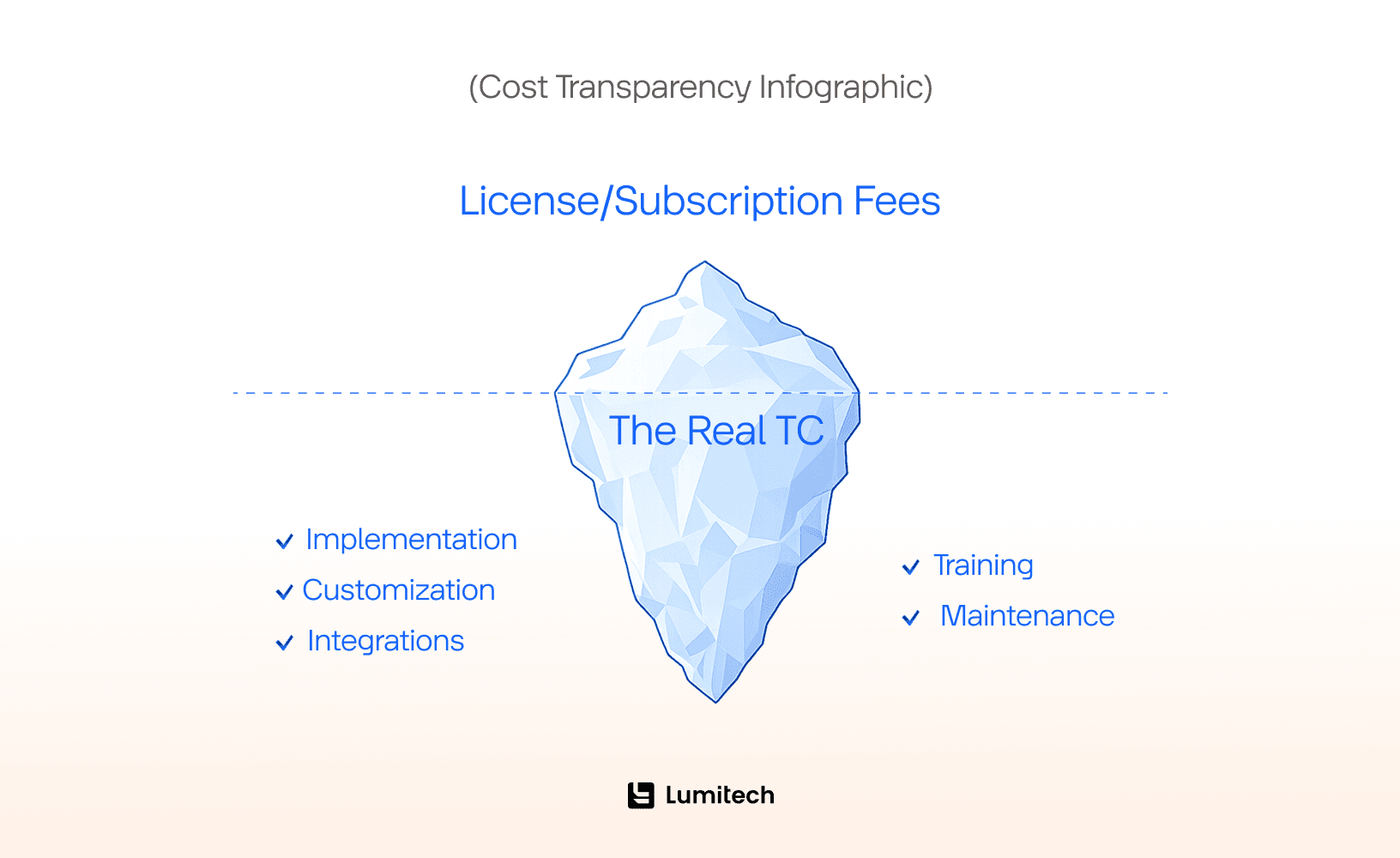
The Real TCO of Best ERP Software in Dubai
Modern ERP is the backbone for a real-time forecasting system that connects orders, inventory, and cash, so leadership isn’t steering by last month’s numbers. If you only budget for licenses, congratulations: your project will become a horror story told at CFO breakfasts.
A widely cited implementation benchmark from Panorama’s ERP research (global dataset) shows:
Median project cost: $450,000
Median project timeline: 15.5 months
Now, your UAE project might be smaller than that median, but the categories of cost are consistent everywhere. Here’s the ERP cost stack that actually matters in the UAE:
1) ERP Implementation Services in the UAE
This includes discovery, design, configuration, data migration, integrations, testing, go-live support.
Rule of thumb: Implementation can range from 1× to 3× your Year-1 software subscription for SMEs, and far more for complex enterprises (multi-entity, heavy customization, multiple integrations). Panorama’s median figures above illustrate how implementation can dwarf licensing.
2) Customization (and the “We’re Unique” Tax)
Some customization is normal. Excessive customization is a business choosing pain.
Customization for ERP software in the UAE becomes expensive when:
processes aren’t standardized
approvals are unclear
requirements change weekly
or the ERP is forced to behave like five legacy systems wearing a trench coat.
To control customization costs, some UAE businesses rely on low-code development services for lightweight workflows and approvals that sit around the ERP without rewriting the core.
3) Integrations (banks, e-commerce, POS, logistics, CRM, HR tools)
UAE companies often run hybrid stacks: Shopify/Magento, POS systems, 3PLs, CRM, industry tools. Integrations for ERP software in the UAE cost money, and then they cost money again when someone updates an API.
For customer portals, supplier onboarding, or order tracking, companies often pair ERP with web development services so external users don’t need ERP licenses just to do basic tasks.
4) Training & Change Management (the Hidden Budget Killer)
The reason for an ERP failure is almost never because “the software was bad”; it’s more usually due to “people not using it”, “data quality deteriorating”, or “Excel carrying out a coup”.
5) Support & Continuous Improvement
Budget for:
vendor support plans
implementation partner support retainers
and internal ERP admins.
After go-live, many firms lean on IT outsourcing companies in Dubai for ERP administration, monitoring, and integration support, especially when internal IT is already overloaded.
6) Upgrades & New Features
Even SaaS has upgrade work (testing, process updates, regression checks). On-prem upgrade projects can be major.
Here’s a realistic breakdown of what you can expect to pay for your ERP solution in Dubai:
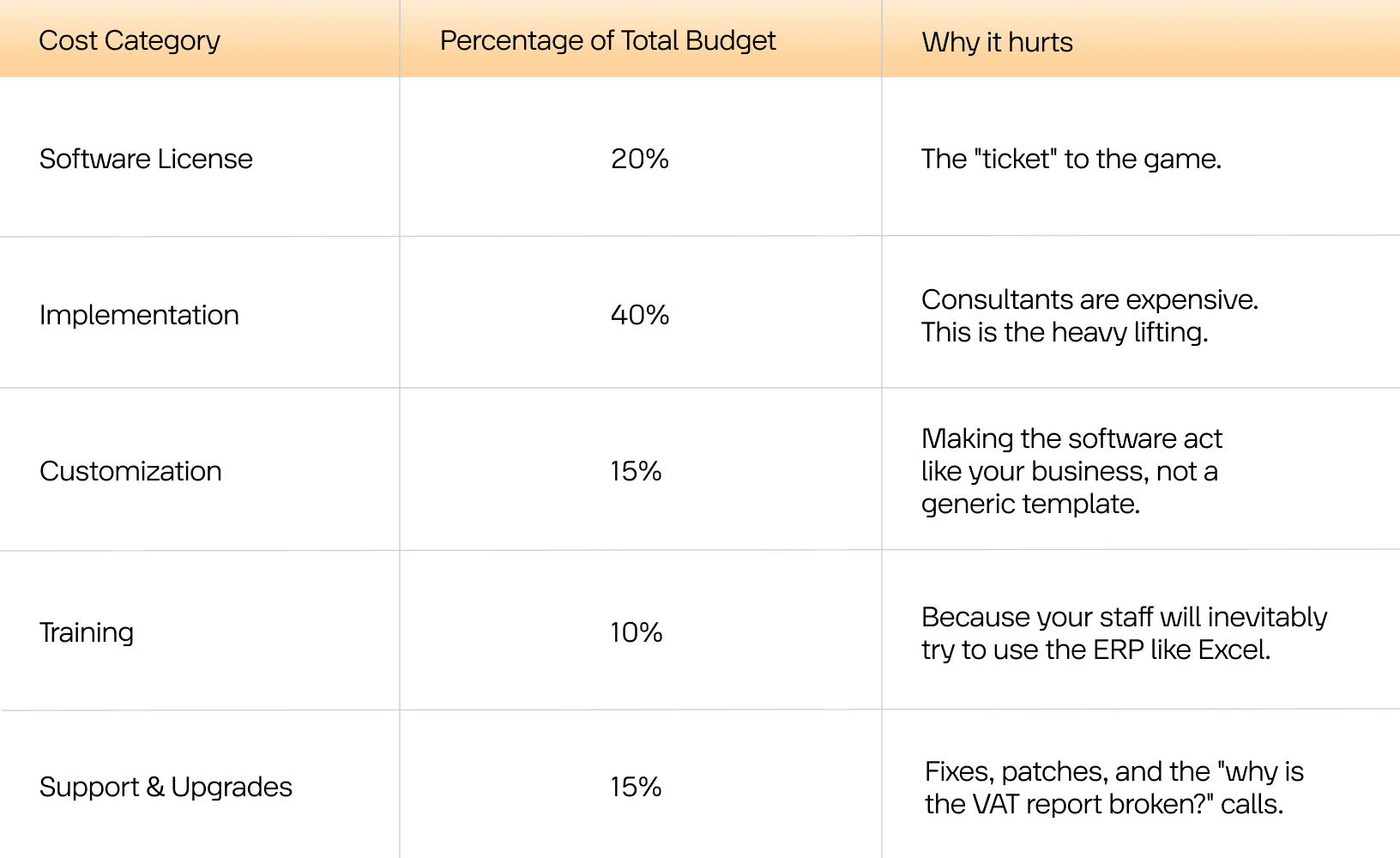
Pro Tip: In the UAE, Data Cleansing is a hidden TCO killer. Migrating messy data from your old legacy system can add 20% to your implementation time and cost.
Planning an ERP budget? We’ll help you model real TCO and avoid the “surprise integration invoice” phase.

ERP Implementation in the UAE: What Determines Timeline
ERP implementation UAE timelines depend far more on scope than on which vendor logo is on the contract. A realistic ERP implementation Dubai project moves through the same phases regardless of platform:
Phase | What it covers |
|---|---|
Discovery/fit-gap | Business processes, entities, requirements, integrations |
Solution design | Configuration vs. customization, security, reporting |
Data preparation | Cleansing, mapping, migration rehearsals |
Build/configuration | Modules, workflows, integrations, extensions |
UAT | Finance reconciliation, inventory, permissions, edge cases |
Cutover | Opening balances, freeze window, go-live plan |
Hypercare | Defects, adoption, monitoring, process tuning |
As a general planning reference — not a verified UAE-wide benchmark — teams often describe rough bands like this: a low-complexity SME rollout (finance, inventory, a few integrations) can land in roughly two to four months if scope stays disciplined; a mid-market project with more warehouses, approvals, and integrations often runs three to nine months; and an enterprise, multi-entity, heavily customized rollout can stretch nine to eighteen months or longer. Treat these as indicative planning bands shaped by scope and data quality, not promises. Digital transformation initiatives that bundle ERP with broader process redesign tend to run longer than a narrowly scoped ERP-only rollout.
Best ERP Software in the UAE for SMEs vs Enterprise
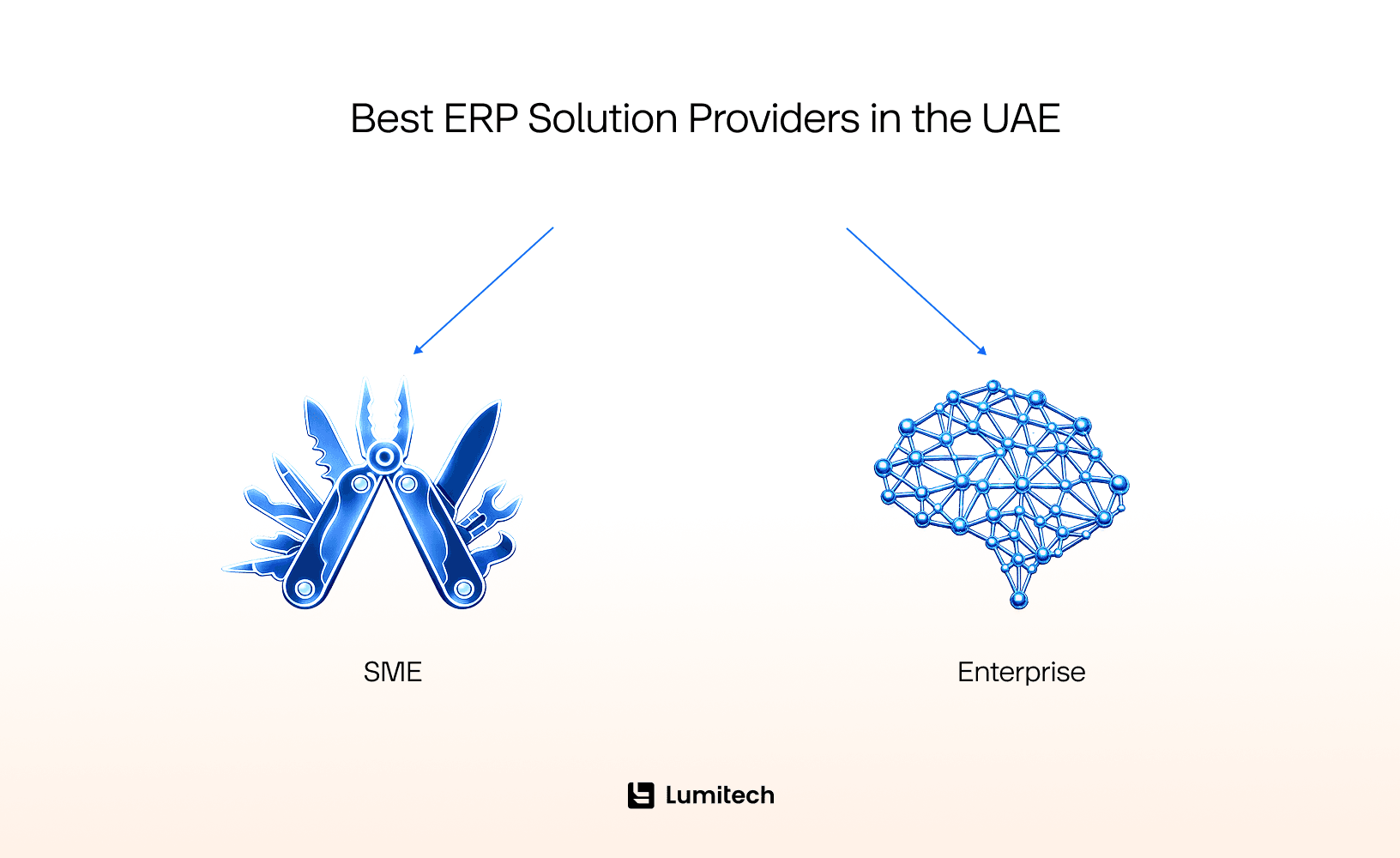
For SMEs in the UAE (Roughly up to ~250 Employees/Simpler Group Structures)
You want fast deployment, lower admin overhead, strong finance + inventory + basic HR, and sane licensing.
Top fits usually include:
Microsoft Dynamics 365 Business Central
Odoo
SAP Business One
Focus Softnet (popular in SME/mid-market across UAE)
A common SME pattern is ERP for finance and inventory, integrated with the best HRMS software in Dubai for onboarding, leave, and payroll workflows, because HR depth often matters more than having ‘one suite’ on paper.
For Enterprises in the UAE (Multi-Entity, High Transaction Volume, Deep Compliance, Complex Operations)
You want serious consolidation, strong controls and audit trails, scalable architecture, and industry depth.
Top fits usually include:
SAP S/4HANA ecosystem
Oracle Fusion Cloud ERP / NetSuite (depending on scale)
IFS (strong for asset/service/manufacturing-centric orgs)
Epicor (strong in manufacturing/distribution)
And sometimes (this matters): a custom ERP build becomes the right answer when your competitive advantage is the workflow, and off-the-shelf ERPs force compromises. That’s where Lumitech comes in.
ERP by Industry: Common Scenarios in the UAE
Beyond company size, common ERP scenarios in the UAE tend to cluster around a handful of operating models.
Trading & Distribution
Multi-warehouse operations, landed costs, and multi-currency transactions are the norm for trading ERP software in Dubai buyers. Look for strong inventory costing, multi-currency handling, and integration with logistics and customs documentation.
Construction & Projects
Construction ERP software UAE buyers need job costing, subcontractor workflows, retention tracking, and progress billing — areas where generic accounting-first ERPs tend to fall short. Construction technology context matters here as much as the module list.
Manufacturing
Bill of materials (BOM), shop floor tracking, and demand planning are the baseline for manufacturing-focused ERP. Vendors with deeper manufacturing operations depth — Epicor, IFS, Sage X3 — tend to outperform generalist platforms once production complexity rises.
Retail & E-Commerce
POS and omnichannel integration, inventory sync across channels, and returns handling matter more than backend accounting depth. Cloud ERP Dubai retail deployments increasingly need to talk to Shopify- or Magento-style storefronts and marketplace integrations out of the box.
When Custom ERP or ERP Modernization Makes More Sense
Sometimes the better answer isn’t a boxed product — it’s a system built around your actual competitive advantage, especially if you’re operating in high-velocity trading/logistics, platform businesses, or niche workflows where off-the-shelf ERP forces awkward compromises.
Lumitech is a UAE-based software development company specializing in custom product and SaaS development, including custom ERP software UAE builds and ERP modernization work, with a UAE-focused business footprint.
When a Custom or Modernized ERP Build Makes Sense
Your workflows are a differentiator, and you don’t want to standardize them into mediocrity.
You need deep integration across systems (banks, logistics providers, marketplaces).
You want a phased roadmap — start with a finance and ops core, add modules gradually.
You need dashboards and data pipelines built for how your business runs today, not a decade-old template.
The Honest Trade-Off
Custom ERP isn’t cheap. But it can be more cost-effective than forcing a poor-fit ERP into your organization through endless customization and workaround culture. You’re trading license fees for product engineering — ideally with clearer control over UX, integration quality, and roadmap. If your current ERP already requires three exports, two VLOOKUPs, and a prayer to close the month, you effectively already have a custom system — it's just custom-built by chaos.
Lumitech's enterprise software development and legacy modernization work covers both new builds and modernizing existing ERP setups that no longer fit how the business operates.
If off-the-shelf ERP doesn’t fit, we can modernize or build ERP modules that match your operations and integrate with banks, HR, and reporting.
ERP Selection Playbook: How to Choose ERP Software Company in Dubai
ERP demos often are like real-estate show apartments: everything is staged, the lighting is flattering, and somehow nobody shows you the tiny room where you’ll be crying during month-end close. The UAE has a dense ecosystem of IT companies in UAE, which is great, until you realize ERP success depends on choosing the right implementation partner, not just the right logo. Finding the best ERP software in the UAE for your business, in other words, comes down to who implements it, not who advertises loudest.
The UAE ERP Reality: You’re Not Buying Software, You’re Buying Operational Behavior
ERP doesn’t just automate processes; it standardizes them. That’s great when your processes are mature, documented, and consistent. It’s a disaster when departments run on tribal knowledge and heroics (“Ask Ahmed, he knows how it works.” Ahmed is not a scalable system.)
When headcount is your biggest cost line, an HR decision-making platform bridges HR activity and financial reality: hiring plans, attrition risk, and budget impact in one place.
So before evaluating vendors, define what you’re trying to standardize:
Are you fixing finance controls and audit trails?
Are you going to be improving inventory accuracy and warehouse discipline?
Are you trying to bring together sales, procurement, and fulfillment?
Or are you creating a reporting structure for a rapidly growing group made up of multiple entities?
Be brutally honest: if your goal is “visibility,” but your data is messy, ERP won’t magically create truth. It will just centralize the mess and make it faster.
How to Compare Vendors to Choose the Best ERP Software in Dubai
A strong UAE ERP evaluation uses three layers:
Layer 1: Fit for your operational shape Trading/distribution-heavy? Project-based construction? Manufacturing? Retail/omnichannel? Shortlist vendors that naturally fit your shape before features enter the discussion.
Layer 2: Implementation reality Most ERP success is implementation quality. Ask vendors/partners to describe:
a similar UAE go-live they’ve done (industry + size),
their data migration approach,
how they handle integrations,
and what they do when requirements change midstream (because they will).
If they can’t talk about testing, training, and cutover like grown-ups, run.
Layer 3: Total cost of ownership (TCO), not Year-1 pricing Use a TCO model that covers:
software subscription/license,
implementation,
customization,
integrations,
support,
training/change,
and upgrades/regression testing.
Conclusion
Choosing the best ERP software in the UAE is less about picking a famous logo and more about picking a system that survives your real life: multi-entity structures, fast-moving operations, VAT discipline, WPS realities, and the daily CFO demand for “show me cash position now, not after three exports and a pivot table.” Once the data is reliable, you can connect finance and operations to talent signals such as employee performance review outcomes, so performance, cost, and capacity planning align.
If you’re an SME, the winning move is usually a clean, fast Phase 1 with strong finance + inventory + essential integrations, then scaling modules as the business grows, rather than trying to implement “everything everywhere all at once” and accidentally inventing a new sport called Month-End Close Wrestling. For enterprises, the priority shifts to controls, consolidation, scalability, and governance, because you’re not just buying software; you’re standardizing how the organization behaves.
And don’t ignore the uncomfortable truth: sometimes the “number 1 ERP software in Dubai” isn’t a boxed product. If your workflows are truly unique, or your competitive edge lives in how you operate (and how quickly you can change), a custom or modernized ERP approach (like the kind Lumitech builds) can be the more rational decision than paying for a platform you’ll spend years bending into shape.
Bottom line: the best ERP software in Dubai, UAE is the one that gets used, stays compliant, integrates cleanly, and costs what you actually budgeted, not what the demo implied. Make the decision with TCO in mind, keep the first rollout practical, and remember: spreadsheets are great… until they become your ERP.


