
How to Build a Real-Time Forecasting System for Data-Driven Decision Intelligence
Real-time forecasting systems are business platforms that continuously update predictions as new information arrives and feed those insights straight into day-to-day decisions.
- Decision Intelligence
December 11, 2025
 AI Overview
Real-time forecasting systems continuously ingest data, update predictions, and push forecasts directly into decision workflows, replacing static monthly or quarterly reports. Core components include event streaming (e.g., Kafka), MLOps pipelines, human-in-the-loop expert input, and low-latency prediction APIs. Because stale data causes outdated predictions, platforms like Arq Decisions combine machine models with human forecasts across a five-step implementation roadmap.

In practice, such real-time demand forecasting systems can be used for sales, inventory management, and strategic HR planning.
Traditional forecasting relies on static, batch snapshots, such as monthly sales reports, quarterly headcount plans, and annual inventory reviews. It is too slow for volatile markets: by the time a slide deck is approved, reality has already moved on. Organizations need continuous prediction loops instead: ingest data, update forecasts, compare to outcomes, adjust, repeat.
This article examines how to design and build such systems in the real world, rather than just on architectural diagrams. As a running example, we’ll use our experience with Arq Decisions — a decision intelligence platform for strategic HR planning. It helps large enterprises systematically capture forecasts from employees, assess their expertise and intuition over time, and bring the most reliable voices into strategic choices.
What Are Real-Time Forecasting Systems, Really?
At their core, these systems are engines that ingest fresh data continuously (or at least very frequently), update predictions, and push those forecasts directly into the workflows where decisions are made. They’re not just dashboards that refresh a bit faster; they’re part of the operational fabric.
It helps to distinguish a few concepts:
Real-time vs. near-real-time. “Real-time” refers to a millisecond-level response for tasks such as ad bidding or fraud detection. Many business cases live comfortably in “near-real-time”: forecasts updated every few minutes, hours, or daily, but reliably and automatically.
Forecast engines vs. reporting dashboards. A reporting layer shows what has happened. A forecasting engine predicts what is likely to occur and exposes that via APIs, planning tools, alerts, or workflow automation.
The necessity for continuous prediction spans all data-intensive operations:
Real-time Demand Forecasting Systems: Analyzing transactions, promotions, and web traffic to predict shifts in customer behavior or inventory needs immediately.
Inventory & Supply Chain: Predicting stock-outs, logistics delays, and component lead times instantly to trigger dynamic reordering.
Risk & Finance: Continuously monitoring market data to update credit risk models or dynamic pricing strategies.
Strategic HR & Workforce Planning: Forecasting headcount requirements, identifying employee attrition risk, and anticipating skill gaps before they become critical.
Where old forecasting lived in slide decks, modern systems aim for AI-powered decision intelligence embedded directly into day-to-day planning and approvals.
Where Human Forecasting Fits
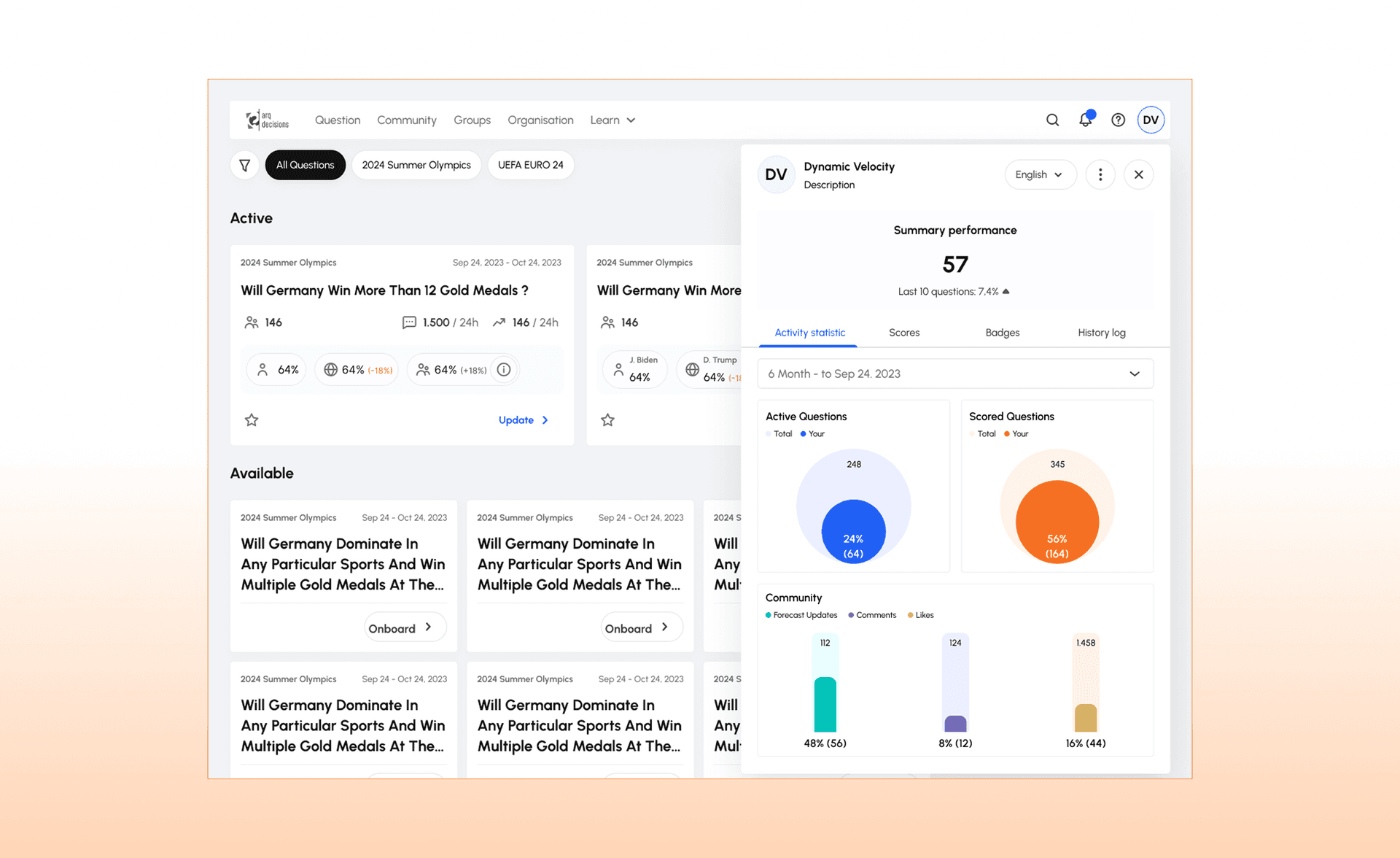
While machine learning models excel at real-time data processing in vast quantities, they often fail when data is sparse, the environment fundamentally changes, or when qualitative knowledge, such as upcoming regulatory shifts or internal politics, is involved. This is where the human element becomes essential.
Human-in-the-loop forecasting systems bridge this gap by establishing structured expert judgment processes (like crowd predictions or Delphi-like methods). This is the mission of Arq Decisions: the platform systematically captures, evaluates, and aggregates human forecasts and expertise, validating the technical prediction model and transforming distributed human knowledge into a structured layer of high-quality, final strategic decision analytics.
Architecture of a Real-Time Forecasting System
To build a real-time forecasting system, you typically follow a layered architecture.
Core Technical Components
Building real-time forecasting systems requires moving data through four distinct, high-speed layers. The initial step is Data Ingestion, which includes continuous streams (such as Kafka events) for real-time data and scheduled micro-batch jobs or API pulls for static data from core systems, including ERPs, CRMs, and HRIS. This data flows into the Storage & Processing layer, typically a cloud-based data lake/warehouse, where stream processing engines (e.g., Flink) run complex, incremental pipelines to calculate features.
The crucial third layer is the Feature and Model Layer. Here, models are trained offline on vast historical data. The resulting model is then deployed to an online/near-real-time scoring environment where it consumes the continuous features computed in the stream processor. Finally, the Serving & Decision Layer exposes these predictions via low-latency Prediction APIs, feeding data into dashboards, applications, and automated alerting workflows.
Human-in-the-Loop Layer (Where Arq Decisions Lives)
The technical real-time prediction system pipeline is a prerequisite for high-quality decision-making, but it often lacks context. This is where the Human-in-the-Loop layer, embodied by the Arq Decisions platform, comes into play. Here, automated forecasting workflows collect predictions from employees and experts on key metrics or scenarios, often asking for probabilities, ranges, and rationales.
The platform then evaluates and calibrates forecasters over time, tracking who tends to be accurate using metrics like Brier scores. Aggregation logic can weight forecasts by historical accuracy or domain expertise and visualize consensus, uncertainty, and outliers. In this way, Arq Decisions acts as a decision intelligence layer that transforms the way organizations approach complex decisions by systematically capturing and synthesizing knowledge within teams and networks, complementing data-driven models and filling gaps when data is limited or ambiguity is high.

Tools & Frameworks to Create a Real-Time Forecasting System
The backbone of any modern forecasting architecture is a specialized toolchain designed for scale, speed, and continuous operation. There’s no single “right stack” for developing real-time data forecasting systems, but most successful setups share similar building blocks.
Data & Streaming
The fundamental step is transitioning data from static records to flowing events. This is achieved through three core mechanisms:
Event Streaming Platforms: Tools like Apache Kafka form the central nervous system, handling massive volumes of high-velocity data — such as user clicks, financial transactions, or sensor data — with low latency and high durability.
CDC and API-based Connectors: Since legacy systems (ERPs, HRIS, manufacturing systems) are rarely stream-native, we rely on Change Data Capture (CDC) tools to monitor database logs and stream changes instantly, treating transactional updates as events. For systems lacking CDC, reliable, low-latency API pulls or scheduled micro-batch pipelines serve as necessary fallbacks.
Data Storage: Scalable, cloud-native storage is required to handle both the historical "cold" data for model training and fast, "hot" key-value stores for serving real-time features to the prediction API.
Modeling & MLOps
Once the data is flowing, the modeling layer provides the quantitative prediction:
Common Approaches: Forecasts often begin with traditional Time-Series Models for baseline seasonality. For complex phenomena like demand, financial risk, or employee churn, Gradient Boosting Machines or deep learning neural networks are used to incorporate thousands of static and dynamic features.
MLOps Stack: Models must live in production, not notebooks. A robust MLOps stack manages the entire lifecycle: experiment tracking for development, a central model registry for versioning, and CI/CD pipelines for automated deployment. Critical to real-time performance is monitoring, which checks for prediction latency, data drift, and model performance decay, triggering automated retraining when necessary.
Decision Intelligence & Human Forecasting
Next comes the decision intelligence layer, where Arq Decisions sits.
You need tools for:
UX for Forecasts: This layer requires user-friendly web interfaces that enable employees to submit structured predictions, including probabilities, ranges, and detailed rationales. Because people interact with the system through surveys, dashboards, and scenario tools, investing in solid UI and UX design services is just as crucial as getting the forecasting models right.
Analytics & Scoring: Sophisticated modules assess forecaster performance, often using metrics such as Brier scores, to identify who is consistently accurate. This creates an expertise assessment and "forecaster reputation" score, allowing the platform to weigh human inputs intelligently.
Visualization & Consumption
Finally, forecasts (machine + human) must be easy to consume:
BI dashboards and planning tools for managers and analysts.
Scenario interfaces for “what if” exploration.
Alerts and notifications when forecasts cross critical thresholds.
For the Arq Decisions, we used a classic tech stack for web development services, primarily anchored in React for the front-end, Node.js for API and microservices, and Amazon Web Services (AWS) for all core infrastructure.
But whatever tools you choose, the litmus test is simple: can decision-makers see, understand, and act on forecasts without needing a data engineer in the room? If not, the stack still needs work.
Challenges in Building Real-Time Forecasting Systems
Developing forecasting systems is less about shiny algorithms and more about wrestling with messy reality — both technical and human.
Data Quality & Latency
The foundation of "real-time" is reliable data delivery. Latency often originates not in the streaming tool, but at the source: missing or late data from legacy ERP or HRIS systems renders even the fastest pipeline useless. Furthermore, large enterprises struggle with inconsistent definitions (e.g., of "sales" or "active user") across global regions or business units. In a real-time environment, if data quality validation fails, the entire prediction engine must halt or output stale results, which demands rigorous in-stream cleaning.
Model & System Complexity
Once the data flows, you have to keep models fresh and reliable in a changing environment. That means synchronizing offline training pipelines with online inference, managing model and feature versions, and monitoring performance over time. Concept drift is inevitable, especially in demand, sales, or HR. Without good observability (metrics, alerts, retraining triggers), a “real-time” system quietly becomes a real-time generator of outdated predictions.
Human Factors & Organizational Adoption
Then there’s the people side. For platforms like Arq Decisions, you need to motivate employees to participate in forecasting workflows and provide thoughtful inputs, not random guesses. You also have to overcome skepticism: “Why should I trust an aggregated forecast over my own gut?” More broadly, you’re asking leaders to shift from HiPPO (highest-paid person’s opinion) to data- and forecast-informed decisions, and to align HR, finance, sales, and operations around a shared view of the future.
Governance, Transparency & Fairness
The final set of challenges involves ensuring ethical and responsible use of real-time prediction systems. Leadership must define governance rules, addressing: Who sees which forecasts? and How do we explain and justify decisions influenced by the prediction? For Arq Decisions, this extends to making the expert evaluation and weighting process transparent and fair, assuring employees that their specialized knowledge is valued, but also rigorously assessed based on past accuracy, maintaining the integrity of the collective strategic knowledge base.
Cost of Building a Real-Time Data Forecasting System
One of the most immediate and critical decisions is the financial commitment. Building real-time forecasting systems involves substantial investment in four main areas:
Main Cost Drivers
Infrastructure: This includes ongoing cloud operational expenditure (OpEx) for scalable streaming infrastructure, high-performance compute for both model training and low-latency inference serving, and specialized data storage.
Engineering Talent: The largest capital expenditure (CapEx) is talent. A successful build requires dedicated Data Engineers (to manage pipelines), ML Engineers (for model deployment and MLOps), and DevOps/MLOps specialists (for platform resilience and monitoring).
Tooling & Licenses: While many core components are open source, specialized software such as feature stores, dedicated model management platforms, and connectors for legacy systems adds significant licensing costs.
Change Management: The non-technical cost of training, internal communication, and the time HR, Finance, and other business teams dedicate to adopting and trusting the new system is often overlooked.
Build vs. Buy vs. Hybrid Real-Time Demand Forecasting System
Organizations rarely build everything from scratch. The decision is typically between a full Buy (using commercial platforms) or a Hybrid approach. The Hybrid model involves leveraging commodity components (cloud data warehouses, MLOps frameworks) combined with custom domain logic built by dedicated development teams. This allows for the integration necessary to feed specialized platforms like Arq Decisions, where generic solutions often fail.
How to Think About ROI
The benefits justify the high cost. Tangible ROI includes reduced over-hiring (saving payroll costs), optimizing budget allocation, and a measurable reduction in employee attrition. Intangible ROI covers improved decision speed, higher confidence, and better cross-functional collaboration. Simple framing suggests: If your real-time forecasting solution reduces unnecessary hiring by X% or high-value attrition by Y%, the system quickly pays for itself.
Implementation Roadmap: How to Get Started
In day-to-day project work, the question of how to build a real-time forecasting system often breaks down into a sequence of small, repeatable steps rather than a single big architectural leap. This roadmap provides a clear, five-step path to move from concept to institutionalized Decision Intelligence.
Step 1: Choose a High-Impact Forecasting Problem
Don't start by trying to fix everything. Select a single, high-impact forecasting problem that is both painful and measurable. This could be predicting short-term demand variability, managing inventory stock-outs, or anticipating a spike in employee attrition. Success here builds crucial internal buy-in.
Step 2: Map Data & Decision Flow
To build a real-time demand forecasting system, before touching code, thoroughly map the ecosystem. You must define where the data comes from (the exact source systems) and, critically, who makes which decisions, and when. This map ensures your latency targets and prediction endpoints align directly with the business need.
Step 3: Build a Minimal Real-Time Loop
Start small. Build a Minimal Real-Time Loop (MRTL) using a simple statistical model or even clear business rules, but with frequent refresh cycles. The goal here is to prove the pipeline's technical viability (ingestion, feature computation, serving) before moving on to complex machine learning. This is also the stage for optional pilot exercises, such as launching a structured human forecasting survey.
Step 4: Add MLOps and Decision Intelligence
Once the MRTL is stable, focus on operationalizing the real-time analytics and prediction. This means implementing the full MLOps stack to automate training, deployment, and monitoring. Crucially, this is the time to introduce structured expert input. Platforms like Arq Decisions can be integrated to ask employees to forecast key outcomes and compare their insights directly against model predictions.
Step 5: Scale & Institutionalize
Finally, scale and institutionalize successful data ingestion and modeling patterns into reusable templates and components for other business domains. Most importantly, integrate forecasting and back-testing (reviewing who and what was right and why) into the core business culture, ensuring the system becomes a source of truth rather than a temporary project.
To accelerate early phases, you can lean on existing AI development solutions for forecasting and focus your internal effort on data quality and embedding predictions into real workflows.
Best Practices & Lessons Learned
Scaling a real-time data forecasting system is fundamentally an exercise in trade-offs and focus. Based on our experience building the foundation for platforms like Arq Decisions, here are the most critical lessons to ensure success:
Start with Decisions, Not Models
The biggest mistake is optimizing an algorithm without knowing its business impact. Always define the decision and action first, then design the forecast to support it. If the HR decision is "trigger a retention interview", the forecast must output a binary risk score that is actionable in that specific context.
Embrace “Good Enough” Real-Time
Don't chase true millisecond latency if it's unnecessary. Don't over-engineer. The immense cost and complexity of perfecting real-time often outweigh the marginal business benefit. Focus on near-real-time (minutes or hours) if that frequency is sufficient to solve the core business problem, whether it's adjusting inventory or allocating recruiter resources.
Use Both Algorithms and People
To create a real-time forecasting system, you should know that the most powerful system is a hybrid one. Utilize machine forecasts for pattern-heavy, high-volume, and objective data (e.g., website traffic, historical sales). Reserve human forecasts (leveraged through platforms like Arq Decisions) for complex, ambiguous, or emerging areas where qualitative knowledge (e.g., market sentiment, competitor strategy) is crucial.
Design for Transparency and Trust
Forecasts must be auditable. Ensure a clear explanation of how both machine and human inputs influence final decisions. For the Decision Intelligence layer, this means designing the system so that the logic for evaluating expertise and aggregating the crowd forecast is open, documented, and fair.
Conclusion: Real-Time Forecasting as a Strategic Capability
Real-time forecasting systems are becoming a core strategic capability, essential across demand, sales, inventory, and HR. The ultimate value, however, comes from combining robust data pipelines and machine learning with a layer of Decision Intelligence. Platforms like Arq Decisions exemplify this, enabling large enterprises to move beyond raw algorithms by systematically capturing, evaluating, and synthesizing internal human expertise.
The time for batch processing is over. We encourage you to identify one single strategic decision in your organization where a real-time, human-and-machine forecasting loop could materially improve outcomes. Start building that minimal viable product today, and begin transforming your data streams into strategic action.


