
How to Perform a Strategic Employee Performance Review for Retention & Growth
Stop treating the employee performance review like an annual HR tax or, worse, an awkward ambush. The performance review is no longer a bureaucratic formality; it is the single most powerful tool for fostering growth, driving engagement, and securing your most valuable talent.
- Best practices
December 17, 2025
 AI Overview
Performance reviews influence far more than compensation and promotions. When structured correctly, they help employees grow, improve alignment with business goals, strengthen engagement, and create a culture of continuous feedback. The challenge is building a process that feels fair, actionable, and valuable for both managers and team members. A thoughtful review framework can turn performance evaluations from a routine HR exercise into a meaningful tool for development and long-term success.

Recent work on performance management finds that structured, narrative-based reviews are strongly tied to motivation and engagement — provided they focus on growth rather than blame. This article walks through what to include in a performance evaluation, which criteria and metrics really matter, and how performance reviews can reinforce engagement rather than kill it. Think of it as an honest guide to turning the dreaded performance review into a process your team actually learns from.
To understand our commitment to growth, you can read more about Lumitech's journey — a history rooted in technical excellence and product innovation that directly informs our people philosophy.
Rethinking Employee Performance Review as a Growth System
If reviews are just an annual verdict — “exceeds,” “meets,” or “does not meet expectations” — no wonder everyone hates them. The goal isn’t to surprise people with a score; it’s to help them grow, stay aligned with business priorities, and feel recognised for real contributions.
Modern performance management is moving sharply toward:
More frequent, lighter-touch conversations instead of one heavy annual meeting.
Development-focused reviews that link feedback to skills and career paths.
Two-way dialogue rather than a manager's monologue.
Companies that adopt this approach see better engagement and retention because employees feel seen and supported, not just judged. So the mindset shift is simple: reviews are a structured checkpoint in an ongoing coaching relationship.
What to Include: The Anatomy of a High-Impact Review
The company's core strategy (and thus its performance reviews) is driven by the results of its in-house development services, making it a relevant starting point. Truly effective employee evaluation examples don't rely on vague ratings or generic praise. It’s a comprehensive document that meticulously balances past accomplishments with future development, ensuring the conversation is anchored in reality and aimed at maximizing potential.
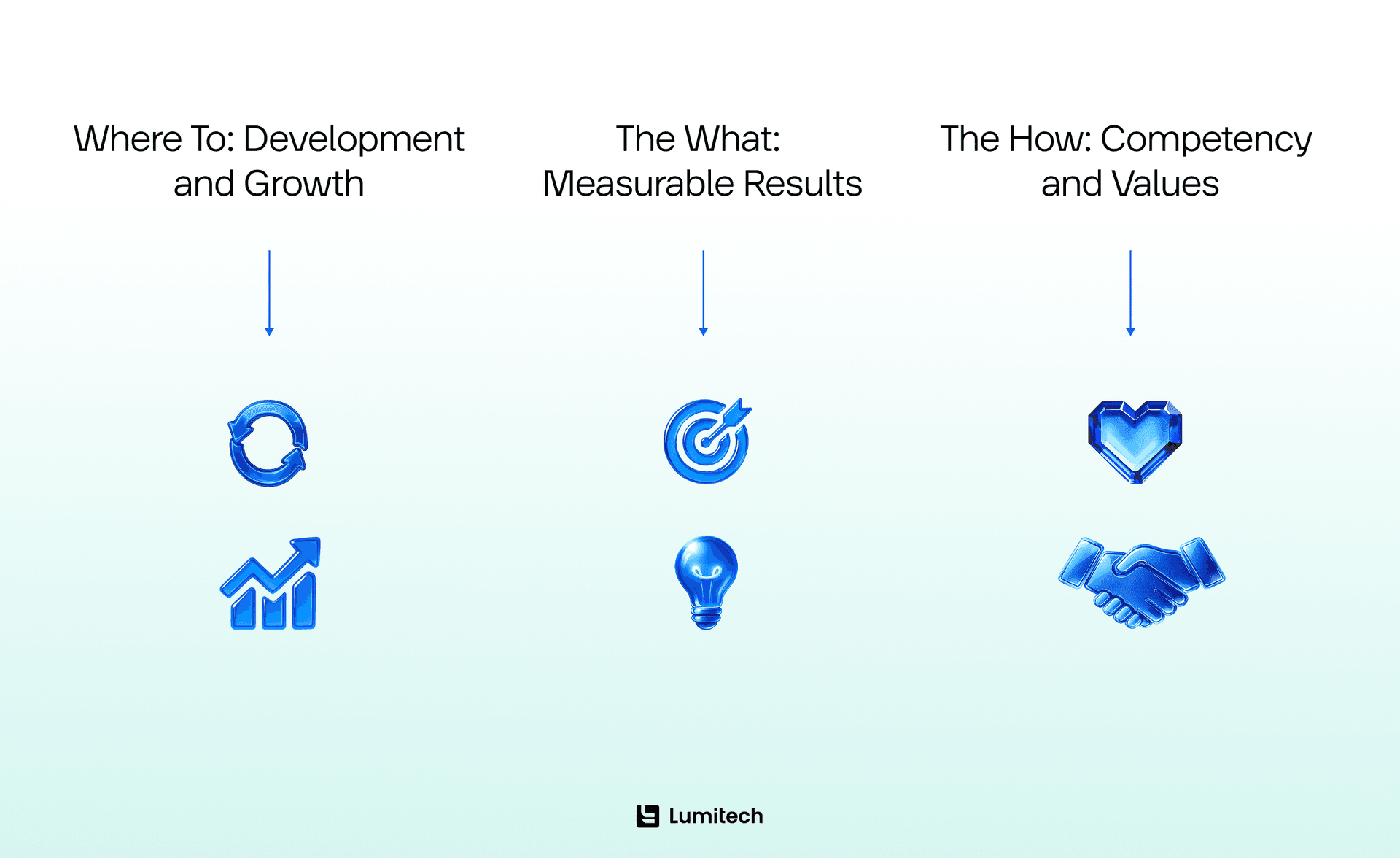
1. The Numbers: Measurable Results (The "What")
Employee performance review must start with objective data. This anchors the conversation, removing the subjectivity that breeds mistrust.
Goal Achievement (OKRs/KPIs): Did the employee hit their defined, measurable goals? Did the developer complete the planned features? Did the salesperson exceed their quarterly quota? Quantifiable metrics are non-negotiable.
Project Impact: Detail specific projects and the tangible business impact. Here’s an example of a performance review phrase: "Reduced cloud hosting costs by 15% through optimisation of EC2 instance usage."
Quantitative Productivity: For roles like software development, this might include metrics like sprint velocity, bug fix rate, or test coverage, always with the understanding that these are indicators, not the sole measure of value.
2. The Behaviors: Competency and Values (The "How")
The "what" is easy to measure; the "how" determines success. High-quality employee review examples spend equal time on demonstrating how the employee operated within the team and the company culture.
Core Competencies: Assess role-specific skills. For an engineer, this includes technical depth, code quality, and architectural decision-making. For a product manager, it's market understanding and roadmap execution.
Organisational Values: How did the employee embody the company's core values? Did they prioritize customer success? Were they transparent? Did they embrace intellectual curiosity?
Collaboration & Communication: Assess their ability to work across silos. Did they proactively share knowledge? Did they communicate risks clearly? This is critical in modern, remote-first teams. The review should also incorporate direct quotes or sample employee comments on performance review from 360-degree feedback to ground the assessment in real-world examples.
Performance in modern companies hinges on effective cross-silo communication. Linking to effective remote meetings directly addresses how that communication happens.
3. The Future: Development and Growth (The "Where To")
Employee performance review examples that don’t conclude with a clear development plan are a failure. This section transforms the review from an assessment into a career coaching session.
Growth Opportunities: Identify specific skills or areas where the employee needs to level up. This should align with their career path.
Resources and Training: Outline concrete actions, such as signing up for a specific course (e.g., advanced React patterns), attending a conference, or shadowing a senior colleague.
Promotion Pathway: If applicable, clarify the criteria for the next promotion. Vague promises are toxic; concrete requirements are motivational.
When critical project needs emerge and internal skills need to be boosted quickly, organisations often turn to IT staff augmentation services to ensure immediate capability while internal team members train up.
Employee Review Examples: What Metrics Should Be Considered During Evaluation?
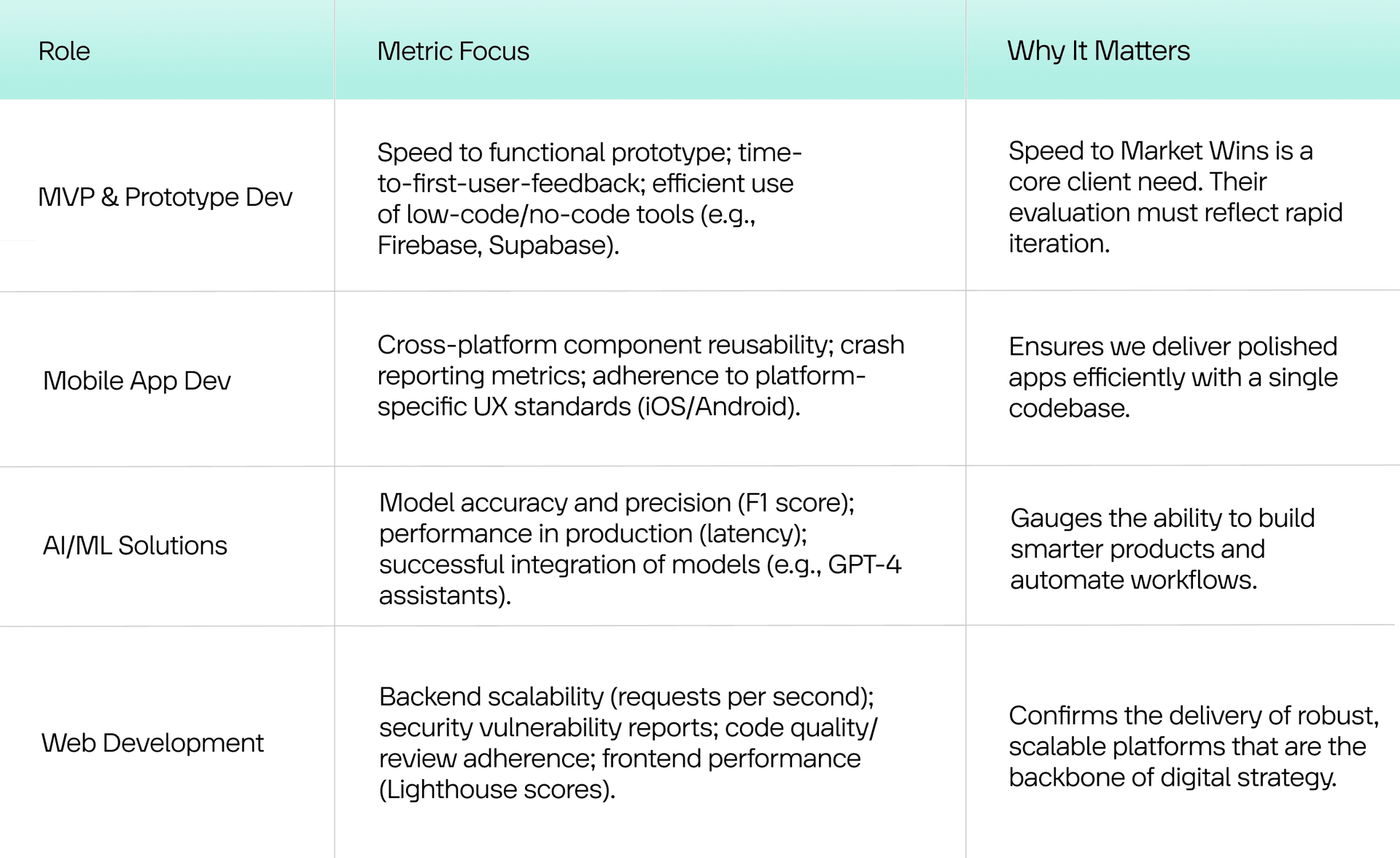
The criteria must be clear, relevant, and communicated transparently before the review cycle begins. One size definitely does not fit all — the metrics for a mobile developer’s job knowledge and expertise are vastly different from those for a marketing specialist.
1. Role-specific technical employee performance review
2. Behavioura and Company-Wide Metrics
Employee evaluation comments must include these metrics to assess the employee's fit, quality of work, and contribution to the overall organisation's success:
Client Communication & Partnership: Since we offer Product Consulting, how effectively did they manage client expectations and contribute sharp product thinking?
Knowledge Sharing: Did they create documentation, mentor junior staff, or lead a knowledge-sharing session? A culture of documentation and knowledge-sharing is a direct value-add to the company's growth culture.
Initiative and Problem-Solving: Did they simply complete tasks, or did they proactively identify and solve issues outside their immediate scope? This reflects the ability to guide clients, not just deliver code.
Feedback Integration: A true indicator of maturity: how well did they receive, process, and apply constructive feedback from their previous review or check-ins?
Can Performance Reviews Really Improve Engagement and Retention?
Short answer: yes, if they’re done well. When they’re poorly done, they absolutely hurt both.
High-quality overall performance comments contribute to engagement and retention in a few specific ways:
Recognition: People stay longer where they feel seen. Reviews are a formal place to acknowledge impact, not just “you’ve been busy,” but “this work moved the needle in these ways.” Research on performance reviews as a retention tool links authentic recognition to stronger commitment and lower turnover.
Development clarity: Reviews that end with clear growth plans — training, stretch assignments, next-step roles — signal that the organization is investing in the person’s future. Evidence reviews on engagement consistently show that learning and development opportunities are major drivers of engagement and retention.
Alignment and voice: A good review is two-way. Employees can surface obstacles, misaligned priorities, or ideas for improvement. That sense of voice is strongly associated with feeling engaged and willing to stay.
On the flip side, biased or purely punitive reviews are strongly associated with lower engagement and increased turnover intentions.
So yes, employee performance evaluation can absolutely help you keep your best people — but only if they’re fair, grounded in reality, and clearly connected to growth.
How to Conduct an Employee Performance Review to Make it Fair and Unbiased
Fairness isn’t “nice to have.” If people believe the process is biased, they will disengage and, eventually, leave. Some studies estimate that more than half of workers see bias in their annual reviews, which significantly affects trust and morale.
Common pitfalls in employee evaluation comments include:
Recency bias: Overweighting the last few weeks and forgetting the rest of the period.
Halo/horns effect: Letting one strong or weak trait color every rating.
Similarity bias: Rating people who remind you of yourself more favorably.
Leniency/strictness: Being an “easy marker” or “tough grader” regardless of reality.
To counter these, best-practice guidance recommends:
Clear, written criteria and rubrics tied to role expectations.
Multiple data points, not just one project or one person’s opinion (use peer feedback where appropriate).
Manager training on bias awareness and how to give evidence-based feedback.
Technology can help here, too: structured forms, calibration dashboards, and analytics that highlight rating patterns can flag where one manager is systematically harsher or more generous than others. Furthermore, making the self-evaluation performance review mandatory as a starting point ensures the employee's documented perspective is submitted before the manager finalizes their review, providing an essential counterweight against potential bias.
Beyond Annual Reviews: Continuous Feedback and Modern Practice
Many companies are rethinking the once-a-year review entirely and moving toward continuous feedback. Some high-profile organizations have even replaced formal reviews with ongoing conversations, compensation and promotion discussions, overall performance comments, and periodic 360s, rather than rigid annual scoring.
This doesn’t mean reviews disappear; it means:
Expectations are discussed more often.
Feedback happens in real time after key projects, not months later.
The “official review” becomes a summary of an ongoing dialogue, not a surprise verdict.
Continuous feedback models have been shown to support engagement and performance when they’re implemented thoughtfully and supported by tools that make check-ins easy rather than adding admin burden.
Employees thrive in environments where they can grow their expertise within stable, dedicated teams focused on a specific product over time. If your organisation isn’t ready to ditch the annual cycle, you can still borrow the spirit of continuous feedback: do lighter mid-cycle check-ins, use 1:1s for regular coaching, and make the review meeting itself feel like “the next step” in a long-running conversation.
How Lumitech fits: tools that support better performance reviews
At Lumitech, we spend a lot of time helping companies build the digital foundations that enable modern performance management. Clients don’t come to us asking for “yet another form”; they want systems that help teams grow faster and make smarter decisions about people and product.
A lot of that starts with speed and learning. Our MVP and prototype development services can help HR and business teams quickly test new performance tools — like lightweight feedback portals, internal coaching apps, or dashboards that unify goals and review data. We use stacks like Replit, Firebase, or Supabase to get something tangible in front of managers and employees fast, then iterate based on actual usage rather than theoretical wish lists.
On the engagement side, mobile and web platforms matter more than ever. Managers need to log feedback on the go; employees want to check goals, request input, and review previous comments on their phone. We build cross-platform apps with frameworks like React Native and Flutter, supported by scalable backends in Node.js or Python, so performance workflows feel like part of everyday work rather than a separate chore.
And of course, AI is changing the game here as well. Integration of AI features has become standard for summarizing feedback threads, suggesting phrasing for reviews, highlighting patterns in comments, and even surfacing early signals of burnout risk. Using NLP and sentiment analysis, we can help HR teams see where morale is drifting or which teams might need extra support long before it shows up in turnover metrics.
Underlying all this is a simple pattern: organizations want lean, scalable, AI-ready platforms that support continuous growth. Our job at Lumitech is not just to deliver the software, but to advise on how these tools can make your performance review process more consistent, more humane, and more effective in driving real team development.
Wrapping Up
Handled with care, performance reviews stop being an annual ordeal and become a lever for growth: they help people see their impact, understand what’s expected next, and feel supported in getting there. That’s how you maximize team growth — not by filling out more forms, but by turning feedback into a continuous, honest conversation backed by the right tools and systems.
If you are ready to be part of a culture that uses performance data not for scrutiny, but for strategic growth and innovation, we invite you to join Lumitech and build the next generation of digital products together.


