Best HRMS Software in UAE (2026): Comparison & Buyer’s Guide
HR management in the UAE has moved far beyond employee records and leave requests. As businesses add free-zone entities, regional teams, and cross-border payrolls, the HRMS connects people operations with compliance and finance.
- For New Clients
August 25, 2026
 AI Overview
HRMS software in the UAE integrates employee records, payroll, attendance, leave, and compliance into a single system, including WPS files and end-of-service benefits. Coverage depends on the employing entity, so mainland, DIFC, ADGM, and free-zone companies each need their own check. Products reach UAE payroll natively, through an implementation partner, or through an Employer of Record.

HRMS Software UAE: The Ten Products
HRMS software in UAE must reflect the structure behind each payroll. A 40-person Dubai company with one entity and a group operating across mainland UAE, DIFC, ADGM, and several GCC countries needs different systems.
This guide compares ten products based on UAE coverage, pricing, and suitability for different business structures. It also explains what buyers should test before signing and when a custom layer can extend the existing HRMS.
How This HRMS List Was Built
HR software UAE covers four different things at once: human resources information systems (HRIS), human capital management (HCM) suites, payroll products, and Employer of Record (EOR) services. We apply the same set of questions to all 10 products and note the product type whenever it differs from that of a standard HRMS.
The assessment uses six questions:
Does it cover the required UAE entity? Support for UAE payroll does not cover every free-zone arrangement.
What does the platform contain? Core HR, payroll, attendance, recruitment, analytics, EOR, and benefits remain separate categories even under a single brand.
Can the vendor demonstrate proficiency in handling WPS and the Salary Information File (SIF)? A statement about “local compliance” settles nothing.
Does it fit the company’s structure of entities, approvals, currencies, and worker types?
How visible is the cost? Public prices allow a first screen; quotes need a scoped estimate.
What needs confirmation? Vendor claims evidence of product scope; the buyer still tests the exact UAE configuration in a demo and pilot.
Those six answers built the shortlist. Each column records what a vendor documents, and every unresolved point stays visible.
Quick Comparison: HRMS Software UAE
The best HRMS software in Dubai depends on the employing entity. A mainland business runs one WPS route; a group with a DIFC subsidiary runs separate payroll rules and reports above them. Compare HRMS systems in UAE first by structure, then by size and features. The table records the documented scope, and the profiles add pricing and the exceptions to test before signing.
Solution | Workforce size | UAE payroll and WPS | UAE and regional coverage |
|---|---|---|---|
1. Bayzat | SMB to mid-market | Built-in WPS reporting WPS files and bank-transfer reports | UAE focus |
2. ZenHR | SMB to enterprise | WPS files and bank-transfer reports | UAE and wider MENA |
3. Cercli | Scale-up to enterprise | UAE WPS inside MENA payroll | MENA payroll and compliance |
4. gulfHR | Mid-market to enterprise | WPS integration with core HR and payroll | UAE and GCC |
5. Zimyo | Small to mid-market | Automatic WPS file generation | Dedicated Middle East edition |
6. Zoho People with Zoho Payroll UAE | Small to mid-market | WPS, pension, gratuity, and SIF files | UAE payroll product available |
7. greytHR Middle East | Small to mid-market | WPS-compliant SIF generation | GCC edition |
8. Darwinbox | Enterprise | Configuration-dependent: country payroll set per deployment | Global HCM, UAE scope needs confirmation |
9. Menaitech | Mid-market to enterprise | UAE WPS needs confirmation; public compliance material centres on Saudi | MENA, with a dedicated UAE site |
10. Deel | Any size with an international footprint | EOR route: Deel’s own entity carries WPS registration, with direct UAE payroll also offered | Global platform with UAE country coverage |
Regional products place UAE payroll at the centre of their materials. Darwinbox, Menaitech, and Deel also publish coverage, but delivery differs: licensing a country payroll, configuring it through an implementation team, or appointing an EOR. The contract must name the model and the party responsible for a failed run.
Documentation confirms what a product supports; the employing entity decides which rules apply to each worker. Establish whether WPS applies and which authority governs gratuity, pension, and data before making a choice.
HR Software in Dubai: What Buyers Need to Check
The best HR software in Dubai must support the regulations applicable to the legal entity employing each worker. Dubai may appear as a single jurisdiction from the outside, yet the mainland, DIFC, ADGM, and other free-zone entities may follow different employment, payroll, and data rules. Products marketed as HR software for UAE labor regulations still need to demonstrate coverage for every entity, and no assumption should be made that WPS applies to all of them.
Mainland Requirements for HRMS Software Dubai
MoHRE describes WPS as the channel through which covered private-sector establishments pay wages through approved banks, financial institutions, and exchange houses. Its December 2025 platform update expanded digital payment channels and direct integration.
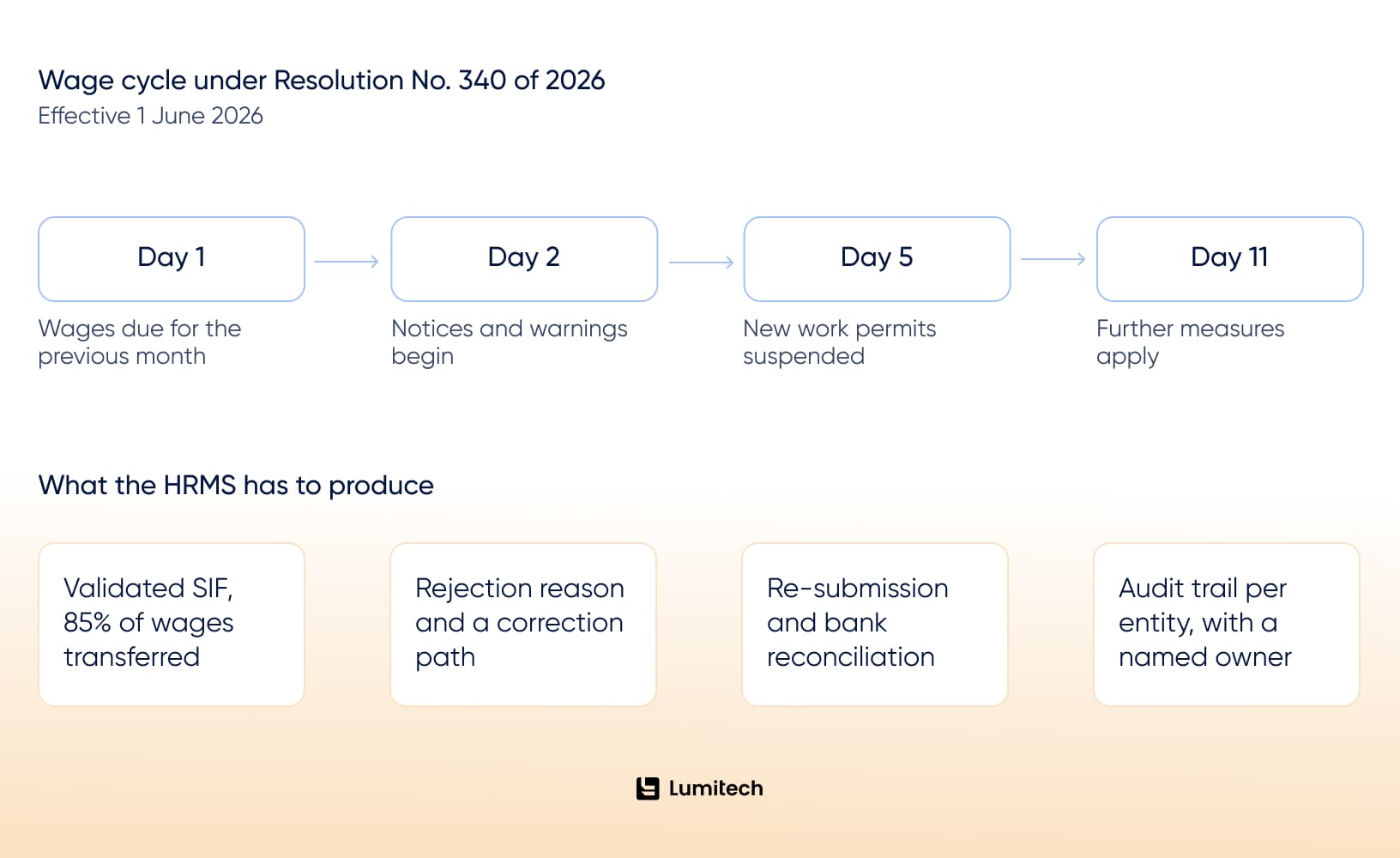
Ministerial Resolution No. 340 of 2026 was issued on 12 May 2026 and took effect on 1 June 2026. It sets the first day of each Gregorian month as the unified due date for the previous month’s wages, so any payments made later are considered delayed. The annex starts notices and warnings on day two, suspends new work permits on day five, and introduces further measures from day eleven. MoHRE describes the process as staged, giving an employer time to correct a delay before subsequent administrative measures are applied.
DIFC / ADGM and Free-Zone Differences
DIFC publishes its own Employment Law and Data Protection Law; ADGM applies the ADGM Data Protection Regulations 2021. Requirements depend on the jurisdiction, so the buyer confirms the regime of each entity instead of assuming that every free zone operates the same way. A group holding mainland and free-zone companies may need separate payroll configurations with consolidated reporting above them.
Multi-Entity Payroll, Data Protection and Integrations
Federal Decree-Law No. 45 of 2021 regulates the processing of personal data and cross-border transfers. It imposes no blanket rule requiring employee data to remain within the UAE, while DIFC and ADGM add their own requirements. The federal overview of data protection law sets out the conditions that apply in its place.
Where payroll has to post to finance, Lumitech's guide to ERP software in the UAE covers the integration side of the same stack.
These obligations also belong in a UAE evaluation:
End-of-service benefits under Article 51 of Federal Decree-Law No. 33 of 2021 are calculated for full-time expatriate workers based on length of service and basic salary, with no single formula applicable across employment models.
General Pension and Social Security Authority (GPSSA) handling for eligible UAE and GCC nationals is treated as a payroll capability where applicable.
Emiratisation targets: 2% annual growth in the number of Emiratis in skilled positions for companies with 50 or more employees, measured as 1% per half-year, and a fixed hiring requirement for companies with 20 to 49 employees in specified sectors only. Nafis is an Emirati talent programme, and no HRMS integrates with it by default.
The AED 6,000 monthly minimum salary for Emiratis in the private sector takes effect on 1 January 2026, with existing contracts to be adjusted by 30 June 2026.
Document-expiry workflows, biometric and attendance integrations, and Arabic and English employee self-service.
Regulatory scope changes over time. Confirm entity-specific obligations with the relevant authority or a qualified UAE adviser before configuring payroll or compliance rules.
Unsure which rules apply to your entities? Lumitech can map the employing entities, payroll routes, and reporting obligations before you compare products.

Top HRMS Software UAE Options by Category
The HR software solutions UAE companies shortlist fall into four buying cases: UAE and GCC payroll, cloud HR for smaller employers, enterprise HCM, and cross-border employment. The profiles compare HRMS software for businesses in UAE with different entity structures, payroll countries, and implementation capacity.
Localised and Compliance-Focused
Localised platforms place UAE and GCC payroll rules at the centre of the product. Shortlist them when local payroll and compliance carry the greatest operational risk.

1. Bayzat
Location: Dubai, UAE
Focus: HR, UAE payroll, benefits and insurance
Pricing model: Quote-based
Best for: UAE SMBs and mid-market companies buying HR, payroll, attendance, and benefits together
Bayzat was founded in Dubai in 2012 and states that it serves over 4,000 companies in the Middle East. Its product pages list the following:
Health insurance administration alongside HR, including policy tracking and claim submission.
Payroll with WPS reporting and SIF file generation.
A mobile self-service portal for payslips, leave requests and identity documents.
Shift scheduling, attendance, and overtime feed the payroll run.
Points to verify: coverage for every legal entity, the end-to-end insurance workflow, reporting depth, integrations, and where UAE support ends and wider GCC support begins.

2. ZenHR
Location: Amman, Jordan, with UAE and wider MENA coverage
Focus: Core HR, payroll, leave and performance
Pricing model: Quote-based
Best for: companies running bilingual HR and payroll across the UAE and neighbouring markets
ZenHR's UAE page lists native integrations with SAP Business One, NetSuite, Dynamics 365, Odoo, QuickBooks, and Xero. The vendor also documents these functions:
Arabic and English interfaces for both administrators and employees.
EOS calculation aligned with UAE Labour Law, including termination type and unused leave.
Biometric attendance hardware integration and geo-fenced check-ins.
Applicant tracking from job posting through digital offers to onboarding.
Points to verify: which modules the proposal includes, how multi-entity reporting works, free-zone coverage, and which integrations arrive without custom development.

3. Cercli
Location: Dubai, UAE
Focus: MENA payroll, contractors, EOR, and payments
Pricing model: Quote-based
Best for: growing MENA companies paying several worker types across countries
Cercli raised a USD 4 million seed round as Afore Capital's first MENA investment. Its payroll pages list the following:
One dashboard for full-time employees, independent contractors, and EOR workers.
WPS file validation before submission, with local and cross-border payments.
Visa, work permit, and onboarding status tracking across MENA.
Points to verify: depth of core HR, talent, performance, and analytics, and which worker types the UAE configuration covers.

4. gulfHR
Location: Dubai, UAE
Focus: Core HR, payroll, time and attendance across the GCC
Pricing model: Quote-based
Best for: mid-sized and larger GCC organisations consolidating regional HR and payroll
gulfHR has been operating since 2003, holds ISO/IEC 27001 certification, and serves over 500 client companies. Its pages describe:
Payroll configured for the UAE and neighbouring GCC countries on one platform.
Multi-tier approval workflows for leave, documents, and expense claims.
Overtime and shift computation set against local labour rules.
Points to verify: analytics and API scope, the standard implementation pattern, and a reference architecture for multi-country payroll.
Cloud HR Software UAE Options for Small Businesses
A small UAE company usually starts with the monthly fee. Yet products listed under “HR software for small business UAE” still need to cover entity-level payroll, local compliance, and the cost of adding a second entity. Compare the full licence, implementation effort, and multi-company cost rather than just the entry price.

5. Zimyo
Location: Gurugram, India, with a Middle East edition
Focus: Core HR, payroll, attendance, and performance
Pricing model: Published pricing page; confirm the UAE package
Best for: cost-conscious UAE SMEs that still need Emiratisation and WPS handling in the product
Zimyo’s Middle East line publishes per-employee prices in dirhams, which is unusual in this segment. Its pages list:
Emiratisation quota monitoring with threshold alerts. Nafis is a separate government talent programme, and no HRMS integrates with it by default.
SIF validation before submission, flagging missing IBANs and formatting errors.
EOS calculation covering resignation, termination, and variable allowances.
Points to verify: which claims apply to the Middle East edition specifically, entity limits, multi-currency handling, Arabic payslip output, and integrations.

6. Zoho People with Zoho Payroll UAE
Location: Chennai, India, with a UAE payroll product
Focus: Core HR plus a separate UAE payroll product
Pricing model: Public pricing for Zoho Payroll UAE
Best for: small and growing companies already standardised on Zoho applications
Zoho Payroll UAE publishes its rate openly, which allows a budget screen without a sales call. The two products together are documented to cover:
Organisational structure, document storage, project hours, and leave in Zoho People.
WPS and SIF generation, GPSSA pension contributions for eligible nationals, and EOS processing in Zoho Payroll.
Payroll ledger entries and expense approvals are posted into Zoho Books and Zoho Expense.
Points to verify: the combined licence model, workflows shared between the two products, limits by legal entity, and the cost of advanced approvals.

7. greytHR Middle East
Location: Bengaluru, India, with a GCC edition
Focus: Payroll-led HR for smaller GCC employers
Pricing model: Public plans with paid add-ons
Best for: small and mid-sized GCC companies that want a visible entry price
The Middle East edition publishes its plans, and the vendor lists:
SIF file creation with password-protected payslips distributed by email and app.
Leave and absence accrual for annual, sick, and compensatory leave.
Self-service requests for salary certificates, salary advances, and claims.
Points to verify: per-employee rates above the base plan, Arabic support, multi-company cost, and which features require add-ons.
AI/Automation & Analytics-Focused
These platforms compete on automation, mobile experience, and reporting depth. A wide HCM scope does not prove the WPS workflow, so employee lifecycle management UAE teams still test local payroll delivery.

8. Darwinbox
Location: Hyderabad, India, with Middle East operations
Focus: End-to-end HCM, payroll, talent, and analytics
Pricing model: Quote-based
Best for: enterprises that want automation and analytics across a large, multi-country workforce
Darwinbox was named a Strong Performer in the Forrester Wave for HCM and serves over 1,000 enterprises across 130 countries. Its regional pages describe these areas:
Hire-to-retire coverage from talent acquisition through onboarding, performance, and exit.
Mobile authentication by one-time code for field and deskless workers without corporate email.
OKR, KPI, and 360-degree performance frameworks with pulse surveys.
Organisational modelling, attrition-risk scoring and workforce reporting.
Points to verify: how UAE payroll is delivered, demonstrated WPS, SIF, EOS, pension, and Emiratisation workflows, and who owns them after launch.
Enterprise HCM
The label “scalable HRMS solutions UAE” usually refers to platforms that can manage several entities, countries, and reporting structures. Enterprise buyers still need to test local payroll delivery because regional HCM coverage does not prove the configured WPS process.

9. Menaitech
Location: Amman, Jordan, with offices in Dubai and across MENA
Focus: HR, payroll, talent management, time and attendance
Pricing model: Quote-based, enterprise, or cloud subscription
Best for: mid-sized and large UAE and GCC employers, holdings, and public-sector bodies that need deep Middle East localisation
Menaitech runs a modular product line covering payroll, core HR, employee self-service, and analytics. The vendor documents these areas:
MenaPAY®, regional payroll: WPS automation for the UAE, GPSSA pension contributions for GCC nationals, and end-of-service calculation across MENA employment models.
Curio®, workforce management: organisational structure, headcount planning, performance appraisal, and learning management.
Arabic and English by design: a native bilingual system built around Middle East document flows and government platforms.
MenaME and Mena360: employee self-service, mobile approvals, and predictive reporting on workforce cost.
Points to verify: UAE WPS and SIF generation end-to-end, Emiratisation reporting, GPSSA handling for the UAE specifically, which modules the quote covers, and whether the UAE deployment matches the Saudi one.
Cross-Border Employment and Employer of Record
An Employer of Record platform hires and pays staff through its own legal entity, making it a different purchase from a licenced HRMS. UAE shortlists often mix the two.

10. Deel
Location: San Francisco, United States, operating globally
Focus: EOR, contractor management, global payroll, and HR
Pricing model: Product-specific
Best for: international companies hiring in the UAE or consolidating cross-border payroll
Deel was placed as a Leader in Everest Group's EOR PEAK Matrix 2025 and states that it owns entities and a payroll engine across 130 countries. Its UAE material describes the following:
Employment through Deel's own UAE entity, covering MoHRE compliance, visas, and payroll.
Locally compliant contractor agreements, document verification, and invoice consolidation.
Multi-currency payouts for contractors and remote employees.
Points to verify: who holds the WPS registration, the employing entity for each worker, payroll scope, core HR depth, and which employer obligations transfer under the EOR contract.
Only three products on the shortlist publish usable entry prices; the other seven require a scoped quote. That makes the pricing structure the next point of comparison.
How Much Does HRMS Software Cost in the UAE?
HRMS pricing usually follows one of five structures: a fee per employee per month, a base fee plus employee charges, module-based tiers, an enterprise quote, or a separate implementation and services fee. The number on the pricing page rarely equals the first-year cost.
Three public examples show why products should be compared by scope, with no attempt to average them into a single UAE benchmark:
Product | Public price checked in August 2026 | Included scope | Important note |
|---|---|---|---|
Zoho Payroll UAE | Standard: AED 35 per organisation/month billed annually, including 5 employees; AED 7 per additional employee | Payroll, WPS, pension, gratuity, SIF files, employee portal | Payroll product; confirm Zoho People and other module costs separately; prices exclude VAT |
greytHR Middle East | Essential: USD 50/month for 10 employees, then USD 2 per additional employee; Growth: USD 60/month, then USD 3 per additional employee | Essential includes payroll, leave, basic core HR; Growth adds attendance and advanced HR | Page labels figures as estimates and excludes taxes; add-ons and premium scope change the total |
Zimyo Middle East | Basic: AED 10 per user/month; Standard: AED 20; Enterprise: AED 30. Billed monthly, minimum 25 users | Core HR, WPS payroll, gratuity, attendance, and performance; Enterprise adds multi-entity payroll across Middle East markets | Add-ons for recruitment, timesheets, and field tracking are priced separately per employee; confirm which UAE package the quote covers |
The other seven products require a sales quote. Request a pricing sheet that separates:
Subscription or licence fees by employee, user, entity, country, and module.
Implementation, configuration, and local payroll setup.
Historical data cleansing and migration.
Integrations for attendance devices, banking, ERP, finance, identity, and benefits.
Custom reports, workflows, and approval rules.
Sandbox, testing, training, support, and post-launch changes.
VAT and third-party partner or payment charges.
The first-year total cost of ownership (TCO) is the sum of these elements. Treat any implementation figure as indicative and scope-dependent unless the vendor publishes it.
Prices become comparable only when they cover the same payroll process. WPS generation, rejection handling, and reconciliation therefore require separate tests.
Payroll and WPS Support: What to Verify in a UAE HRMS
Resolution No. 340 treats an establishment as compliant once it transfers at least 85% of total wages by the deadline, and lawful deductions may account for the balance without the employee losing the right to claim the balance. The resolution also permits delegated wage processing once MoHRE has the delegate’s details and scope, while responsibility for timely payment stays with the employer.
Credible payroll software generates, corrects, and reconciles the WPS file. Ask the vendor to run one anonymised pay cycle with allowances, lawful deductions, leave, an employee exit, and a rejected SIF.
How to Choose HRMS Software in UAE
Buyers comparing HR management software in UAE should define the operating model before booking demonstrations. The implementation effort is determined by entity count, payroll migration, attendance devices, ERP and finance integrations, historical data, security review, testing, and training. The seven steps below bring those dependencies into the review before vendors quote the work.
Map every entity and worker type, then assign each one its regulator, payroll country, and payment route.
Write migration and compliance acceptance tests covering historical data, WPS and SIF, EOS, Emiratisation, pension, document expiry, and data transfers.
Separate core requirements from optional modules, including custom workflows, approvals, analytics, and AI functions.
Design integrations early, naming the owner and direction of every data flow. Teams without an internal data function can bring in data engineering and analytics support once the architecture is clear.
Run task-based demos with the same payroll scenarios, migrated data sample, security roles, rejected SIF, and reconciliation process.
Model first-year and steady-state cost, including testing, training, internal staff time, support, and future entities.
Assign ownership for local rules, release testing, payroll exceptions, and user support.
Those seven checks narrow the choice to a licenced product, an HRMS with a custom layer, or a full build. HR digital transformation UAE usually starts from the same entity map, so digital transformation services scoping and HRMS selection read from one source.
Buy an HRMS, Add a Custom Layer, or Build?
The choice depends on process fit, integration load, regulatory scope, and the role of HR data. Most UAE groups end up with a licenced HRMS and a separate integration, workflow, or data layer. The right boundary becomes clear only after the company maps the process that the standard product cannot support.
Situation | Rational path | Reason |
|---|---|---|
One entity with standard payroll, leave, and attendance | Ready-made HRMS | Faster setup and a vendor-maintained compliance core |
Several entities or unusual approval chains | HRMS plus integrations or a custom workflow layer | Keeps proven transactional modules while adapting the process around them |
Fragmented HR, payroll, finance, and planning data | Custom data and decision layer | Creates a consistent model for reporting, analytics, and workforce forecasting |
A unique HR product or workflow is part of the company’s IP | Custom HR platform | Makes sense when the process cannot be expressed responsibly in standard software |
Most companies land on the hybrid route: keep the HRMS and build around a defined gap. A short product discovery phase sets that boundary before anyone commits to licences.
For a custom layer, MVP development tests the riskiest workflow first. For an ageing on-premise stack, legacy modernization is often the shorter route.
Buyers weighing embedded HR automation against specialist development can review Lumitech's directory of AI companies in the Middle East. Where the requirement is a model instead of a module, AI and ML development belongs in the scope from the start.
Where payroll works but workforce planning does not, the HRMS stays, and a separate decision layer uses its data. The case that follows shows that boundary in practice.
From HR Data to HR Decisions: A Lumitech Example
An HRMS records employees, payroll, and completed transactions. Headcount plans and skills demand need scenario testing, expert input, and forecasts checked against outcomes.
Lumitech's HR decision-making platform case shows that additional layer is in use. Arq Decisions was built for HR teams and corporate managers at a Hamburg-based client, and it does not run payroll or hold employee records.
A UAE buyer keeps those functions in the operational HRMS, unifies the data model above it, and adds a decision intelligence layer to address questions the core system answers poorly. Teams comparing HR analytics software in UAE should examine data governance first, because consistent definitions of headcount, cost, and role determine the quality of every report that follows.
Conclusion
The best HR software in UAE is the product that can run the buyer’s actual payroll across every employing entity, approval route, and finance handoff. A regional product page may justify a demonstration. The contract should follow only after the vendor completes WPS generation, rejection correction, reconciliation, and finance posting in the configured environment.
A business with a single mainland entity may obtain everything it needs from a UAE or GCC platform. A multi-country group may need a global HCM system connected to local payrolls. Complex approvals, integrations, or fragmented data may require a custom layer on top of the existing HRMS.