
AI Sentiment Analysis for HR: Smarter Employee Forecasting & Retention
By the time a problem shows up in your HR dashboard, it’s usually already expensive. Attrition has spiked, burnout is visible in sick notes, or a “high-performing” team quietly crumbles. None of this happens overnight.
- AI Development
December 05, 2025
 AI Overview
AI sentiment analysis for HR uses natural language processing to detect emotional tone in employee feedback, Slack messages, and exit interviews, turning unstructured text into attrition and burnout forecasts. Key components include emotion classification, topic detection, and anomaly flagging by team. Since replacing an employee can cost half to twice their annual salary, early sentiment shifts let HR intervene months before resignation.

The warning signs were there in survey comments, Slack messages, exit interviews, and 1:1 notes – just scattered, unstructured, and ignored because nobody has time to read thousands of lines of text every quarter.
AI-powered HR forecasting is basically a way to connect those dots before things break. It takes what people are already saying and turns it into signals you can trend, compare, and, crucially, use for forecasting: which teams are drifting toward burnout, where attrition risk is building, how a big policy change is actually landing, and what the next 6–12 months might look like if you do nothing.
In this article, we’ll walk through why HR should use sentiment data for decision-making, what AI sentiment analysis actually adds, how it feeds into forecasting, the ethical traps you absolutely need to avoid, and whether any of this replaces classic employee surveys (spoiler: no).
What is AI sentiment analysis for HR?
Sentiment-driven HR forecasting models use AI to read text (and sometimes voice) and infer emotional tone and themes. Instead of manually reading every comment like a doomed intern, you let algorithms process:
Open-ended survey responses
Exit interview transcripts
Feedback from engagement platforms
Opt-in suggestions, forms, and internal forums
Modern tools don’t just mark things as “positive” or “negative.” They can:
Classify emotions (frustrated, anxious, optimistic, cynical)
Detect topics (workload, pay, leadership, career growth, remote work)
Track changes over time by team, role, or location
Flag anomalies – sudden morale drops in one unit, for example.
There’s a growing body of work on AI tools for employee engagement, showing that these models can uncover disengagement and early burnout signals in workplace communication and use them to support targeted retention plans.
Once you connect those emotional signals to outcomes like attrition, absenteeism, and performance, you’re no longer just measuring feelings — you’re using them as inputs to forecast what happens next.
Why HR Teams Must Listen to the Algorithmic Whisper
HR sentiment analytics is the rich, qualitative gold that has historically been too time-consuming or massive for human HR teams to process effectively. Ignoring this data is like sailing without a weather report — you might survive, but you’ll never thrive.
Here’s the blunt truth: If you rely only on structured, numerical data (like turnover rate or absence days), you’re seeing the symptoms, not the disease. Sentiment data, pulled from the unstructured text of employee communications, gives you the context, the "why," and the emotional temperature of the workplace.
The Business Case for Emotional Data
- 01
Retention is a Fortune Teller’s Art: The cost of replacing an employee can be anywhere from half to twice the employee's annual salary. Sentiment analysis serves as an early warning system for disengagement. By tracking a dip in positive language or a spike in frustration-related keywords in internal forums, HR can predict who is at risk of leaving months before they update their LinkedIn profile. This predictive capability allows HR to initiate targeted interventions — a career discussion, a mentorship offer, a workload adjustment — before a valued employee walks out the door.
- 02
Uncovering the ‘Silent Majority’: Traditional surveys often suffer from response bias; either the super-engaged or the super-disgruntled speak up. AI, by analyzing organic communication from diverse channels (if ethically and legally sourced, a major caveat we’ll address later), provides a more holistic view. Decision intelligence solutions give voice to the silent majority — the neutral, the indifferent, the quiet achievers — whose shifting sentiment is often the most critical leading indicator of future organizational health.
- 03
From Lagging to Leading Indicators: HR has long been plagued by lagging indicators: data that describes what already happened (e.g., last quarter’s turnover). AI sentiment analysis for HR delivers real-time or near-real-time leading indicators (e.g., a sudden collective frustration about a new internal policy), allowing HR to intervene when the problem is still a manageable spark, not a company-wide blaze.
The Transformative Benefits of AI-Powered HR Forecasting
When you actually put this into practice, a few benefits show up quickly. What you’re seeing with AI sentiment analysis is part of a bigger shift in how AI is changing SaaS systems, from static dashboards to products that continuously learn from employee behavior and feedback.
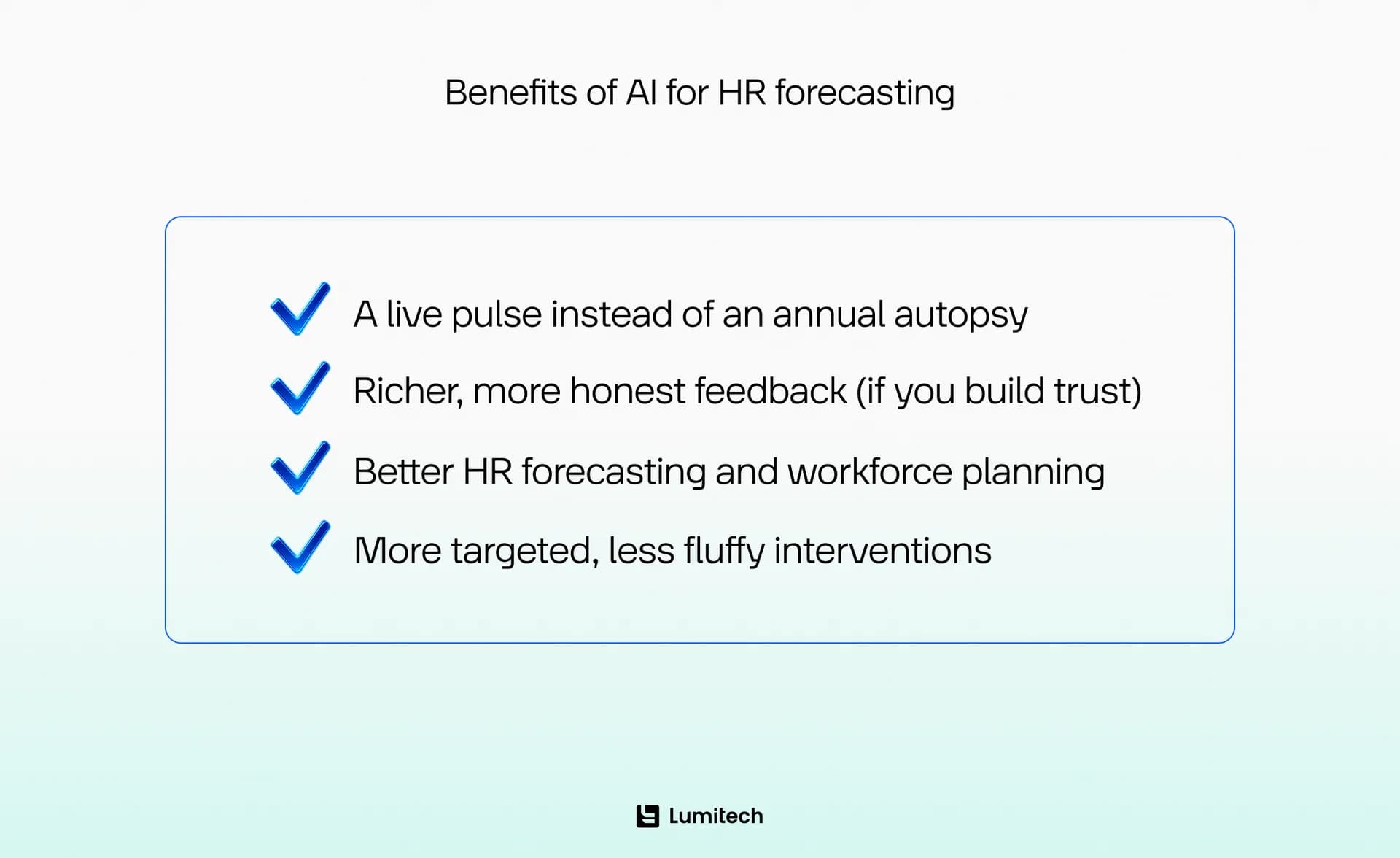
1. A live pulse instead of an annual autopsy
HR data forecasting AI can process new text continuously or in frequent batches. That means you can:
Track how people react to a leadership change in the weeks after the announcement
See morale shifts in hybrid or remote teams you don’t physically see
Spot early warning signs of disengagement before the next survey cycle
Analyses like Infosys BPM’sstress the advantage of real-time feedback over slow, one-off surveys that produce outdated insights by the time HR has processed them.
2. Richer, more honest feedback (if you build trust)
Employees are often painfully honest in open comments and anonymous channels — as long as they believe you won’t use their words to hunt them down. AI sentiment analysis for HR teams lets you aggregate that feedback at scale:
Anonymized and grouped at the team or org level
Filtered by topic (e.g., workload vs. leadership)
Trendable over time
This is how tools like Worksense market themselves: always-on, AI-powered sentiment, “no surveys required.” The tech is powerful; the responsibility is on HR to use it transparently and ethically.
3. Better HR forecasting and workforce planning
Sentiment analysis for workforce insights becomes another set of features in your predictive models. Alongside tenure, role, manager, salary band, performance, overtime, and absenteeism, you can now include:
Team-level sentiment scores by topic
Volatility of sentiment (how fast it’s changing)
Emotion markers linked to burnout or disengagement.
Research and practice papers on AI-driven employee engagement forecasting show that these enriched models consistently outperform traditional spreadsheet-based approaches in forecasting attrition, engagement drops, and other workforce trends.
Jara Analytics’ Integrating AI Sentiment Analysis with Traditional HR Metrics walks through this combination: you don’t throw away your existing KPIs; you let sentiment enrich and contextualize them.
4. More targeted, less fluffy interventions
Instead of, “Engagement is down, let’s do a wellbeing week,” you can act like this:
Team A: high negative sentiment on workload → rebalance responsibilities, pause low-value projects, staff up.
Team B: neutral workload but poor leadership sentiment → manager coaching, 360 feedback, mentoring.
Team C: mostly positive but anxious about strategy → better comms, more Q&A and town halls.
Research shows that using targeted interventions based on sentiment patterns improves retention and engagement outcomes compared with one-size-fits-all solutions.
How to Use AI Sentiment Analysis in HR: Use Case Scenarios
Let’s look at how this actually plays out.
Scenario 1: “Stable” team with hidden attrition risk
Your dashboards say everything is fine: attrition is normal, performance looks good. But sentiment analysis shows a six-month trend of rising negativity around workload, recognition, and “career growth” in a specific product team. When you train predictive models on historical data, this pattern has usually been followed by a wave of resignations three to six months later. That gives you a chance to intervene now — restructuring work, adjusting compensation, offering employees clear progression in their careers — instead of writing shocked post-mortems after your best people leave.
Scenario 2: Major strategy shift or reorg
After a big strategic announcement, leadership sentiment is high (“excited,” “impactful”), but operational teams show rising mentions of “unclear expectations,” “more work, same headcount,” and “no one asked us.” Combined with ticket volumes, market pressure, and past change patterns, your AI HR analytics tools forecast elevated burnout and attrition in specific support functions if nothing changes. You can slow the rollout, add resources, or adjust scope accordingly instead of discovering the problem via customer complaints and exit interviews.
Scenario 3: Forecasting future skills and hiring needs
As you conduct sentiment analysis in HR about learning, tooling, and tech stack, you notice a strong link between positive sentiment on “ability to grow” and lower attrition in specialist roles. When that sentiment dips in a particular skill group (say, data engineering), your models warn of future gaps that will be expensive to hire for externally. You can invest in internal mobility and training now, instead of panic-buying senior specialists at a premium later.
Scenario 4: Turning employee predictions into an internal forecasting engine
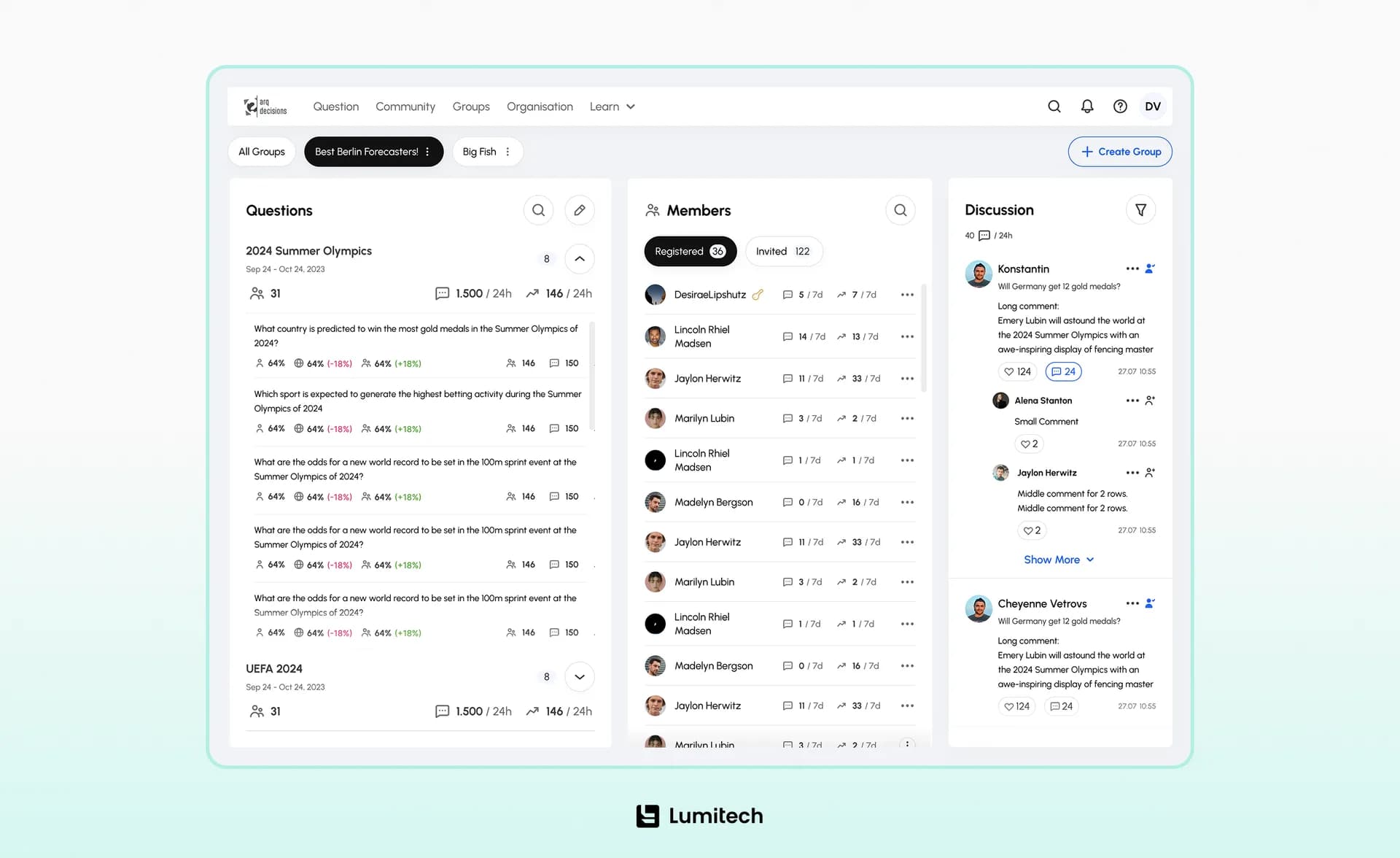
Now imagine layering sentiment analysis onto a platform that actively collects predictions from employees about key business and HR outcomes — product launches, market shifts, talent risks, and major changes. The system doesn’t just record those predictions; it also tracks who tends to be right, how confident they were, and how their comments felt over time. Patterns emerge: some people or teams consistently spot risk early, others are better at sensing upside, and sentiment around specific scenarios lines up with what actually happens. This is exactly the kind of people analytics using AI we’ve helped our clients implement in a decision intelligence platform for strategic HR planning. For a large enterprise, that becomes an internal radar: you can identify and involve your best “super forecasters” in strategic decisions and use their sentiment-weighted predictions as an early signal when planning headcount, change initiatives, and workforce strategy.
The Ethical Minefield of HR Sentiment Analytics
Here’s where we swap the inspirational music for a cautionary score. The power of AI sentiment analysis for HR is matched only by its ethical risk. The use of this technology, if not handled with absolute integrity, can quickly destroy the very trust it is meant to help build, turning your predictive tool into a catastrophic liability. That’s why policies and guardrails matter as much as the models, and why HR needs to work closely with legal, security, and enterprise software development teams to bake ethical standards into the way these tools are designed and deployed.
1. Privacy and the Scope of Surveillance
The primary source of rich, unstructured data for employee sentiment analysis AI is often internal communications: emails, Slack, Microsoft Teams, company forums, and shared documents.
The Big Brother Effect: Employees must be made aware of what data is being analyzed and why. Analyzing every personal email for sentiment is not only a massive ethical violation but also often illegal under data protection regulations like GDPR (General Data Protection Regulation) or CCPA (California Consumer Privacy Act). If employees feel they are under constant surveillance, they will simply stop using honest language in official channels, rendering the data useless and destroying psychological safety.
Solution: Aggregate, Anonymize, and Consent: The data must be anonymized and analyzed at an aggregate level (e.g., "The Engineering team's sentiment about the new build process dropped by 15% this week"), not to identify individual employee "moods." HR must establish and clearly communicate a consent framework — for example, by analyzing only optional, open-text feedback channels or by limiting internal communication platform analysis to work-related topics and never to individual messages.
2. Algorithmic Bias and Discrimination
When you learn how to use AI sentiment analysis in HR, you should remember that AI models are only as good as the data they are trained on.
The Feedback Loop of Bias: If historical HR data (from which the model learns to predict "high flight risk") shows, for instance, that employees who frequently use non-native English phrases were often fired or promoted less, the model may incorrectly flag certain linguistic styles as a "risk factor." This can unfairly penalize diverse groups, reinforcing existing organizational prejudices.
Language and Culture: An AI for hr forecasting model trained predominantly on American English may completely misinterpret sentiment cues, slang, or cultural expressions from an office in Mumbai or Berlin. This introduces an inherent bias against your global workforce.
Solution: Audits and Diversity: Organizations that provide AI and ML development services must conduct regular algorithmic audits to test for disparate impact across demographic groups (gender, race, age). Furthermore, the training data for NLP models must be diverse and tailored to the company's unique language and jargon.
3. Transparency and the "Black Box" Problem
When sentiment analysis in HR flags a team for a high retention risk, the HR team needs to know why. If the AI is a "black box" that simply spits out a score without explanation, it is useless for intervention.
Accountability: HR remains ultimately accountable for the decisions made. Suppose an action is taken (or not taken) based on an AI's output. In that case, a human must be able to justify it with clear, transparent, and explainable insights.
Can AI Sentiment Analysis in HR Replace Traditional Employee Surveys? (The Unpopular Opinion)
No. A thousand times, no. And frankly, the idea that it can is a lazy technocratic fantasy often pushed by software vendors who have never actually managed a workforce.
The Limits of AI-Only Insight
AI sentiment analytics for HR teams is a brilliant diagnostic tool, but it is not a consultant or a therapy session.
The Essential Synergy: AI and Human-Centric HR
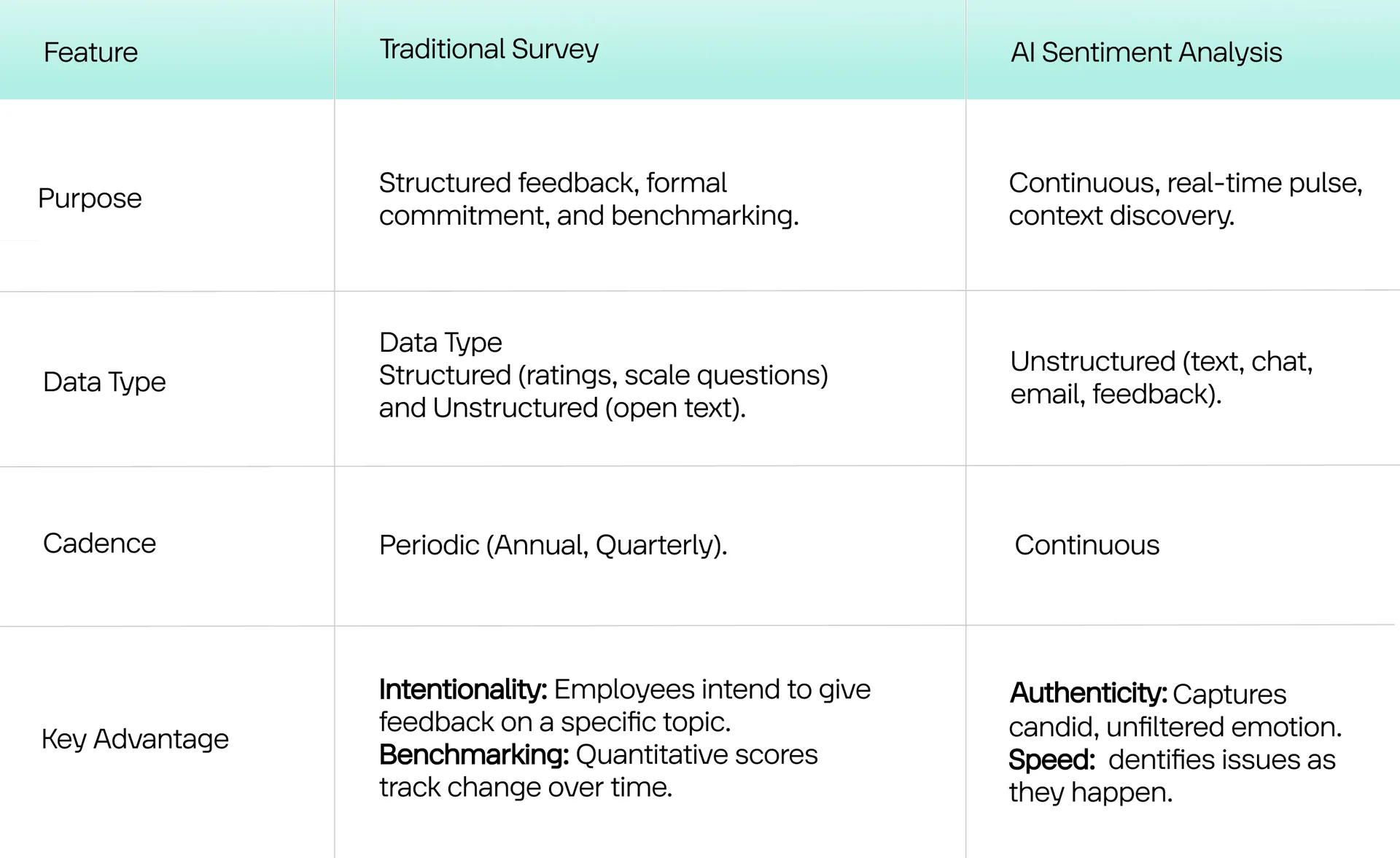
Surveys force a formal moment of reflection and a clear commitment to action. When you ask, "On a scale of 1-10, how clear is your career path?" and the average score is 4, you have a solid, quantifiable business metric for your board meeting.
The AI, meanwhile, is the background noise that says, "Okay, the score is 4, but the reason is all the frustrated chatter in the #dev channel about 'no clear promotion path' and 'dead-end roles.'"
The future of intelligent HR forecasting using AI is a hybrid model:
- 01
Surveys for Metrics: Use short, targeted surveys (pulse checks) to gather clean, quantifiable metrics on core issues and track long-term progress.
- 02
AI for Context: Use AI sentiment analysis for HR to continuously analyze unstructured data, providing the qualitative context and early warning signs that explain why the numbers are changing.
- 03
HR for Humanity: Use the combined data to inform human-led action: manager training, one-on-one meetings, and policy changes. AI identifies the "what" and the "when." HR delivers the "how" and the "who."
Getting started without overwhelming yourself
To learn how to use AI sentiment analysis in HR, you don’t need a moonshot. Start with three things:
One clear question. For example: “Where are we likely to see higher attrition in the next 12 months?” or “Which teams are drifting toward burnout?”
The data you already have. Past surveys with comments, exit interviews, feedback forms, and HRIS data. This is often enough to run a small pilot and see whether sentiment adds predictive value for you.
Basic guardrails. Decide what data is in (e.g., surveys, feedback tools) and what’s out (e.g., private DMs), how you’ll anonymize, and what the insights will and will not be used for.
From there, you can either choose a platform with built-in sentiment and predictive capabilities or partner with your internal data science team and in-house development services to build something more tailored. Responsible AI in HR is less about the fanciest architecture and more about boring-but-critical things: consent, guardrails, explainability, and a culture that actually listens to what the data says.
Used thoughtfully, sentiment analysis in HR won’t replace human judgment, but it can stop you from flying blind. Instead of reacting to crises you “couldn’t see coming,” you’ll have the data to prove that, actually, you did see them coming — and you did something about it.


