Top 10 Application Modernization Companies to Consider in 2026
Modernizing a live application is harder than building from scratch. The team must evolve the architecture without losing data, breaking integrations, or disrupting the people and processes that rely on the system every day.
- Digital Transformation
August 26, 2026
 AI Overview
Application modernization companies update legacy software through portfolio assessment, replatforming, refactoring, architecture changes, delivery automation, and security work. Dependency mapping and phased releases reduce outage and budget risk. A CAST study reported by IBM in February 2026 found that 45% of the world's code is fragile, and that repairing global technical debt in 2025 amounted to the equivalent of 61 billion days of work.

Top 10 Application Modernization Companies at a Glance
Once you start looking for a partner, every provider seems to offer the same things: portfolio assessment, replatforming, microservices, cloud-native architecture, and DevOps automation. The pages read like twins, and the choice gets harder the more of them you open.
After a while, you find yourself asking: How do I choose an application modernization company?
Start with finished work. Ask whether the provider has modernized a system like yours, on a similar stack, and published enough detail to show what reached production. Case studies that stop at the target architecture leave out data migration, cutover, and the work required to keep the existing system running.
This guide applies that test to ten application modernization companies, comparing them by scope, legacy stack, platform coverage, suitable buyer scenario, and public evidence. It is intended for CTOs, CIOs, product leaders, and procurement teams selecting partners for business-critical software. Vendor information and links were checked in August, 2026.
Application Modernization Providers Compared
The table keeps only what a first pass needs: what each provider modernizes, which legacy stacks it has worked in, and who it suits.
Company | Company type | Core focus | Legacy stack strength | Best fit |
|---|---|---|---|---|
1. Fortude | Enterprise resource planning (ERP) and enterprise applications specialist | Infor-centered modernization, Azure application work, reporting | Infor M3, Infor LN, ERP reporting and integrations | Manufacturing, distribution, and fashion operations running on Infor |
2. Polcode | Full-stack web development partner | Framework upgrades, API refactoring, incremental modernization | PHP, Ruby, JavaScript, Laravel, Symfony, Rails | Aging open-source stacks needing an upgrade without a rewrite |
3. Reenbit | Microsoft-focused software engineering company | .NET migration, Azure-native architecture, enterprise integration | Legacy .NET Framework, single-tenant products | .NET portfolios with Azure already chosen as the target |
4. EffectiveSoft | Engineering and data consultancy | Desktop-to-web replatforming, data migration, analytics | C++, Delphi, VB.NET desktop, mainframe | Application replacement where the data migration is as large as the rebuild |
5. Lumitech | Senior-led software engineering company | Phased modernization of web and cloud platforms, AI-ready architecture | Monoliths, fragile integrations, live production systems | Mid-market and enterprise web platforms that cannot go offline |
6. Simform | Product and cloud engineering company | Application and platform modernization, modular architecture | Large codebases, outdated authentication flows | One partner across application code, cloud services, and pipelines |
7. Brights | Digital product engineering company | Product modernization, experience redesign, container infrastructure | Web and mobile products, coupled backends | Customer-facing products where the interface carries the value |
8. Grid Dynamics | Large-scale digital engineering company | Enterprise application transformation, cloud and data platforms | Enterprise monoliths, legacy warehouses, batch processing | Fortune 1000 portfolios running multi-year programs |
9. Itransition | Global systems integrator | Full-cycle modernization across mixed portfolios, integration, testing | Mixed enterprise estates, CRM and ERP integrations | Portfolios holding several generations of software at once |
10. BairesDev | Nearshore software engineering provider | Legacy migration, refactoring, cloud adoption, delivery automation | Java, .NET, Python, C++ enterprise stacks | Roadmaps already defined internally that need engineering capacity |
The delivery evidence and the questions worth raising take longer to read, so they belong with the individual profiles. Before those, the criteria that put these ten on the list.
How We Selected These Application Modernization Companies
Seven criteria determined which application modernization firms appear on this list. They cover enterprise application modernization requirements across global consultancies, platform specialists, and senior-led engineering firms.
Established modernization practice: the provider needed a dedicated service, delivery framework, or substantial body of published material.
Verifiable delivery record: we reviewed case studies, client references, documented outcomes, independent reviews, partnerships, and analyst coverage.
Lifecycle coverage: we assessed discovery, architecture, cloud, data, integration, security, testing, delivery automation, migration, and support.
Enterprise delivery context: we prioritized evidence involving critical applications, regulated data, complex dependencies, strict availability, or multi-application programs.
Platform relevance: Amazon Web Services (AWS), Microsoft Azure, Google Cloud, hybrid infrastructure, mainframes, and enterprise platforms were recorded only with public support.
Defined procurement role: each company needed a clear reason for consideration, such as senior access, platform depth, regional capacity, engineering scale, or program governance.
Editorial currency: provider information was verified in August 2026 and is scheduled for review twice a year. One provider from the previous edition was removed because its modernization practices could not be publicly verified.
Inclusion indicates documented modernization capability, reviewable evidence, and a defined procurement role. It does not imply equal suitability across all portfolios.
Disclosure: Lumitech publishes this guide and appears in the list, assessed against the same seven criteria as the other nine providers. The profile uses the same fields, the same length, and links to the same kind of public evidence.
Ten Modernization Providers: Our Verified List
The profiles cover the modernization scope, published evidence, and what to check during discovery. Everything under Published record is verifiable, and you can open each source yourself. Things to consider are our reading of that material. Results reported in provider-owned case studies still need reference calls behind them.

1. Fortude
Fortude is an ERP specialist out of Colombo, with offices in the US, UK, and Australia. Its published modernization work centers on Infor, extending into reporting, integration, and testing around the core platform.
Core capabilities
Moves Infor M3 and Infor LN environments to supported cloud configurations.
Replaces static and disconnected reporting with Power BI and cloud data platforms.
Automates manual workflows and repetitive regression testing across ERP releases.
Published record
A dedicated Infor CloudSuite practice, with Microsoft Solutions Partner designations covering Data and AI, Digital and App Innovation, and Infrastructure on Azure.
Fortude reported recognition as a Microsoft Fabric Featured Partner in July 2026.
A published APP Group program that went live in seven months across the USA, Canada, and Europe at once.
Things to consider: Confirm experience with your exact Infor product and version. The published record concentrates on ERP, so standalone product work requires a separate reference.

2. Polcode
A Warsaw company with close to two decades of experience in open-source stacks, Polcode works on established web platforms that have become slow to change and has more than 100 modernization projects under its belt.
Core capabilities
Upgrades Laravel, Symfony, and Ruby on Rails applications one version at a time.
Extracts tightly coupled functions where independent services solve a defined constraint.
Builds test coverage before refactoring, then introduces containers and continuous integration and continuous delivery (CI/CD).
Published record
A dedicated legacy system modernization practice, with published case material across PHP, Ruby, and JavaScript stacks.
The Firm Prospects case covers legacy database and reporting modernization.
Things to consider: Ask which projects match your framework and version, since a Symfony upgrade and a Rails rescue need different engineers. Mainframe, ERP, and portfolio-wide programs require separate references.
3. Reenbit
Reenbit is based in Lviv and has an EU presence, focusing on migrating .NET systems to Azure. That focus is useful when the target platform is already decided.
Core capabilities
Moves applications from the legacy .NET Framework to current, cross-platform .NET versions.
Rebuilds selected components around Azure App Service, Functions, containers, and managed databases.
Adapts single-tenant products for multi-tenant software-as-a-service (SaaS) delivery, including account and data isolation.
Published record
Microsoft Partner, with ISO/IEC 27001:2022 certification.
In an energy-platform case, Reenbit modernized roughly 30 microservices using an AI agent it markets as autonomous, reporting 30-times faster modernization and over 90% of generated code accepted without significant rewriting.
Things to consider: Ask what baseline produced the 30-times figure and who reviewed the generated code. The published record is Microsoft-heavy, so multi-cloud buyers should request a separate reference.

4. EffectiveSoft
EffectiveSoft has been in enterprise software since 2003, headquartered in San Diego, with international delivery operations. Its published projects center on desktop and enterprise systems holding years of records, so replacement and data migration are planned together.
Core capabilities
Replaces aging C++, Delphi, and VB.NET desktop software with browser-based applications.
Plans extract, transform, and load (ETL) changes, data validation, and cutover alongside application delivery.
Updates authentication, access controls, logging, and regulated data handling.
Published record
ISO/IEC 27001:2022 certification, with AWS, Microsoft, and Oracle partnerships, plus a separate mainframe modernization practice.
A published healthcare case covering electronic health record (EHR) replacement across a multi-site clinic network.
Things to consider: Modernization is one practice within a broader outsourcing portfolio, so confirm the proposed team is the modernization team and establish who owns data validation and cutover.

5. Lumitech
Lumitech is based in Dubai and has an R&D team in Eastern Europe. Its legacy modernization services cover platforms that must keep serving users while they evolve. One senior-led team handles both architecture and implementation, so the decomposition order, data changes, and release sequencing are decided together rather than through separate handoffs.
Core capabilities
Breaks monoliths apart in stages, starting with the components that block releases
Moves workloads and databases to Amazon Web Services (AWS) or Microsoft Azure with revised pipelines, monitoring, and integration layers.
Prepares data layers for generative AI solutions, including a rebuilt AI engine with post-release MLOps monitoring.
Published record
Lumitech reports inclusion in the 2025 Clutch 1000 list of B2B service providers.
In clinical platform modernization, Lumitech redesigned data visualization, decision-support workflows, and patient-facing reporting across a hardware-software diagnostic ecosystem without interrupting the existing product.
The company delivered legacy modernization for a large-scale insurance company by launching the main website and key customer services first, while some internal portal modules remained outside the initial release.
Things to consider: Mainframe, IBM i, and enterprise resource planning (ERP) programs turn on platform expertise outside this focus. Ask for the phasing plan and rollback design at the proposal stage.
6. Simform
Simform combines application engineering with cloud delivery from Orlando and development centers in India, using its NeuVantage accelerator to map dependencies and decomposition points.
Core capabilities
Rebuilds selected application functions around managed cloud services.
Extracts services from large codebases where independent scaling solves a defined operational problem.
Defines infrastructure as code and automates builds, tests, and releases through CI/CD.
Published record
Assessed as a Pervasive Player among the top 35 vendors reviewed by MarketsandMarkets on its 360Quadrants platform, from a field of more than 200 companies.
Azure Expert Managed Services Provider, with Microsoft Solutions Partner designations across Infrastructure, Security, Data and AI, and Digital and App Innovation, behind a dedicated application modernization practice.
Things to consider: Verify cloud partner tiers against the provider's current listing before they enter a scorecard, and confirm how the team will control migration and operating costs.

7. Brights
Brights, split between Kyiv and Warsaw, approaches modernization as product engineering, and its published cases span the full stack, from interface redesign to service decomposition and container orchestration.
Core capabilities
Rebuilds web and mobile products with React, Vue.js, Node.js, Flutter, and related frameworks.
Splits coupled backends into services and rebuilds the container layer around them.
Adds AI features to existing products to reduce manual work or improve a specific user task.
Published record
Published modernization cases including INGO, one of Ukraine's three largest insurers by assets, and Renovero, the largest Swiss platform for finding skilled trades.
Case material documenting monolith decomposition, Kubernetes cluster rebuilds, and deployment moved to Terraform.
Operating since 2011, with more than 300 projects delivered and over 120 engineers, 88% of them at mid or senior level.
Things to consider: Ask for a comparable customer-facing product on your stack. Regulated, ERP, and mainframe programs require separate references.

8. Grid Dynamics
Grid Dynamics is a US company listed on Nasdaq, headquartered in San Ramon. It runs portfolio-level programs where transaction volumes and organizational dependencies both matter, and its financial reporting is public.
Core capabilities
Splits large monoliths into services that deploy and scale independently.
Replaces legacy warehouses and batch processes with cloud data platforms and streaming pipelines.
Establishes platform engineering, site reliability engineering (SRE), and continuous delivery practices across large development organizations.
Published record
Named a Notable Provider in Forrester's research on modern application development services.
Microsoft Azure specialized partner holding five advanced specializations, including infrastructure and database migration.
An AI-native modernization service on Azure, launched in May 2026 and built on the GAIN platform, benchmarks internally at more than 30%.
Things to consider: Productivity figures are based on the company's own benchmarking. Confirm the minimum viable program size, since the delivery structure may exceed what a contained rewrite needs.

9. Itransition
Operating since 1998 from the United States with international delivery centers, Itransition works across application, data, integration, and cloud workstreams. That breadth suits portfolios holding several generations of software with no single dominant stack.
Core capabilities
Chooses between refactoring, replatforming, rearchitecting, and interface replacement per application.
Connects older software and databases with customer relationship management (CRM), ERP, and newer web services.
Adds automated regression testing before high-risk components change.
Published record
More than 1,600 delivered projects for over 800 customers across 40-plus countries, ISO/IEC 27001 and ISO 9001 certified.
Its awards page lists assessments by Everest Group, Forrester, Gartner Peer Insights, and Quadrant Knowledge Solutions, with named clients including Lloyd's Register and The Economist.
A legacy application modernization practice with published cases, including a music distribution platform migrated from monolithic code to independent microservices.
Things to consider: The service range is wide, so evaluate the proposed delivery team and directly comparable references. A single provider reduces handoffs, and architecture ownership still needs to be explicit.
10. BairesDev
BairesDev is a US company with delivery hubs across Latin America. It is most relevant when the modernization plan already exists, and the gap is engineering capacity, since its nearshore model keeps engineers in compatible time zones.
Core capabilities
Provides engineers experienced in migrating Java, .NET, Python, C++, and other established enterprise stacks.
Supports internal teams with microservices development, containerization, Kubernetes, and cloud migration.
Builds automated delivery pipelines to remove manual release constraints.
Published record
Founded in 2009, with more than 4,000 professionals across 50-plus countries.
Named to the IAOP Global Outsourcing 100 list of top outsourcing providers.
A dedicated legacy application migration practice, with a published case replacing a news organization's Classic ASP platform with modern .NET.
Things to consider: Establish who owns the architecture before the team scales. In staff-augmentation arrangements, documentation standards and acceptance criteria stay with the buyer.
Two or three of these ten will match your system closely enough to justify a call. Six questions decide what comes out of it.
How to Choose a Modernization Partner
Choose a provider based on how well it understands the system you already run. Legacy code, data, integrations, and uptime requirements determine most of the cost and delivery risk, while the target technology a provider promotes says little about either.
Step 1. Request a Comparable Production Case
Ask for work involving a similar application, stack, scale, and availability requirement. Confirm the scope, delivery period, architecture owner, and whether the system reached production. If no close reference exists, ask which capabilities the provider will need to add.
Step 2. Review the Assessment Before the Proposed Architecture
The assessment should cover the codebase, databases, integrations, identity controls, batch jobs, external services, and operating requirements. Microsoft's migration assessment guidance recommends mapping dependencies before setting migration waves. Every major architecture decision should follow from a documented finding.
Step 3. Put Decision Rights in the Contract
Name the provider architect and the person on your side who approves major changes. The contract should also cover senior-engineer access, team continuity, documentation ownership, and responsibility for architecture decisions. With staff augmentation, that responsibility usually remains with the buyer.
Step 4. Require a Plan for Failed Releases
The proposal should explain how old and new components will coexist, how data will be reconciled, and how a failed release will be reversed. Include regression testing, cutover rehearsals, monitoring, and post-launch support. Use the NIST Secure Software Development Framework to define security and supplier responsibilities.
Step 5. Define Acceptance Criteria Before Delivery
Record current response times, operating costs, incident frequency, deployment lead time, and recovery time. Measure each application or service separately, as recommended by DevOps Research and Assessment guidance. Assign an owner and measurable completion criteria to every phase.
Step 6. Ask Who Owns the System After Launch
Modernization does not end at a release. Financial operations (FinOps) track cloud costs as workloads move in waves. Platform engineering keeps delivery consistent while the architecture changes underneath it, and security integrated into development and operations (DevSecOps) protects the pipelines that now carry generated code. A proposal that leaves these three unassigned is describing a project, and what you get is a system that needs an owner.
A strong provider understands the starting point, accepts clear technical responsibility, and proposes a first phase small enough to test before the wider budget is approved. That first phase is also the only reliable way to price the rest, regardless of what the market numbers suggest.
Still weighing how much of the system to change?
Lumitech reviews your existing plan and identifies the dependencies that should be tested first.
Application Modernization Market: Size, Growth, and Caveats
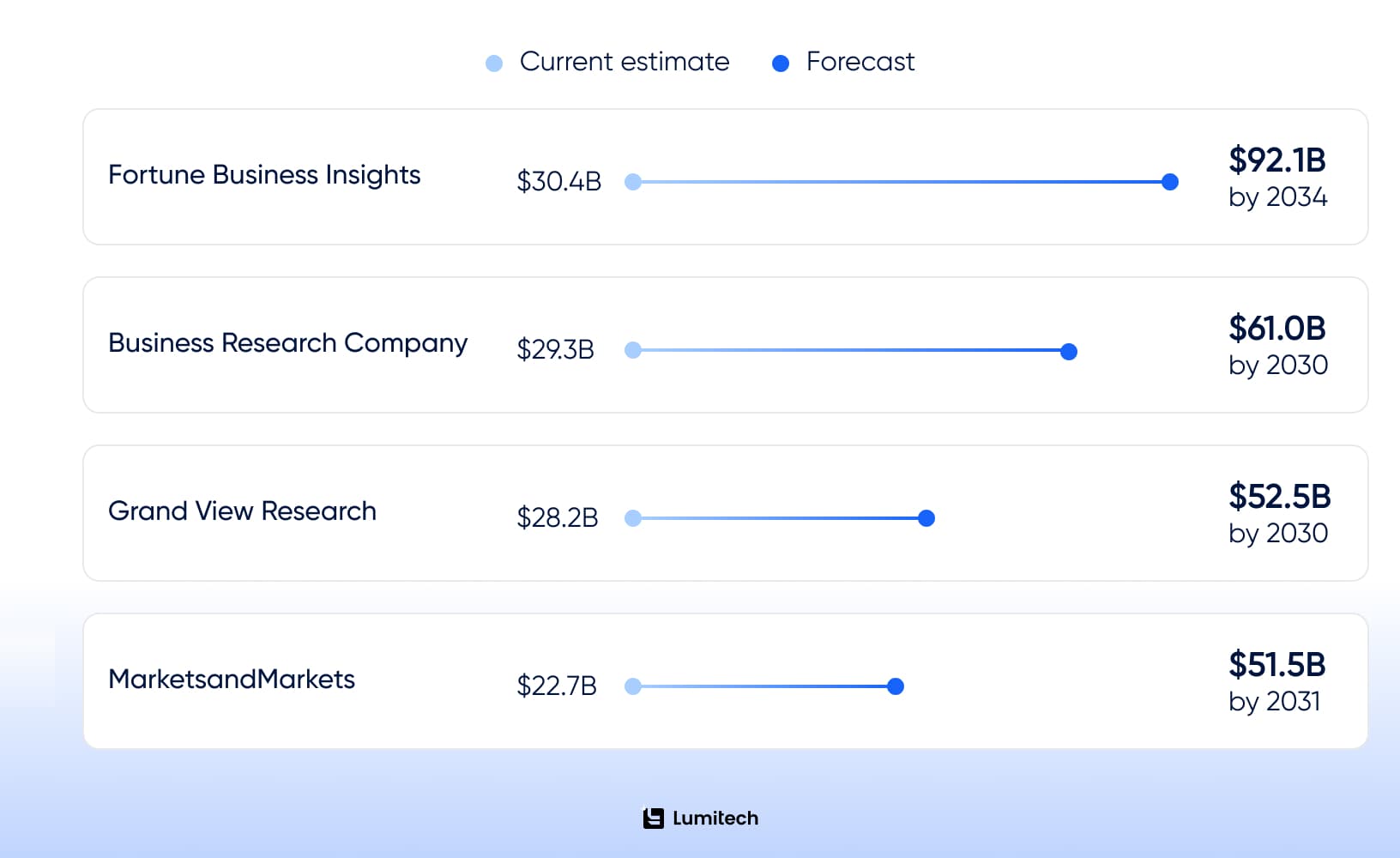
The market numbers are large, although they reveal little about an individual project. Fortune Business Insights values application modernization services at $30.36 billion in 2026, and three other analysts put the current market within a few billion of that figure. Their forecasts then diverge by almost half, because each firm draws the boundaries of the category differently and measures to a different horizon.
Budget overruns and missing skills explain the demand more clearly than the totals do. Legacy maintenance tends to cost more than planned, and cloud architecture and migration skills are among the hardest to staff internally, which is why most of this work goes to an outside partner as part of a broader digital transformation program.
Refactor vs. Replatform vs. Rearchitect: How to Choose the Right Level of Change
The same three words mean different things depending on who wrote the proposal. Microsoft keeps replatforming, refactoring, and rearchitecting as separate strategies. AWS folds refactoring and rearchitecting together in its migration framework. So a label tells you almost nothing, and the proposal has to say which platform, code, data, and architecture changes it covers.
Approach | What changes | Use it when | Main concern |
|---|---|---|---|
Replatform | The hosting model, runtime, database, or infrastructure changes with limited changes to application code | The application still serves the business, but its infrastructure is costly, unreliable, or difficult to manage | Existing code and architectural problems may carry over to the new platform unchanged |
Refactor | Developers revise application code while keeping the main architecture largely intact | Technical debt, outdated frameworks, poor performance, or weak test coverage slow development | The work can affect many connected functions, so regression testing needs a clear scope |
Rearchitect | Component boundaries, data flows, and the integration model are redesigned | The current architecture prevents independent releases, scaling, resilience, or major product changes | Data migration and hidden dependencies can extend the transition and raise delivery risk |
Microsoft’s modernization guidance draws these lines with concrete examples, which help when a proposal stays vague: virtual machines onto a managed platform, dependency and instrumentation updates, or a split into components with a reorganized data layer. AWS guidance adds a warning worth pricing in early, since the architectural route costs the most and takes the longest.
In a real portfolio, the three rarely appear alone. A single wave might replatform a stable customer portal, refactor a slow pricing engine, and redesign a coupled integration layer, with the call made per component once the dependency map is in place.
All three approaches assume the application stays. Applications that will be switched off or replaced by a purchased product fall outside this scope, and the 7 Rs of cloud migration cover those cases.
What are the 7 Rs of cloud migration, and how do they relate?
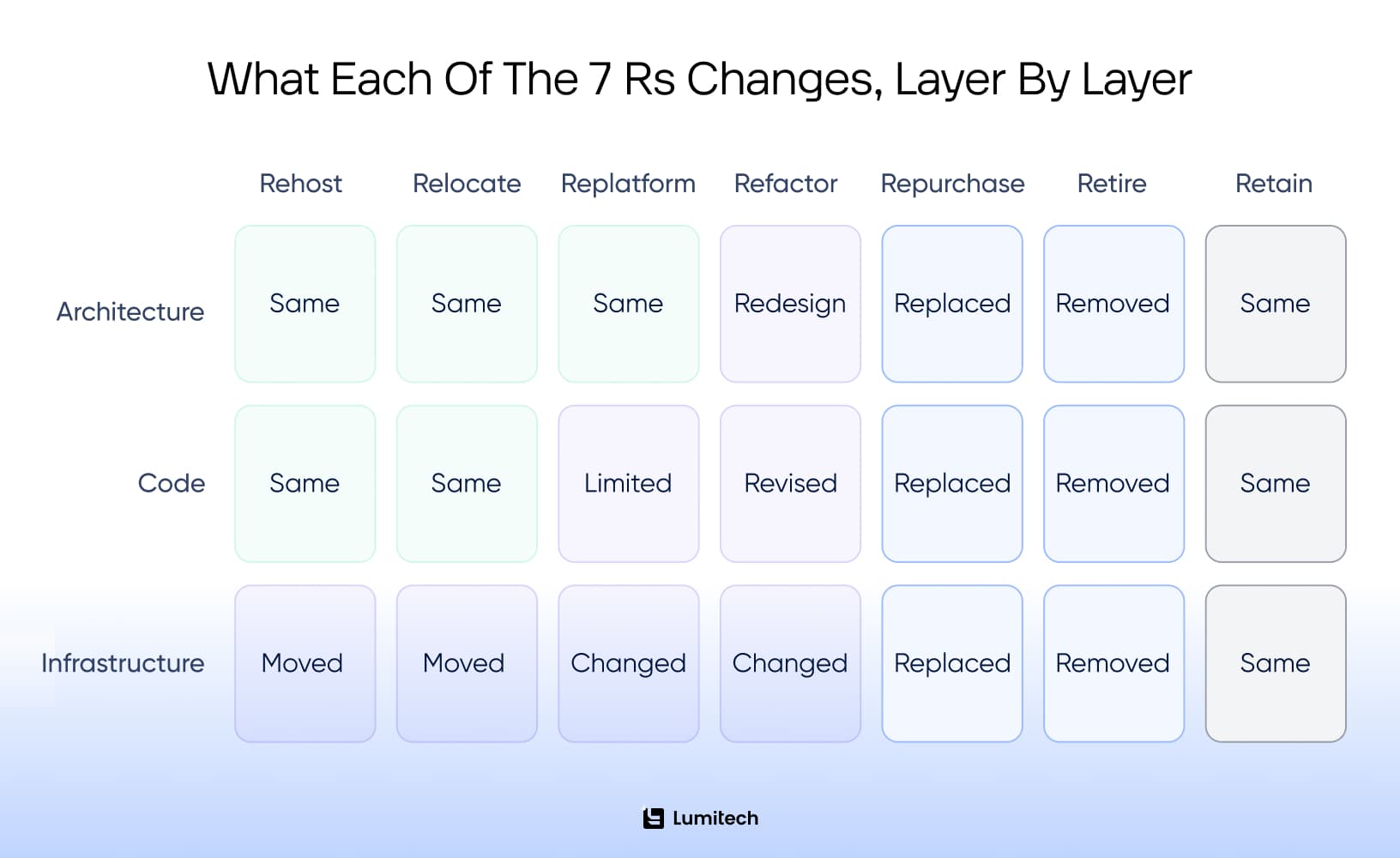
The 7 Rs classify what should happen to each workload. They do not all produce application modernization. The current IBM and AWS frameworks use the following seven paths:
Strategy | What happens | Modernization depth |
|---|---|---|
Rehost | Move the application without changing its code or architecture | Little or none |
Relocate | Move the existing platform stack to another environment | None |
Replatform | Adopt managed services, containers, or a newer runtime with limited code changes | Moderate |
Refactor / rearchitect | Change the code, component structure, or data architecture | Deep |
Repurchase | Replace the application with a commercial or SaaS product | Replacement |
Retire | Decommission the workload | None |
Retain | Keep it in the current environment for now | None |
A portfolio can use several paths at once. Rebuild may still be a valid modernization option, but it is not one of the standard 7 Rs in the current AWS and IBM taxonomy. Each path carries a different price, and that is where most modernization budgets go wrong.
How Much Does Application Modernization Cost?
Application modernization services have no reliable universal price because systems of similar size can have different frameworks, test coverage, databases, and undocumented integrations. Price four lines separately: assessment, build, migration, and ongoing operation. Migration estimates often fail to account for historical data, validation, and cutover rehearsals, while run costs continue for cloud services, licenses, monitoring, and support.
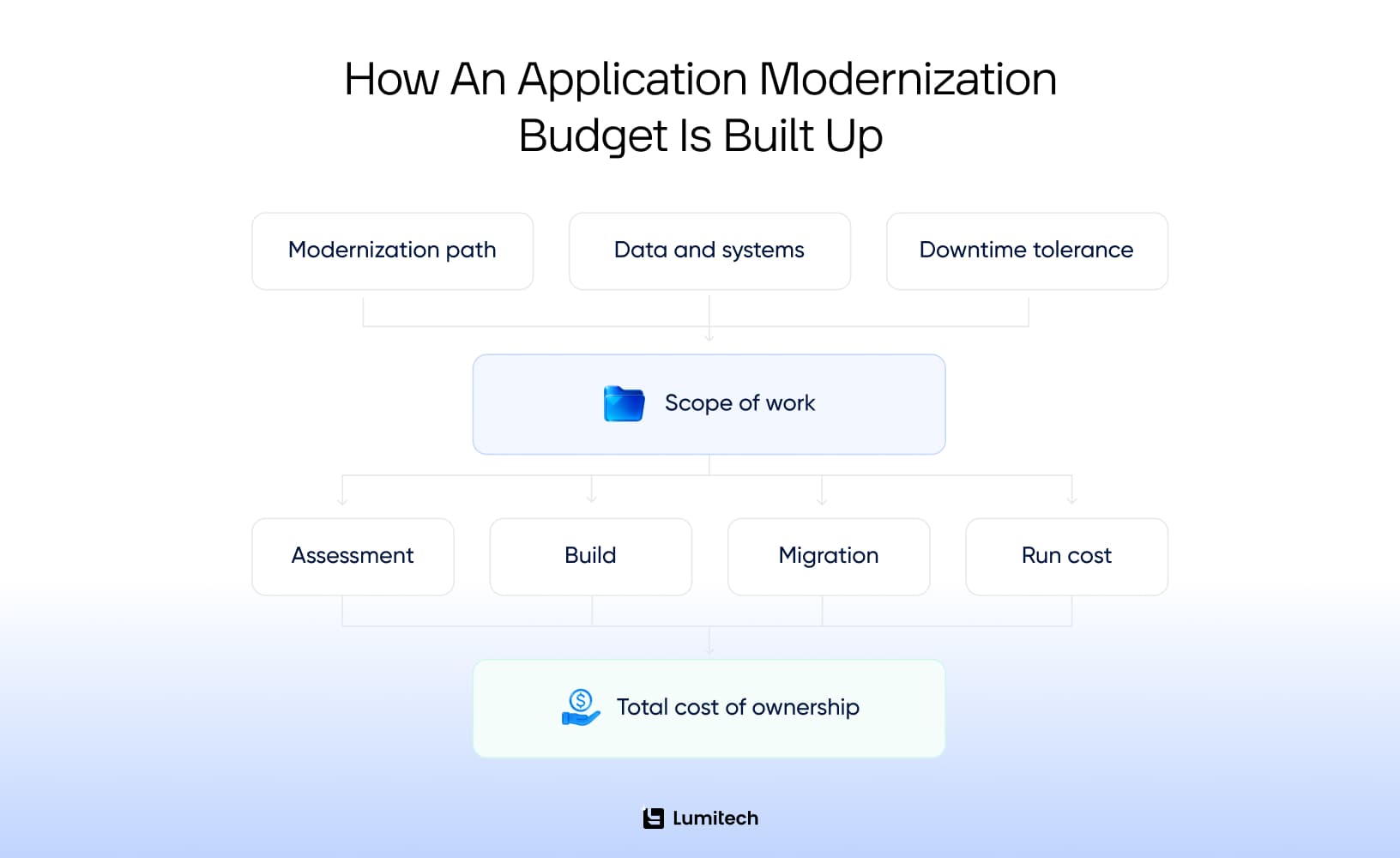
An hourly rate for app modernization services prices only part of the build. Microsoft's cost-estimation guidance recommends fixing architecture, service tiers, regions, performance needs, and compliance requirements before calculating total cost of ownership (TCO).
An application modernization roadmap should start with an assessment or a contained pilot. This provides evidence to price the wider program and test its assumptions before committing the full budget. Any uncertainty left after assessment should shape the engagement model.
Matching the Engagement Model to Delivery Uncertainty
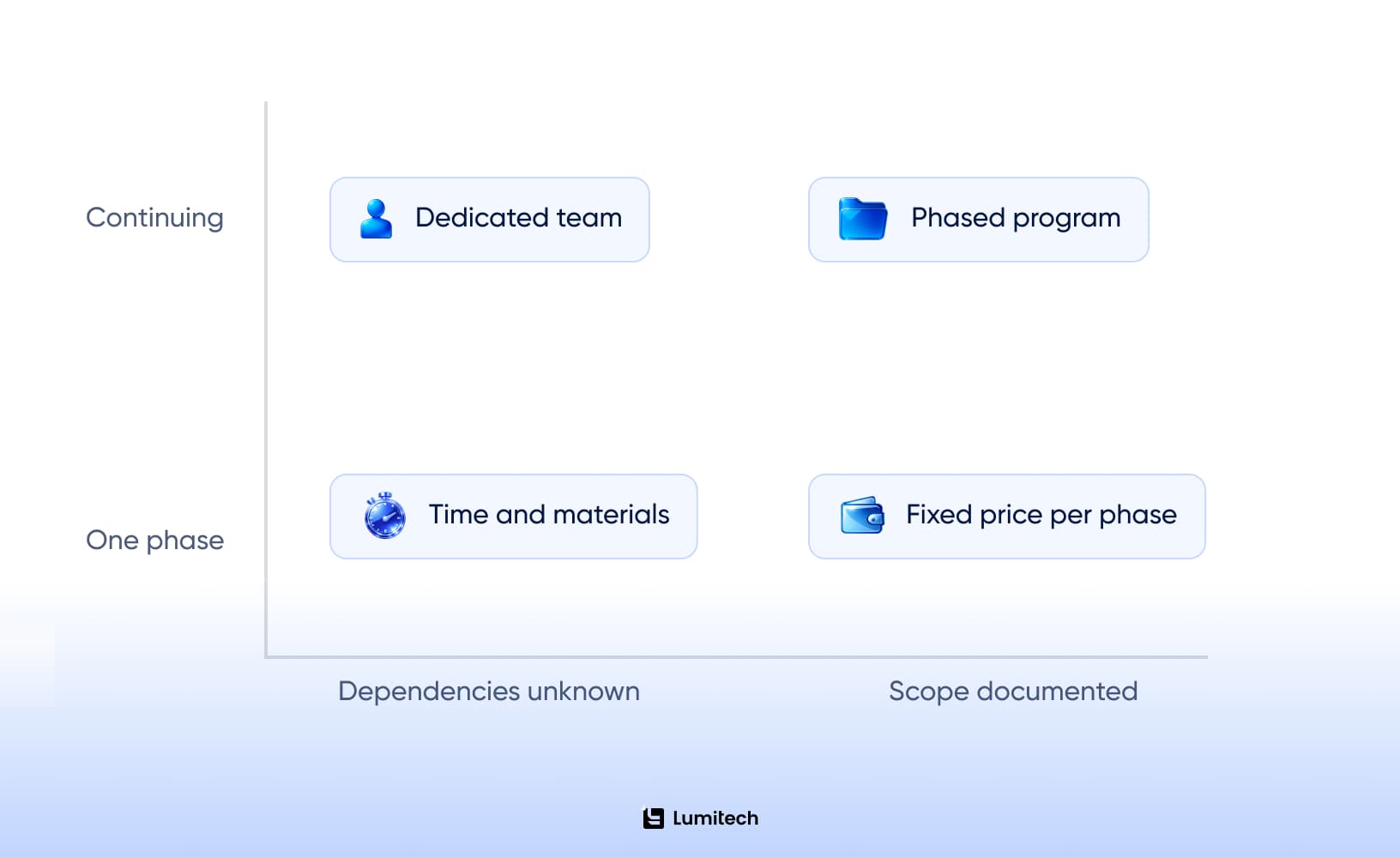
The contract should reflect how well the scope is understood and who owns the technical decisions. A fixed price offers little protection when dependencies remain unknown.
Four models cover most programs. They differ in how they handle situations where the work turns out to be larger than the proposal.
Model | Fits when | Watch for |
|---|---|---|
Fixed price per phase | The scope is documented, and the phase stands alone, like an assessment or one application | Every new dependency becomes a change request. You pay upfront for the certainty |
Time and materials | Legacy dependencies are unknown, and the plan will change as they surface | Budget control rests on your own reporting and acceptance criteria |
Phased program | A portfolio moves in waves, with a decision point at each one | Someone on your side has to make the go or no-go call every wave |
Dedicated team | Modernization continues past the first release into platform evolution | Put team continuity and architecture ownership in the contract, not the kick-off call |
For an uncertain or business-critical portfolio, a separately scoped assessment followed by a phased program gives the buyer clear points to review progress, revise the plan, or stop further work. A contract cannot make up for weak discovery, unclear ownership, or an unsafe release plan.
Why Application Modernization Projects Fail
Projects go off track when teams approve the target architecture before they understand the current system. Shared databases, batch jobs, identity services, and external integrations then appear after the budget and migration order have been set, and data migration, testing, and rollback get squeezed into a plan that no longer matches the work.
These application modernization challenges recede once a dependency map is in place. The proposal can then name owners for architecture, data, security, and cutover, and set acceptance criteria and a rollback path for each phase. What the map usually reveals is that a broad label hides several different environments, and IBM estates are the clearest example of that.
Mainframe, AS/400, and COBOL Modernization: Match the Vendor to the Stack
Buyers get caught here more often than anywhere else in the process. Mainframe, AS/400, and COBOL land in the same sentence so often that they start to feel interchangeable, and they are not. AS/400 is an older IBM system family, now IBM i. COBOL is a language that runs in many places besides mainframes. So a vendor can be entirely honest about its COBOL experience and still have never touched the platform you actually run.
That is why the reference matters more than the credential. When reviewing vendors for mainframe application modernization, ask which engineers will go through the environment and map dependencies, what they expect to keep, and how a release can be rolled back if it misbehaves. Then ask for a finished project on your stack, because an Azure certification tells you nothing about RPG or Db2 for i. And that is a fair question to put to us as well.
Why Lumitech: Our Modernization Focus
Our platform modernization of a legal media platform and other cases gave us firsthand experience in keeping a critical product live while its backend, integrations, internal tools, workflows, and AWS infrastructure changed around it. The difficult part was deciding what to replace first, how old and new components would work together, and how to keep releases moving without putting daily operations at risk.
That experience drove this guide. Its practical conclusion is smaller than choosing among application modernization companies: start with the assessment, as its own contract with its own price and deliverable. It gives you the dependency map, the phasing order, and a number you can take into a budget conversation. Whichever provider you continue with, that first phase is what makes the rest of the program predictable.