



Before we jump into the technical part, it is important to say this. The goal of this project was not to “replace lawyers with AI”. It was to give a large, regulated organization a trustworthy way to access legal knowledge – without overloading the legal team every single day.
About the Client
The client is a large financial‑technology organization operating in corporate finance, payment solutions, and regulated services across the MENA region. They work under strict regulatory supervision and maintain a complex internal structure with many policies, procedures, and legal constraints that govern day‑to‑day operations.
Inside the company, thousands of employees need regular access to legal and regulatory information to make operational and business decisions. This includes front‑office teams, product managers, operations, risk, and many others who cannot afford to wait days for a simple clarification. At the same time, every answer must align with internal policy and external regulation.
The Challenge
From the business side, the situation looked familiar for many large institutions:
A constant flow of repetitive, similar questions to the legal team.
Strong dependency of business units on manual consultations.
Difficulty finding the right policy or procedure at the right moment.
Risk of using outdated documents or misinterpreting rules.
Even simple questions took time. Someone had to:
Check the context.
Locate the needed document.
Confirm the latest approved version.
Explain what actions were allowed in that scenario.
As a result, the legal team spent a significant share of their time on repeated queries, business units faced delays, and both operational and regulatory risk started to grow.
On the technical and governance side, the problem was even more sensitive. Key constraints included:
No legal or internal data could be processed by public AI services.
Access to information had to strictly follow roles and clearance levels.
Knowledge sources were constantly updated by different owners.
Every answer needed to be traceable and anchored in approved documents.
Existing systems – intranet, SharePoint, document management – were not designed for natural language Q&A. Classic keyword search did not match real‑world questions, especially when employees used informal language or mixed several topics in one request.
So the organization needed a solution that would bring together:
Accuracy – answers grounded in official, approved content.
Security – strict data governance, no leakage to public models.
Explainability – visible links back to source documents.
Scalability – a platform that can grow with new policies and use cases.
Our Approach
Lumitech approached this project from the legal and business side first, not from the model side. The team started with a legal‑focused discovery phase instead of jumping straight into picking an LLM or framework – something that often gets skipped, but here it was critical.
Key steps included:
Analyzing typical queries to the legal team and grouping them by real scenarios rather than by documents.
Identifying areas where automation is acceptable and where mandatory escalation to humans is needed.
Designing answer patterns with explicit references to sources and clear boundaries of what the assistant can and cannot say.
Separating “what the policy says” from “what you should do next in your process”.
This last point became one of the most important design decisions. Informational answers (policy explanations) and process guidance (steps, approvals, who to contact) were handled as two distinct layers. This helped avoid a dangerous trap: an AI tool that looks like it is giving full legal advice without understanding context or individual case details.
Architecturally, the solution combined:
Secure LLM orchestration, ensuring that prompts, context, and answers stay inside the organization’s trusted environment.
Retrieval‑Augmented Generation (RAG) to ground responses in internal documents instead of relying on model “memory”.
Role‑based access control so users only see content they are allowed to see.
Enterprise document indexing tuned for policies, SOPs, internal guides, and regulations.
Cloud‑agnostic design that can adapt to the client’s regulatory and infrastructure constraints.
The project started as a pilot. This format allowed the client to test the assistant on a limited set of legal domains, validate answer quality with the legal team, and adjust workflows before considering a broader rollout across departments.
Features
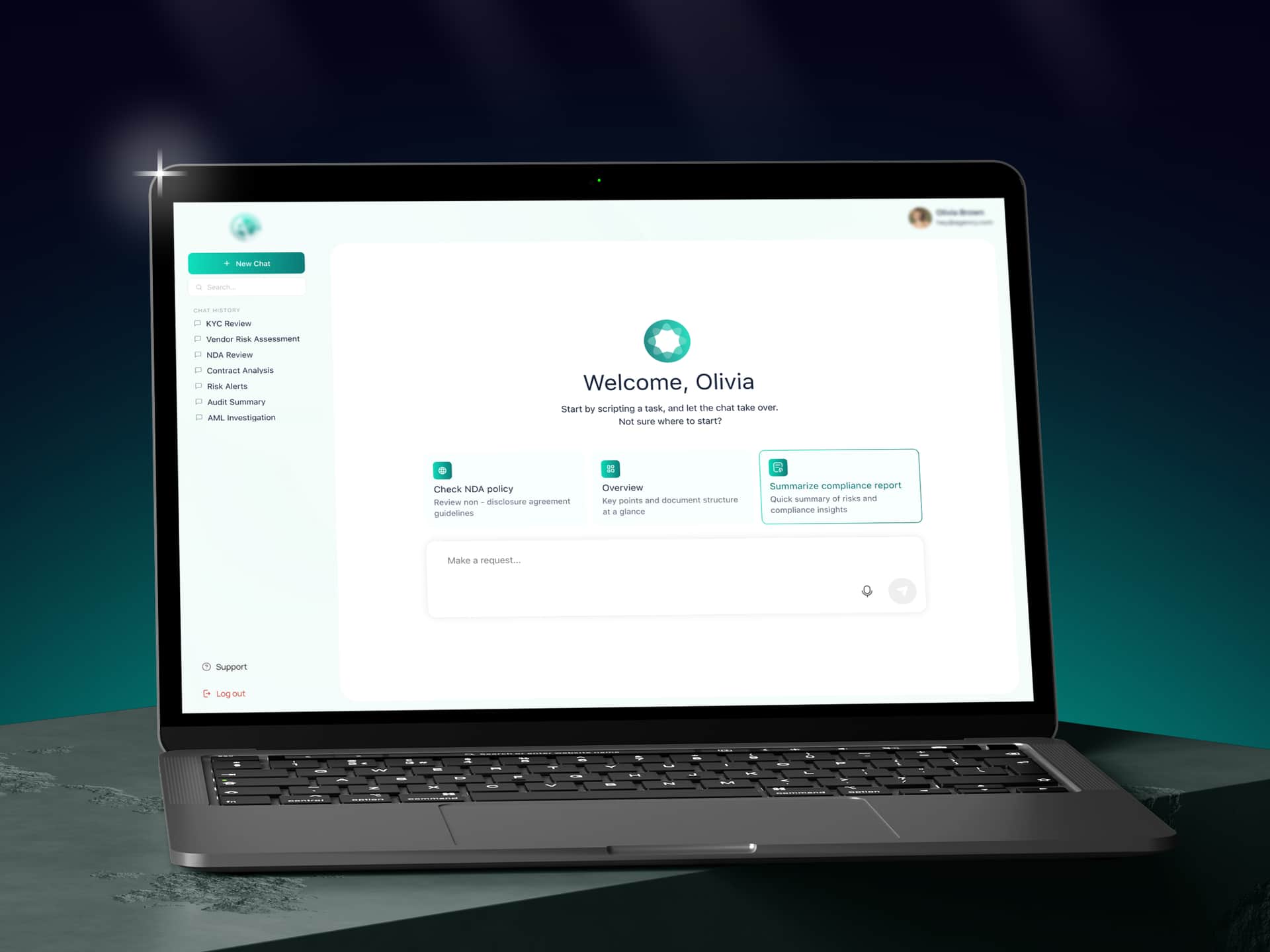
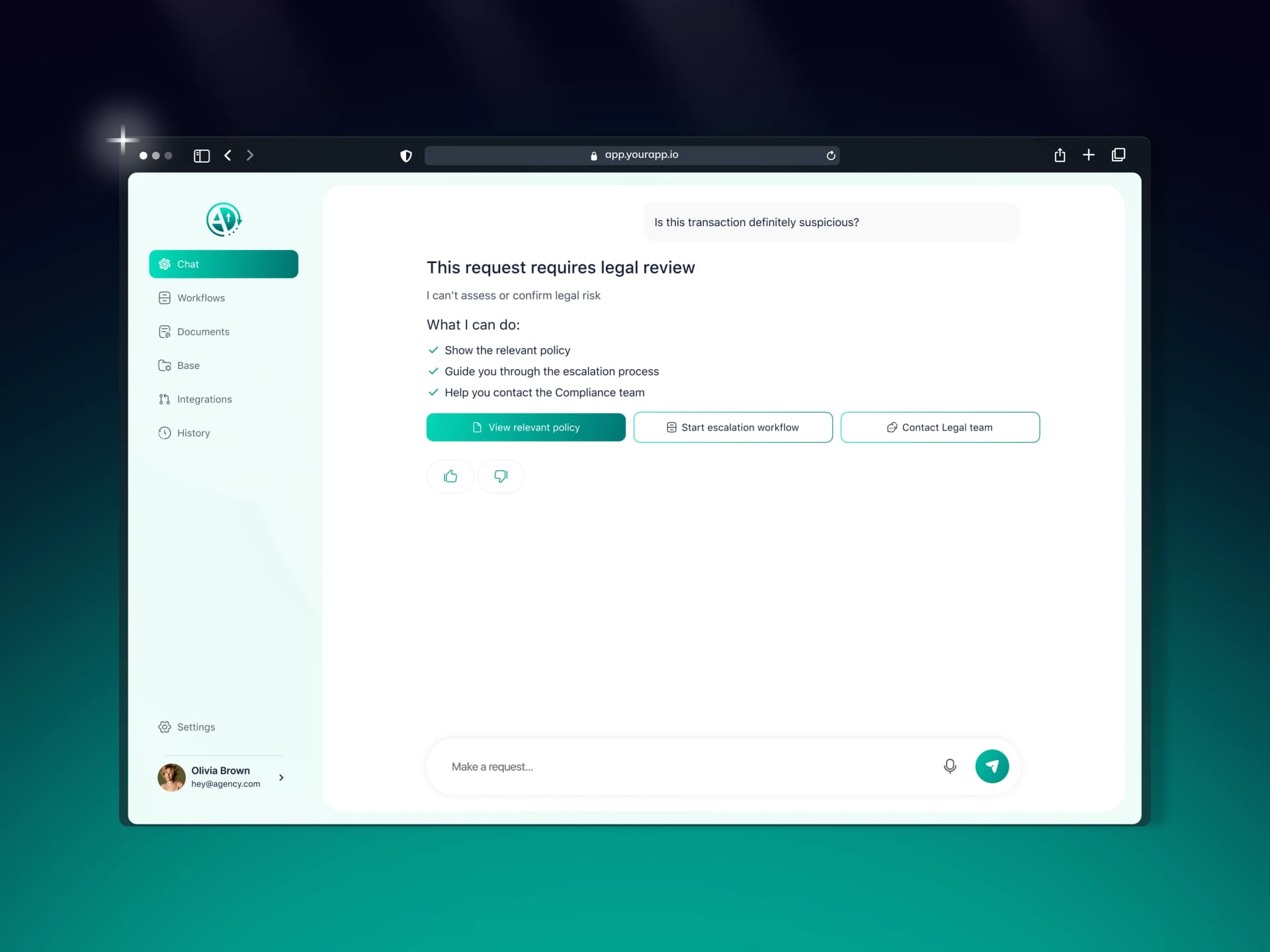
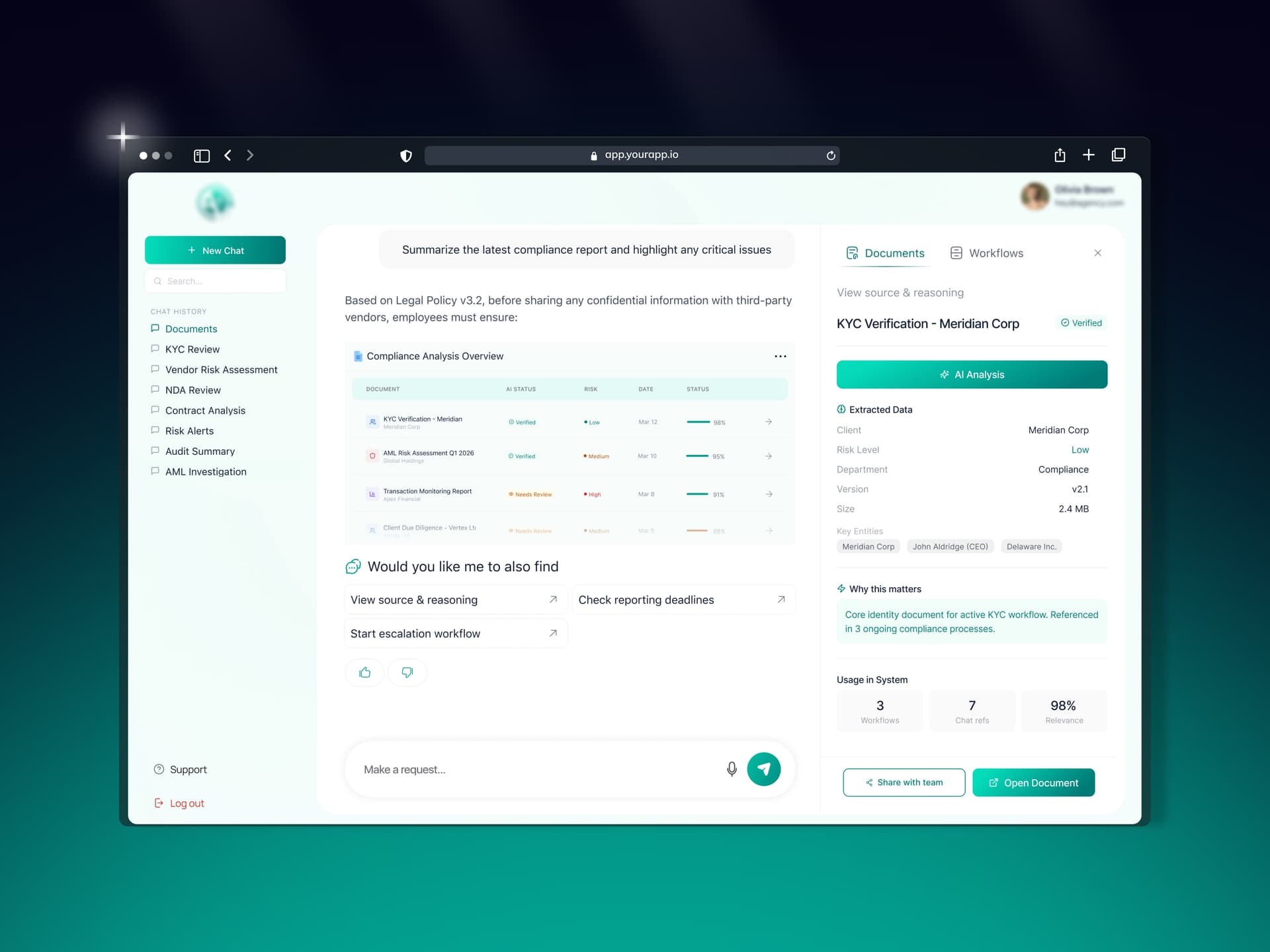
The result of this work is an internal AI‑powered legal knowledge assistant – an enterprise chatbot that becomes a single entry point into the company’s legal and compliance knowledge. It does not replace the legal department, but it makes their expertise more accessible at scale.
At the core sits the AI assistant interface, where employees can ask legal and regulatory questions in natural language. The assistant provides:
Answers to frequent legal and compliance questions, framed in business‑friendly language.
Contextual explanations adapted to the user’s role, so different teams see information that is relevant for them.
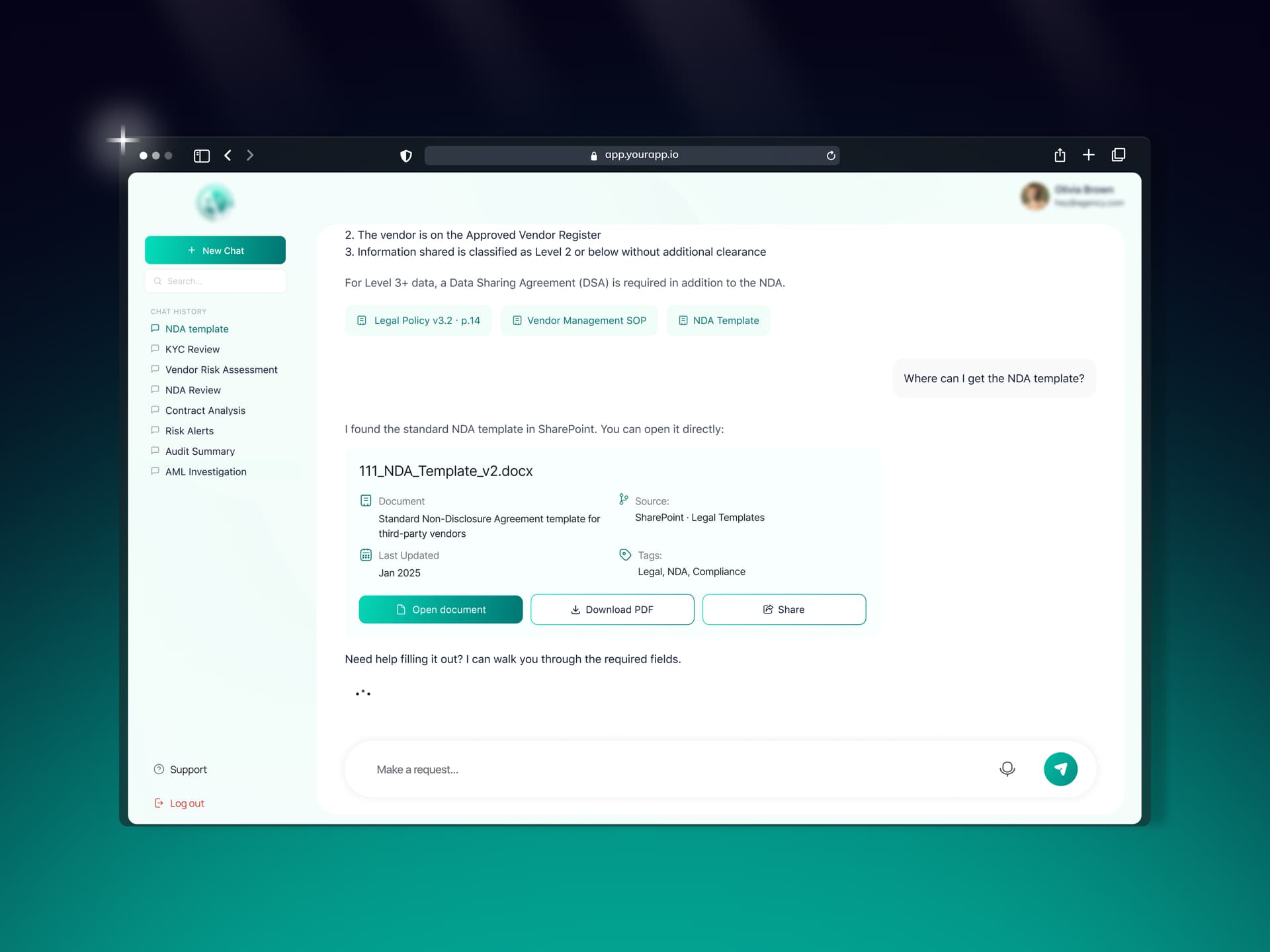
Links back to primary sources – policies, procedures, and official documents – so users can verify details if needed.
Document Intelligence & Retrieval
Behind the scenes, the solution indexes and understands a wide variety of internal documents:
Policies, standard operating procedures, internal guides, and regulations.
Prioritization of current, approved versions over outdated or draft documents.
Automatic exclusion of obsolete or duplicated files from the answer pipeline.
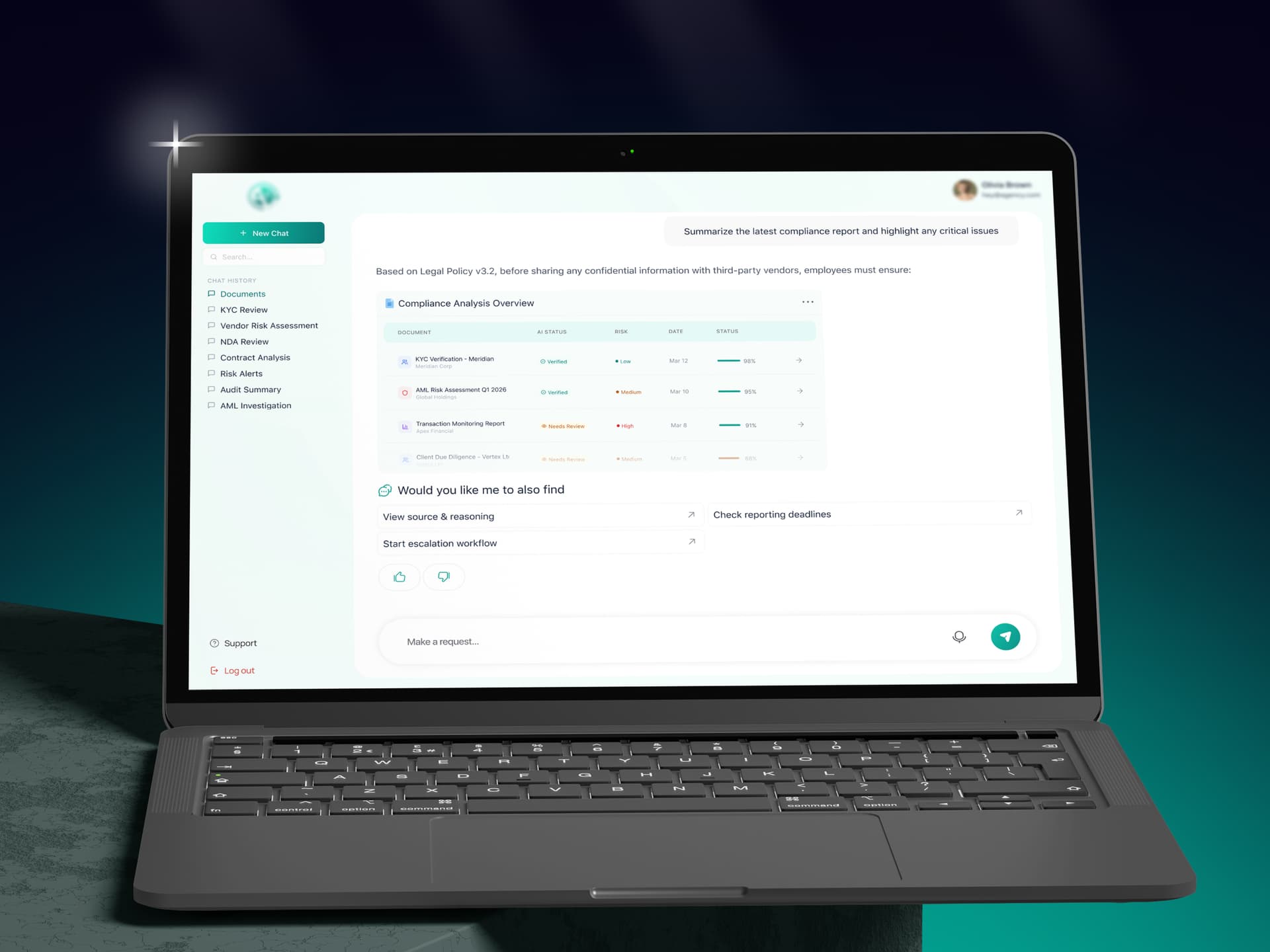
Instead of keyword search that returns long lists of results, users get targeted answers backed by the right passages and references. This is where Retrieval‑Augmented Generation becomes important – the model uses internal content as context to build its responses.
Guided Legal Workflows
Not every situation can be solved with a short answer. For repetitive processes, the assistant supports guided workflows:
Step‑by‑step scenarios for typical legal and compliance processes.
Help for business users in following approval chains correctly.
Reduction in errors, back‑and‑forth communication, and rejected requests.
In practice, this means that instead of asking “What should I do now?” in ten different emails, a user can follow a structured path directly in the assistant and understand what information is needed and who needs to be involved.
Knowledge Base Management
A critical part of the solution is that it can be maintained by internal teams, not only by developers. The platform supports:
Knowledge management by legal and compliance owners.
Content updates and adjustments without involving engineers every time.
A distributed ownership model, where different teams are responsible for their parts of the knowledge base.
This approach keeps the assistant aligned with reality. As policies change or new procedures appear, internal experts can reflect those updates in the system and see them surface in answers.
Enterprise‑Ready Integrations
The assistant is built to fit into the client’s existing ecosystem rather than live as a standalone island. The design includes:
Integration with corporate portals, so users can access the assistant where they already work.
Readiness for deployment in internal messengers and interfaces.
Compatibility with the organization’s broader IT stack and security controls.
This makes adoption easier. Employees do not have to learn a completely new environment just to ask a legal question – the assistant comes to the tools they already use.
Our Results
Even at the pilot stage, the impact was visible for both business teams and the legal department. The assistant delivered several key outcomes:
Noticeable reduction in repetitive, low‑complexity queries to the legal team.
Faster decision‑making for business units that now receive baseline answers in minutes, not days.
Lower operational and regulatory risk thanks to better access to current, approved policies.
Improved transparency – employees can see not only the answer, but also where it comes from.
Beyond immediate metrics, the project created something more strategic: a stable internal platform for AI‑driven knowledge in a regulated environment. The same approach can now be extended to other functions – risk, operations, HR – using the same orchestration, access control, and document intelligence backbone.
This case shows that AI in fintech and banking is not only about experiments or side projects. It is about structuring knowledge, controlling access, reducing pressure on critical teams, and building infrastructure that can support the organization for many years – even as regulations and internal processes keep changing.