
Transparency in AI: Why It Matters, Key Challenges, and Best Practices
The more AI takes on, the more often a simple human question comes up: how does this actually work? In this article, we look at why transparency matters, where it tends to break down, and what can make AI easier to understand.
- AI Development
April 20, 2026
 AI Overview
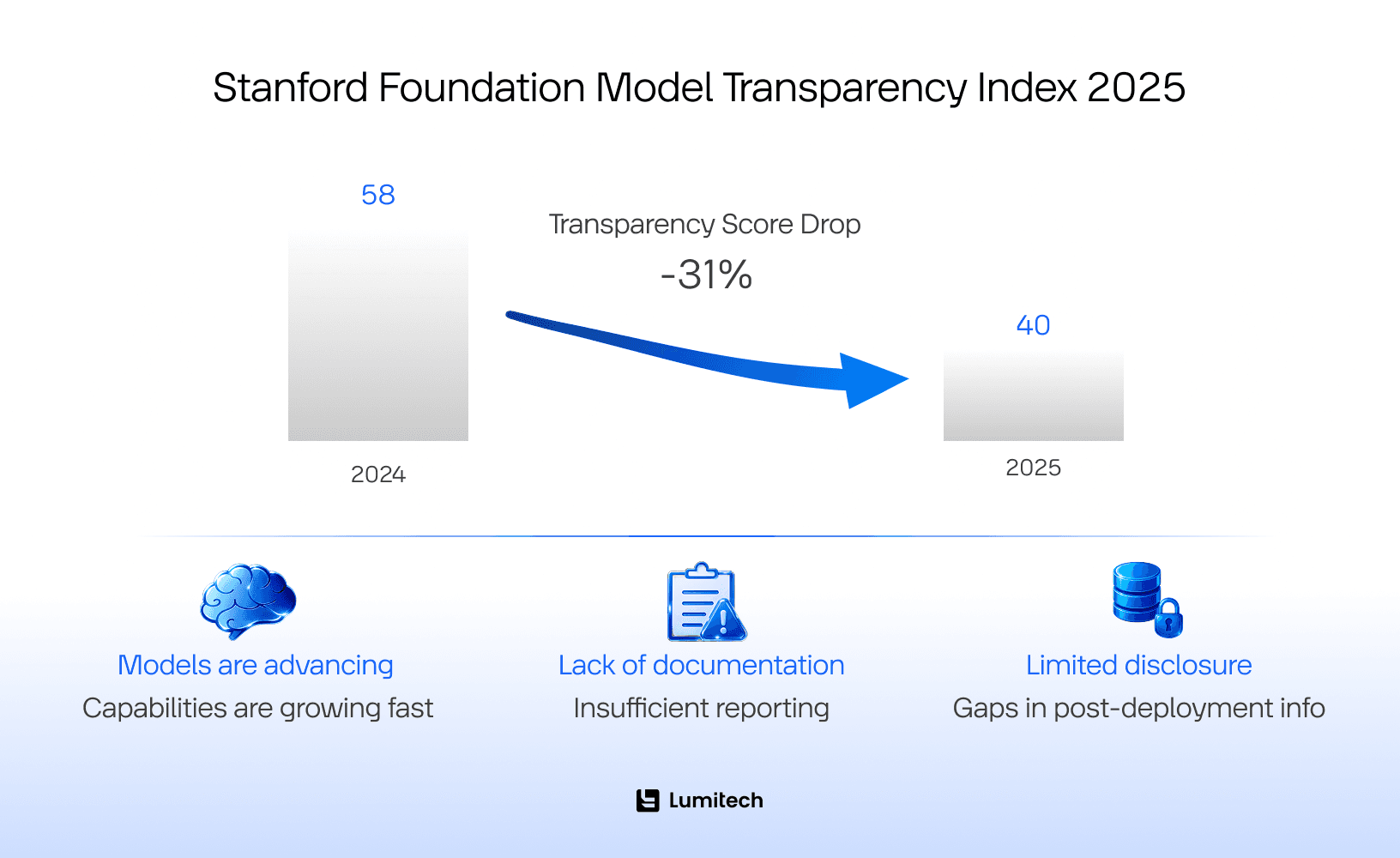
AI transparency means giving clear visibility into how a system is built, what data trains it, its limitations, and when human review is required, so users and auditors can verify results rather than trust a black box. Key components include model documentation, data-source disclosure, output traceability, and disclosure logic for end users. The average transparency score for major foundation model developers fell from 58 in 2024 to about 40 in 2025.


Transparency in AI must be a part of the product quality and governance discipline. The OECD directly links transparency and explainability to ensuring that people understand when they interact with AI and can challenge or verify its results. NIST, for its part, includes “accountable and transparent” among the characteristics of trustworthy AI.
According to the Stanford Foundation Model Transparency Index 2025, the average transparency score for large foundation model developers decreased from 58 in 2024 to about 40 in 2025. This means the following: model capabilities are growing, and transparency, documentation, and post-deployment disclosure do not always keep up.
In Lumitech’s practice, this is especially noticeable in AI prototyping, transparency in AI decision-making, intelligent document processing services, generative features for business software, and in cases where the business really understands what decision intelligence means.
When the model starts to influence the real workflow, the team almost immediately has the same questions: how to explain the role of AI to the user, how to define the system's boundaries, how to prepare for an audit, and how to avoid losing control after the release. That is why transparent, ethical AI today should be considered an operational capability that supports trust, safety, compliance, and scalability.
What Is Transparency in Artificial Intelligence?
Definition-First: Transparency in AI Systems Explained
Transparency in artificial intelligence is clarity about how an AI system is built, what it is used for, what data or sources it operates on, what limitations it has, what controls are in place, and how the results should be interpreted. IBM dives deep in AI, what is transparency, and describes it as clarity and openness around how AI is designed and operated, including information about training data, model design, and decision logic.
What Transparency Covers in Practice
In practice, it lets us see that the system is understandable and can be easily managed. The team knows why the model was created, what data it works on, where its strengths are, and where it is worth being more careful. The user understands when the AI is used. And the business sees that the system can be explained, tested, and properly integrated into real processes.
Usually, this includes several practical elements: information about the model and its versions, understanding of the data sources, a description of limitations, disclosure logic for users, traceability of outputs, and clear rules for when human verification is required. In short, transparency encompasses everything that helps people understand how the AI works and where its limits lie.
In real projects, this is especially clearly visible after launch. As long as AI stays in demo mode, transparency tends to feel like a nice bonus. But as soon as the system starts to affect documents, recommendations, automation, or customer-facing workflows, system visibility becomes difficult: it becomes harder for the team to maintain quality, for users to trust the results, and for the business to scale the solution without unnecessary risks.
Quick Checklist: Is Your AI Actually Transparent?
Here’s a quick test for your team on transparency in AI systems, explained through the following points:
The user understands that they are interacting with AI;
You have explanations for high-impact outputs;
There is documentation about the purpose and boundaries of the system;
You store all model versions, prompts, key parameters, and audit logs;
You see when there is a need for human review;
Risk, compliance, and product teams must see the same picture.
If even half of the points are “floating,” AI openness has not yet become a systemic practice.
Why AI System Transparency Matters
Imagine the following. A company creates a legal AI assistant for its support team. Everything looks great in the demo: the answers are fast, the tone is right, and managers really like it.
But after a while, completely mundane questions arise. Why did the system give this answer? Where did it get this information? Why did it work well in one case, and in another, it gave something questionable? And it is at this point that transparency ceases to be a “topic for the policy deck” and becomes a very practical thing.
We need visibility into how the system works in terms of trust. It is much easier for people to use AI when they understand where it is involved, what it does, what it can influence, and where its limits are. This applies to end users, internal teams, and customers who buy an AI-enabled product. When a system looks like a solid black box, tension quickly builds around it: someone is afraid to rely on its results, someone is not ready to accept its results, and someone simply does not know how to work with it without risk.

There is another side. Responsibility. If AI affects decisions, the company’s task is to understand who is responsible for what. For example, who approved the model, who controls its updates, who assesses risks, and who monitors quality signals after release. Without this information, any incident very quickly turns into chaos. Everyone remembers that “there was AI somewhere”, but no one can properly explain what happened and how to fix it. But when there is transparency, support appears: you can track the logic, understand the context, see the system’s limitations, and properly understand the situation.
For business, it is also about security and compliance. When you actively use AI in document management, analytics, or, let’s say, customer flows, you need to focus on the way how to manage all of it. Because regulators, enterprise clients, and internal risk teams strive to see a clear process around the model. They want to know how it is used, where its risks are, how disclosure works, and where human verification is required. That’s why clearer AI behaviour today helps companies pass internal approvals faster, prepare for audits more strongly, and scale AI into real operations more confidently.
In Lumitech projects, this is felt very quickly. As soon as AI moves from the “interesting prototype” stage to a real product or business process, the team almost immediately faces the same questions: how to explain the role of AI to the user, how not to lose control over output quality, how to make the system auditable, and how to give the client a sense of predictability. And AI trust and transparency help put all this into one clear picture: for the product, the team, and the business.
Transparency vs. Explainability vs. Interpretability
Why Teams Often Mix These Terms
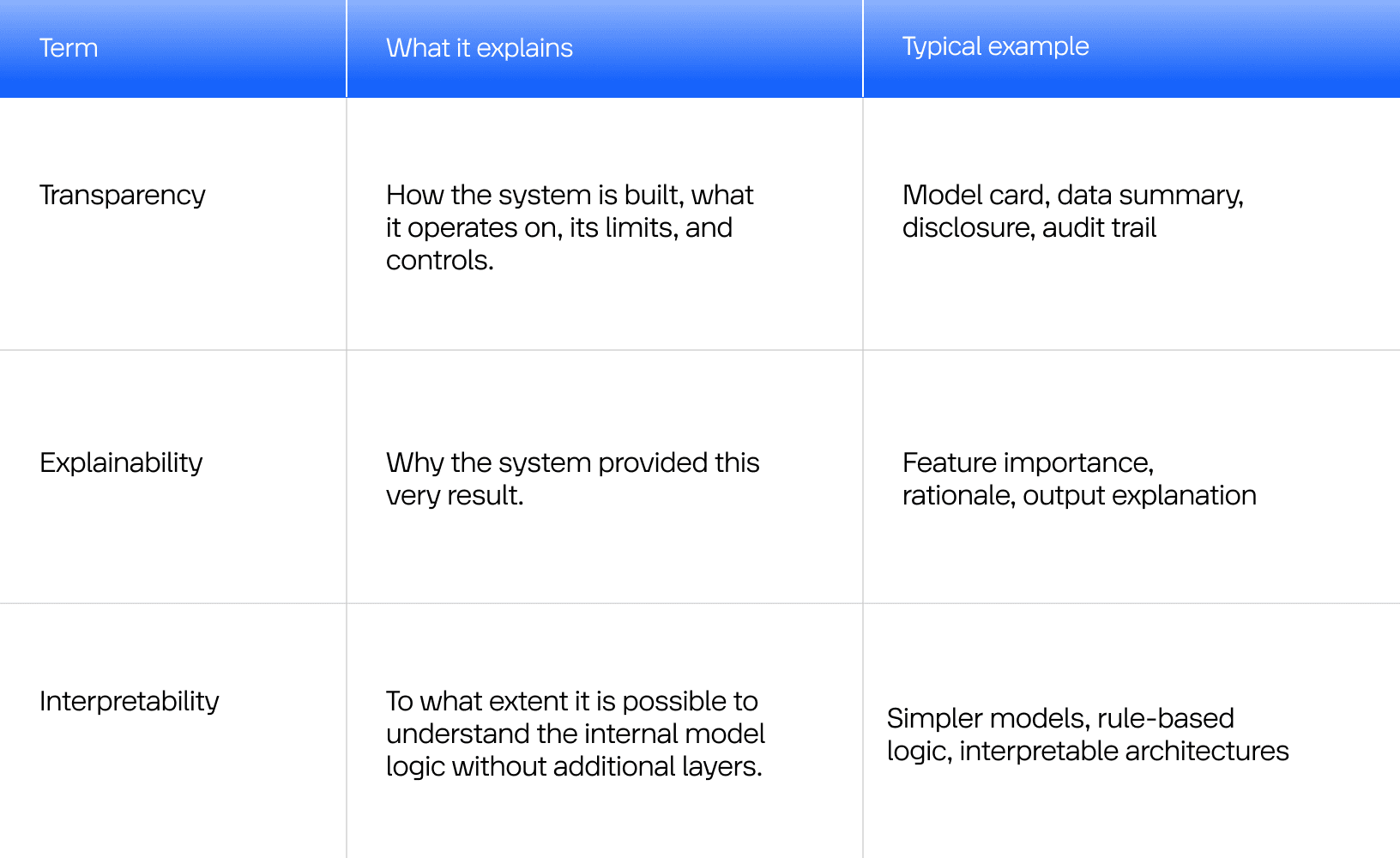
These three concepts are often conflated in AI in SaaS development. Because of this, teams sometimes think that a short explanation widget already solves the transparency issue. In fact, it doesn’t: explainability, interpretability, and transparency answer different questions.
Practical Takeaway
A company usually needs a combination of all three throughout its digital transformation journey, powered by AI. Transparency provides a complete framework. Explainability helps explain the output. Interpretability is useful when the model’s logic can be read and analyzed. Together, this creates a stronger foundation for trustworthy AI.
Transparency in AI Systems Explained Through Different Layers
Documentation and Model Records
Among all examples of transparency in AI, the first basic layer is documentation. The team needs to know:
what problem the model solves;
what input/output boundaries exist;
what data sources were used;
what limitations are already identified;
which use cases the system is not suitable for.
For large models, this topic becomes even more important: the EU already requires technical documentation and a public summary of training content for GPAI providers.
Traceability and Auditability
Next comes traceability, and here everything becomes very practical. When transparent and ethical AI already works in a real product, it is important for the team to see exactly what happened: which version of the model worked, what the inputs were, what the system generated in response, how it was checked, and what changed after the update. Without this, visibility quickly becomes very abstract.
In daily work, traceability provides the team with routine support. It helps to understand why the system behaves the way it does, find problems faster, go through reviews more calmly, and better control changes. And when there is also an audit trail – with logs, check history, approval records, and incident visibility – transparency becomes a real operational practice.
Disclosure and User Communication
The second layer is disclosure. The user needs to understand when they are interacting with AI, when they are reading AI-generated content, and when the system may require human review. This is particularly critical for chatbots, AI assistants, recommendation systems, and content generation flows. Section 50 of the AI Act explicitly requires disclosure for interactions with AI and for AI-generated or AI-manipulated content.
Governance and Ownership
Another important part is governance and ownership. Transparency works much better when specific people are clearly responsible for the AI system. Someone has to monitor the model, someone should be responsible for quality signals, someone for policy, disclosure, and how the system changes over time. Without it, documentation becomes outdated, rules are inconsistently applied, and responsibility becomes very unclear.
In real projects, this is felt very quickly. As soon as AI moves from prototype to production, the team needs a clear structure: who owns the system, who approves updates, who assesses risks, and who is responsible for communicating with users. This is what helps make transparency a stable part of the product.
Checklist: Transparency in AI Decision Making
Your team should know how AI transparency works. Thus, a secure system should have:
AI features for system inventory;
documented purpose and limits;
user-facing disclosure;
traceable outputs and logs;
review path for high-risk cases;
governance owner;
periodic reassessment after deployment.
Transparency in Generative AI
Why LLM Transparency Is Harder
Generative AI creates a separate class of problems. LLMs and multimodal models don’t just classify or rank; they generate new text, code, images, videos, audio snippets, and synthetic content. NIST describes generative AI as systems that produce synthetic content derived from learned patterns in data. Because of this, openness around how the system operates here is closely related to provenance, uncertainty communication, and disclosure.
Synthetic Content, Provenance, and Labelling
According to NIST’s 2024 report, there are several ways to make content more transparent. It includes provenance tracking, watermarking, labelling, synthetic content detection, and auditing. Companies will have to add metadata, use watermarking when appropriate, label AI-generated content, set up review workflows, and define clear rules for public-facing outputs.
Market Signal: the Transparency Gap Is Widening
Stanford FMTI 2025 showed a decline in the average transparency score and that companies are particularly opaque about training data, compute, and the post-deployment impacts of flagship models. This is an important signal for businesses that use LLM openness as a sales argument or compliance promise: the market itself has not yet closed this problem.
Where Lumitech Experience Maps In
Our expertise extends beyond building models or AI features. We help build disclosure, traceability, auditability, human review logic, and governance controls at the design and implementation stages.
This helps companies in building trust in AI systems that are easier to agree on, more secure to scale, and easier to integrate into mission-critical workflows.
Responsible AI Transparency: Requirements and Regulation
EU AI Act Timeline
Regulations are already affecting the teams' roadmaps. According to the official AI Act Service Desk, obligations for providers of general-purpose AI models entered into application on 2 August 2025, and transparency rules under Article 50 start to apply from 2 August 2026. This is an important timeline for those building or deploying GPAI-based products in the EU.
Article 50 In Practical Terms
Article 50 covers several types of obligations:
notifying people about their interactions with an AI system;
labelling AI-generated or AI-manipulated content;
disclosure for deepfakes;
disclosure when using emotion recognition or biometric categorization systems.
For product teams, this means that disclosure logic, content labelling, and detectable marking need to be considered already at the design stage.
Enterprise Governance Beyond Regulation
Many companies are taking a broader approach to AI governance and transparency than the law requires. Large organizations already have understandability for:
procurement checks;
security review;
legal review;
vendor due diligence;
model risk management (like supply chain risk management for modern models by Lumitech);
internal AI approval boards.
That’s why following AI transparency regulations is increasingly part of enterprise architecture, on par with cybersecurity and data governance.
Main Challenges of AI Trust and Transparency
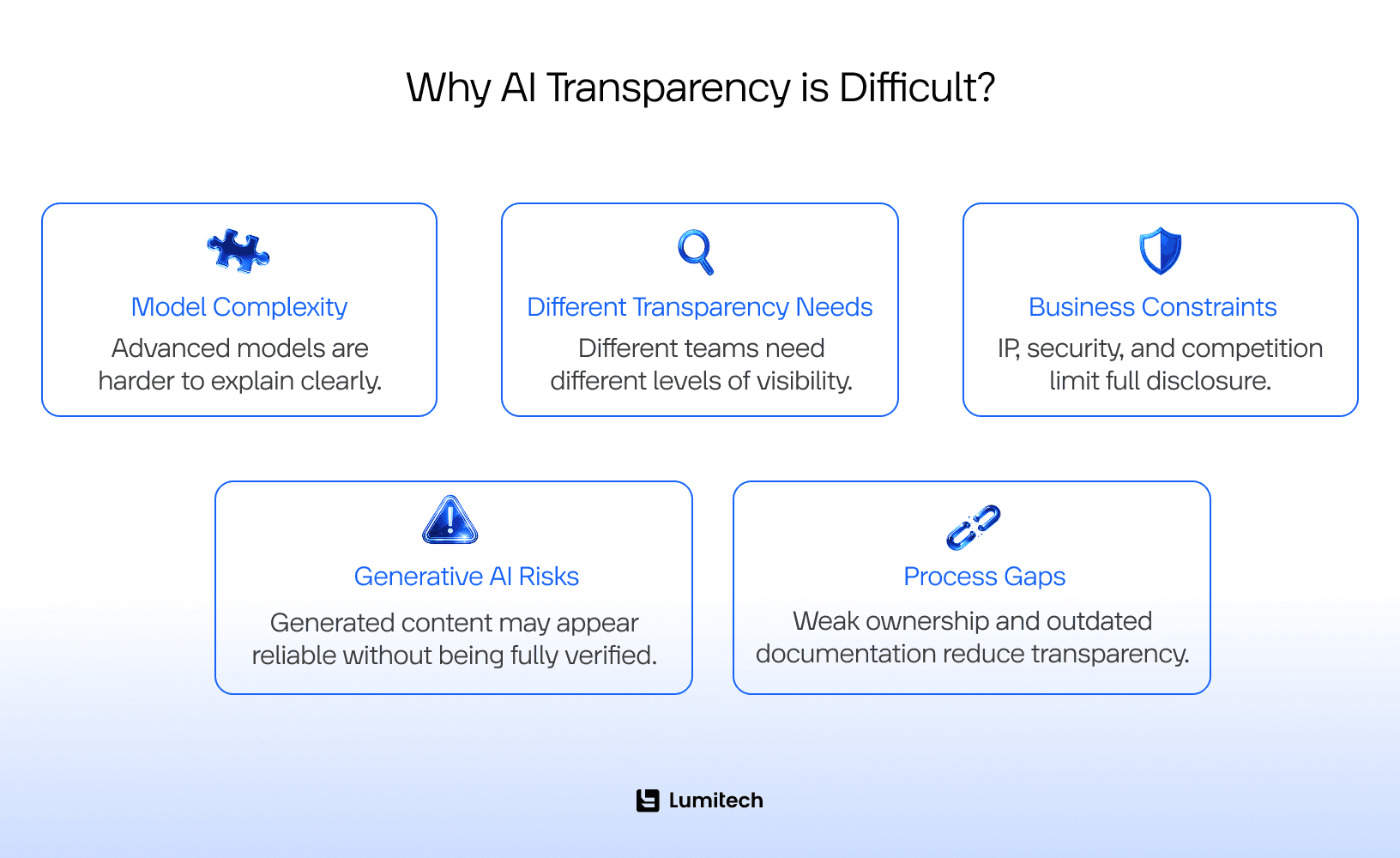
AI transparency standards sound right to almost everyone. At the idea level, it’s hard to argue with it: of course, you want the system to be understandable, manageable, and trustworthy. But once you get to the actual product, things get a little more complicated. This is where the main challenges emerge.
Model Complexity Makes Things Harder
One of the first problems is the complexity of the models themselves. The more powerful the system, the harder it is to explain in simple human language. This is especially noticeable in large language models, recommendation engines, fraud systems, and other multi-layered AI setups, where the result depends on many factors simultaneously. The team may understand the general logic perfectly well, but giving a short, honest, and truly useful explanation to the user is much more difficult.
Different People Need Different Levels of Transparency
Another challenge is that everyone looks at AI from different perspectives. It’s important for the user to understand that the AI is in front of them and how much they can rely on the result. The product team wants to see how this affects the user experience. Compliance and legal look at disclosure, risk controls, and auditability. Engineers want traceability, logs, and technical context. And at some point, it becomes clear that there is simply no one-size-fits-all explanation.
Business Realities Add Pressure
Added to this is the reality of business. Companies are not always ready to fully disclose such details as how their model works, what data it uses, or how its internal logic is built. This is where IP, security, competitive risks, and vendor ecosystem restrictions come into play. Therefore, AI system transparency almost always lies somewhere between “explain enough” and “not reveal too much.”
Generative AI Makes the Issue Even More Visible
In generative AI development services, this topic becomes even more visible. When a system generates text, images, or other content, users can easily perceive it as confident, complete, and verified. When in reality, the model may be wrong, fantasizing, or simply sound more convincing than it deserves. And if the product lacks a well-thought-out disclosure, review logic, provenance, or at least a clear explanation of the system’s boundaries, it quickly starts to hurt both trust and the quality of the result.
Transparency Often Breaks Down at the Process Level
And another very real problem: transparency often breaks down at the process level. There is no single owner; the documentation is outdated; someone updated something without proper review; and the product and risk teams view the system differently. As a result, AI seems to be there, the explanation seems to be there, but there is no complete picture. And without it, transparency very quickly turns into something nominal.
Best Practices for Building More Transparent AI Systems
The good news is that transparent artificial intelligence systems don’t have to be reinvented from scratch for every new product. There are quite practical things that really help make the system clearer, more controllable, and more peaceful for the business. So, check below how to improve transparency in AI.
Start With Visibility Into Where AI Is Used
The first step for implementing transparency in AI is quite basic but very important: the team must clearly see exactly where in the product or processes AI is used. It sounds simple, but in practice, chatbot features, recommendation logic, copilots, automations, document flows, and third-party AI tools quickly accumulate in the company – and without a normal inventory, it becomes difficult to even understand the full picture. And if you don’t see it, it is very difficult to build transparency systematically.
Document the System In a Way People Can Use
Documentation is next in the practical steps for AI transparency. Whether you want to automate cashback processing and use AI technology, manage risks in your operations, or focus on transforming real estate with AI, good documentation helps to quickly answer very practical questions: what is this system for, what are its limitations, where are its strengths, what risks are already known, who is its owner, and when human participation is needed. In real work, such things relieve a lot of tension between engineering, product, compliance, and stakeholders.
Make Disclosure Part of the Product
Show users that they interact with AI. Without any hidden explanations. This is important for generative AI, assistants, recommendation systems, and any customer-facing features. The clearer the product communicates the role of AI, the easier it is for users to navigate its results.
Give Ownership to Real People
Transparency works much better when it has specific owners. Someone should be responsible for the model, someone for documentation, someone for user disclosure, and someone for the monitoring and review process. When this responsibility is blurred, visibility does not last long. When ownership is clearly defined, the system becomes much more stable for both the team and the business.
Treat Transparency as Part of Product Quality
One of the most useful changes in thinking is to stop considering transparency as a separate ethical superstructure. In strong teams, it works as part of product quality. Just like security, observability, or maintainability. If AI affects the real workflow, then transparency simply becomes another property of a good product. As an example, you can read our case study on ethical AI in finance.
Bringing It All Together
Responsible AI transparency provides much more than just a “better explanation” for the user. It helps teams better understand their systems, businesses scale AI solutions more confidently, and users trust what they see in the product. That is why transparency today is closely tied to trust, control, auditability, and long-term product quality.
In this article, we examined what a transparent artificial intelligence system is and why it has become an important part of modern AI practice. We looked at why transparency directly affects trust, accountability, safety, and compliance, how it differs from explainability and interpretability, and what elements make an AI system truly transparent in practice – from documentation and disclosure to traceability, auditability, and governance.
We also touched on the benefits of AI transparency and generative AI, noting that system visibility has become even more acute due to synthetic content, uncertainty, provenance, and disclosure requirements. We also looked at the regulatory context, in particular the EU AI Act, and saw that for businesses, transparency has long gone beyond good practice and is gradually becoming an operational requirement.
The main conclusion here is quite simple: openness around how the system operates must be built into the system itself – in the architecture, product logic, user communication, and governance process. When all of this is in place, AI becomes more understandable, more manageable, and better prepared for real use.


