
Supply Chain Risk Management (SCRM) for Modern, Resilient Operations
A few years ago, many companies still treated disruption like bad weather: annoying, expensive, but somehow temporary. Now it is clear that uncertainty is a part of daily operations.
- Logistics
- Industrial
- Big Data & Analytics
April 03, 2026
 AI Overview
As supply networks become more global and interconnected, organizations face growing exposure to geopolitical events, supplier dependencies, cyber threats, regulatory changes, and demand fluctuations. Effective risk management helps businesses identify vulnerabilities, improve resilience, strengthen decision-making, and respond more quickly to unexpected disruptions while maintaining supply chain performance.

Tariffs shift priorities, cyberattacks hit logistics providers, supplier concentration creates hidden dependencies, and global networks remain as interconnected as ever. McKinsey’s latest survey found that nine in ten supply chain leaders experienced supply chain challenges in 2024, while many still rated long-term visibility as a weak capability.
That is why supply chain risk management (SCRM) has moved from a side process to a board-level capability. Done well, it helps companies spot disruption early, respond faster, protect margins, and keep customers supplied without turning every problem into a fire drill. Or, in less corporate language: fewer surprises, fewer emergency calls, fewer “why is this container somewhere mysterious again?” moments.
At its core, supply chain risk management (SCRM) is the structured process of identifying, assessing, mitigating, and continuously monitoring threats across suppliers, logistics, inventory, production, and compliance. IBM and ASCM both frame it as a resilience-building discipline that supports continuity, cost control, quality, and customer satisfaction.
But modern risk management in the supply chain is also becoming deeply technical. It depends on supply chain data, real-time signals, predictive analytics, workflow automation, and increasingly, AI. That is where software engineering and digital product strategy become central. Building risk-aware platforms is now about creating systems that can map dependencies, surface weak signals, and drive action across procurement, planning, and supply chain operations.
In this article, we will look at how businesses are adapting to geopolitical uncertainty, which KPIs matter most, what technologies are reshaping the field, and how to design a practical supply chain risk management process that is actually usable in the real world.
Why Supply Chain Risk Management (SCRM) Matters More Now
The classic global supply chain was optimized for cost and efficiency. The modern global supply chain has to optimize for something harder: resilience without losing speed. That means companies must manage a growing mix of operational, geopolitical, cyber, supplier, regulatory, climate, and logistics risks simultaneously.
IBM notes that rising complexity has increased the number of failure points, while ASCM emphasizes the need for structured mitigation processes rather than reactive responses.
This is also why global supply chain risk management is no longer limited to Tier 1 supplier reviews or annual scorecards. Real exposure often hides deeper in the network. Interos publicly argues that most businesses monitor only a tiny fraction of their supply chain directly, and positions automated mapping as the way to uncover sub-tier dependencies at scale.
Want a more resilient and agile supply chain? We help businesses build tailored solutions for monitoring, analytics, and operational response across modern supply chains.

How Are Companies Adapting Supply Chain Management Risks to Geopolitical Uncertainty?
They are doing four things at once: diversifying suppliers and regions, increasing visibility into sub-tier dependencies, expanding scenario planning and inventory flexibility, and investing in digital capabilities to improve response speed. McKinsey’s recent research shows leaders balancing short-term tactical moves, such as inventory shifts and supplier renegotiations, with longer-term efforts, such as network redesign and digitization.
The challenge is that many organizations are still underinvesting in the digital backbone needed to sustain those changes.
A practical takeaway: resilience is a portfolio. If a business relies on one supplier, one region, one carrier route, or one manual spreadsheet champion who is “the system,” it does not really have resilience. It has optimism.
What KPIs Matter Most in Supply Chain Risk Management Solutions Today?
The most useful KPIs in supply chain risk management are the ones that connect disruption signals to real business impact. They help teams measure resilience, prioritize action, and improve response speed across suppliers, logistics, and planning. In practice, strong metrics turn risk visibility into better operational and financial decisions.
The shortlist should include:
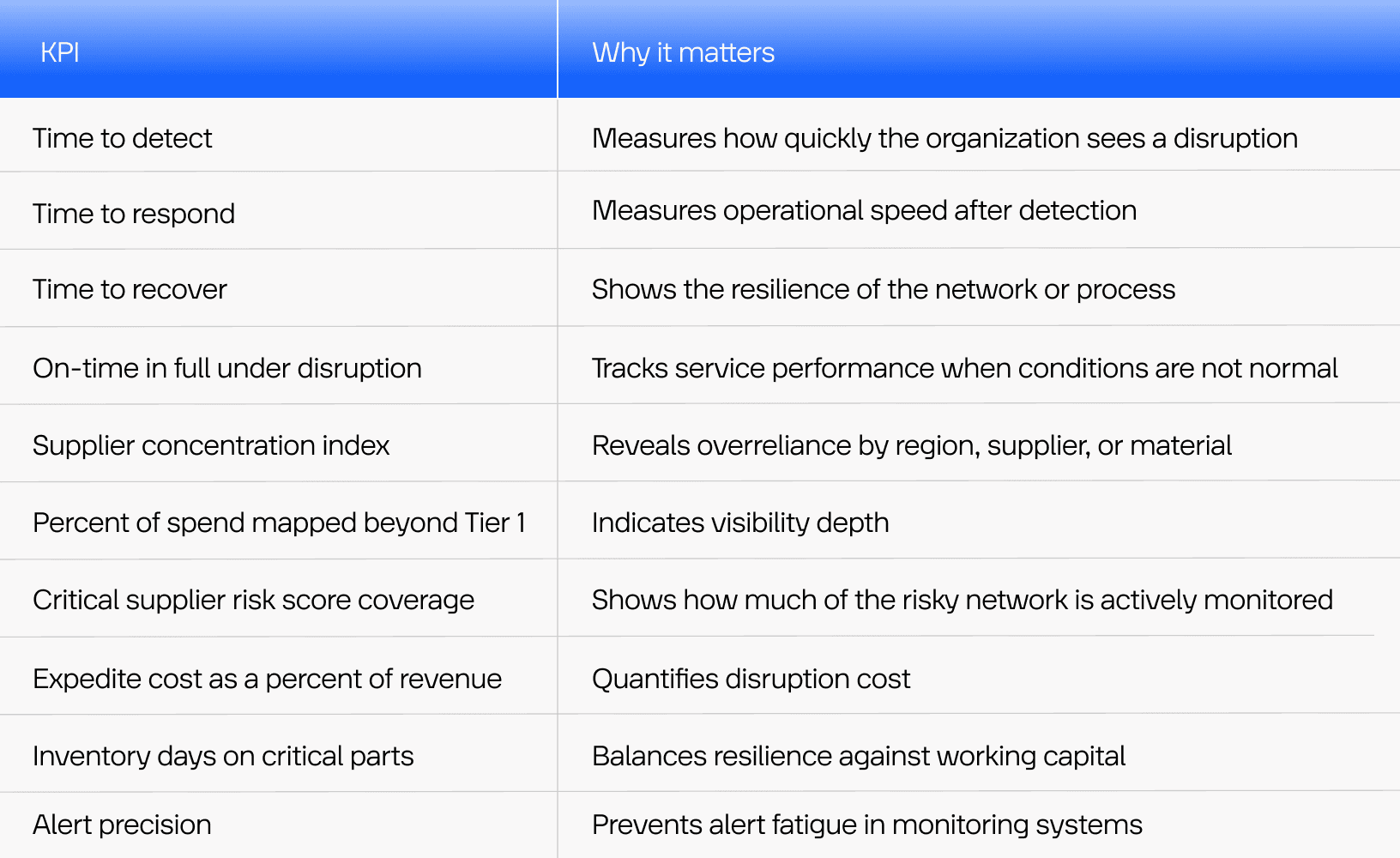
McKinsey’s research also points to visibility and data quality as major differentiators in resilience performance.
For product teams, an underrated KPI is action completion time: how long it takes to convert a validated risk event into a completed mitigation task. That is often where digital transformation in logistics either proves itself or quietly excuses itself.
From Reactive Control to a Modern Supply Chain Risk Management Strategy
A mature model of risk management in the supply chain usually includes five layers.
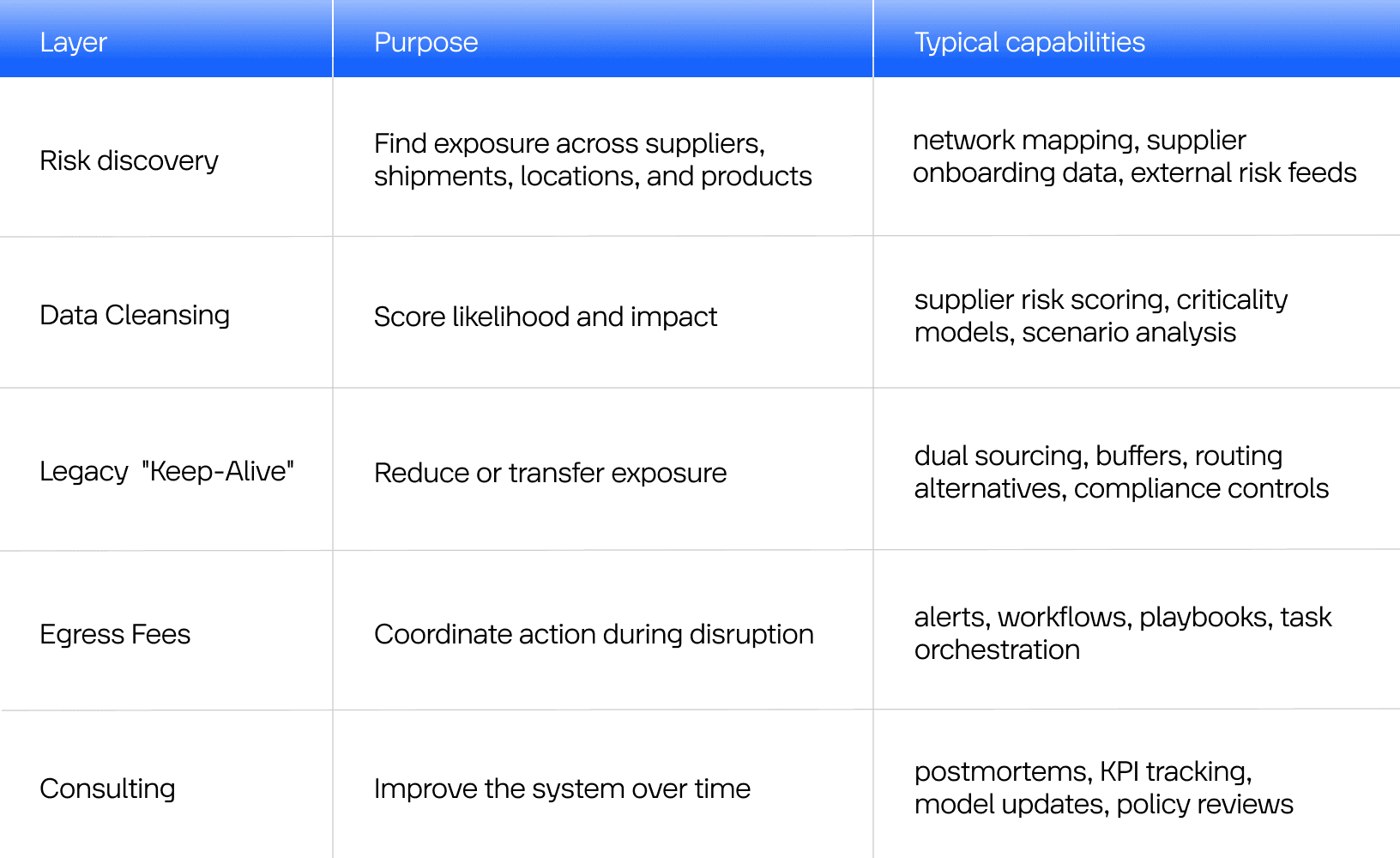
Such supply chain risk management model looks obvious on paper. In practice, many companies still operate a fragmented version: procurement owns supplier assessments, logistics owns visibility, planners manage exceptions, compliance runs separate checks, and leadership sees only lagging metrics.
Modern platforms try to unify those pieces through a shared data layer and decision workflows. That is the difference between “we know risk exists” and “we can do something about it this hour.”
A strong supply chain risk management framework also needs governance. That is where a supply chain risk management policy matters. The policy should define:
risk categories and ownership,
supplier segmentation and review frequency,
escalation thresholds,
required data sources,
response playbooks,
audit and compliance requirements.
Without policy, every disruption becomes a custom project. With policy in place, teams can move faster because the rules of engagement are already defined.
Challenges of Supply Chain Risk Management
Companies face a number of systemic challenges of supply chain risk management that prevent them from building a truly resilient and adaptive supply chain.
Limited visibility beyond Tier 1 suppliers
Most companies only see their direct suppliers, but have a very limited understanding of what is happening at the Tier 2 and Tier 3 levels. This is where hidden dependencies, risk concentrations, and critical bottlenecks often hide.
Fragmented data and disconnected systems
Supplier, logistics, inventory, risk, and incident data are often scattered across ERP, TMS, WMS, spreadsheets, supplier portals, and email communications. This makes it difficult for teams to form a single risk picture and make coordinated decisions quickly.
Too many signals, not enough prioritization
Supply chain teams receive too many alerts, updates, and external signals, but they don’t always have the tools to prioritize them properly. As a result, important events get lost among less critical ones, and the response becomes slow and chaotic.
Slow response across multiple teams
A single disruption can simultaneously impact procurement, logistics, planning, production, and customer service. If there is no common workflow between these functions, the company loses coordination time when speed matters most.
Weak connection between assessment and action
In many businesses, supply chain risk assessment exists separately from actual operational actions. A company may know that a particular supplier, route, or region is risky, but may not have a prepared response plan, alternative scenario, or clear mitigation workflows.
Hidden dependencies and concentration risk
Even if a company works with multiple suppliers, this does not always mean real diversification. They may all depend on one upstream supplier, one region, one port, or one technology provider. Such hidden dependencies often become noticeable only after a failure.
Growing cyber and third-party exposure
The modern supply chain is a digital one. Suppliers, logistics partners, SaaS platforms, integrations and external enterprise software development services create an additional layer of risk. This makes supply chain security an important part of overall business resilience.
Difficulty proving ROI
Investments in resilience are often difficult to justify because their value is not only reflected in direct revenue, but also in reduced losses, faster response, better business continuity and less reliance on manual processes. For many companies, this is still difficult to translate into a simple financial model.
The Supply Chain Risk Management: Process and Adaptability
What Does the Step-by-step Supply Chain Risk Management Process Look Like?
1. Map what matters
Start the supply chain risk management process with critical suppliers, high-margin products, constrained materials, major lanes, and single points of failure. Then go deeper into sub-tier dependencies where exposure is concentrated. Interos and Everstream both position automated mapping and monitoring as essential because hidden dependencies often sit below Tier 1.
2. Build a meaningful risk taxonomy
Group risks into categories such as:
supplier financial health,
geopolitical concentration,
cyber and supply chain security,
transportation and port disruption,
quality and capacity,
ESG and regulatory compliance,
weather, and natural hazards.
This is not just an academic exercise. A clean taxonomy makes it easier to design data models, dashboards, and escalation paths.
3. Score risk using context, not just checklists
A supplier in a volatile region is not automatically high risk. A sole-source supplier for a critical component probably is. Risk scoring should combine likelihood, impact, detectability, and time-to-recover. That is where supply chain risk analytics becomes useful: it can combine internal and external signals rather than relying solely on questionnaire responses. IBM specifically highlights real-time calculation and alerts in its supplier risk tooling.
4. Connect mitigation to execution
Risk registers are nice. Action is nicer. A strong process links each major risk to predefined mitigation options: alternate suppliers, substitute materials, rerouting logic, reserve inventory, contractual changes, or customer communication triggers.
5. Monitor continuously
This is where supply chain risk management monitoring makes a difference. Continuous monitoring should include supplier news, shipment events, inventory positions, compliance updates, weather, sanctions, cyber incidents, and quality anomalies. Everstream, project44, and FourKites all publicly position real-time monitoring and visibility as essential to preventing and resolving disruptions.
6. Learn and update
Every disruption should improve the system. Which alerts mattered? Which thresholds were noisy? Which supplier data was outdated? Which workaround was too manual? That feedback loop is how supply chain resilience management becomes a capability instead of a slogan.
How Can Businesses Build a More Adaptive and Future-Ready Supply Chain Risk Management in Detail?
By combining operating model changes with digital foundations. A future-ready approach usually includes segmented resilience strategies by product and supplier criticality, flexible sourcing and logistics design, stronger logistics risk management, shared data models across procurement, planning, and transportation, continuous monitoring instead of periodic reviews, playbooks for business continuity, and engineering support for integration and automation.
This is where business continuity in the supply chain becomes concrete. Continuity is not just a contingency PDF in a folder last opened during a major crisis. It is the ability to maintain service through designed alternatives: alternative suppliers, routes, allocations, and workflows. IBM directly ties supply chain risk management to business continuity and brand protection.
A good north star is not “eliminate all risk.” That is impossible. The goal is to become more adaptive: faster to detect, faster to decide, and better at absorbing shocks without breaking service or economics.
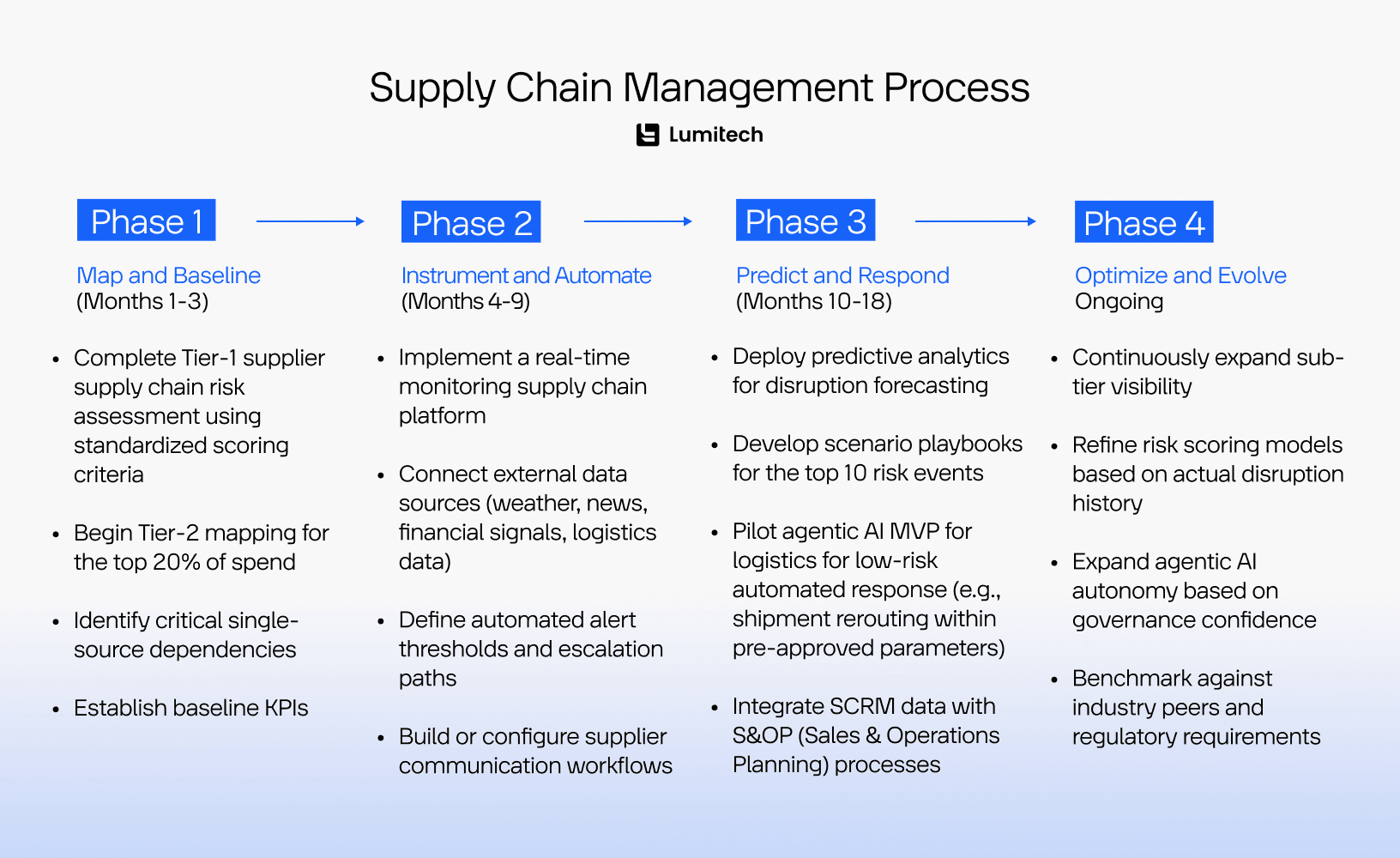
Below is a practical roadmap.
Phase 1: Map and Baseline (Months 1-3)
Complete Tier-1 supplier supply chain risk assessment using standardized scoring criteria
Begin Tier-2 mapping for the top 20% of spend
Identify critical single-source dependencies
Establish baseline KPIs
Phase 2: Instrument and Automate (Months 4-9)
Implement a real-time monitoring supply chain platform
Connect external data sources (weather, news, financial signals, logistics data)
Define automated alert thresholds and escalation paths
Build or configure supplier communication workflows
Phase 3: Predict and Respond (Months 10-18)
Deploy predictive analytics for disruption forecasting
Develop scenario playbooks for the top 10 risk events
Pilot agentic AI MVP for logistics for low-risk automated response (e.g., shipment rerouting within pre-approved parameters)
Integrate SCRM data with S&OP (Sales & Operations Planning) processes
Phase 4: Optimize and Evolve (Ongoing)
Continuously expand sub-tier visibility
Refine risk scoring models based on actual disruption history
Expand agentic AI autonomy based on governance confidence
Benchmark against industry peers and regulatory requirements
What Technologies Are Shaping the Future of Supply Chain Risk Management Solutions?
The future of supply chain risk management solutions is being shaped by technologies that do more than collect data. The most valuable systems help companies see risk earlier, understand its business impact faster, and respond through connected workflows instead of manual coordination.
In practice, the market is moving toward a combination of visibility, intelligence, automation, and AI-driven execution. ASCM describes this broader shift as a move from reactive disruption management to “intelligent transformation,” while IBM links modern SCRM directly to better detection, faster response, and stronger resilience.
1. Real-time visibility platforms
What the technology does:
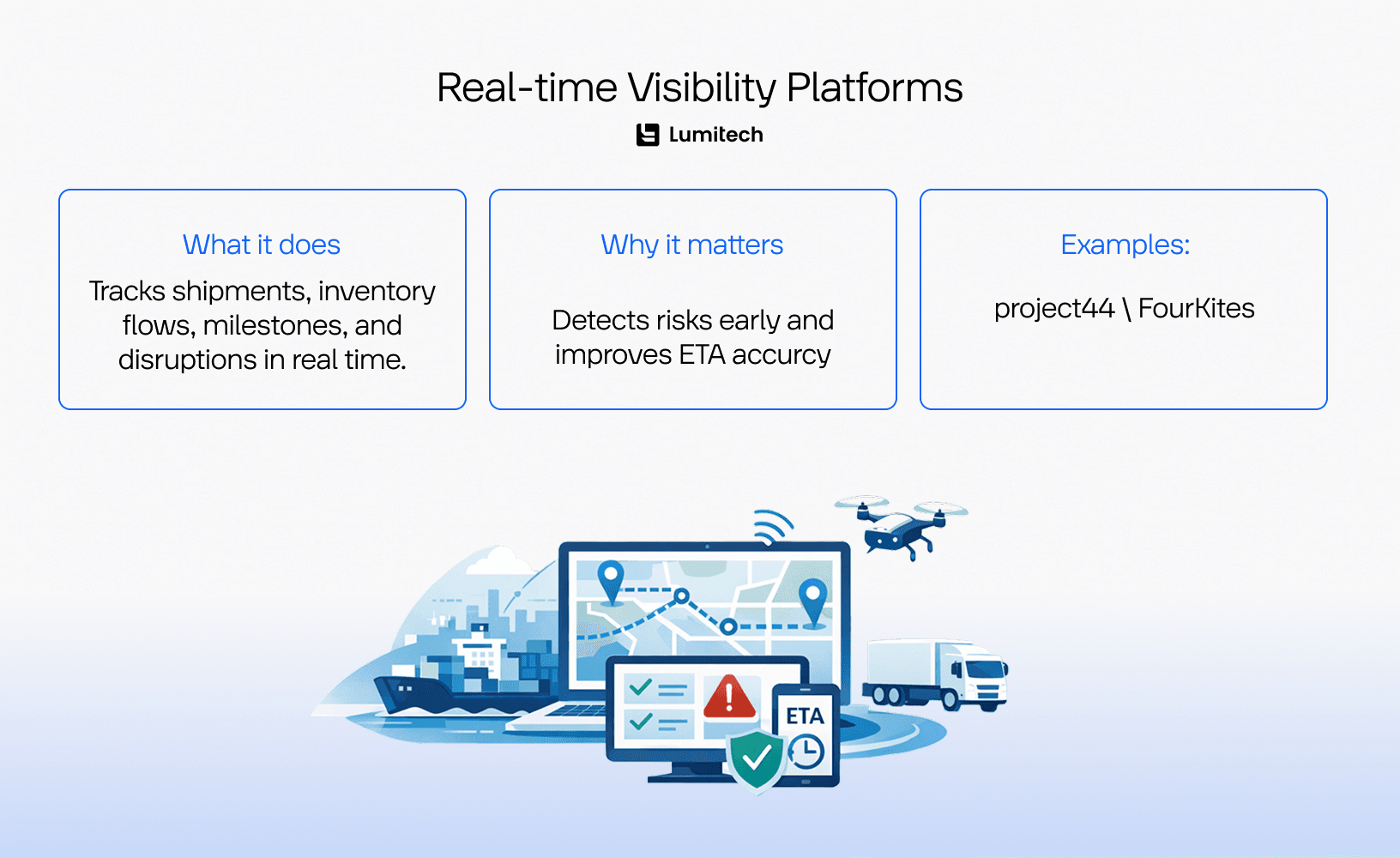
Platforms for supply chain visibility and risk management track shipments, inventory flows, transport milestones, and exceptions. Their main value is helping teams identify disruptions early enough to act before customer service, production, or inventory availability is affected.
IBM notes that AI-enabled supply chain risk control towers use this visibility to provide end-to-end views across suppliers, inventory, and delivery flows, while project44 and FourKites position real-time operational visibility as the backbone of proactive exception management.
Why it matters for risk management:
Without live operational signals, most companies discover risk too late. A delay becomes visible only after it affects a customer order, a supplier issue shows up only after inventory tightens, and a port disruption reaches planners only after the escalation chain has already started.
Real-time visibility shortens time to detect, improves ETA confidence, and gives teams a shared operational picture for faster decisions.
Examples:
CEVA Logistics expanded its partnership with project44 to improve ocean and port visibility, aiming to achieve more accurate, timely shipment tracking. FourKites’ Intelligent Control Tower is built around the same logic, combining real-time data with AI to surface risks, recommend actions, and even trigger autonomous workflow steps.
2. Supply chain control towers
What the technology does:
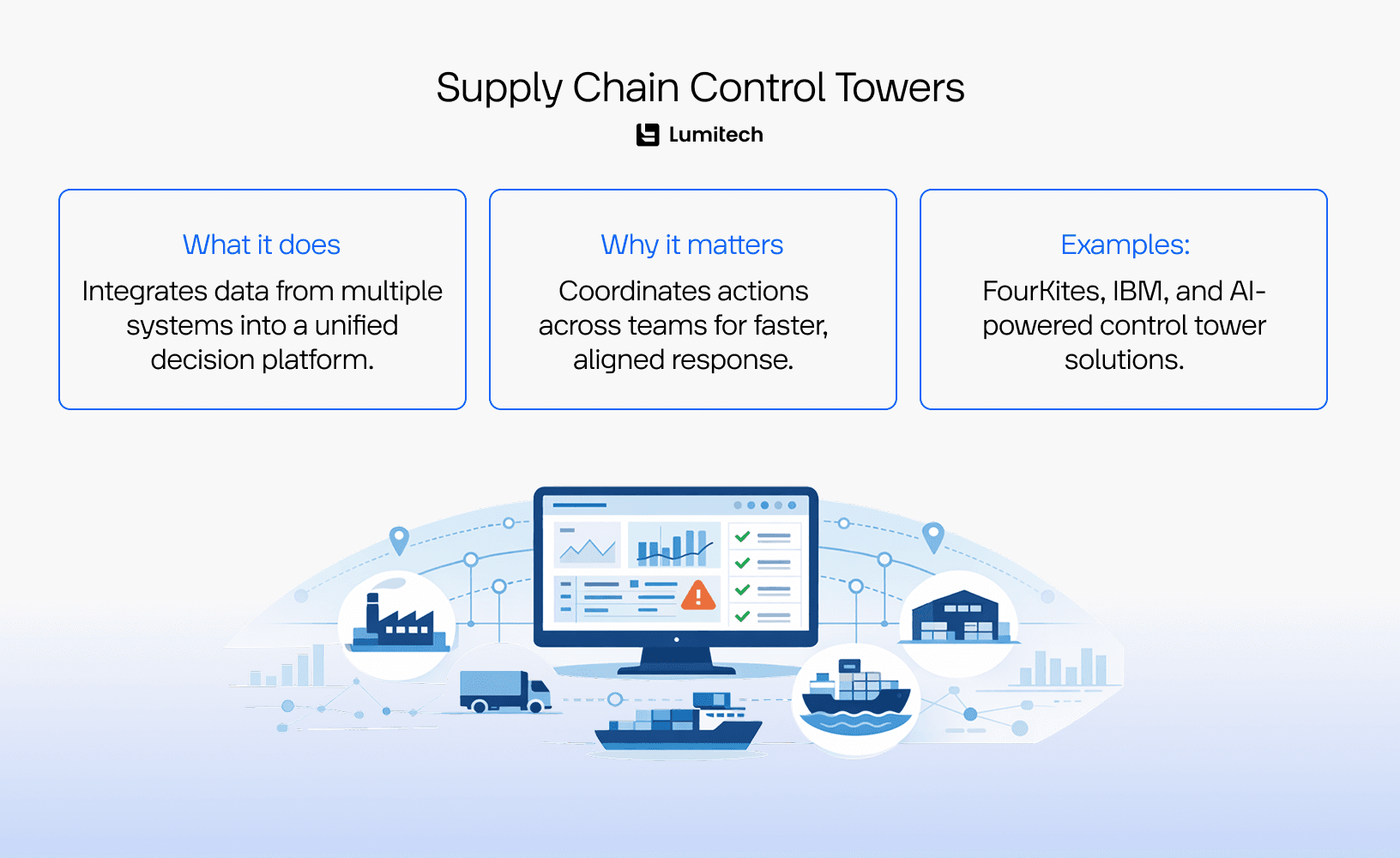
A control tower consolidates data from multiple systems into a single decision environment. Instead of teams working separately in ERP, TMS, WMS, supplier portals, spreadsheets, and email threads, the control tower creates a shared layer for monitoring, prioritization, and response.
IBM describes supply chain control towers as systems that provide end-to-end visibility across inventory silos and disparate systems, enabling easier prediction of vulnerabilities and understanding of upstream and downstream impacts.
Why it matters for risk management:
A disruption is rarely limited to one function. A supplier delay affects procurement, production, logistics, inventory planning, and customer communication simultaneously.
Control towers matter because they reduce fragmentation: they help companies coordinate action across teams, align on a single version of the truth, and connect alerts to response workflows rather than leaving them as isolated notifications.
Examples:
FourKites’ Intelligent Control Tower combines real-time data, digital twins, and AI-powered agents to move beyond reporting toward more active orchestration. IBM also positions the AI-enabled control tower as a core building block of a cognitive supply chain that can detect disruption earlier and respond more consistently.
3. Digital twins for supply chain networks
What the technology does:
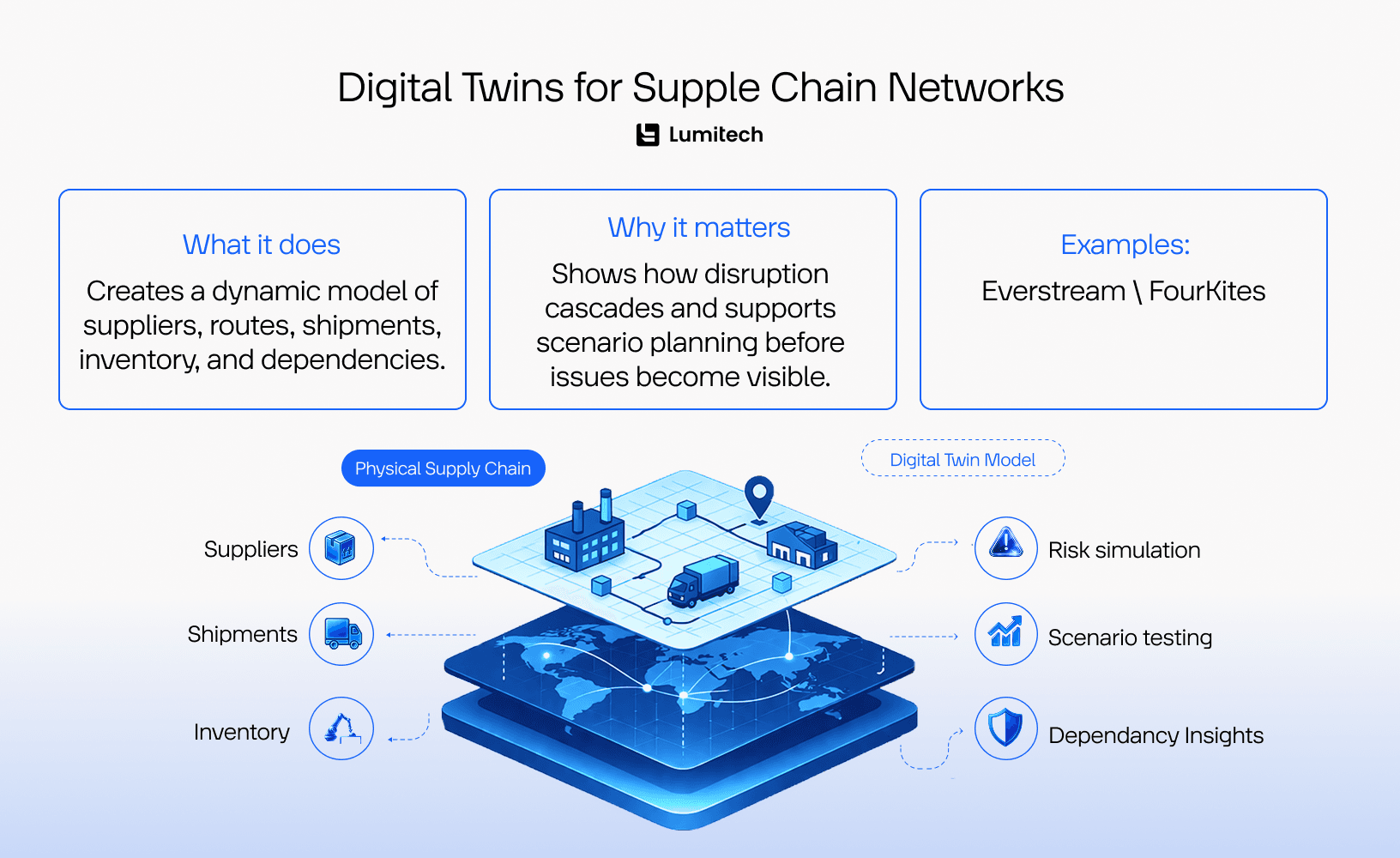
A digital twin is a dynamic digital model of the supply chain network, including suppliers, sites, locations, lanes, shipments, inventory nodes, and their relationships. Unlike a static map, a digital twin is designed to simulate risk, expose vulnerabilities, and test scenarios.
Everstream explicitly describes its platform as creating a digital twin of the network to detect vulnerabilities and optimize supply and logistics resilience. IBM Research has also explored agentic AI for digital twins in shipping, highlighting their value for handling complexity and multiple data sources.
Why it matters for risk management:
Risk is networked. A plant shutdown, supplier issue, weather event, or cyberattack does not stay in one place. It cascades. Digital twins help companies understand those dependencies faster by showing which suppliers, products, routes, or regions are connected and what the downstream impact may be.
This is especially useful for scenario planning, stress testing, and designing mitigation strategies before disruption becomes operationally visible.
Examples:
Everstream uses digital twin logic to continuously monitor suppliers, shipments, and locations. FourKites also ties digital twins to its control tower positioning, using them to support real-time decision-making and AI-powered workflow orchestration.
4. Supplier mapping and multi-tier network intelligence
What the technology does:
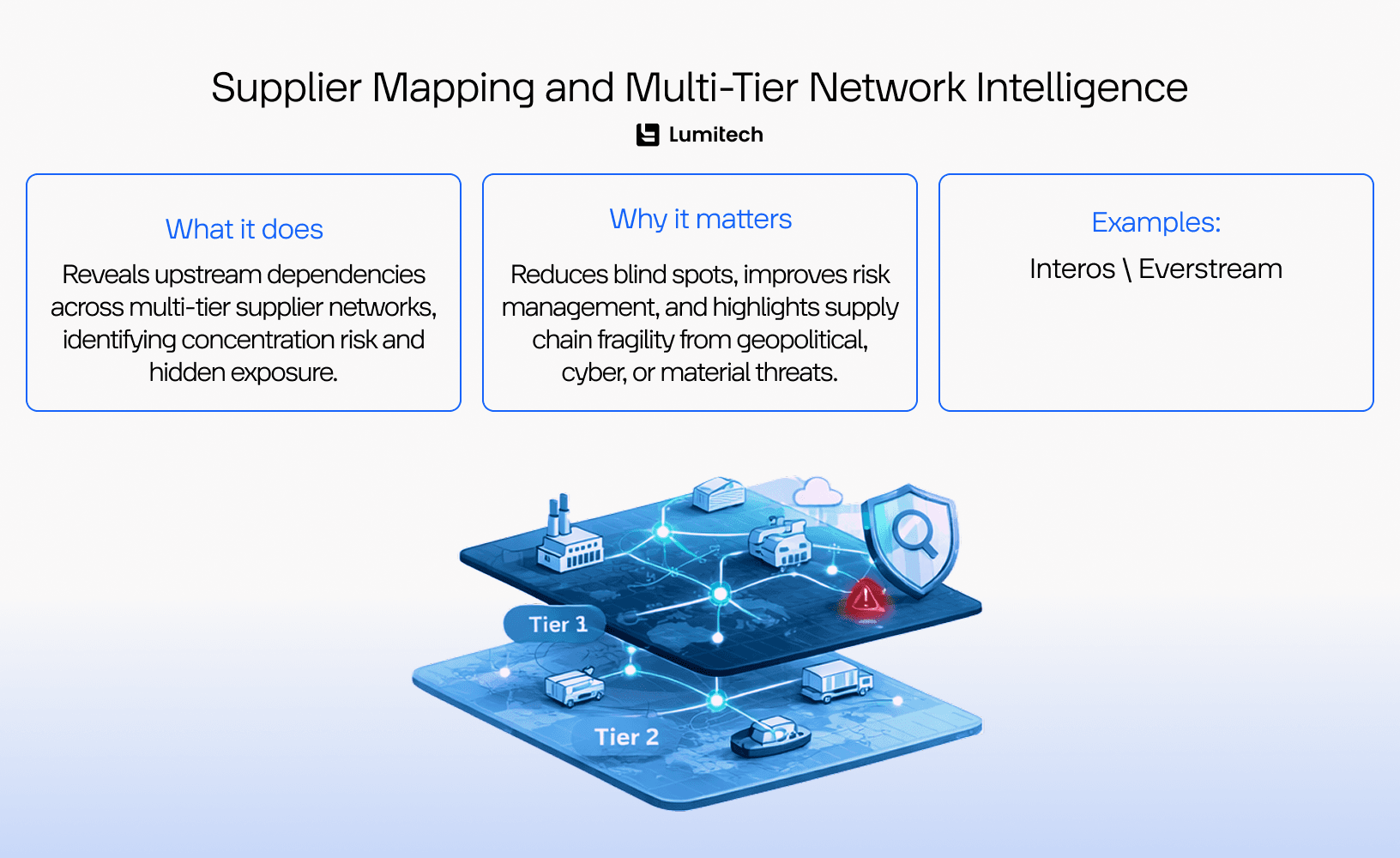
Supplier mapping technologies reveal dependencies beyond Tier 1 suppliers by identifying upstream relationships across multiple layers of the network. These systems often rely on graph models, external business relationship data, and automated monitoring to show where concentration risk, single points of failure, or hidden exposure may exist.
Interos describes its platform as an AI-driven supplier resilience system for supply chain risk management that maps and monitors supply chains at scale across all tiers.
Why it matters for risk management:
Many companies know their direct suppliers but have very limited visibility into deeper tiers. That creates blind spots around shared upstream dependencies, geopolitical concentration, sanctions exposure, cyber vulnerabilities, and raw-material bottlenecks.
Supplier mapping reduces that hidden risk by helping procurement and resilience teams see not only who they buy from, but where structural fragility sits inside the network.
Examples:
Interos positions its platform around multi-tier mapping, unified third-party risk visibility, and earlier disruption detection. Everstream also supports supplier and location risk scoring to inform sourcing and supplier selection decisions, which complements mapping with continuous risk assessment.
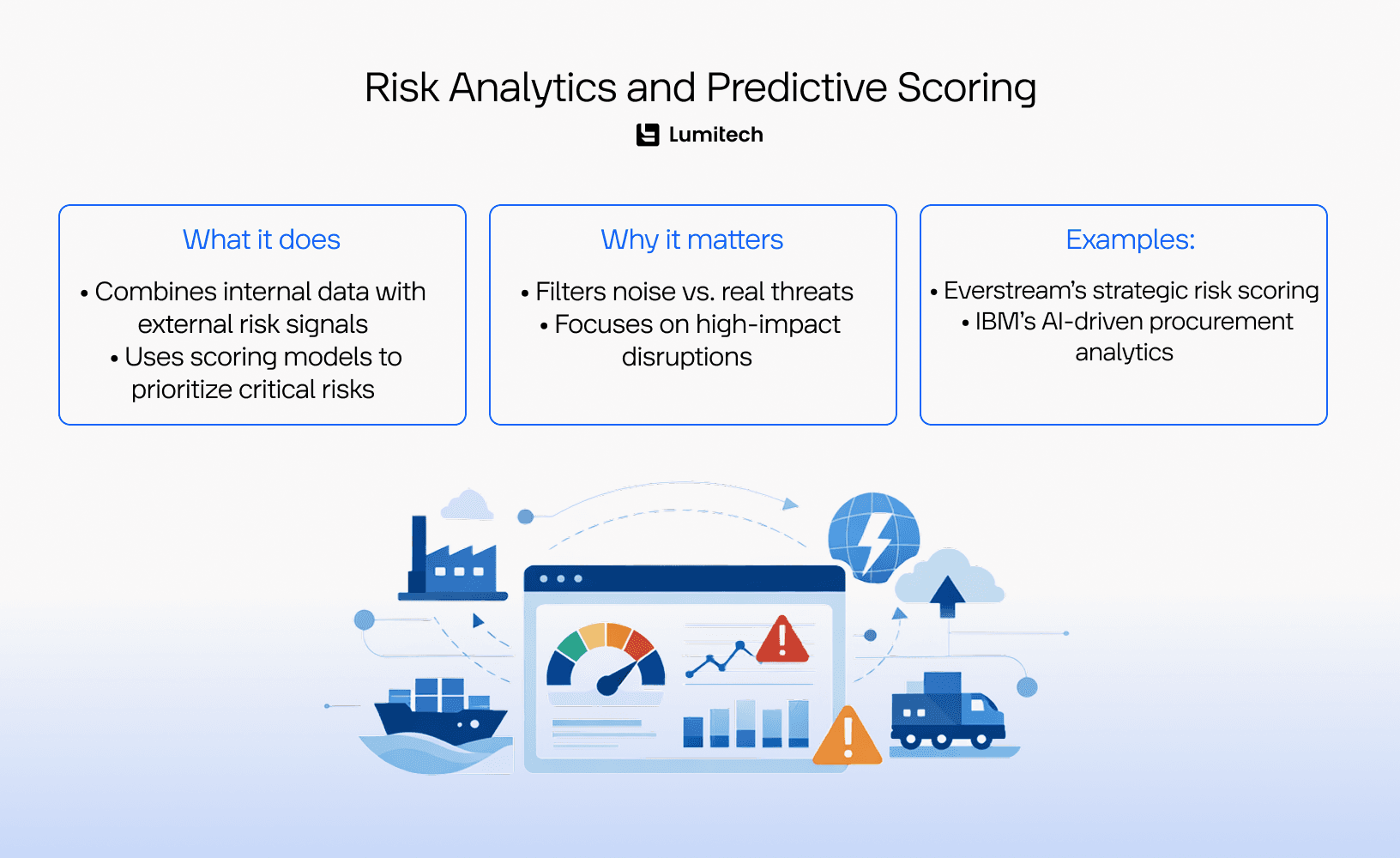
5. Risk analytics and predictive scoring
What the technology does:
Supply chain risk analytics technologies combine internal operational data with external signals such as weather, geopolitical events, supplier performance, cyber alerts, and logistics disruptions to estimate likelihood, impact, and response urgency. These systems usually include scoring models, scenario analysis, prioritization logic, and dashboards that help teams focus on the most material risks first.
IBM highlights the value of combining internal and external data to detect disruption earlier, while Everstream promotes predictive supplier and location risk scoring as part of its risk-assessment layer.
Why it matters for risk management:
Not every alert deserves the same response. Risk analytics helps businesses distinguish between noise and real exposure. It supports faster triage, better sourcing decisions, and more credible planning by enabling teams to rank disruptions by business impact rather than by alert volume.
This is especially important in environments where planners and procurement teams already face too many disconnected signals.
Examples:
Everstream’s Explore supply chain risk management solution focuses on automated, location-based strategic risk scoring for sourcing and procurement decisions. IBM points to AI-powered procurement analytics tools that combine internal and external data to give teams a more complete view of supplier risk.
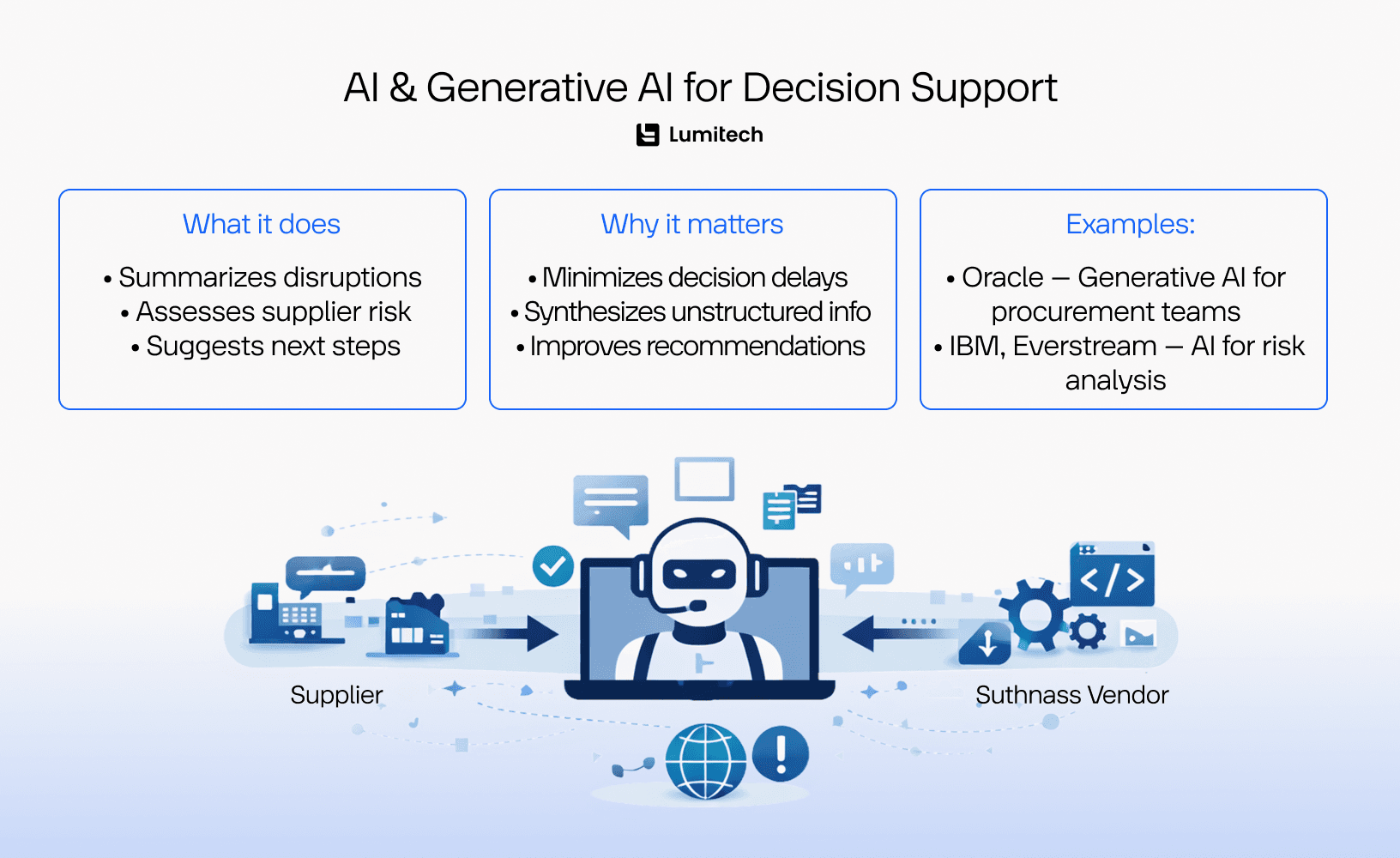
6. AI and generative AI for decision support
What the technology does:
AI in logistics and SCRM is increasingly used to summarize events, classify disruptions, assess likely impact, support supplier risk evaluation, and surface next-best actions. Generative AI is especially useful when risk teams need to quickly synthesize large volumes of structured and unstructured information.
Oracle’s example of supplier risk assessment with generative AI shows how AI can help procurement teams analyze supplier-related information more efficiently, while Everstream positions AI as a key layer in modern risk detection and prioritization.
Why it matters for risk management:
The problem is decision latency. Teams often spend too much time gathering context, reading fragmented updates, or manually interpreting signals before they can act. AI can reduce that friction by turning scattered risk inputs into usable summaries, classifications, and recommendations. Used well, it accelerates human decisions.
Examples:
Oracle has published a supplier risk assessment approach using generative AI for buyers and procurement teams. IBM and Everstream also frame AI as essential for analyzing complex risk environments and improving response quality across procurement and supply chain operations.
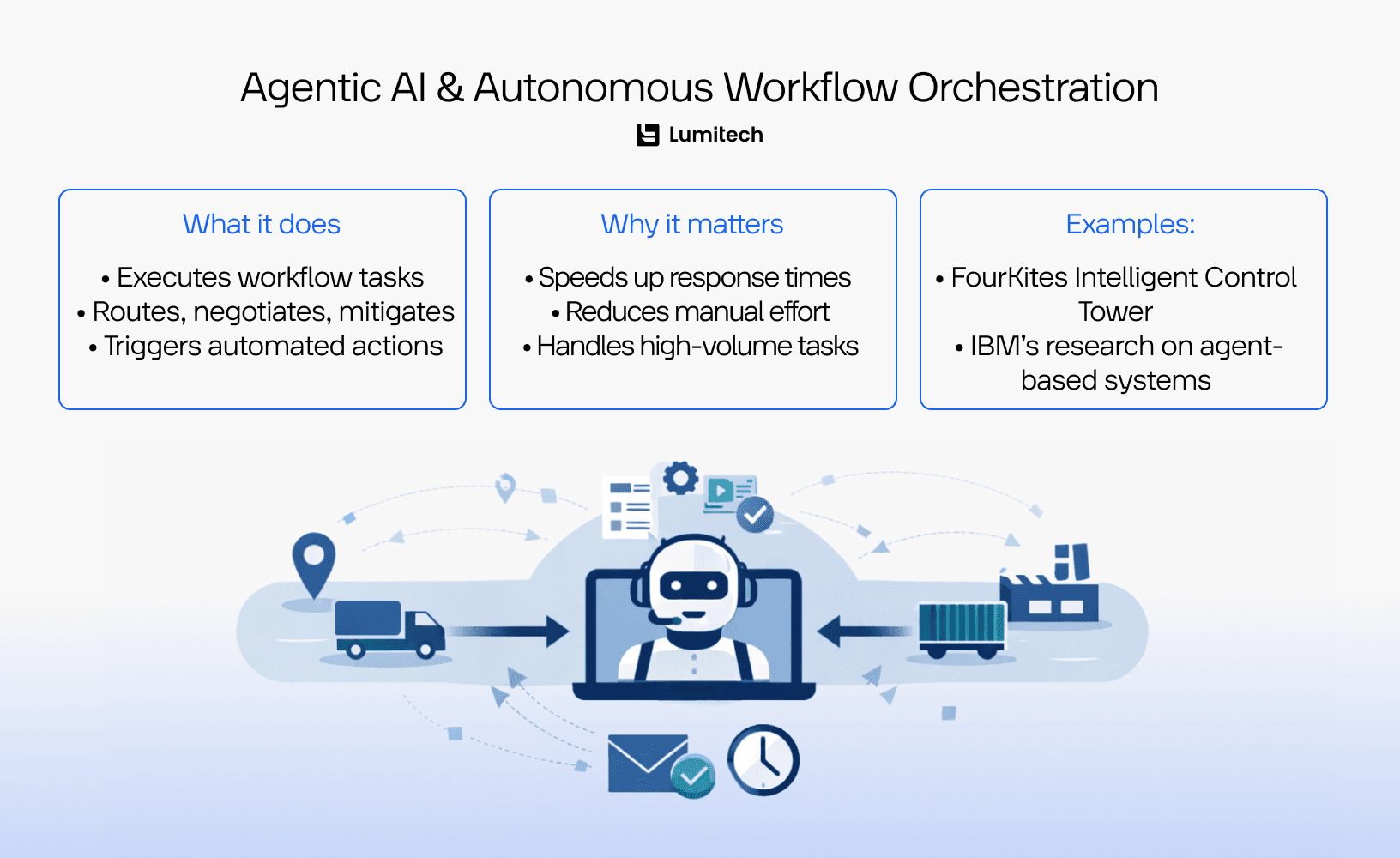
7. Agentic AI and autonomous workflow orchestration
What the technology does:
Agentic AI goes a step beyond analysis. Instead of only surfacing insights, it can execute parts of the workflow: gathering context, evaluating options, routing cases, recommending actions, and sometimes automatically triggering approved responses.
FourKites describes AI agents in its Intelligent Control Tower as a “digital workforce” capable of taking autonomous action across complex workflows. IBM likewise discusses agentic AI as a model where autonomous agents can reroute shipments, adapt to changing conditions, negotiate with suppliers, and mitigate risks in real time.
Why it matters for risk management:
Many disruptions become expensive because responses take too long. Agentic AI matters when companies need to compress time between signal, analysis, and action. It is especially promising for repetitive, high-volume tasks such as case triage, shipment rerouting, escalation preparation, supplier follow-ups, and recommendation drafting.
Examples:
FourKites is one of the clearest public examples of agentic AI applied to supply chain control towers. IBM’s recent research and thought leadership also point to agent-based systems as the next stage of autonomous and semi-autonomous supply chain operations.
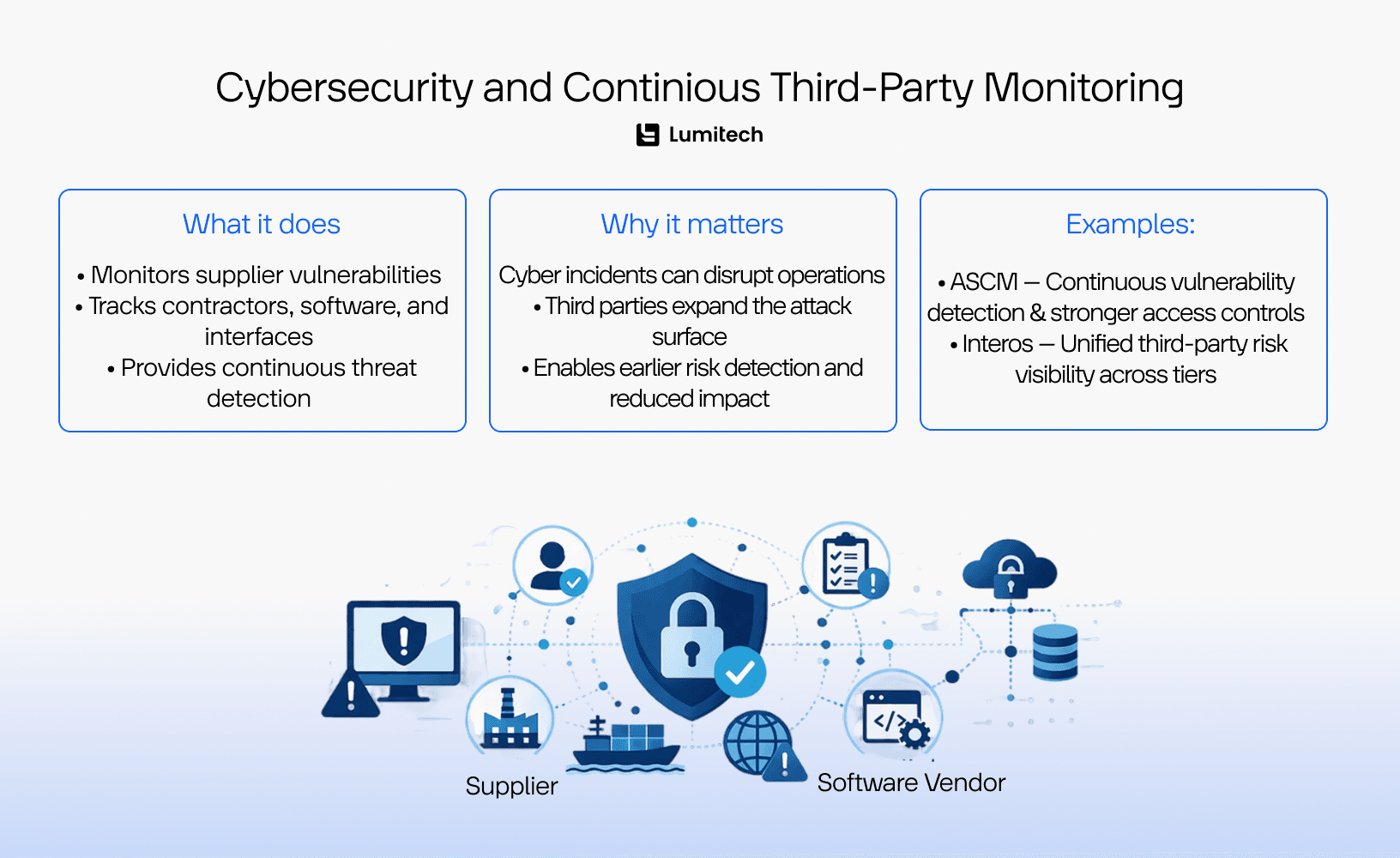
8. Cybersecurity and continuous third-party monitoring
What the technology does:
Cybersecurity technologies in supply chain risk management focus on monitoring vulnerabilities across suppliers, contractors, software providers, interfaces, and connected ecosystems.
ASCM’s 2026 outlook highlights continuous vulnerability detection, stronger supplier interface security, and broader third-party risk programs as growing priorities. Interos also positions third-party risk management as part of unified supplier visibility across all tiers.
Why it matters for risk management:
Supply chains are now digital networks as much as physical ones. A cyber incident involving a logistics partner, software provider, or supplier can quickly disrupt operations. That makes cybersecurity part of business continuity, not just IT governance. Continuous monitoring helps companies identify weaknesses earlier and reduce the blast radius of third-party incidents.
Examples:
ASCM’s current trend guidance points to continuous vulnerability detection and stronger access control across supplier data exchanges. Interos includes third-party risk visibility as a core platform capability, demonstrating how cyber and supplier risk are increasingly converging within a single operating model.
Real Market Examples of the Supply Chain Risk Management: What Already Works
The strongest proof that supply chain risk management delivers value is how companies use these platforms to reduce uncertainty in real operations. In practice, the biggest gains usually come from better visibility, faster response, and fewer manual decisions under pressure.
Below are several examples of companies that integrated risk, visibility, or control-tower platforms into their supply chain environments and achieved measurable benefits either through legacy modernization services or building solutions from scratch.
Case 1 – Lumitech: Real-Time Forecasting as a Foundation for Proactive Supply Chain Decisions
At Lumitech, we build real-time forecasting system as a key enabler of modern supply chain risk management. In our article, we show how forecasting systems can support inventory planning, stock-out prediction, logistics delay forecasting, and dynamic replenishment by continuously processing fresh data and updating predictions in near real time.
We also describe the architecture behind these systems, from ingestion and processing to APIs, dashboards, and alerts. In practice, this approach helps businesses improve planning accuracy, respond more quickly to disruptions, and make supply chain decisions with greater confidence.
Our most relevant cases include a logistics SaaS platform for a client from London and a charter bus booking system for a Miami-based partner. Both cases are supported by smart risk management software solutions for logistics industry.
Ready to build a smarter supply chain system? At Lumitech, we help companies design and develop custom platforms for real-time forecasting, operational visibility, and faster risk response.
Case 2 – Danone: Stronger Resilience and Wider Network Visibility with Everstream
Danone partnered with Everstream Analytics to improve real-time risk visibility across its global supply chain. According to Everstream’s case study, the company used AI-powered monitoring to identify vulnerabilities earlier, strengthen compliance, and support supply continuity.
Everstream says Danone achieved 60% coverage of its worldwide supply network within one year, giving teams a much clearer view of hidden dependencies and emerging disruption risks. For a global business, that kind of visibility is a serious operational advantage: it improves prioritization, speeds up mitigation, and reduces the odds of being surprised by sub-tier issues.
Case 3 – CEVA Logistics: Better Ocean Shipment Tracking Through project44 Integration
CEVA Logistics expanded its partnership with project44 to improve visibility for ocean freight shipments. In its announcement, CEVA said the integration of project44’s ocean and port visibility tools would provide customers with greater accuracy and timeliness in tracking ocean shipments.
That matters because ocean freight risk delays downstream planning, customer communication, inventory buffers, and exception management. In other words, better visibility helps CEVA move from reactive status updates to more proactive logistics coordination.
Case 4 – Automotive Industry: Semiconductor Crisis (2020-2023)
The global semiconductor shortage that began during COVID-19 resulted in over $210 billion in lost automotive revenue by 2021. The root cause: carmakers had heavily optimized for just-in-time inventory, with virtually no buffer stock for critical chips and no visibility beyond their Tier-1 suppliers.
The response has fundamentally reshaped the industry's supply chain risk management strategy. Major OEMs now require multi-tier supplier mapping, maintain strategic chip inventory, and have implemented real-time supply chain monitoring tools that continuously track semiconductor supply conditions. Toyota, which had maintained strategic buffer stocks following the 2011 Tohoku earthquake, fared significantly better than competitors.
Key lesson: Risk visibility must extend to Tier-2 and Tier-3 suppliers. Buffer stock for truly critical components is insurance.
Case 5 – DHL Customer Case: Integrated Systems, Better Visibility, Lower Complexity
In a DHL case study on redesigning global supply chain operations, the company described how it integrated a customer’s ERP systems with DHL’s SCi Transport Management System and warehouse systems.
The result was increased visibility across the supply chain, along with broader operational improvements, such as packaging redesign, hub creation, and network changes.
This example is useful because it shows that supply chain risk management often works best when it is not a standalone tool. The biggest gains usually come when risk intelligence, transport systems, warehouse systems, and planning data are integrated into a single operating model.
Case 6 – Pharmaceutical: Supply Chain Resilience Post-COVID
Following COVID-19, the pharmaceutical sector fundamentally restructured its approach to supply chain risk management. The FDA's Drug Shortage Action Plan, updated in 2025, now requires pharmaceutical manufacturers to maintain risk management plans for all drugs at risk of shortage.
Companies like Pfizer and Roche have invested heavily in supply chain data platforms, real-time supplier monitoring, and geographic diversification of API (Active Pharmaceutical Ingredient) manufacturing.
The result: improved early warning capabilities, faster response to supply disruptions, and better alignment with regulatory requirements.
Frameworks of Risk Management in Supply Chain: Choosing the Right Approach
Not every organization needs the same SCRM framework. The right structure depends on industry, supply chain complexity, and risk tolerance. Here are the most widely adopted approaches.
ISO 31000 – Risk Management Guidelines
A general-purpose risk management standard applicable to supply chains. Provides a structured process for risk identification, assessment, treatment, monitoring, and communication. Good for organizations building their first formal SCRM capability.
NIST Cybersecurity Framework (for Supply Chain)
Specifically addresses supply chain security from a cybersecurity lens. Critical for organizations handling sensitive data or operating in regulated industries (healthcare, defense, financial IT services for enterprise companies). Increasingly relevant as cyber risk becomes a top supply chain threat.
Supply Chain Operations Reference (SCOR) Model
Developed by APICS/ASCM, the SCOR model provides a standard language and metrics for supply chain performance, including risk-related KPIs. Useful for benchmarking and for organizations that want to align their SCRM with broader operational performance management.
Custom Risk Scoring Models
Many enterprises operating complex global supply chains develop proprietary supplier risk-scoring models that combine financial health indicators, geographic risk data, performance history, and compliance status into a single risk rating for each supplier. These are typically implemented on platforms such as SAP Ariba, GEP, or MetricStream.
Conclusion: How to Handle Supply Chain Management Risks Effectively
Modern solutions for supply chain management risks is a cross-functional digital capability built on visibility, analytics, monitoring, and action. Companies that treat it as a living system, not a yearly compliance ritual, are better positioned to handle disruption, protect service, and adapt to changing markets. IBM, ASCM, McKinsey, and leading market platforms all point in the same direction: resilience now depends on better data, deeper visibility, and faster response.
For businesses operating in complex ecosystems, the opportunity is clear. Build the right supply chain risk management strategy, connect it to real workflows, and use technology where it actually improves decisions. Because the future of supply chains will belong to the companies that recover faster, learn quicker, and keep moving when conditions get messy. Professionally, of course.


