


About the Project
In New York’s dynamic real estate market, agents handle many leads, properties, documents, and deadlines each day. While speed matters, staying organized and open is just as important for commissions, client trust, and team results. When there is no central system, details get lost, and even strong teams start to feel like they are fighting their own tools.
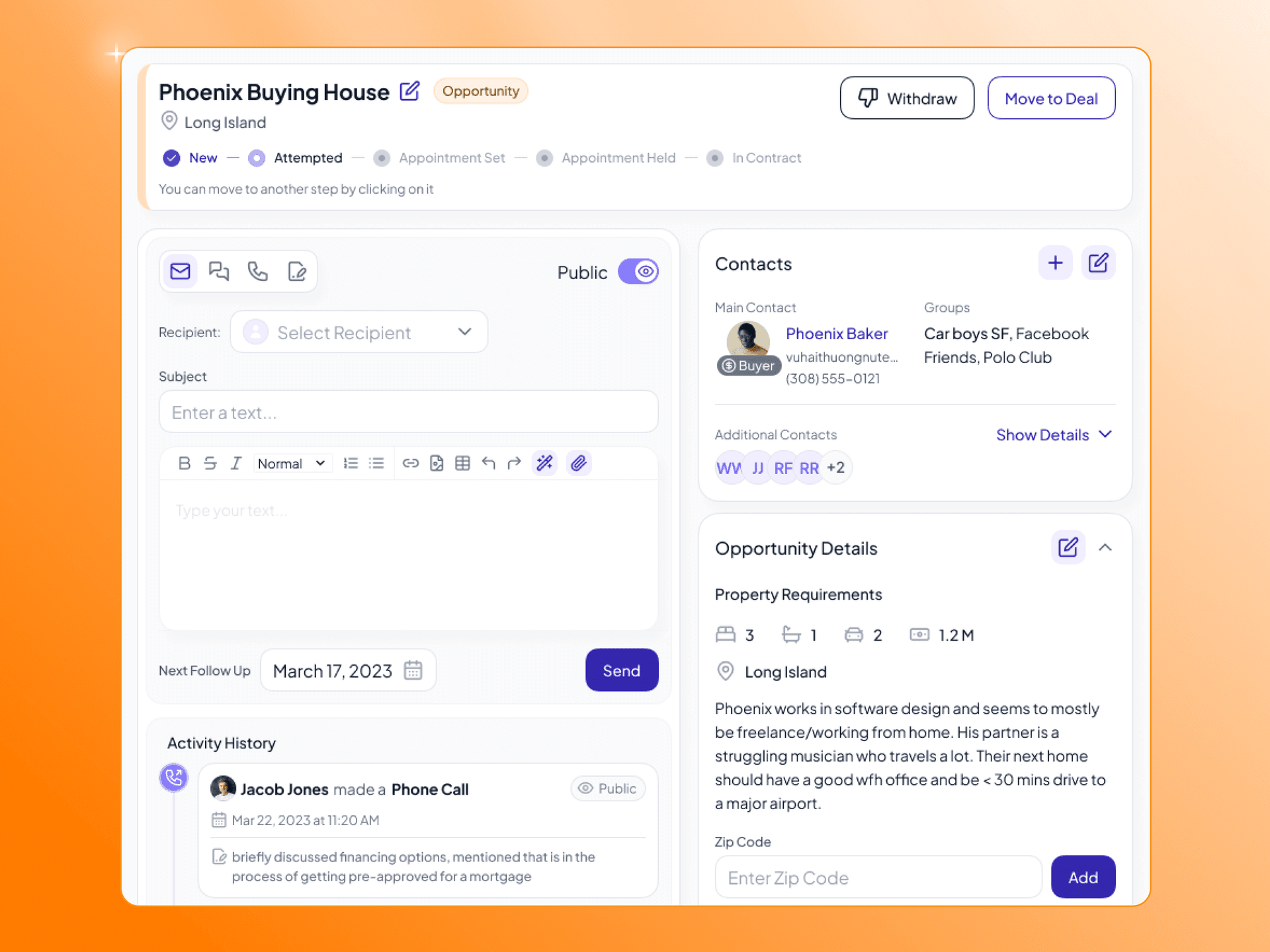
HotSheet was built for this challenge. It’s an AI-powered, browser-based CRM made to help agencies track deals, manage clients, and automate the process from first contact to closing. In addition, it supports real estate workflow automation and better visibility for managers who need to see the full picture in one place. Lumitech worked with the founders for over a year to turn the idea into a working product that agencies now use every day.
Interesting Facts
The client is a New York startup with a team spread across the US. The founders have already built and sold several successful companies.
The CTO worked closely with Lumitech’s engineers, reviewing code, shaping the system’s design, and making sure it could grow over time.
Over a year of active collaboration, HotSheet grew into one of the most technically advanced CRM for real estate agencies in the client’s target market.
The product is live and in use, and it keeps improving as agencies start using more AI-powered workflows and expect more automation from day one.
Client Request
Many real estate agencies faced the same issues: using spreadsheets, scattered tools, and CRMs that weren’t built for real estate deals. As a result, deals were missed, client records were incomplete, and agents spent too much time on manual updates instead of building relationships.
The founders wanted to fix this. They asked Lumitech to build a modern platform where:
Every opportunity, from first lead to closed contract, is tracked centrally and consistently.
Real estate client management is easy and structured, not buried in emails or personal notes.
AI helps predict which deals are most likely to close, so teams can focus their energy where it matters.
Internal workflows such as reminders, notifications, and approvals are automated instead of manually managed in chat or email.
In short, they wanted an AI-driven CRM designed for real estate from the start, not just a generic tool with some custom fields. What’s more, the client wanted it to support digital transformation for real estate agencies without forcing them to fully change how they already work.
Approach
Lumitech began with a small team of three developers and added more people as the product grew. The team worked in a mix of ways:
Lumitech owned the main implementation work, from backend services to front-end interfaces and infrastructure.
The client’s CTO stayed deeply involved, joining technical discussions, shaping architecture decisions, and doing code reviews to keep everything consistent with the long-term vision.
The team took a tech-focused approach. Rather than adding lots of features quickly, they focused on:
Clean, scalable architecture that can handle large volumes of deals and clients.
High-quality code and clear boundaries between frontend, backend, and the AI layer.
Reliable integrations with external tools like Google Workspace, Twilio, and OpenAI, so the platform fits into agents’ existing environments.
Feedback was fast and frequent. New versions were released often, reviewed quickly, and improved based on how the client’s team thought agencies would use the system in practice. While doing this, Lumitech also kept an eye on real estate process optimization, making sure every change supported better day-to-day operations, not just “more features.”
Challenges
Even with a strong team and clear goals, there were some big challenges along the way:
Complex architecture: A modern real estate CRM is more than just a list of contacts and properties. It needed to bring together pipeline views, client records, communication history, and AI insights in a clear, easy-to-use way.
Real-time analytics: Adding machine learning models to score deals and update their chances of success in real time meant carefully connecting Node.js/NestJS services with Python microservices.
Performance: Agencies handle a lot of data—historic deals, long client histories, and multiple active pipelines. The system needed to remain responsive even when many users and records were active at the same time.
Customization vs. product focus: Every agency works a bit differently. The challenge was to balance flexible options with a strong, easy-to-maintain product.
Distributed teams: With people in different US time zones and Lumitech’s remote team, communication needed to be organized but also quick.
Despite these challenges, the teams stuck to one rule: deliver value early, then improve it.
Features
Over time, HotSheet became a focused toolkit for automated deal management and real estate operations, built with modern technologies like React, Next.js, Node.js, NestJS, PostgreSQL, Python, and AWS. Key features include:
AI-Based Deal Management and Tracking
A special AI layer, built with Python microservices, scores deals and predicts how likely they are to close. This AI-powered deal tracking helps agents and managers know where to focus, which leads need more attention, and which deals might be at risk. As a result, decisions across the pipeline are based on data, not just gut feeling, and artificial intelligence in real estate becomes a daily tool, not a buzzword.

Client and Lead Management
HotSheet brings all real estate leads and client relationships into one place. New leads become organized records, and real estate lead management is supported by automatic creation and updates of client cards. This makes it easier to see the full picture: when a contact joined, what was discussed, and which properties were considered. In practice, this supports smoother real estate client management across long, complex cycles.

Task Automation and Workflows
A major feature of the platform is automating real estate workflows. The system manages:
Status changes and pipeline transitions.
Notifications and reminders for follow-ups, contract deadlines, or missing documents.
Routine tasks that normally eat into agents’ time.
This task automation for real estate agents helps by reducing mental effort and keeping deals moving without constant manual tracking.

Reporting and Analytics
Built-in dashboards let managers and founders see pipeline health, conversion rates, revenue forecasts, and team performance. This helps improve real estate deal management because bottlenecks are easy to spot, not hidden in spreadsheets or private notes. It also supports more predictable property sales automation, since teams see what works at each stage.
Integrations and Infrastructure
HotSheet works with tools agencies already use, like Google Workspace for communication, Twilio for messaging, and OpenAI API for AI features. With AWS infrastructure, Docker, and GitHub Actions, the platform supports smooth updates without downtime and gives a strong base for future extensions. In the background, this combination makes it a solid real estate CRM platform that can grow with the business.
Summary
After just over a year of working together, HotSheet is now a live platform used by real estate agencies. It adds structure, speed, and visibility to daily work:
Agencies use it as the central system for real estate deal management, from the first touch to closing.
Routine work is automated, so teams can spend more time with clients and less time updating tools.
Deal success can be predicted with about 80% accuracy, thanks to a reliable AI module that is now a key part of the product, not just an extra feature.
Overall, the platform helps agencies go digital by bringing AI-driven CRM ideas into daily workflows, not just executive dashboards. HotSheet is still growing, but its foundation already delivers on the original promise: a focused system for real estate client management, real estate workflow automation, and real estate process optimization that supports growth without losing control or insight.