
AI Decision Making in Practice: Architecture, ROI & Real-World Cases
When did you last decide based on gut feeling? Without data, it’s just gambling. While managers waste 30% of their time on outdated reports, market leaders use AI decision making to turn data into a real-time competitive edge.
- Decision Intelligence
- AI Development
March 03, 2026
 AI Overview
AI decision-making converts predictive model outputs into guided business actions, replacing static reporting with real-time recommendations that account for risk, policy, and error cost. Core components include an inference layer generating risk scores, prescriptive analytics for action guidance, and edge AI for millisecond response times. Managers currently waste 30% of their time reviewing outdated reports before AI-driven systems close that gap.

At Lumitech, we see this every day: the CEO’s headache is not a lack of information, but an excess of it. You’re drowning in terabytes of data, but when it’s time to press the “Start” button, you still feel like a blind pilot. AI decision making is about creating a “digital copilot” that can calculate millions of scenarios in seconds, detect anomalies that the eye is blinded to by routine, and replace “I think” with “I know because the data confirms it.”
The rise of decision intelligence and its speed has become the main currency. If your analytics system is slower than the market, you’re not just standing still – you’re regressing. In this article, we’ll explore how AI for decision making is transforming chaotic data flows into clear roadmaps, and why in 2026, the ability to delegate analytics to algorithms will be the only way to maintain control over your business.
The Death of Intuition: Why AI Decision-Making Rules the 2026 Market
As of 2026, we are witnessing not just an “interest” in AI, but a real explosion in the Decision Support Systems (DSS) segment. The market for AI in decision making systems is growing at a compound annual growth rate (CAGR) of over 25%, and this is no coincidence. We have crossed the threshold beyond which the human brain is physically unable to process the volume of input signals.
Why has this market “detonated” right now? There are three fundamental reasons.
The Erosion of Traditional Analytics
Classic BI tools (Business Intelligence) have taught us to look to the past: they beautifully draw graphs of what has already happened. But in the conditions of 2026 volatility, knowing that sales fell yesterday does not help save profits today. The market requires Prescriptive Analytics (attributional analytics) when AI for decision making does not just say "there will be a storm", but gives a clear instruction: “Change course 15 degrees to the left to save 10% of fuel”.
Availability of Computing Power and Edge AI
Thanks to the development of cloud computing and edge computing, complex AI making decisions models now operate not in laboratories but “in the fields”: in warehouses, logistics centers, and bank terminals. The reaction speed has decreased from days to milliseconds. For businesses, this means moving from quarterly strategy sessions to dynamic real-time management.
The Problem of Cognitive Overload
The number of data sources (IoT sensors, social networks, market indicators, and internal ERP) has grown exponentially. Today's CEO faces more variables in one morning than a manager in the 90s did in an entire year. AI services are becoming the only filter, cutting out the noise and leaving only the signals that really affect the bottom line.
Companies that integrate AI decision making today are creating an invisible but critical gap with their competitors. It’s no longer a question of “better marketing”; it’s a question of intellectual superiority. While others are trying to guess the trend, you are already operating with probabilities confirmed by algorithms.
Lumitech is figuring out how to work with this. We help companies not just collect data, but turn it into “active knowledge.” Our expertise in data architecture enables us to build systems that help AI overcome analytical paralysis, so it can focus on the main thing – vision and leadership. For example, here you can read how we built HR decision making platform for our client from Hamburg.
AI for Decision Making: Looking Beyond Automated Logic
Marketing jargon aside, AI decision making is an engineering discipline focused on turning a model’s prediction/assessment into a guided action within a real business process. That is “the system made (or recommended) decision Х, taking into account risk, policies, constraints, and the cost of error, and left the audit and rollback options.”
In mature companies, AI in decision-making is almost never limited to a single model. It’s a decision stack that typically includes:
Inference layer (signal generation)
These are the “eyes and ears” of the system. This is where machine learning models work, transforming gray data into predictions and estimates. At this level, we get probabilistic signals.
What’s happening here: Models calculate risk scoring (probability of default), forecast demand for the next week, detect anomalies in transactions, or estimate the probability of customer churn.
Output: A numeric value or a checkmark (e.g., “Probability of equipment failure is 87%”).
Decision policy layer (logic of the actions)
A signal without action is just information. This layer turns “87% probability” into a specific business command. It is a bridge between mathematics and business.
What happens here: Thresholds and business rules are written here. For example: “If the probability of default is > 20%, reject automatically”, or “If the customer is a VIP and the probability of churn is > 50%, send a personal discount”.
Result: Command: “Approve”, “Reject”, “Redirect to manager”.
Constraints & optimization (search for ideal)
When you have thousands of options and limited resources, a simple rule is not enough. This is where mathematical programming (Operations Research) comes into play.
What happens here: The system takes into account budget limits, compliance requirements (SLA), staff availability, or logistics capacity. The decision making AI is not just looking for a “good” solution, but the best among all possible ones (optimal).
Example: A bot decides to replenish warehouse stock, but the optimization layer says, “We have a limited logistics budget this week, so we only load the highest priority items.”
Human-in-the-loop (control and escalation)
Even the smartest AI shouldn’t be held legally accountable. This layer provides mechanisms for human intervention at critical moments.
What’s happening here: Confirmation mechanisms for high-value transactions, handling of edge cases that the model hasn’t seen before, and the ability to “manually” override.
Result: A verified solution that a human is willing to sign off on.
Observability & governance
This is a layer of safety and quality. AI models tend to “degrade” over time (model drift), so they require constant supervision.
What happens here: Real-time accuracy monitoring, auditing of each step (why was this decision made?), control of the absence of bias (fairness), and rollback procedures to previous versions if something goes wrong.
Result: Reporting to regulators and confidence that the system is working correctly.
AI in Decision Making: Decision Intelligence vs. Decision Automation vs. AI Copilot
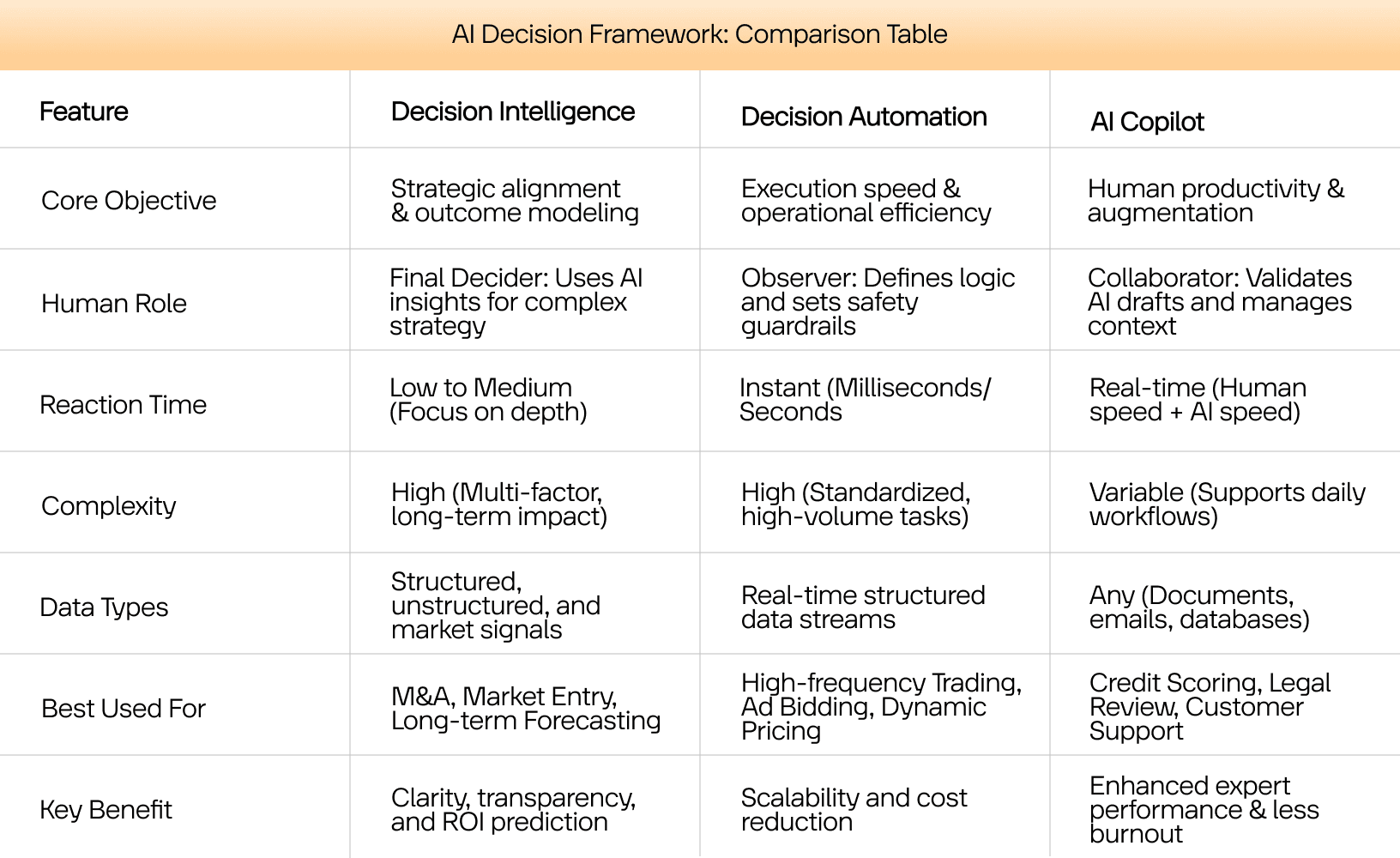
While all three concepts use AI, they have radically different goals, interfaces, and business outcomes.
Decision Intelligence (DI): Strategic Architect
This is the highest level of “meaningful” AI. DI is about understanding complex relationships. It is a discipline that combines Data Science with management theory.
The bottom line: DI models how decisions affect business outcomes over the long term. It analyzes cause-and-effect chains.
Example: The system doesn’t just say “lower the price,” it models how that change will affect margins, customer loyalty, and competitor reactions in 6 months.
For whom: CEOs and C-suite executives to make high-value strategic decisions.
Decision Automation: Autonomous Executor
This is the “autopilot” of your business. Here, speed and scalability are more important than human intuition. A person is excluded from the operational cycle; they only set the rules of the game and limits.
The bottom line: Automatic execution of decisions based on real-time signals. AI sees the problem itself, chooses an option itself, and performs the action itself.
Example: Algorithmic trading, dynamic pricing in Uber, or automatic blocking of suspicious bank transactions.
For whom: Operations departments, where thousands of micro-decisions need to be made per second.
AI Copilot: Intelligent Partner
This is the most inclusive model, where AI works side by side with a human, expanding their cognitive capabilities, but leaving the final “yes” or “no” to them.
The bottom line: AI takes on the dirty work, such as collecting data, preparing options, assessing risks, and writing drafts. The human acts as a curator and validator.
Example: AI assistant for a credit officer who collects a client’s dossier, highlights risks, and offers a rate, but the officer signs the final decision.
For whom: Specialists and middle managers, where context, ethics, and personal responsibility are important.
Lumitech knows how to handle this. We help our clients choose the right operating mode for each business unit. Whether you need a sophisticated decision-intelligence platform for your board of directors or an autonomous AI decision engine for your supply chain, or building real-time forecasting system, we create the underlying architecture that makes it work.
Stop playing the intuition game and start operating on probabilities. We’ll help you build a robust decision stack, ensuring every move your business makes is backed by intelligence.

Typical Classes of AI Decision-Making Processes
To ensure that businesses don’t waste resources on automating everything at once, it’s important to understand where AI provides the greatest leverage. At Lumitech, we identify five classic areas for artificial intelligence decision making.
Scoring and Evaluation
This is the area where you need to instantly evaluate an object based on dozens of parameters and assign it a “score” or category.
Where it works: Credit decisions (should I lend it?), fraud monitoring (is this a legitimate transaction or a theft?), compliance, and prioritization of sales leads.
The bottom line: AI analyzes historical data and patterns to make a verdict in milliseconds that would take a human hours.
Forecast-driven decisions
Here, AI acts as a strategist, seeing the future through cycles and trends.
Where it works: Inventory management (how much to order?), production planning, staffing schedules, and demand forecasting.
The bottom line: Instead of reacting to shortages, you act proactively. The system takes into account everything from seasonality to currency fluctuations.
Anomaly-driven
This is the area of security and uninterrupted operation. AI works like a “smoke detector” that never sleeps.
Where it works: IT incidents, production quality control, and predictive maintenance.
The bottom line: The system knows what the norm looks like and instantly decides whether to stop the line or call a technician before a real breakdown occurs.
Optimization solutions
The most complex type of decision intelligence solutions, where you need to choose the best option from millions of possible ones, with limited resources.
Where it works: Building logistics routes, complex schedules, and distributing resources (budgets, energy, people).
The bottom line: Mathematical programming combined with AI finds the same “golden mean” where costs are minimal, and the result is maximum.
Knowledge-grounded (RAG) decisions
This is the area of smart bureaucracy, where every decision must be supported by a document or rule.
Where it works: Legal analysis, decisions based on internal company policies, and claims processing.
The bottom line: Thanks to RAG (Retrieval-Augmented Generation) technology, AI finds answers in the knowledge base by referring to a specific clause of the contract. This ensures 100% transparency and traceability.
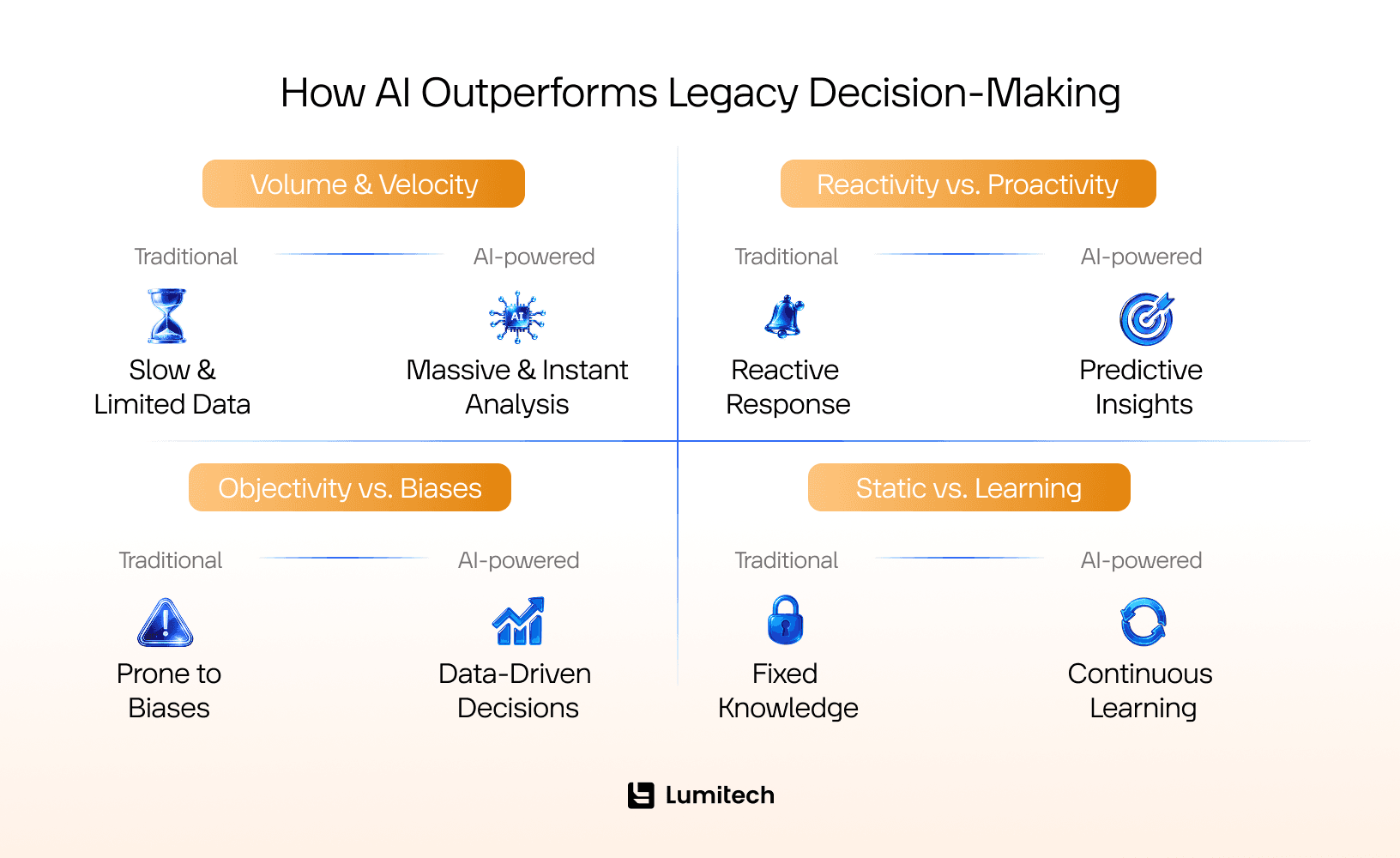
How AI Decision Making Outperforms Legacy Approach
Volume & Velocity
Traditional: A person or group of people collects reports, analyzes them (which usually takes days or weeks), and holds meetings. The number of factors that the brain can take into account is limited to 5-7 variables at a time.
AI-powered: AI decision-making processes millions of records in milliseconds. It takes into account thousands of parameters simultaneously: from weather and stock prices to the smallest changes in user behavior on the site.
Objectivity vs. Cognitive Biases
Traditional: We are all prone to biases. We trust intuition, are afraid of losing what we have already invested in (Sunk Cost Fallacy), or pay attention only to information that confirms our opinion.
AI-powered: AI algorithms for decision making have no emotions. It operates on dry probabilities. If the data says that a project is unprofitable, the AI will highlight this without any sentiment, migrating bias in AI.
Reactivity vs. Proactivity
Traditional: Most business decisions are reactive. When something happens (sales drop, a machine breaks down), we react.
AI-powered: AI anticipates (Predictive). It sees patterns that precede a problem and suggests solutions before the crisis becomes obvious.
Static vs. Continuous learning
Traditional: Experience accumulates in individual employees' minds. If an expert leaves the company, experience goes with them. Business processes often remain unchanged for years.
AI-powered: The system is constantly learning (Feedback Loop). Each new decision and its result become data for further training the model. The company's intelligence becomes a digital asset that only grows over time.
Strategic Deep Dive: How AI Helps Decision Making
To ensure that the benefits of AI decision making don’t look like marketing slogans, it’s worth analyzing them through the lens of architectural advantages and business economics. In 2026, the transition to AI decision-making is about changing the fundamentals of the company operations.
High-Frequency Decision Making (Scaling Without Hiring)
There is a limit to the capacity of the classic human-manager model. If your business needs to make not 10, but 10,000 decisions per hour (for example, in dynamic pricing or micro-lending), you can’t just hire a thousand times more people; your margins will burn.
Benefit: AI allows you to scale intelligent work as easily as you scale servers. You incur zero marginal cost for each subsequent decision.
Multi-Objective Optimization (Resolving Conflicts of Interest)
AI decision making in business is a compromise. For example, logisticians want fast delivery, and financiers want low cost. A person usually chooses one side.
Benefit: AI decision-making uses mathematical optimization to find “Pareto-efficient” solutions. The system simultaneously accounts for the budget, deadlines, staff workload, and environmental standards, finding the perfect balance that is not available to linear human thinking.
Real-Time Sensitivity & Pivotability (Reaction to “Black Swans”)
Traditional strategies are prepared for months. When the market changes dramatically (an exchange rate jump, a logistical collapse), companies spend weeks revising plans.
Benefit: AI for strategic decision making in business works in continuous planning mode. The system constantly recalculates scenarios. If the input data changed at 4 am, at 4:01, your prices, routes, or purchases have already been adapted to the new reality. This provides the business with anti-fragility.
Explainability & Auditability (Transparency and Security)
Contrary to the myth of the black box, modern artificial intelligence decision making systems provide a higher level of reporting than people. You cannot always explain why the manager made a particular decision (intuition? bad mood?).
Benefit: Every solutions based on AI decision making in companies has a digital trace (traceability). Thanks to XAI (Explainable AI) methods, the system can provide a log that shows which factors (weights) influenced the result. This is critical for passing government audits and internal compliance.
Institutional Knowledge Retention (Protection Against Loss of Expertise)
When a top manager leaves the company, they take part of the business's brain with them.
Benefit: AI preserves experience. By learning from the best solutions of your specialists, the system creates a digital twin of your business logic. This ensures that the company’s intelligence remains within the company, constantly growing and improving, regardless of staff turnover.
Real-World Success Stories: From Data to Action through AI Decision Making Examples
When we talk about real-world cases, it’s important to look at giants that have already rebuilt their operating model around AI. These are the systems that generate billions of dollars in incremental revenue.
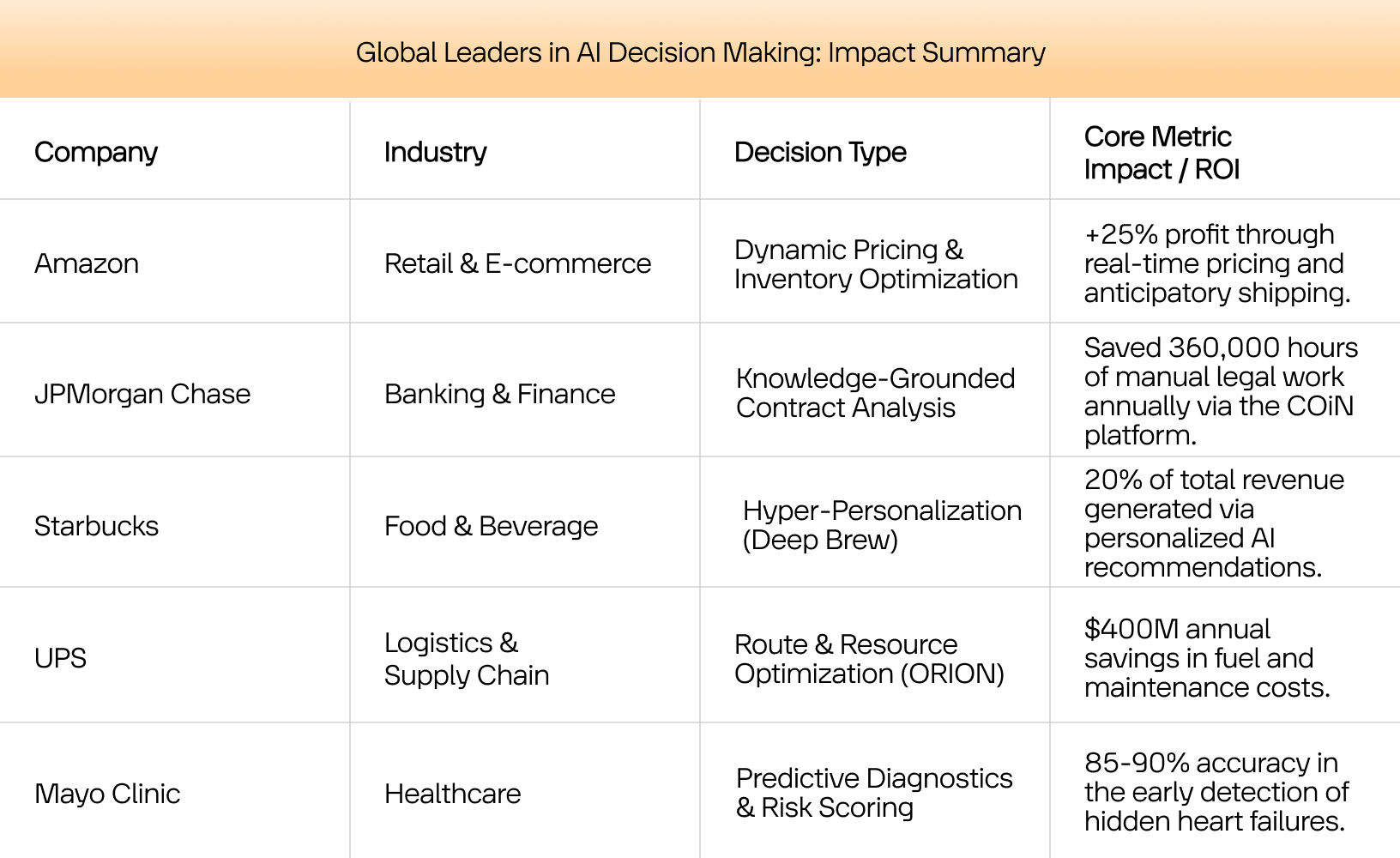
AI-powered decisions are valued in many sectors, such as logistics, healthcare, retail, or industrial software development. Here we collected five AI decision making examples from global leaders that illustrate different types and approaches of implementation in various industries.
Amazon: Dynamic Pricing and Logistics Forecasting
Solution Type: Optimization & Forecast-driven decisions
Amazon is the benchmark for decision automation. Imagine a system that has to change prices for millions of products every day, taking into account competitor prices, inventory levels, and real-time demand.
How it works: Amazon’s AI algorithms for decision making make over 2.5 million price change decisions every day. This is physically impossible to do manually. In addition to price, AI decides which regional hub to ship the product to before the customer buys it (Anticipatory Shipping).
Result: 25% increase in net profit thanks to dynamic margin and reduced delivery time to “one-day delivery” due to the fact that the product is already waiting for the customer at the nearest hub.
JPMorgan Chase Among Top AI Decision Making Examples
Solution Type: Knowledge-grounded & Compliance decisions
At large banks, lawyers spend thousands of hours reviewing loan agreements. This is a classic bottleneck that slows capital issuance.
How it works: JPMorgan is also among AI decision making examples. They implemented the COiN platform, which uses NLP (natural language processing) to analyze complex commercial loan agreements. AI makes decisions about whether the agreement complies with internal policies and identifies potential risks.
Result: Work that previously required 360,000 lawyer hours per year is now done in seconds. The level of errors caused by the human factor is reduced to almost zero.
Additionally, you can read more about Lumitech expertise in the legal and banking spheres. Here is the case study about partnering with the client from Dubai, building a legal AI assistant, or another story about developing an analytics-driven investment platform for a client from Bucharest.
Starbucks: Deep Brew – Personalization at Scale
Solution Type: Scoring & Hyper-personalization
Each Starbucks customer gets a unique experience in the mobile app. It’s a decision made specifically for you at that specific moment.
How it works: The Deep Brew platform analyzes your order history, the time of day, the weather in your city, and even the traffic volume of a particular coffee shop. Based on this, the AI decides which drink to offer right now so that you are most likely to make a purchase.
Result: 15-20% of Starbucks’ total revenue is now generated by AI-driven personalized offers. Also, barista scheduling optimization: AI decides how many people are needed on a shift, predicting demand down to the minute.
UPS: ORION System – The Art of Route Optimization
Solution Type: Optimization decisions
For logistics giant UPS, every extra kilometer on the route costs millions of dollars in lost revenue. Traditional navigators do not account for thousands of constraints (delivery time, cargo type, customer windows).
How it works: The ORION (On-Road Integrated Optimization and Navigation) system uses advanced AI algorithms to determine the order of stops. It analyzes more than 250 million data points every day. Interesting fact: the system prefers right turns (in countries with right-hand traffic) to minimize waiting times at traffic lights and the risk of accidents.
Result: Reduction of truck mileage by 160 million kilometers per year. Savings of more than $400 million annually on fuel and maintenance. Reduction of CO₂ emissions by 100,000 metric tons.
Mayo Clinic: AI in Diagnosis and Treatment Management
Solution Type: Scoring & Anomaly-driven decisions
In healthcare, decision making and artificial intelligence save lives by helping doctors detect conditions the human eye might miss due to fatigue or data complexity.
How it works: Mayo Clinic has implemented AI and decision making systems that analyze patients’ ECGs, MRI results, and genetic data. The algorithm makes decisions about the risk level (Scoring) of developing heart failure or stroke years before symptoms appear. AI also offers personalized treatment plans based on the analysis of millions of similar clinical cases (Similarity matching).
Result: The accuracy of early detection of hidden heart dysfunction has increased to 85-90%. Significantly reduced the time to prescribe the right therapy, which is critical for patients in serious conditions. Freeing doctors from routine image analysis allows them to focus on direct communication with patients.
Lumitech also has experience in developing AI solutions for healthcare domain. For one of our clients, our team developed a platform with AI in remote patient monitoring.
AI Decision-Making Processes: From Idea to AI Prototype in 4 Weeks
This guide is designed for those who don’t want to spend months on lab research but want to get a working PoC (Proof of Concept) in real combat conditions. At Lumitech, we call it a modernization sprint for implementing decision making and artificial intelligence. Here’s your 4-week plan: from idea to intelligent prototype.
Week 1: Identifying High-Value Tasks
Don’t try to automate everything. Choose one narrow area where decisions are made frequently and mistakes are costly.
Process Audit: Find the bottleneck where people spend more than 2 hours analyzing data before making a choice.
Data Health Check: Check whether you have historical data (at least the last 6-12 months) that artificial intelligence and decision making can use to identify patterns.
Result: A clearly formulated business hypothesis (for example: “AI can predict customer churn with 80% accuracy”).
Week 2: Building a Data Pipeline and Choosing Tools
AI is only as smart as its data. This week, we’re preparing the “fuel”.
Extraction & Cleaning: Gathering data from different sources (CRM, ERP, Google Analytics) into a single repository.
Feature Engineering: Selecting the key parameters that most influence the decision.
Result: A clean data set, ready to be loaded into the model.
Week 3: Model Training and Building the Logic
This is where the magic happens: we create an inference layer and a policy layer (what we wrote about above).
Model Selection: Choosing an algorithm (XGBoost for tables, LLM for texts, or neural networks for complex predictions).
Decision Logic: Writing code that says: “If the model scores X, then the business action should be Y”.
Result: First test predictions and their validation by experts.
Week 4: Interface Integration and MVP Launch
The prototype is ready. Now it should become a convenient tool.
UI/UX Launch: Build a simple dashboard or integrate with Slack/Email so recommendations come in.
Human-in-the-loop: Set up an “Approve/Reject” button so that a human can control the AI decision-making processes.
Result: A working prototype that makes real decisions in test mode.
Ready to see AI decision intelligence in action? We’ve mapped out the process; now let’s apply it to your specific business challenges.
Selecting the Right Toolkit for Autonomous Decision-Making
To implement such a 4-week sprint in 2026, we use a modern stack that combines the power of data processing and the flexibility of AI.
Data collection and storage (Data Foundation)
Snowflake / Databricks: For storing and processing huge amounts of data in the cloud.
dbt (data build tool): For transforming data directly in storage.
Pinecone / Milvus: Vector databases if your decisions are based on knowledge (RAG).
Machine learning and AI Core (Inference Layer)
PyTorch / TensorFlow: A classic for building deep neural networks.
OpenAI GPT-4o / Claude 3.5 Sonnet: For analyzing unstructured text and decision making in artificial intelligence based on documents.
Hugging Face: A library of ready-made AI decision making models that speeds up startup launch several times.
Decision Intelligence (Orchestration) Platforms
PyCaret: For rapid prototyping of machine learning models.
Gurobi / Google OR-Tools: The best tools for mathematical decision optimization (routing, graphs).
LangChain / LlamaIndex: For linking AI models to your internal knowledge bases.
Monitoring and UI (Observability)
Grafana / Weights & Biases: For monitoring the “health” of the model and the deviation of the results.
Streamlit: The perfect tool for quickly creating the web interface of your prototype. For example, here you can read about how AI chat interfaces redefine decision-making and why UX is so important.
Conclusion: AI-Driven Insights for Business Decision-Making by Lumitech
To summarize: artificial intelligence and decision making combines in 2026 is a complex, multi-layered architecture. We analyzed how top market players (from Amazon to UPS) are using the decision stack to beat the competition by milliseconds and billions of dollars.
We found how AI helps decision making and that the success of the implementation depends on the balance between:
Inference Layer: high-quality signals and predictions.
Decision Policy: clear business logic and rules.
Optimization: the ability to find the best path in a sea of constraints.
Why is Lumitech your best partner for implementing AI for strategic decision making in business?
Our expertise goes beyond writing code. We understand that modernizing the decision-making system is an “open heart surgery” for a business, and we have the necessary tools to successfully carry it out:
AI-Ready Architecture: Lumitech builds modern data pipelines and vector warehouses that become a solid foundation for any intelligent model.
Engineering Precision: We know the difference between decision automation and AI Copilot. We help you choose the level of autonomy that maximizes ROI while maintaining security and transparency (Explainable AI).
Speed to Value: Our 4-week sprint is a proven methodology that enables your business to obtain a working prototype and initial performance data before your competitors finish planning.
Legacy Modernization DNA: We understand how difficult it is to extract data from monolithic systems of the past decade. Lumitech specializes in “rejuvenating” software, turning legacy code into fuel for AI solutions.
Lumitech is figuring out how to turn your technical debt into intellectual capital. We provide AI-driven insights for business decision-making and build a transparent, manageable, and incredibly fast system where every decision is informed, and every risk is calculated.
Stop relying on intuition where algorithms should be. It’s time to build a future where your business dictates the change.


