
AI Chat Interfaces in Enterprise Decision Platforms: 2026 Trends
If your decision platform still starts with dashboards, you’re already behind. Enterprise AI chat interfaces are turning data into dialogue, adding context, and reshaping how business decisions are made.
- Decision Intelligence
- AI Development
- UX/UI Design
February 12, 2026
 AI Overview
Instead of navigating complex dashboards, employees expect to ask business questions the same way they interact with AI assistants. This article explores how chat-based interfaces are changing enterprise decision platforms and simplifying access to operational intelligence.

Five years ago, corporate dashboards resembled an airplane cockpit: dozens of graphs, KPIs, filters, and buttons intended to support decision-making but often created more noise than clarity. Businesses were drowning in data, not managing it.
In 2026, this metaphor no longer works. Executives, analysts, and operations teams are increasingly interacting with data in the same way they would with a colleague – through AI chat interfaces in enterprise decision platforms. Instead of “build me a report for Q3 with a filter by region,” it’s “What had the biggest impact on the margin decline in Europe last quarter?”
This isn’t just a UX trend but a paradigm shift in enterprise decision-making. In this article, we examine the enterprise chat AI trends shaping this paradigm in 2026.
Trend 1. Conversational UX Replaces Dashboards as the Future of AI Chat in Decision Platforms
What’s Happening
AI chat interfaces in enterprise decision platforms are becoming the first point of interaction with data. The user no longer starts with a dashboard or report – they start with a question.
Instead of searching for the right graph, a manager asks: “Why did operational costs spike in APAC last month?” – and gets an answer with an explanation, not just a visualization. This determines the future of AI chat in decision platforms.
Why This Trend Emerged
Classic BI interfaces required the user to:
know the data structure;
understand the filters;
interpret the result independently.
In reality, this only worked for analysts. AI chat for business decision support removes this cognitive barrier and translates the interaction into a human-like model of thinking: a dialogue.
Enterprise Specifics
In an enterprise environment, chat doesn’t replace dashboards – it orchestrates them. Dashboards remain verification tools, not starting points.
What to Expect in 2026
By 2026, AI conversational interfaces for enterprise will become the default entry point for executives and business users into decision platforms. Dashboards will not disappear, but their role will change: they will be used for verification, monitoring, and detailed analysis, rather than for primary insight search.
Role-aware chat UX is also expected to emerge – the same request from the CFO, Head of Operations, and Product Lead will give different answers, adapted to the context and responsibility of the role.
Trend 2. Decision Intelligence Moves from Reports to Dialogue: One of the Benefits of AI Chat Interfaces in Enterprise
What’s Happening
AI chats stop answering questions like “what happened?” and move on to “why it happened” and “what happens next.”
This is a shift from descriptive analytics to decision intelligence solutions, where the system doesn’t just show data; it helps you think through scenarios.
Why This Trend Emerged
The problem faced by businesses was not a lack of information but an abundance of interpretations. Each department saw its own numbers and drew its own conclusions.
AI chat allows you to:
combine data from different systems;
maintain the context of the conversation;
ask clarifying questions as a live analyst would.
Enterprise Specifics
The key requirement is explainability. In decision platforms, using AI in wealth management, for example, an answer without logic is unacceptable.
What to Expect in 2026
Decision intelligence in 2026 will look like a continuous dialogue, not a series of separate reports. AI chats will be able to:
remember the logic of previous decisions,
return to them in weeks or months,
explain how assumptions have changed over time.
This will effectively create an “organizational decision memory,” where AI acts not as a judge, but as a chronicler and analyst.
Trend 3. Semantic Layers Become the Backbone of AI Chat Interfaces
What’s Happening
In 2026, the winners will not be the platforms with the “best LLM”, but those with the best semantic layer. This is one of the most significant AI chat interface trends.
AI chat does not work with raw data; it works with business concepts: revenue, churn, active customers, and utilization.
Why This Trend Emerged
An LLM without semantics is dangerous. It can:
mix definitions;
ignore context;
draw logically correct but business-false conclusions.
Enterprise Specifics
Semantic layer:
unifies terms across departments;
controls access to data;
reduces hallucinations.
What to Expect in 2026
In 2026, the semantic layer will be as standard as data governance or role-based access control. AI chat without semantics will be perceived as a PoC or experiment.
Companies will begin investing in business ontology management as a standalone discipline – not just for AI, but across the entire digital ecosystem.
Trend 4. How AI Chat Interfaces Are Transforming Enterprise Decision Platforms through Conversational Forecasting
What’s Happening
Forecasting is no longer an “analytical task” but a conversational practice. Managers no longer read complex models – they ask questions and receive scenarios.
Why This Trend Emerged
Speed of decision-making has become a competitive advantage. AI chat shortens the path from question to action.
Enterprise Specifics
The forecast is not given as a single number, but as:
range;
risk;
assumption.
What to Expect in 2026
Conversational forecasting will become the standard for the executive level. Classic models will remain “under the hood”, but interaction with them will occur through dialogue.
The emergence of collaborative forecasting is also expected, in which several managers can discuss scenarios in a single AI chat, seeing each other’s arguments and assumptions.
Trend 5. Trust, Transparency, and “Why” Become UX Requirements
What’s Happening
AI chats are no longer evaluated for “quality of response,” but for the quality of reasoning.
Why This Trend Emerged
Enterprise solutions have legal, financial, and reputational implications.
Enterprise Specifics
There is a need for:
traceable answers;
source attribution;
confidence levels.
What to Expect in 2026
Explainability will no longer be a competitive advantage, but a minimum requirement. AI chatbots without transparency simply will not pass internal security and compliance reviews.
Many companies will adopt AI decision audits, in which decisions made with AI participation will be stored and analyzed post-facto.
AI chat interfaces are becoming the new decision UX. The next step is designing them to fit your data, governance, and business reality.

Real-World Cases of the AI Chat Interfaces in Enterprise Decision Platforms
The development of enterprise AI chat interfaces has long since moved beyond experimentation. Leading technology and consulting companies are implementing conversational interfaces as a core component of their decision-making platforms, with a focus on prediction, explainability, and speed of action. Below are illustrative cases from various industries showing the benefits of AI chat interfaces in enterprise systems.
Microsoft Copilot: Conversational Analytics at Scale
Use case:
Business analytics & AI decision support chat interfaces
How it works:
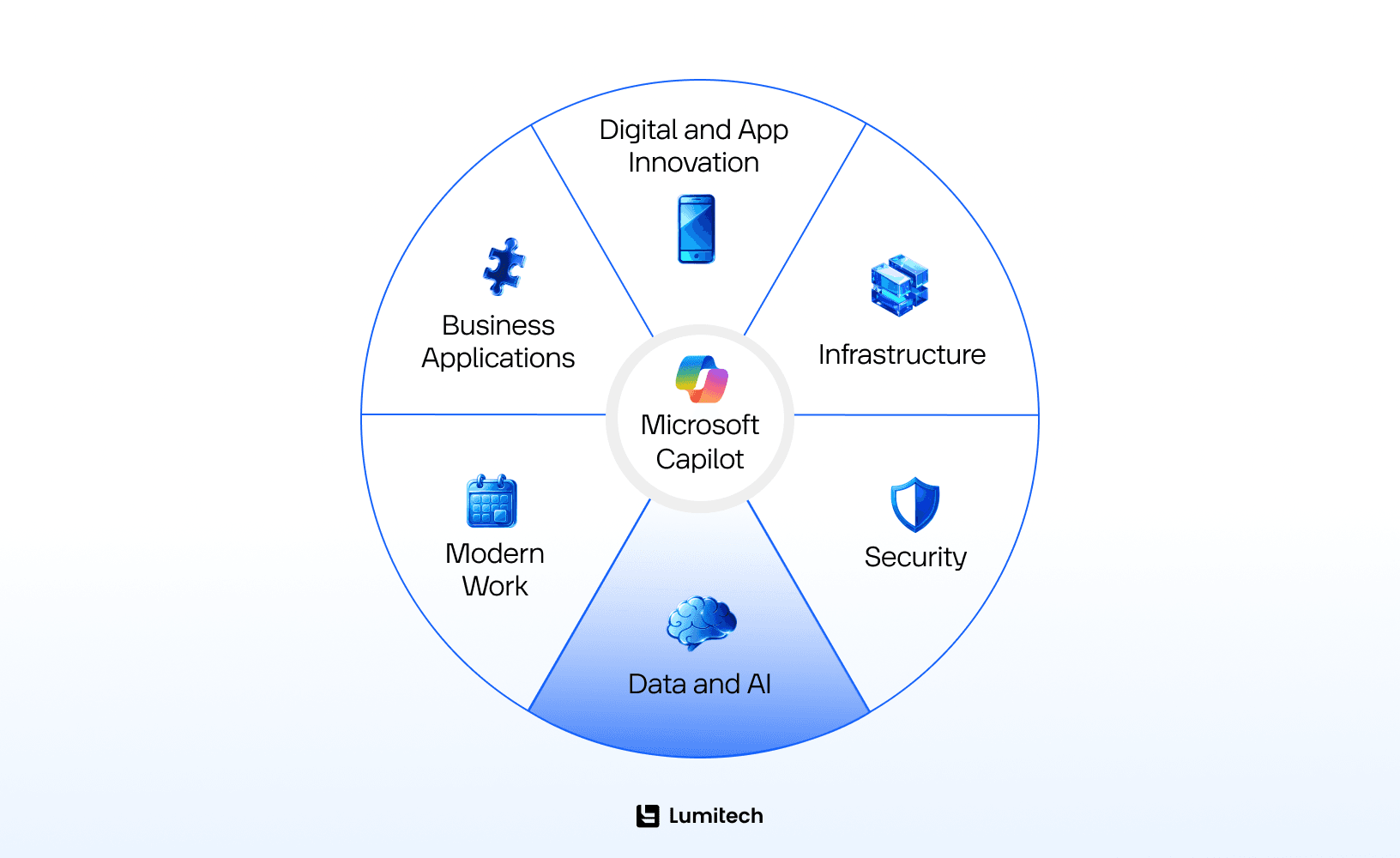
Microsoft Copilot is integrated into Power BI and Fabric and allows users to interact with analytics through natural language. Leaders and managers can ask questions about the reasons for changes in metrics, compare periods, and refine scenarios – without manually building reports.
Impact:
up to 25% reduction in time to prepare analytical insights;
increased adoption among non-technical users;
faster management decisions thanks to explanatory answers.
Salesforce Einstein GPT: Conversational Forecasting and AI Chat for Business Decision Support
Use case:
Sales forecasting & pipeline management
How it works:
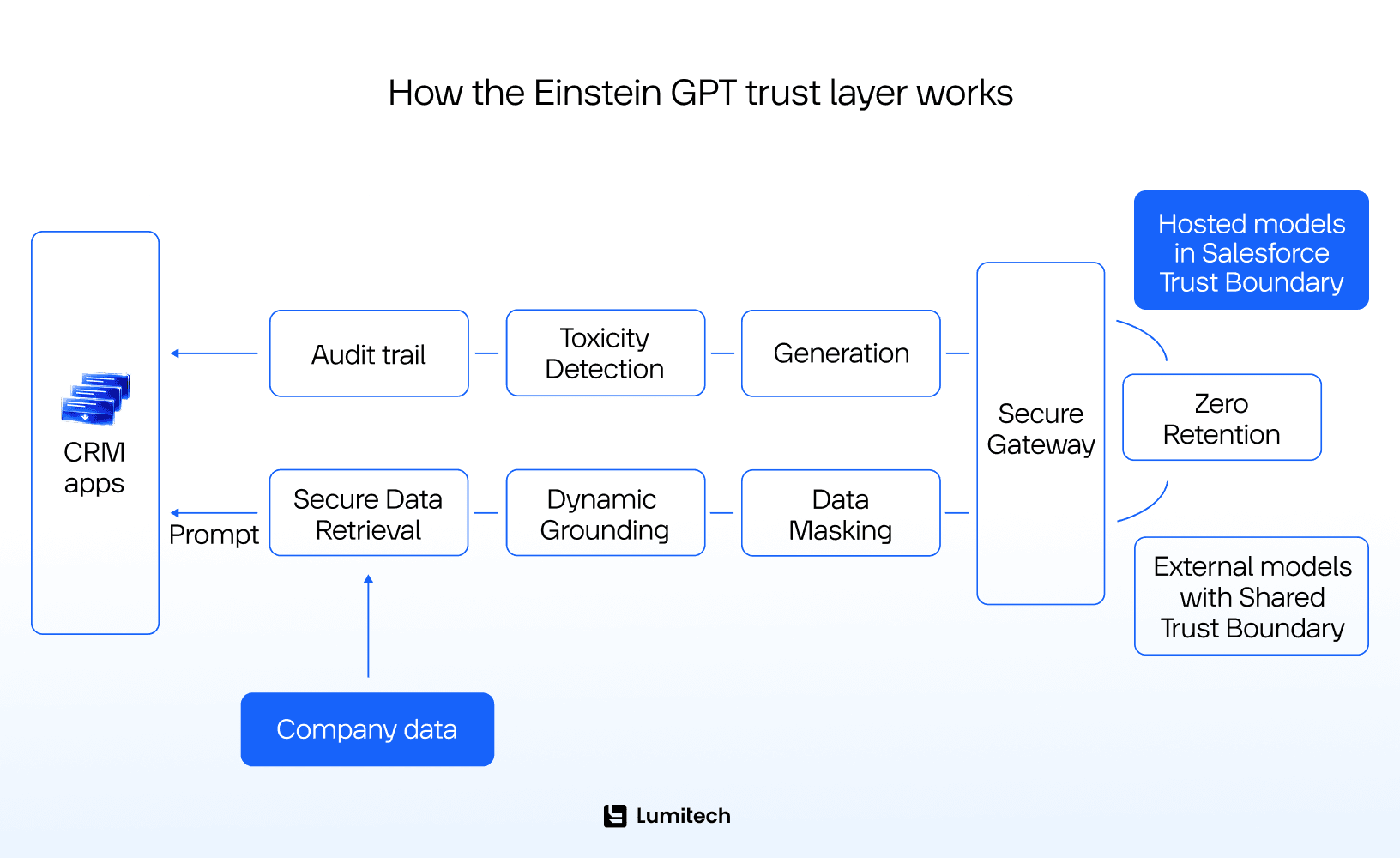
Einstein GPT allows sales managers to engage with CRM data: analyze pipeline, test “what-if” scenarios, and understand the causes of forecast risks.
Impact:
10-15% increase in sales forecast accuracy in large teams;
narrowing the gap between sales and finance in interpreting numbers;
faster response to market changes.
SAP Joule: Explainable AI for Finance and Supply Chain, Displaying Key Benefits of AI Chat Interfaces in Enterprise
Use case:
Financial planning & supply chain decision support
How it works:
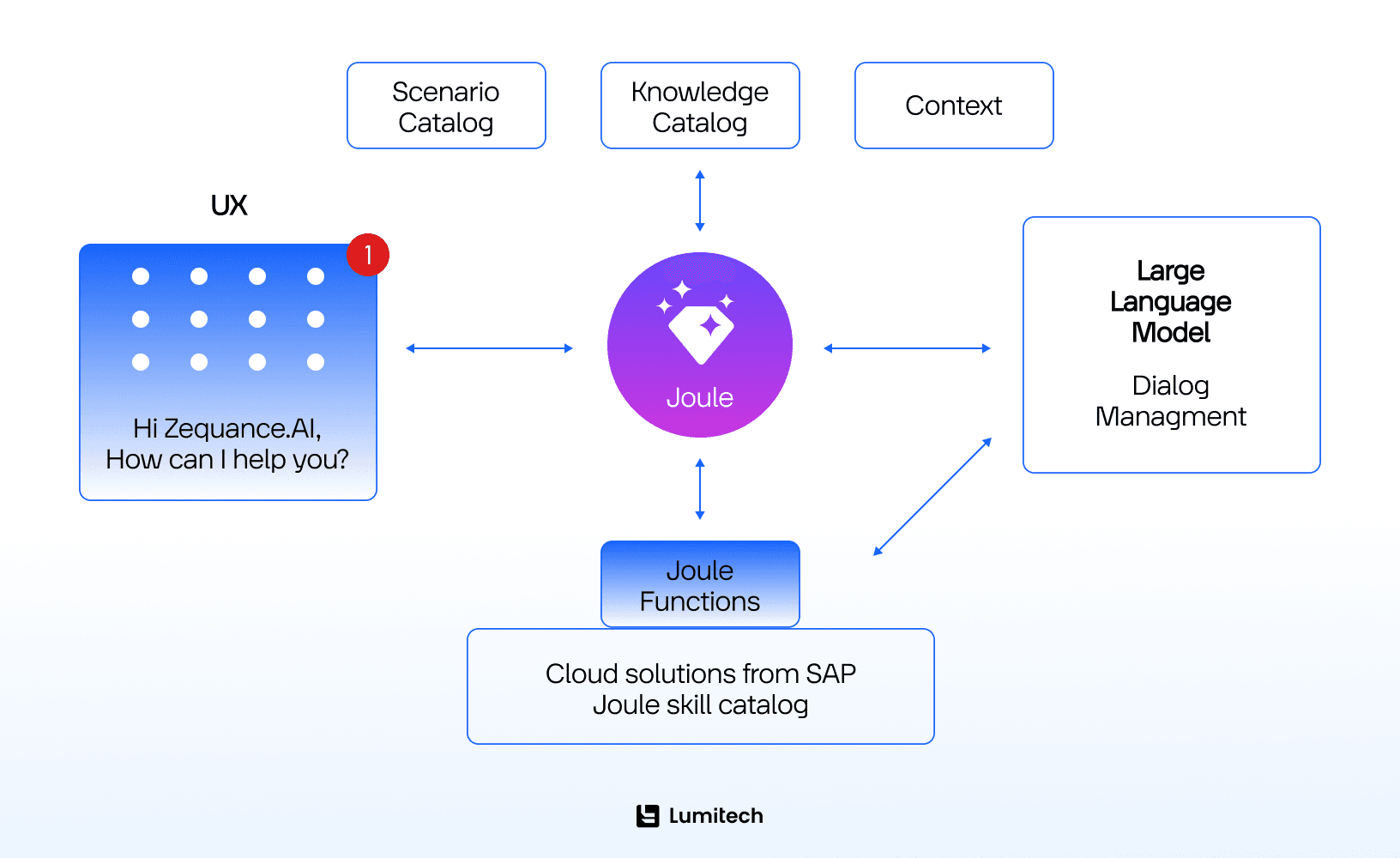
SAP Joule runs on top of SAP ERP data and semantic models, providing explainable answers to complex operational and financial questions. The enterprise AI chat interfaces are used for variance analysis, supply risk analysis, and scenario planning.
Impact:
reduced time spent analyzing variances;
increased decision transparency in regulated environments;
better alignment between finance and operations.
Palantir AIP: Ontology-Driven AI Chat for High-Stakes Decisions
Use case:
Strategic & operational decision platforms
How it works:
Palantir AIP combines AI chat with formalized business process ontologies. Users can ask questions about complex systems (production, logistics, defense) and receive answers tightly tied to real processes and data.
Impact:
using AI chat for decision platforms in critical environments;
reducing the risk of misinterpretations;
supporting multi-step decision workflows.
Building Trustworthy Enterprise AI Chat Interfaces in Regulated Environments: Lumitech Case Study
AI chat for decision platforms in enterprise environments must meet significantly higher requirements than conventional corporate chatbots. This is especially evident in data governance in the banking industry, where every decision carries legal consequences. This is exactly one of the challenges of AI chat in enterprises Lumitech worked with in a project for a regional fintech institution in the MENA region.
Client Сontext
The client is a large financial and technology organization operating in corporate finance, payment solutions, and regulated services. Within the company, thousands of employees – from front-office to product and operations – regularly face legal and compliance issues.
At the same time, the business demanded:
quick answers without waiting for lawyers;
full compliance with internal policies and regulations;
minimizing the risk of using outdated documents.
The Challenge
The problems the organization faced were typical of large enterprise companies:
A constant stream of repetitive requests to the legal team.
The dependence of business units on manual consultations.
The difficulty of finding the right policy at the right time.
The risk of misinterpreting rules.
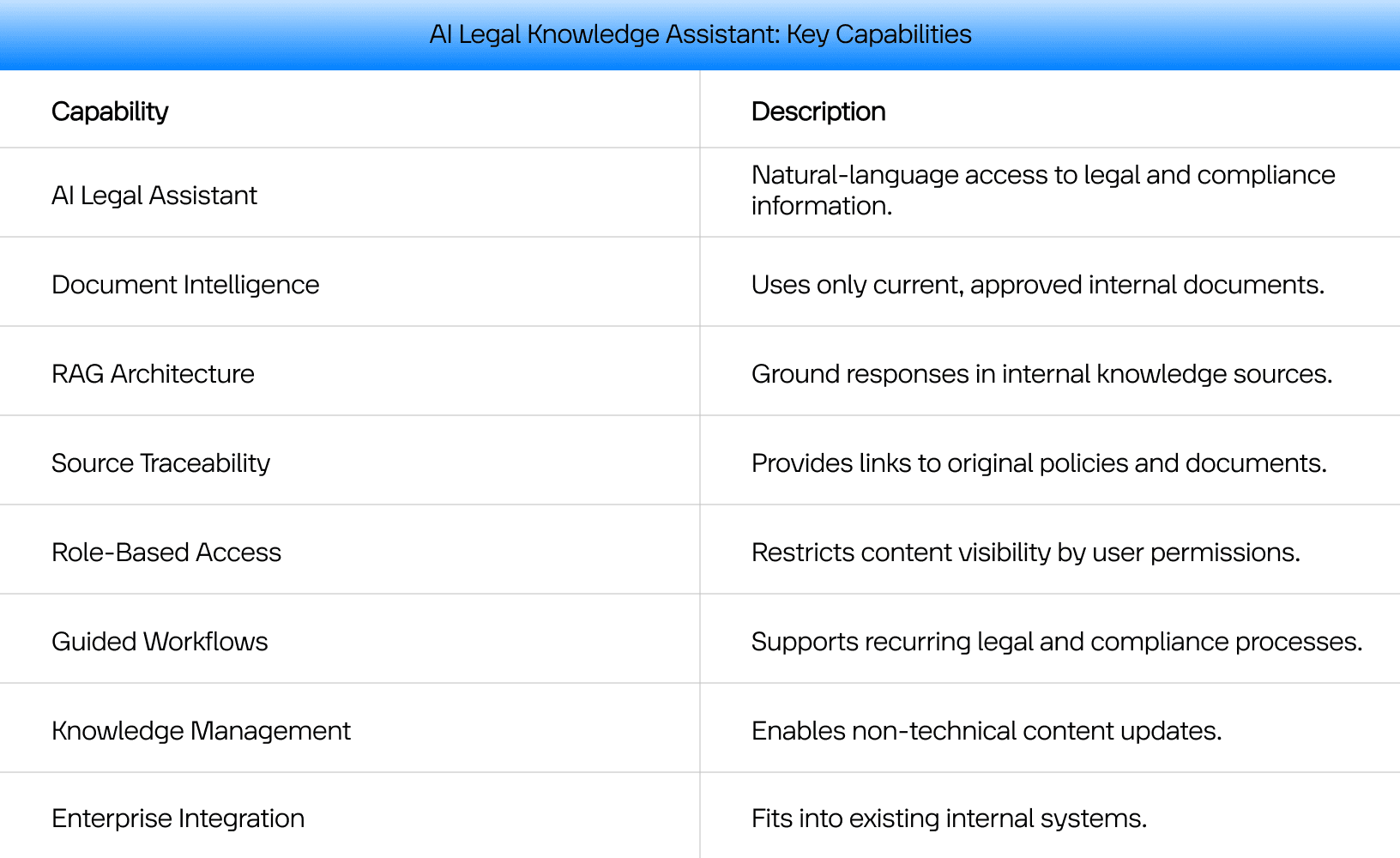
On the technical side, there were strict controls, including a ban on using public AI in financial services, role-based access to knowledge, a requirement for full traceability of each response, and up-to-date documentation.
Lumitech’s Approach
Lumitech started with legal- and business-oriented discovery while delivering web development services. Key decisions included analyzing typical legal requests in real-world scenarios, clearly defining automation boundaries and escalation zones for lawyers, separating informational responses from process guidance, and designing response templates with links to primary sources.
From the point of view of the enterprise AI chat architecture, the solution is based on:
secure LLM orchestration in a trusted environment;
Retrieval-Augmented Generation (RAG);
enterprise document indexing;
role-based access control;
cloud-agnostic design.
Results and Impact
Even in the pilot format, the platform showed tangible results:
reduction in the number of repetitive requests to the legal team;
faster decision-making in business units;
reduction of operational and regulatory risks;
increased transparency of legal decisions.
More strategically, the client received a stable AI-driven knowledge platform that can now be scaled to other functions – risks, operations, HR – without changing the basic architecture.
Industries Leading AI Chat Adoption by 2026
Financial Services
This is the #1 candidate for leadership due to the combination of high cost of errors, strict compliance, and a huge number of internal policies/procedures. Here, the benefits of AI chat interfaces in enterprise include: explaining changes in risks, scenario planning, compliance FAQs, analyzing client/portfolio metrics, using generative AI for wealth management, and preparing materials for financial closing.
Bain notes significant productivity gains in the financial sector from generative AI chat in enterprise platforms in 2024 (particularly in software development solutions for fintech and customer service), which directly fuels demand for enterprise-grade conversational UX design that reduces time-to-insight.
Healthcare & Life Sciences
Healthcare is traditionally “data-heavy” and “process-heavy”: many systems, many roles, many rules. Here, AI chat becomes a convenient UX layer for working with protocols, operational decisions, resource planning, the medical supply chain, and quality analysis.
PwC notes that industries with high data intensity and operational complexity (particularly healthcare) are well-positioned to lead the AI shift.
Manufacturing & Industrial
How AI chat interfaces are transforming enterprise decision platforms in manufacturing? It is the fastest way to land on decisions that impact the bottom line every day: line downtime, quality, planning, inventory, OEE, and supply. Chat interfaces are useful here as an “operational navigator”: why has waste increased, what happens if a supplier is delayed, and which shop is at risk of a shutdown.
PwC also identifies manufacturing as one of the industries well-positioned to lead the AI transformation, leveraging data and complex processes.
Retail & CPG
Retail has a fast decision cycle and many “what-if” scenarios across demand, pricing, promotions, logistics, and inventory. AI chat here becomes a convenient decision UX for merchandising and planning: it is important for business users to ask questions quickly and receive explanations without waiting for analysts.
PwC notes the active movement of AI in retail, with “winners/losers” emerging on the horizon of 2026.
Transportation & Logistics
Here, conversational forecasting and operational control have a significant impact: routes, slots, loading, SLAs, and risk of delays. The chat interface scales well to a wide range of users (operators, planners, managers), because it eliminates the need to “learn BI”.
How to Build AI Chat Interfaces for Enterprise Decision Platforms
After AI chat interfaces became an obvious trend, many companies are tempted to “just add chat.” This is where the biggest mistakes start. Enterprise-level AI chat for decision-making is not a UI feature or a chatbot. It is a separate system component that works at the intersection of UX, data architecture, and business logic.
Start with Intent when Designing AI Chat Interfaces in Enterprise Decision Platforms
One key mistake is starting AI and ML development with prompt engineering. In decision platforms, this almost always leads to a dead end. It is critical to first define the types of business intents that the chat should serve:
explanation of changes (why did X change);
comparison of scenarios (what if);
finding causes (root cause);
forecasting;
recommendations for action.
Each type of intent requires different data access logic, different models, and different levels of explainability. Without this, the chat quickly turns into a “smart search term” rather than a decision-making tool.
Semantic Layer Is Not Optional in Creating AI Chat for Decision Platforms
In the enterprise context, the semantic layer is the foundation, not the optimization layer. It is responsible for ensuring that AI interprets business terms consistently across systems and departments.
In practice, this means:
formalization of KPIs, metrics, and their dependencies;
clear definitions of concepts (revenue, active user, churn);
rules for aggregation and data access.
Without this, AI chat may be linguistically correct, but business-unsafe. This is unacceptable in production systems.
Don’t Optimize for Speed, Optimize for Trust: Encouraged by Enterprise Chat AI Trends
Unlike consumer chat, in enterprise decision-making UX, response speed is not the primary metric. Users are willing to wait a few seconds longer if they get:
explanation of logic;
data sources;
assumptions and constraints.
Therefore, the architecture should provide:
traceable answers;
confidence ranges instead of a single number;
the ability to drill down into the answer.
This directly affects adoption: systems without explainability are simply not trusted.
UX of the Enterprise AI Chat Interfaces: Conversation Is Not Free-Form Chat
Another trap is to copy ChatGPT’s UX. Enterprise chat should guide the dialogue, not leave it completely free.
Practices that work well:
prompts for typical questions;
clarifying questions from the system;
structured answers (insight → explanation → next steps).
This reduces cognitive load and helps users think through scenarios rather than “guessing the right prompt.”
Team Composition: Who Builds Enterprise AI Chat Interfaces
AI chat for decision platforms is an interdisciplinary product. A typical team looks like this:
Product Manager (AI/Decision Platforms)
Forms, use cases, business intents, and success metrics for evaluating AI chat interfaces for enterprise use.
Solution / Data Architect
Designs the semantic layer, data flows, and integrations.
ML / LLM Engineer
Responsible for model orchestration, tool calling, and guardrails.
Data Engineer
Builds pipelines, ensures data quality and relevance.
Backend Engineer
Implements APIs and integrates with BI/ERP/CRM.
UX Designer (Enterprise UX)
Designs conversational UX design for fintech or other domain and interaction scenarios.
Security / Compliance Specialist (part-time)
Controls access, auditing, and regulatory compliance.
An attempt to assemble such a system only by “AI engineers” almost always ends in a PoC that does not reach production.
Budget Reality: What Companies Should Expect
Budgets vary greatly depending on scale, but on average:
Discovery & architecture: $30k-$60k
MVP (limited data scope): $100k-$200k
Production-ready system: $250k-$500k+
It is worth considering separately:
LLM costs (API or self-hosted);
semantic layer support;
MLOps and response quality monitoring.
It is important to understand that AI chat is not a one-time development but a product that evolves with the business and data. Consider the pros and cons of AI chat interfaces in the enterprise from this perspective.
AI Chat Interface Trends: From Conversational AI to Decision Intelligence
AI chat interfaces are quickly becoming the new standard in enterprise decision platforms, changing how businesses interact with data – from static reports to dialogue and scenario-based thinking. The AI chat interface trends and cases show that integrating AI chats delivers the greatest value not through automation, but by reducing the time between a question and a reasoned decision.
For companies, this means faster management processes, better alignment between teams, and new requirements for data quality, semantics, and explainability. Without trust and transparent logic, such solutions do not scale.
In 2026, AI chat will become the main interface for accessing decision platforms for executives and business users, while dashboards will serve as verification and control tools.
Lumitech’s experience shows that successful AI chat solutions result from a systems approach in which business context, engineering, and UX work together to turn AI into a reliable decision-making tool.


