
AI in Remote Patient Monitoring: From Signal Processing to Insights
Remote patient monitoring (RPM) has evolved from occasional at-home readings to continuous streams of data from wearables and connected devices: heart rhythm, oxygen saturation, glucose trends, blood pressure, activity, and sleep.
- AI Development
January 14, 2026
 AI Overview
Patient monitoring generates a constant stream of data, but data alone rarely improves outcomes. The real challenge lies in identifying meaningful changes early enough to support timely intervention. AI helps teams move beyond static thresholds and manual reviews by detecting patterns, prioritizing high-risk cases, and turning continuous signals into actionable insights. This creates new opportunities for proactive care, better resource allocation, and more personalized patient management.

The goal is simple: catch deterioration earlier and support chronic disease management between visits.
However, traditional RPM systems are increasingly hitting a ceiling. Healthcare providers are often buried under a “data deluge” — receiving thousands of static data points that lack context. This leads to debilitating alarm fatigue, where false positives from poor sensor contact or intermittent measurements mask critical clinical events. Without personalization, distinguishing a harmless spike from a life-threatening trend remains exceptionally challenging for these systems.
That’s where AI in remote patient monitoring adds value. AI enables improvements in signal quality, can learn individual baselines, recognize meaningful patterns over time, and translate raw time-series data into outputs that are more meaningful when prioritized: risk flags, summaries, and actionable alerts. Done well, AI doesn't replace clinical judgment; it reduces the burden of constant review and helps teams focus on the right patients at the right time.
This article walks through the journey from signal processing to insights: how AI-powered RPM works, how it improves traditional systems, its key benefits, best practices for workflow integration, and the biggest real-world challenges to plan for.
What is AI in Remote Patient Monitoring, and How Does It Work?
AI in remote patient monitoring (RPM) refers to algorithms (typically machine learning and related analytics) that turn patient-generated health data from home and wearable devices into clinically useful outputs, such as actionable alerts, risk scores, trend summaries, and prioritized patient lists. In other words, RPM collects data; AI helps interpret it at scale.
Well-made AI development solutions usually support decisions rather than empower a system to make them autonomously. They can surface patterns that are difficult to see in raw dashboards, but clinical judgment (and clinical protocols) still determines what action to take.
The End-to-End Pipeline: From Signal to Insight
The transition from a raw heartbeat to a life-saving intervention follows a rigorous multi-stage pipeline. Each step is critical to ensuring the final output is both accurate and valuable.
Data Capture (Signals + Context). The process begins at the “edge,” where hardware (such as smart patches, continuous glucose monitors (CGMs), and high-fidelity wearables) captures physiological signals. However, AI-driven RPM goes beyond just heart rate or blood pressure. It integrates multimodal data, combining physiological signals with behavioral data (sleep patterns, gait speed) and Patient-Reported Outcomes (PROs) collected via mobile apps. This context is vital; a spike in heart rate means something very different during a morning jog than it does during deep sleep.
Signal Processing & Data Quality. Raw data from the home environment is notoriously “noisy.” Movement, poor sensor contact, or a low battery can create artifacts that look like medical emergencies. AI employs advanced filtering and normalization techniques to clean this data. If a patch is peeling off, the AI identifies the drop in signal quality and flags a hardware issue rather than triggering a false cardiac alert.
Feature Extraction. Once the signal is clean, the AI identifies specific “features” — mathematical characteristics of the data. This includes time-domain features (such as the exact interval between heartbeats) and frequency-domain features (such as the power of different rhythms).
Modeling & Inference. This is the core of the AI engine. Using time-series models (such as LSTMs or Transformers) and classic machine learning, the system compares current features against two benchmarks: population-wide medical standards and the patient’s historical baseline. This personalization is the “secret sauce” of AI; it learns what is “normal” for a specific 80-year-old patient with COPD, which prevents unnecessary alerts based on generic thresholds.
Clinical Insight Layer. The final technical stage is translating math into medicine. Instead of showing a nurse a raw ECG strip, the AI provides an explanation. It might state: "High-priority alert: Patient’s respiratory rate has increased by 20% over 48 hours, coinciding with decreased physical activity — indicative of potential heart failure exacerbation." This layer prioritizes the patient list so the most at-risk individuals appear at the top of the clinical dashboard.
What outputs does AI in Remote Patient Monitoring typically produce?
To summarize, most AI-enabled RPM systems aim to produce some combination of:
Actionable alerts (with confidence and context)
Risk scores and prioritization (who needs attention today)
Trend summaries (what changed, over what time period)
Operational insights (adherence, device issues, missing data patterns)
When implemented well, this pipeline turns RPM from “remote data collection” into continuous decision support — grounded in signal processing, validated modeling, and a workflow designed to act on insights rather than drown in measurements.
Upgrade of Traditional RPM: How AI Improves Remote Patient Monitoring Systems
To understand the leap forward that AI represents, we must first look at the limitations of “Traditional RPM.” In a conventional setup, devices act as simple conduits — they record a physiological value (like weight or blood pressure) and transmit it to a portal. The logic governing these systems is almost entirely threshold-based. For example, every patient in a program might be assigned a blood pressure ceiling of 140/90 mmHg. When a patient crosses that line, an alert is triggered.
The result is a “one-size-fits-all” approach that creates three primary problems:
The Data Deluge: Medics are forced to swim through endless dashboards of green-light data to find the few red-light emergencies.
Alarm Fatigue: High false-positive rates stemming from “noisy” data or a patient simply being active during a reading lead clinicians to become desensitized to alerts.
Fragmented Context: Traditional systems treat each reading as an isolated event, failing to see the slow, dangerous trend developing over weeks.
The Remote Patient Monitoring AI Upgrade: Precision and Prediction
AI-enabled RPM transforms this passive data collection into an active, intelligent filter. The improvements are categorized by three main “upgrades”:
Smart Filtering and Automated Triage: AI filters out low-quality data from movement and artifacts, so only clinically valid information is relayed to human observers. More importantly, the AI system auto-triages the patient list, prioritizing those with the highest risk of deterioration to the top.
Predictive Monitoring vs. Reactive Alerts: Where traditional RPM tells an individual that a patient is in crisis, AI performs time-series analysis on data to predict that a patient will be in crisis. By detecting changes in heart rate variability or sleep fragmentation days before a medical event, truly preventive care becomes possible.
Adaptive Baselines (Personalization): AI discards population averages in favor of “N-of-1” monitoring. It learns that a specific patient’s “normal” resting heart rate is 55 bpm; if that rate climbs to 75 bpm, the AI triggers an alert even though 75 is technically within the “normal” range for the general population.
Here are some comparative examples of how remote patient monitoring AI can improve routine processes:
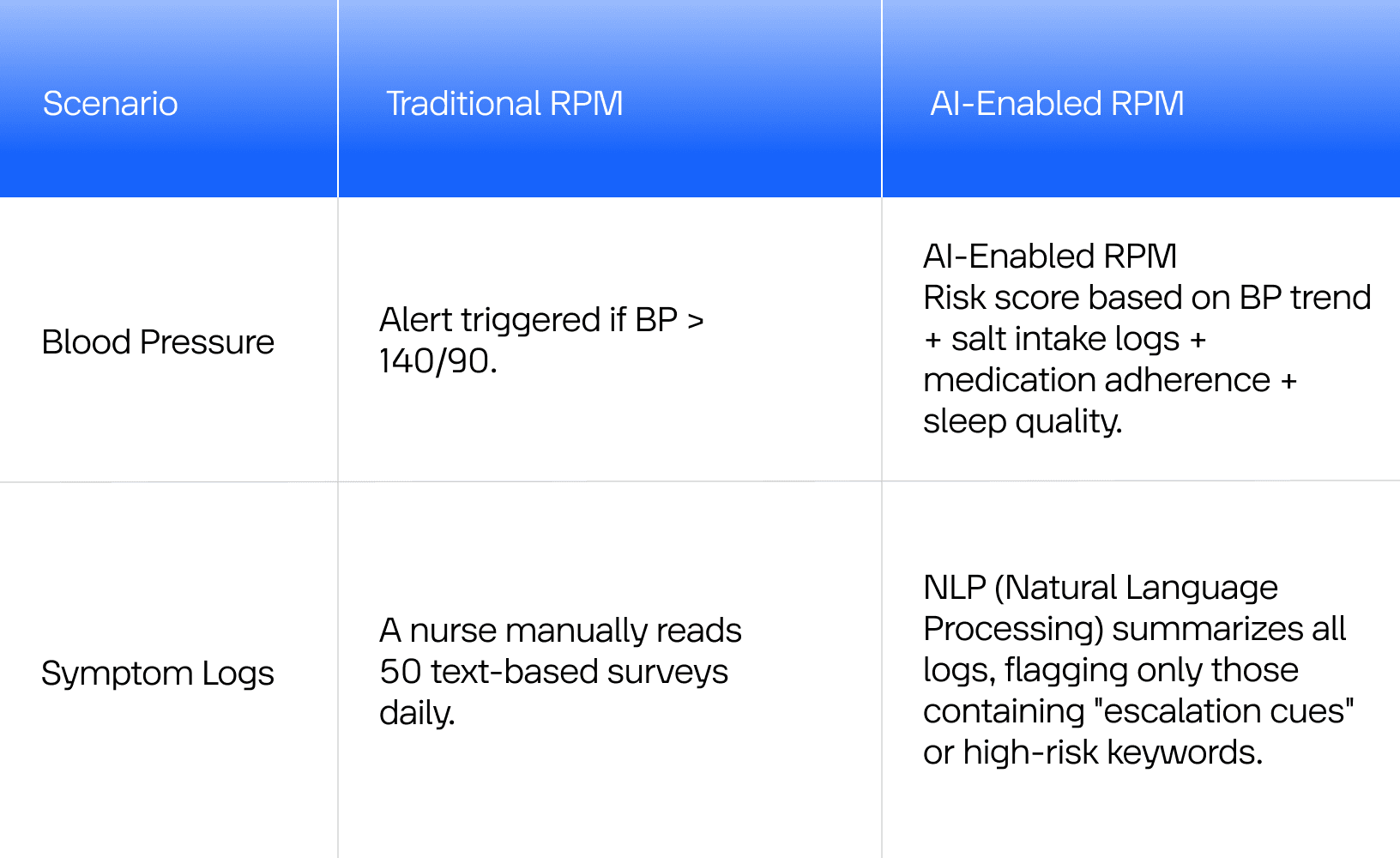
In short: AI improves traditional RPM by cleaning and contextualizing incoming data, learning what “normal” looks like for each patient, and translating continuous streams into prioritized, explainable insights that fit how care teams actually work.
Key benefits of using AI for remote patient monitoring
The value of AI in RPM isn’t just “more advanced analytics.” The real benefit is practical: AI helps turn frequent, imperfect data into insights that care teams can use without drowning in alerts, and helps patients receive more timely, personalized support. Below are the most important benefits, grouped by who experiences them.
Clinical benefits: earlier signals, clearer prioritization
The primary clinical value of AI-powered remote patient monitoring is its ability to identify “silent” deterioration. Many chronic conditions, such as congestive heart failure or COPD, involve a slow decline that patients may not perceive until they are in acute distress. AI models can detect these sub-clinical shifts days before a patient requires emergency care. Furthermore, AI supports better chronic disease control by providing clinicians with longitudinal data that is already “cleaned” and summarized, allowing for more precise medication adjustments during follow-up appointments.
Operational benefits: less noise, more scalable programs
For healthcare providers, the “Data Deluge” is a significant contributor to burnout. One of the main benefits of AI in remote healthcare is that it provides an essential operational filter by prioritizing by risk rather than the order in which data arrived.
Reduced Alert Fatigue: By suppressing noise and artifacts, AI ensures that when a nurse receives an alert, it is statistically likely to be clinically significant.
Scalable Patient Panels: Traditional RPM requires a high ratio of staff to patients to manually review data. AI-enabled systems allow a single care manager to oversee a much larger population — sometimes double or triple the traditional panel size — without sacrificing safety, as the AI highlights only the "outliers" who need immediate attention.
Patient benefits: personalization, engagement, and fewer unnecessary escalations
Patients benefit from a more personalized experience that feels less like “surveillance” and more like “guidance.” When a system uses AI to provide meaningful feedback — such as a weekly summary explaining how their increased walking distance has improved their cardiac recovery — engagement spikes.
Fewer Unnecessary Escalations: Because AI understands the patient’s personal baseline, they are less likely to be called into the clinic for a “false alarm” caused by a one-off high reading.
Convenience: Patients can remain in the comfort of their homes longer, knowing that intelligent patient monitoring systems are providing a safety net that is active 24/7, not just during office hours.
To maximize engagement, health systems often utilize professional web development services to build HIPAA-compliant patient portals that turn complex AI insights into simple, easy-to-read charts and educational modules

Best practices for integrating AI RPM with clinical workflows
The hardest part of artificial intelligence in remote patient monitoring is rarely the model — it’s making insights usable in the day-to-day reality of clinical operations. The goal is to design a workflow where AI outputs are actionable, auditable, and aligned with clinical responsibility, while minimizing alert fatigue.
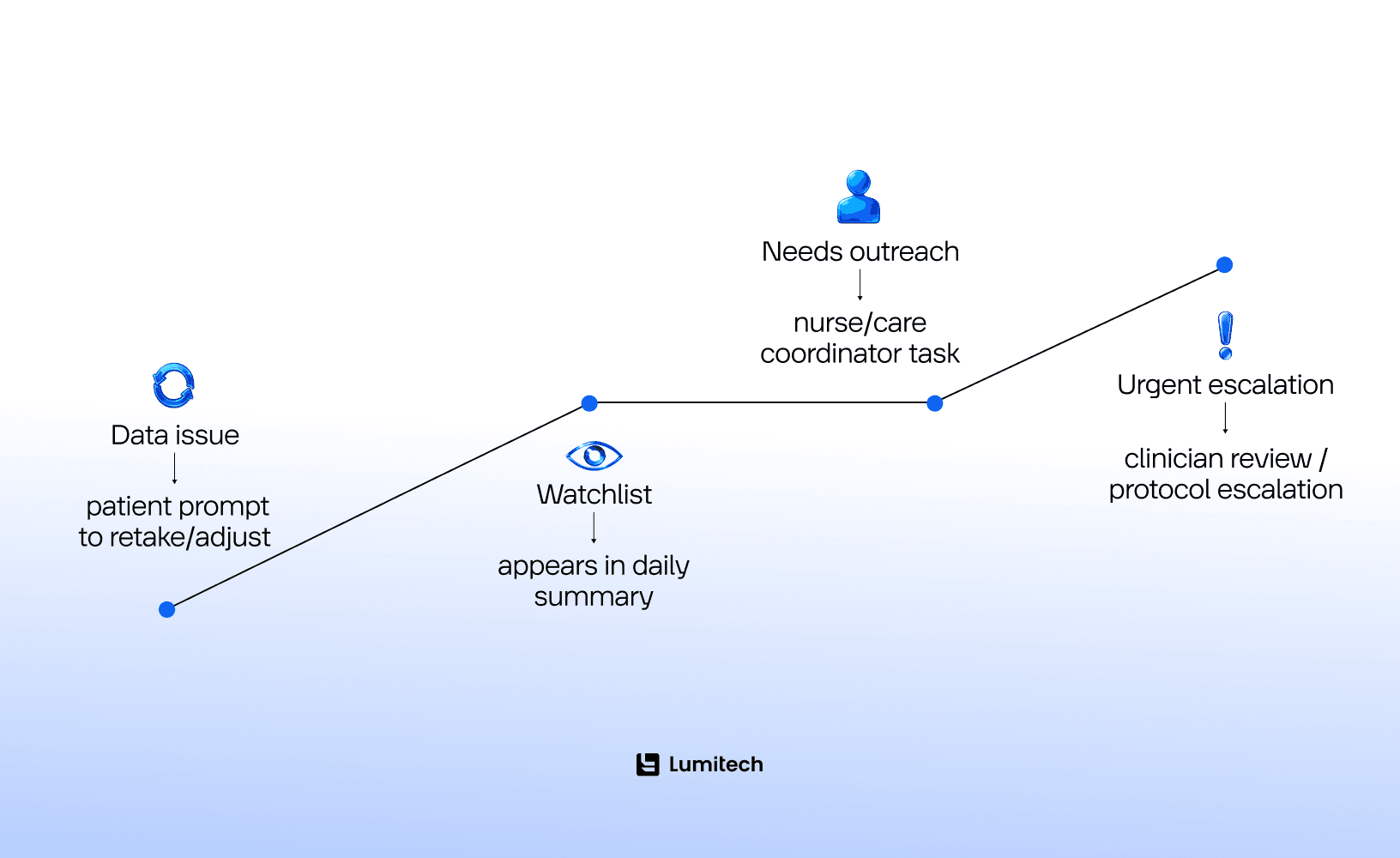
Design for Workflow, Not Just Accuracy
Many implementations have failed because of their model, not movement. Before the first device is distributed, there is a need for the healthcare team to establish:
Tier 1 (Automated): It is a self-care message or reminder for the patient to take their medication.
Tier 2 (Nursing Review): A low-priority notice that needs a review of the record in 24 hours.
Tier 3 (Urgent Escalation): High-priority notification that inspires an immediate call and visit to the clinic. It is necessary to clearly establish the “actionability” of any notification type to avoid data lingering in an inbox.
Successfully deploying AI-RPM at scale demands a level of enterprise software development that prioritizes interoperability, ensuring that the AI platform can 'talk' to every other system in the hospital’s IT stack without creating security vulnerabilities.
Implement Rigorous Alert Governance
To prevent the “alarm fatigue” that plagued early RPM systems, AI must be governed by strict suppression rules.
Quality Gates: Only trigger an alert when the AI provides a high confidence score regarding the data quality. If the signal is too noisy to be certain, the system should flag “low data quality” for the patient to fix their sensor, rather than alerting a nurse to a false medical event.
Bundling: Instead of sending five separate alerts for minor fluctuations, the AI should bundle these into a single Daily Executive Summary, reserving real-time “interruption” alerts only for life-critical events.
Prioritize Explainability and Auditability
Black-box AI is a liability in a clinical setting. When combining artificial intelligence and remote patient monitoring, every AI-generated alert should be accompanied by a “why.” Instead of a generic notification, the dashboard should present contributing factors: “Alert triggered due to 15% increase in resting heart rate over 3 days, correlated with a decrease in daily steps and a patient-reported symptom of 'shortness of breath'.” Linking directly back to the underlying raw data (the ECG strip or the weight trend graph) allows the clinician to perform a “sanity check” in seconds, building trust in the system.
Because adoption hinges on clarity and trust, investing in UI and UX design services can improve alert readability, reduce cognitive load, and make patient-facing prompts more engaging.
Seamless EHR and Role-Based Integration
Data should live where the clinician already works. Modern AI-RPM systems use HL7 FHIR standards to push summaries directly into the Electronic Health Record (EHR).
Roles-Based Views: A nurse needs a high-level “triage list” of all patients, while a specialist needs a deep-dive trend report for a specific patient.
Automated Documentation: AI can draft “Review Notes” summarizing the week’s monitoring. The clinician then reviews, edits, and signs the note — a process that saves minutes per patient and ensures the documentation meets billing requirements for RPM reimbursement.
Biggest Challenges of AI-Powered Patient Monitoring
AI can make RPM far more actionable, but a few recurring challenges often constrain implementation. Keeping these in mind early will save time, reduce risk, and improve adoption.
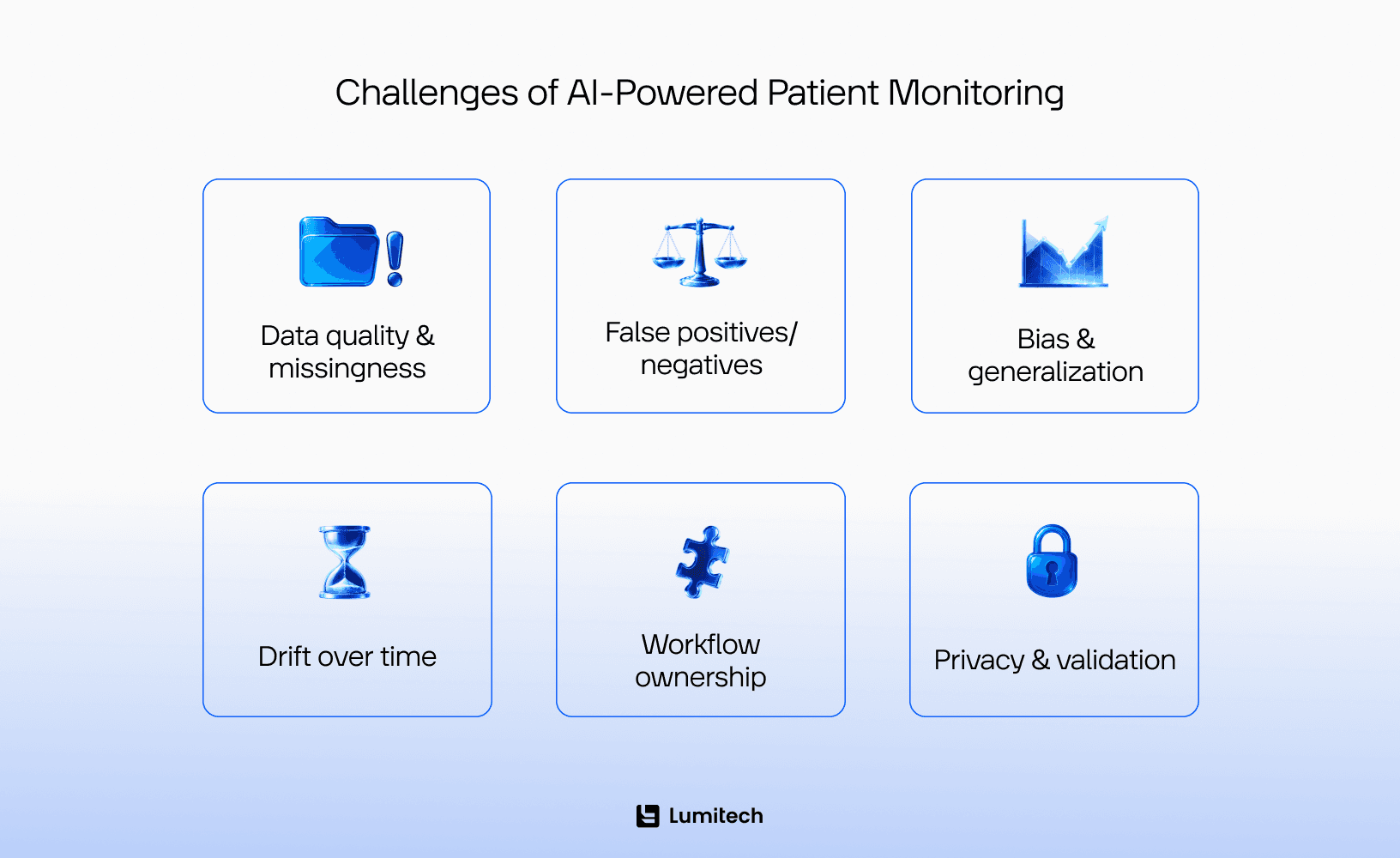
Data quality is the limiting factor
Wearable and home-device data is messy: motion artifacts, poor sensor contact, incorrect measurement technique (especially BP), intermittent connectivity, and missing data. If quality controls aren’t strong, AI will generate confident-looking outputs from unreliable inputs — leading to false alarms and loss of trust.
False positives, false negatives, and clinician trust
Keeping the data clear is one of the biggest challenges of AI-powered patient monitoring. Even small error rates matter when monitoring many patients continuously. Too many false positives create alert fatigue; false negatives can be safety-critical. Trust depends on:
conservative alerting (especially early)
transparent confidence indicators
and clear “intended use” boundaries.
Generalization, bias, and population mismatch
Models trained on one population or device ecosystem may not perform the same elsewhere. Performance can vary by age, comorbidities, and measurement conditions — and some sensors (e.g., optical) can behave differently across individuals. This makes local validation and subgroup monitoring important.
Drift and changing baselines
Patients change over time — medication adjustments, disease progression, recovery, seasonal effects, and lifestyle shifts. Devices also change (firmware updates, new models). Without monitoring and recalibration, model performance can degrade quietly.
Workflow friction and unclear ownership
AI insights that don’t map to a clear action path add burden instead of reducing it. Common pitfalls include:
alerts routed to the wrong role,
too many “FYI” notifications,
unclear escalation responsibility,
and no time budget to respond.
Privacy, security, and validation requirements
RPM involves sensitive continuous data. Given privacy, auditability, and validation requirements, software development for the healthcare industry should prioritize secure data handling, traceable decision support, and governance-ready reporting. Programs must address consent, data minimization, secure storage/transmission, auditability, and appropriate clinical validation — especially if outputs influence care decisions.
Bottom line: most failures of remote patient monitoring AI come from weak data quality and weak workflow design, not from choosing the “wrong” model.
Use cases: where AI RPM is most mature (and where it’s emerging)
Remote monitoring is one of the most practical AI in healthcare applications, because it converts continuous real-world patient data into earlier interventions and more targeted follow-up. To ground the theoretical benefits of AI in remote patient monitoring, it is helpful to look at where the technology is already a clinical standard and where it is still pushing the boundaries of "hospital-at-home" care.
Where AI RPM is most mature
Cardiac rhythm monitoring (ECG-based detection support): AI-assisted identification of arrhythmia segments and event review prioritization is one of the clearest fits, because the signal is relatively information-dense and clinical workflows already exist for escalation.
Diabetes monitoring (CGM trend interpretation): AI can help summarize glucose patterns (time-in-range trends, recurring highs/lows, overnight issues) and highlight days or periods that warrant review.
High-risk post-discharge and chronic care triage (multi-parameter watchlists): Many programs use AI-like risk stratification to prioritize outreach using vitals trends plus adherence and symptom reports—even when the “AI” is conservative and heavily workflow-driven.
Where it’s emerging
Multi-modal deterioration prediction: Combining vitals, activity/sleep, symptoms, and sometimes messaging data to predict near-term worsening earlier than thresholds. Promising, but highly dependent on data quality and local validation.
Respiratory exacerbation monitoring (COPD/asthma): Using patterns like repeated desaturation events, reduced activity, symptom changes, and inhaler/adherence signals to flag possible exacerbations—still challenging due to confounders and sensor variability.
NLP for care-team workflow: Summarizing patient messages, clustering similar concerns, and triaging outreach needs. Useful operationally, but requires careful governance because language is ambiguous and context-heavy.
In short, AI-powered remote patient monitoring is strongest where signals are reliable, and the escalation pathway is clear—and still evolving where outcomes depend on complex, multi-factor interpretation.
Conclusion
AI is pushing remote patient monitoring beyond passive data capture and toward practical decision support. By improving signal quality, learning individual baselines, and interpreting trends across time, AI in remote patient monitoring can reduce noise, prioritize the right patients, and deliver insights that fit clinical reality—when it’s designed to support (not replace) clinical judgment.
At the same time, the success of artificial intelligence in remote healthcare is rarely determined by model sophistication alone. It depends on fundamentals: reliable data collection, strong quality controls, clear alert governance, and workflows that define who acts, how fast, and what “actionable” actually means. Programs that treat AI as part of a closed-loop system—where outputs are explainable, auditable, and continuously monitored for drift and bias—are far more likely to earn clinician trust and produce meaningful impact.
The most effective way to move forward is pragmatic: start with a focused use case and a single care pathway, validate performance locally, measure workload and alert quality, and scale only when the system consistently turns signals into timely action. Done well, AI doesn’t just make RPM smarter — it makes it more usable, more scalable, and ultimately more helpful for patients outside the clinic.


