
Mitigating Bias in AI: How to Build Fair Models Without Breaking the Business
AI models are already influencing who is hired, who is given credit, and what decisions doctors make. So the bias is no longer a theory. It has become a real risk.
- AI Integrations
December 12, 2025
 AI Overview
AI bias mitigation refers to systematic methods for reducing unfair model outcomes across gender, age, or ethnicity through pre-processing, in-processing, and post-processing interventions. Key techniques include data rebalancing, fairness constraints in training, and post-hoc threshold adjustment. Unaddressed bias creates legal exposure, since 65% of organizations report data bias but only 13% actively mitigate it.


AI bias is a system error that leads to unfair or, at best, worse decisions for distinct human groups. This can be bias based on gender, age, ethnicity, language, social status, skin type, or location. And also a bias towards rare cases or non-standard user behaviour.
Sounds like a moral problem? Sure, but in 2026, it’s going to be a financial, legal, and reputational threat that can cause customer and market losses, legal risks and fines, a decline in brand trust, and more. A Progress survey found that 65% of organizations are already experiencing data bias, 78% expect the problem to grow, but only 13% have ongoing processes in place to assess and combat it.
Additionally, the regulations are changing: the EU AI Act explicitly requires that data for high-risk AI systems be relevant, representative, and vetted for potential biases and gaps. This is no longer a recommendation. It’s a requirement with deadlines and accountability. And the NIST AI RMF (used as an international AI risk management standard) puts bias at the forefront of risks that need to be identified, measured, and managed to mitigate throughout the model’s lifecycle.
So, in 2026, AI bias mitigation is just like cybersecurity or QA: you can’t add it later, because later it will cost much more. In this article, we will examine the sources of artificial intelligence bias, how to measure it, and practical strategies for systematically reducing bias in models.
Where Bias in AI Models Comes From: A Short but Honest Map of Causes
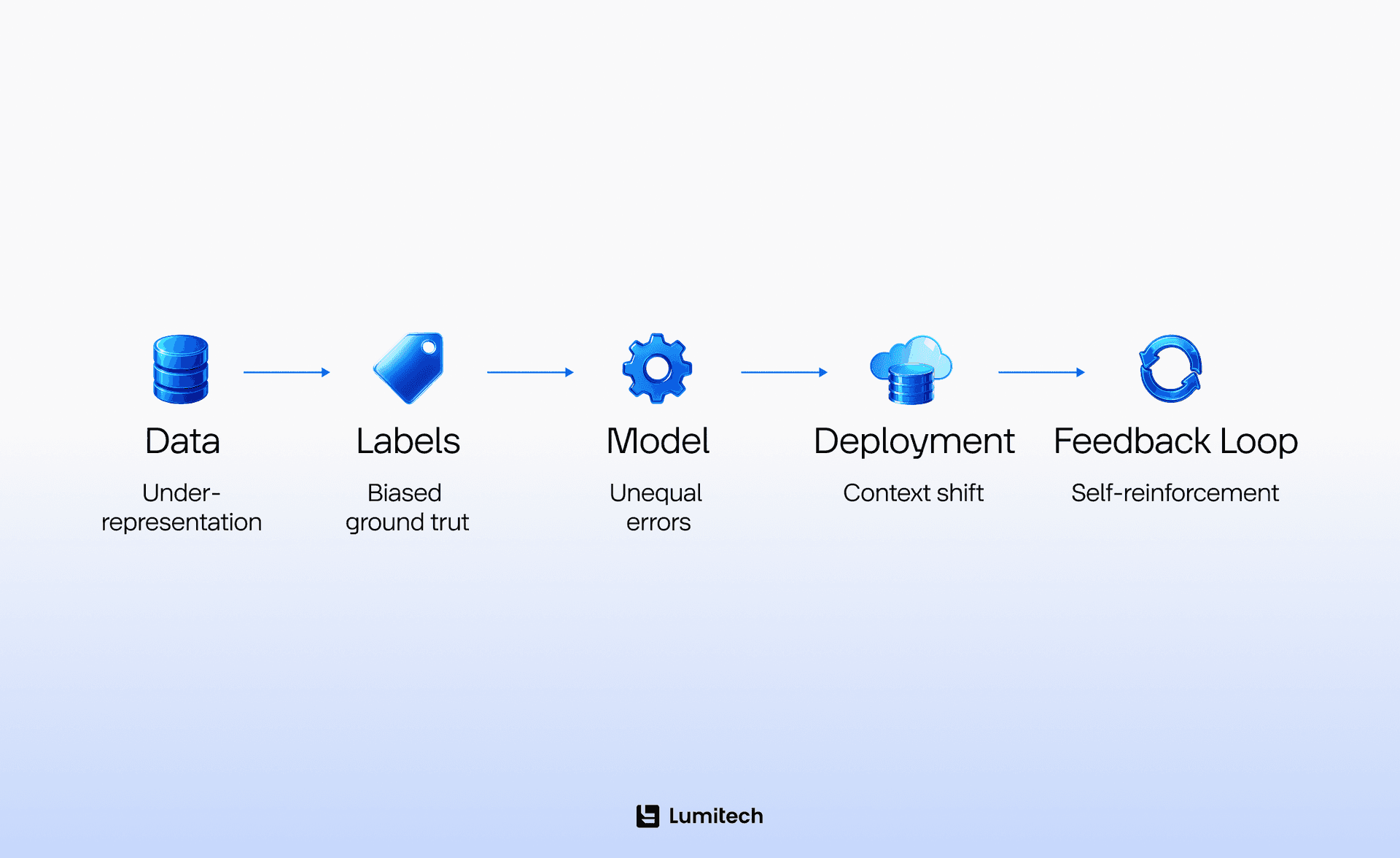
Artificial intelligence bias does not come from nowhere. It is always a consequence of how we collect data, how we look for the correct answers, and how we then apply the model to the real world. Most frequently, the bias in AI is caused by one of the following reasons:
Data bias. Suppose the dataset is poorly representative of the real population, for example. In that case, it has more data about one group of people and almost none about another: the model will automatically perform better for the majority and worse for the minority. The same thing happens when the data is historically skewed: the model simply learns from past patterns and reinforces them.
Label/measurement bias. Even if the data is balanced, bias can still be present in how we label the correct answers. For example, if people with their own biases defined the candidate’s success or the client risk, the model would inherit those definitions without mitigating bias in AI.
Algorithmic bias. Sometimes a model becomes unfair not because of the data, but because of what it is optimized for. If the goal is only to maximize the average accuracy, the system may sacrifice smaller groups because it is easier to achieve high overall scores.
Deployment bias. A model may have been tested in one environment, but in production, it works in another: different countries, languages, behavioral patterns, and regulations. As a result, what was fair in the test becomes distorted in reality.
Feedback loop bias. The most insidious thing is when the model itself influences the data, on which it then keeps retraining. For example, if credit scoring is less likely to grant loans to a particular group, then over time, there will be fewer positive examples of this group in the data, and the bias in AI models will become even stronger.
The bottom line is simple: bias in AI models isn’t just a flaw, it’s a systemic effect shaped by data, team decisions, and real-world context. That’s why bias in AI models mitigation has to be addressed end-to-end, not with one-off fixes.
Real-World Cases That Changed the Bias in AI Models Mitigation
Not to rely only on theory, let’s look at several stories that have really undergone the impacts of AI bias. These are the cases after which the industry no longer asks whether bias is present, but instead asks how to eliminate it systematically, mitigating bias in AI.
Gender Shades and the Faces AI Can’t See
A study by Joy Buolamwini and Timnit Gebru was groundbreaking in the sphere of computer vision. They tested three commercial facial gender recognition systems and found a stark disparity: for light-skinned men, the error rate was around 0.8%, while for dark-skinned women, it reached 34.7%. Now, you should see how important it is to know how to prevent bias in AI.
This is not just about the model working worse. It is a situation in which the product discriminates against one group of users due to unrepresentative data and narrow testing. An important nuance is that the authors also showed intersectional bias: when a combination of characteristics (for example, gender + skin tone) increases inequality more than each characteristic separately.
A lesson learnt: fairness cannot be tested on average. Subgroups and subgroup intersections must be tested separately, especially if the product works with faces, voice, language, or medical data. This can be achieved with proven AI development solutions.
Amazon Hiring Tool: Historical Inequality Automation
Amazon has been developing an ML system for screening CVs since 2014. The idea seemed logical: train the model on successful hires and get a smart recruiter. But in 2018, the project was shut down because the model systematically underestimated women’s CVs for technical roles. The reason was as simple as 1-2-3: Amazon’s historical data reflected male dominance in tech hiring, and the model simply learned this pattern.
This is a classic example of AI repackaging the human past into a scalable process. And importantly, even if the company didn’t intend to discriminate, the result was exactly that. This is why it is critical to understand how to prevent AI bias.
A lesson learnt: if a business process was historically biased, an ML model won’t fix it on its own. First, debias the data/labels and define fairness metrics, and only then automate.
COMPAS in Criminal Justice
The COMPAS case in criminal justice has become a textbook example for the entire field of AI-fairness. In 2016, ProPublica published an investigation that revealed disparities in error rates. Black defendants who did not reoffend were almost twice as likely to be falsely labelled as high-risk (45% vs. 23% for whites), while white repeat offenders were more likely to be falsely labelled as low-risk (48% vs. 28%).
Then a considerable discussion ensued: the system’s authors and some researchers disputed ProPublica’s interpretation, showing that, by other metrics, the model may appear equal. And this is where the key insight was born: in high-stakes domains, it is impossible to satisfy all fairness definitions at the same time. You will need to choose which type of fairness is most important (e.g., FPR/TPR equality or predictive parity), and explain this choice to stakeholders.
A lesson learnt: fairness is a compromise that needs to be made transparent. Choose a domain metric, set the trade-off, and establish a human control/appeal mechanism.
Apple Card and Credit Limits
In 2019, Apple Card users publicly claimed that women were receiving lower credit limits than their male counterparts with similar credentials. This prompted an official investigation by the NYDFS. In 2021, the regulator reported that there was no systemic gender discrimination in the results, but at the same time obliged Goldman Sachs (the underwriter) to improve transparency and work with customer complaints.
This case showed a vital thing: in financial products, the feeling of injustice is often no less destructive than real bias. If the user does not understand why the system made a specific decision, trust drops instantly.
A lesson learnt: fintech and all trust domains need explainability, auditability, and a clear appeal path. The model must not only be correct, but also explainable in, let’s say, fintech UX design.
Bias is not an exotic bug. It is a predictable outcome when the data is skewed, metrics are chosen without domain logic, and the production context is different from the test context. That is why modern AI bias mitigation strategies start with measurement, data auditing, and honest negotiation of fairness goals before the model reaches the user.
At Lumitech, we understand how AI bias is essential in the modern tech world. Let us help your business avoid it and eliminate potential risks.

Three Major Strategies of Bias Mitigation in Artificial Intelligence
In practice, mitigating bias in artificial intelligence almost always falls into three types of interventions: before training the model, during training, and after obtaining the prediction. This classification is convenient because it immediately tells you where exactly in your pipeline the problem occurs and what level of control you have over the data and the algorithm.
A critical point is that these are not three mutually exclusive paths, but a constructor that often produces the best effect when combined and launched with top web development services.
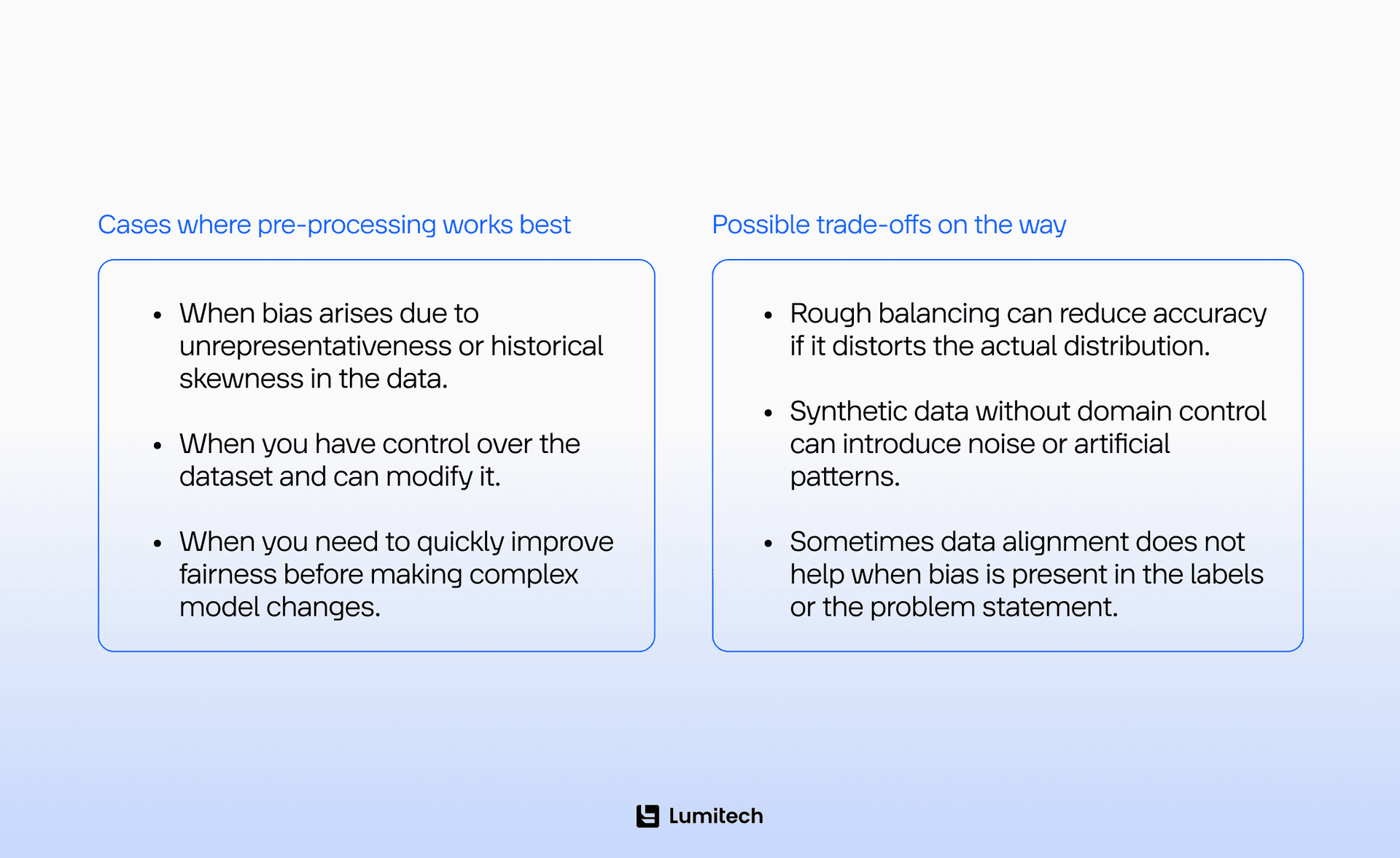
Pre-processing AI Bias Mitigation Strategies: Fixing Data Before Training
This is a strategy that reduces bias before the model has learned anything. Its logic is simple: if the input data is skewed, the model will amplify it, even if the algorithm is neutral. Therefore, the first and most noticeable effect is often obtained by working with the dataset, whether it’s an MVP development or enterprise software development. Here is what this strategy for bias mitigation in artificial intelligence can mean in practice.
Group representation equalization
If you have, say, 80% of the data on one group of users and 20% on another, the model will be biased toward the majority. Equalisation is achieved either by oversampling the minority, undersampling the majority, or by a clever combination of the two.
Re-weighting
When you don’t change the number of examples, but you give different groups different weights in the loss function. This is useful if the data is expensive/sparse and can’t be simply duplicated.
Data augmentation for poorly represented cases
For example, for CVs – synthetic variations of lighting, angles, colours; for NLP – paraphrases, translations, noise variants. It is important to do this on a domain-wide basis to avoid creating a fake reality.
Label debiasing (label audit)
Very often, the problem is not the amount of data, but how it is marked. For example, a “successful candidate” or a “risky borrower” has historically been assessed subjectively. In this case, reviewing labels, double-marking by different experts, and creating a gold set help.
Forming fair representations
There are approaches that transform features so that sensitive features (or their proxies) are less visible to the model while preserving valuable information. This is more complex but can provide a good compromise between accuracy and fairness.
In-processing: Building Fairness Into the Model While Mitigating Bias in AI
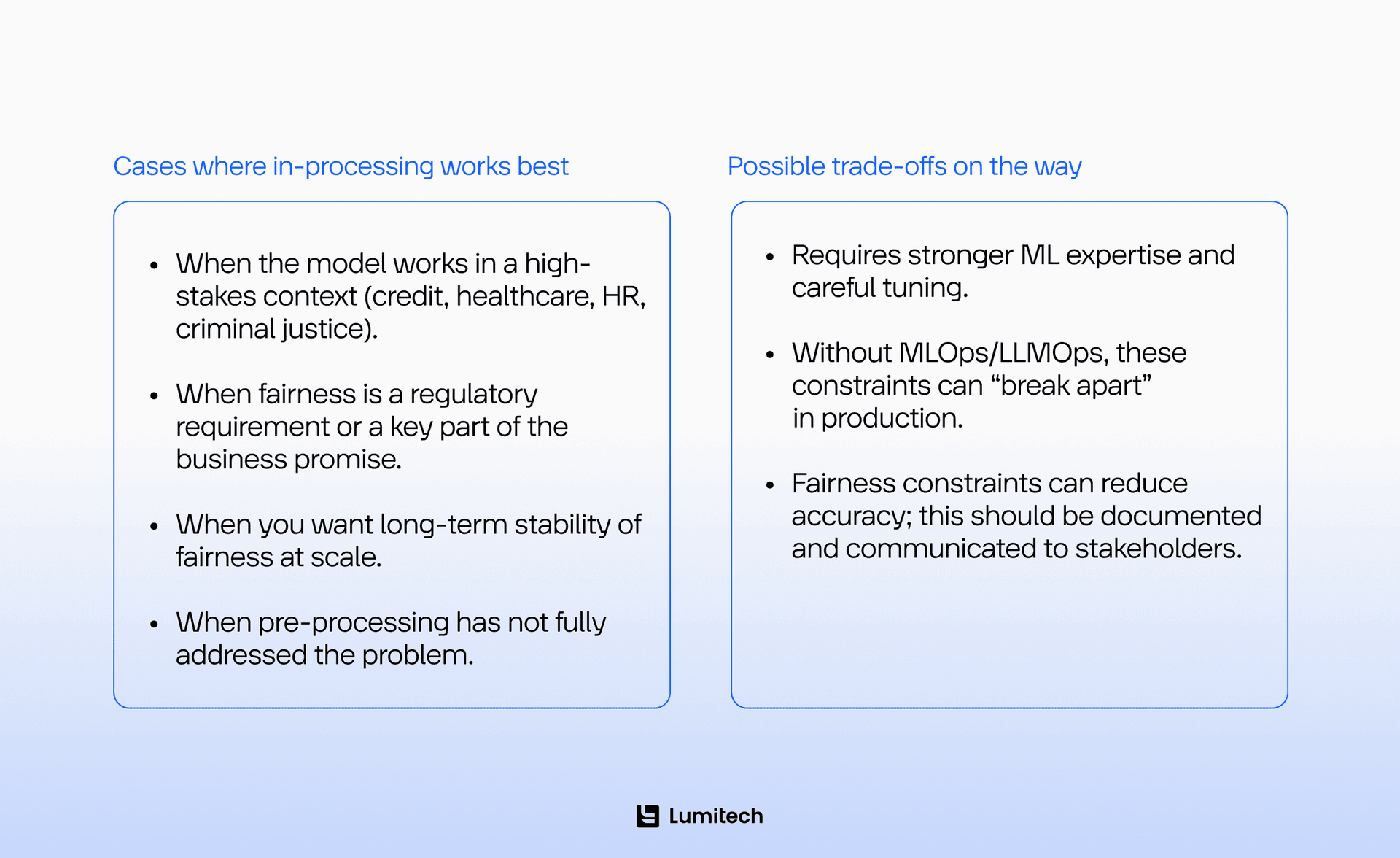
This is a strategy for bias mitigation in artificial intelligence for cases where the data cannot be fully corrected or where strong fairness guarantees are needed at the algorithm level. Here, we intervene in the learning process: the model optimises not only accuracy but also fairness metrics. Let’s highlight the key approaches.
Fairness constraints in the loss function
You add a penalty for violating the chosen fairness metric (demographic parity, equal chances, etc.). For example, if the FPRs differ across groups, the model is penalised and, during training, seeks parameter settings that minimise the gap between them.
Adversarial debiasing
Works like a game: the main model solves your problem, and the parallel adversarial model tries to recover the sensitive attribute from the output. If the adversary is successful, sensitive information leaks, and the main model is not allowed to operate. As a result, the model becomes less inclined to use sensitive or proxy features.
Multi-objective optimization
When you explicitly optimise for multiple goals at once: accuracy + fairness + other business metrics. This is a more honest and controlled approach than other AI bias mitigation solutions because it makes the trade-offs explicit.
Post-processing Bias in AI: Adjusting Decisions After Inference
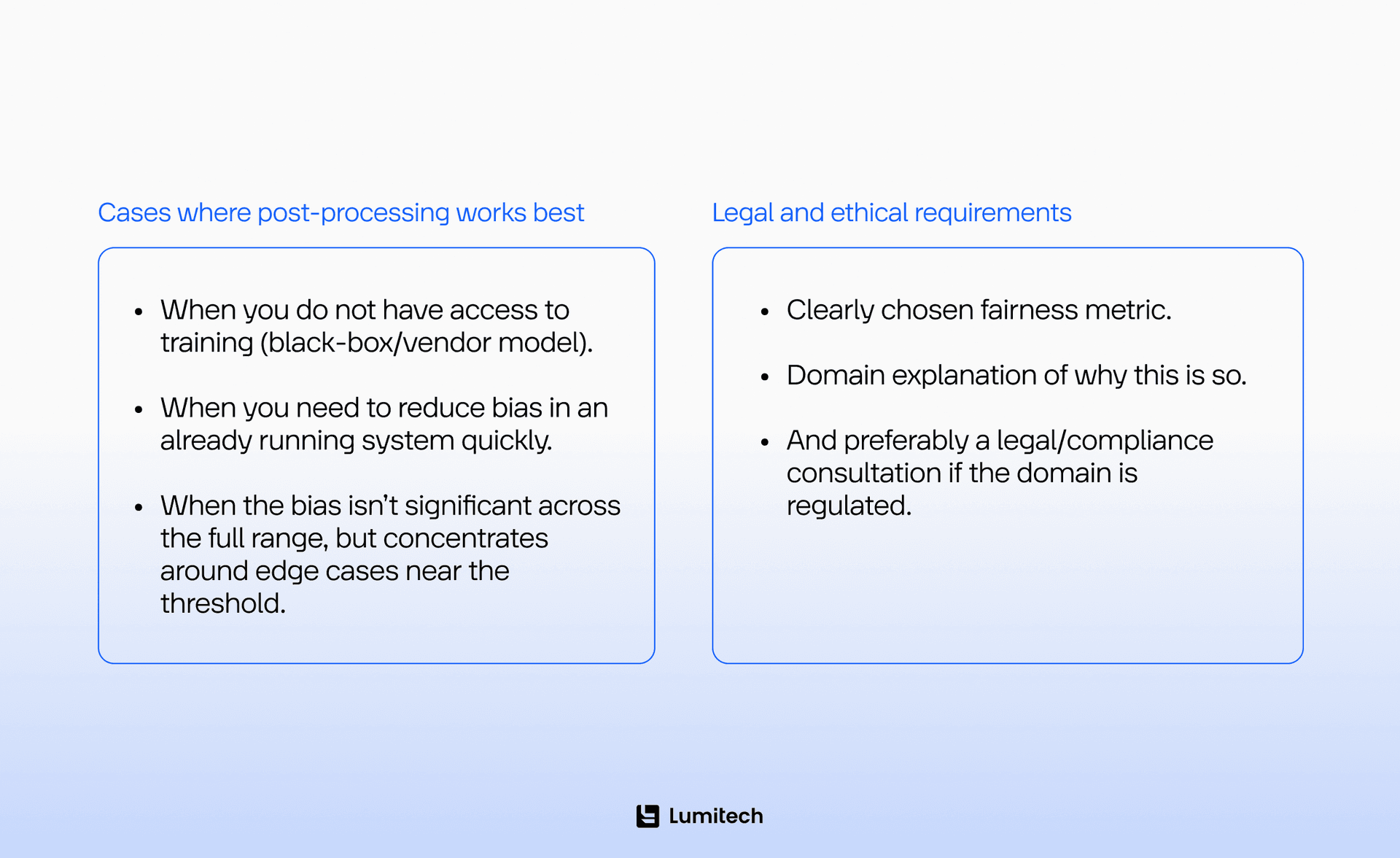
Postprocessing means leaving the model as is while adjusting its decisions or thresholds to reduce group disparities. This is especially useful if the model is already integrated into the product, or you are using a third-party model and cannot retrain it. Here are the key methods of mitigating bias in artificial intelligence in this case.
Group-specific thresholding
Different decision thresholds are set for various groups to equalise FPR/TPR. For example, if the model is falsely rejecting one group more often, the threshold can be adjusted.
Calibrated equalised odds
Recalibration of probabilities to maintain equality of odds/errors between groups.
Reject option classification
The model only changes its decision when its confidence is low and when the most unfairness occurs.
How to choose between these three AI bias mitigation strategies? Here is a simple checklist:
If the problem is data-related, start with pre-processing.
If the problem is fairness (regulatory or strategic requirement), then you need to start implementing bias mitigation in AI projects with in-processing.
And if the model already operates in production, post-processing is your best option.
But in real projects, a combo often works: light data alignment + fairness constraints during training + post-hoc threshold control or human-in-the-loop for complex cases.
Major Points to Be Aware of While Mitigating Bias in AI: from Metrics to Tools
Based on the above information, you can choose a strategy to minimise bias in artificial intelligence and be ready to implement it in your operations to maintain the business’s trust. However, many more peculiarities must be taken into account. Let’s go through some of them.
How to Measure Bias
Bias mitigation starts with measurement. And here’s the important thing: there is no universal metric that will work for everyone. The most commonly used groups of metrics in practice are:
Demographic parity: the proportion of positive decisions in groups should be similar.
Equalised odds/equal opportunity: the quality should be similar across groups (e.g., TPR/FPR).
Group loss/worst-case error: the model should not fail on a single group.
Modern mitigation toolkits, such as Fairlearn, directly support these metrics.
The key point: choosing a metric is a business and ethical decision. In lending, equalised odds (also called equality of errors) are often significant. In SaaS product onboarding, equality of access (demographic parity) may be necessary. In medical models, the focus is often on worst-case error: you can’t treat poorly one group for the sake of average accuracy.
Tools Worth Knowing
The toolkits below will not replace domain logic, but they will significantly lower the barrier to entry into system mitigation.
IBM AI Fairness 360 (AIF360)
An open library with metrics and built-in mitigation algorithms for all three classes of approaches.
Microsoft Fairlearn
This toolkit measures fairness and supports mitigation algorithms like demographic parity and equalised odds, with native scikit-learn integration.
Google What-If Tool
A visual interface for auditing models: group performance, counterfactual scenarios, and fairness metrics. Very useful for product/marketing communication because it clearly shows bias.
If you want to put these tools into practice, our team can help. We can quickly audit your models, surface bias risks, and apply the right mitigation strategy end-to-end.
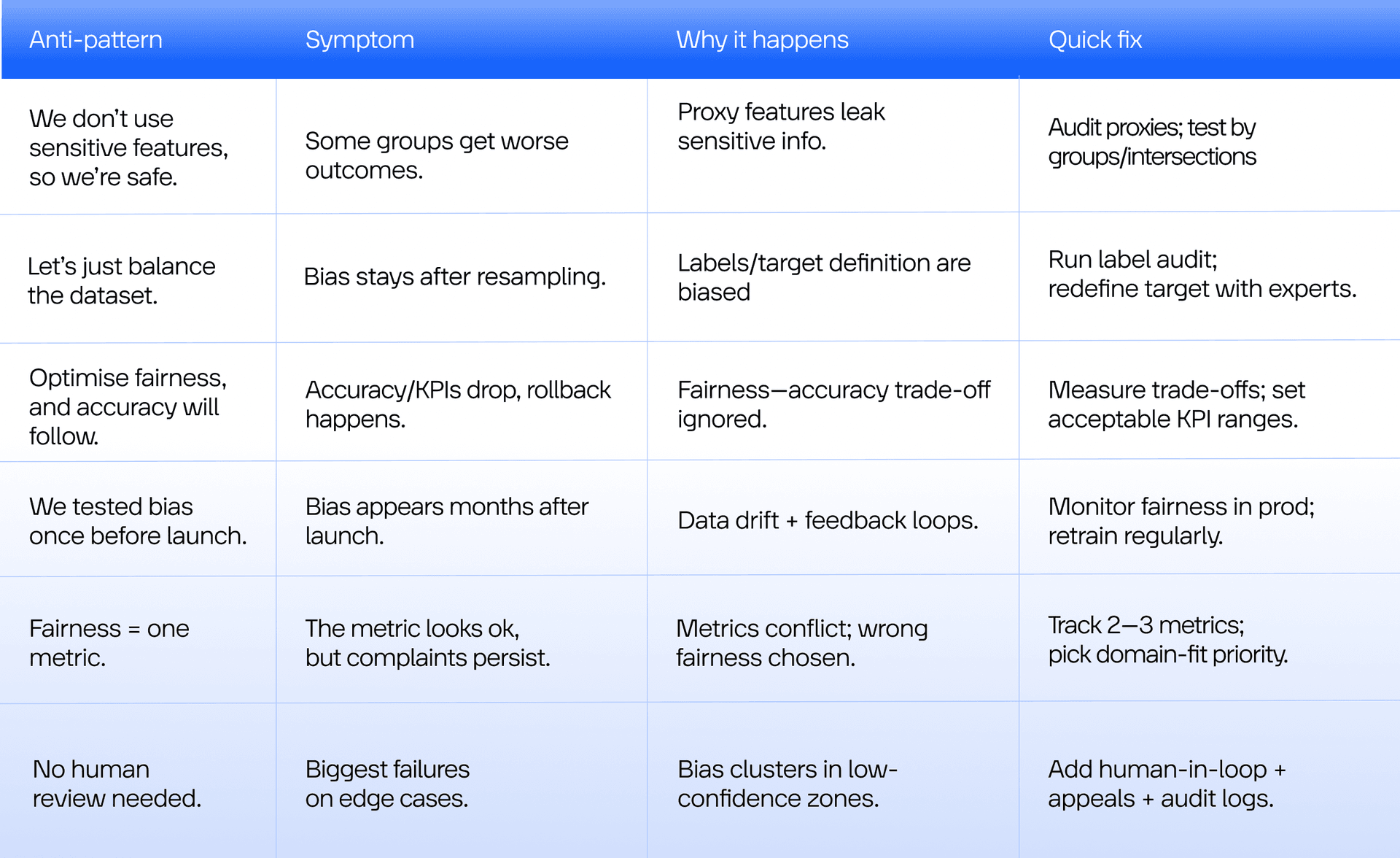
Common Team Mistakes
Even the teams with experienced ML engineers often stumble not on algorithms, but on minor, systemic miscalculations in data, metrics, or production processes. Below are typical mistakes that most often lead to bias, along with simple ways to avoid them.
Summing Up: What Is the Vector of AI Bias in 2026?
First of all, there is a shift from “fairness as a metric” to “fairness as part of the product”: SaaS teams are increasingly adding decision explainability, transparent reasons for rejection, and appeal scenarios directly into the interface with the right UI and UX design services, thereby strengthening trust and reducing risk.
In parallel, the market is pressured by systemic regulatory requirements: the EU AI Act for high-risk systems establishes mandatory data quality and representativeness, the detection and correction of potential biases, as well as human supervision, documentation, and continuous monitoring; that is, bias control is becoming a norm of compliance, not goodwill.
The third vector is a sharp rise in attention to LLM bias and multimodal fairness. As biases in generative AI solutions encounter new linguistic, cultural, and contextual gaps, teams increasingly rely on RAG, domain fine-tuning, and red-teaming to keep models grounded and safe in production.


