
Synthetic Data Generation Methods: What They Are and How They Work
What if you could train and test AI models without the risk of private data, lack of examples, and expensive data collection? Synthetic data generation methods are changing the way teams build and test AI.
- AI Development
- Big Data & Analytics
August 26, 2026
 AI Overview
Synthetic data generation creates artificial records that preserve real-world statistical properties without copying sensitive information, used to train AI when real data is scarce, imbalanced, or privacy-restricted. Key methods include probabilistic modeling, generative adversarial networks, and simulation environments like Waymo's virtual driving worlds. Gartner forecasts that by 2026, 75% of businesses will use generative AI to create synthetic customer data.

In February 2026, Waymo said its self-driving system had logged nearly 200 million fully autonomous miles on public roads. But just as importantly, it had also logged billions of miles in virtual worlds to learn rare and dangerous scenarios before seeing them on real streets. This is synthetic data in action, as a practical way to train and test AI in situations that are too sensitive, too rare, too expensive, or too risky for large-scale real-world deployment.
This one example explains why interest in synthetic data generation is growing so rapidly. AI teams want more data, better edge case coverage, more secure sharing, and faster iteration. Regulators and security leaders want stronger privacy protections. Product development teams want to test systems without exposing production records. And enterprises want all of this without compromising quality.
This article breaks down the main synthetic data generation methods, how they work, when each method fits, what the market is responding to, how synthetic data is generated, and where teams should be cautious.
Why Synthetic Data Is Suddenly a Boardroom Topic
Synthetic data has moved from a niche data-science topic to an enterprise priority for a few reasons. First, real data is often hard to access, expensive to label, and limited in supply. IBM notes that synthetic datasets can be generated on demand in large volumes and tailored to business needs, which is especially useful when real datasets are sensitive or hard to share.
Second, privacy and governance pressures are increasing. NIST describes synthetic data as artificially generated data that can be used in place of original records, especially when real data contains sensitive information. Its guidance also emphasizes the need to evaluate both privacy and utility.
Third, the economics are changing. IBM cites a Gartner forecast that by 2026, 75% of businesses will use generative AI to create synthetic customer data. That prediction does show where enterprise priorities are moving.
So the questions are: what methods exist, how do they work, and where do they create the most value?
What Is Synthetic Data Generation?
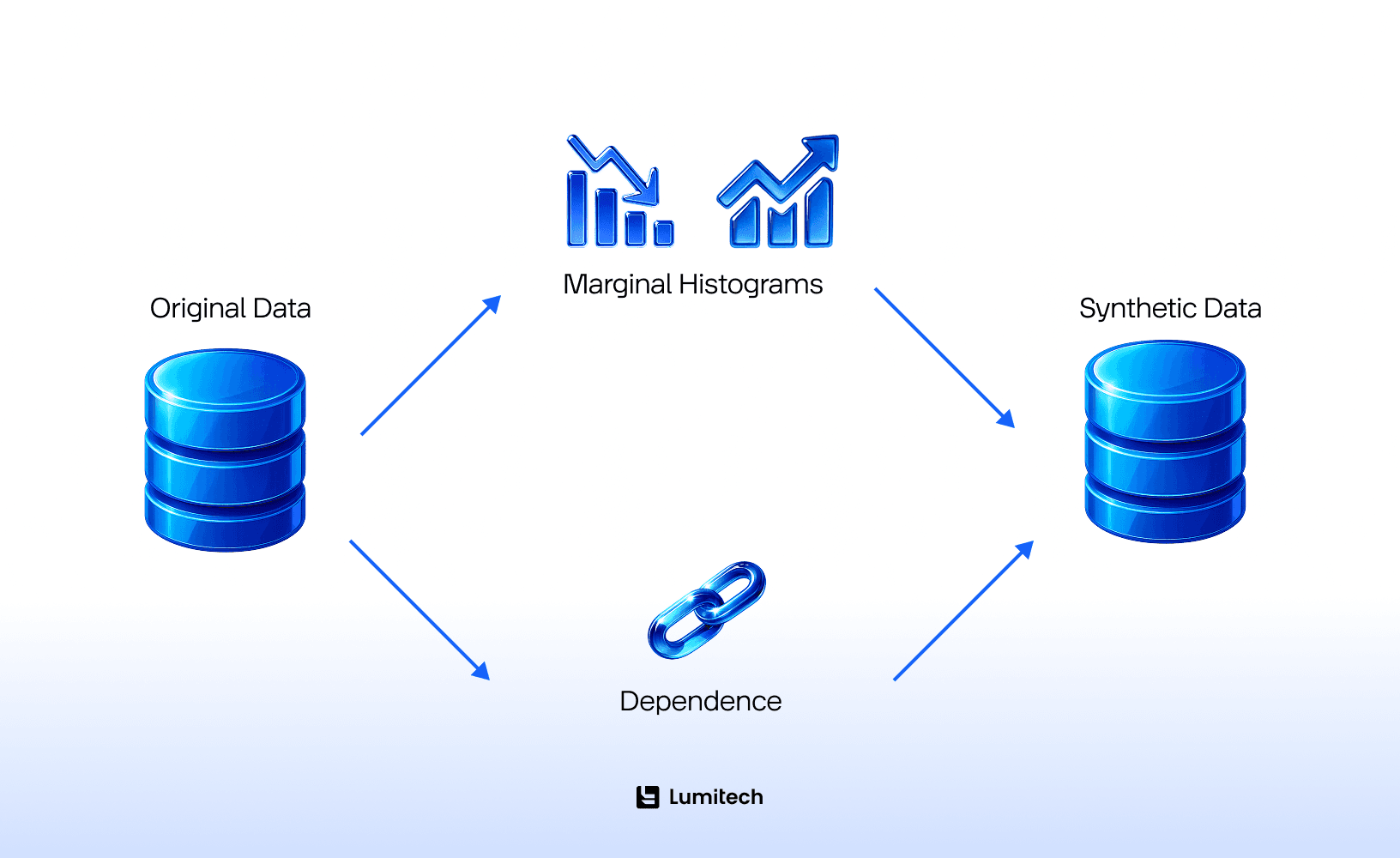
Synthetic data generation basics is the process of creating artificial data that preserves the useful properties of real-world data without being a copy of specific real records. IBM defines it as artificially generated information that can supplement or replace real-world data for training or testing AI models. NIST frames it similarly, explaining that synthetic data generation starts by learning a probabilistic model of the original population and then generating “fake” records that preserve those properties.
Why Use Synthetic Data in AI?
The simplest answer to the question “why use synthetic data in AI” is that, for many AI systems, real-world data is either insufficient or does not meet the quality, security, and coverage requirements for the model to work reliably. In real-world projects, teams often face one of several typical problems: the data is too small, poorly balanced, contains sensitive information, or does not cover rare but critical scenarios. This is where synthetic data becomes a practical tool.
One of the main reasons is the lack of high-quality training datasets. AI models need large amounts of data, but in many areas, real-world examples are either rare or difficult to collect. For example, this applies to fraud detection, anomaly detection, healthcare AI, autonomous systems, or industrial monitoring. Synthetic data helps supplement real-world datasets and provide the model with more examples to train on, especially when edge cases or underrepresented scenarios are important.
Another important reason is privacy and compliance constraints. In many industries, especially healthcare, finance, insurance, and enterprise software, the use of real-world data for training or testing AI is limited by laws, internal policies, or security requirements. Synthetic data allows you to create more secure datasets for experimentation, prototyping, testing, or collaboration without directly using sensitive information.
Synthetic data is also useful for improving a model’s coverage and robustness. Real-world historical datasets don’t always represent rare events, new scenarios, or atypical behavior well. If AI is trained only on what has happened frequently in the past, it can be weak exactly where the most accuracy is needed. Synthetic generation enables you to deliberately add missing scenarios, thereby making the model more robust to complex or less typical situations.
In addition, synthetic data enables teams to accelerate development workflows. It helps with testing, QA, sandbox environments, and product experiments. In such cases, AI teams can test hypotheses faster, test pipelines, and launch new iterations without waiting for access to production-safe data or manually preparing test sets.
Why it matters in practice
In the context of AI, synthetic data is valuable because it helps create better conditions for training, testing, and model development. It gives you more control over what scenarios the model sees, what data is available to the team, and how quickly new experiments can be launched.
How Synthetic Data Generation Works
Most methods of generation follow a similar logic, even when the math differs. Synthetic data management processes are almost as important as the model itself. If a team skips the evaluation, management, or update logic, the result may look impressive but imperceptibly fail to accomplish its intended purpose.
The Synthetic Data Generation Pipeline
Stage | What happens | Typical output |
|---|---|---|
Define purpose | Decide whether the goal is training, testing, simulation, privacy-safe sharing, or augmentation. | Use-case requirements |
Profile source data | Understand schema, distributions, correlations, missingness, imbalance, and edge cases. | Data profile |
Choose method | Pick statistical, deep learning, rule-based, simulation, or hybrid methods. | Generation plan |
Generate data | Produce synthetic records, images, events, or sequences. | Synthetic dataset |
Validate quality | Measure fidelity, utility, bias, privacy risk, and robustness. | Evaluation report |
Deploy and monitor | Use in training, QA, product testing, or controlled sharing. | Managed lifecycle |
The NIST Synthetic Data Guide underscores this point. It emphasizes that generation begins with modeling the source population, and that evaluating synthetic data involves testing for both usefulness and privacy. IBM similarly recommends testing against accuracy and usefulness metrics, as well as ongoing monitoring of how the synthetic data performs in future use.
The Synthetic Data Lifecycle
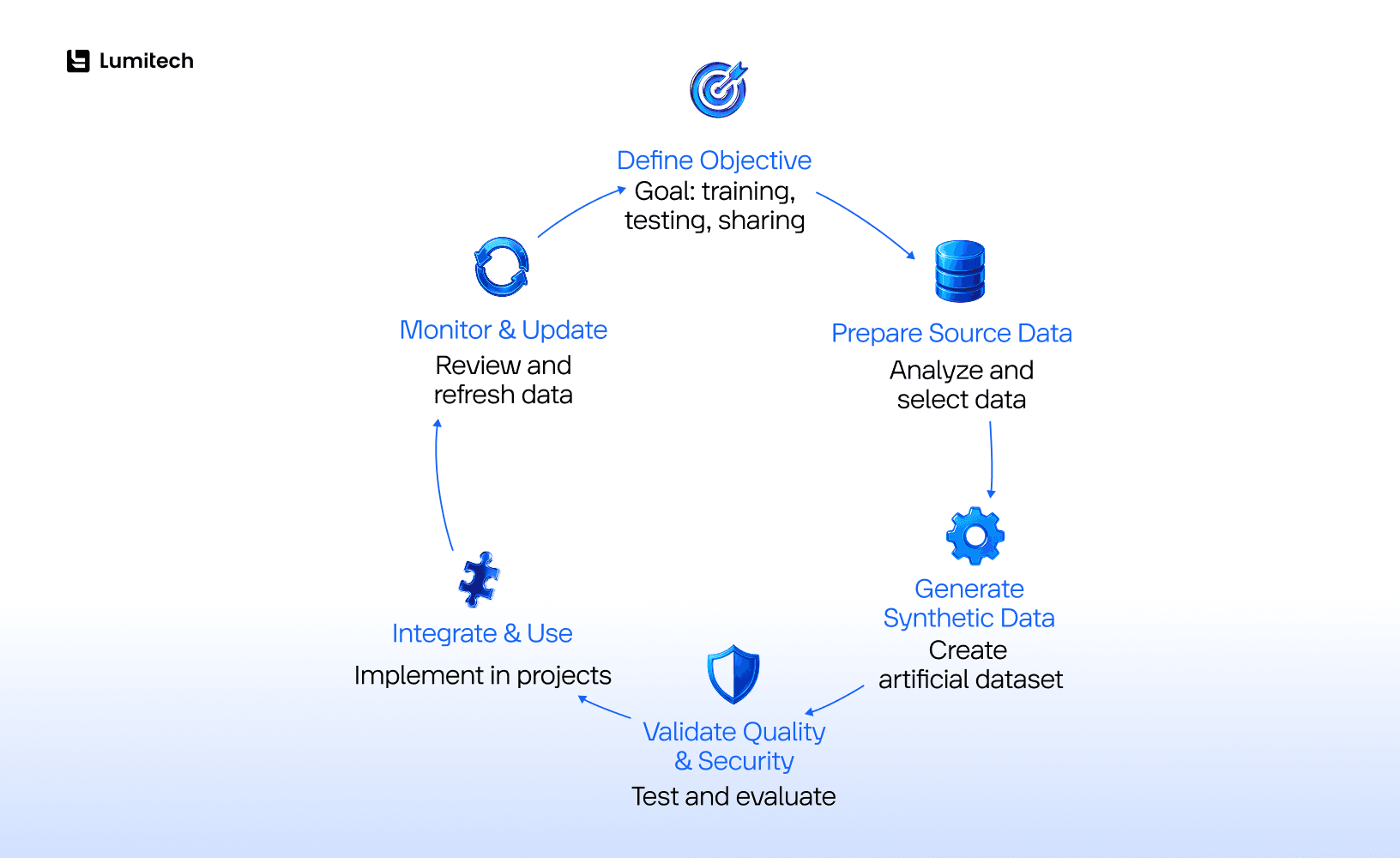
The synthetic data lifecycle is the complete process of creating, verifying, using, and further updating artificial datasets. It helps understand how synthetic data generation works. In practical AI and data workflows, synthetic data should be useful for a specific task, privacy-safe, and of sufficient quality for training, testing, or experimentation.
Typically, this cycle goes through several consecutive stages:
1. Defining the goal
The team starts with the main question: what exactly is the synthetic data needed for? This could be training an AI model, testing the system, safe data sharing, sandbox experimentation, or preparing data for development workflows.
2. Preparing the source data
Next, the source data is analyzed: its structure, quality, distributions, correlations, missing values , and potential biases. At this stage, it is important to understand which characteristics should be preserved in the synthetic dataset and which risks should be reduced.
3. Synthetic data generation
The team then selects an appropriate generation method, like statistical modeling, generative AI, simulation, or a hybrid approach, and creates a synthetic dataset that meets the goal.
4. Quality and security verification
The generated data should be evaluated for usefulness. This includes checking fidelity, privacy risk, bias, coverage, and how well the synthetic data fits a real downstream use case.
5. Integration and use
If the dataset passes the verification, it can be used in training pipelines, testing environments, analytics sandboxes, or product workflows. At this stage, the synthetic data becomes part of a practical process.
6. Monitoring and updating
Synthetic data should be regularly reviewed, updated, and re-evaluated, especially if the source data, business scenarios, or model requirements change.
What Are the Main Types of Synthetic Data Generation Methods?
If you strip away the hype, there are three types of synthetic data generation methods.
1. Statistical modeling
Uses probability distributions and dependency structures learned from real data to sample new records.
2. Deep learning / Generative AI
Uses models such as GANs, VAEs, diffusion models, or LLM-based generators to learn more complex patterns and produce realistic outputs.
3. Rule-based / Simulation
Uses domain logic, process rules, simulators, or synthetic environments to create artificial data when the system behavior is well understood, or real data is scarce.
IBM explicitly notes that simple datasets may benefit from statistical methods, while more complex structured or unstructured data may require deep learning, and organizations may combine synthetic data generation techniques depending on the task. NIST also points to a spectrum ranging from simple counting-based approaches to deep learning.
Method family | Best for | Strengths | Weaknesses |
|---|---|---|---|
Statistical modeling | Tabular business data, official statistics, simpler distributions. | Fast, explainable, cheaper to implement. | May miss complex dependencies. |
Deep learning / generative AI | Images, text, time series, complex tabular patterns. | Handles higher-dimensional structure. | More compute, more tuning, harder validation. |
Rule-based / simulation | Physical systems, process flows, edge-case scenarios. | Great control, good for rare events. | Can be expensive to model well. |
Hybrid methods | Enterprise production pipelines. | Balances realism, control, and privacy. | More architectural complexity. |
Synthetic Data Generation Method: Statistical Modelling
Statistical approaches are often the starting point for generating synthetic data, especially for structured tabular data. The idea is straightforward: analyze the source dataset, estimate distributions and relationships, then sample new data points that preserve those patterns.
NIST describes one simple family of methods based on marginal distributions and weighted randomness. IBM likewise notes that statistical distributions can be used to generate synthetic samples that mirror real data distributions.
These types of synthetic data generation methods are strong when:
the data is mostly tabular,
the relationships are relatively stable,
explainability matters,
and teams need faster implementation with lower computational cost.
Examples of this synthetic data generation method include marginal distributions, copula-based modelling, Bayesian network approaches, parametric sampling, and count-based differential privacy methods.
When statistical methods fit best
Use them when you need privacy-conscious sharing of business tables, internal analytics sandboxes, synthetic test data creation for applications with structured schemas, and baseline generation before moving to more complex models.
They are less ideal when the target includes rich images, free text, highly nonlinear dependencies, or intricate temporal behavior.

Deep Learning and Generative AI Methods
When people hear “synthetic data,” this is often what they imagine. Deep learning methods aim to learn more complex latent patterns from the source data and generate new samples with a similar structure.
IBM lists generative adversarial networks (GANs) as a common mechanism and explains how a generator and a discriminator iteratively improve the output. IBM also points to deep learning methods for more intricate structured and unstructured datasets. NIST research adds one concrete example: a hybrid CT-VAE approach that uses a variational autoencoder to learn a latent representation and then samples from that space to generate synthetic data. In NIST’s experiments, models trained on the synthetic data for AI produced by the NIST process performed similarly to those trained on real data for the evaluated task.
Common Deep-learning Methods:
Method | Best known for | Typical use |
|---|---|---|
GANs | Realistic image-like generation. | Vision, medical imaging, and fraud examples. |
VAEs | Latent-space modeling and controllable sampling. | Tabular, mixed data, compressed representation. |
Diffusion models | High-quality image and multimodal generation. | Vision, simulation, synthetic scenes. |
LLM-based generation | Text, dialogs, instruction data. | AI assistants, training corpora, QA pairs. |
This category is especially important for synthetic training data generation, where teams need richer variation than simple statistical resampling can provide.
Where deep learning shines
Computer vision datasets;
Medical imaging;
Time series with nonlinear relationships;
Transactional fraud modeling;
Language-model fine-tuning;
Edge-case generation for simulation-heavy products.
IBM Research, for example, describes a synthetic training-data method for LLMs that helps enterprises update models with task-specific knowledge and skills.
The right deep-learning method is usually the one that matches the failure mode you care about, such as coverage, realism, class imbalance, or controllability, not the one with the flashiest demo.


Rule-Based Synthetic Data Generation and Simulation
Not every synthetic-data problem needs a neural net. Rule-based synthetic data generation types remain highly valuable when the domain is well understood or governed by explicit processes.
This category includes decision rules, scenario logic, scripted event generation, agent-based simulation, physics engines, and synthetic environment modeling.
IBM notes that enterprises may combine techniques depending on their requirements, and simulation-based approaches are particularly useful when real data is rare or inaccessible. Waymo’s current simulation work is a powerful example: the company uses a world model to simulate rare conditions like tornadoes, wrong-way drivers, and other long-tail events that would be nearly impossible to collect at scale in real-world driving.
Why simulation still matters
Simulation is often the best answer when:
you need controllable edge cases,
the system involves physical constraints,
you want to test decisions under rare conditions,
or you need large quantities of labeled scenarios fast.
This is especially relevant in robotics, autonomous systems, industrial operations, and gaming.
Hybrid: Combining Several Types of Synthetic Data Generation Methods
In real projects, teams in companies of various sizes often apply multiple approaches. A hybrid pipeline may use:
statistical models for baseline tabular generation,
GANs or VAEs for complex features,
simulation for rare events,
and rule layers for policy constraints.
This combination of synthetic data generation solutions is very popular because enterprise requirements are rarely one-dimensional. For example, a bank might need synthetic fraud data that saves transaction structure, captures rare attack templates, and still satisfies privacy control requirements.
Or another example. A team in the hospital might need clinically plausible records, privacy guarantees, and test datasets for future applications.
A hybrid design is often the most realistic approach to synthetic data generation in production.
How Synthetic Data Is Generated: Step-by-Step Guide
If your team is wondering how to generate synthetic data, the process should be methodical. Below is a practical generation workflow.
1. Start with the use case you have
Is the goal model training, QA, sandbox analytics, or sharing data in a secure way?
2. Profile the original data
Look at distributions, missing values, imbalance, outliers, and correlations.
3. Pick the right method family
Statistical, deep learning, rule-based, simulation, or hybrid.
4. Prepare source data carefully
According to IBM, the quality of synthetic data depends on the real data that underpins it. Clean duplicates, errors, and inconsistencies first.
5. Generate and iterate
Synthetic generation is not one-shot. Teams usually tune parameters, retrain, and compare outputs.
6. Validate utility and privacy
NIST and IBM both emphasize this. Measure fidelity, utility, and disclosure risk.
7. Deploy with governance
Track dataset and model versions, document generation methods and assumptions, define ownership, and monitor downstream performance. For AI systems moving toward production, these controls can also become part of an AI readiness audit that evaluates data governance, model risks, documentation, testing, monitoring, security, and production readiness.
Metric group | What it answers |
|---|---|
Fidelity | Does the synthetic dataset resemble the real one? |
Utility | Does it work for the target ML or testing task? |
Privacy risk | Could records be reverse-engineered or linked back? |
Bias/fairness | Did the method amplify underrepresentation? |
Coverage | Are rare classes and edge cases represented? |
Stability | Does downstream performance hold across refreshes? |
Synthetic Data Generation Use Cases that Matter in Practice
The value of generating synthetic data is best seen in specific business and technical scenarios. Synthetic data is most often used when real data is difficult to obtain, dangerous to distribute, expensive to prepare, or simply insufficient for high-quality training, testing, or validation of systems.
That is why practical synthetic data generation use cases are often embedded in broader data, product, and data engineering services and workflows.
Training and Testing AI Models
One of the most obvious scenarios is training or testing artificial intelligence (AI) models. When real-world examples are few, unbalanced, or contain sensitive information, synthetic data helps expand the training set, improve coverage, and add more rare or complex scenarios. This is especially useful for fraud detection, computer vision, healthcare AI, recommendation systems, and other data-intensive use cases.
In production projects, synthetic datasets often become part of broader AI/ML development services, where data preparation, model training, evaluation, deployment, and monitoring are handled as a connected lifecycle.
Synthetic test data creation
Another very practical direction is the creation of synthetic test data for development, QA, and staging environments. Teams often need production-like datasets to test functionality, data pipelines, analytics flows, or integrations, but using real user data for this is dangerous or simply inconvenient. Synthetic data combined with data analytics services allows you to create test environments that are realistic enough to test systems without the same privacy and compliance risks as production records.
Privacy-safe data sharing
Synthetic data is also valuable when you need to share data between teams, partners, or external contractors without sharing real-world sensitive records. In such cases, synthetic datasets provide a more secure dataset for research, experimentation, prototyping, or vendor collaboration. This is especially true for healthcare, fintech, insurance, and public-sector environments. Combined with decision intelligence software development, it can improve planning accuracy and response strategies.
Rare-event and edge-case modeling
In many domains, the most important scenarios are the ones that occur the least. These can be fraud attempts, safety incidents, industrial failures, anomalous transactions, or other edge cases that are critical to AI systems but poorly represented in real-world historical datasets. Synthetic data allows you to intentionally create more examples of such events so that models can better learn from rare but high-value scenarios.
Product testing and scenario simulation
Synthetic data generation is also useful for product testing and scenario modeling. This applies to both analytical platforms and AI-enabled products, where it is necessary to test system behavior under different loads, configurations, or user scenarios. In such cases, synthetic data helps iterate faster, test assumptions, and create more controlled test conditions.
Data augmentation for underrepresented cases
Another important use case is data augmentation for situations where real-world data has gaps or uneven representation of different groups, patterns, or outcomes. If done correctly, synthetic generation can help reduce data sparsity, improve model robustness, and partially balance the training distribution. But it is especially important to remember that synthetic data does not automatically eliminate bias; it can both correct and reproduce problems depending on how it is generated and tested.
The Benefits of Generating Synthetic Data
Companies begin to see the benefits of synthetic data generation when they face data limitations or when their data is too expensive to label or too weak to support AI.
In practice, synthetic data helps teams move faster, test more safely, and build models with better coverage across real-world cases.
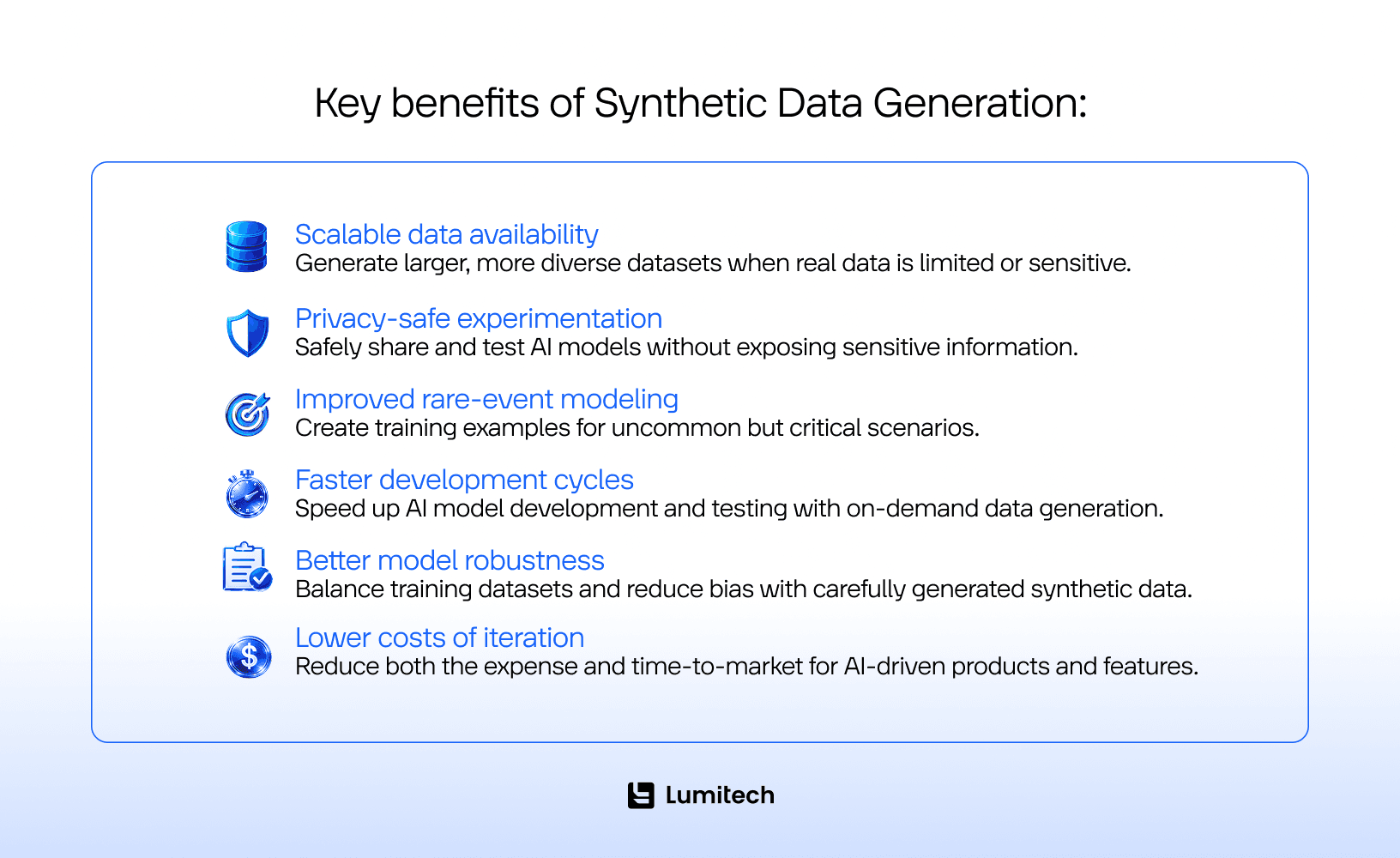
So, here are the key advantages:
1. Scalable data availability
Synthetic data helps teams generate larger and more diverse datasets when real-world data is limited, sparse, or difficult to access.
2. Privacy-safe experimentation
It enables safer model training, testing, and collaboration in environments where using real sensitive data creates legal or operational risk.
3. Improved rare-event modeling
Teams can create additional examples of uncommon but high-impact scenarios, such as fraud attempts, failures, or other edge cases.
4. Faster development cycles
Synthetic datasets enable faster prototyping, QA, staging, and AI experimentation without waiting for production-ready data extracts.
5. Improved model robustness
When used carefully, synthetic augmentation can improve coverage, rebalance skewed datasets, and reduce blind spots in model behavior.
6. Lower cost of iteration
Synthetic data can reduce the time, effort, and expense required to collect, label, and prepare data for new model versions or product experiments.
For teams working with AI, the value of synthetic data is ensuring data is prepared for the purpose: safer data for testing, broader data for training, and more targeted data for rare cases. That is why the strongest benefits usually appear where access, privacy, speed, and coverage are all equally important.
The Challenges and Risks You Can Face
Now the cautionary part. The challenges of synthetic data generation are not theoretical.
IBM warns that synthetic data can still inherit bias from source data, and that generating it can be difficult because teams must preserve realism while protecting privacy. IBM also notes the risk of model collapse when AI models are repeatedly trained on AI-generated data rather than on real data. NIST emphasizes that utility and privacy must both be measured; getting one without the other is not enough.
Key Risks of Synthetic Data Generation
Bias carryover from source data.
False realism: looking plausible without being useful.
Privacy leakage if records are too close to originals.
Model collapse when synthetic-on-synthetic training compounds errors.
Missed correlations in simpler methods.
Governance gaps when teams skip validation and documentation.
Can Synthetic Data Introduce Bias into AI Models?
Yes. If the original data underrepresents certain populations, outcomes, or behaviors, the synthetic dataset can reproduce or even amplify that bias. IBM explicitly recommends blending multiple data sources for mitigating bias in AI and warns that a lack of diversity in source data can lead to inequitable model performance.
That is why bias testing belongs inside the synthetic data generation pipeline, not after deployment.
Tools for Generating Synthetic Data: What Teams Should Look for
There is no one perfect list of synthetic data generation tools, because requirements differ by domain. Still, serious buyers usually compare tools across six criteria:
Capability | Why it matters |
|---|---|
Data-type support | Tabular, text, image, time series, multimodal |
Method flexibility | Statistical, generative, simulation, hybrid |
Privacy controls | Differential privacy, access controls, risk reporting |
Validation | Fidelity, utility, bias, and privacy metrics |
Workflow integration | Pipelines, MLOps, testing environments |
Governance | Versioning, documentation, and audit trails |
Some tools are built primarily for generating synthetic tabular data, while others focus on developer testing, privacy-safe enterprise sharing, prompt-based generation for modern AI workflows, or even help with data migration.
For example, SDV (Synthetic Data Vault) is a well-known open-source ecosystem for tabular synthetic data and supports single-table, relational, and sequential data generation. MOSTLY AI positions its platform and SDK around privacy-safe, enterprise-ready synthetic data creation, including multi-table generation. Tonic.ai focuses strongly on high-fidelity synthetic and de-identified data for software development, testing, and AI workflows. Gretel provides synthetic data generation capabilities through its platform and documentation, supporting both prompt-based and seeded generation workflows.
Your use case can be more domain-specific. Synthea is widely used in healthcare as an open-source synthetic patient generator, while enterprise platforms such as Tonic Fabricate and MOSTLY AI’s SDK are more focused on practical product, QA, and AI-development workflows.
Examples of tools:
SDV (Synthetic Data Vault): open-source library for tabular, relational, and sequential synthetic data creation.
MOSTLY AI: enterprise platform and open-source SDK for privacy-safe synthetic data, including multi-table generation.
Tonic.ai: a synthetic and de-identified data platform for software development, testing, and AI workflows.
Gretel: a synthetic data platform with documentation and workflows for seeded or prompt-based generation.
Synthea: open-source synthetic patient data generator, commonly used in healthcare and health IT testing.
YData Synthetic: a toolkit focused on synthetic data creation and data-centric AI workflows.
Hazy: enterprise synthetic data platform centered on privacy-preserving structured data generation.
Practical recommendation
In most real projects, teams choose tools based on whether the platform can support the full synthetic data lifecycle: generation, validation, governance, and integration into production workflows. That is especially true when synthetic data is used for training or testing artificial intelligence (AI) models, regulated environments, or privacy-sensitive enterprise products.
Where the Market Is Heading
The synthetic data generation market is growing because three enterprise pressures are converging:
privacy regulation,
AI demands more and better data,
and the cost of relying only on real datasets.
IBM’s article citing Gartner’s 2026 forecast captures the momentum, but the more durable shift is structural: teams increasingly need production-safe data access patterns, rather than bigger datasets.
In practice, that means we are likely to see more demand for domain-specific generators, simulation-first pipelines, privacy-measurement tooling, evaluation layers, and hybrid systems that responsibly combine real and synthetic data.
Final Thoughts: Choosing the Right Synthetic Data Generation Method
The most important thing to understand about synthetic data generation is that the methods are not interchangeable. Statistical modeling, generative AI services, and simulation each solve different problems. The right choice depends on the type of data, the cost of error, privacy constraints, and the business outcome.
For teams training or testing artificial intelligence (AI) models, synthetic data can be a major advantage. It can speed experimentation, improve edge-case coverage, unlock privacy-safe development, and support better product delivery. But it only works when the process is disciplined: start with a clear use case, choose the right method, validate rigorously, and treat governance as part of the modern data platform architecture.
That is also the premium view of the topic. Enterprises need trustworthy ways to build and test AI faster, more safely, and with greater operational control.


