
Modern Data Platform Architecture: Streaming, Lakehouse Tables, and Data Products
If your data strategy still revolves around a monolithic, “wait-24-hours-for-the-ETL-to-finish” warehouse, you’re running a museum, not a business. In 2026, data is a high-velocity stream that needs to be captured, refined, and governed in real-time.
- Big Data & Analytics
February 04, 2026
 AI Overview
Modern data platforms have become the foundation for analytics, AI, automation, and data-driven decision-making. Because organizations manage growing volumes of structured and unstructured data, architecture choices directly affect scalability, performance, security, and operational efficiency. A well-designed platform enables teams to integrate data from multiple sources, process it in real time, support advanced analytics, and create a reliable foundation for future innovation while maintaining governance and compliance.


For years, the industry was locked in a civil war: the Data Warehouse (structured, fast, but expensive) vs. the Data Lake (flexible, cheap, but often a disorganized “swamp”). Today, that war has ended in a peace treaty called the Data Lakehouse. This architecture, combined with real-time streaming and robust governance, represents the “Gold Standard” for any enterprise that wants to do more than just report on the past.
This article breaks down the big platform choices and the trade-offs on cost, latency, and governance. We’ll walk through modern data platform reference architecture for streaming and batch processing, ML feature stores, and secure data sharing, and examine migration paths from legacy stacks and the practical ROI levers you can quantify.
How Modern Data Architecture Differs from Traditional One
Traditional data platform architecture was built for a world where:
Most important data lived in relational systems
Business reporting was the primary consumer
Data changed at human speed (daily or weekly)
Storage was expensive, and computing was… also expensive
The “classic” model looked like this:
Operational systems → ETL → central warehouse → BI
It worked until it didn’t. The modern enterprise reality is messier: clickstreams, IoT, unstructured logs, semi-structured JSON, third-party datasets, real-time personalization, and ML training pipelines that want a lot of historical data yesterday.
Modern enterprise data architecture responds with a different set of assumptions:
1) Storage becomes a shared foundation
Object stores (S3/ADLS/GCS) are cheaper and more scalable than trying to cram everything into a single monolithic database. Your warehouse can still exist, but it’s no longer automatically the “one true home” for all data.
2) Compute becomes modular
Instead of relying on a single engine to handle everything, modern platforms run multiple compute engines on shared data: SQL query engines, stream processors, ML training clusters, and specialized services. Tools like Trino are explicitly designed to query large datasets across heterogeneous sources.
3) ELT replaces a lot of ETL
Transformation increasingly happens in the analytical environment (warehouse or lakehouse) with version-controlled SQL pipelines. dbt is a canonical example: it transforms raw data into trusted data products using modular SQL modeling.
4) Streaming is no longer “nice to have”
Real-time isn’t just for trading desks and ad tech anymore. Many domains now benefit from real-time data streaming architecture: fraud, supply chain, dynamic pricing, observability, and customer experience. Apache Kafka positions itself as a distributed event streaming platform for high-performance pipelines and streaming analytics.
5) Governance becomes a scale problem
At a small scale, a Slack message like “don’t use that table” is governance. At enterprise scale, it’s a lawsuit waiting for an intern to make a mistake. Modern data architectures treat governance as a platform feature: catalogs, access controls, lineage, and auditability.
Warehouse vs. Lake vs. Lakehouse: The Trade-off Matrix
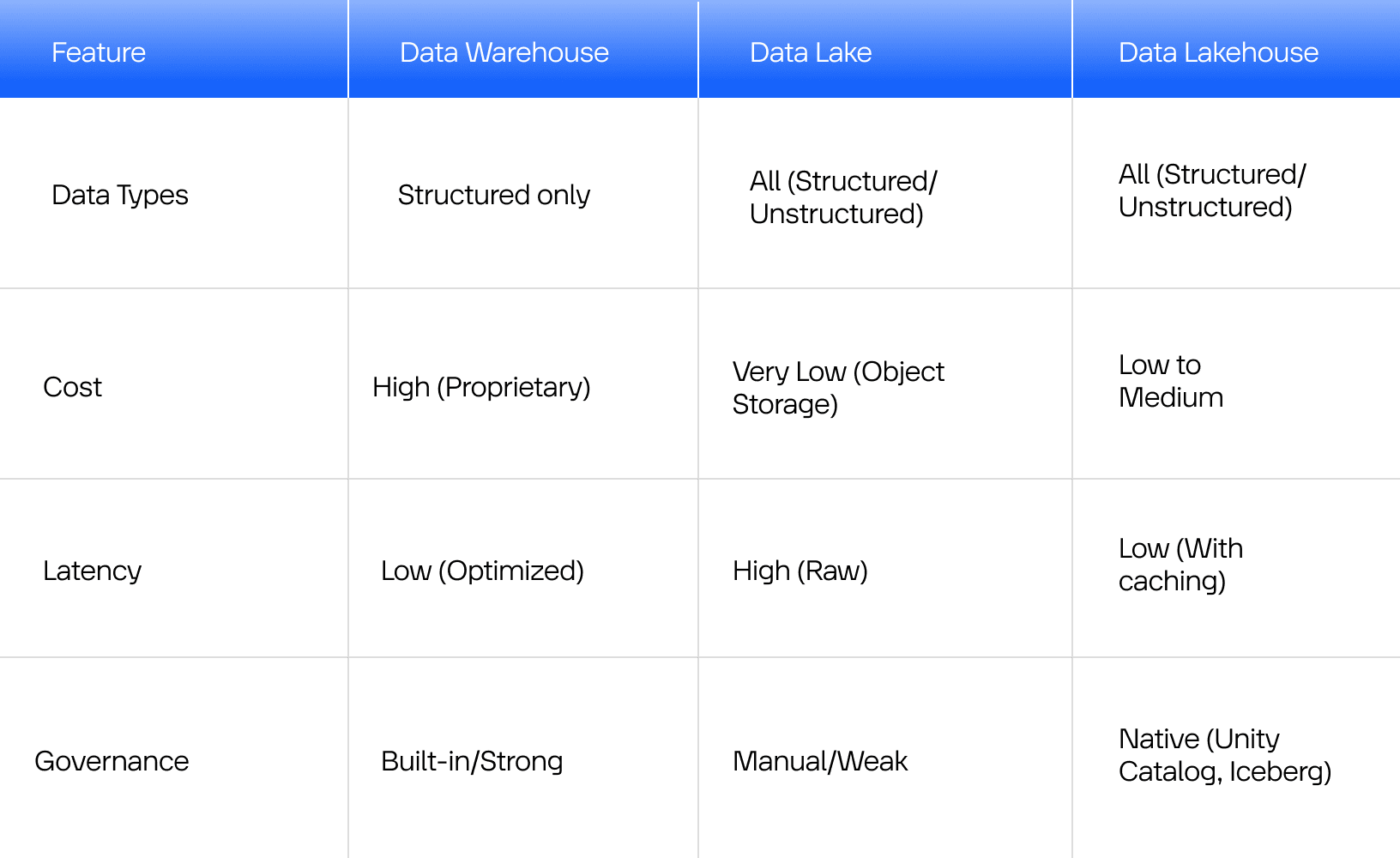
Choosing your foundation is the most expensive decision you’ll make. To make this real, the sections below provide modern data platform architecture examples for streaming + batch, feature stores, and secure data sharing. Let’s break down the contenders.
1. The Data Warehouse (The Polished Library)
Best for: Structured reporting and BI.
Pros: High performance, ACID transactions, easy for SQL users.
Cons: Expensive storage, cannot handle unstructured data (images, voice), often creates data silos.
2. The Data Lake (The Vast Wilderness)
Best for: Data science and massive-scale storage.
Pros: Very low cost (S3/Azure Blob), stores everything in its raw form.
Cons: Poor performance for BI, no data quality guarantees, and without strict management, it becomes a Data Swamp.
3. The Data Lakehouse (The Hybrid Evolution)
The Lakehouse is the architectural "sweet spot." It implements data warehouse-like features (ACID transactions, schema enforcement) directly on top of cheap cloud storage.
Why it wins: It serves as a single source of truth. Data scientists get their raw files, while analysts get their high-performance SQL tables, all from the same storage layer.
A lakehouse is essentially a bet on a unified data platform architecture — one storage layer with multiple engines, instead of copying data into separate systems for BI and ML.
What makes a lakehouse modern data architecture possible: open table formats
The “secret sauce” of modern lakehouses is the table format layer — software that adds database-like behavior to files in object storage.
Apache Iceberg is an open table format that brings SQL-table-like reliability to large analytic datasets and is designed to work with multiple engines (Spark, Trino, Flink, etc.).
Delta Lake is an open-source storage layer that adds ACID transactions and a transaction log over Parquet data files, unifying batch and streaming.
These formats matter because they enable:
schema evolution without chaos,
time travel/versioning,
safe concurrent reads/writes,
metadata handling at scale.
Without table formats, a data lake often becomes “files with vibes.” With them, it becomes a platform.
The Big Trade-Offs of Data Platform Architecture: Cost, Latency, and Governance
A modern data architecture is a three-way negotiation between your CFO, your product team, and your auditors. Cost, latency, and governance are the trade-offs that decide whether your architecture feels like a well-run highway or a permanent construction zone.
Cost
Warehouses often win on developer productivity and consistent performance, but can get expensive when you store massive raw history or run many concurrent workloads.
Lakes win on raw storage cost and flexibility, but can leak cost through duplicated pipelines, inconsistent standards, and operational toil.
Lakehouses can reduce duplication (less “ETL into the lake, then ELT into the warehouse”) and keep more data in open storage, while still enabling BI/SQL performance, if implemented well.
Latency
Warehouses often offer strong interactive SQL latency and governance out of the box.
Lakes can be low-latency for ingestion, but serving low-latency analytics requires careful engineering.
Lakehouses can support both streaming and batch on the same tables (depending on tool choice). Delta Lake explicitly emphasizes unifying streaming and batch processing on data lakes.
Low latency doesn’t come from hype; it comes from streaming data architecture best practices such as state management discipline, handling late-arriving data, and idempotent writes.
Governance
Warehouses are historically strongest on governance and role-based controls.
Lakes require a governance layer: catalog, access policies, lineage, and audit.
Lakehouses succeed or fail based on whether governance is treated as foundational (and not a “phase 2” that never arrives).
Governance isn’t generic everywhere — data governance in banking has extra gravity because access control, lineage, and auditability aren’t “best practices,” they’re survival skills.
How to Design a Modern Data Platform Architecture: Streaming, Batch, and ML
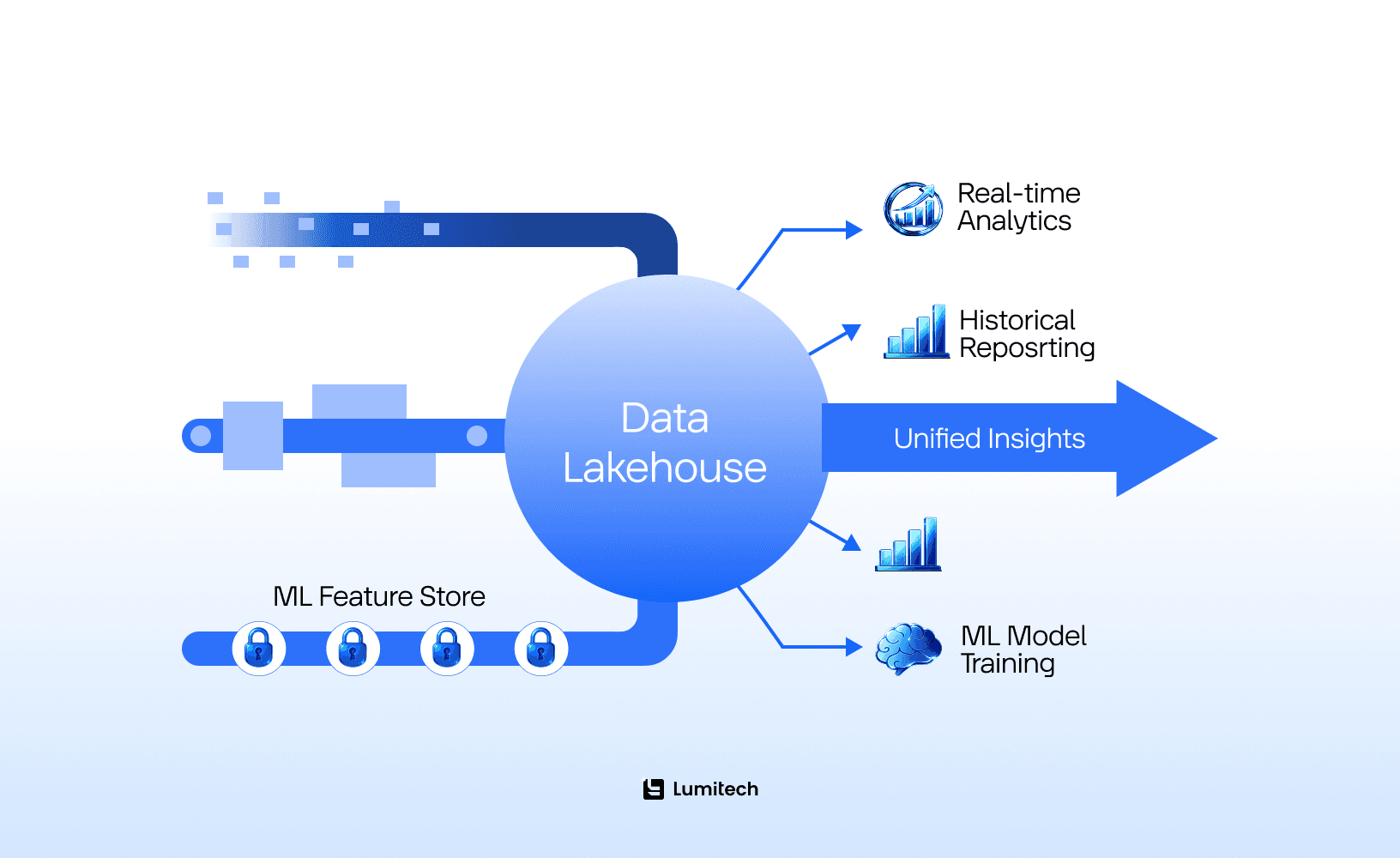
A modern platform isn't just a place to put data; it’s a factory that processes it. Ultimately, how to design a modern data platform architecture comes down to one thing: building a platform that scales across data volume, teams, and compliance without rewriting everything every year.
The Streaming Core (Kappa Architecture)
In 2026, “Batch” is becoming a subset of “Streaming.” Using technologies like Apache Kafka or Redpanda, data is ingested as a continuous stream of events. This allows for:
Real-time Fraud Detection: Analyzing a transaction while it's happening.
Dynamic Pricing: Adjusting ecommerce prices based on live supply and demand.
The ML Feature Store
For companies serious about AI, a Feature Store is the secret sauce. It acts as a centralized repository where data scientists can find pre-computed “features” (e.g., a customer's average spend over 30 days) to feed into ML models. This ensures that the data used to train a model is exactly the same as the data used in production.
If your platform supports ML, you’ll quickly discover it’s not just a tooling problem — it’s a workflow problem that often needs data science services to operationalize features, training pipelines, and monitoring.
Secure Data Sharing
We are moving away from “copying” data. Modern data platform architectures use Zero-Copy Data Sharing (e.g., Snowflake Data Sharing or Delta Sharing). You don't send a CSV file to a partner; you grant them secure, read-only access to your live data table without moving a single byte.
A lot of “data sharing” is really product packaging: an admin platform for restaurant analytics is a clean example of delivering governed insights to many consumers without handing out direct storage access.
Technologies Powering the Modern Data Platform Architecture
A practical modern data infrastructure architecture usually includes object storage, open table formats, at least one batch engine, at least one streaming engine, and a governance layer that’s not optional. Building this requires a “Best of Breed” approach. Here is the 2026 toolkit:
Storage & Format: Apache Iceberg, Delta Lake, or Apache Hudi. These table formats bring reliability to the data lake.
Compute: Spark (Databricks), Trino (for fast SQL queries), and Snowflake.
Streaming: Confluent Kafka, Flink (for real-time transformations).
Governance: Collibra, Alation, or Atlan for cataloging and lineage.
Orchestration: Dagster or Airflow (the “traffic control” of the data world).
Organizational Roles Required to Support Modern Data Architecture
Modern centralized data platforms aren’t just technology projects — they’re operating models. You don’t get data platform scalability without clear ownership: platform engineers for reliability, FinOps for cost control, and governance roles for policy enforcement. The minimum viable cast often includes:
Data platform team (the team building scalable data platforms)
Data platform engineers (infrastructure, storage, compute, security primitives)
SRE/Platform reliability (SLAs, monitoring, incident response)
FinOps/cost management (because “elastic” can also mean “surprise invoice”)
Data engineering + analytics engineering
Data engineers (pipelines, ingestion, performance tuning)
Analytics engineers (dbt models, tests, semantic modeling)
Governance and security
Data governance lead/council (policies, prioritization, exceptions)
Data stewards (definitions, ownership, metadata hygiene)
Security/IAM specialists (policy design, access reviews, audits)
ML platform (if you do ML in production)
ML engineers/ML platform engineers (training pipelines, feature store, serving)
Model risk & validation (in regulated industries)
Rule of thumb: if you want “governance at scale,” you need a real owner. Otherwise, governance becomes a shared responsibility, which is corporate for “nobody does it.” Treating shared datasets like products is much easier when you borrow discipline from multi-tenant SaaS architecture: clear contracts, tenant-aware permissions, and usage monitoring.
Building Scalable Data Platforms: Migration Paths From Legacy Stacks
Most enterprises don’t wake up one day and delete their warehouse. Modernization is incremental, and it should be, because “big bang migration” is a fun phrase until it’s your weekend.
Step 1: Baseline your current pain (with numbers)
Before you pick a shiny architecture, quantify:
total platform spend (licenses + infra + support)
pipeline failure rate and on-call cost
time-to-deliver a new dataset
duplicate datasets and redundant ETL jobs
query latency and concurrency bottlenecks
compliance overhead (access approvals, audit effort).
Step 2: Establish a landing zone (lake or lakehouse)
Most migrations start by landing raw data into low-cost storage, then gradually curating it using table formats and consistent conventions. The lakehouse argument here is reducing duplication and staleness caused by moving data from the lake to the warehouse repeatedly.
Step 3: Move one domain end-to-end (a “lighthouse use case”)
Pick a domain with clear value and measurable outcomes:
customer 360
supply chain visibility
fraud signals
revenue analytics.
Deliver it with the new platform standards and measure the delta.
Step 4: Industrialize governance and operations
This is the unglamorous core of building scalable data platforms: paved roads, templates, and guardrails that stop every team from inventing its own universe. You need to build:
standard ingestion templates
standardized table formats
lineage and catalog integration
automated data quality checks
access policies as code.
“Paved roads” should include documentation templates, not just pipelines—shipping a consistent portal via a multi-tenant CMS makes every new data product easier to discover and safer to reuse.
Step 5: Migrate workloads by value and risk
Not everything needs to move. Some workloads stay in the warehouse (especially if they’re stable and well-served), while others shift to lakehouse tables and modern engines. For operations-heavy businesses, industrial software solutions often become the clearest lighthouse use case, because streaming telemetry + governed history unlocks quality, maintenance, and throughput wins.
Need a migration plan that won’t become a two-year science project? We’ll help you pick a lighthouse and ship it.

Quantified ROI levers (practical, not mythical)
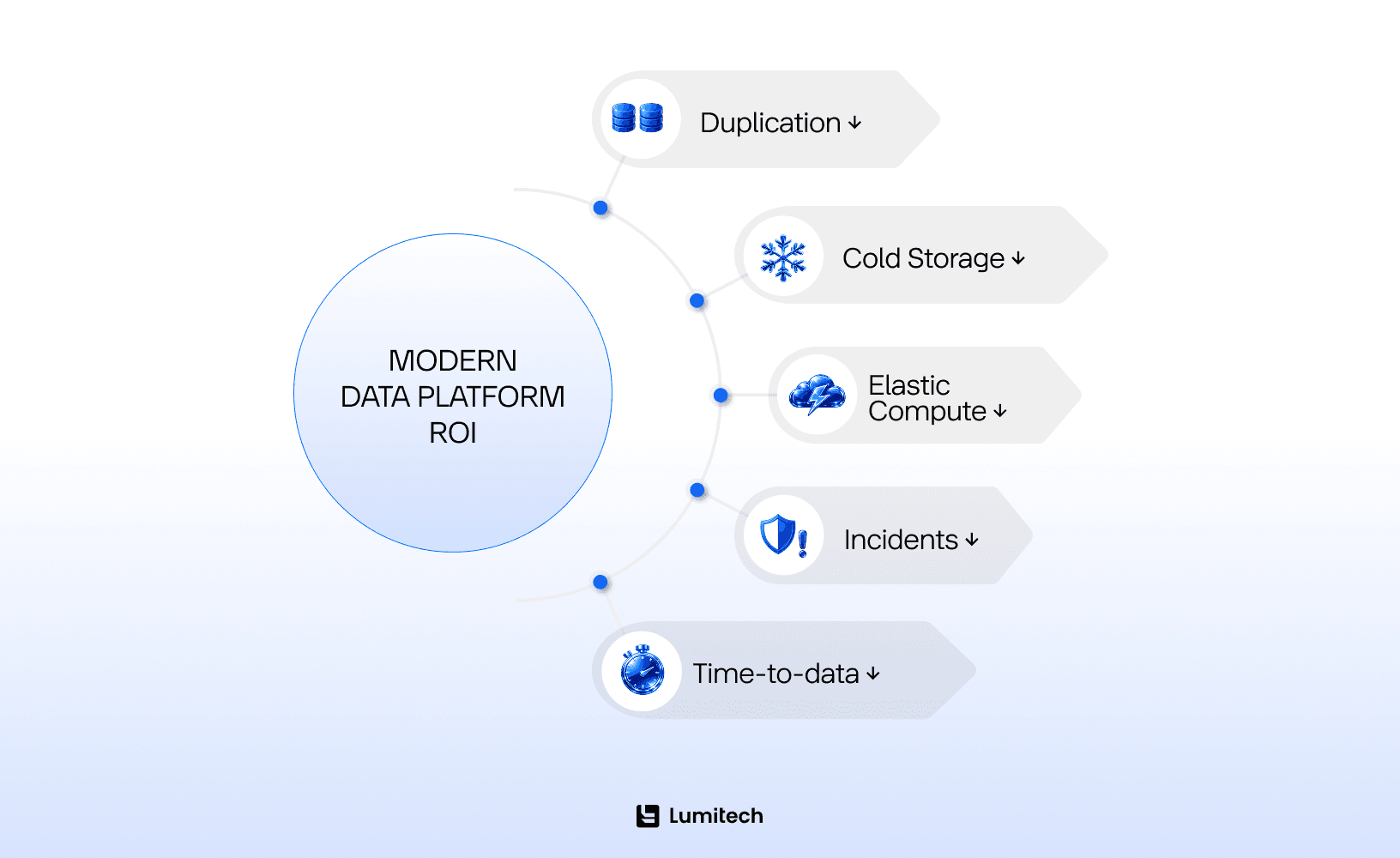
You can usually estimate ROI from modernization using a handful of levers. A few examples:
Lever A: Reduce data duplication and ETL complexity
If you currently do “ETL into lake → ELT into warehouse,” you’re paying for:
duplicated storage
duplicated compute
duplicated logic
duplicated failures.
Lakehouse patterns aim to reduce that two-tier friction. How to quantify: count the number of replicated datasets and the compute hours for replication pipelines; estimate savings from consolidation.
Lever B: Shift cold data to cheap storage
Object storage is typically far cheaper than warehouse storage for long retention. How to quantify: TBs of cold/rarely queried data × (warehouse storage $/TB - object storage $/TB). Use your vendor pricing and actual retention needs.
Lever C: Elastic compute and workload isolation
With decoupled compute, you can:
scale up for peak loads
scale down off-hours
isolate workloads (BI vs ingestion vs ML) to reduce contention.
How to quantify: compare baseline “always-on” cluster costs vs scheduled/auto-scaled compute usage.
Lever D: Faster time-to-data = faster business decisions
This is the lever executives love, and the one engineers hate measuring. Still, you can approximate:
reduced time to launch experiments
faster reporting cycles
fewer manual reconciliations.
How to quantify: time saved per analyst/engineer × loaded labor cost × frequency.
Lever E: Fewer incidents and less “data downtime”
Better orchestration (Airflow/Dagster) and lineage signals (OpenLineage) reduce firefighting and speed root-cause analysis. How to quantify: incidents/month × average hours to resolve × labor cost + opportunity cost (missed decisions, delayed releases).
A realistic ROI model includes 2–3 levers you can measure confidently, and 1–2 “soft” benefits you track over time.
Some of the easiest ROI to quantify comes from operational cycle time — tools like a turnaround tracker for industrial sector turn raw events into measurable bottlenecks, not just dashboards.
Modern Enterprise Data Architecture: Decision Checklist
If you’re choosing between lake, warehouse, and lakehouse, ask:
Do we need open storage + multi-engine compute (Spark/Flink/Trino) for flexibility?
Do we need BI-first simplicity and mature governance controls today?
Do we have strong needs for streaming + batch convergence on the same tables?
Are we building ML systems that require a feature store pattern?
Do we plan to share data externally without making copies?
Do we have the org roles to run this, or are we hoping the platform will “govern itself” (it won’t)?
Conclusion
Modern data platform architecture isn’t a religious war between lake, warehouse, and lakehouse — it’s a design exercise in trade-offs. Warehouses still shine when you need fast, governed BI with predictable performance. Lakes still win when you need cheap, flexible storage for raw and diverse data. Lakehouses are attractive when you want open storage plus warehouse-like reliability, and you’re willing to invest in table formats, metadata, and operational discipline to make it real — not just aspirational.
The biggest shift is that streaming and governance are no longer optional side quests. Streaming turns data into a living system — events flowing continuously through Kafka-style backbones and processed by engines like Flink or Spark Structured Streaming. Governance turns that living system into something safe and scalable—catalogs, lineage, access policies, and quality signals that make sure the platform can grow without turning into a high-performance rumor factory.
If you’re migrating from a legacy stack, the winning path is rarely a big-bang rewrite. Start by quantifying your current pain, land data into a modern foundation, deliver one lighthouse domain end-to-end, and then industrialize the “paved roads” that make everything repeatable: table formats, orchestration, testing, lineage, and policy-as-code. Tools matter—but operating model matters more. A modern platform is ultimately a promise to the business: faster access to trustworthy data, with costs and risk you can actually control.


