






About the Project
The client is a fintech startup based in Panama that is building an investment intelligence platform for individual and institutional investors. Their core idea was technically demanding: aggregate portfolio data from multiple brokerage accounts and add an AI layer that explains market events, surfaces hidden risks, and helps users make more informed investment decisions.
The founding team brought a strong technical background to the table. Architecture discussions focused on vector database trade-offs, embedding strategies, and LLM orchestration patterns. This created the conditions for deep technical collaboration, in which Lumitech contributed at the level of architectural and engineering decisions.
The product targets investors who are tired of switching between four brokerage apps, manually reconciling positions, and then still not understanding why their portfolio moved the way it did on a given day.
Client Request
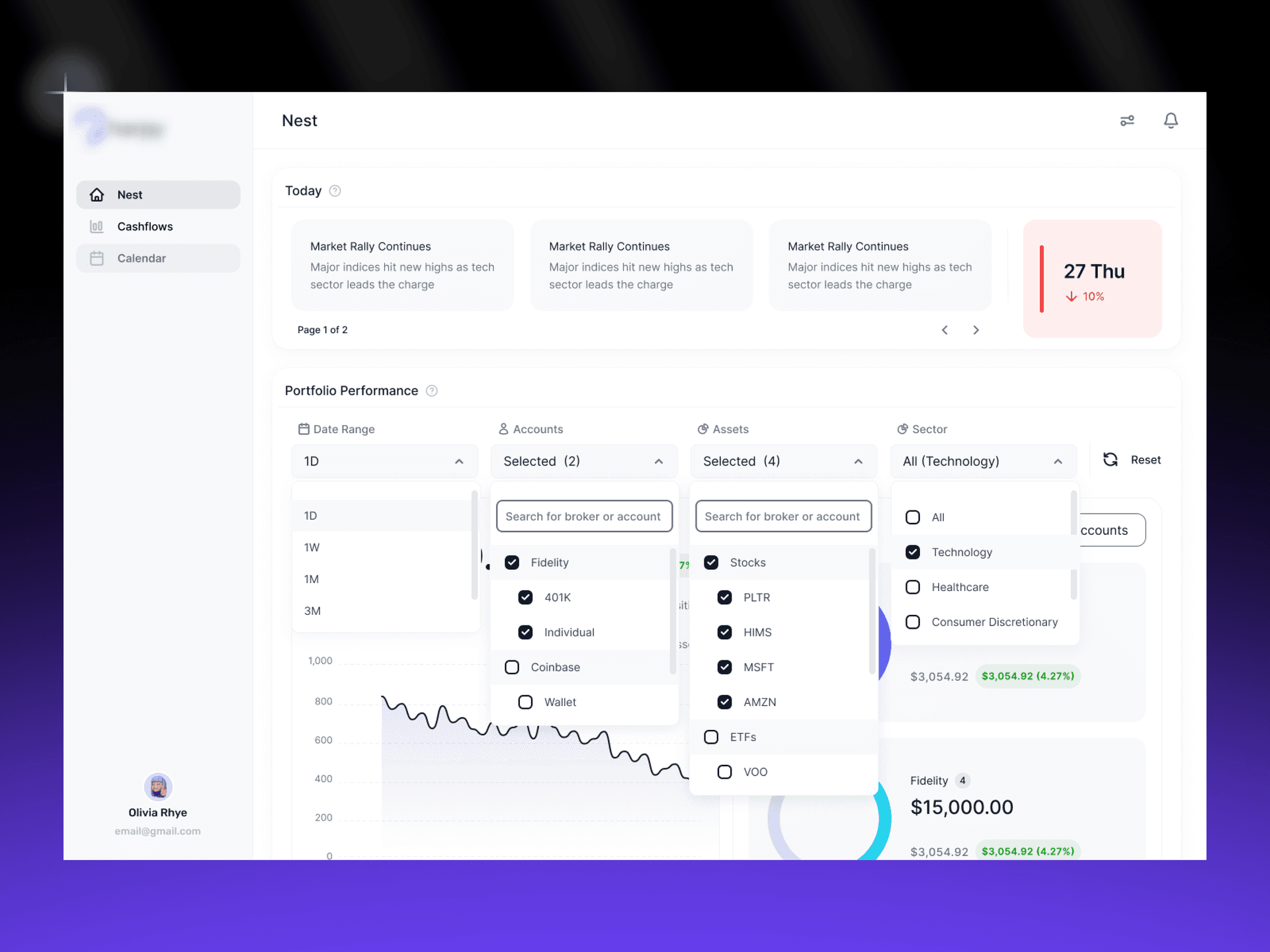
The client wanted to move beyond standard portfolio dashboards. The core request: aggregate multi-broker investment data into a single platform and build an AI layer based on the RAG architecture that explains market events, surfaces hidden risks, and connects financial news to a user's actual holdings.
Interesting Facts
According to the Investment Trends 2024 US Active Trader Report, 70% of active traders called for improvements to their broker's research and trading ideas — the exact gap this platform addresses.
Our client’s team includes FAANG alumni — former engineers and leaders from the world’s most competitive tech companies (Facebook, Apple, Amazon, Netflix, Google). They know exactly what great looks like. And they chose us anyway.
Qdrant won on metadata filtering. It was selected for its ability to filter by metadata at query time, without post-retrieval filtering. In financial contexts, a highly similar but outdated chunk is worse than a less precise but current one.
Fixed-size chunking failed immediately. Early tests split earnings call discussions mid-sentence, breaking financial reasoning. Structure-aware chunking which are respecting paragraph and section boundaries fixed this.
Redis handled both caching and LLM cost control. After major market events, users tend to ask structurally similar questions about the same assets. Response-level caching reduced LLM API costs without affecting UX.
The RAG pipeline was modular by design. New document types, such as SEC filings, macro reports, and alternative data, can be plugged in via a new parser module without touching the embedding, indexing, or retrieval layers.
A technical client team compressed decision-making. With three engineering-level stakeholders on the client side, architectural decisions were resolved in real time, a key factor in this MVP shipping in six months.
The Challenge
Most investment platforms solve a data problem. They pull in account balances, show performance graphs, and display allocation breakdowns. Our client had a different ambition: to solve the problem of understanding.
From the product side, the key gaps were clear:
Investors managing accounts across multiple brokers had no unified view of their total exposure.
Standard portfolio analytics tools showed distributions and returns but offered no causal explanation.
Market events such as earnings releases, macro news, and sector rotations were happening in parallel to portfolio data, with no connection between the two.
Risk concentration was often invisible: a user could be heavily exposed to a single sector across three different instruments without realizing it.
The technical challenge behind solving these gaps was significant. To explain why a portfolio moved, the system needs to do several things simultaneously: pull real-time and historical position data, retrieve relevant financial news and company documents, understand the semantic relationship between a user’s specific holdings and market events, and generate a coherent, grounded explanation — all without hallucinating facts.
Standard LLM integrations fail at this. A model trained on public data does not know what the user holds, does not have access to yesterday’s earnings call transcript, and has no way to connect a Fed rate decision to a specific bond position in a specific account. The architecture had to be built from the ground up to handle this.
Additional technical constraints shaped key decisions:
Market data is time-sensitive: stale data in financial analysis creates real risk.
Financial documents (earnings transcripts, 10-Ks, analyst reports) are long and dense, requiring intelligent chunking rather than naive full-document processing.
Query latency matters. An investor asking “Why did my portfolio drop today?” expects an answer in seconds.
The system needed to scale as the number of connected accounts and watched assets grew over time.
Our Approach
Lumitech served as the primary technology partner on the project. The team included three software engineers and one business analyst working alongside three technical stakeholders from the client side.
The architecture was designed around three distinct layers that had to work in tight coordination:
Data Foundation
The first decision was to clearly separate concerns: financial position data and financial knowledge data require different storage strategies.
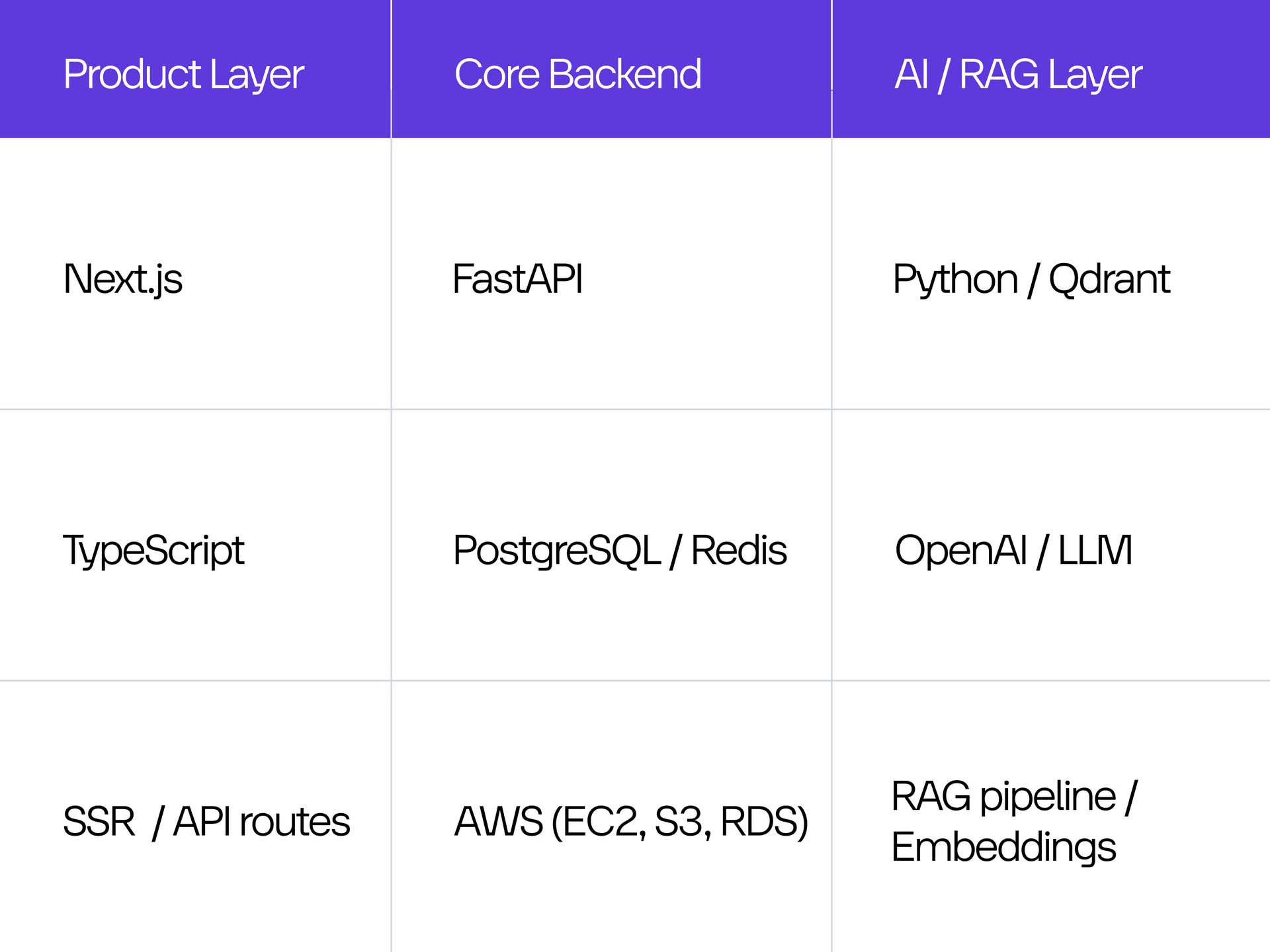
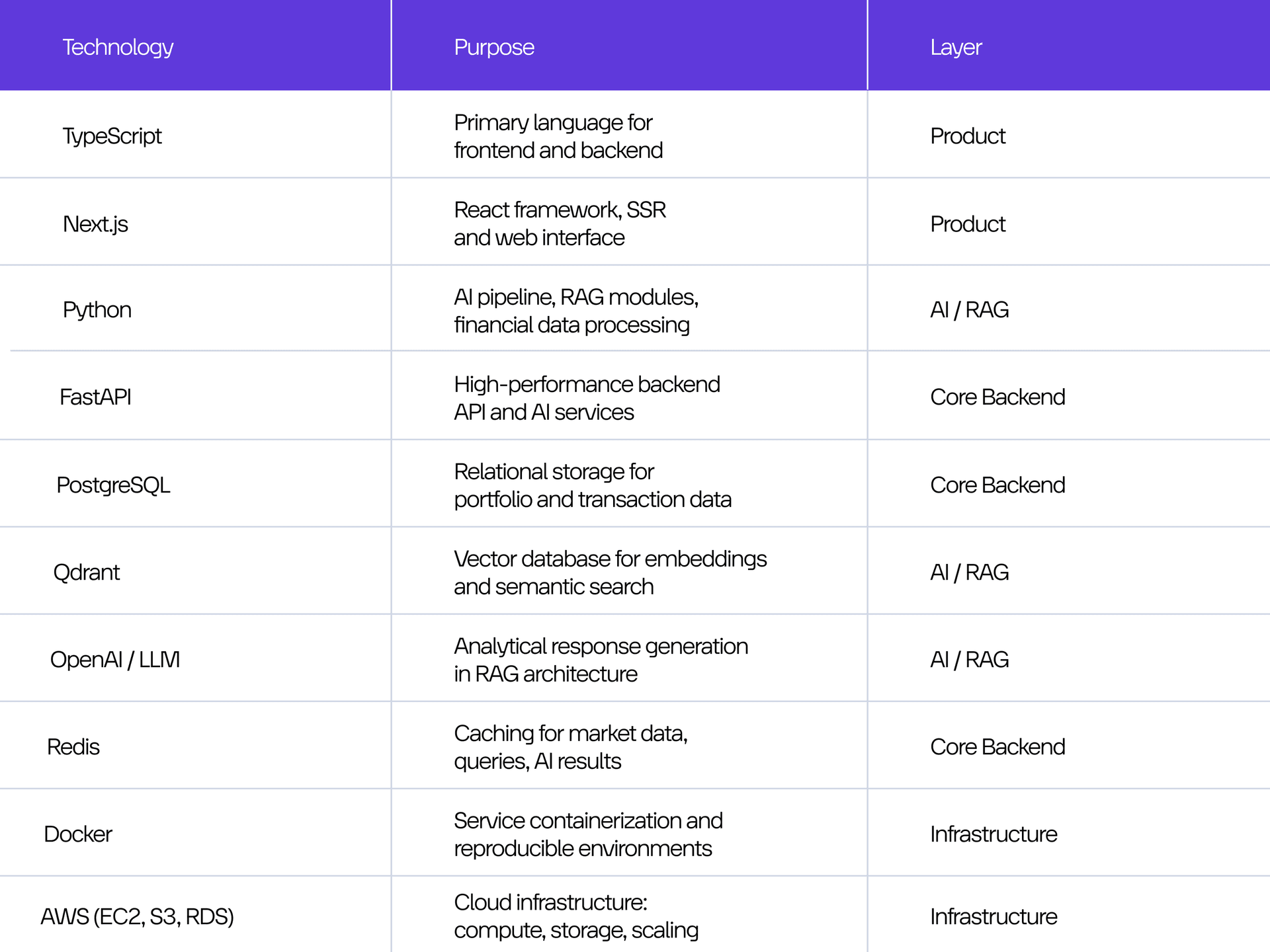
Portfolio data, such as positions, transactions, and account balances, flows from brokerage APIs into PostgreSQL. Redis sits in front of frequently accessed data, such as market prices, session context, and cached AI responses. This keeps the product layer fast without overloading the database or AI pipeline on every request.
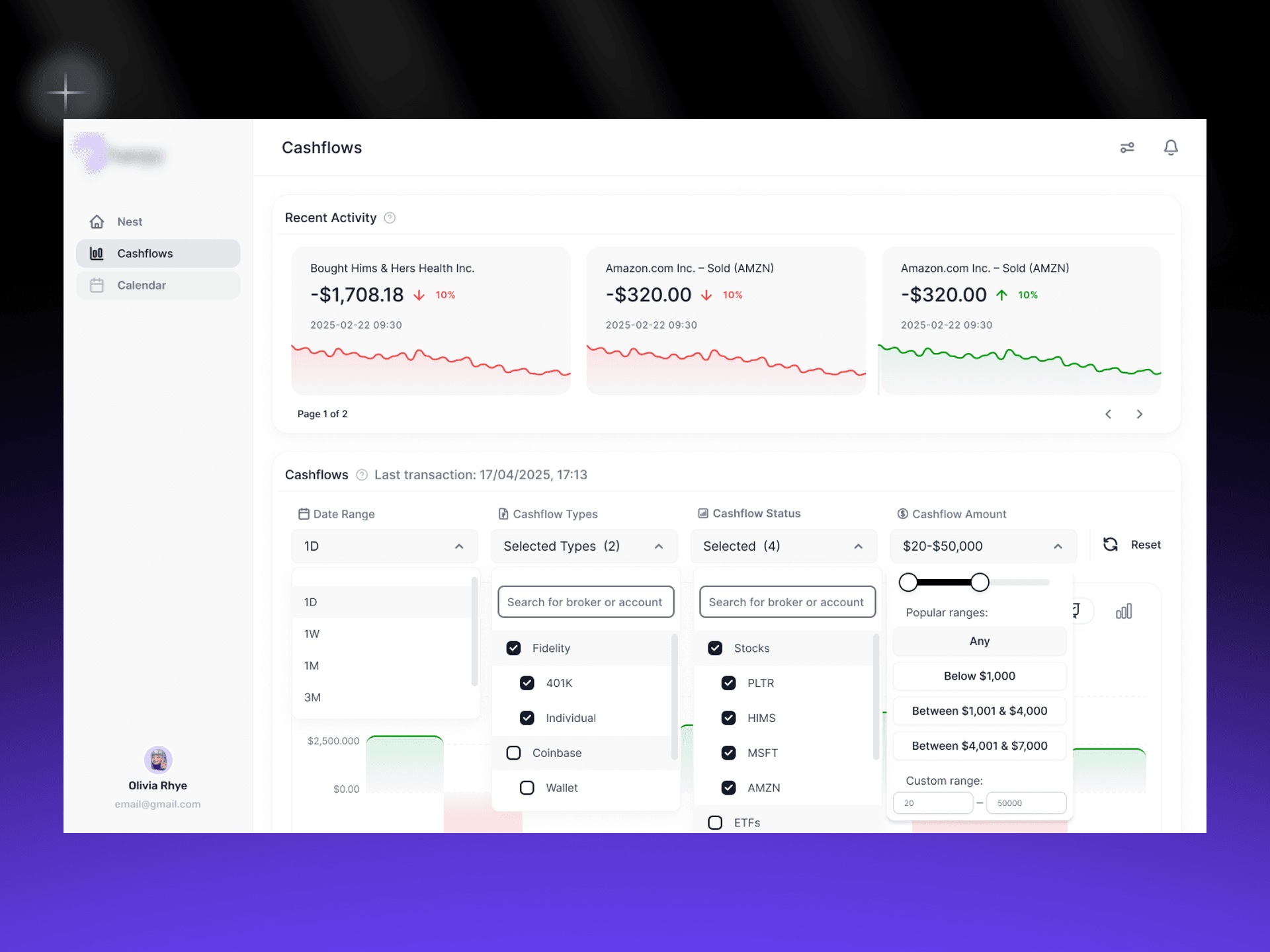
Knowledge data, such as news, earnings transcripts, and company filings, takes a different path through a dedicated processing pipeline before it becomes useful for retrieval.
Building the RAG Pipeline
Financial documents entering the system go through four steps: parsing, semantic chunking, embedding generation, and indexing into Qdrant with metadata (ticker, document type, publication date).
When a user submits a query, the RAG engine:
Analyzes and expands the query to capture financial intent: “why did NVDA drop” maps to earnings miss, guidance revision, and sector sentiment.
Retrieves relevant chunks from Qdrant, filtered by the user’s specific holdings.
Combines retrieved context with portfolio data from PostgreSQL.
Passes this to the LLM with a prompt that grounds the response in real sources.
Returns the answer with source attribution so users can verify what informed it.
If a relevant document is in the knowledge base, the answer cites it. If not, the system says so. It never fabricates.
Product and API Layer
Next.js and TypeScript cover the frontend and server-side rendering. A unified TypeScript stack reduced context-switching across frontend and API boundaries.
FastAPI handles backend and AI service endpoints. Its async-native architecture suits a system where broker API calls, vector searches, and LLM completions all benefit from concurrent execution.
Infrastructure runs on AWS (EC2, S3, RDS) with Docker, ensuring environment consistency.
Core Features
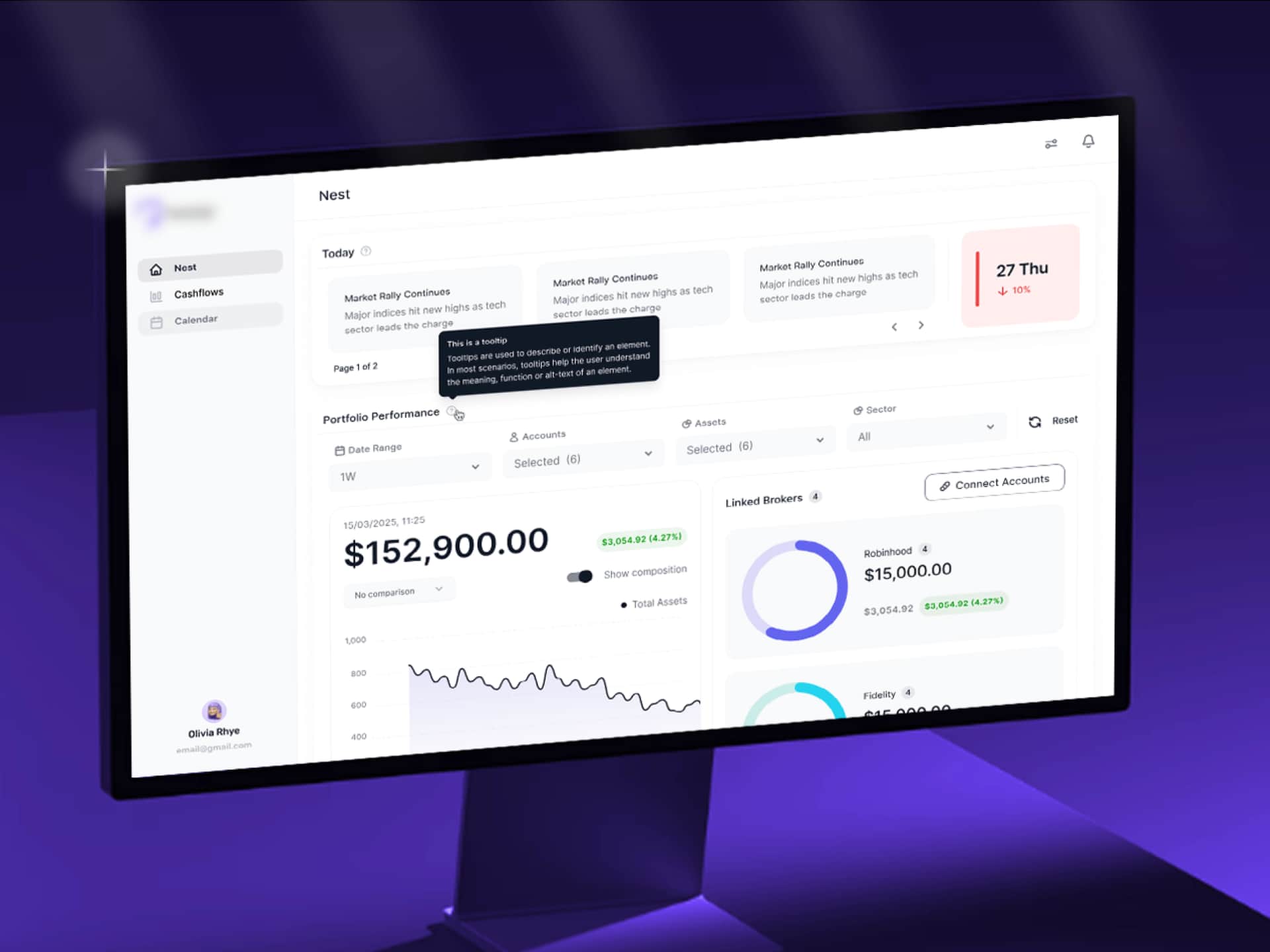
Unified Portfolio Dashboard
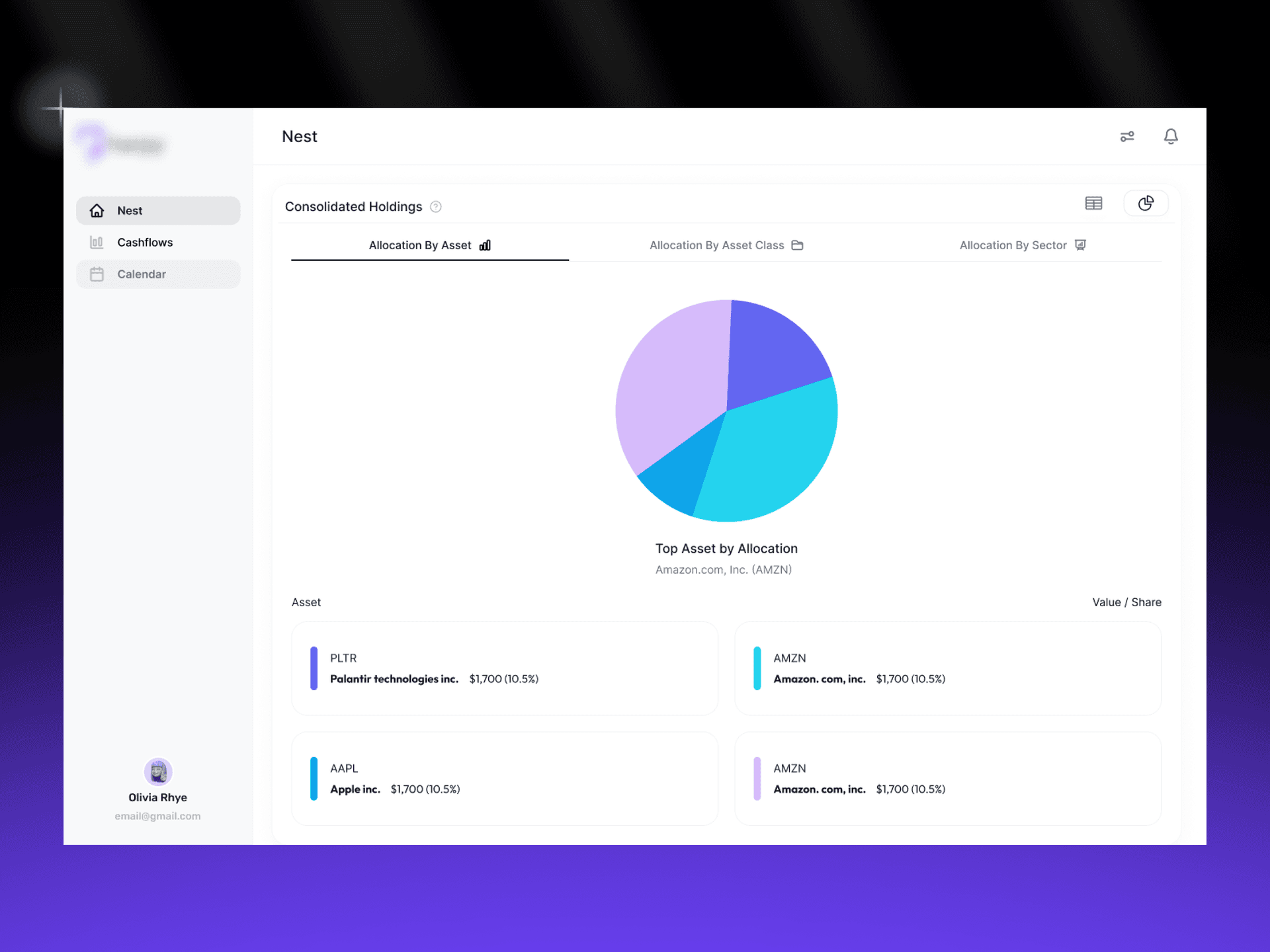
The dashboard aggregates investment data across all connected brokerage accounts into a single view. Users see the total portfolio value, asset-level performance, asset-class allocation, and sector exposure — all reconciled in real time.
The aggregation layer handles differences in data formats across brokers, normalizes position data, and dynamically updates as market prices change.
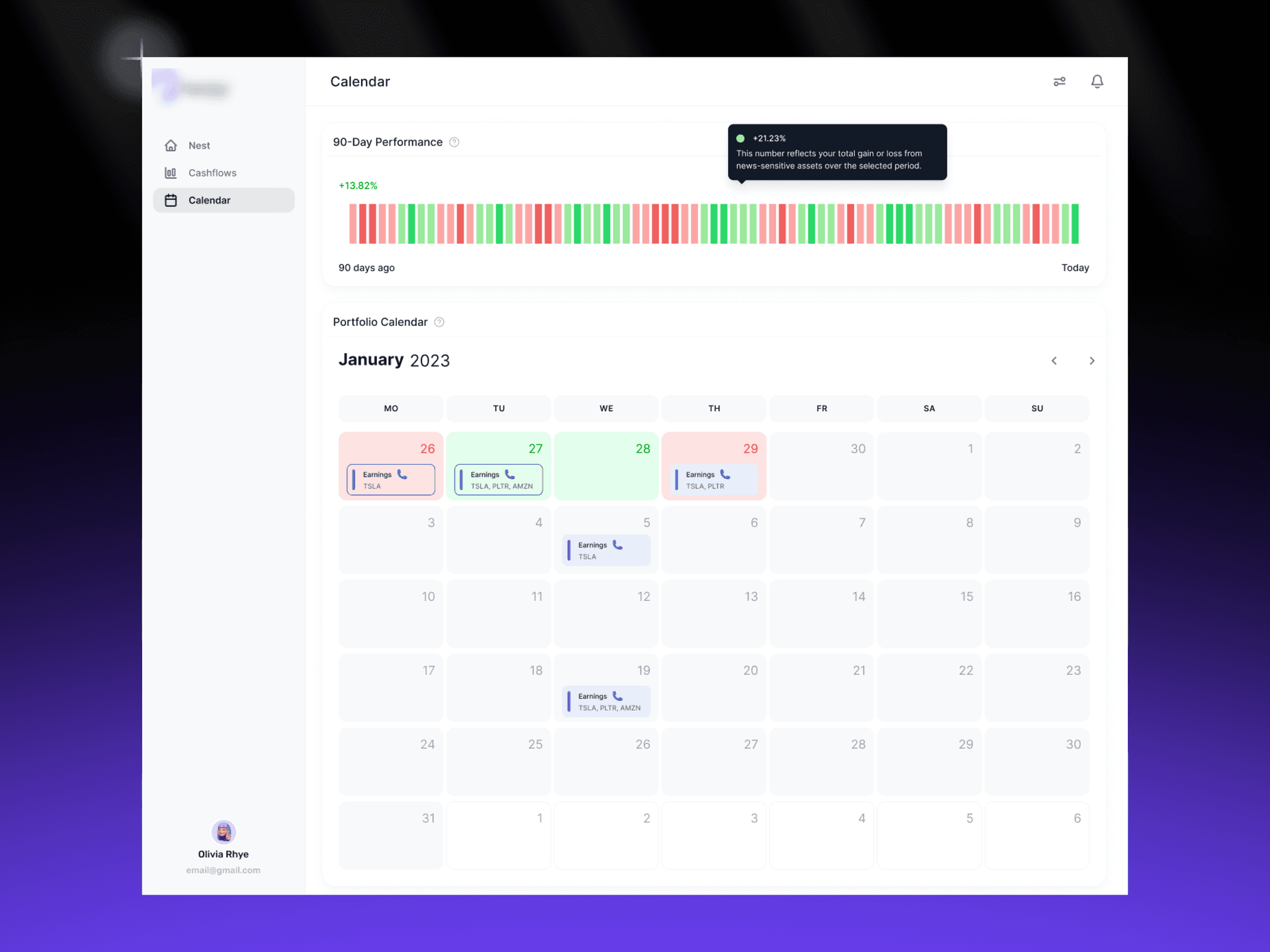
Portfolio Analytics
The analytics engine goes beyond simple allocation charts. It surfaces:
Concentration risk: cases where a user has significant exposure to a single sector, geography, or underlying factor spread across multiple instruments.
Contribution analysis: which specific positions drove the portfolio’s performance over a given period and by how much.
Cross-account correlation: identifying hidden overlaps between holdings across different brokers.
This gives investors a structural understanding of their portfolio.
AI Investment Insights
This is where the RAG pipeline surfaces in the user interface. Users can ask natural language questions about their portfolio, specific holdings, or market events. The AI module retrieves relevant context from the knowledge base, such as news, earnings reports, or analyst commentary, and generates explanations grounded in real sources.
Examples of the queries that the system handles:
Why did a specific position move on a given day?
What are the current risk factors for a held asset?
How is a macro event likely to affect a particular sector allocation?
What is the most recent analyst sentiment on a watched company?
Responses include source references, and the model is instructed to generate explanations and analysis based on available information.
Company Intelligence Cards
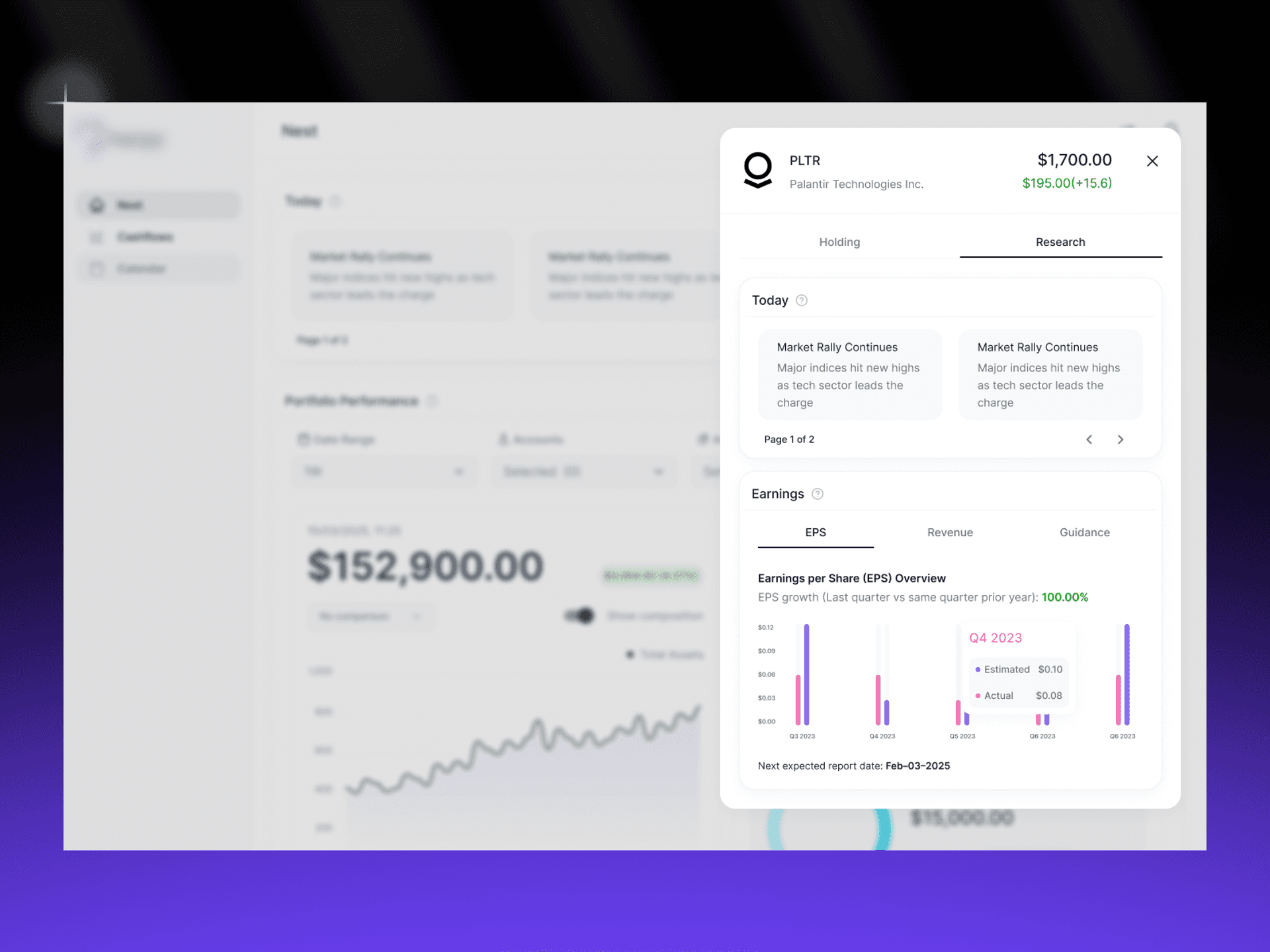
Each asset in the portfolio has a dedicated intelligence view. This includes performance history, exposure analysis, a timeline of market-relevant events, and an AI-generated summary that synthesizes recent news and filings into a plain-language overview. The context for these summaries is dynamically rebuilt from the knowledge base, so it stays current as new documents are indexed.
AI Chat Assistant (in development)
The next stage of the platform replaces the structured query interface with a conversational assistant.
This assistant uses the same data foundation such as brokerage-aggregated positions, vector-indexed knowledge base, and real-time market data, but exposes it through a chat interface where users can ask follow-up questions, request comparisons, and explore their portfolio through dialogue.
The architecture was designed with this expansion in mind from the start, so the underlying pipeline required no structural changes to support it.
Technology Stack
Results We Delivered
The MVP was completed in approximately six months, from initial development in August through platform delivery in February. For a system of this architectural complexity, including multi-source data aggregation, a production RAG pipeline, real-time market data integration, and an AI explanation layer, that timeline reflects both the clarity of the technical direction and the efficiency of close collaboration with a technically fluent client team.
The delivered platform provides investors with something that did not previously exist in a single product: a unified view of their portfolio, combined with an AI layer that explains market context in relation to their specific holdings.
Key outcomes at MVP stage:
Unified cross-broker portfolio view with real-time data reconciliation.
AI-driven explanations for market events grounded in retrieved financial documents.
Concentration and contribution analytics surfacing risks invisible in standard dashboards.
A modular RAG pipeline ready to support the conversational assistant in the next phase.
"From a technical standpoint, this project demonstrates a pattern increasingly relevant across fintech: RAG-based AI is an architectural decision that shapes how data is stored, processed, and retrieved from the ground up." — Denis Salatin, Founder and CEO at Lumitech
The platform is now moving into its next development phase with the conversational assistant, expanding from a passive analytics tool into an interactive investment intelligence system.


