Enterprise Software Trends in MENA Region: What Is Actually Driving Growth in 2026
Talk to CIOs and founders across the region and you hear the same story: MENA is no longer a “promising future market.” It is already where large enterprises run multi-year transformations, budgets are serious, and pressure to prove impact is real.
- For New Clients
April 03, 2026
 AI Overview
Enterprise software in MENA is shifting from basic digitization toward AI-driven, infrastructure-dependent systems, since board-approved transformation programs now demand measurable ROI rather than pilots. Key drivers include integrated CRM/ERP platforms, AI and connected-device investment, and infrastructure-grade software adoption. MENA enterprises allocate 9.8% of revenue to digital transformation, expecting payback in about 4.7 years on average.


A GSMA report that covered more than 850 enterprises in eight MENA countries found that, between 2025 and 2030, companies plan to invest on average 9.8% of revenue into digital transformation — with GCC firms slightly higher at 9.9%. Saudi Arabia, Qatar, and the UAE now sit among the top seven countries worldwide by transformation spend, which is not what many people outside the region expect.
This is not “playing with pilots”. The same GSMA research shows enterprises expect a payback on their digital investments in about 4.7 years on average — and just 3.3 years in Saudi Arabia. So yes, budgets are growing, but they are also very ROI‑driven.
Underneath those numbers, the real shift is simple: the region is moving from basic digitization to AI‑driven, infrastructure‑dependent systems. To understand where enterprise software trends in MENA region are actually going, we need to start with the structure of the market.
Enterprise Software Market MENA: Scale, Growth, and Investment Drivers
Estimates differ depending on what exactly is counted, but they all point in one direction — strong, structured growth.
Future Market Insights places the MEA enterprise software market at USD 9.1 billion in 2026, with a projection to reach USD 15.8 billion by 2036 at a 5.7% CAGR. Grand View Research, looking at a slightly different basket, expects the market to climb from around USD 10.5 billion in the mid‑2020s to roughly USD 21.4 billion by 2030, at a 13.2% CAGR, with CRM and ERP as main drivers.
Enterprise Software Market MENA — Size, Growth, and Spending Patterns
On the spending side, GSMA’s work is useful because it ties software back to revenue and outcomes:
9.8% of revenue allocated to digital transformation trends in MENA enterprises, 9.9% in the GCC.
AI, mobile, and connected devices capturing almost 45% of that transformation spend.
Average payback period of 4.7 years, with Saudi enterprises expecting around 3.3 years.
Gartner adds a wider IT context: MENA IT spending is forecast to reach USD 169 billion in 2026, up 8.9% from 2025, with software as one of the fastest‑growing categories because CIOs are prioritizing AI‑enabled applications.
You can read these numbers in many ways, but one takeaway is hard to ignore. The enterprise software market MENA is not powered by experimentation anymore. It is powered by structured, board‑approved programmes with clear expectations about how quickly they should pay back.
Still, market size alone does not tell us much about how enterprise software is changing in MENA. For that, we need to look at behavior.
How Enterprise Software Is Changing in MENA
Five or six years ago, many projects in the region were still about “getting off paper” — putting services online, automating a specific workflow, and adding a first CRM. That phase is not fully over, but it is no longer the main story.
The shift we see with clients and in the data is:
from isolated tools to integrated, AI‑aware systems;
from single “IT projects” to software being treated as part of critical infrastructure.
It is visible in how budgets are allocated. Future Market Insights notes that ERP software accounts for about 24% of MEA enterprise software spend, and CRM roughly 30.25% — the largest and fastest‑growing segment. Large enterprises take about 62% of the market, which makes sense if you think about who can fund multi‑year migrations and handle strict compliance.
At the same time, AI is no longer just a lab topic. GSMA reports that 39% of MENA enterprises already use generative AI at an advanced level, and 82% of business leaders say AI is actively shaping their growth. Around 65% of CEOs admit they are pushing AI adoption at a pace that feels uncomfortable internally; in Saudi Arabia, that number jumps to 76%.
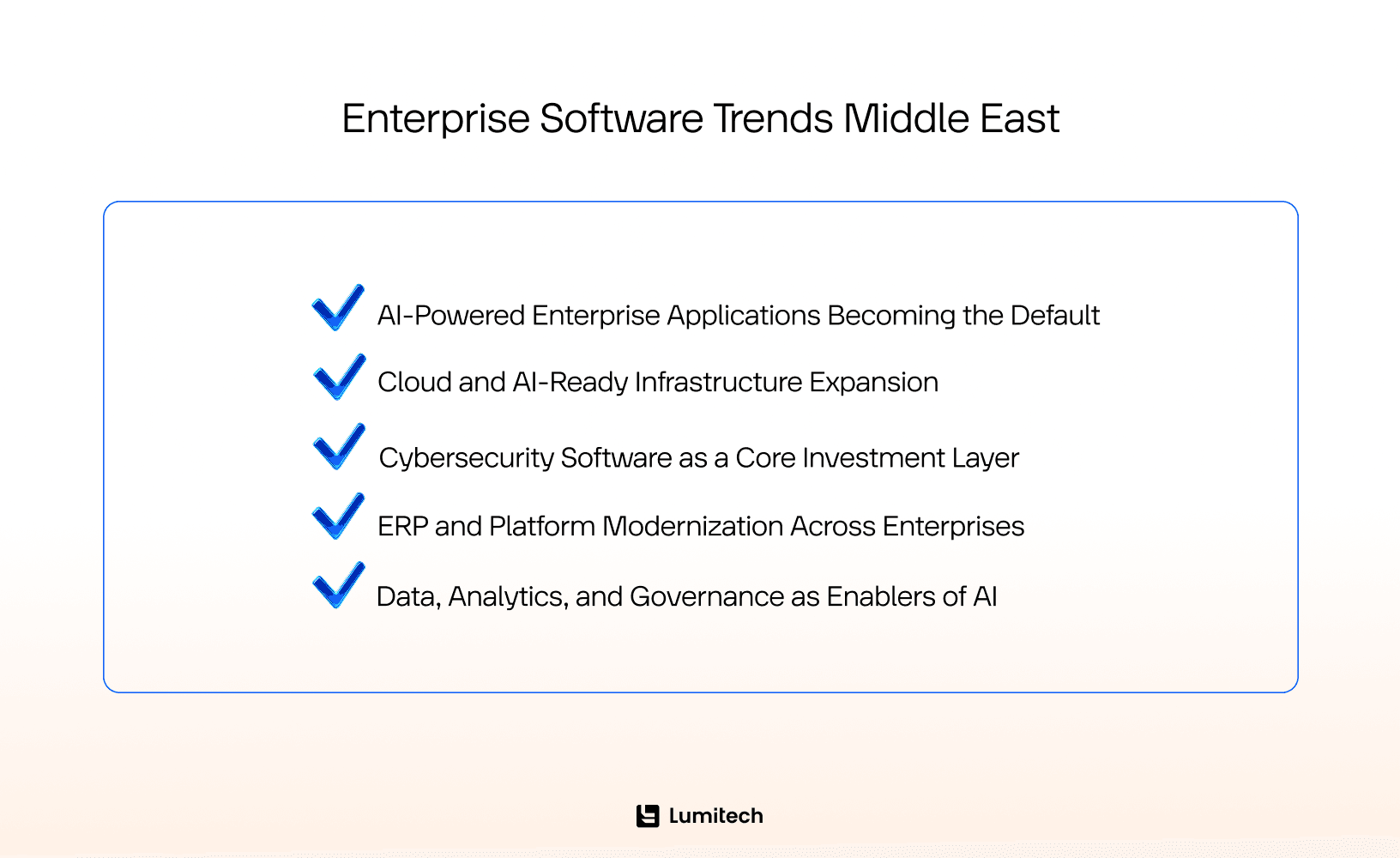
So when we talk about enterprise software trends in MENA, we are really talking about five intertwined movements:
AI‑powered applications becoming standard.
Cloud and infrastructure being rebuilt for AI.
Security sitting inside the architecture, not next to it.
ERP and core platforms going through real modernization.
Data, analytics, and governance are catching up so AI has something to stand on.
Let’s unpack these, because this is where the real Middle East enterprise software trends show up.
Key Enterprise Software Trends in the Middle East
Below are the key enterprise software trends in MENA for 2026.
AI-Powered Enterprise Applications Becoming the Default
AI is the most visible trend — but also the easiest to misread. It is not just about adding a chatbot somewhere in the flow.
The GSMA / e& / IBM report shows:
39% of surveyed MENA enterprises already use GenAI at an “advanced” level.
82% of leaders say AI is already shaping their growth story.
AI, connectivity, and devices combined will make up around 45% of transformation spending through 2030.
Gartner, looking at the global picture, expects that by the end of 2026, around 40% of enterprise applications will include task‑specific AI agents — up from less than 5% in 2025. It is reasonable to assume that AI‑capable apps will also dominate MENA IT trends 2026, simply because national strategies are pushing in that direction.
In practice, this means:
service desks that triage and resolve a good chunk of cases with AI;
document workflows in legal, lending, and compliance that rely on AI rather than manual review;
planning and risk modules that use predictive models instead of fixed rules.
So, AI is not a “feature” sitting next to the system. It is slowly becoming the logic inside the system. That is the first layer of enterprise technology trends in MENA.
Cloud and AI-Ready Infrastructure Expansion
AI has a physical footprint — it needs compute, storage, and network capacity. That is why the cloud and infrastructure are moving fast.
Several sources point in the same direction:
the Middle East cloud market is expected to reach roughly USD 10 billion as more than 60% of businesses commit to cloud adoption in the short term;
one survey shows 85% of companies in the region already on their cloud journey and 76% planning to increase cloud budgets;
CEOs report a 21% year‑on‑year increase in hybrid‑cloud spend to support future workloads, especially AI.
At the same time, MENA has its own specifics. Government policies in Saudi Arabia, the UAE, and other GCC countries emphasize “cloud‑first” but also insist on local data residency, especially for public sector and regulated industries. This is creating a strong pull toward sovereign cloud adoption GCC and in‑country hyperscale regions.
For software buyers, questions like how data residency affects enterprise software in MENA have become practical everyday issues, not abstract legal topics. If you are in BFSI or government, you need to know exactly where your ERP runs, where your AI models are hosted, and how cross‑border access is controlled.
For vendors and internal teams, it means enterprise IT trends MENA are 50% software and 50% infrastructure choices. You cannot promise an AI‑heavy SaaS without having a clear answer on how it will run under local rules.
Cybersecurity Software as a Core Investment Layer
Security has always mattered, but in this region it is increasingly one of the most predictable software line items.
Gartner notes that information security spending in MENA is on track to reach USD 3.2 billion in 2025, up 14% in a single year. Almost 45% of that spend goes into security software — not hardware or services. The combination of broader digitalization, more cloud workloads, and stricter regulation means few CIOs see security as “optional”.
In real systems, this plays out as:
identity and access platforms integrated across ERP, CRM, and custom apps;
application security and API gateways built in from the start;
security analytics and SIEM/SOAR tools becoming part of the standard stack.
If you look at enterprise software market MENA from this angle, security is not a separate “vertical” anymore. It is part of how people design their architecture from day one.
ERP and Platform Modernization Across Enterprises
The next big chunk of work — and budget — sits in ERP and core platforms. This is less visible from the outside, but it is where many of the most difficult decisions are made.
Future Market Insights estimates ERP at roughly 24% of the MEA enterprise software market, with demand driven by the need to standardize finance, HR, procurement, and supply chain across multi‑entity organizations and public institutions. Grand View points out that CRM is the largest and fastest‑growing segment, with about 30.25% revenue share in 2025 as companies compete on customer experience and retention.
Behind those percentages, there is a lot of real work:
replacing old on‑prem systems with cloud or hybrid platforms;
consolidating separate country deployments;
embedding local rules — from VAT to e-invoicing ZATCA — directly into the system rather than “fixing it in Excel”.
This is also where AI will quietly embed. ERP modernization MENA projects are starting to include AI modules for demand planning, anomaly detection, collections, and vendor management. For many teams, this is their first real experience of AI enterprise automation MENA in everyday operations.
Data, Analytics, and Governance as Enablers of AI
Finally, none of this matters if data is not in a shape that AI can actually use. In the e& / IBM research, 46% of CEOs in the region put modernizing data architecture — data fabrics, data meshes, and better integration patterns — at the top of their list to support AI and analytics. At the same time, confidence in existing digital infrastructure dropped from 82% in 2023 to 64% in 2024, which suggests leaders know their current stacks will not scale with new AI workloads.
What we see on the ground matches this:
more projects around unified data platforms;
governance layers that track lineage, quality, and access;
business intelligence software MENA efforts that go beyond dashboards and into real modelling.
Among key enterprise software trends in the Middle East, this one feels less glamorous — but it is usually where AI projects succeed or fail.
These trends, however, are not evenly distributed. Some industries pull harder than others.
What Industries Drive Enterprise Software Demand in MENA
If you ask what industries drive enterprise software demand in MENA, the numbers say: large, regulated players are still in the lead — but the base is widening.
Future Market Insights breaks it down roughly as follows:
Large enterprises account for about 62% of enterprise software spending;
BFSI holds around 23% of the market, with strong demand for core banking, risk, compliance, and customer platforms;
Other big spenders include telecom, retail, manufacturing, healthcare, and public sector. all feeling their own regulation and efficiency pressure.
At the same time, more than 90% of companies in the region are SMEs, and their demand is expected to add roughly USD 3 billion to market growth as cloud and SaaS models become easier to adopt. This is where the B2B software market Middle East opens up beyond the classic “top 50” accounts.
In banking and finance, you see:
modernization of core and channels,
Islamic finance software integration into core banking and treasury,
credit and lending platforms that combine AI, data, and compliance.
In the public sector, software solutions for government sector are tied to identity systems, tax platforms, and service portals — often with strong commitments under national visions. In logistics and industry, digital transformation in logistics demands end‑to‑end visibility, IoT, and optimization, which also pushes ERP and data projects forward.
So, the picture is top‑heavy for now, but the opportunity base is much broader. When people ask what drives enterprise software adoption in MENA, “BFSI and large enterprises” is a good short answer — but it is only the start.
The next question is what all of this means for priorities in 2026.
Enterprise Software Trends in MENA for 2026: What Companies Should Prioritize
It is one thing to know the numbers. It is another to decide what to do over the next 12–24 months. So, what are the best enterprise software strategies for MENA businesses? When we talk with clients about enterprise software trends in MENA for 2026, a few strategic choices come up again and again.
AI‑first or AI‑later?
Not every company needs to go “AI‑first” across the board. For some, it is more realistic to treat AI as a set of targeted upgrades layered on top of stable systems. For others — especially in customer‑facing BFSI or telecom — delaying AI too long means falling behind. A practical way to think about how enterprise software is changing in MENA is to identify the few processes where AI can obviously remove bottlenecks or improve risk management, then build from there.
Cloud, hybrid, or sovereign?
With strong data residency rules, a pure “all‑in public cloud” story rarely holds for large players. Many end up with a mix: some workloads on hyperscale public cloud, some in sovereign environments, some on‑prem. MENA IT trends 2026 show hybrid setups growing quickly as organizations try to balance performance, compliance, and cost. The important part is not which option is “right” in theory, but which one fits your regulatory and operational reality.
Platforms or point solutions?
Point tools are still useful, especially for niche domains. But with ERP and CRM taking such a large share of spend, the direction is clearly toward fewer, stronger cores — and then extending them. That often means investing in ERP modernization, picking a CRM that actually matches your sales and service structure, and then adding AI and specialized modules on top instead of building a zoo of disconnected systems.
"In MENA, enterprise software is no longer about ‘adding a system’ — it is about deciding which parts of your business you are willing to hard‑code into your architecture. If you make those calls without understanding regulation, data, and infrastructure together, you are baking fragility into the next decade."



In these conversations, our role at Lumitech is usually not to push a specific product. It is to help clients design the architecture and choose between options in a way that matches their constraints. Sometimes it is full‑cycle delivery, sometimes it is dedicated teams integrating with in‑house development services. Either way, we start from the outcome and work backward — which is also how we think about Lumitech as a long‑term partner, not just another vendor.
All of this naturally leads to the bigger question — what does the future of enterprise software in MENA region look like beyond 2026?
Future of Enterprise Software in MENA Region— From Digital Transformation to System Design
The first wave of “digital transformation MENA” was about putting services online, automating back offices, and getting rid of paper. The next wave is closer to system design — treating AI, infrastructure, and regulation as one problem, not three separate ones.
Future of Enterprise Software in MENA Region
National programmes make this clear. Saudi Vision 2030 IT infrastructure positions digital, data, and AI as core to economic diversification. The UAE is working toward a UAE 2031 digital economy vision, with a national AI strategy that sets governance and infrastructure priorities. Similar trajectories are visible across other GCC states.
At the enterprise level, this creates a different kind of question. It is less “Which CRM do we buy?” and more “How do we design a system where:
AI can run safely and efficiently;
data stays where it must stay;
and we can still move fast enough to compete?”
The future of enterprise software in MENA region, as we see it, belongs to companies that:
design around constraints instead of ignoring them;
treat AI as a structural element, not a decorative one;
and accept that infrastructure and regulation are part of product design.
From our side, this space is where we feel most at home. We build systems that have to work under real‑world pressure — regulated industries, multi‑country architectures, and AI components that actually earn their keep, at the same time smartly adopting emerging enterprise software technologies in MENA.
Enterprise Software Trends in MENA Region: What This Means for Global Companies
For global software providers and enterprises, MENA is not “just another region” to localize into. The combination of budgets, regulation, and infrastructure makes it a test of your system design.
A few implications:
Localization goes deep. It is not just language and currency. It is SaaS localization MENA, regulatory logic, tax, Islamic finance rules, and integration with local identity and payment systems. If you ignore these, adoption stays low or deals never close.
Multi‑cloud and data residency are normal. You will meet requirements around sovereign cloud adoption GCC, restrictions on where certain data can sit, and questions about AI model hosting. If your architecture cannot handle this, your sales deck will not matter for long.
Procurement will check the architecture. Especially with large banks, insurers, and government entities, architecture reviews are part of the process. They will ask how your system handles data residency, failover, security, and AI governance. It is better to have real answers than to improvise.
Regional delivery matters. Enterprises often prefer to work with partners who already have experience delivering software solutions in Bahrain or software development services in KSA, or who understand software development in Oman and neighbouring markets. For many buyers, the “best IT companies in Qatar” or “best IT companies in Saudi Arabia” are not just measured by code quality — but by their ability to navigate local complexity.
From Lumitech’s side, we lean into this by staying honest about what we do best. We are not trying to be everything to everyone. We focus on systems where engineering, architecture, and AI meet real business constraints. Whether it is IT services for enterprise companies, SaaS development solutions, or helping clients figure out how to choose the right partner in UAE, our starting point is always the same: clarify the real pain, then design the smallest system that can actually solve it.
Closing Words
In short, MENA has become a place where enterprise software exposes whether your architecture is real or just a slide. If you can handle deep localization, data residency, multi‑cloud, and strict reviews from regulated buyers, you will probably be fine anywhere else. If not, this region will surface the gaps very quickly.
This is exactly the environment where Lumitech is comfortable operating. For the case you are looking for a partner who can design and build systems — not just ship features — we can help.