Top 10 IT Companies in Qatar (2026): Software, Cloud & ICT Guide
Qatar’s IT market spans custom software, systems integration, managed IT, cloud and telecom-backed ICT. This guide compares 10 providers by category, local presence, services and buyer fit, with a transparent method and vendor facts checked in August 2026.
- For New Clients
September 22, 2026
 AI Overview
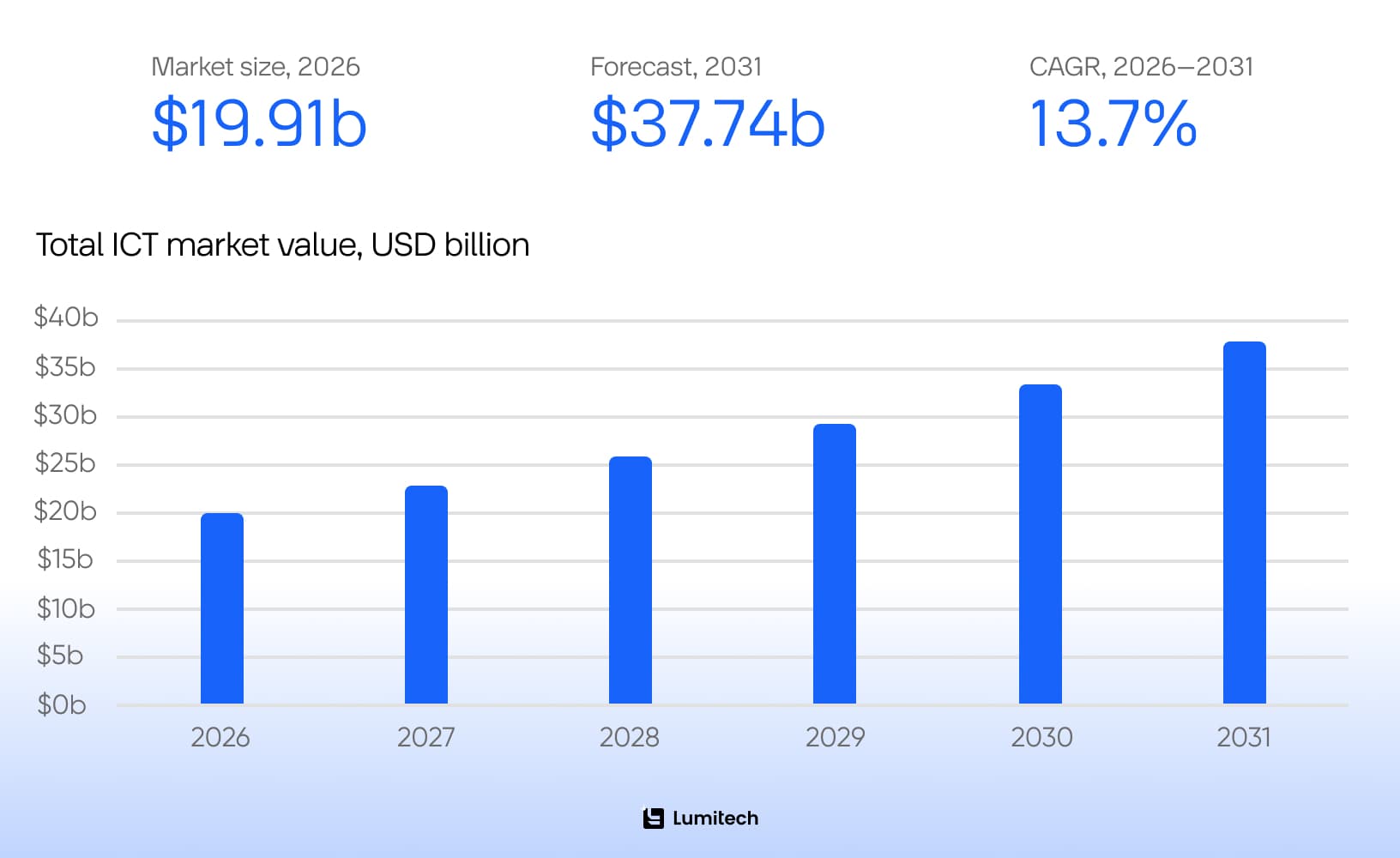
IT companies in Qatar span custom software firms, systems integrators, managed-service providers, cloud and data-center operators, and telecom-backed ICT companies. The right shortlist depends on the problem, documented delivery presence in Qatar, public proof, security, and post-launch ownership. Mordor Intelligence estimates Qatar’s ICT market at USD 19.91 billion in 2026, growing to USD 37.74 billion by 2031.

Top 10 IT Companies in Qatar at a Glance
Search for IT companies in Qatar, and the results mix five different businesses under one label. A custom software house, a systems integrator, a managed IT provider, a data-center operator, and a telecom enterprise arm all appear on the same page, and their proposals are priced and delivered in completely different ways.
This guide solves that problem. Each of the ten providers below is described using the same fields, so you can compare a software partner and an infrastructure operator on the same page without pretending they do the same job.
Companies are listed alphabetically. The numbering is for navigation and carries no ranking. Provider category and buyer fit sit in the comparison table below, because those decide the shortlist, and alphabetical order keeps the publisher of this guide from occupying the top slot. We checked vendor facts, service pages, and directory entries in August 2026.
Lists of the top IT companies in Qatar usually mix these categories without saying so. This guide is written for CIOs, CTOs, procurement teams and business owners choosing a technology partner in Qatar, and it keeps top software companies in Qatar visibly separate from cloud operators, integrators and telecom ICT arms.
IT Companies in Qatar Compared: Quick Reference
Company | Provider type | Qatar presence | Core services | Best fit | Public proof |
|---|---|---|---|---|---|
BRQ Qatar | Custom software and AI | Doha HQ | Custom platforms, e-commerce, ERPNext, AI consulting, bilingual web | Product builds and digital commerce for local operations | Published Hukoomi integration and PDPPL-aligned handling; SelectedFirms 2026 listing |
iHorizons | Enterprise transformation and software | Doha HQ, MENA delivery | Enterprise platforms, digital government, Quasar AI platform, Arabic NLP | Government and large enterprise transformation with Arabic requirements | Ministry of Endowments platforms; AI Labs at QSTP; 250+ staff stated |
Lumitech | Senior-led software engineering | Dubai entity, delivers into Qatar | Custom platforms, internal systems, AI and ML development, modernization, data engineering | Software-first builds and modernization of live business platforms | Published customer stories; Clutch 1000 2025 inclusion reported by the company |
malomatia | Digital transformation and managed security | Qatari company, Doha | Digital government, managed security operations, cloud managed services, data and AI | Government, healthcare, transport and regulated-sector programs | IDC MarketScape ME Managed Security Services 2026 Leader; GovAi national champion |
Mannai Technologies | Enterprise systems integrator | ICT division of Mannai Corporation, Doha | Networking and ELV, data-center infrastructure, ERP and CRM, enterprise applications | Large ICT implementation where infrastructure and applications move together | Only HPE and HP Inc. Platinum Partner in Qatar; Cisco partnership at MWC Doha |
MEEZA | Cloud and data center operator | Qatari company, listed on QSE | Colocation, hosting, IaaS, managed IT, managed security, disaster recovery | Local hosting, resilience and managed infrastructure for regulated workloads | MCIT agreement on Azure Qatar capacity; quarterly financials published as a listed company |
Ooredoo Qatar | Telecom-backed ICT | Qatari operator, Doha | Enterprise connectivity, managed security, IoT, sovereign AI cloud on Nvidia GPUs | Connectivity-dependent environments and local AI compute | Nvidia Cloud Partner status; AI cloud launch July 2025; Syntys data-center spin-out |
QDS (Qatar Datamation Systems) | Managed IT and security integrator | Doha HQ since 1983 | IT infrastructure, network and security, managed services, cloud, analytics and AI | Private enterprise needing independent managed IT and security operations | Microsoft, Commvault, Matrix42 and Progress partner pages; Commvault Gulf Partner of the Year 2023 |
Synergy Labs | Product and app engineering | Doha office, US HQ in Miami | iOS and Android apps, web platforms, UX/UI, QA, staff augmentation | Consumer-facing apps and product MVPs with a documented review record | 40+ verified Clutch reviews, with quality concerns raised in roughly 30% of them |
Vodafone Qatar | Telecom-backed ICT | Qatari operator since 2009 | Managed cloud and hosting, IoT and fleet management, critical comms, corporate internet | Distributed operations needing connectivity, cloud and device management together | H1 2026 results citing managed services growth; Microsoft Azure partnership |
Qatar presence is recorded as stated in public sources. A Doha headquarters, a registered local entity and remote delivery into Qatar carry different implications for procurement, on-site work and hosting, so the column separates them. Providers selling bundled ICT solutions in Qatar sit in the last three rows, where connectivity, hosting, security and managed services arrive under a single contract.
How We Selected These IT Companies in Qatar
Eight criteria decided which top IT companies in Qatar appear on this list.
Qatar relevance: headquarters, local office, registered Qatari entity, or documented delivery into Qatar, as stated by the sources.
Commercial offering: the provider sells technology services or solutions to organizations. National research and innovation bodies sit in a separate section further down.
Provider category: custom software, systems integration, managed IT, cloud and data center, or telecom-backed ICT.
Public proof: official service pages, Qatari business directories, verified reviews, analyst assessments, government programs, and named client work.
Delivery scope: consulting and discovery, implementation, integration, and operations or support.
Buyer fit: a concrete scenario where this provider is a sensible first call.
Commercial signal: published rates, minimum project sizes, or quote-based engagement, taken from public listings only.
Editorial currency: vendor facts verified in August 2026, with review scheduled every six months.
Inclusion signals a documented offering, reviewable evidence, and a defined procurement role. It does not imply equal suitability for every project.
Who Is Not on This List, and Why
We checked four groups and left them out on purpose.
National research and innovation bodies. QMIC and QSTP shape Qatar’s technology landscape without selling commercial delivery. Both appear in a separate section below.
Global consultancies with Doha offices. Accenture, IBM, Deloitte and their peers are relevant to enterprise buyers, and their procurement class, minimum program size and contracting model sit far from the providers compared here. A ten-row table mixing both would flatten that difference.
ELV and structured-cabling contractors. Several Doha firms marketed as IT companies deliver cabling, CCTV, access control and equipment supply, with software as a minor line. Category integrity matters more than list length.
Staffing and manpower agencies. Qatari IT outsourcing search results mix vendor selection with recruitment. Supplying engineers is a different service from owning delivery.
Disclosure: Lumitech publishes this guide and appears in the shortlist. The list is not a strict 1–10 performance ranking, because the providers serve different needs. We applied the same inclusion criteria to Lumitech and the other nine companies, using public evidence where available.
Ten IT Companies in Qatar: Our Verified List
Each profile carries the provider’s offering, its published record, and one thing to test during discovery. Everything under Public record is verifiable through the linked source. What to check is an editorial reading of that material.

1. BRQ Qatar
BRQ Qatar presents itself as a Doha custom software and AI partner for startups, growing brands, and enterprises, with e-commerce and ERP work alongside product engineering.
Core capabilities
Custom platforms, MVPs, and SaaS products, with AI consulting applied to existing workflows.
E-commerce builds on Magento Hyvä, Shopify Plus and Strapi, with bilingual Arabic and English content structures.
ERPNext configured for Qatari accounting and operational requirements.
Public record
Service pages document Hukoomi integration and data handling aligned to Qatar’s personal data law.
SelectedFirms lists BRQ Qatar as a Doha AI and digital commerce company in its 2026 Qatar directory.
What to check: Several similarly named entities operate locally, including brqtech.qa and brqloud.qa, and the Brazilian firm BRQ is unrelated. Confirm the exact legal entity named in the contract.

2. iHorizons
iHorizons is headquartered in Doha and states 30 years of operation with more than 250 engineers and consultants serving Qatar, Saudi Arabia, Kuwait, Iraq, and Algeria. Public-sector platform work is its strongest documented area.
Core capabilities
Enterprise platforms and digital government services, with Arabic language technologies.
Quasar, its enterprise AI platform, deployable on premises, hybrid, or in private cloud.
Application development, managed operations, and enterprise integration.
Public record
Published work for the Ministry of Endowments and Islamic Affairs, including the FatwaTok platform and semantic search on Islamweb.
AI Labs at Qatar Science & Technology Park, plus an MOU signed with Globitel at MWC Doha.
What to check: The company reports that 70% of its code is now generated with AI tools. Ask who reviews that output and how QA is structured before it reaches production.

3. Lumitech
Lumitech is a senior-led engineering company registered in Dubai with an R&D team in Eastern Europe, and it delivers to Qatar as a software development company in Qatar without a Doha office. One senior team owns both architecture and implementation.
Core capabilities
Custom platforms, internal business systems and client portals, delivered in phases.
AI and ML development built into existing operational workflows.
Modernization of live platforms, including data layers prepared for AI workloads.
Public record
Lumitech reports inclusion in the 2025 Clutch 1000 list of B2B service providers.
Published customer stories cover clinical platform modernization and an insurance platform rebuilt while the existing product stayed live.
What to check: Hosting inside Qatar runs through a local cloud region or a partner data center. Confirm that arrangement early, along with the on-site presence your program requires.
Building or rebuilding a platform that has to run inside Qatar?
A scoped assessment covers the hosting question, the integration map and the phasing order before a build contract is signed.


4. malomatia
malomatia is a Qatari IT services and digital transformation provider founded in June 2008, working primarily with government, healthcare, transport, and regulated sectors.
Core capabilities
Digital government platforms, including customs and postal service systems.
Managed security operations, cloud managed services and compliance support.
Enterprise architecture, data engineering and analytics.
Public record
Named a Leader in the IDC MarketScape: Middle East Managed Security Services 2026 Vendor Assessment in July 2026.
Endorsed under Qatar’s GovAi program as a national champion AI systems integrator in December 2025, with the Qatar Customs Clearance Single Window among its published government work.
What to check: Procurement is oriented toward public-sector programs. Private mid-market buyers should confirm minimum engagement size and the commercial model before a bid.

5. Mannai Technologies
Mannai Technologies is the ICT division of Mannai Corporation and describes itself as Qatar’s leading systems integrator, with more than 30 years in the market and over 5,000 customer entities from ministries to SMEs.
Core capabilities
Networking, ELV and data-center infrastructure through Mannai Networks.
ERP, CRM, enterprise content management and bespoke application work through Mannai InfoTech.
Hardware, security and end-user computing through Mannai TechHub.
Public record
The only Platinum Partner in Qatar for both HP Enterprise and HP Inc., according to its service pages.
A Cisco partnership covering secure networking, hybrid cloud and data-center architecture, presented at MWC Doha.
What to check: Capability spans several business units. Establish which unit owns delivery and who is accountable for the program end to end.

6. MEEZA
MEEZA operates five M-VAULT data centers in Qatar and has been listed on the Qatar Stock Exchange since its 2023 IPO, which makes it the most financially transparent provider on this list.
Core capabilities
Colocation, hosting and infrastructure as a service from local facilities.
Managed IT and managed security services, expanded through the Black Arrow acquisition in December 2025.
Cloud infrastructure, business continuity and disaster recovery.
Public record
A cooperation agreement with MCIT signed in December 2025 to add 4 MW and 6 MW of capacity to the Azure Qatar data center.
A 4 MW hyperscaler expansion delivered in June 2026, nine months ahead of contract, with Q1 2026 revenue of QAR 104.7 million, up 22% year on year.
What to check: Application development sits outside the core offering. Pair MEEZA with a software provider when the program includes a build.

7. Ooredoo Qatar
Ooredoo Qatar is the country’s largest telecom operator, and its business arm bundles enterprise connectivity with ICT, security, IoT and AI compute.
Core capabilities
Fixed and mobile enterprise connectivity at national scale.
Managed security, IoT platforms and collaboration services.
Sovereign AI cloud built on Nvidia Hopper GPUs and hosted in Qatar.
Public record
The AI cloud launched in July 2025 under Ooredoo’s status as an Nvidia Cloud Partner.
The group’s data-center business, formerly MENA Digital Hub, was spun out and rebranded as Syntys in 2025 and now operates that infrastructure.
What to check: Connectivity, hosting, and AI compute may sit with separate legal entities after the Syntys spin-out. Confirm which entity signs the SLA for each component.

8. QDS (Qatar Datamation Systems)
QDS has operated from Doha since 1983 as part of Al Darwish United Group and states a workforce of over 150 professionals. It occupies the independent managed IT and security slot between the public-sector integrators and the data-center operators.
Core capabilities
IT infrastructure, enterprise computing, storage, backup and virtualization.
Network and security work, including managed security services and secure web gateway deployments.
Cloud adoption, data analytics, AI solutions, digital workplace, and 24/7 monitoring and support.
Public record
Vendor alliances documented on the vendors’ own partner pages, including Microsoft, Commvault, Matrix42, and Progress.
Named Commvault Partner of the Year for the Gulf region at GITEX 2023, and presented as a Microsoft Platinum partner at the Microsoft booth at Web Summit Qatar.
Exhibitor at MWC Doha 2026, with a stated portfolio across government, healthcare, banking, energy and education.
What to check: Delivery strength sits in infrastructure, security and operations. Confirm scope, team and comparable references for any custom application work.

9. Synergy Labs
Synergy Labs runs a Doha office on C Ring Road from a US headquarters in Miami, with further offices in Dubai and Riyadh. Product and app delivery is its documented focus, and it holds the largest verified review record among the smaller providers serving Qatar.
Core capabilities
iOS, Android, and cross-platform applications built with Flutter, React, and Next.js.
Web platforms, UX/UI design, backend integration, and QA.
Staff augmentation and custom software for startup and enterprise product teams.
Public record
More than 40 verified Clutch reviews, with client-reported outcomes including a 95% student adoption rate and one million app downloads.
Published product work for Forbes Councils and consumer platforms, plus fintech delivery covering banking API integration.
What to check: Clutch’s own review summary notes that around 30% of reviews raise product quality or contract adherence, and a 2025 review describes a non-functional delivery, so read the full set before shortlisting. No Qatar client case is published, and Clutch shows a small share of staff in the Doha office, so confirm who delivers locally. Several unrelated Doha companies share the Synergy name.

10. Vodafone Qatar
Vodafone Qatar has operated since 2009 and reported 2.2 million mobile customers as of December 2025. Its business unit sells connectivity together with cloud, IoT, and managed ICT.
Core capabilities
Managed cloud, hosting and backup services for business customers.
IoT and fleet management, with solutions hosted on Microsoft Azure.
Push-to-Talk Plus mission-critical communications, upgraded in August 2026, plus corporate internet and security.
Public record
H1 2026 service revenue of QAR 1.59 billion, up 9.3%, with managed services and IoT named among growth drivers.
A Microsoft partnership under which its IoT portfolio, including fleet management, runs on Azure.
What to check: Custom application development is not part of the published portfolio. Scope integration and build work with a software partner alongside the connectivity contract.
Qatar Innovation Organizations to Know
Two bodies appear constantly in Qatari technology coverage without selling commercial delivery.
QMIC is a national research, development and innovation center owned by Qatar University, working on smart mobility and intelligent systems.
Qatar Science & Technology Park (QSTP) is the free-zone research park hosting corporate R&D operations, including iHorizons AI Labs.
Approach both for research partnerships, pilots, and applied innovation. Neither belongs on a vendor shortlist for production delivery.
Qatar’s IT Market in 2026: What Buyers Should Know
According to Mordor Intelligence, Qatar's ICT market is worth USD 19.91 billion in 2026 and is forecast to reach USD 37.74 billion by 2031, a CAGR of 13.7%. The same report puts cloud services on the steepest growth curve in the country at 21.7% CAGR, while communication services still hold the largest revenue share.
Public investment explains much of that curve. Qatar's Digital Agenda 2030, run by the Ministry of Communications and Information Technology, is built on six pillars covering infrastructure, government, technologies, innovation, economy and society, delivered through 23 strategic programs. The stated target is around USD 11 billion (QAR 40 billion) added to non-hydrocarbon GDP and 26,000 new ICT jobs by 2030. Separately, USD 2.47 billion sits in an incentive package supporting national digital transformation, including the Al Fanar Arabic AI project.
Local cloud capacity has grown on the back of that programme. The Azure Qatar region is live, and MCIT has signed agreements with MEEZA to add capacity to it.
Digital transformation in Qatar is state-led first. Mordor attributes much of the sector's growth to government programmes, and procurement reflects that: state entities and regulated sectors set the pace, while private buyers largely deploy on the same local regions and certifications. The same report notes that sector-specific compliance kept 63.55% of 2025 budgets on premises, with hybrid models gaining ground. Buyers scoping digital transformation services against that backdrop are choosing a deployment model as much as a vendor.
For buyers, the practical effect is a wider mix of IT services in Qatar than the market supported five years ago. The categories drawing the most demand in 2026:
Enterprise applications, custom platforms and enterprise software development for internal operations.
Managed cloud, colocation and infrastructure operations.
Cybersecurity, managed detection and resilience.
Digital transformation services covering process redesign and implementation.
AI-enabled business systems, supported by data engineering work on the underlying data layer.
Application modernization, alongside data migration strategy for systems holding years of records.
Smart infrastructure, IoT and digital government services.
Most programs touch more than one category, which is why a shortlist of software companies in Qatar often runs in parallel with a second shortlist for cloud and managed operations.
Data Residency in Qatar: What the Law Actually Requires
A common assumption is that all data handled by tech companies in Qatar must stay inside the country. Qatar’s general privacy law does not say that.
Law No. 13 of 2016 on Protecting Personal Data Privacy governs personal data processed electronically in Qatar. Article 15 forbids a controller from taking decisions or measures that would limit cross-border data flow, with exceptions where the processing breaches the law or may cause serious harm to the data or the individual. Special-category data, including health records and children’s data, carries additional requirements. The law excludes the Qatar Financial Center, which operates its own data protection regime.
Sector rules are the place where localization actually appears. Government programs and regulated-sector entities may apply their own hosting and security policies, so confirm the applicable rule for your sector before treating residency as settled either way. Local deployment through the Azure Qatar region, MEEZA facilities or Ooredoo’s local infrastructure remains valuable for latency, procurement and governance.
Questions worth putting in writing to any provider:
Where will data be stored, processed, backed up, and monitored, and in which cloud regions?
Which subprocessors touch the data, and under what contractual terms?
Which certifications apply to the delivery team and the hosting environment?
How are encryption, access control, and incident response handled?
Can the solution be deployed in a Qatar region or local data center if a sector rule requires it?
How Much Do IT Services Cost in Qatar?
A single average price for this list would be misleading, because it mixes custom software, managed IT, cloud, systems integration and telecom ICT. Public commercial signals by provider category are more useful.
Provider category | Public commercial signal | What drives the price |
|---|---|---|
Small local software providers | Qatari directories show bands from below $25/hr up to $100–149/hr depending on scope, with minimum project sizes from $1,000 on local listings | Team seniority, project size, whether packaged products are configured or built from scratch |
Regional software teams serving Qatar | Public bands commonly $25–49/hr or $50–99/hr, with minimum project sizes from $25,000 on Clutch listings for Qatar | Discovery depth, architecture ownership, integrations, QA and post-launch support |
Systems integrators | Quote-based and project-based | Third-party vendors, hardware and licenses, integration count, implementation and support |
Managed IT and cloud | Recurring subscription or SLA plus infrastructure consumption | Service scope, response times, monitoring, DR, security coverage and support hours |
Telecom-backed ICT | Quote-based enterprise bundle | Connectivity, hosting, cloud, IoT, security and managed services combined in one contract |
Advisory-only engagements from IT consulting companies in Qatar are typically priced as a day rate or a fixed assessment fee, separate from any build that follows. Treat all of these bands as directory signals, never as an official market rate. What moves a Qatari budget is scope: discovery, architecture, integrations, data migration, licenses and cloud consumption, security work, QA, change requests, support hours and SLA level. An assessment or contained first phase priced on its own is the only reliable way to price the rest.
What to Check Before Signing with an IT Company in Qatar
Is the core problem software, infrastructure, cloud, integration, security or support? The answer determines the category before it determines the vendor.
What Qatar presence exists in practice: headquarters, office, registered entity, local partner or remote delivery?
Which comparable Qatar or GCC projects can be shown publicly or under NDA?
Who owns architecture, delivery management, QA, security, and release approval?
What does the quote include: licenses, cloud consumption, integrations, support, change requests, and SLA?
What happens after go-live: support hours, response times, escalation path, and knowledge transfer?
Will the presales team stay on the project, or will delivery move to another team?
Vague answers on ownership and post-launch accountability are the most common early warning sign among IT solutions companies in Qatar, and they surface in the first two meetings if the questions are asked directly.
Where Lumitech Fits in Qatar’s IT Market
Much of the Qatari market is infrastructure-led, and that is a genuine strength for hosting, integration and managed operations. Lumitech occupies a different slot: software-native delivery, where a platform has to be designed, built and kept accountable to a business outcome.
The work that matches that profile includes internal business systems, client portals, AI-enabled workflows, data-heavy platforms and modernization of software already carrying daily operations. Buyers comparing application modernization companies for a live platform, or shortlisting software development companies in Qatar for a build, are looking at the category Lumitech in Qatar works in.
For hosting resilience, national-scale connectivity, or large ICT implementation, MEEZA, Mannai, Ooredoo Qatar, and Vodafone Qatar are the more relevant names on this list. For public-sector transformation, iHorizons and malomatia carry the deepest documented record. Matching category to problem is the whole exercise.