
Top 10 IT Companies in Saudi Arabia (2026): Software, Cloud & AI Guide
Saudi Arabia’s IT market is no longer a side character in the Gulf story. Vision 2030, public-sector digitization, AI investment, and a very real appetite for modern platforms have turned the Kingdom into one of the top tech markets in the region.
- For New Clients
- Software Development
September 04, 2026
 AI Overview
IT companies in Saudi Arabia range from national ICT and cybersecurity providers to global consultancies, enterprise-platform vendors, AI companies, and product-engineering teams. The right shortlist depends on project type, Saudi delivery presence, technical depth, compliance, and post-launch ownership. GASTAT reports that Saudi Arabia’s digital economy reached 16.0% of GDP in 2024.

Top 10 IT Companies in Saudi Arabia at a Glance
Saudi Arabia’s IT market is no longer a side character in the Gulf story. Vision 2030, public-sector digitization, AI investment, and a very real appetite for modern platforms have turned the Kingdom into one of the top tech markets in the region.
This can be verified by the macro figures: in 2023, the contribution of the digital economy to Saudi Arabia’s GDP amounted to 15.6%, while the implementation of Vision 2030 and the National Transformation Program continues to support the expansion of digital governments, the modernization of the private sector, as well as large-scale construction works.
As more Saudi organizations modernize operations and invest in AI, demand is also rising for strong data engineering services that can support analytics, automation, and scalable digital platforms behind the scenes.
For customers, the choice of an IT company in Saudi Arabia is not just about finding people who can code without setting production on fire. It is about finding a company that understands regulation, localization, cybersecurity, Arabic-first user realities, procurement rhythms, and the growing importance of data sovereignty. In other words, the cheapest proposal is often just the most affordable route to a future headache.
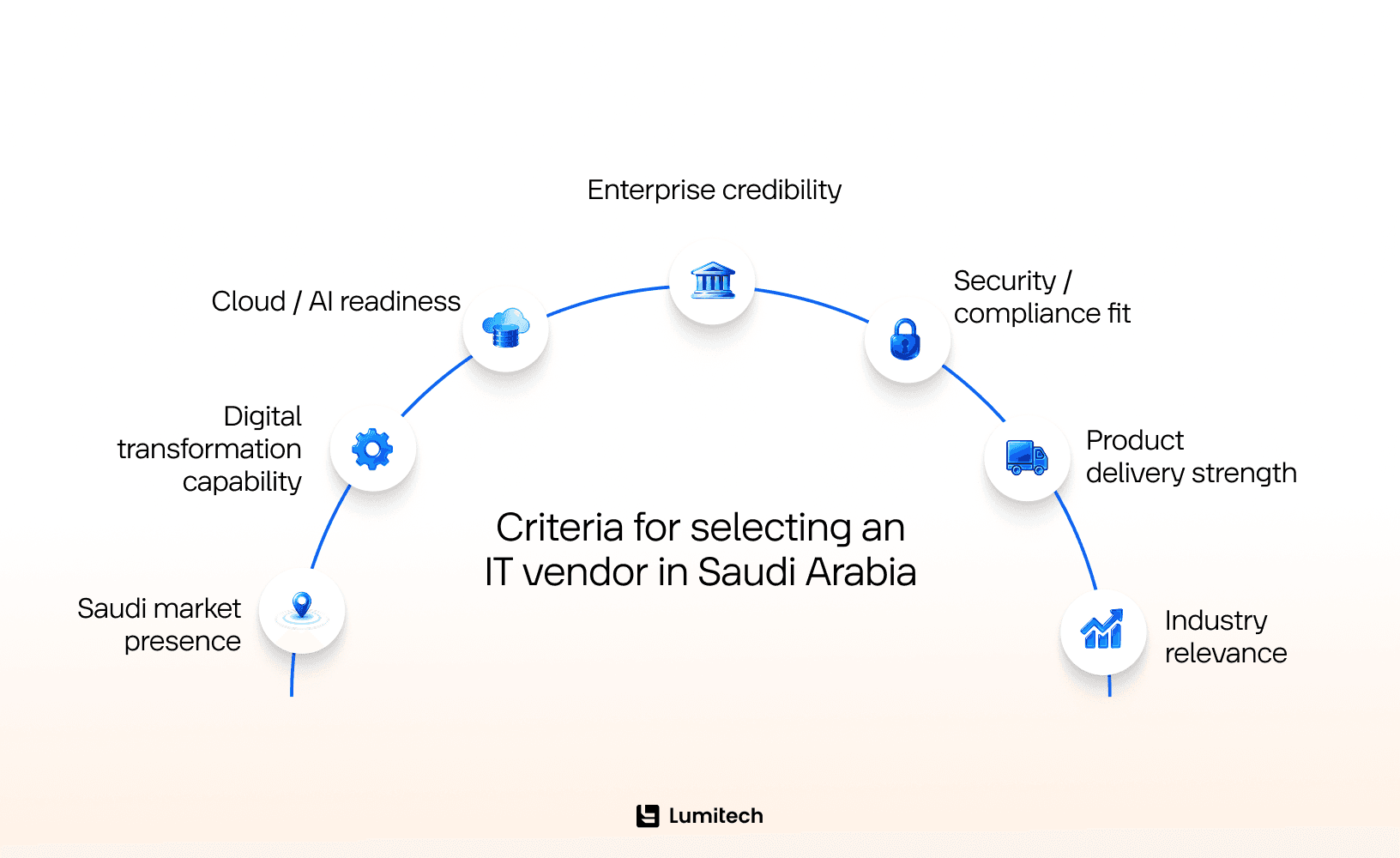
Presented below is the 2026 list of the best IT companies in Saudi Arabia. The ranking considers market presence, digital-transformation capability, delivery breadth, cloud and AI readiness, enterprise credibility, and usefulness for actual buyers in KSA. It intentionally mixes Saudi champions, global consulting heavyweights, and product-minded engineering firms, because real projects do not all look the same. A ministry modernization program, a bank core platform renewal, and a startup’s SaaS launch should not be shopping from the same shelf.
Saudi Arabia’s IT Market in 2026: What Buyers Should Know
Before diving into the list, we need some context on Saudi Arabia. The Kingdom is no longer just “the place with the oil.” It’s the place with the NEOM cognitive-city project, the place where The Line is redefining urban living, and the place where digital transformation is a national mandate.
For regional buyers comparing vendors across the Gulf, the Saudi market is increasingly evaluated alongside leading IT companies in the UAE, especially for cross-border product development, cloud migration, and enterprise modernization initiatives.
The government continues to invest heavily in the Riyadh tech hub, focusing on AI (including AI in SaaS development), cloud computing, and cybersecurity. That means the ecosystem of software companies in Saudi Arabia, particularly in Riyadh, is dense with talent — but also mixes long-established integrators with newer, faster-moving specialists, so it is not always obvious which one actually fits a given project.
How to Choose an IT Company in Saudi Arabia for Your Project?
To find the right partner among the many tech companies in Saudi Arabia, start with the problem’s shape, not the vendor’s fame. A lot of buyers reverse that logic and end up with an expensive mismatch.
While some businesses compare Saudi vendors against IT outsourcing companies in the UAE, the smarter comparison is not country versus country, but rather whether the provider’s delivery model, regulatory awareness, and domain expertise match the project you are trying to deliver. Many IT consulting companies in Saudi Arabia sound similar on paper, so the real differentiator is usually delivery model and Saudi-market fluency, not the pitch deck.
If your project is a national-scale transformation, shortlist IT companies in Saudi Arabia with strong enterprise integration, governance, and long-cycle delivery muscle — think Accenture, IBM, TCS, solutions by stc, Ejada, Elm, or SITE, depending on the sensitivity and scale.
If your project is a new platform, SaaS product, or digital service launch, you may get better results from a leaner engineering-focused partner such as Lumitech. Buying a giant transformation machine to build an MVP is like renting a cargo plane to deliver one laptop. Technically possible. Spiritually incorrect.
Criteria for Selecting an IT Vendor in Saudi Arabia
Challenge these concepts:
1. Saudi market fit.
Do they understand local procurement, compliance, Arabic UX, and data-residency expectations? For IT companies in KSA, this is not “nice to have.” It is project hygiene.
2. Delivery model.
Are you buying advisory services, implementation support, management services, staff augmentation, or a dedicated product team for the project? Many project failures start with both sides using the same words to mean completely different things.
3. Technical depth in your exact problem.
Cloud migration is not the same as application modernization. ERP transformation is not the same as product engineering, and enterprise integration is not the same as web development. “We do digital transformation” is often just a polished way of saying “we have a sales team.” Not all software development companies in Saudi Arabia offer the same depth in these areas, so while comparing IT companies in Riyadh, ask for directly comparable work.
4. Security and sovereignty posture.
If your workloads are sensitive, ask blunt questions about hosting, access control, incident response, and jurisdiction. SITE, Elm, Oracle, IBM, HUMAIN, and Accenture are all relevant here, but for different reasons and architectures.
5. Post-launch support.
Who owns support, maintenance, optimization, and handover? A beautiful go-live followed by six months of chaos is not success, but a delayed disappointment. The best partners among IT outsourcing companies in Saudi Arabia don’t quit after launch.
6. Team composition.
Will the senior staff actually take part in the project, or will they merely appear at the pitch like guest stars? Find out who the architect, delivery lead, product lead, QA lead, and security owner will be.
7. Commercial logic.
The cheapest or largest option isn’t necessarily the best choice; it should be the one whose engagement model matches your level of uncertainty, your speed, your governance arrangements, and your budget. A fixed-price contract based on a vague scope is something that will soon become an argument.

Methodology: How This Shortlist Was Built
This shortlist favors companies that can do one or more of the following at a serious level: enterprise systems integration, cloud migration, managed services, cybersecurity, platform engineering, AI adoption, digital-product delivery, and ongoing support inside the Saudi market. Specifically, we weighed:
Saudi relevance — HQ, registered entity, regional headquarters, office, or documented KSA delivery.
Commercial technology offering — software, enterprise IT, cloud, cybersecurity, AI, systems integration, or digital platforms.
Public proof — official Saudi pages, annual reports, public case studies, or verified partner and regulator references.
Buyer fit — government and public sector, regulated enterprise, product engineering, AI, cloud, cybersecurity, or enterprise applications.
Delivery depth — strategy and discovery, build and implementation, integration, migration, and managed operations or support.
KSA compliance readiness — PDPL and data-transfer understanding, security controls, local cloud or hosting options where required, and procurement readiness.
Commercial signal — public pricing, minimum project size, or a stated rate band, where verifiable; otherwise, quote-based.
Freshness — facts checked as of August 2026, with a plan to refresh the shortlist at least every six months.
Preference also goes to firms with a visible Saudi footprint, Saudi-specific offerings, or clear alignment with the Kingdom’s digital-transformation agenda. That is why some globally famous firms make the cut, but not automatically — name recognition is nice; execution in Riyadh is nicer.
Disclosure: Lumitech publishes this guide and is included in the shortlist. The ranking order broadly reflects each company’s overall size and market scale — global reach, workforce, and market presence — rather than a universal 1–10 performance score, since these companies serve different project types. The same inclusion criteria above apply to Lumitech and to every other company on this list.
Top 10 Best IT Companies in Saudi Arabia

1. Accenture Saudi Arabia
Accenture is a global consulting and technology group with an established presence in Saudi Arabia, relevant for complex transformation programs where strategy, operating-model redesign, cloud adoption, data and AI, and industry-wide change intersect. In 2025, Accenture announced a collaboration with Google Cloud to accelerate sovereign cloud and generative AI adoption in Saudi Arabia, and the company has also highlighted national-scale AI and skills initiatives in the Kingdom.
Why it stands out: transformation maturity at global scale. Accenture is usually not the cheapest partner, and buyers do not hire it to save money. They hire it when a project touches processes, technology, governance, and people at the same time — the kind of program where “install software and hope” is not an acceptable strategy.
Best fit: digital-transformation strategy, cloud and AI roadmaps, large-enterprise modernization, operating-model change, and programs where executive alignment matters as much as technical delivery. If you are a mid-size company that just needs a product shipped fast, Accenture may be more orchestra than garage band.
2. TCS
TCS (Tata Consultancy Services) has a long-standing presence across the Middle East and Africa, backed by the scale of the wider Tata Group, with its Saudi footprint including the all-women Digital Services Center in Riyadh and the TCS Pace Studio Riyadh for co-innovation and digital transformation. Its Saudi work also includes financial-infrastructure projects such as real-time payments transformation with Banque Saudi Fransi.
Why it stands out: enterprise delivery discipline with industry depth. TCS is especially strong where IT modernization intersects with financial services, large operations, platform transformation, and offshore-plus-local delivery models.
Best fit: banking and payments modernization, enterprise platforms, co-innovation programs, and digital transformation for organizations that want a globally proven partner with a genuine Saudi presence.

3. IBM Saudi Arabia
IBM has incorporated the Kingdom into its regional strategy: the company opened its regional headquarters in Riyadh in January 2024 and subsequently announced its intention to invest more than $200 million in talent and infrastructure for a new software lab in the city. IBM’s position in the consulting market is still based on hybrid cloud, AI, application modernization, and enterprise transformation.
Why it stands out: heavyweight enterprise engineering. IBM is particularly relevant for organizations with legacy estates, complicated integrations, and regulated workloads that need hybrid architectures rather than an all-or-nothing cloud migration.
Best fit: hybrid cloud, AI-enabled operations, application modernization, core-enterprise transformation, and projects that require deep architecture plus change at scale. IBM is less suited to buyers seeking a boutique, founder-led product team with startup energy and fewer layers.

4. Oracle Saudi Arabia
Oracle’s importance in Saudi Arabia has increased significantly since cloud locality is no longer a minor consideration. The company has announced a planned $1.5 billion investment to extend its cloud infrastructure in the country, and its Riyadh cloud area became available in July 2024. Oracle also continues to have a strong position in Saudi Arabia with regard to cloud infrastructure, distributed cloud, and the modernization of enterprise applications.
Why it stands out: enterprise cloud and platform backbone. Oracle functions as an enabling layer for regulated and large-scale workloads that need local hosting, cloud migration, resilience, and modernization, which matters even more for organizations already deep in Oracle ERP, database, or enterprise-application ecosystems.
Best fit: ERP and enterprise-stack modernization, cloud migration, data-heavy systems, and regulated workloads, where architecture decisions need to respect both scale and locality. If your goal is a fast consumer-app MVP, Oracle is probably not the opening move.

5. solutions by stc
For big projects that require heavy infrastructure, span multiple sites, involve the public sector, or are core to enterprise operations, stc’s solutions should be among the first you consider. The company says it has over 25 years’ experience and an end-to-end position across the IT value chain, and the information it provides highlights its expertise in managed services, systems integration, cloud, cybersecurity, and large-scale digital transformation.
Why it stands out: scale and breadth. Many vendors can build an app. Fewer can modernize networks, integrate enterprise systems, manage hybrid infrastructure, and keep operations running long after the launch party ends. For large organizations in telecom, government, utilities, or conglomerate environments, that depth matters.
Best fit: major digital-transformation programs, managed services, cloud and infrastructure modernization, security-heavy enterprise environments, and long-horizon modernization roadmaps. If you need a compact product squad for a fast-moving greenfield build, there may be leaner options.

6. Elm
Elm is a company that is based in Saudi Arabia and has a strong presence in the area of secure platforms, government-linked services, and operationally rigorous digital products. It describes itself as a provider of secure, innovative solutions for both the public and private sectors, highlighting its involvement in digital transformation, IT strategy, data, cloud computing, AI, and managed IT services, as well as its close connections with the Saudi public sector ecosystem.
Why it stands out: local institutional depth. Saudi Arabia is not a market where generic global slides double as localization. Elm’s familiarity with the Kingdom’s institutional logic makes it especially relevant for projects involving compliance, citizen services, smart operations, or public-private execution models.
Best fit: government platforms, regulated-industry transformation, smart services, secure digital products, and digital-strategy engagements that require Saudi-market fluency.

7. HUMAIN
HUMAIN is the latest major entry on this list and perhaps the most significant for Saudi Arabia’s AI goals. The company, set up on 12 May 2025 as a PIF-owned firm, was designed to encompass the entire AI value chain: data centers and AI infrastructure, the cloud, foundation models such as ALLAM and HUMAIN Chat, and applications tailored to specific sectors. It has entered into infrastructure partnerships with companies including NVIDIA, AMD, Cisco, AWS, and Qualcomm to increase the kingdom’s AI computing capacity, and in 2025, a consolidation deal absorbed SCAI’s assets into HUMAIN, extending its presence.
Why it stands out: national-scale AI infrastructure. Few companies anywhere are building AI infrastructure, sovereign and Arabic-language models, and enterprise AI applications under one roof, backed by PIF capital. For buyers exploring an AI software development company in Saudi Arabia versus a full AI infrastructure partner, HUMAIN sits firmly in the latter category.
Best fit: AI infrastructure and compute, sovereign and Arabic-language AI, and enterprise or public-sector AI adoption, especially for organizations that want a Saudi-based partner for AI strategy that goes beyond a single chatbot pilot.

8. Ejada
Ejada is one of the clearer Saudi-headquartered contenders for digital transformation, serving organizations across MENA and describing itself as a key participant in Saudi Arabia’s digital-transformation agenda. The company also highlights close to 20 years of operation, more than 3,500 employees, and strength across enterprise applications and cross-industry solutions.
Why it stands out: local enterprise credibility without losing breadth. Ejada sits in a useful middle ground between giant global consultancies and smaller specialist firms — enough scale to handle critical programs, enough regional familiarity to avoid tone-deaf execution, and enough service breadth to cover applications, operations, and transformation.
Best fit: enterprise applications, digital modernization, government and blue-chip transformation, and sector-specific platform work where a Saudi-rooted partner with broad capabilities is preferable to a pure-play global name.

9. SITE
SITE is a cybersecurity and secure-cloud company from Saudi Arabia that has a noticeable presence in the areas of digital transformation, cybersecurity, and sovereign cloud. The company states it has been a partner for hundreds of clients since 2017 and positions itself around digital and cybersecurity services, future technologies, and secure digital transformation. Its cloud materials stress sovereign, compliant cloud services based in Saudi Arabia, spanning more than 100 products and services.
Why it stands out: sovereignty and security. In Saudi Arabia, many organizations now care not only about whether a platform works, but also where data resides, who controls it, and how local compliance is handled. For buyers in government, critical infrastructure, defense-adjacent, or sensitive-data environments, that focus can be a decisive advantage.
Best fit: sovereign-cloud adoption, cybersecurity-led transformation, secure hosting, and compliance-heavy modernization for organizations that do not want their cloud posture to become tomorrow’s legal memo.

10. Lumitech
Lumitech is the smaller, more product-oriented name on this list of IT companies in Saudi Arabia, and that is precisely why it is included: not every Saudi project needs a large integrator, a bench of subcontractors, and a deck built around the word “synergy.” Lumitech provides software development services in Saudi Arabia, delivering product-first engagements with compact, senior-led teams across enterprise software, SaaS, AI/ML, and end-to-end product engineering. The company reports sixfold revenue growth since 2022, making it one of the fastest-growing companies in its segment across the MENA region.
Why it stands out: speed, product thinking, and team shape. Lumitech focuses on shipping working software rather than running a consulting engagement, with capabilities spanning enterprise software development, AI-enabled product features, and end-to-end delivery for startups, scale-ups, and established companies launching new digital products. You can see examples of delivered work in Lumitech’s customer stories.
Best fit: custom software development, SaaS products, enterprise web and mobile platforms, AI-enabled product features, and situations where a buyer needs a delivery partner that behaves like an embedded product team rather than a large program office.
Also Worth Considering: Mobily Digital Hub
Beyond the ranked Top 10, Mobily Digital Hub is worth a mention for a specific kind of buyer. Mobily is primarily known as a telecom operator, but its Digital Hub is relevant to Saudi enterprise IT conversations spanning internet services, digital content, cloud computing, and integrated infrastructure, backed by large-scale network, FTTH, and data-center capabilities in Saudi Arabia.
Best fit: telecom-adjacent enterprise transformation, connectivity-led modernization, cloud and hosting environments, and projects where network and colocation infrastructure are a core part of the value proposition rather than an afterthought. In practice, many digital programs fail not because the app is ugly, but because the underlying infrastructure assumptions were fantasy — Mobily helps with that less glamorous, highly necessary part of the stack.
Which IT Companies in Saudi Arabia Specialize in Digital Transformation Projects?
Many of the companies on this list are especially well-suited for digital transformation, but they differ in their approach. This mirrors broader enterprise software trends in MENA, where buyers increasingly expect vendors to combine platform depth with genuine local delivery.
Best for large enterprise and public-sector transformation: solutions by stc, Accenture, IBM, TCS, and Ejada. These firms are strongest when transformation means multiple workstreams — architecture, cloud, operating model, data, integration, security, and long-term managed delivery.
Best for Saudi-native secure transformation: Elm and SITE. These are especially compelling when sovereignty, secure digital services, public-sector alignment, or highly regulated environments are central to the brief.
Best for cloud and backbone modernization: Oracle, IBM, solutions by stc, and Mobily Digital Hub. These companies become highly relevant when the project depends on cloud locality, enterprise applications, hybrid infrastructure, or network-heavy architecture.
Best for AI infrastructure and enterprise AI adoption: HUMAIN. For broader regional context, see Lumitech’s overview of AI companies in Saudi Arabia and MENA.
Best for product-led transformation or new digital products: Lumitech. This is the better fit when “transformation” really means launching or rebuilding software products, improving user experience, accelerating engineering throughput, and getting from strategy theater to an actual release. This is also the category where experimentation matters most, since many organizations now begin transformation with AI prototyping development before committing to full-scale platform rollouts or enterprise-wide AI implementation.
A Practical Shortlist of IT Companies in Riyadh by Project Type
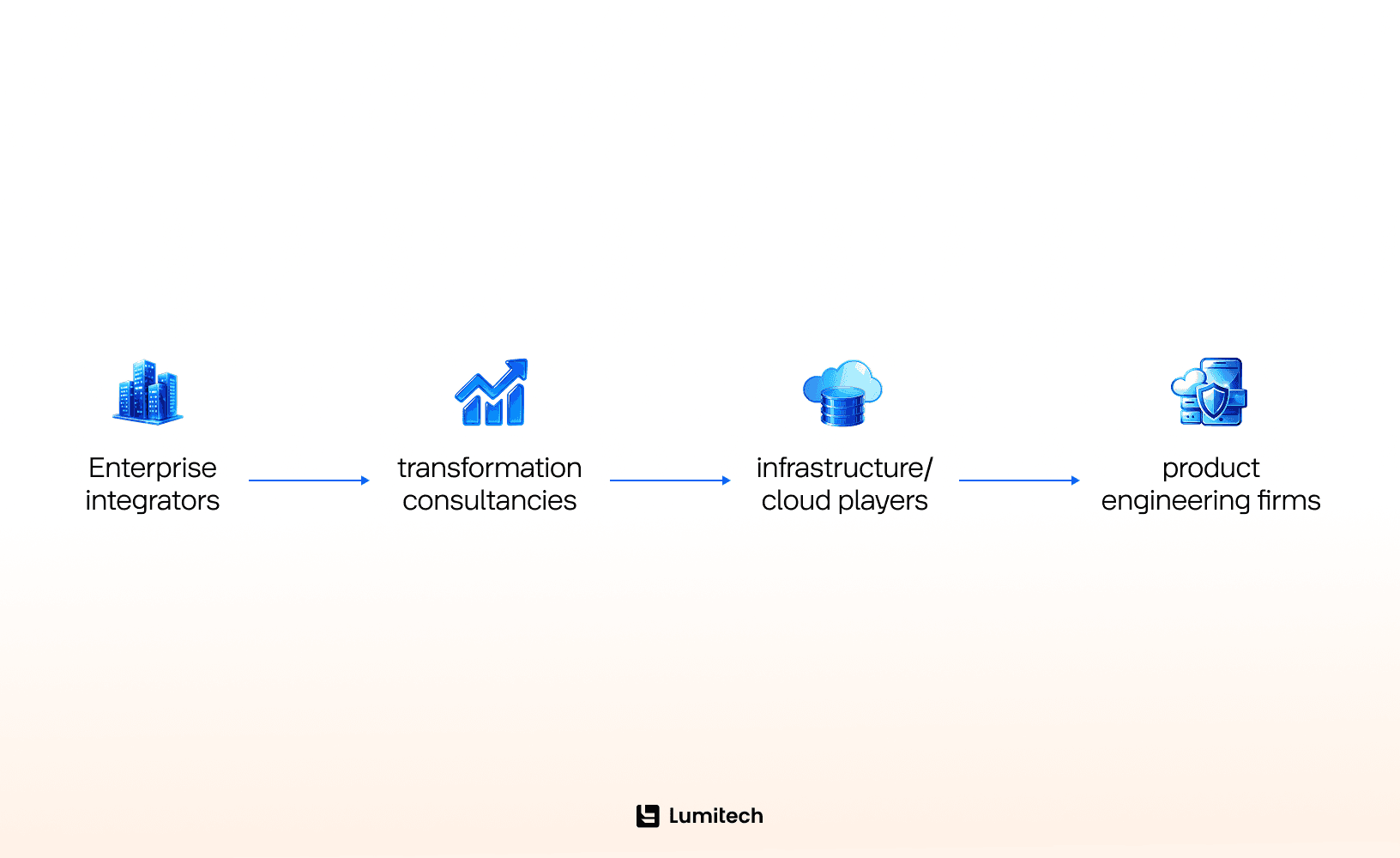
For government organizations, public services, and regulated industries, start with Elm, SITE, and the solutions offered by stc, IBM, Accenture, and Ejada, since these companies align well with security, scale, and governance, as well as the local context in Saudi Arabia.
The same logic applies to manufacturing, logistics, and energy businesses looking for software solutions for the industrial sector, where integration with operations, asset visibility, and long-term reliability often matter more than flashy front-end features.
For banks, fintech, payments, or high-stakes transaction systems, look hard at TCS, IBM, Oracle, Ejada, and Accenture, or consider a partner with dedicated fintech software development experience for a more product-led build. Their enterprise and financial-services depth is especially relevant.
For enterprise cloud modernization, Oracle, IBM, solutions by stc, SITE, and Mobily Digital Hub are strong candidates.
For AI infrastructure and sovereign AI initiatives, HUMAIN is the most relevant Saudi-based option.
For custom software, SaaS, internal products, and faster-moving builds, Lumitech is one of the more interesting options because its proposition is engineering-led rather than bureaucracy-led.
Beyond Riyadh: Jeddah and the Eastern Province
Riyadh has the strongest concentration of headquarters, government bodies, finance, enterprise, and national digital programs, and most of the vendors above are based or most active there. But Saudi Arabia’s IT market is not limited to one city.
Riyadh — the strongest concentration of HQs, government, finance, enterprise, and national digital programs.
Jeddah — relevant for commerce, logistics, travel and hospitality, and western-region businesses; buyers should confirm a vendor’s verified local presence before assuming Jeddah coverage.
Eastern Province (Al Khobar, Dammam) — relevant for energy, industrial, logistics, and B2B software, and a useful reference point for industrial-sector buyers.
If you are specifically evaluating IT companies in Jeddah, Saudi Arabia, treat city coverage as a question to verify directly with each vendor rather than an assumption based on their Riyadh presence.
Software Companies in Saudi Arabia Compared: Quick Reference
The table below summarizes provider type, Saudi presence, best fit, and commercial signal for each company on this list. Where pricing is not publicly disclosed, we say so rather than guessing at a band.
Company | Provider type | Saudi presence | Best fit | Commercial signal |
|---|---|---|---|---|
Accenture Saudi Arabia | Global consulting & technology | Global company with Saudi operations | Large-scale strategy & transformation | Quote-based (enterprise programs) |
TCS | Global IT services | Global company with Saudi delivery centers | Banking/payments, enterprise platforms | Quote-based (enterprise programs) |
IBM Saudi Arabia | Global enterprise technology | Global company, Riyadh regional HQ | Hybrid cloud, AI, core modernization | Quote-based (enterprise programs) |
Oracle Saudi Arabia | Global enterprise cloud/platform | Global company, Riyadh cloud region | ERP & enterprise-stack modernization, cloud migration | Quote-based (licensing + services) |
solutions by stc | Saudi enterprise ICT | Saudi company, part of stc Group | Managed services, cloud, cybersecurity, SI | Not publicly disclosed/quote-based |
Elm | Saudi digital products & platforms | Saudi-headquartered, public-sector depth | Government platforms, regulated transformation | Not publicly disclosed/quote-based |
HUMAIN | AI infrastructure & applications | Saudi (PIF-owned) | AI infrastructure, sovereign & Arabic AI | Not publicly disclosed/quote-based |
Ejada | Saudi enterprise applications | Saudi-headquartered | Enterprise apps, government & blue-chip transformation | Not publicly disclosed/quote-based |
SITE | Cybersecurity/secure cloud | Saudi-headquartered | Sovereign cloud, cybersecurity-led transformation | Not publicly disclosed/quote-based |
Lumitech | Product engineering/custom software | Saudi-headquartered company, KSA delivery | Custom software, SaaS, AI-enabled products | Not publicly disclosed/quote-based |
Mobily Digital Hub | Telecom & infrastructure | Saudi-headquartered | Connectivity-led modernization, hosting | Not publicly disclosed/quote-based |
How Much Does It Cost to Hire an IT Company in Saudi Arabia?
There is no single reliable 'Saudi market rate' because global consultancies, Saudi systems integrators, and software-engineering firms — from web development services to large-scale enterprise integration — use fundamentally different commercial models. The table below outlines what typically drives total cost of ownership (TCO) for each provider type.
Provider type | Commercial model | What drives TCO |
|---|---|---|
Saudi/global consultancies & large integrators | Mostly quote-based enterprise programs | Transformation scope, governance, implementation, licenses, managed services |
Saudi systems integrators/ICT providers | Project, managed-service, or infrastructure quote | Hardware/cloud/vendor licenses, integration, SLA, local support |
Software/product engineering firms | Public directories commonly show hourly bands such as $25–49 and $50–99, with some vendors above or below | Use vendor-level sources, not a generic “Saudi average” |
Dedicated teams | Monthly or hourly, by role and seniority | Product management, QA, DevOps/security, and local coordination, confirmed separately |
AI/cloud infrastructure | Consumption plus platform plus implementation, or enterprise contract | GPU/cloud usage, data, security, integration, support |
Public directories such as Clutch and GoodFirms can be used as current commercial signals, not as official market pricing. Whatever the provider type, compare scope, licenses, and cloud costs, support, security, change-request handling, and local delivery costs rather than a single headline number.
Compliance, Data Residency, and PDPL: What Buyers in Saudi Arabia Need to Know
PDPL does not mean “data must stay in Saudi Arabia” as a blanket rule. Article 29 of Saudi Arabia’s Personal Data Protection Law and the current SDAIA transfer regulation permit personal data to be transferred, or disclosed, outside the Kingdom for defined purposes, subject to safeguards, and provided the transfer does not harm national security or vital interests or violate other Saudi law. That said, local hosting may still be required or preferred for particular government, critical-system, or regulated workloads, so buyers should confirm the applicable sector rules and NCA requirements before committing to an architecture.
Relevant frameworks to ask vendors about:
PDPL /SDAIA — personal-data processing and transfer rules; Article 29 permits transfer or disclosure outside the Kingdom for defined purposes, subject to safeguards.
SDAIA Transfer Regulation — transfers must not harm national security or vital interests, or violate other Saudi law; controllers must follow the applicable transfer safeguards and assessments.
NCA Essential Cybersecurity Controls (ECC 2-2024) — current baseline cybersecurity controls for national entities.
NCA Cloud Cybersecurity Controls (CCC 2-2024) — controls for cloud providers and tenants; use this current framing rather than older, unverified “Class A/B/C” cloud language.
CST Cloud Computing Services Provisioning Regulations — govern cloud providers and users; confirm any specific claims against the current published document.
Before signing, run this checklist with any shortlisted vendor:
Which Saudi law or regulator applies to our data and sector?
Where will production data, backups, and disaster-recovery copies be processed?
Which subprocessors and cloud regions are used?
What transfer mechanism or assessment applies if personal data leaves Saudi Arabia?
Which NCA controls apply to our organization or system, and who owns the compliance evidence?
How are access control, encryption, incident response, audit logs, and data deletion handled?
Local Entity, Procurement, and Etimad: Do You Need a Saudi Partner?
It is tempting to write a blanket rule — “foreign IT companies can serve the private sector, but public-sector work always requires a Saudi commercial registration or local partner” — but reality is more specific than that. The correct structure depends on the activity, tax and permanent-establishment status, licensing, and the procurement route in question.
Private contracts — non-resident companies can contract in many Saudi scenarios, but tax, withholding, permanent-establishment, and licensing obligations may still arise depending on the engagement.
Etimad — the government procurement platform supports foreign suppliers and includes a “No CR” foreign-supplier onboarding path; a regional headquarters is not required for every use case on the platform.
Government procurement — some services and tenders carry additional eligibility or regional-headquarters requirements, so buyers should verify tender-specific conditions rather than assume a blanket rule.
Buyer implication — ask any vendor what legal entity signs the contract, how invoicing and tax are set up, who is locally accountable, and whether that structure is eligible for your specific procurement route.
How to Choose the Right IT Company in Saudi Arabia
There is no single, universal answer to who the top IT companies in Saudi Arabia are — only the one that is the best fit for your specific project. Saudi Arabia is one of the region’s most dynamic IT markets, but that also means buyers have to sort through a lot of noise. Big promises are easy; real delivery is harder. The best-fit partner among the many software companies in Saudi Arabia isn’t simply the biggest brand or the cheapest bidder — it is the one whose project fit, technical complexity, regulatory readiness, and pace of execution match yours.
For large-scale digital transformation, enterprise modernization, cloud migration, or regulated-sector work, companies such as solutions by stc, Elm, SITE, IBM, TCS, Accenture, Ejada, Oracle, HUMAIN, and Mobily Digital Hub stand out for their scale, infrastructure strength, and market presence. For businesses that need fast, product-focused execution, especially in custom software and digital platforms, Lumitech offers a more agile alternative.
The key takeaway: choose by project type, not logo size. In Saudi Arabia’s fast-moving digital economy, the right match can accelerate growth, while the wrong one can turn a promising initiative into a very expensive lesson.


