
Pragmatic AI in Asset Management: Governance & Oversight
Asset management has always been an information business wearing a finance suit. The suit is expensive; the information is messy; and the decisions are made under uncertainty while everyone pretends it’s just “process.”
- FinTech & Finance
- AI Development
February 20, 2026
 AI Overview
AI in asset management applies machine learning and NLP across research, portfolio construction, trading, and client operations to convert messy, unstructured data into consistent investment decisions. Key components include alternative-data signal generation, risk stress-testing with synthetic scenarios, and execution analytics, with humans retaining final judgment. Satellite imagery analysis can reveal signals like a 12% YoY foot-traffic increase weeks before earnings reports confirm it.

AI doesn’t change that. What it can change is how quickly you convert messy information into consistent decisions, and how often your process catches itself before a small mistake becomes a portfolio-level event.
But the industry has a bad habit: it falls in love with models and forgets to marry outcomes. The firms getting real value from AI don’t start with “let’s deploy LLMs.” They start with “what outcome are we buying?” (Alpha? Risk reduction? Lower costs? Faster research? Better client reporting?) Then they build the governance, data, and tooling needed to repeat that outcome at scale, without turning the organization into a permanent pilot.
Zoom out, and you’ll see the same pattern across AI in financial services: the winners tie use cases to measurable outcomes and treat governance as part of the product, not an afterthought.
Regulators and standard-setters have been explicit that AI brings both opportunities and risks in capital markets, from model issues to governance and operational resilience. And enforcement has already hit “AI washing” (marketing AI claims that don’t match reality), which is a fancy way of saying: don’t sell vapor.
This guide covers how you can use AI in asset management, how alternative data fits in, what the biggest adoption challenges look like in practice, and what LLMs can realistically do for PMs and analysts, without the hype hangover.
How is AI Used in Asset Management?
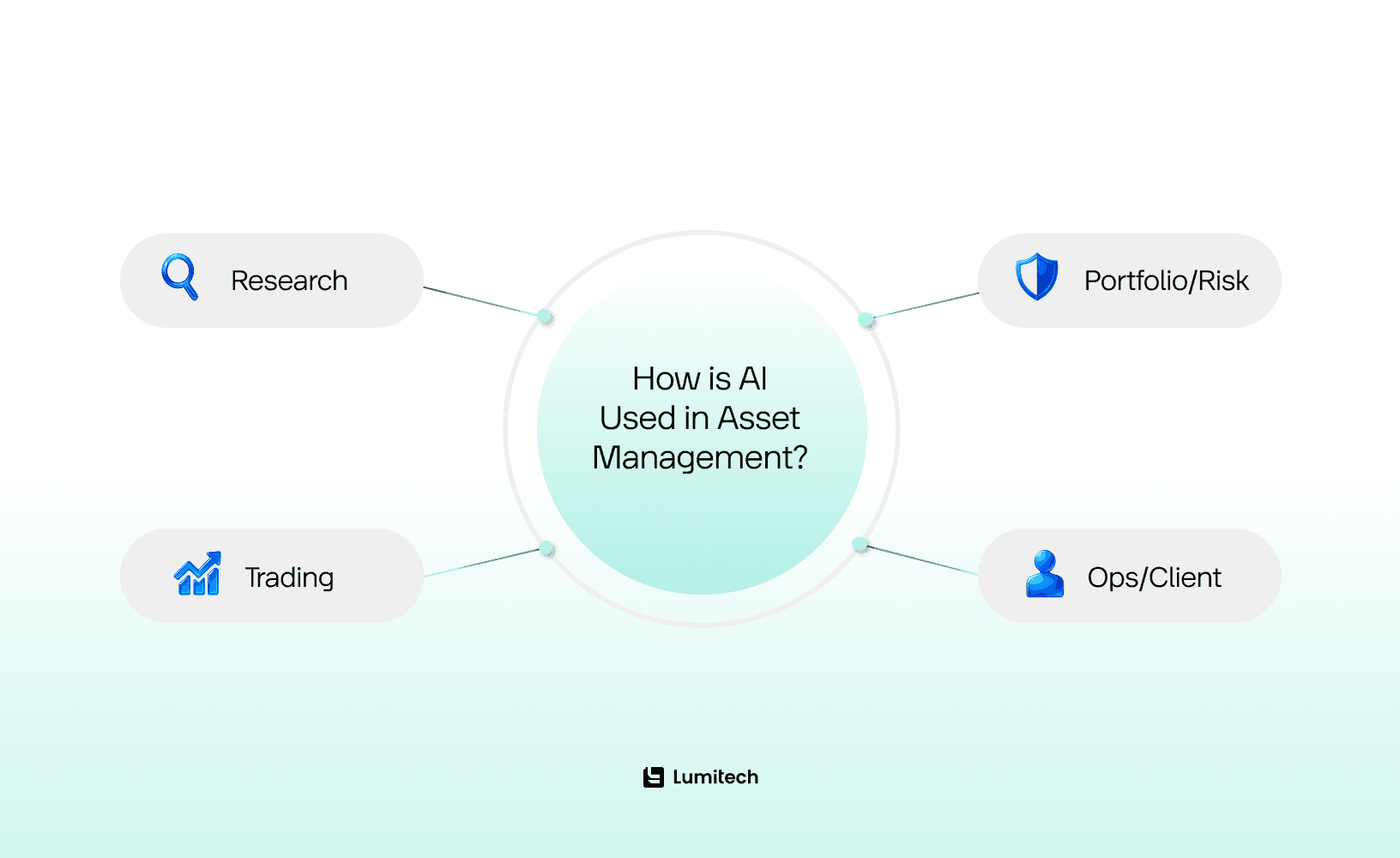
AI in asset management typically shows up in four places:
Investment decision support (research, signal generation, idea prioritization)
Portfolio construction and risk management (forecasting, optimization, monitoring)
Trading and implementation (execution analytics, cost prediction, liquidity signals)
Operations and client work (reporting, DDQs/RFPs, communications—carefully)
Many capabilities overlap with adjacent domains like AI in wealth management, especially when it comes to reporting, client communication, and regulated personalization.
That’s the “where.” The “how” is usually a mix of machine learning models for structured prediction and NLP/LLMs for unstructured data. ESMA has noted increasing use of AI and NLP by asset managers across investment strategies, risk management, and compliance, while fully AI-based investment processes remain relatively limited.
Here are some more detailed examples of the use of AI in asset management:
Systematic Alpha Generation
Machine Learning (ML) has evolved from simple linear regressions to complex, non-linear models that can identify “regime shifts” in real-time.
Factor Investing 2.0: AI identifies hidden factors, such as supply chain resilience or executive sentiment, that traditional Fama-French models miss.
Deep Learning for Price Prediction: Using Recurrent Neural Networks (RNNs) to analyze time-series data, capturing short-term momentum patterns that are invisible to the human eye.
Smart Beta and Passive Management
Even passive providers are using AI and machine learning in asset management to optimize index tracking. AI-driven rebalancing algorithms can minimize “slippage” and “market impact” when moving large blocks of capital, ensuring that "passive" doesn't mean “inefficient.”
Risk Management and Stress Testing
Traditional Value-at-Risk (VaR) models often fail during “Black Swan” events because they rely on historical distributions. AI uses Generative Adversarial Networks (GANs) to create “synthetic market crashes”: scenarios that haven't happened yet but are mathematically possible, allowing managers to battle-test their portfolios against the unknown.
The practical truth about AI and asset management
Most firms won’t run fully autonomous portfolios any time soon. Not because it’s impossible in a lab, but because markets shift, oversight matters, and clients (and regulators) prefer “explainable accountability” over “trust the model, bro.”
So the winning posture is augmentation:
AI accelerates discovery and standardizes analysis
Humans own judgment, accountability, and final decisions.
And yes, this is less cinematic than “AI replaces portfolio managers.” It’s also far more profitable.
The Highest-ROI Use Cases of AI for Asset Management
1) Research acceleration and idea generation
Analysts drown in text: filings, transcripts, news, macro releases, broker research, internal notes. AI asset management helps by:
extracting key themes and risk factors
clustering companies by business similarity (not just sector labels)
surfacing weak signals that deserve investigation
standardizing how you summarize and compare companies.
What “good” looks like: faster time-to-thesis with traceable sources, and less “we missed that because nobody had time to read it.” Think of this as decision intelligence services for research: not replacing the thesis, but improving what gets surfaced, compared, and decided under time pressure.
2) Signal engineering and forecasting (structured ML)
Classical machine learning in banking sector still does heavy lifting in asset management:
ranking securities based on factors
forecasting volatility/liquidity
detecting anomalies in fundamentals or price behavior
predicting flows or risk regime shifts.
Here, simple often beats fancy. A robust gradient-boosted model with clean data and monitoring routinely outlives an overfit neural network that looked amazing in backtests and then got humbled by reality.
3) Risk monitoring and early-warning systems
AI for asset management can monitor:
factor exposures and drift
concentration risks
unusual behavior in holdings or pricing
“thesis drift” signals (e.g., fundamental deterioration, sentiment shift).
BIS research frames AI as part of the financial system’s broader evolution in information processing, while highlighting risks from complexity and dependencies.
4) Trading and execution analytics
Artificial intelligence in asset management improves implementation by predicting:
transaction costs
liquidity conditions
short-term volatility patterns
optimal execution schedules.
This is one of the cleanest “business value” links: reduce implementation shortfall, and you’ve created measurable value without pretending you can predict next quarter’s earnings better than the market.
5) Client reporting and communications (LLM-heavy)
LLMs can draft commentary, performance explanations, client Q&A responses, and DDQ/RFP drafts. Done well, it looks a lot like generative AI for wealth management: grounded drafts, controlled tone, and humans signing off before anything goes out the door.
But: external-facing outputs need strict grounding and review. Hallucinated numbers in a client report are not “AI’s fault.” They are your firm’s fault.
Move from “AI ideas” to a production-ready use case with monitoring, controls, and adoption baked in.

AI Asset Management and Alternative Data: The New "Oil" Needs a Refiner
If traditional data (earnings, PE ratios, interest rates) is the "fuel," then alternative data is the high-performance additive. But there is a catch: alt-data is notoriously messy. This is where AI becomes the "refinery."
Satellite and Geolocation Data
Asset managers are using computer vision to analyze satellite imagery of retail parking lots, oil storage tanks, and even crop health. AI converts these images into a numerical signal: e.g., “Target’s foot traffic is up 12% YoY,” weeks before the quarterly report is released.
Transactional and Web Scraping
By processing anonymized credit card flows and scraping millions of job postings, AI asset management models can detect a company’s operational health in real-time. If a tech firm suddenly stops hiring and its employees are updating LinkedIn profiles en masse, the AI flags a structural risk signal to the analyst.
The "Signal-to-Noise" Challenge
The danger of alt-data is “overfitting”: finding patterns in random noise. Pragmatic firms use Bayesian ML models to assign a “confidence score” to alt-data signals. If the satellite data contradicts the fundamental earnings trend, the AI doesn't just average them; it asks why they diverge.
For digital-asset exposure, some teams incorporate a real-time crypto market analytics platform as part of their alternative data stack to monitor liquidity, sentiment, and on-chain market structure.
The real AI asset management challenge: not “can we get data?” but “should we use it?”
Alternative data is also where you can accidentally step on legal and ethical landmines. A common compliance framing highlights insider trading and privacy as two major concerns for fund managers consuming alternative data. Privacy regulators have also issued guidance on protecting against unauthorized data scraping and complying with data protection requirements, relevant if your alternative data pipeline touches scraped sources.
A practical alternative-data workflow
Here’s an example of artificial intelligence in asset management workflow that doesn’t end in a compliance meeting:
Source vetting: provenance, licensing, consent, and whether the data could contain MNPI-like signals.
Data documentation: what it is, what it isn’t, refresh frequency, biases, gaps.
Feature engineering: robust transformations, outlier handling, stability testing.
Modeling: strict out-of-sample validation and transaction-cost realism.
Monitoring: drift detection (data and signal decay), vendor changes, coverage shifts.
Controls: access restrictions, retention, auditability.
If this sounds like a lot, it is. But it’s still cheaper than building a signal on data you don’t actually have the right to use.
AI and Asset Management: What Can LLMs Do for Managers and Analysts?
LLMs are best described as language engines that excel at summarizing, drafting, classifying, and retrieving knowledge, especially when paired with retrieval systems (RAG) over approved internal sources. In practice, that makes well-governed copilots a form of decision intelligence services: they don’t decide, but they dramatically improve what humans decide with.
1) Research copilots that speed up synthesis
This is one of the most practical use cases of AI and machine learning in asset management. A strong LLM copilot can:
summarize earnings calls and filings with key drivers
compare management tone changes across quarters
extract risk disclosures and identify what changed
generate first drafts of investment memos.
It won’t replace the investment thesis. But it will reduce the time spent getting to the point where a human can form one.
2) Institutional memory on demand
Asset managers have years of internal research, committee notes, meeting write-ups, and “why we did this” documentation, often buried in shared drives that resemble archaeological sites.
A retrieval-grounded model for artificial intelligence asset management can answer:
“Have we owned this before? Why did we exit?”
“Find similar cases and summarize outcomes.”
“What were the top risks flagged last time?”
This reduces repetitive work and helps avoid the classic mistake: repeating a past error because no one remembered it had happened.
3) Workflow support: DDQs, RFPs, and reporting
These are high-volume, high-friction tasks that don’t directly create alpha but do consume talent. When talking about asset management and AI, LLMs can draft responses using approved content and style, turning teams from writers into reviewers.
4) Analyst “linting” (quality checks)
LLMs can flag:
inconsistent assumptions (“your thesis says pricing power; your model assumes margin compression”)
missing sections
unclear logic
sloppy wording that compliance will reject.
Think of it as Grammarly for investment logic, minus the guarantee it’s right.
Non-negotiable controls: source grounding, permissioning, logging, and human review, especially for anything that could be construed as advice or marketed claims.
The Biggest Challenges of AI Adoption in Asset Management
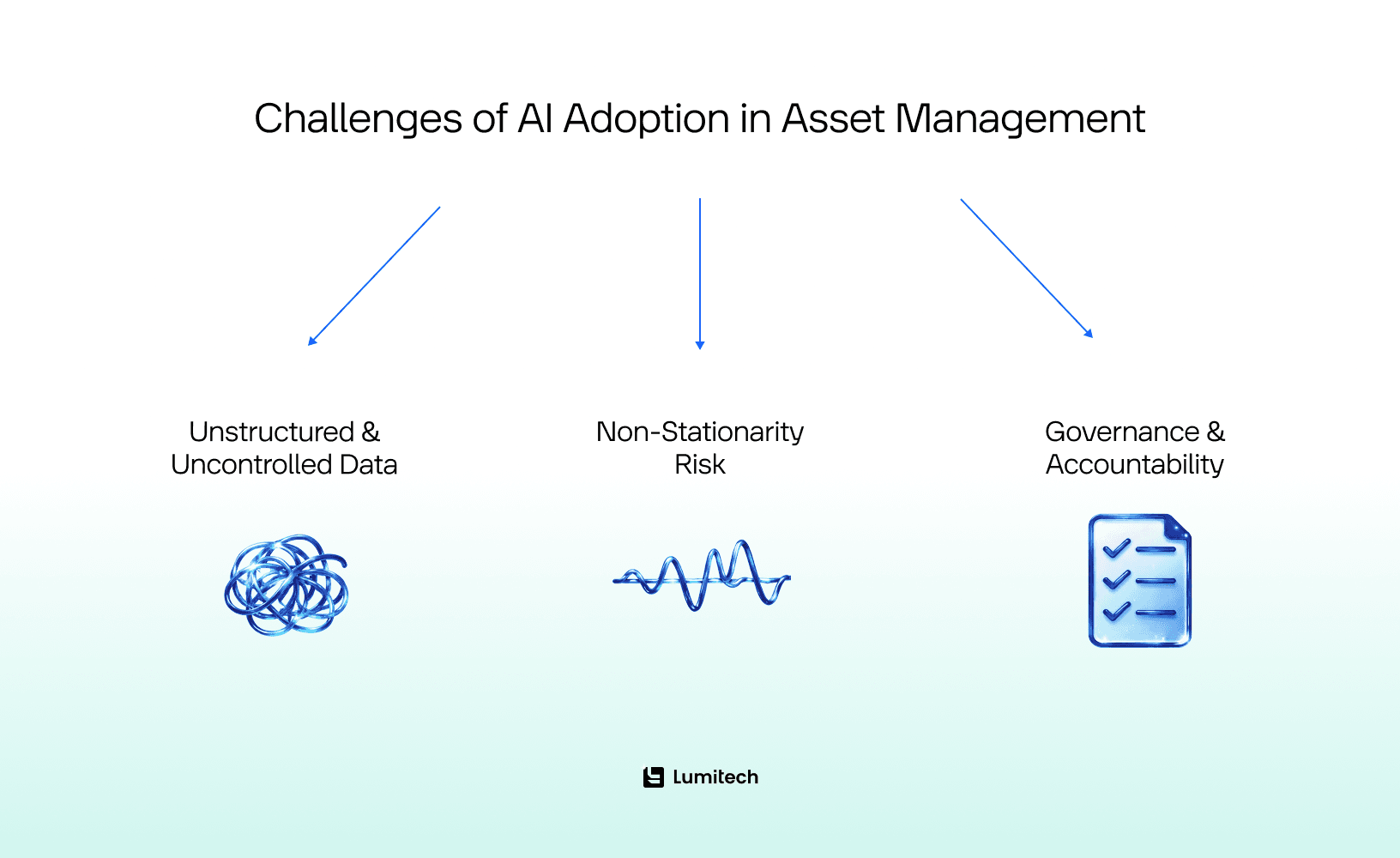
AI adoption struggles are rarely about “the model didn’t train.” They’re about the operating system of the firm.
1) Data quality, lineage, and permissioning for AI in asset management
Most legacy firms have data scattered across 20 different systems. AI requires a “Clean Data Lake.” Without centralizing and cleaning your data, your high-end AI is just a very expensive way to generate wrong answers. Asset management data is scattered across:
market data platforms
internal research stores
vendor feeds
portfolio accounting systems
risk engines
spreadsheets that somehow became “critical infrastructure.”
If you can’t answer “where did this data come from?” and “who is allowed to use it?”, you can’t scale AI-powered asset management safely. This is why data governance in the banking industry is the model that asset managers increasingly borrow.
2) Non-stationarity and regime shifts
Markets change. Models trained on one regime can break in another. This is why ESMA’s observation (that fully AI-based investment processes remain limited) makes practical sense.
3) Overfitting and backtest theater
If your ML pipeline isn’t designed to prevent leakage and selection bias, you’ll produce impressive charts that won’t survive contact with live trading.
The telltale sign: a backtest that looks like an elevator, paired with a shrug when asked about costs, liquidity, and stability.
4) Explainability, accountability, and governance
While combining asset management and AI, remember: investors, risk committees, and regulators want clarity.
What does the model do?
What data does it use?
What are its limitations?
Who signs off on changes?
What happens when it misbehaves?
IOSCO’s work on AI in capital markets emphasizes governance, controls, and the benefits and risks of AI in asset management.
Regulators (and clients) demand to know why a trade was made. If your combination of AI and asset management suggests a massive short position on a blue-chip stock, “the model said so” is not a valid defense. Explainable AI (XAI) is the biggest technical hurdle; firms must build “interpreter” layers that translate complex neural outputs into human-readable logic.
5) Tooling gaps and “pilot purgatory”
Many firms run AI proofs of concept that never graduate because:
models aren’t productionized
monitoring is missing
data pipelines aren’t stable
integration with portfolio/risk systems is weak
compliance sign-off arrives late (or never).
For many firms, escaping that loop means investing in software development solutions for fintech that connect data, models, and governance into one production-grade workflow.
6) Culture and change management
The most underpriced risk: adoption failure. The “Quants” speak one language, and the “Fundamental PMs” speak another. The firms that fail are the ones where the AI team is an “island.” The winners are those who embed data scientists directly into the investment pods.
And yes, adoption is also a product problem: UX design for fintech matters because analysts won’t use tools that add friction when deadlines hit.
A Pragmatic Roadmap: How to Adopt AI in Asset Management Without Turning it Into a Science Project
Step 1: Start with outcomes, not algorithms
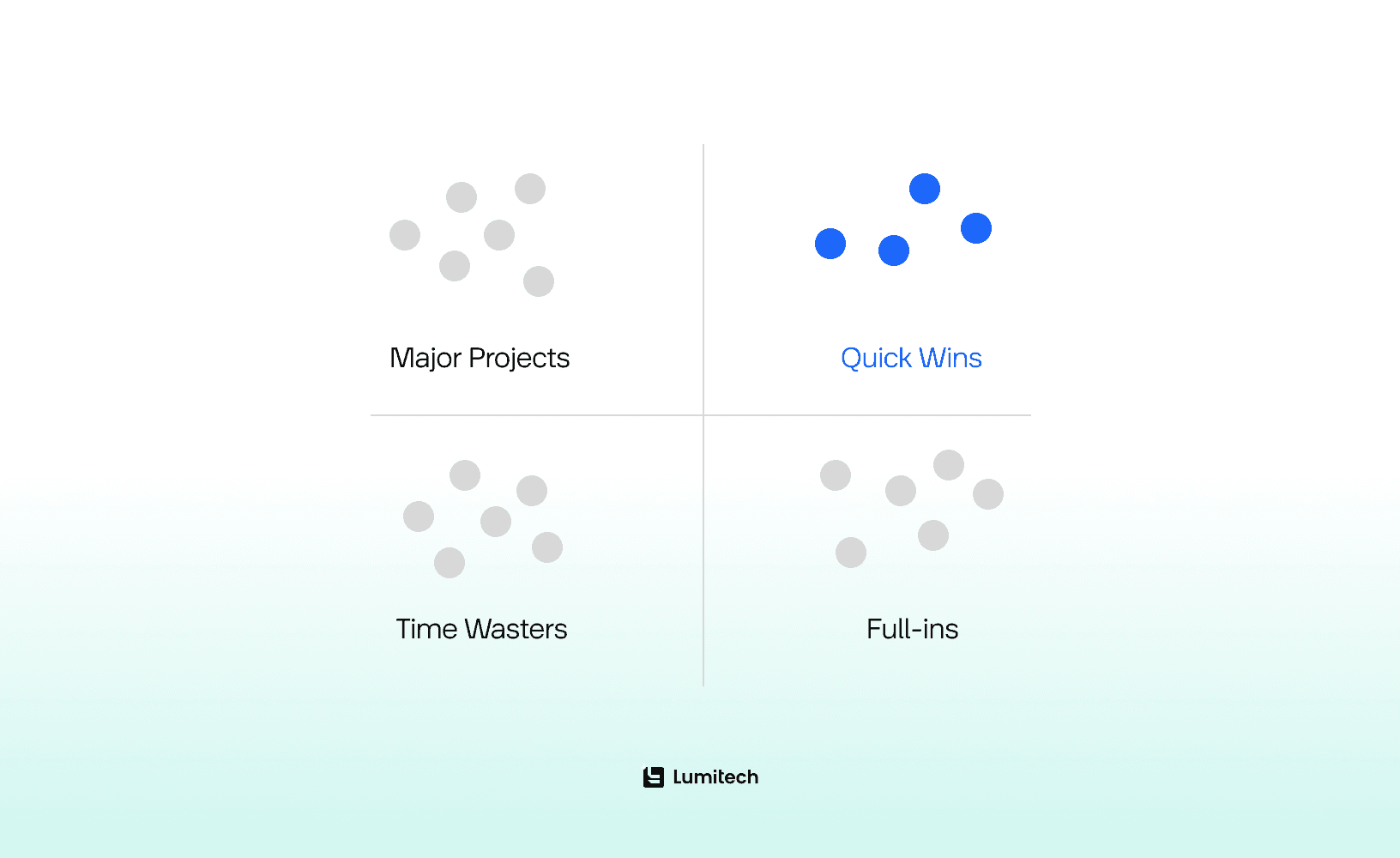
Pick 5–10 candidate use cases and score them on:
measurable business value
feasibility (data access, integration)
risk (client impact, regulatory sensitivity).
Tie each use case to metrics before you build anything.
Step 2: Define the “human decision boundary”
Decide explicitly:
where AI recommends vs decides
what requires human approval
what requires compliance review
what can be automated end-to-end.
This avoids accidental autonomy creeping in because “the tool made it easy.”
This is the same hard lesson teams learn in AI in investment management: when accountability is fuzzy, risk grows faster than performance.
Step 3: Build governance that enables speed and safety
A solid baseline is to adapt a general risk framework like NIST’s AI Risk Management Framework into investment-firm realities (model inventory, documentation, monitoring, incident response).
Governance doesn’t mean “create a committee that meets quarterly.” It means clear ownership, validation gates, change control, monitoring, audit trails, and an escalation path when things go wrong.
“Borrowing practices from machine learning in banking — validation gates, monitoring, and change control — helps asset managers avoid ‘pilot purgatory’ and audit panic later.
Step 4: Choose the right technical pattern (especially for LLMs)
For artificial intelligence asset management use cases, “RAG + permissions + logging” is usually the safe default:
keep documents internal
retrieve only what the user is entitled to see
ground outputs in sources
log prompts/outputs appropriately.
Step 5: Pilot like a clinical trial, not a demo
A real pilot has a primary metric, a baseline comparison, a defined evaluation window, clear go/no-go criteria, and documentation of failure modes.
If success is defined as “stakeholders liked the demo,” you’re doing theater, not product.
Step 6: Productionize with monitoring and kill-switches
Models drift. Data changes. Vendors update feeds. Your system needs performance monitoring, drift detection, alerting thresholds, and rollback/kill-switch procedures.
If this sounds paranoid, good. In finance, paranoia is just “risk management with a personality.” Most failed initiatives aren’t failures of modeling. They’re failures of AI and ML development discipline: versioning, deployment pipelines, observability, and rollback.
How do Firms Measure the Success of Artificial Intelligence in Asset Management?
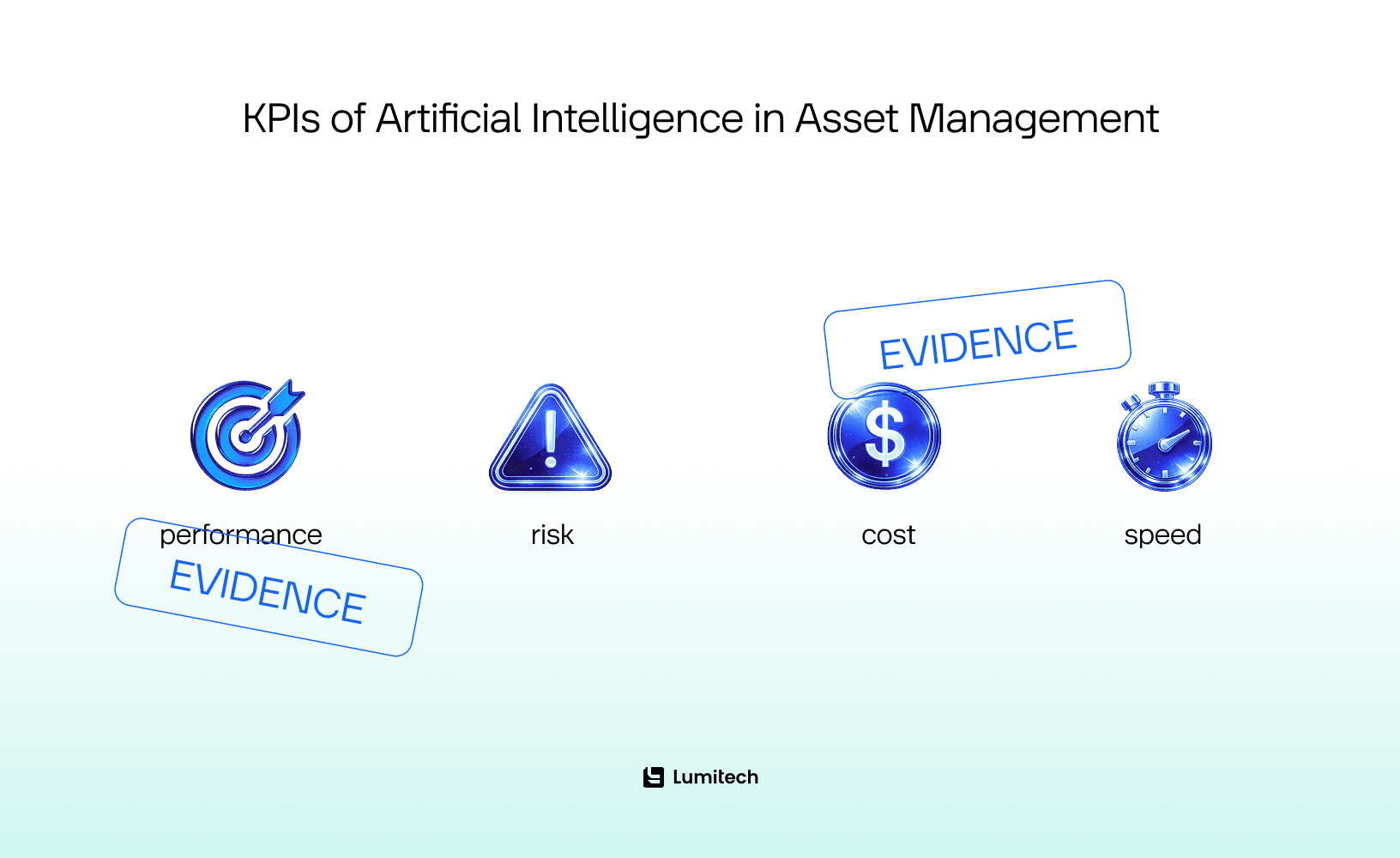
This is where many programs collapse into vague claims and internal slides. Don’t do that. Using investment analytics software to connect model usage to performance, risk, and cost outcomes is how teams avoid ‘AI value’ turning into storytelling. Choose metrics that match the use case:
Investment performance metrics (when AI touches signals or construction)
out-of-sample performance vs benchmark
hit rate/information ratio
drawdown and tail risk impacts
turnover and transaction-cost impacts.
Implementation metrics (when AI for asset management touches trading)
implementation shortfall improvements
cost reduction per unit traded
liquidity capture
slippage vs baseline.
Productivity and operational metrics (when AI touches workflows)
time-to-produce (reports, memos, DDQs)
error rates and rework
analyst hours freed for research
adoption and usage (active users, tasks completed).
Risk and governance metrics (when AI touches monitoring/compliance)
incident frequency and severity
audit findings
false positive rates in surveillance/monitoring
time-to-detect anomalies.
And one more: marketing integrity. If you claim AI capabilities you can’t prove, regulators have shown they’re willing to act. The SEC’s 2024 enforcement actions against two advisers for misleading AI claims are a clean warning shot.
What Could Go Wrong? A Short List of Avoidable Pain
In the process of AI adoption in asset management, beware of these situations:
You ship an LLM tool that drafts commentary, and someone sends hallucinated numbers to a client.
You buy alternative data, build signals, and later discover licensing or privacy issues.
You deploy a model that worked in one regime and quietly deteriorates—until the drawdown makes it everyone’s problem.
Your “AI strategy” is really “a notebook on someone’s laptop,” and when they leave, your program leaves with them.
You market “AI-powered” products without evidence and invite the wrong kind of attention.
None of these are unsolved mysteries. They’re governance and execution problems wearing a tech costume.
Wrapping Up
AI in asset management isn’t a shortcut to effortless outperformance. It’s a capability that can make your investment process faster, more consistent, and more scalable, if you connect it to measurable outcomes and treat it like a governed system, not a weekend experiment.
The firms that win will be the ones that operationalize AI: clean data pipelines, disciplined validation, monitoring that treats models as living systems, and LLM deployments grounded in approved sources with strict permissioning. They’ll use alternative data responsibly, document what their models do (and don’t do), and build workflows where humans stay accountable even when machines do the heavy lifting.
Everyone else will still “have an AI initiative.” It will live in a slide deck. And every quarter, it will be described as “promising. The difference isn’t ambition. Its execution.


