
AI in Investment Management: What Works, What Breaks, and Why
“AI is transforming investing” is true in the same way “the gym transforms bodies” is true: results happen only if you actually show up, train with a plan, and stop pretending protein powder is a strategy.
- Finance & Fintech
- AI Development
February 11, 2026
 AI Overview
AI in investment management applies machine learning, NLP, and alternative-data processing to research, portfolio construction, trading, and risk monitoring, augmenting rather than replacing human judgment. Core components include reinforcement-learning execution algorithms, sentiment analysis on filings and transcripts, and agentic AI drafting investment memos. Because AI struggles with regime shifts and causal reasoning, firms tie use cases to measurable outcomes instead of full automation.


Investment management is being reshaped by AI, just not by magic. The firms getting value are the ones that tie specific use cases for AI in financial services to measurable business outcomes, build governance that doesn’t suffocate innovation, and treat implementation like a change program (because it is). Regulators are also paying attention: from conflicts-of-interest concerns in “predictive analytics” to enforcement actions for “AI washing.”
This article is a pragmatic blueprint for adopting AI in investment management, linking use cases to business value, and covering the governance, tooling, and change management needed to scale safely.
The Taxonomy of Intelligence: What’s Under the Hood?
Before you can fix the engine, you need to know the parts. In investment management, AI isn't a monolith. It’s a toolkit of distinct models, each suited for different “alpha-generating” or “cost-saving” tasks.
Machine Learning (ML) & Predictive Analytics
Machine learning in investment management is the bread and butter of quantitative finance. ML models don't just follow rules; they find patterns in historical data to predict future outcomes.
Regressions & Random Forests: Used for traditional factor modeling (e.g., predicting which value stocks will finally stop being “value traps”).
Deep Learning (Neural Networks): Mimicking the human brain's structure to find non-linear relationships in massive datasets.
Reinforcement Learning (RL): Often used in execution algorithms. The AI “learns” by trial and error to execute a large block trade with minimal market impact, essentially playing a video game where the prize is lower slippage.
Natural Language Processing (NLP) & GenAI
If ML handles the numbers, NLP handles the “noise.”
Sentiment Analysis: Scanning millions of tweets, earnings call transcripts, and Reddit threads to see if the market's mood on a stock is shifting before the price does.
Agentic AI: The 2026 frontier. Unlike standard chatbots, AI agents can perform multi-step tasks, like researching a company, cross-referencing its ESG scores, and drafting a preliminary investment memo for a human analyst to review.
Alternative Data Processing
AI is the only way to process “Alt-Data” at scale. This includes everything from satellite imagery of retail parking lots to credit card transaction flows. Without AI and ML development, this data is just a digital landfill; with it, it's a proprietary signal.
What AI in Investment Management Actually Does Well (and What It Doesn’t)
AI is best at pattern extraction, ranking, classification, and summarization, especially when the input space is huge (news, filings, transcripts, satellite data, ticks, alternative data). It can:
digest far more information than a human analyst team can
highlight signals worth investigating
standardize processes (and reduce “key-person risk”)
automate repetitive research and monitoring.
But AI for investment management is not a mystical oracle. It struggles with:
regime shifts (the market changes the rules mid-game)
causal reasoning (knowing why something worked)
non-stationarity (today’s signal becomes tomorrow’s noise)
good judgment under uncertainty (which is… investing).
If your AI program is framed as “replace PMs,” you’ll build political resistance and poor systems. If it’s framed as “augment decisions, tighten risk controls, and accelerate research,” you’ll get adoption.
The Business-Value Lens: Benefits of AI in Investment Management
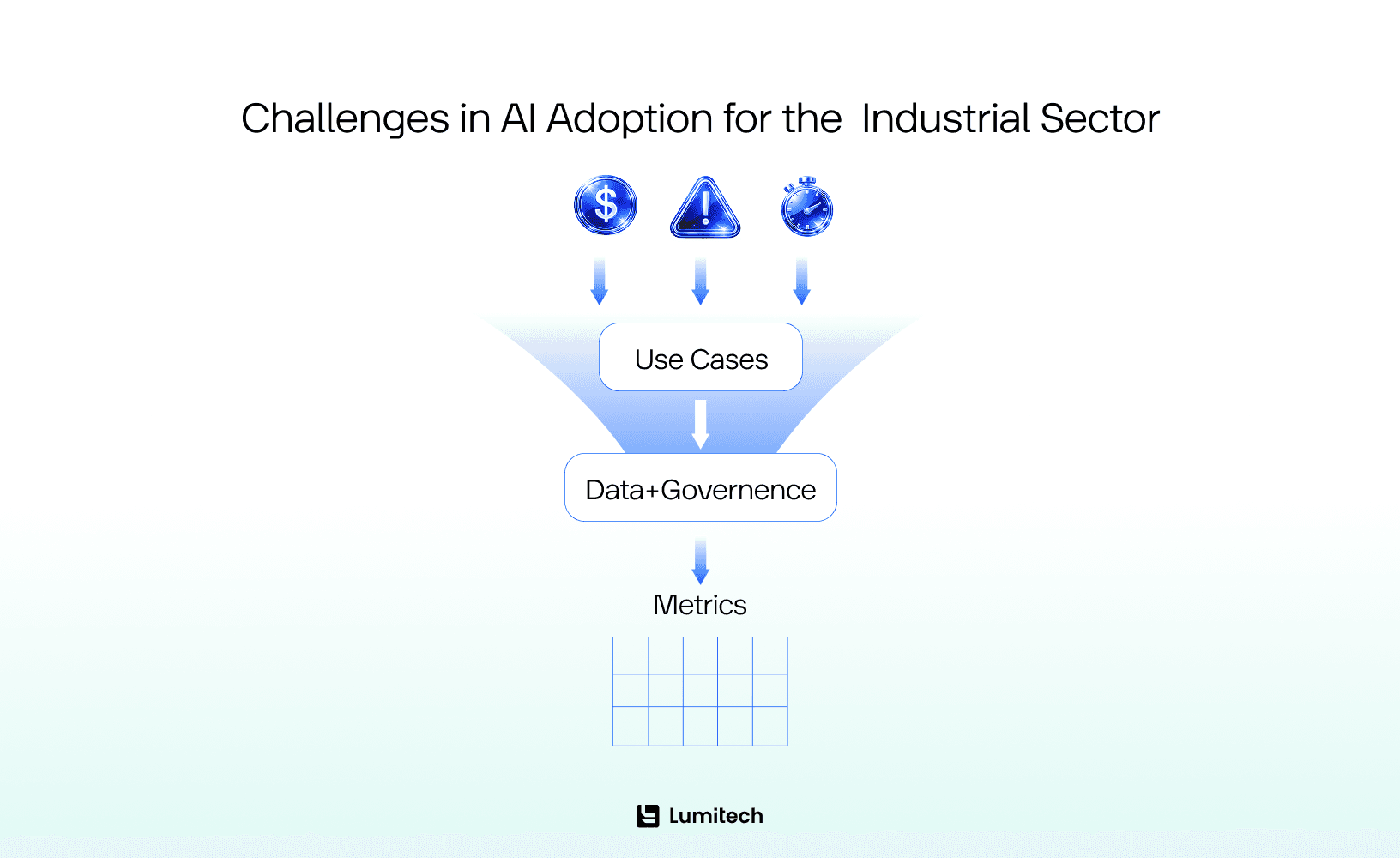
A useful AI roadmap begins with measurable outcomes, and the fastest way to prove them is to instrument your workflow with investment analytics software that tracks impact end-to-end. Not “deploy LLMs.” Not “use deep learning.” Outcomes.
Here are typical business objectives for artificial intelligence in investment management:
1) Improve investment performance (without blowing up risk)
AI for investment management can help generate, refine, and monitor signals; improve portfolio construction; and reduce execution costs. IOSCO’s 2024 work notes firms using AI for decision support across trading, research, and sentiment analysis. CFA Institute’s research also documents expanding use across portfolio management and risk analysis, alongside the need for strong governance.
Business metrics to attach:
information ratio/hit rate of signals (out-of-sample)
drawdown profile/tail risk changes
turnover and transaction cost improvements
implementation shortfall and slippage.
2) Reduce operational cost and cycle time
AI helps automate document intake (mandates, DDQs, RFPs), compliance checks, report generation, post-trade analytics, and client servicing (with controls).
Metrics:
time-to-produce (reports, commentary)
cost per account / per report
error rates and rework
analyst hours redeployed to higher-value tasks.
3) Strengthen risk management and monitoring
AI in investment management can enhance anomaly detection (positions, cash, pricing), early warning signals (credit, liquidity), and model monitoring (drift, performance decay).
BIS research emphasizes AI’s expanding role across finance while underscoring systemic and operational risks, especially concentration in a few providers and vulnerabilities like manipulation or over-reliance.
Metrics:
alert precision/recall
time-to-detect issues
incident frequency and severity
reduction in near-misses.
4) Improve client outcomes and personalization
AI-driven investment management can easily tailor portfolios, recommendations, and communications. But this is also where conflicts of interest and “nudging” concerns show up. The SEC has explicitly targeted risks tied to predictive data analytics in investor interactions, focusing on conflicts where firm incentives may be placed ahead of clients.
Metrics:
client retention and satisfaction
suitability exceptions
complaint rates
compliance incidents.
Key Use Cases of AI-Powered Investment Management (With a Reality Check)
AI in investment management for research & signal discovery
What it looks like: NLP on earnings calls, filings, news; feature generation from alternative data; factor discovery pipelines.
Where it adds value: Speed, breadth, consistency.
Reality check: The signal must survive data leakage, overfitting, and regime changes. Most “amazing backtests” die when exposed to transaction costs and live markets.
Decision support for PMs and analysts
What it looks like: “Copilot” tools that summarize research, compare scenarios, and surface precedent — essentially, decision intelligence services applied to portfolio decisions.
Where it adds value: Faster synthesis and better institutional memory.
Reality check: Copilots can hallucinate. If you don’t build guardrails, you’re essentially giving the team a brilliant intern who is also occasionally confident and wrong.
Portfolio construction and optimization
What it looks like: Machine-learning risk models, nonlinear optimizers, reinforcement learning (rare in production), robust optimization enhanced with ML forecasts.
Where it adds value: Improved constraints handling, better forecasts of covariance/returns (sometimes), scenario-aware construction.
Reality check: A fancier optimizer doesn’t fix fragile inputs.
AI-powered investment management for trading, execution, and market microstructure
What it looks like: Predictive models for short-term price movement, liquidity, and cost, often fed by a real-time crypto market analytics platform when the strategy touches digital assets.
Where it adds value: Lower transaction costs and improved execution quality.
Reality check: This is where model risk meets “markets hit back.” Drift can be rapid.
Risk, compliance, surveillance
What it looks like: Trade surveillance, communications monitoring, fraud and anomaly detection, policy checks, and monitoring of personal account dealing.
Where it adds value: Scale and consistency, especially for large platforms.
Reality check: False positives create alert fatigue. Calibration and human workflows matter as much as the model.
Client reporting and communications: generative AI in investment management
What it looks like: Automated commentary drafts, Q&A systems over portfolio holdings, and interactive explanations of performance and risk are all great use cases for generative AI for wealth management.
Where it adds value: Speed and personalization.
Reality check: Everything you publish must be verifiable. Regulators have penalized misleading AI marketing claims (“AI washing”), which is a polite way of saying, “Don't lie about your tech.”
What Types of AI/ML Models are Used in Investment Management?
You don’t need every model under the sun for your AI-driven investment management. You need the right tool for each problem, plus controls.
Core ML families you’ll actually see
1) Supervised learning (structured prediction)
Linear/logistic regression (still wins for interpretability and stability)
Gradient boosting (XGBoost/LightGBM/CatBoost)
Random forests
Neural networks (when data volume and signal justify it)
Use cases: return prediction, default risk, anomaly detection, signal ranking.
2) Unsupervised learning (structure discovery)
Clustering (k-means, hierarchical, DBSCAN)
Dimensionality reduction (PCA, autoencoders)
Use cases: regime detection, peer grouping, anomaly detection.
3) Time-series models
ARIMA-family (still used)
State-space / Kalman filters
Temporal CNNs / RNNs / Transformers (selectively)
Use cases: forecasting volatility, liquidity, flows, and macro nowcasting.
4) NLP models
Traditional: TF-IDF, topic models
Modern: transformer-based models for embeddings and classification
LLMs for summarization and retrieval-augmented Q&A (RAG)
Use cases: sentiment, event extraction, doc understanding, research copilots.
5) Reinforcement learning (RL) Used more in research than production for trading due to stability and validation challenges.
6) Causal and structural approaches Not always “AI-branded,” but crucial to avoid spurious correlation:
causal graphs, instrumental variables, synthetic controls,
uplift modeling for client interactions (with strong compliance controls).
CFA Institute’s asset management work surveys a broad range of tools and frontiers, reflecting how diverse the model stack can be, yet governance and accountability remain central.
How AI Improves Investment Decision-Making (When Done Right)
AI for investment management improves decisions less by “predicting the market” and more by improving the decision process:
1) Better coverage and faster synthesis
Instead of sampling 50 documents, you can scan 50,000 and prioritize what matters.
2) More consistent signal evaluation
Humans are inconsistent (and moody). AI pipelines can enforce consistent feature definitions, scoring, and monitoring.
3) Earlier detection of risk
One of the clearest benefits of AI in investment management: anomaly detection and monitoring can catch issues before they become performance events.
4) Stronger “institutional memory”
LLM-powered retrieval (with proper access control and citation) can surface prior research, past decisions, and rationale—reducing repeated work and forgotten lessons.
5) Improved scenario analysis
AI software for investment management can help build richer scenarios from structured and unstructured inputs, but the key is that humans still make the decision.
The Risks of Using AI in Investment Management (and Why Governance Is Not Optional)
AI investment management risk isn’t just “the model may be wrong.” In finance, wrong can become contagious.
IOSCO highlights a spectrum of AI risks and challenges in capital markets, including governance, explainability, data quality, and operational resilience. BIS publications similarly emphasize reliability, accountability, transparency, and security themes emerging across AI guidance.
1) Model risk: overfitting, drift, and brittle performance
Markets evolve, and so does the impact of AI in investment management. A model that worked for three years can fail in three weeks.
Mitigation: strong validation, stress testing, challenger models, drift monitoring, and kill-switches.
Traditional model risk management guidance remains relevant, especially for teams borrowing lessons from machine learning in banking, where validation, documentation, and ongoing monitoring are table stakes. For example, U.S. banking supervision’s SR 11-7 has long emphasized validation, documentation, and ongoing monitoring — principles that map cleanly onto AI systems.
2) Data risk of AI for investment management: leakage, bias, and provenance
Leakage: future information sneaks into training.
Bias: data reflects structural distortions.
Provenance: you don’t know where the data came from—or whether you’re allowed to use it.
Mitigation: lineage tracking, dataset documentation, privacy checks, rights/licensing review.
3) Explainability and accountability
When AI influences investment decisions, clients and regulators may demand explanations, especially for suitability, marketing claims, and controls.
Mitigation: model cards, interpretable baselines, explanation tooling, and clear accountability assignments.
4) Conflicts of interest and “behavior shaping”
In wealth and advisory contexts, AI in wealth management can optimize for engagement or revenue rather than client outcomes, creating conflicts.
The SEC has proposed requirements aimed at identifying and addressing conflicts tied to predictive analytics and similar technologies used in investor interactions.
5) Operational and cyber risk
AI investment management increases attack surfaces: prompt injection, data poisoning, model extraction, and vendor concentration risks.
BIS work repeatedly flags dependency and concentration risks as AI becomes embedded in financial operations.
6) Regulatory and legal exposure
Europe’s AI Act creates a broad compliance landscape for AI systems, including “high-risk” classifications in financial contexts such as creditworthiness evaluation. Even when investment systems aren’t explicitly labeled “high-risk,” the Act signals where regulators see potential harms.
7) Reputational risk of AI investment management
If your marketing implies capabilities you don’t have, you’re not “positioning,” you’re building a regulatory problem. Enforcement actions have already targeted misleading AI claims by investment advisers.
A Pragmatic Adoption Roadmap: How Investment Firms Implement AI Solutions
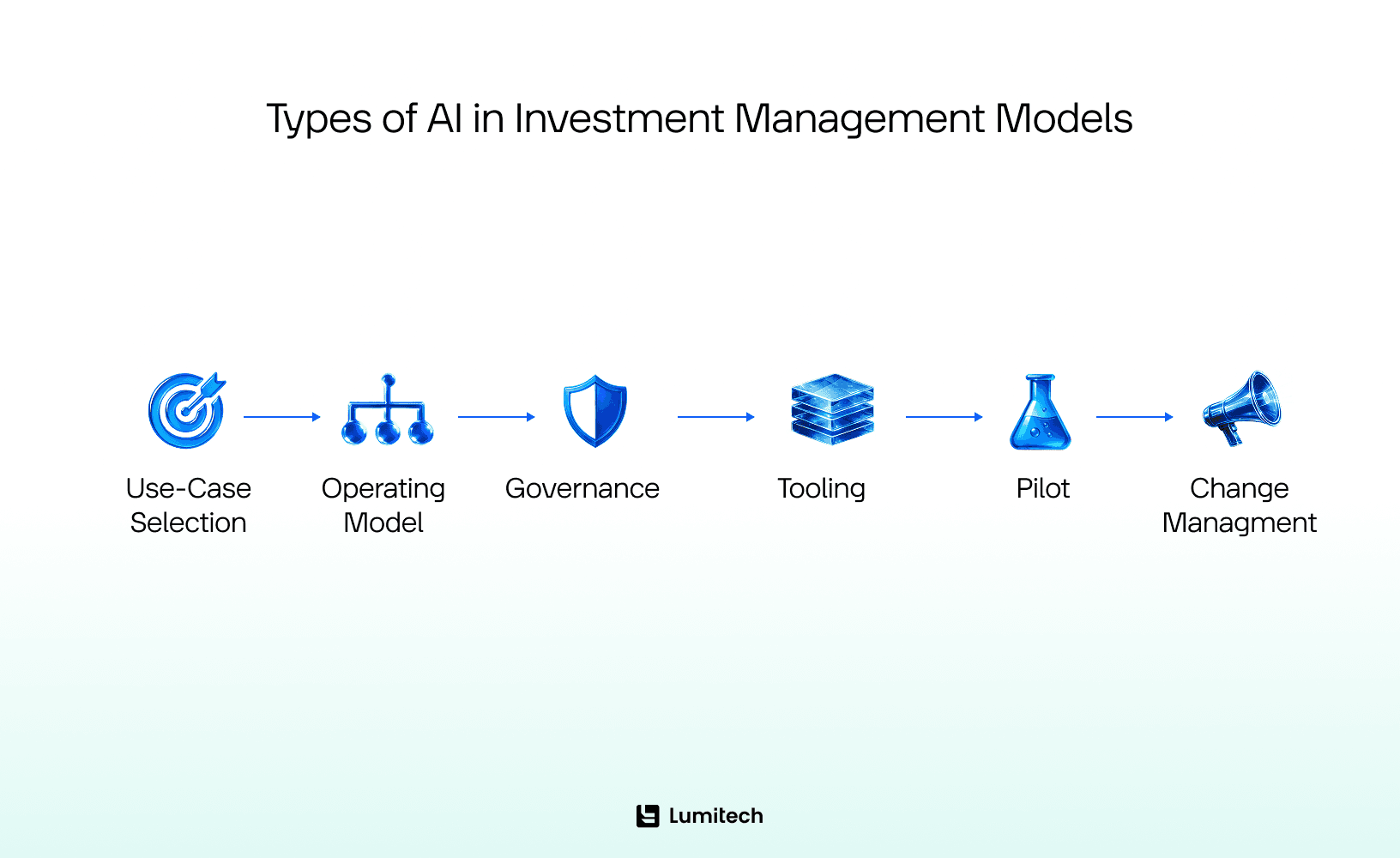
Here’s an implementation approach that works in real firms: messy data, legacy systems, auditors, and all.
Step 1: Build an AI use-case portfolio (value × feasibility × risk)
Treat artificial intelligence in investment management like a product portfolio. Pick 6–12 candidate use cases and score them.
Value: revenue uplift, cost reduction, risk reduction. Feasibility: data availability, system integration, talent. Risk: client impact, regulatory sensitivity, model risk, operational risk.
Avoid the trap of starting with the most glamorous use case (usually “LLM does everything”). Start with something that:
has clear metrics
can be piloted in 8–12 weeks
doesn’t require rewriting your entire platform.
Step 2: Decide your operating model (who owns what)
Successful investment firms make ownership explicit:
Business owners (PMs, research heads, trading) own outcomes.
Data/ML teams own model development and monitoring.
Risk & compliance define controls and sign-off gates.
IT/security owns infrastructure, access control, and vendor risk.
This is where the governance of AI technology in investment management stops being a slide deck and starts being a set of decisions.
Turn your AI roadmap into a measurable pilot: use cases, KPIs, governance, and a production plan included.

Step 3: Put governance in place that enables speed and safety
Use an AI risk framework as scaffolding. NIST’s AI Risk Management Framework is widely referenced as a practical structure for managing AI risks across design, deployment, and monitoring. Overlay it with model risk discipline (validation, monitoring) and financial-sector expectations.
Minimum viable governance for investment AI:
model inventory (what models exist, where used, who owns them)
documentation standards (data sources, features, training, limitations)
validation gates (backtests, stress tests, bias checks)
monitoring SLAs (drift, performance decay, incidents)
change control (versioning, approvals, rollback plans)
audit trails and reproducibility.
Step 4: Build the tooling stack (don’t duct-tape your way into production)
While buying or developing an AI service for investment, know that a scalable AI stack typically includes data, modeling, deployment, and GenAI layers. And for many companies, that means investing in software development solutions for fintech that can meet security, audit, and integration requirements.
Data layer
data lake/warehouse + feature store (optional but useful)
lineage, quality checks, and access control.
Modeling layer
experiment tracking
reproducible pipelines
model registry and versioning.
Deployment layer
APIs, batch pipelines, or embedded analytics
canary releases and rollbacks
monitoring (performance + data drift + latency).
GenAI layer (if using LLMs)
retrieval-augmented generation (RAG) over approved corpora
strict permissioning (who can query what)
citation and source attribution in outputs
guardrails (policy filters, prompt injection defenses)
human review for external-facing content.
Step 5: Run pilots like scientific experiments
For each pilot:
define a primary metric (one)
define guardrails (risk constraints)
pre-register evaluation windows and datasets,
compare against baseline methods,
document results, including failures.
If you “move the goalposts” after the pilot, you’ll always be “successful,” and your production system will always be “mysteriously disappointing.”
Step 6: Scale through change management (the part everyone forgets)
Scaling AI is mostly a people problem. PMs fear black boxes, analysts fear replacement, compliance fears headlines, and IT fears shadow infrastructure.
To scale, you need:
training by role (PM, analyst, risk, ops)
new workflows (how models enter decisions)
incentives aligned with adoption (time saved is a real KPI)
clear escalation paths (“model behaving oddly” playbook)
leadership backing that survives the first bad week.
The Bank of England/FCA survey work illustrates how widely AI is being adopted across UK financial services, and implicitly, how governance maturity varies across firms.
Governance at Scale: the Control Plane You’ll Wish You Built Earlier
When AI is small, everyone “just knows” what’s running. When it scales, nobody does, until something breaks.
A robust control plane typically includes:
Model inventory + classification
Classify models by impact:
Tier 1: directly influences trading/portfolio decisions or client outcomes
Tier 2: decision support
Tier 3: internal productivity and ops
Higher tiers require stronger validation, monitoring, and approvals.
Validation that matches the risk
Validation for a trading signal is not the same as validation for an LLM that drafts commentary.
Signals: out-of-sample tests, transaction costs, stability, stress regimes.
Risk models: sensitivity, backtesting, explainability, governance review.
GenAI: hallucination testing, retrieval evaluation, red-teaming, output logging.
Monitoring, drift, and incident response
If the model is live, it’s a living system:
drift metrics (feature distributions, embedding shifts)
performance tracking (live vs expected)
alerting and thresholds
rollback and kill-switch procedures.
Vendor and concentration risk controls
If your AI stack relies heavily on one provider, you need:
exit plans
redundancy or fallbacks
contractual clarity on data use
security review and continuous monitoring.
BIS has repeatedly pointed to concentration and dependency risks as AI adoption deepens in finance.
How to Avoid the Classic AI-in-Investing Failure Modes
Failure mode 1: “We have data” (but it’s unusable) Data exists but lacks lineage, is inconsistent, or isn’t permissioned.
Fix: data governance, ownership, and quality checks — borrowing proven practices from data governance in the banking industry before you build anything fancy.
Failure mode 2: “The backtest is incredible” Then live trading disappoints because costs, market impact, and leakage weren’t handled.
Fix: realistic simulation, transaction costs, strict leakage controls.
Failure mode 3: “We built a model; no one uses it” The model isn’t embedded into workflows, or users don’t trust it. This is why UX design for fintech matters as much as model accuracy when you’re trying to change behavior at scale.
Fix: decision-support UX, interpretability, training, and accountability.
Failure mode 4: “GenAI is everywhere” You deploy an LLM to talk to everything, then it hallucinates a number in a client report.
Fix: RAG with approved sources, citations, human review for external outputs, and tight permissions.
Failure mode 5: “We marketed AI… aggressively” Congrats, you invented a compliance problem.
Fix: substantiate claims, maintain evidence, and align marketing with reality.
Long-Term Impact of AI in Investment Management: What to Expect in the Next Decade
Forecasting is risky, but we can outline credible directional shifts:
1) “Research as a service” inside firms
LLM-based systems will increasingly answer questions over internal research and holdings, surface relevant precedent, and draft analyses with traceable sources.
The winners will be firms that treat this as a governed knowledge system, not a chatbot free-for-all.
2) More systematic decision-making across discretionary processes
Even discretionary managers will adopt systematic guardrails: standardized signal dashboards, probabilistic risk overlays, automated monitoring of thesis drift.
3) Governance maturity becomes a differentiator
AI governance will move from “nice-to-have” to core capability, especially as regulators watch conflicts, disclosure, and accountability.
4) AI provider concentration becomes a strategic risk
Vendor dependence will be treated like a resilience issue (similar to cloud concentration).
5) Client expectations shift
Clients will ask:
How is AI used in decisions?
What controls exist?
Can you explain model-driven outcomes?
Firms with transparent processes and defensible governance will win trust.
Conclusion
AI in investment management isn’t a silver bullet—it’s a lever. Pull it correctly and you get faster research cycles, tighter risk controls, better execution, and more consistent decision-making. Pull it blindly and you get brittle models, compliance headaches, and an expensive machine for producing confident nonsense at scale.
The pragmatic path is straightforward (not easy, but straightforward): start with use cases tied to measurable business value, build data and model discipline that survives real markets, and put governance in place that protects clients without killing iteration speed. Treat LLMs like powerful interns: great at summarizing, drafting, and finding needles in haystacks, but absolutely not qualified to sign off on numbers or investment decisions without supervision.
Over the next decade, the differentiator won’t be who “uses AI” (everyone will claim they do), but who operationalizes it responsibly, embedding models into workflows, monitoring them like living systems, and being honest about what’s automated and what still requires human judgment. In a world where alpha is scarce and trust is fragile, AI will reward the firms that combine technical capability with rigorous accountability and punish the ones who mistake hype for strategy.


