
Payments Trends 2026: How Businesses Can Modernize Payment Infrastructure
Here is a quick reality check: if your payments infrastructure still runs on logic designed for the era of swipe-and-sign, you are not just behind the curve — you are the curve.
- Fintech
- Finance services
June 19, 2026
 AI Overview
By 2026, payments will be faster, smarter, and more embedded into digital commerce. This article explains key payment trends, their business impact, signs your infrastructure needs modernization, and practical steps to support real-time payments, wallets, AI fraud detection, orchestration, and seamless checkout.

The future of payments is not approaching; it has already arrived at checkout, is tapping its foot impatiently, and will abandon the cart in 3.2 seconds if you keep it waiting.
By 2026, the latest trends in the payments industry converge on a single thesis: payments will be faster, smarter, more secure, and more deeply woven into the fabric of digital commerce. Businesses that upgrade now will gain compounding advantages in conversion, trust, and operational efficiency. Businesses that wait will pay — literally — in lost revenue and remediation costs.
This article is a practical guide: what is happening, why it matters to your bottom line, how to know if you are at risk, and what to do about it. Let’s get into it.
Why Payment Infrastructure Modernization Matters in 2026
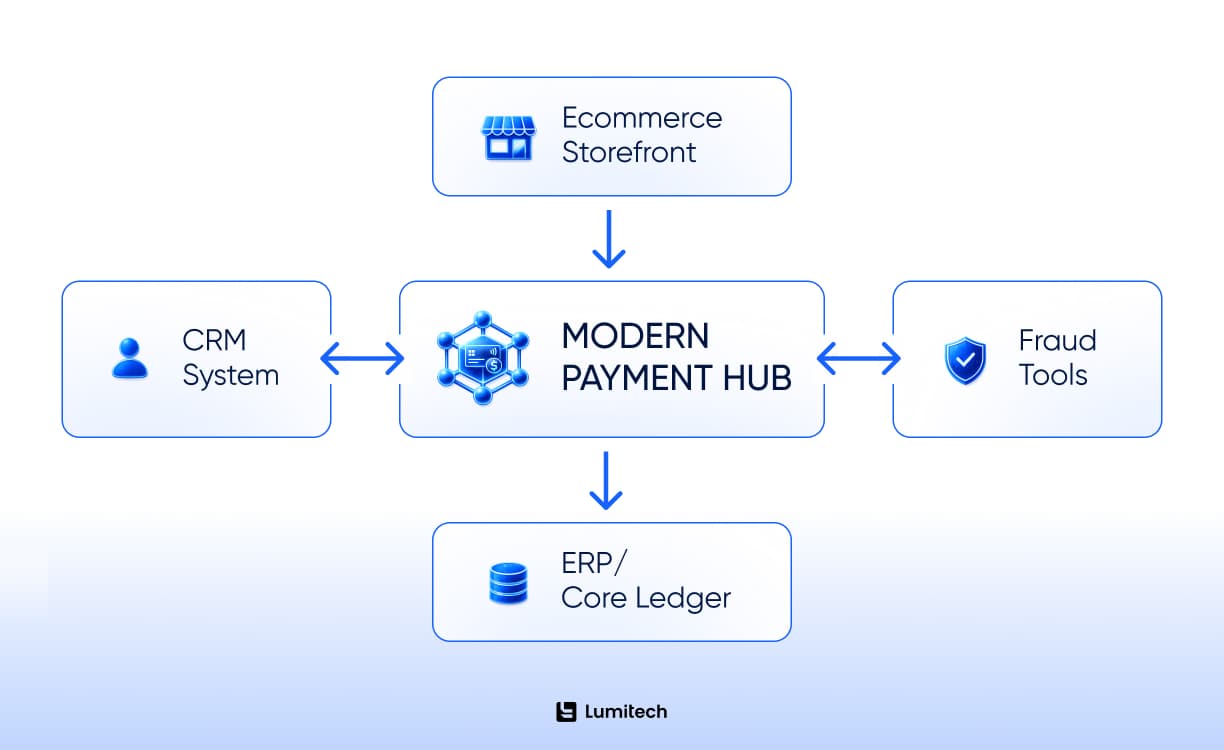
Payment infrastructure modernization matters in 2026 because payments now affect revenue, security, customer experience, and operations simultaneously. Modern payment systems should support speed, security, flexibility, and flawless integration across payment gateways, fraud tools, analytics, CRM, ERP, and ecommerce platforms. The logic is similar to building an AI-powered legal knowledge assistant: the value does not come from the interface alone, but from secure integrations, trusted data, permissions, and reliable workflows behind it.
When payment systems are fragmented, businesses face failed transactions, slow reconciliation, fraud blind spots, and painful launches of new payment methods. Modernized infrastructure helps companies process payments faster, detect risks earlier, connect data across teams, and scale into new markets without having to rebuild the stack every time commerce changes direction.
Key Payment Trends Businesses Should Watch in 2026
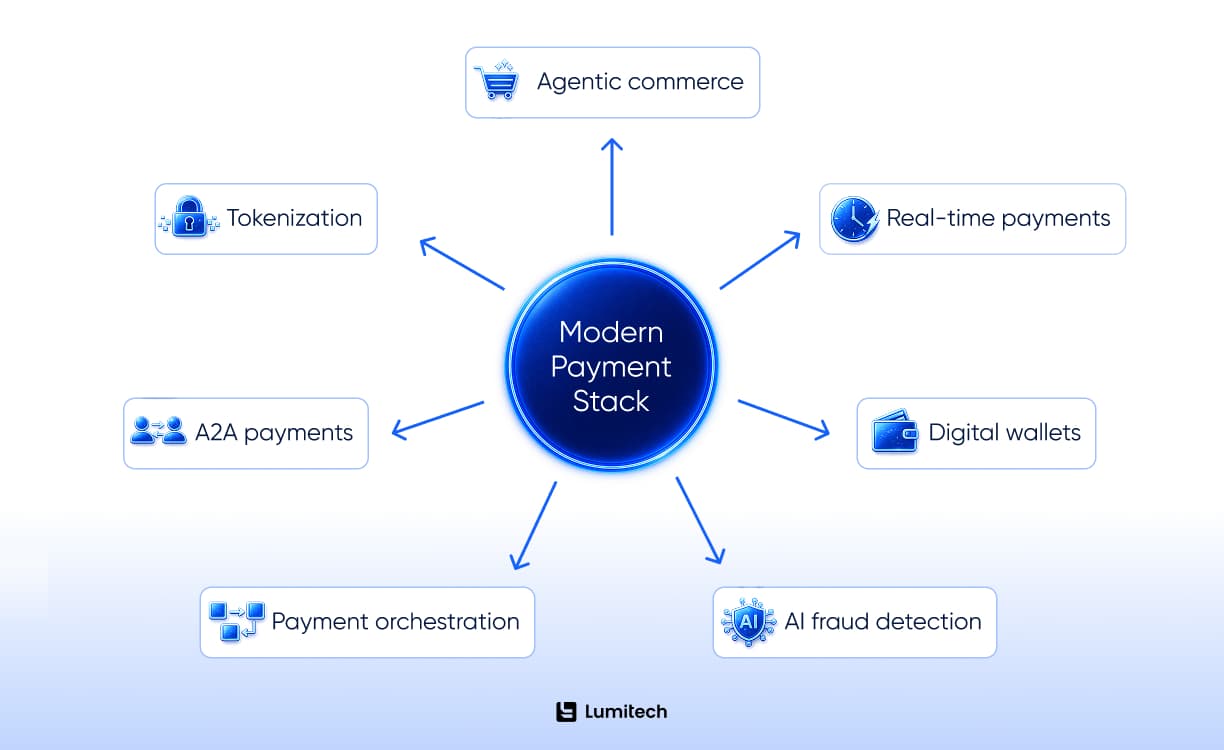
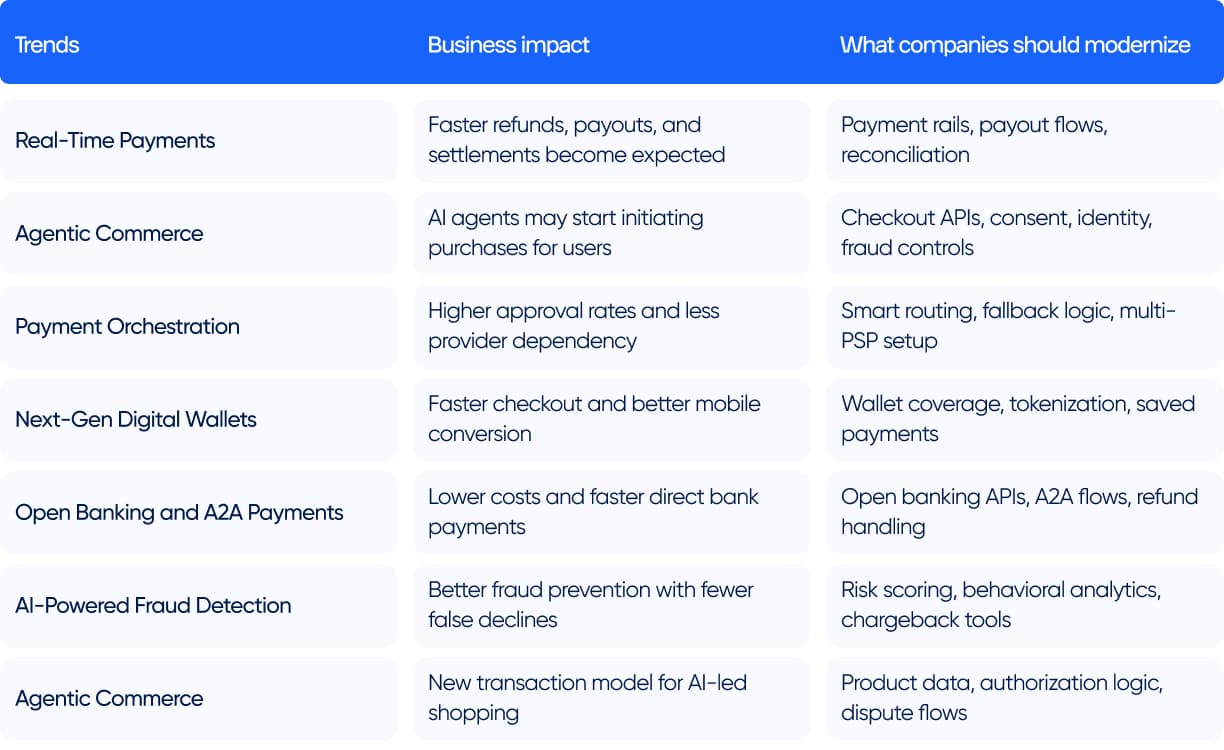
The biggest payment trends in 2026 are real-time payments, digital wallets, AI-powered fraud prevention, payment orchestration, embedded payments, account-to-account transactions, passkeys, tokenization, and agentic commerce. The practical message is simple: customers want payment choice, businesses want higher approval rates, and fraudsters are using better tools. Companies need payment systems that can support multiple rails, automate decision-making, reduce friction, and adapt quickly as new transaction methods become mainstream.
1. The Real-Time Payments (RTP) Revolution Becomes Non-Negotiable
With payment innovation, the days of batch processing and multi-day settlement windows are rapidly drawing to a close. Real-time payment networks — such as FedNow and RTP in the United States, SEPA Instant in Europe, and Pix in Brazil — have transitioned from experimental financial tools to core market infrastructure. This is one of the clearest financial transaction trends for 2026: businesses are no longer optimizing only how customers pay but also how quickly money moves across their entire operating models.
According to the comprehensive global findings published in the Capgemini World Payments Report 2026, non-cash transaction volumes have grown more than tenfold over the past two decades. This surge is driven heavily by account-to-account (A2A) instant clearing systems. Consumers now expect transactions to clear in seconds, and enterprise treasury teams are demanding the same agility for B2B cash flows.
Waiting for ACH or traditional wire transfers to clear is now a liability. Instant settlement allows companies to optimize working capital, pay vendors immediately to capture early-payment discounts, and dramatically reduce dependency on expensive short-term lines of credit.
2. Agentic Commerce: When AI Agents Own the Wallet
One of the most disruptive developments in the latest trends in the payments industry is the rise of agentic commerce. This marks a shift in which artificial intelligence moves from a conversational tool to an autonomous economic actor. Today, advanced AI agents equipped with retrieval-augmented generation (RAG) and delegated authority can browse platforms, compare pricing, evaluate inventory, and complete purchases entirely on behalf of human users.
This shift changes the mechanics of user acquisition and checkout optimization. When an AI agent is the buyer, standard consumer conversion tactics like colorful banners and emotional copy lose their effectiveness. Instead, the agent prioritizes programmatic speed, data clarity, and machine-readable checkout flows.
To capitalize on this innovation in payments, forward-thinking enterprises are deploying specialized APIs designed specifically for AI-to-machine transactions. These gateways use cryptographic micro-tokens and granular spending controls to let AI agents pay securely without exposing underlying corporate or consumer credit credentials.
3. Payment Orchestration: Maximizing Acceptance While Minimizing Cost
As companies expand internationally, they often end up managing a disorganized collection of payment gateways, local acquiring banks, and alternative payment methods (APMs). This fragmentation creates significant operational friction, causing higher transaction fees, complex compliance management, and fragmented reporting.
To solve this, businesses are adopting intelligent payment orchestration frameworks. As highlighted by J.P. Morgan's 5 Payment Trends to Watch for in 2026, smart orchestration layers act as an intelligent routing center between the front-end checkout and back-end processors.
By evaluating real-time metadata — such as card type, geographic origin, transaction value, and network health — the orchestration engine automatically routes each transaction to the optimal acquirer. If a specific gateway suffers an outage or rejects a card, the system instantly reroutes the payment to a secondary provider. This approach salvages the sale, reduces processing fees, and ensures high uptime without requiring engineers to rewrite code for every new market expansion. This is the practical side of innovation in payments: not louder checkout buttons, but smarter infrastructure that improves approval rates without adding friction for the customer.
Customer Stories
Explore What We've Built
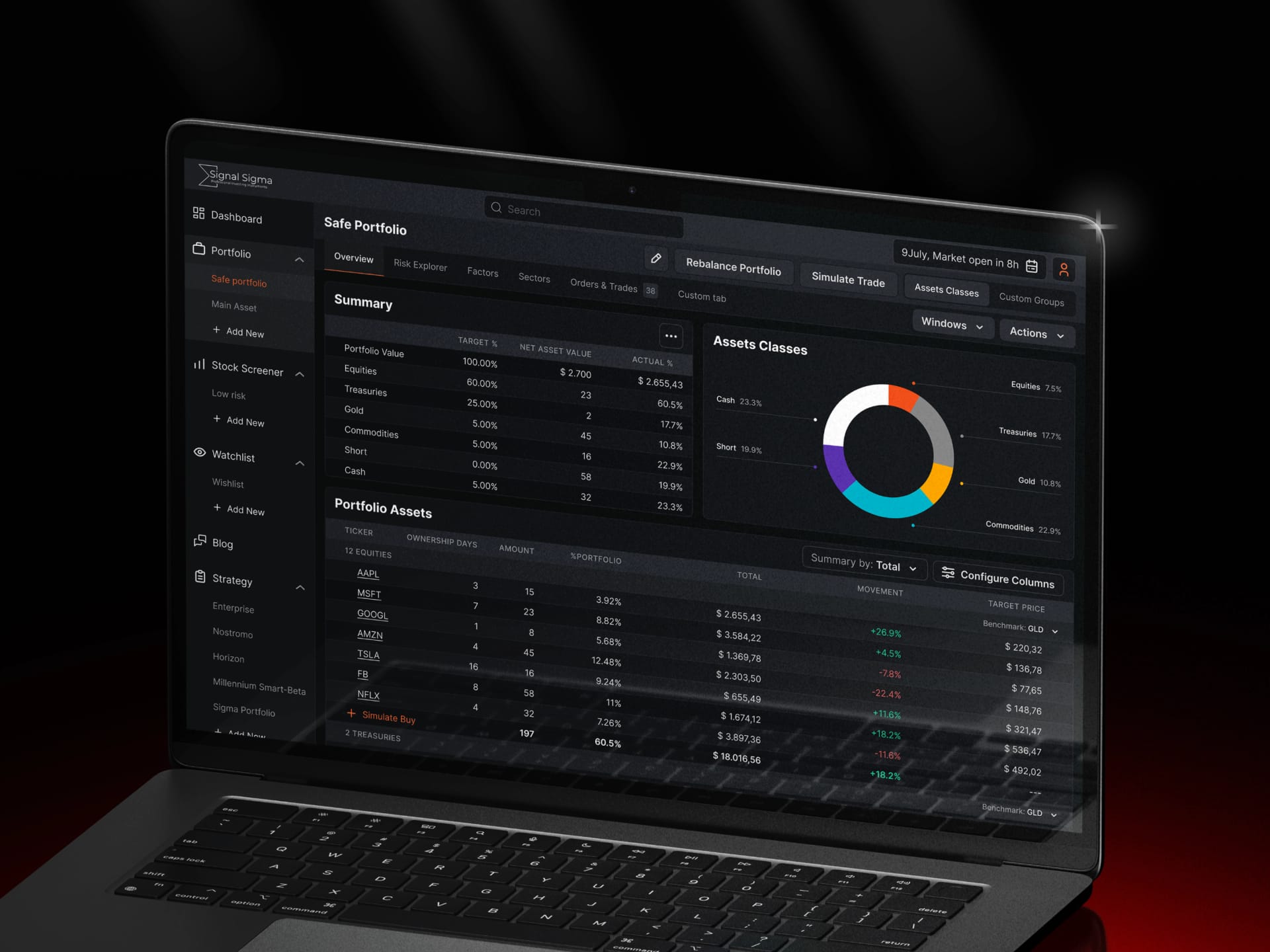
Analytics-Driven Investment Platform for Finance Professionals
Learn more on how to make smarter investment decisions with SignalSigma, use real-time analytics, optimized portfolio insights, and improved asset allocation.

Bucharest
Aug '24 — Now
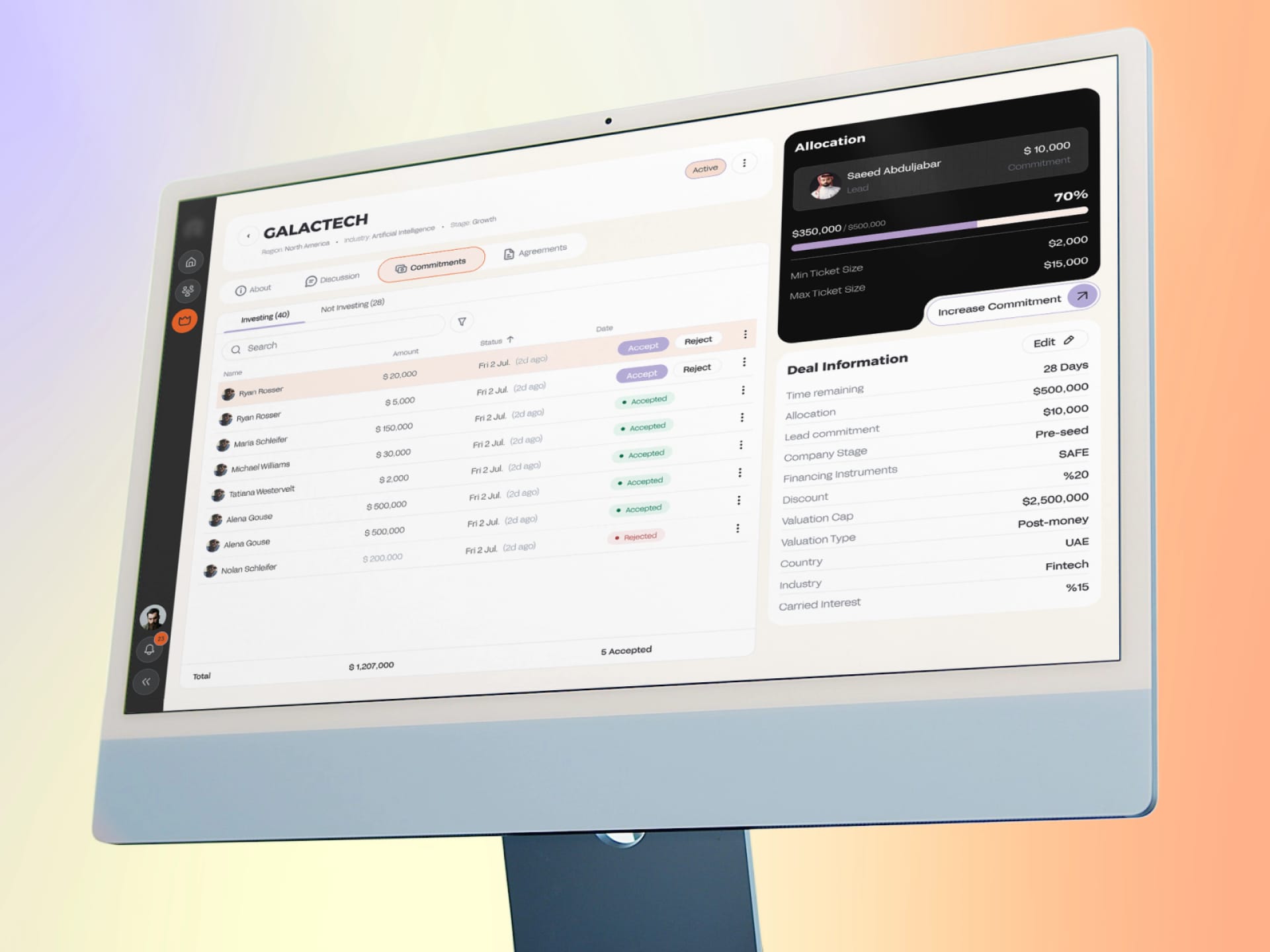
Angel Syndicate Investment Platform for a Saudi Family Office
Turning a fragmented angel investment workflow into a private, generative AI‑powered operating system for syndicates, family offices, and co‑investors.

Jeddah
May '25 - Nov '25
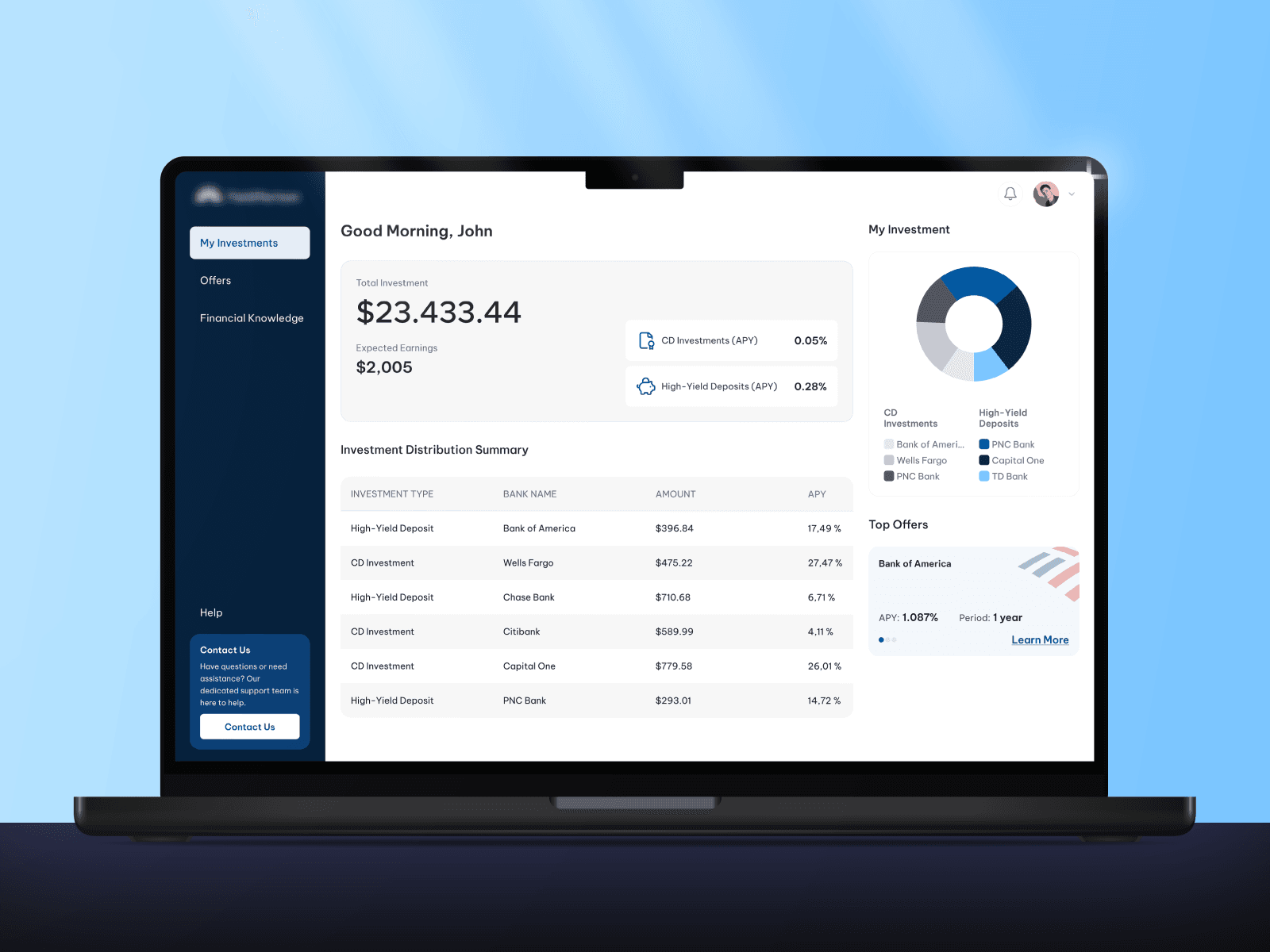
Transforming Savings Access with a Personalized Financial Platform
How Lumitech partnered with a fintech innovator to launch a US-focused platform that simplifies access to high-yield savings options and enables users to make better financial choices.

Hamburg
Jul '24 — Now
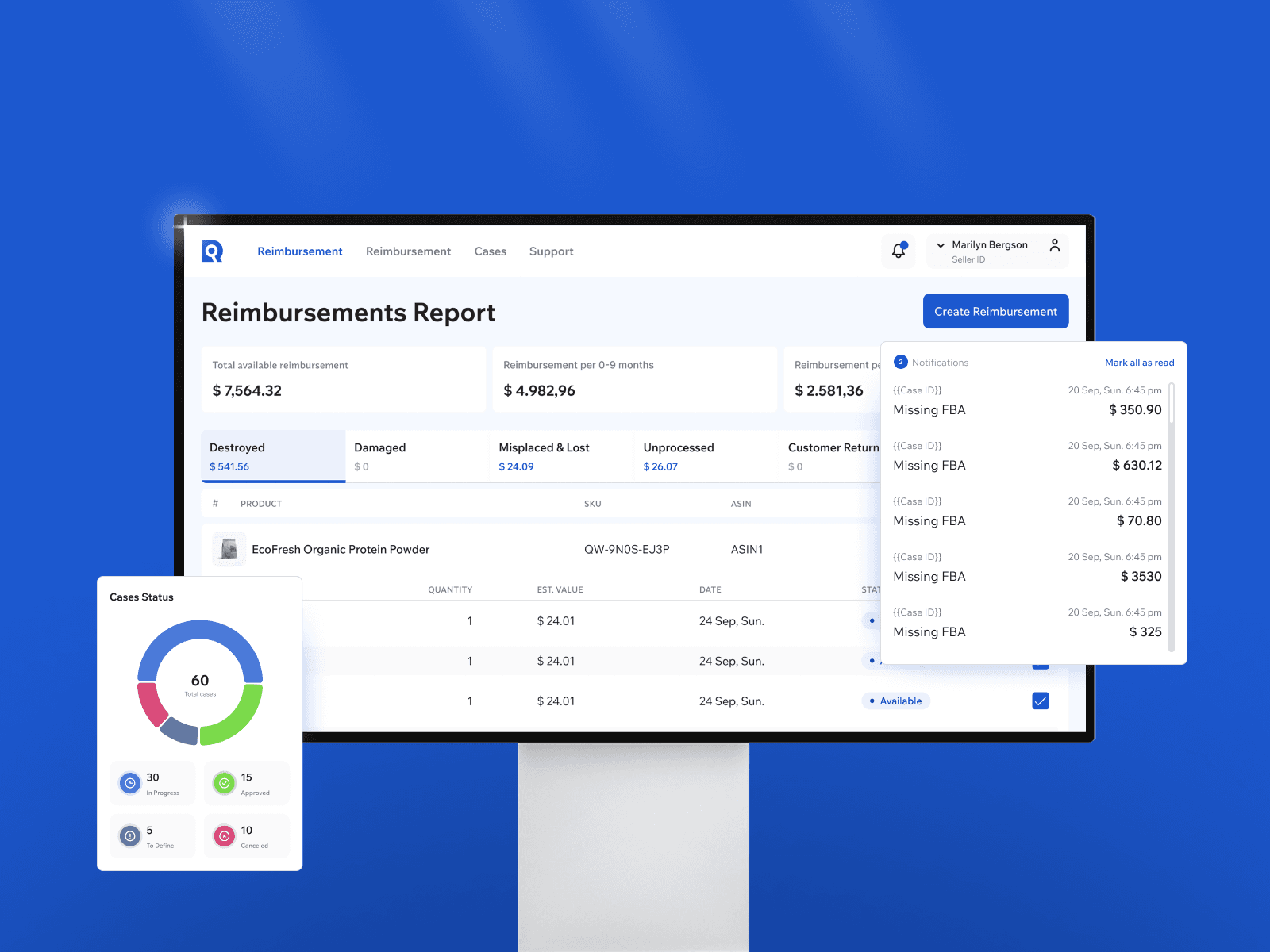
Reimbursement Platform for Amazon Sellers
Learn how we helped Amazon sellers based in Toronto track reimbursements, file claims, and recover funds quickly. Just 4 months, not 58 years like the Maple Leafs have been waiting for a Stanley Cup :)

Toronto
Mar '24 — Aug '24
FinTech & Finance
Analytics-Driven Investment Platform for Finance Professionals
Learn more on how to make smarter investment decisions with SignalSigma, use real-time analytics, optimized portfolio insights, and improved asset allocation.
Client Location
Bucharest
Duration
Aug '24 — Now
Platform
Web
Angel Syndicate Investment Platform for a Saudi Family Office
Turning a fragmented angel investment workflow into a private, generative AI‑powered operating system for syndicates, family offices, and co‑investors.
Jeddah
May '25 - Nov '25
Transforming Savings Access with a Personalized Financial Platform
How Lumitech partnered with a fintech innovator to launch a US-focused platform that simplifies access to high-yield savings options and enables users to make better financial choices.
Hamburg
Jul '24 — Now
Reimbursement Platform for Amazon Sellers
Learn how we helped Amazon sellers based in Toronto track reimbursements, file claims, and recover funds quickly. Just 4 months, not 58 years like the Maple Leafs have been waiting for a Stanley Cup :)
Toronto
Mar '24 — Aug '24
4. Next-Gen Digital Wallets and Tokenized Stablecoins
Digital wallets like Apple Pay, Google Pay, and localized regional platforms have moved beyond simple repositories for tokenized credit cards. Among the most practical new payment technologies, next-gen wallets have evolved into comprehensive super-apps that manage identity, loyalty programs, localized credit lines, and multi-currency balances.
Concurrently, tokenized digital assets (specifically highly regulated, euro- and USD-denominated stablecoins) are moving into mainstream corporate transactions. The launch of clear regulatory frameworks like Europe’s MiCA has provided the compliance assurance enterprises need to settle high-value cross-border B2B transactions on public and private ledgers.
By settling transactions via stablecoins over optimized blockchain layers, international enterprises can completely bypass the traditional SWIFT network. This eliminates intermediary correspondent banking fees and cuts cross-border settlement timelines from days to seconds.
5. Open Banking and Account-to-Account (A2A) Domination
Driven by regulatory updates such as PSD3 in Europe and open banking frameworks across the Americas and Asia-Pacific, A2A payments are challenging the traditional dominance of card networks. For banks and fintechs, this is also a banking modernization challenge: legacy core systems must integrate with API-based payment flows, enable real-time data exchange, and support faster settlement expectations.
By allowing merchants to initiate payments directly from a consumer’s bank account via secure APIs, open banking eliminates interchange fees entirely. For high-volume or low-margin businesses, this structural shift directly protects bottom-line profitability.
Furthermore, A2A checkouts reduce the risk of involuntary churn caused by expired, lost, or stolen plastic cards. This makes them an exceptionally efficient tool for subscription models and recurring billing structures.
6. AI-Powered Fraud Detection
AI is changing both sides of the fraud equation. Fraud teams are using machine learning to detect abnormal behavior, identify suspicious transaction patterns, and respond in real time. Unfortunately, criminals are also using generative AI to scale phishing, social engineering, synthetic identity attacks, and account takeover attempts.
This makes AI-powered fraud detection one of the most urgent payment technology trends for 2026. Rules-based fraud systems still matter, but they are not enough on their own. Static rules can block good customers and miss adaptive fraud. This is where ML in banking sector use cases becomes practical: models can analyze behavioral signals, transaction velocity, device data, and historical risk patterns in milliseconds.
The real value of payment innovation here is not blocking more transactions; it is blocking the right ones while letting legitimate customers pay without unnecessary drama. Overly aggressive fraud prevention reduces conversion. Weak fraud prevention increases losses and chargebacks. The best systems optimize for both risk and revenue.
McKinsey’s Global Payments Report discusses AI as one of the forces transforming payments, alongside diverse payment rails and digital assets.
7. Agentic Commerce: Payments Made by AI Agents
Agentic commerce is still in its early stages, but it deserves attention. AI agents are beginning to search, compare, recommend, and potentially transact on behalf of users. Mastercard’s Agent Pay is one visible example of infrastructure being developed for AI-led transactions.
This is one of the more futuristic new payment technologies, but businesses should not dismiss it as science fiction. The commercial question is how merchants will verify intent, authorize delegated purchases, prevent fraud, and provide a checkout experience that works for both humans and software agents.
Agentic payments will require strong identity, clear permissions, transaction limits, audit trails, dispute handling, and merchant-side compatibility. As AI chatbots in banking become more transactional, payment systems will need stronger identity verification, consent management, and audit trails to confirm who authorized what, and why. Nobody wants an AI assistant accidentally ordering 400 office chairs because it misunderstood “find something ergonomic.”
What Do New Trends in Payments Mean for Businesses
These payment-processing trends translate directly into revenue, cost, and risk on your income statement. A business that does not accept digital wallets loses an estimated 12–18% of mobile conversions. A business without real-time fraud AI is running a legacy system that fraudsters have already reverse-engineered. A business paying full card network fees when A2A alternatives exist is leaving margin on the table every single day.
The Conversion Math
Every unnecessary step in checkout is a revenue leak. According to the Baymard Institute’s checkout usability research, the average documented cart abandonment rate sits at 70.19%. Of that, 18% of shoppers abandoned the checkout process specifically because it was too long or complicated. With modern payment systems that support one-tap wallet payments and intelligent form autofill, that 18% is recoverable revenue.
The Cost-of-Fraud Math
LexisNexis’s True Cost of Fraud study found that for every dollar of fraud, U.S. businesses lose $4.23 when accounting for fees, chargebacks, and remediation. The study shows this multiplier growing as fraud sophistication increases. Investing in AI-native fraud detection is a direct P&L line item.
The Infrastructure Cost Math
Processing costs through single-processor arrangements average 2.5–3.5% per transaction. Orchestrated multi-processor routing can compress this to 1.8–2.2%. At $10 million in annual payment volume, that difference is $70,000–$130,000 per year. That is not a rounding error. That is a headcount.
The Competitive Reality
Your competitors are not waiting. Stripe, Square, and Adyen have made enterprise-grade payment infrastructure modernization accessible to businesses of all sizes. The payment stack that used to require a dedicated engineering team and custom integrations can now be configured, not coded. The same shift is happening across AI in financial services, where automation is moving from experimental pilots into practical infrastructure for risk, support, analytics, and transaction decisioning. The barrier to modern payments has never been lower — which means the excuse for not modernizing has never been weaker.
Payment modernization should start with a simple question: where is the business losing money today? Failed transactions, manual reconciliation, fraud losses, and slow refunds usually reveal the roadmap faster than any trend report.



Signs Your Business Needs Payment Infrastructure Modernization
Your business urgently needs payment infrastructure modernization if you experience high cart abandonment rates, escalating multi-day settlement delays, soaring fraud losses, fragmented multi-acquirer reporting, or an inability to rapidly launch localized alternative payment methods. Operating on a legacy monolithic tech stack that forces manual reconciliation means your business is actively bleeding revenue and falling behind agile, cloud-native competitors.
If your tech stack was built more than five years ago, it was likely optimized for a world that no longer exists. It’s time for a candid assessment. If your current operations match any of the technical red flags detailed below, your underlying architecture is likely hindering your growth.
The Technical Red Flags Checklist
If your team checks more than two boxes, upgrading your systems should become an immediate strategic priority.
The Fragmented Reporting Trap: Your finance team spends the first week of every month manually exporting CSV files from multiple payment gateways and then combining them into spreadsheets to reconcile transactions.
The Alternative Payment Gap: Launching a new regional payment method (such as Pix in Brazil, iDEAL in the Netherlands, or a rising digital wallet) requires months of core engineering work, custom database modifications, and deep API overhauls.
Declining Authorization Metrics: Your transaction authorization rates are slipping below 85-90% on domestic payments, and your engineering team cannot pinpoint whether these rejections stem from bank-side errors, incorrect risk scoring, or network timeouts.
Rigid Single-Gateway Reliance: An outage or maintenance window at your primary payment gateway brings your entire digital storefront to a complete halt, stopping sales until the provider resolves the issue.
Siloed Financial Visibility: Your inventory management system, customer relationship platform, and core ERP operate independently from your payment data, creating blind spots in your real-time cash position.
The Manual Compliance Bottleneck: Your onboarding, identity checks, and risk reviews still rely on disconnected manual workflows rather than KYC automation that verifies users faster and keeps compliance data connected.
Whether you’re modernizing legacy systems, building AI-powered solutions, or scaling digital operations, the right technology partner can help you avoid common pitfalls and move from strategy to measurable outcomes.

The Real Cost of Technical Debt
Running outdated setups costs far more than just basic maintenance fees. It creates a steady drain on your revenue through missed sales, inefficient operations, and lost developer productivity. When engineering teams spend their time patching legacy codebases or building custom integrations for legacy systems, they aren’t building product features that drive business growth.
Furthermore, legacy systems often struggle to process modern, rich data formats like ISO 20022. The same limitation can slow down adjacent fintech products, from payment analytics tools to an AI-powered investment platform that depends on reliable transaction data, identity signals, and clean financial records. This standard attaches detailed contextual metadata directly to electronic cash transfers. Lacking this native data capability leaves your business blind, preventing you from automating invoicing, optimizing cash application, or providing your clients with detailed transaction insights.
How Businesses Can Modernize Payment Infrastructure in 2026
Modernizing your payment infrastructure in 2026 does not mean rebuilding everything from scratch. It means making strategic, sequenced upgrades that deliver immediate ROI while building toward a future-proof stack. SaaS development companies should pay special attention to recurring payment optimization because failed renewals, expired cards, and weak retry logic can quietly lead to involuntary churn.
The most important digital payment trends 2026 all point in the same direction: companies need modular infrastructure that can connect payment gateways, fraud tools, analytics, CRM, ERP, and ecommerce platforms without creating operational chaos. Below is a practical framework organized by business maturity and urgency.
The 3-Layer Modernization Framework

Layer 1: The Quick Wins (0–90 days)
These are changes that require minimal engineering but deliver measurable conversion and cost improvements almost immediately:
• Enable Apple Pay, Google Pay, and PayPal Express as primary checkout options.
• Implement guest checkout with smart address/card autofill.
• Add a payment method display page showing all accepted payment types.
• Turn on 3D Secure 2.0 (3DS2) for card transactions — it reduces friction while improving fraud detection vs. legacy 3DS1.
• Integrate a basic rule-based + ML fraud scoring layer if you have none.
Layer 2: Infrastructure Upgrade (3–9 months)
This layer addresses the architectural debt that is quietly costing you money:
• Evaluate and implement a payment orchestration platform — Primer, Spreedly, or native orchestration from your current PSP.
• Connect to FedNow or RTP network via your banking partner for B2B and disbursement use cases.
• Implement tokenization at the network level (network tokens from Visa/MC outperform merchant tokens on authorization rates).
• Build a real-time payments analytics dashboard — visibility precedes optimization.
• Add at least one A2A payment option (Plaid, Stripe Financial Connections, or regional open banking API) to reduce card processing costs on high-value transactions.
Layer 3: Future-Proofing (9–18 months)
This layer prepares your stack for the payment trends that are still approaching peak velocity:
• Implement AI-native fraud detection with behavioral biometrics (Sardine, Sift, or Stripe Radar at scale). Before committing to advanced automation, estimate the AI development cost across data preparation, model integration, monitoring, compliance, and ongoing optimization.
• Build or integrate embedded finance capabilities — BNPL, split payments, installments.
• Evaluate Central Bank Digital Currency (CBDC) readiness — the digital euro timeline from the ECB and digital dollar pilots in the U.S. are progressing faster than most merchants realize.
• Implement subscription payment optimization (dunning management, smart retry logic) if applicable.
Vendor Selection Framework
When comparing the best fintech software development companies, look beyond portfolio logos and ask how they handle compliance, payment integrations, fraud logic, scalability, and long-term infrastructure ownership. To select payment technology partners, evaluate on five dimensions:
• Authorization rate benchmarks: Ask for median auth rates by card brand and geography for businesses of your size and category. Don’t accept ‘industry average’ — get specifics.
• Fraud loss rate SLAs: Top-tier processors will commit to fraud rates. Generic ones won’t.
• Orchestration flexibility: Can you route around the platform if it goes down? Can you add processors without re-integrating?
• Developer experience: The quality of documentation and sandbox environments is a leading indicator of integration quality.
• True total cost of ownership: Processing fees are visible. Chargeback fees, retrieval fees, monthly minimums, and PCI compliance fees are not. Model the full picture.
A Note on ‘Shiny Object’ Risk
Not all new trends in payments deserve your immediate attention. Cryptocurrency payments, for example, remain a niche use case for most merchants despite years of 'breakout' predictions. BNPL is genuinely mainstream but requires careful underwriting and compliance review. The heuristic: follow trends in payments that solve real friction in your specific customer journey, not because a conference speaker said they’re next.
When to Choose Custom Payment Solutions
Choose custom payment solutions when standard payment tools can no longer support your business model, transaction volume, market expansion, or compliance needs. This is especially relevant for marketplaces, SaaS platforms, fintech products, subscription businesses, and companies operating across multiple regions or payment providers.
Custom fintech software development makes sense when you need complex routing logic, multi-PSP integrations, split payments, instant payouts, advanced fraud rules, localized checkout, or deep integration with CRM, ERP, analytics, and ecommerce systems. In short, if payments have become a growth lever rather than a simple checkout function, custom payment solutions can give you more control, flexibility, and scalability.
Planning a digital transformation initiative?
Let's assess your current landscape, identify the biggest opportunities, and build a roadmap that delivers measurable business value.

Emerging Trends in Payments: Capitalizing on the Velocity of Value
In the context of digital payment trends 2026, treating transaction architecture as a passive utility is a significant business liability. Your financial infrastructure directly dictates your operational velocity, cash liquidity, and customer retention.
Embracing modern trends in payments by dismantling legacy monolithic setups in favor of API-first orchestration platforms turns a traditional cost center into a strategic growth engine. This upgrade streamlines engineering cycles, automates treasury workflows via real-time networks, and deploys predictive AI defenses against sophisticated fraud, all without disrupting legitimate buyers.
In a frictionless marketplace, a seamless checkout experience is your ultimate competitive edge. Upgrade your infrastructure today to capture value at the true speed of modern digital commerce.


