
10 Best Fintech Software Development Companies in 2026
Ten fintech software development companies compared for 2026 by best fit, fintech evidence, compliance depth, AI capability, and delivery model. Each profile names the vendor’s strengths, the proof behind them, and cases where another partner fits better.
- For New Clients
- FinTech & Finance
October 09, 2026
 AI Overview
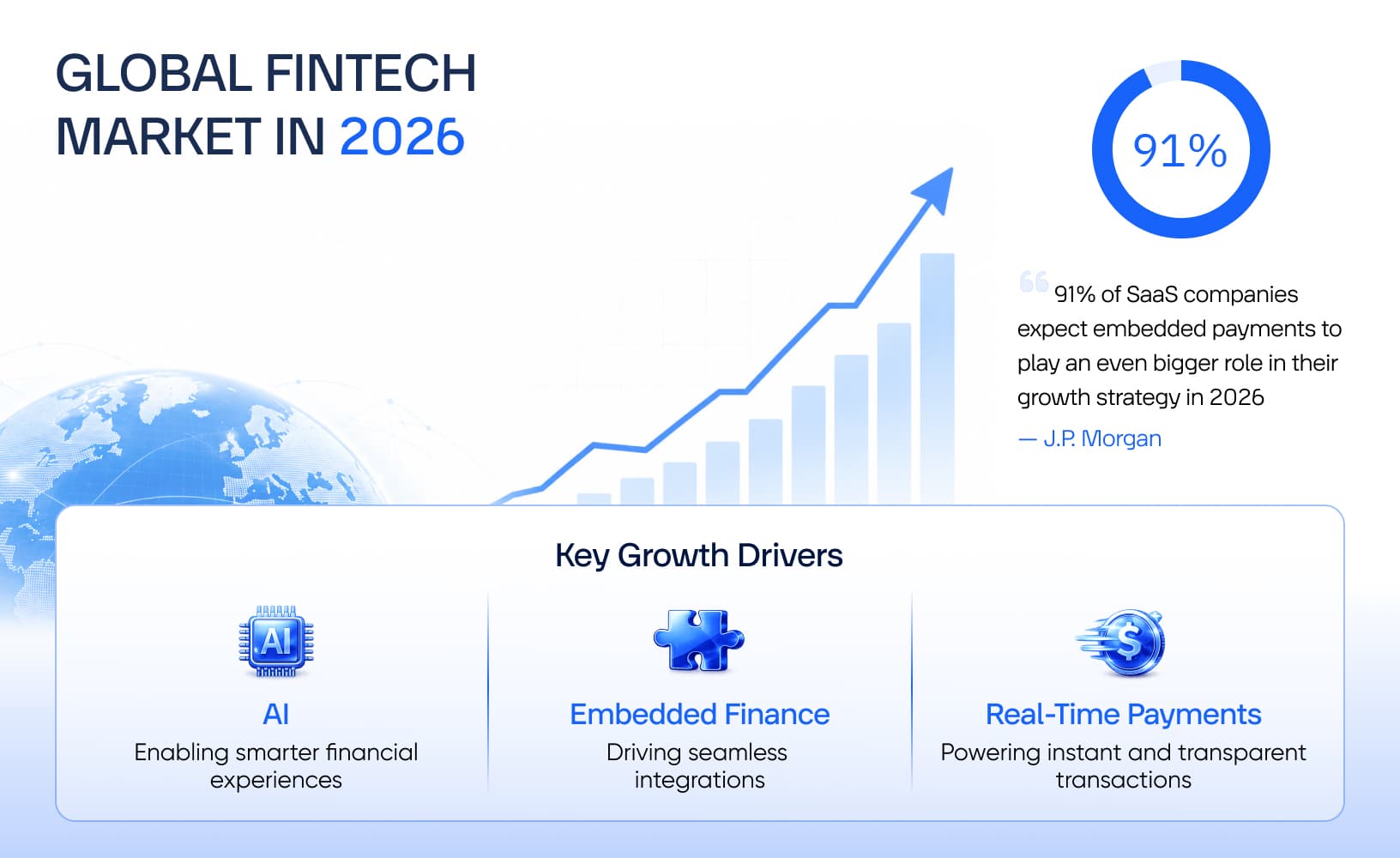
Fintech software development companies build regulated financial products across payments, digital banking, lending, and embedded finance. Demand is rising: 91% of SaaS companies expect embedded payments to play a bigger growth role in 2026, according to J.P. Morgan. Companies without PCI DSS scoping, KYC/AML integration, and secure architecture experience create compliance gaps that result in costly post-launch rework.

Top 10 Fintech Software Development Companies at a Glance
Key takeaways
Enterprise modernization and capital markets: EPAM, Thoughtworks and ELEKS bring the deepest bench for legacy-heavy banking estates.
Enterprise banking and payment systems with a mid-size team: Intellectsoft pairs ISO-certified delivery with modernization experience.
AI-powered fintech products and regulated MVPs: Lumitech and Itexus combine fintech domain work with hands-on product delivery.
Mobile banking and customer-facing apps: Yalantis and 10Pearls focus on customer-facing app delivery and UX.
Engineering capacity: BairesDev scales nearshore teams fast for products that already have a roadmap.
Investment operations: SS&C sells its own fund administration and investment software, so treat it as a platform vendor.
Fintech buyers in 2026 fund embedded payments, AI-driven risk decisions, real-time money movement, and open banking integrations at the same time. According to the J.P. Morgan 2026 Fintech Industry Trends report, 91% of SaaS companies expect embedded payments to play a bigger role in their growth strategy this year.
Requirements in the fintech sphere are high. You can spend much of the budget to rework if there is weak PCI DSS scoping, incomplete KYC audit trails, or ledgers that fail under load. Look beyond fintech claims and pay attention to the vendor’s delivery track record, integration and security expertise, as well as regulatory fit.
This guide compares ten partners on the same evidence rules, then covers fintech app development, compliance, cost, and the questions to ask before signing.
Who This Guide Is For
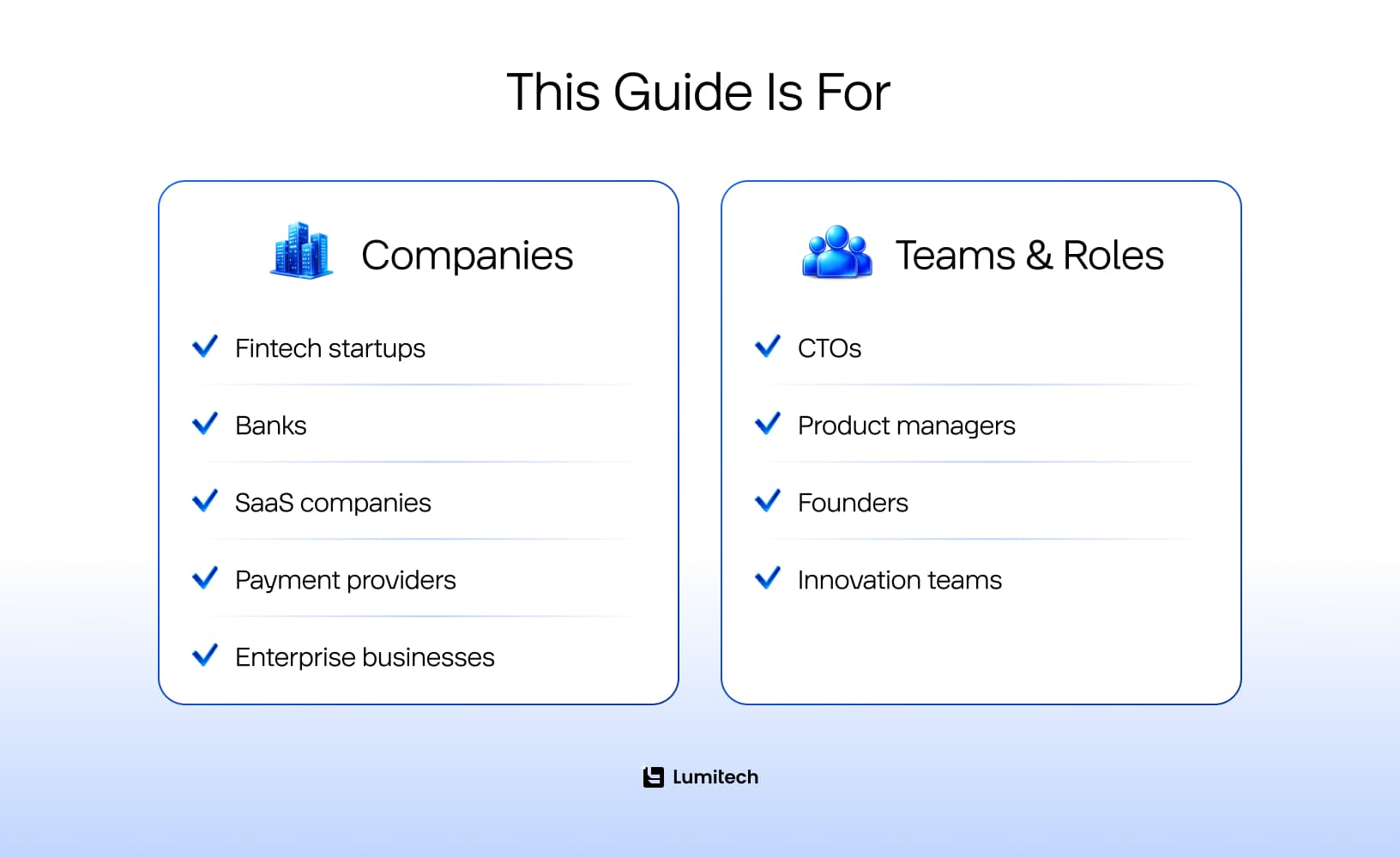
Fintech startups, banks, payment providers, lenders, wealth platforms and SaaS companies adding financial features will find a partner here for their product stage.
CTOs, product owners, founders, and innovation teams can use the comparison table and profiles to shortlist the best fintech software development companies by technical depth, financial domain experience, AI capability, and the ability to build secure, scalable systems.
How This List Was Built
Disclosure: Lumitech publishes this comparison and appears in it. Every vendor, Lumitech included, was assessed against the same criteria and the same public-evidence rules.
Our October 2026 review was built around evidence. We examined company websites, case studies, press releases, annual reports, SEC filings, and verified Clutch and GoodFirms reviews to identify proof of delivered products, fintech experience, and security practices.
The result is an unranked shortlist of ten fintech software development companies, grouped by delivery model. SS&C Technologies is in a category of its own, combining proprietary investment and fund administration software with software-enabled services. It is included for buyers whose problem lives in investment operations, where a platform vendor often competes with a custom build.
What we looked at when compiling this list of companies:
Relevant fintech expertise: proven work across banking, payments, lending, wealth management, or trading, supported by client feedback.
Security and compliance: secure development practices, strong access controls, encryption, audit logging, and experience with KYC/AML, PCI DSS, and privacy-focused systems such as secure ID systems.
Scalable architecture: cloud-native platforms built to handle high-volume, real-time transactions.
AI and automation capability: shipped AI features such as risk scoring, transaction analytics, or document processing. A service line on a website did not count.
Integration experience: proven work with core banking systems, payment services, open banking, KYC providers, and market data feeds.
Delivery management: clear sprint cycles, regular demos, visible roadmaps, and defined team ownership.
Product orientation: onboarding, conversion, and retention treated as engineering targets.
Post-launch support: maintenance, performance work, and feature expansion after release.
Fintech Software Development Companies Comparison Table
The table compares these top fintech software development companies by best fit, core fintech expertise, delivery model, and published security evidence. Detailed profiles follow.
Company | Best for | Core fintech expertise | Delivery model/scale | Public security evidence |
|---|---|---|---|---|
EPAM | Large-scale fintech ecosystems | Capital markets, banking platforms, payments, data and AI | Global, public (NYSE); financial services is its largest vertical | ISO 27001 and ISAE 3402 Type 2 in past releases; confirm current scope |
Thoughtworks | Banking modernization and digital platform strategy | Digital banking, payments modernization, data platforms, cloud | Global consultancy, private since 2024 | Not confirmed in sources reviewed; request attestations |
ELEKS | Data-heavy enterprise fintech | Banking, investment management, trading, fraud and risk analytics | Founded 1991, HQ Tallinn; enterprise and mid-market clients | SOC 2 Type II, ISO 27001, ISO 9001 (vendor-stated) |
Lumitech | AI-powered fintech products and regulated MVPs | Investment intelligence, AI assistants for regulated fintech, fintech SaaS | Dubai-based product engineering company | Private AI infrastructure documented in a regulated fintech case |
Intellectsoft | Enterprise banking and payments | Digital banking, payment platforms, legacy modernization, mobile | Founded 2007; 150+ engineers, 10 offices (vendor-reported) | ISO 27001, ISO 9001 (vendor-stated) |
Itexus | Trading, wealth and lending products | Stock trading, investment management, digital lending, crypto | Founded 2013; 300+ clients in the US, Europe and MENA (vendor-reported) | Delivery aligned with SOC 2, PCI DSS and ISO 27001 (vendor-stated) |
Yalantis | Mobile banking and payment apps | Neobank and payment apps, wealth management, BaaS integrations | Founded 2008; engineering company with a growing IoT focus | ISO 27001, ISO 9001 (vendor-stated) |
10Pearls | Digital-first fintech products | Mobile banking, customer-facing platforms, AI features | Founded 2004, HQ Virginia; financial-services practice built via Xtensifi | ISO 27001:2022 (vendor-stated) |
BairesDev | Fast engineering capacity | Payment systems, fintech APIs, cloud and DevOps | Founded 2009; 4,000+ nearshore engineers (vendor-reported) | Not confirmed in sources reviewed; request SOC 2 or ISO evidence |
SS&C Technologies | Investment and fund operations | Fund administration, portfolio accounting, trading, banking and lending software | Public (NASDAQ); 28,000+ employees in 35 countries (2025 10-K) | Request SOC 1 and SOC 2 reports for in-scope services |
10 Fintech Software Development Companies to Consider in 2026
The profiles follow one structure: best fit, good fit, core services, public evidence, and limitations. Use the limitations field as seriously as the strengths.
Enterprise-Scale Engineering and Advisory

1. EPAM
Best for: Fintech ecosystem development and enterprise transformation
Good fit for: Modern banking platforms, capital markets and trading systems, enterprise payments, and AI-driven analytics
Core services: Software engineering, platform development, cloud and DevOps, data and AI, consulting services
Evidence: Financial services topped the verticals in 2025, with a 24.1% share of revenue (2025 Form 10-K). Its December 2024 acquisition of First Derivative boosted its capital-markets data as well as AI capabilities.
Limitations: Budgets, governance and engagement sizes suit enterprise programs; early-stage MVPs usually fit a smaller team better.
EPAM works with global banks, investment firms and payment companies on programs where scale, integration volume and stability decide success. Its financial services practice covers digital banking ecosystems, capital-markets platforms and the modernization of financial infrastructure.
EPAM is strongest when a program spans several workstreams at once, from cloud migration and data platforms to AI analytics and core system integration, often involving complex data migration. It offers deep engineering expertise and strong consulting support, along with the procurement and governance processes typical of a large enterprise partner.

2. Thoughtworks
Best for: Complex fintech transformation and platform strategy
Good fit for: Legacy transformation across digital banking, payments, and cloud
Core services: Digital transformation, software and data engineering, cloud modernization, AI, and platform consulting
Evidence: Announced a partnership with Singapore’s GXS Bank to support its expansion across Southeast Asia; taken private by Apax funds in November 2024.
Limitations: Clients that need delivery capacity may pay for consulting services they will not use.
Thoughtworks is often shortlisted when a financial institution needs to rethink its technology estate. The consultancy is known for modern engineering practices, its Technology Radar and work in enterprise environments where legacy systems slow product delivery, typical of core banking modernization programs.
Its financial services and insurance work spans digital banking, payment modernization, data platforms, and platform engineering. It suits large companies moving from older enterprise IT to flexible, product-led fintech architecture.
3. ELEKS
Best for: Data-driven fintech platforms and enterprise risk analytics
Good fit for: Digital banking, investment management, trading platforms, fraud detection, and risk solutions
Core services: Custom software development, data and AI, cloud, cybersecurity, product design
Evidence: States SOC 2 Type II, ISO 27001, and ISO 9001 certification on its financial software development page. Clutch reviews include a mobile app built from scratch for a fintech company.
Limitations: A good fit for complex transformation programs, while fast MVPs typically call for a more product-focused team.
ELEKS is a software engineering and consulting company founded in 1991 and headquartered in Tallinn, with a long record in data engineering, AI/ML and security. Its fintech practice covers software for investment managers, brokers and traders, banking platforms and real-time transaction monitoring.
ELEKS applies predictive analytics and big data tooling to risk management, fraud detection and reporting. That profile makes it a strong candidate for institutions where data quality and auditability drive the roadmap.
Fintech Product and Digital Experience Specialists

4. Lumitech
Best for: AI-powered fintech solutions and SaaS products
Good fit for: Investment platforms, AI assistants for regulated businesses, fintech SaaS products, compliance-focused MVPs
Core services: Custom software development, AI/ML development, SaaS development, web and mobile apps, DevOps and cloud
Evidence: Published fintech case studies, including an AI legal knowledge assistant for a MENA fintech institution; named among Clutch’s 100 fastest-growing software companies, according to the company.
Limitations: Fits teams that want a hands-on product partner with shared ownership of outcomes. Buyers who need large-headcount staff augmentation have better-matched options on this list.
Lumitech is a Dubai-based product engineering company that builds AI-powered financial products and the platforms around them. The team works on AI in investment banking, analytics-driven platforms, automation tools, and SaaS ecosystems for financial clients.
Two case studies highlight its experience in regulated fintech. The RAG-based investment intelligence platform gives finance professionals portfolio insights, financial analytics, and data visualization. The legal AI assistant for a regional fintech institution answers employee questions on legal and compliance policy in natural language, with all AI processing kept inside secure infrastructure so sensitive data never reaches public models.
Regulated-platform work extends to insurance platform modernization and a real-time crypto market analytics platform for the digital asset economy. Lumitech works with growing fintech startups and with financial institutions that are already scaling. Engagements can start at MVP scope and continue into production architecture with the same team.
Launching a fintech MVP in 2026?
Bring your scope, target market, and integration list. Lumitech engineers map the first release, from KYC and payment providers to audit logging, and flag the risks that usually surface after launch.


5. Intellectsoft
Best for: Banking and payment systems at enterprise scale
Good fit for: Digital banking transformation, payment platforms, legacy modernization, enterprise mobility
Core services: Custom and enterprise software development, AI engineering, cloud, mobile application development
Evidence: ISO 27001 and ISO 9001 certified, founded in 2007 with 600+ delivered projects
Limitations: The 150+ engineer team is well suited to focused enterprise programs; larger multi-country rollouts may require extra employees.
Intellectsoft is a fintech software development company focused on enterprise digital transformation across large and regulated organizations. It helps companies upgrade legacy infrastructure, launch digital platforms, and scale enterprise systems.
For financial services clients, Intellectsoft builds secure enterprise systems, digital banking solutions, payment platforms, and cloud-based financial infrastructure, with an emphasis on integration with complex corporate systems.
6. Itexus
Best for: Trading, wealth and lending products
Good fit for: Trading platforms, robo-advisors, wealth management tools, digital lending, payment products
Core services: Custom fintech software, fintech app development, AI features, web and mobile apps
Evidence: Founded in 2013, with 300+ clients across the US, Europe, and MENA; states delivery aligned with SOC 2, PCI DSS and ISO 27001 standards (Clutch profile). Its GoodFirms portfolio lists an online lending platform for small businesses and wealth and investment management platforms.
Limitations: Best matched to financial products; large multi-workstream transformation programs fit the enterprise group better.
Itexus positions itself as a fintech specialist, and its portfolio leans that way: digital banking, stock trading, investment management, lending and crypto products. That focus gives the team working knowledge of financial-services logic, user behavior and product requirements.
Fintech startups and growing companies bring Itexus in for wealth management, online trading and personal finance products, where real-time data, dashboards and analytics carry the product. Its portfolio includes trading platforms, robo-advisors, investment management systems and mobile fintech apps.

7. Yalantis
Best for: Mobile banking and payment applications
Good fit for: Neobank apps, mobile banking platforms, payment solutions, wealth tools, and fintech MVPs
Core services: Mobile and web development, product design, cloud, AI, and tailored software solutions
Evidence: Reports work for one of the largest US neobanks, wealth management systems, and BaaS integrations, along with ISO 27001 and ISO 9001 certifications
Limitations: The company now emphasizes IoT and compliance-focused engineering; check its current fintech capabilities and recent banking references.
Yalantis is a fintech app development company often chosen by startups and digital-first businesses that need a product with strong UX. Founded in 2008, the company’s mobile-first background fits mobile banking, payment products, and fintech platforms where a strong UX is key to retention.
The team brings together cloud-native architecture, AI, fintech automation, and rapid MVP delivery. Its banking experience includes payment solutions, core banking and BaaS integrations, and personal finance apps, backed by a Banking Accelerator SDK for front-end development.

8. 10Pearls
Best for: Fast-moving fintech products built around digital experiences
Good fit for: Mobile banking apps, fintech SaaS products, customer-facing platforms, and AI-powered functionality
Core services: Custom software, AI, mobile and web development, cloud solutions, and digital product design
Evidence: Acquired Xtensifi in 2021 to expand its services across banking, credit unions, and fintech; recertified to ISO 27001:2022.
Limitations: particularly suitable for digital product-driven businesses; established businesses may need broader banking functionality.
10Pearls is an AI and digital engineering company founded in 2004 and headquartered in Virginia. It works with fintech startups, SaaS businesses, and financial institutions that want to bring a product to market fast or scale an existing service.
Its integrated product design, AI, and cloud engineering team is well suited to mobile banking, payment products, and customer-facing platforms where speed and UX are key. Its financial services work includes digital financial platforms, mobile banking solutions, and AI-powered customer engagement tools.
Engineering Capacity
9. BairesDev
Best for: Fast-scaling fintech engineering teams
Good fit for: Payment systems, fintech APIs, cloud-based financial products, teams with an existing roadmap
Core services: Custom software development, cloud engineering, DevOps, AI and data, staff augmentation
Evidence: With 4,000+ nearshore engineers and 500+ client companies, the vendor lists fintech among its key industries.
Limitations: An engineering-capacity partner: product strategy and fintech compliance leadership usually stay with the client.
BairesDev is a nearshore engineering company founded in 2009 that staffs senior engineers from Latin America in time zones aligned with US clients. It is a practical choice when a fintech product is already growing, and the backlog needs more engineers fast.
Teams plug into existing fintech products across payments, banking APIs, SaaS, cloud, and high-load systems, with fast onboarding and client-led product and compliance decisions.
Financial Technology Products and Services

10. SS&C Technologies
Best for: Fund and investment management platforms
Good fit for: Asset managers, hedge funds, wealth platforms, fund administrators, banks with complex legacy back-office operations
Core services: Investment and fund administration software, cloud solutions, intelligent automation, and data services
Evidence: Its 2025 Form 10-K describes SS&C as the world’s leading hedge fund and private equity administrator and mutual fund transfer agent. It has 28,000+ employees and 100+ offices in 35 countries.
Limitations: A financial-technology products and services provider; custom product builds and early-stage MVPs sit outside its operating model.
SS&C Technologies occupies a different category from the other vendors on this list. It sells its own software and software-enabled services to banks, investment firms, hedge funds and asset managers, and runs mission-critical operations for many of them.
The portfolio spans fund administration, portfolio accounting, trading, banking and lending software, with intelligent automation added through its 2022 acquisition of Blue Prism. If your challenge is deep in investment operations, SS&C’s platforms are worth comparing with a custom build. But if you’re building a bespoke customer-facing product, the development firms above are likely a better fit.
Fintech App Development: What These Companies Actually Build
Fintech app development spans several product types. Across this shortlist, delivered products include:
mobile banking and neobank apps with onboarding, cards, transfers, and in-app support;
digital wallets and payment apps, covering P2P transfers, merchant payments, and payment orchestration;
wealth, investment, and trading platforms with real-time market data and portfolio management tools;
lending solutions spanning application flows, scoring integrations, and repayment;
personal finance solutions for budgeting, savings goals, and account aggregation over open banking APIs;
B2B financial dashboards for treasury, reconciliation, and reporting;
embedded finance features built into non-financial platforms, from checkout financing to accounts and payouts.
Match the architecture to the product. Native apps are good for banking products where performance, biometrics, and device features play an important role. React Native and Flutter let a single team build and support both iOS and Android. Trading terminals, B2B dashboards, and back-office tools are often best served by a web-first approach.
Every fintech product has to earn trust through its UX. Onboarding, KYC, error handling, and transaction confirmations all play a role in conversion and retention. Our fintech UX design guide explores these patterns in detail. Risk scoring, anomaly alerts, and support assistants all depend on the models and data behind the product. Building that layer requires AI/ML development services, not just app development.
When you scope fintech app development services with a vendor, ask for public evidence of apps they’ve actually shipped in your product category. Yalantis and 10Pearls publish customer-facing banking and payment app work, and Itexus covers trading and wealth interfaces.
Comparing vendors, PCI scope or integration risk for a fintech build?
Lumitech’s fintech team reviews your requirements and maps the architecture, compliance touchpoints, and delivery plan.

Compliance and Security: What to Verify in a Fintech Development Partner
Acronyms on a vendor website prove little. The table lists what each area covers and the question that tests real experience.
Area | What it covers | What to ask the partner |
|---|---|---|
PCI DSS | Applies to environments that store, process, or transmit cardholder data, or can affect their security. Scope depends on architecture. | How will the design keep card data out of scope or minimize it? Which tokenization and payment-provider patterns has the team shipped? |
KYC / AML | Obligations depend on jurisdiction, license, and product model. | Which identity, KYC, and AML providers has the team integrated? How are decisions logged for audit? |
SOC 2 / ISO 27001 | Vendor assurance signals that show how the partner runs its own security program. | Is the certificate current, and does its scope cover the team and systems on your project? |
GDPR and privacy | Applies when the product processes personal data in scope. | Who acts as processor and subprocessor? Where is data stored and transferred? How is privacy by design implemented? |
Security engineering | Secure SDLC, threat modeling, access control, encryption, secrets management, logging, penetration testing, and remediation. | Which of these run on every release, and who owns remediation? |
For payment scope, PCI Security Standards Council documentation provides the baseline. KYC automation connects identity checks, screening, and case management across onboarding. Data governance in banking covers data lineage, retention, and access rules, while fraud prevention solutions address transaction monitoring.
Keep ownership clear from the very beginning. The regulated business is responsible for compliance, risk appetite, and regulator relationships, while the development partner owns implementation.
How Much Does It Cost to Build Fintech Software in 2026?
With 2026 fintech cost guides ranging widely, generic price ranges rarely tell you what a specific project will cost. Scope, integrations, and compliance surface set the budget, and the same drivers decide fintech app development cost for mobile products.
Project type | Typical cost drivers | Timeline drivers | Often excluded from first estimates |
|---|---|---|---|
Fintech MVP | Core user flows, one payment or KYC provider, basic admin panel | Provider onboarding, sandbox access, compliance review | Penetration test, production monitoring, load testing |
Mobile banking or wallet app | Native or cross-platform build, card and transfer flows, biometric security | App store review, provider certification, security testing | Ongoing provider fees, fraud tooling |
Lending or BNPL platform | Scoring integrations, decision engine, repayment and collections | Credit data access, review of regulated flows | Collections tooling, lender reporting |
Trading or wealth platform | Market-data feeds, broker or custody APIs, real-time updates | Data licensing, latency testing, reconciliation | Data feed licenses, audit reporting |
Core banking modernization | Data migration, parallel runs, number of integrations | Migration waves, cutover planning, regulator notification | Legacy decommissioning, staff retraining |
The main cost drivers are KYC/AML integrations, payment rails, core banking or broker APIs, data migration, audit logging, security testing, SLA requirements, reconciliation, fraud controls, and post-launch support. Startups can use MVP development for startups as a baseline, while AI-first products should follow the AI MVP development path. Ask vendors to price each driver separately and list their assumptions.
How To Choose a Fintech Software Development Company
In fintech, a partner affects security, scalability, compliance, and launch speed at once. Evaluate engineering skill together with how well the company understands your business, product, and the specifics of financial services. Lumitech's fintech software development services page shows how one such partner structures fintech delivery.
Start with relevant fintech experience. Teams with proven fintech delivery experience can ramp up faster and avoid common implementation challenges. Then look at how they approach product development:
Does it help with product strategy?
Can it scale architecture as transaction volume grows?
Does it have experience with cloud infrastructure and security?
Can it support the product after launch?
Match the partner profile to your product stage:
To test a fintech idea or launch an MVP, pick a product-oriented team with a strong startup mindset.
To modernize enterprise banking infrastructure, look for a company with long experience in complex systems and compliance-heavy environments. Core banking modernization outlines the program stages, and a shortlist of app modernization companies helps when legacy apps sit around the core.
For AI automation or analytics, ask for evidence of AI features already running in production. An AI service listed on the website proves little on its own
Communication and transparency weigh as much as code. Fintech requirements change often, so the partner must respond quickly, flag risks openly, and work as an extension of your internal team.
What to Ask Before Choosing a Fintech Partner
Which fintech products or financial platforms has the company launched?
What experience does it have with compliance requirements and security standards?
How does the team handle scalability and cloud infrastructure?
Who will work on the project: an in-house team or contractors?
How are communication and delivery processes organized?
Does the company help with product strategy and post-launch support?
What experience does it have in AI, automation, and financial analytics?
How does the team adapt to changing scope and post-launch growth?
Mistakes to Avoid When Choosing a Fintech Partner
Choosing on price alone. In fintech, the cheapest bid often leads to security issues, scalability problems, or expensive rework a few months after launch.
Selecting a partner without fintech experience. A strong engineering team can still miss critical compliance or UX requirements if it has never shipped a financial product.
Underestimating long-term support. A fintech product needs constant updates, new integrations, and infrastructure scaling, so evaluate a partner as a long-term technology ally from day one.
The Bottom Line
AI, embedded finance, automation and cloud-native platforms set the 2026 baseline for financial products. Choosing among the best fintech software development companies therefore shapes scalability, security and competitive position for years.
Start from your product stage, regulatory scope, and integration map. Then shortlist two or three vendors from the comparison table and test them against the questions above. For examples of regulated delivery, browse Lumitech’s fintech customer stories.


