
Beyond the Pitch: How AI in Investment Banking Drives Deals
If investment management is about the slow, calculated harvest of alpha, investment banking is about the hunt. It is a world of high-velocity deals, grueling due diligence, and the high-stakes theater of the pitch.
- AI Development
- FinTech & Finance
February 16, 2026
 AI Overview
Processing market data is no longer the biggest challenge in investment banking — turning it into actionable insights is. AI helps firms identify patterns faster, support investment decisions, and reduce manual analytical work across complex financial operations.

For decades, the “edge” in investment banking was defined by who could survive on four hours of sleep and who had the most exhaustive Rolodex.
As we move through 2026, that edge has shifted. The most successful bankers aren't just relationship experts; they are “Centaur” dealmakers — humans who have successfully offloaded the industrial-scale drudgery of banking to AI.
But let’s be sharp: the industry is currently littered with “AI-washed” tools that are little more than expensive spell-checkers. To win in this environment, firms need to stop treating AI as a shiny toy for the IT department and start treating it as a strategic architect for the deal pipeline.
This article lays out what LLMs can do for bankers, how AI for investment banking supports origination and pipeline management, how banks protect confidential client data, and how to implement AI in legacy environments: pragmatically, at scale, without creating a new class of “oops.”
The New Operating System for IB: Compressing the Deal Lifecycle
Think of an investment bank’s workflow as a long chain of activities that repeatedly turn unstructured information (emails, decks, filings, meeting notes, transcripts, PDFs) into structured decisions (qualification, valuation, positioning, risk sign-off, pricing, documentation).
AI (especially LLMs) excels at exactly that conversion: summarizing, extracting, classifying, drafting, and retrieving. When you deploy investment banking AI correctly, the output isn’t “a chatbot.” It’s:
fewer hours spent building first drafts
fewer cycles lost searching for precedent
faster internal approvals
better coverage of client and market signals
more consistent knowledge reuse across teams.
If you measure value by “model accuracy,” you miss the point. For IB, the metrics are cycle time, coverage, quality control, and risk reduction.
AI Use Cases in Investment Banking: What Can LLMs Do for Bankers and Analysts?
Let’s be direct: LLMs won’t replace the judgment needed to run a deal. But they can remove a lot of the work that makes that judgment harder to reach on time.
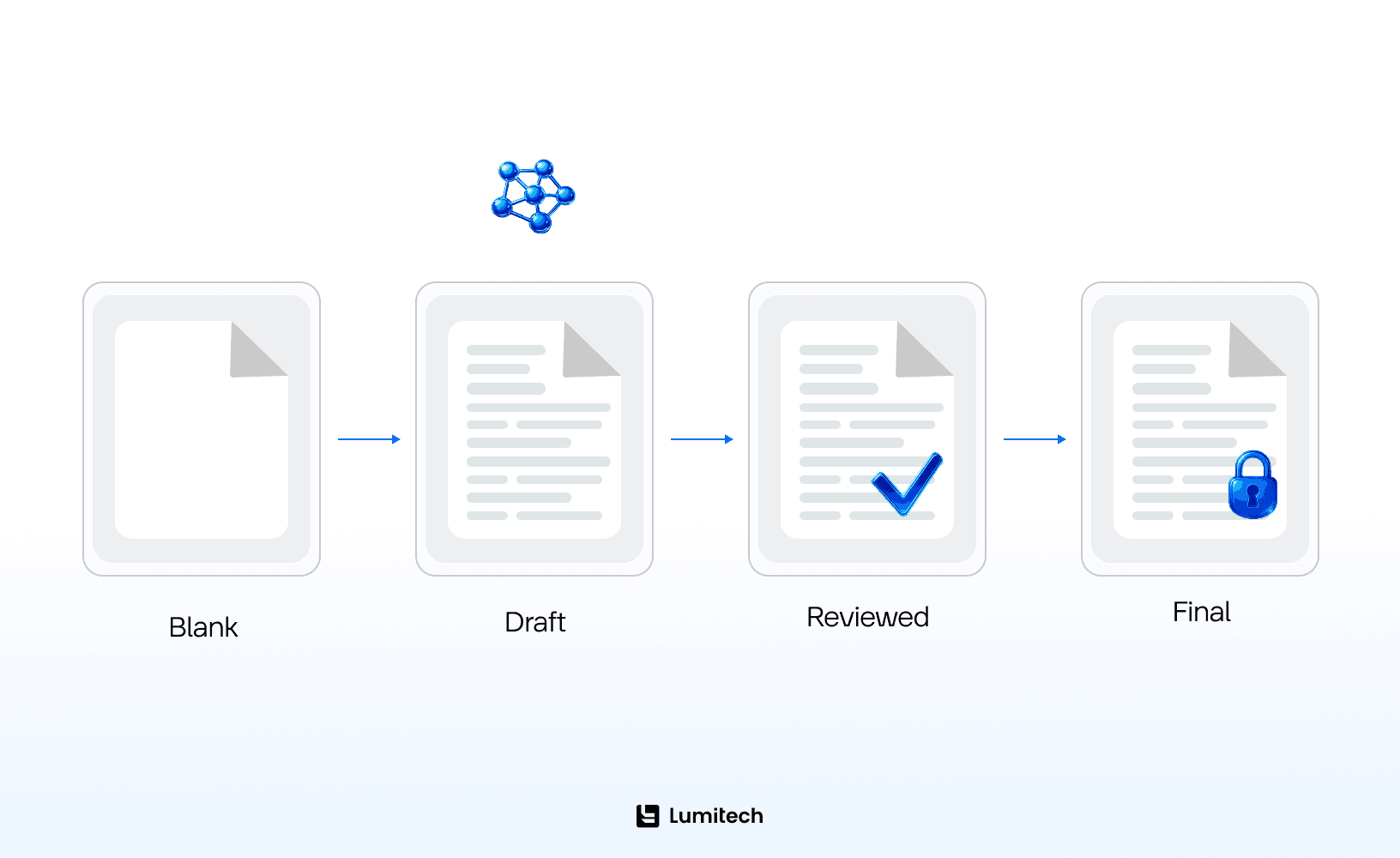
1) Drafting: from blank page to usable first version
This is one of the most obvious AI use cases in investment banking. LLMs are great at producing first drafts of:
pitch narratives
company overviews
market landscapes
investment highlights
management Q&A prep
buyer lists (with constraints and logic)
internal deal updates.
McKinsey describes examples of genAI tools creating first drafts of pitch materials and saving analysts meaningful time in preparation work.
While LLMs handle drafting and synthesis, machine learning in investment banking is already powering quieter workhorses such as client-targeting signals, anomaly detection, and smarter prioritization across coverage and deals.
The winning pattern: Human-edited LLM drafts that pass compliance checks.
The losing pattern: LLM drafts are simply copied, pasted, and shown to a client.
(You can guess which one becomes an “incident review.”)
2) Research and precedent retrieval: “Find me the closest deal”
LLMs shine when paired with retrieval (RAG) over approved internal corpora:
past pitch decks
CIMs / teasers
investment committee memos
precedent transaction databases
internal research
legal and risk guidance notes.
Instead of searching folders like it’s 2009, bankers ask: “Show me three similar sell-side mandates in industrials, €200–500m EV, with cross-border buyers, and summarize positioning angles that worked.” That’s how artificial intelligence in investment banking operates institutional memory at query speed.
3) Diligence acceleration: turning document piles into structured outputs
Diligence is a natural LLM workload:
summarize data room documents by topic
extract key terms from contracts
build Q&A trackers
identify missing documents or inconsistencies
draft diligence request lists based on deal type.
4) Model-support (not model-building)
LLMs won’t reliably perform valuation modeling on their own (and shouldn't be trusted to do so). But AI in investment banking can:
explain assumptions
generate checklists for sensitivity analysis
translate model outputs into narrative text
flag inconsistencies (“your revenue growth assumptions conflict with your market size section”).
5) Meeting intelligence (with strict controls)
For internal meetings, LLMs can summarize: what was decided, open questions, action items, and who owns what.
For client meetings, the controls must be stronger — confidentiality and consent matter. More on that later.
A useful mental model: LLMs are “analyst assistants,” not “deal leads”
If a banker’s role is persuasion + judgment + risk management, an LLM’s role is speed + synthesis + standardization. Treat it like a junior analyst who’s fast, tireless, and occasionally wrong with extreme confidence.
How Does Investment Banking AI Help with Deal Origination and Pipeline Management?
Origination is not one activity; it’s a system: sourcing, qualification, relationship intelligence, timing, and follow-through. AI helps across that system, but only if it’s integrated into the tools bankers already live in (CRM, email, notes, research portals).
1) Smarter targeting and “who should we call?”
Banks have mountains of client interaction data (emails, meeting notes, CRM logs), plus external signals (earnings calls, filings, press, hiring, M&A rumors). AI can fuse these into:
propensity-to-transact signals (e.g., acquisition appetite, divestiture likelihood)
“trigger event” detection (CEO change, activist entry, refinancing window)
sector theme momentum signals.
The value of AI-powered investment banking isn’t “AI predicted a deal.” It’s “AI told us who to prioritize this week, and we were right more often.”
Practical KPI: conversion rate from the target list to the first meeting and a mandate.
2) Pipeline hygiene: less CRM fiction, more truth
CRMs often contain optimistic fiction (“hot lead,” “strong relationship,” “next steps: soon”). AI can improve pipeline quality by:
auto-suggesting stage updates based on real activity
summarizing last interactions and next steps
flagging stalled deals (no activity in X days)
recommending follow-ups based on similar pipeline patterns.
This reduces the “weekly pipeline meeting as performance art” problem.
3) Pitch personalization at scale
Instead of generic pitch decks, AI can draft tailored angles:
relevant sector comps
prior transactions
positioning and potential buyer logic
key risks and mitigations
tailored financing story.
McKinsey and other industry sources explicitly point to genAI-driven support for marketing content and pitch materials in corporate and investment banking contexts.
4) Relationship manager enablement
For coverage bankers, AI can create “client briefs” before meetings. It can include recent news and filings, performance drivers, strategic moves, likely board priorities, and tailored discussion points.
The same playbook is showing up beyond IB as well, with AI in wealth management leaning heavily on summarization, client briefs, and compliant personalization.
This is where the combination of artificial intelligence and investment banking does more than save time. It improves preparedness, which improves outcomes.
Turn origination signals and pipeline hygiene into a working AI workflow, integrated with your CRM, knowledge base, and controls.

The Deal Lifecycle: Where AI-Driven Investment Banking Fits
To keep things concrete, here’s how AI maps to the major phases.
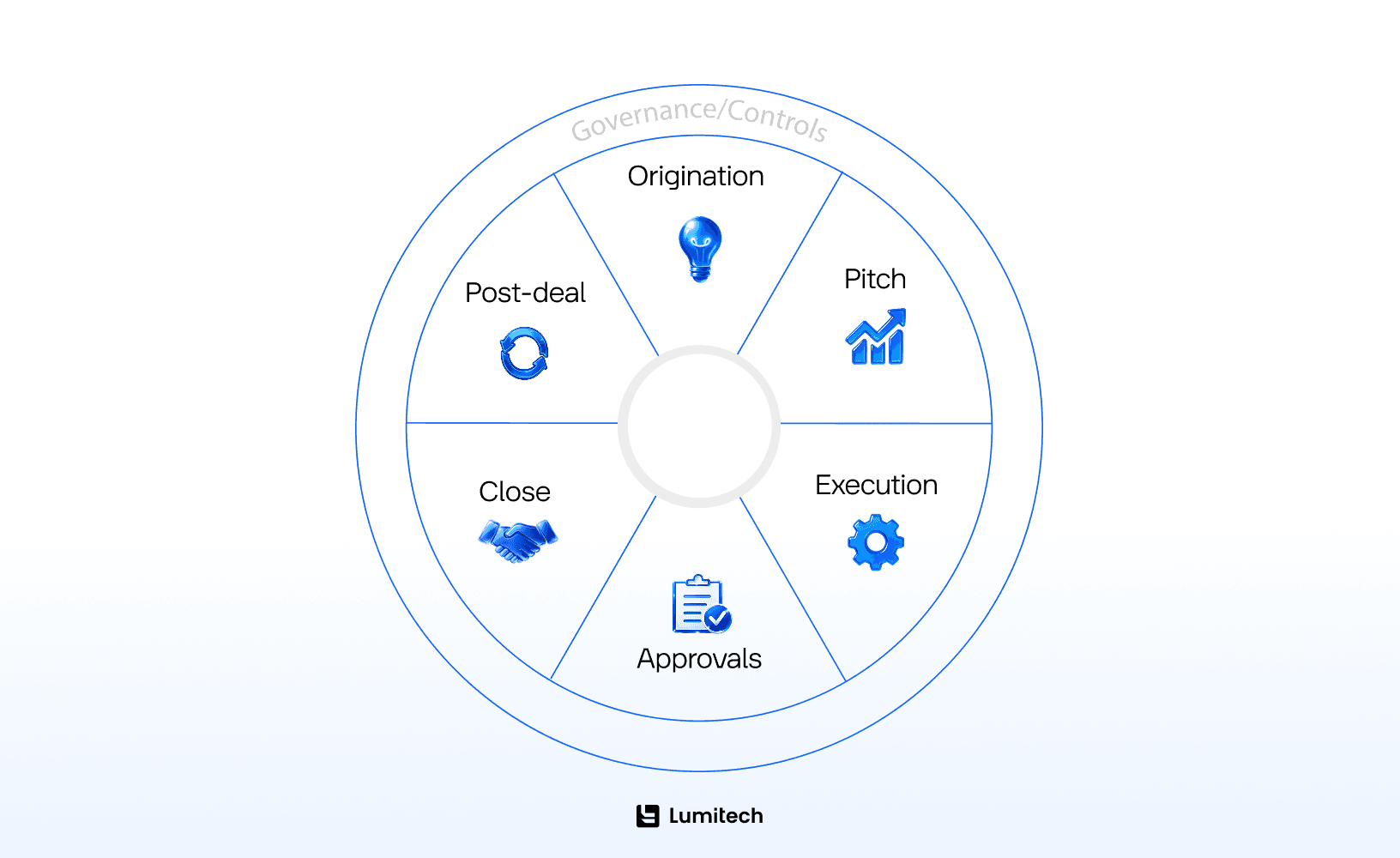
Phase 1: Origination & qualification
AI assists with: target screening, trigger events, client briefs, outreach drafts, and CRM updates. For digital-asset mandates, teams may plug in a real-time crypto market analytics platform to monitor market signals and buyer interest without relying on ad-hoc screenshots.
Guardrails: don’t create “personal data” landmines; ensure explainability of targeting logic; avoid biased signals.
Phase 2: Pitch & mandate
AI assists with: deck drafting, comps summaries, precedent retrieval, positioning angles, and buyer universe.
Guardrails: factual accuracy checks; compliance review; source traceability for claims.
Phase 3: Execution & diligence
AI assists with: data room summarization, contract extraction, Q&A tracking, task management, and risk issue flagging. None of that works safely without data governance in the banking industry that classifies documents, enforces deal-team entitlements, and prevents accidental cross-deal retrieval.
Guardrails: strict access controls; logging; prevent exporting confidential snippets into unsecured tools.
Phase 4: Documentation & approvals
AI assists with: drafting internal memos, synthesizing risk notes, producing first-pass legal summaries (not legal advice).
Guardrails: legal/risk ownership; versioning; audit trails.
Phase 5: Post-deal knowledge capture
AI assists with: archiving key learnings, extracting reusable templates, and updating precedent databases.
Guardrails: sanitize client confidentials; retention policy compliance.
The Fortress: Protecting Confidential Client Data
The biggest hurdle for AI in investment banking isn't performance; it's paranoia. In a world where a data leak can collapse a merger or trigger an SEC investigation, “plugging into ChatGPT” is a fireable offense.
The "Private Cloud" Solution
Public AI and investment banking are not a good match for top-tier banks. They are deploying Single-Tenant LLM Environments. This means the model lives inside the bank’s firewall. The data used to “fine-tune” the model never leaves the building, and the model provider (be it OpenAI, Google, or Anthropic) has zero visibility into the prompts or outputs.
Data Anonymization & Synthetic Data
Before data even hits the AI, sophisticated “privacy layers” strip out PII (Personally Identifiable Information). In some cases, banks use Synthetic Data (artificially generated data that mimics the statistical properties of real client data) to train models without ever exposing an actual client’s balance sheet.
Semantic Guardrails for AI-driven investment banking
Modern AI implementations include a “Compliance Copilot” that sits between the user and the LLM. If an analyst tries to upload a restricted “Project X” document to an unapproved model, the system kills the process instantly.
The same control principles apply to generative AI for wealth management: grounding in approved sources, strict permissions, and human review whenever outputs are client-facing.
Build AI that respects confidentiality and information barriers: RAG, permissions, logging, and governance included.
How Can AI for Investment Banking Be Implemented into Existing Systems?
Investment banks are not greenfield startups. They are a museum of critical systems—some of which are older than the analysts using them.
So implementation success depends less on clever modeling and more on integration design. Done well, AI and ML development in IB looks like integration engineering: permissions, retrieval, logging, and deployment pipelines that match regulated reality.
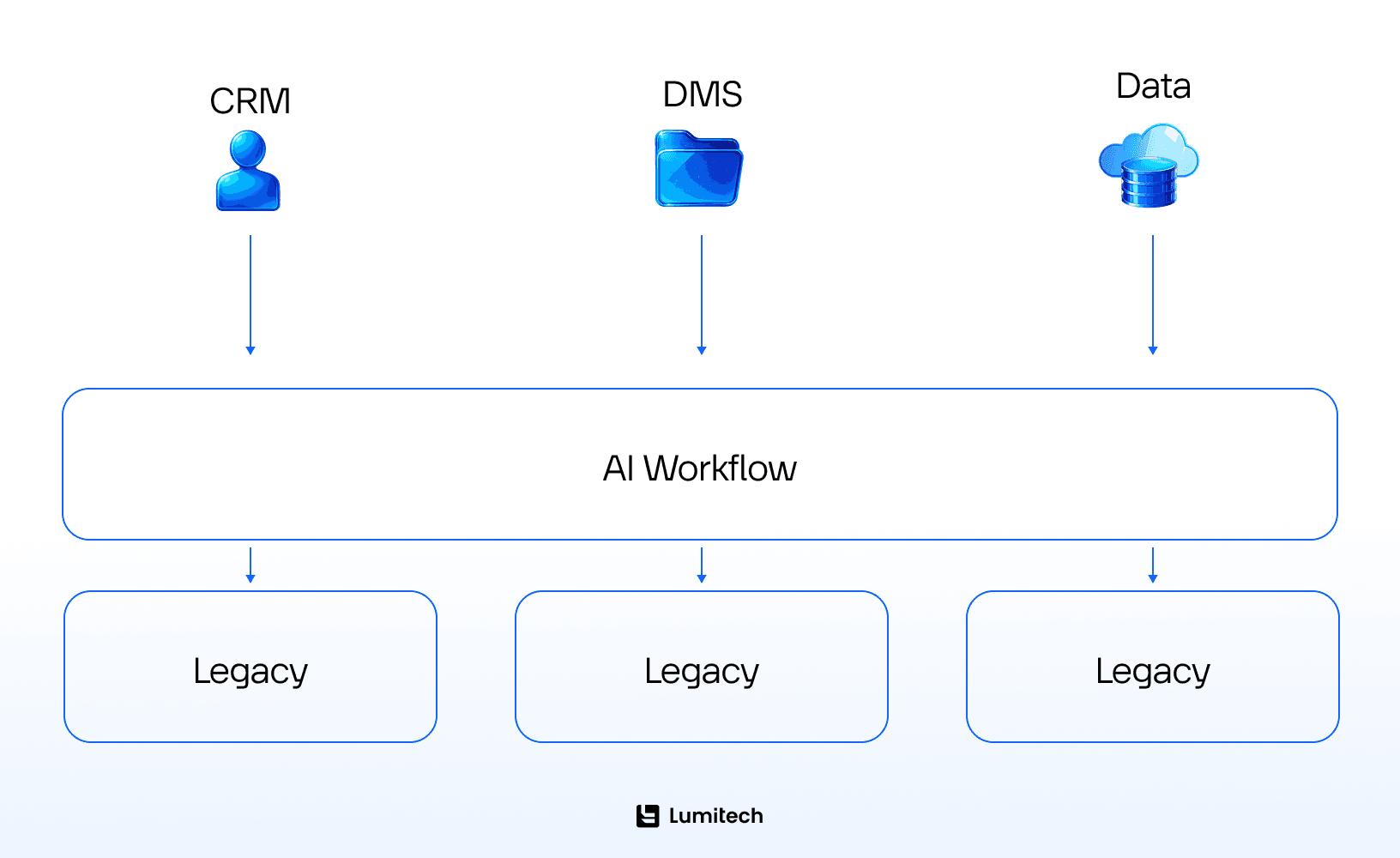
The practical integration principle for AI in investment banking
Build AI where work already happens, or adoption will die quietly in a “pilot” folder. The quickest wins come from automation in investment banking that lives inside existing systems—turning drafting, retrieval, and status updates into one-click workflows rather than extra portals.
That means connecting to:
CRM (pipeline, contact history)
email and calendar metadata (with tight controls)
document management systems (SharePoint-like, DMS, deal rooms)
research portals and internal knowledge bases
compliance and surveillance tools
data warehouses/lakes
workflow tools (task trackers, approvals)
For many teams, this requires software development solutions for fintech that can integrate legacy systems, enforce controls, and still ship usable tools fast.
Step 1: Pick “thin-slice” use cases with clear ROI and low blast radius
The fastest wins are usually:
pitchbook first drafts (internal)
precedent retrieval assistant (internal)
diligence summarization (deal-team restricted)
meeting notes summarization (internal)
McKinsey and Deloitte both highlight productivity-led generative AI use cases in investment banking, often starting with drafting and knowledge access.
Step 2: Establish the “AI control plane”
Before you scale, you need:
model inventory (what exists, owned by whom)
policy tiers (what data can be used where)
approval gates (risk/compliance sign-offs)
monitoring and incident response.
Regulatory-facing guidance increasingly points toward structured risk management for AI in finance. Banks can borrow hard-earned lessons from machine learning in banking, where model validation, change control, and monitoring are expected, not optional.
Step 3: Build the data layer for retrieval (the unglamorous part)
LLMs are only as useful as the knowledge they can safely access. To make investment banking and AI work together, banks need:
document ingestion pipelines
deduplication
metadata enrichment (deal type, sector, date, confidentiality tier)
permissions mapping
indexing for retrieval.
This is where many “AI copilots” fail: they become confident but shallow because they aren’t connected to the right internal sources.
Step 4: Choose a deployment pattern by risk tier
A typical pattern for AI and ML in investment banking:
Tier A (client confidential/MNPI-adjacent): private environment + strict RAG + strict logging
Tier B (internal productivity, not client-facing): controlled enterprise LLM access
Tier C (public/marketing drafts): strongest filters + mandatory review
Step 5: Embed human-in-the-loop reviews where they matter
For IB, human review isn’t optional in:
anything client-facing
anything that summarizes confidentials
anything that could create a disclosure issue.
Step 6: Change management (the silent killer)
Analysts and associates will use tools that:
save time today
fit existing workflows
don’t create compliance anxiety.
If your tool creates extra steps (“paste into portal, wait, export, reformat”), adoption drops. That’s why UX design for fintech is a make-or-break factor: if the tool adds friction, bankers won’t use it when deadlines get real. The best copilots feel like a power tool inside Word/PowerPoint/DMS, not a separate “AI website.”
Copilots in Investment Banking: what “good” looks like
A bank “AI copilot” is usually a set of capabilities, not one bot. Think of the best copilots as decision intelligence services for deal teams: they compress research, retrieval, drafting, and next-step planning into one governed workflow layer.
1) A drafting assistant with templates and guardrails
pitch narrative templates
tone and formatting consistency
source grounding (citations)
prohibited content filters
2) A precedent and knowledge assistant (RAG)
strong search + summarization
access control mirroring DMS permissions
retrieval citations and document links
“compare these three deals” outputs
3) A pipeline assistant integrated with CRM
next-step reminders
meeting prep briefs
auto-suggest stage changes (with approval)
coverage insights
4) A diligence assistant for deal teams
Q&A extraction and tracking
document summaries by workstream
contract clause extraction (flagging only)
issue list compilation
KPMG and others emphasize repeatable delivery processes for generative AI in banking sector, factoring in regulated realities and legacy constraints.
The Real Risks of AI in Investment Banking (And How to Manage Them)
Let’s name the landmines artificial intelligence in investment banking can create. These concerns aren’t theoretical; they’re part of the broader risk conversation around AI in financial services, especially as AI gets embedded into critical workflows.
1) Confidentiality and information barriers
The risk is not just “data leak to vendor.” It’s internal leakage across deal teams, coverage groups, research, trading, and regions.
Mitigation: entitlements in retrieval; barrier controls; logging; redaction; policy tiering.
2) Hallucinations and “confident wrongness”
Here’s one of the biggest risks of combining artificial intelligence and investment banking. A hallucinated market statistic in a pitch is bad. A hallucinated term in a draft contract summary is worse.
Mitigation: retrieval grounding; “must cite sources” rules; automated fact checks where feasible; human review on critical outputs.
3) Model drift and inconsistent behavior
Models change. Prompts change. Data changes. Your controls must handle version drift.
Mitigation: versioning; regression testing; monitoring; rollback.
4) Regulatory and conduct risks
AI may influence communications, suitability-like interactions, and marketing claims. UK regulators have actively studied AI use and its associated risks across financial services.
Mitigation: compliance-by-design; clear accountability; evidence logs.
5) Vendor concentration and resilience
If the same few providers power large parts of AI-driven investment banking, outages or vulnerabilities can become systemic.
Mitigation: exit plans; fallback modes; vendor risk management; redundancy where necessary.
Measuring ROI in AI and Investment Banking Without Fooling Yourself
To prove impact, teams increasingly pair copilots with investment analytics software that tracks cycle time, usage, and downstream quality signals. A simple measurement framework:
Productivity metrics
hours saved per pitch (baseline vs after)
analyst throughput (pitches per analyst)
cycle time from request → first draft
Origination metrics
target list quality (conversion rates)
time-to-first-meeting improvement
follow-up completion rates
Quality + risk metrics
reduction in rework and formatting cycles
fewer compliance exceptions
audit pass rates
incident rates
If a pilot can’t name its primary metric, it’s not a pilot; it’s a demo.
Wrapping Up
AI in investment banking won’t change the fundamentals: relationships, judgment, and execution still win deals. What it will change is the operating speed of the entire machine. The banks that deploy AI well will compress the deal lifecycle: faster origination signals, quicker pitch iterations, cleaner pipeline hygiene, and diligence that moves from “document avalanche” to structured insight without burning weeks of analyst time.
But the real differentiator won’t be who has the fanciest model. It’ll be whoever builds the safest system. With investment banking and AI, a productivity boost isn’t worth much if it comes with data leakage, broken information barriers, hallucinated “facts” in client materials, or an audit trail that looks like a crime scene. That’s why successful programs treat LLMs as governed workflow components: grounded in approved sources, permissioned like any other sensitive system, logged by default, and reviewed by humans whenever outputs leave the building.
In other words, AI should behave like a well-trained analyst, fast, helpful, and supervised. Not like an overconfident intern who writes your pitchbook and then leaks it. Banks that pair speed with control will win. The rest will get very familiar with “incident response.”


