10 Best SaaS Development Companies in 2026: A Vendor Shortlist
Which vendor deserves a place on your shortlist? This guide compares the best SaaS development companies in 2026 by fit, so you can see which teams match your product stage, technical risks, budget logic, and growth plans before the first sales call.
- SaaS
- Software Development
October 05, 2026
 AI Overview
SaaS development companies build and scale cloud products through MVP development, architecture, integrations, and modernization. The right partner depends on the product stage, technical complexity, and level of delivery ownership the client wants to retain. That means buyers should compare vendors by the SaaS work they have actually delivered, the decisions they can own, and the support required after launch.

Who’s on the List
The right choice depends on more than engineering capacity. A team that is well suited to an MVP may be a poor match for a migration-heavy platform, while an enterprise-focused vendor may bring more process and infrastructure than a narrow validation build needs.
We compare ten companies by the SaaS work they have documented and the types of projects they appear best suited to support. The guide also shows how SaaS development services differ across MVP delivery, product engineering, integrations, modernization, and ongoing support.
How We Selected the Companies
We reviewed public service descriptions, case studies, and project evidence for each company. The assessment reflects published information rather than direct observation of the teams currently assigned to client projects.
The review considers:
Delivery evidence: what was built, the vendor’s role, and how closely the work matches comparable product requirements.
SaaS architecture: tenant separation, permissions, integrations, subscription logic, and cloud operations.
Product delivery: discovery, scope definition, phased releases, and coordination between design and engineering.
Security and support: documented controls, maintenance, and post-launch responsibilities.
Engagement model: staff augmentation, dedicated teams, or responsibility for a defined project.
Each company needed a public SaaS service page or at least one verifiable SaaS project to be included. We reviewed official service pages and case studies, along with public security or cloud credentials where they supported a specific claim.
These sources show relevant experience, but they do not predict how a particular team will perform on a future project. Companies are therefore compared by project fit rather than treated as a universal ranking. The information was reviewed in September 2026.
Disclosure: Lumitech publishes this guide and is included in the shortlist. Its profile follows the same public-evidence criteria as the other companies, and no company paid for inclusion or placement in the list.
Quick Comparison of the Top SaaS Development Companies
The companies below are grouped by the SaaS work they appear best suited to handle, based on publicly documented projects and services. Their position in the list reflects the structure of the comparison, not an order from strongest to weakest.
Company | Suggested Fit | Delivery Approach to Discuss |
|---|---|---|
ELEKS | Established SaaS platforms adding modules or changing architecture | Dedicated engineering and feature-based delivery |
BairesDev | SaaS teams adding engineering capacity or commissioning a wider build | Staff augmentation, dedicated teams, software outsourcing |
Lumitech | B2B SaaS with custom workflows, integrations, or AI requirements | Product discovery, full-cycle development, dedicated team |
Itransition | SaaS development, migration, and enterprise integration | Consulting, development, migration, support |
ScienceSoft | Existing business software being developed into multi-tenant SaaS | Project engineering and phased releases; agree on ongoing support |
Netguru | SaaS products needing user research, interface redesign, and engineering | Product design and development alongside an internal team |
Clockwise Software | SaaS MVPs and products with integration or backend requirements | Discovery and full-cycle development |
MindK | Operational SaaS with data, reporting, or workflow automation | Product development, co-development, modernization |
Orases | Businesses turning operational software into a SaaS product | Consulting, application development, team augmentation |
Codica | Marketplace and transaction-based SaaS products | Product discovery, MVP development, integrations |
Several companies span more than one type of engagement. The profiles below show which projects and capabilities support each suggested fit.
Not sure which delivery model fits your team?
Lumitech can help determine whether your project needs a dedicated team, a full-cycle build, or targeted engineering support.

The Real Challenge Behind Hiring a SaaS Development Company in 2026
Finding a SaaS development vendor is relatively easy. The harder test comes when requirements begin to interact, and a seemingly local decision changes the rest of the product.
An additional user role can reshape permissions; an integration can alter the data flow; an AI feature can expose data the platform never collected in the first place. These dependencies affect architecture, scope, and release order, which is why sequencing matters as much as execution.
Vendor selection therefore needs to account for product judgment: whether a team can identify dependencies early, explain what should come first, and challenge decisions that create avoidable work later. The profiles below consider that judgment alongside documented SaaS experience and delivery models.
Top SaaS Development Companies in 2026
Similar service lists can hide substantial differences between SaaS development companies. One team may be strongest when shaping an early product, another when extending an established platform, and another when the work depends on complex integrations or operational workflows.
This list focuses on development partners that build SaaS products for other organizations. It differs from rankings of top SaaS companies or software as a service companies that sell their own subscription platforms. The profiles below compare documented projects, delivery models, technical strengths, and the decisions buyers still need to clarify before signing.
1. ELEKS
Focus: Extending and modernizing established SaaS platforms.
Core services: Application development, product design, cloud engineering, and modernization can be combined with a dedicated development team for longer product engagements.
Public evidence: The Coras project involved adding modules to an existing SaaS organization management platform alongside mobile development, business intelligence, database migration, architecture improvements, and support.
Best fit: Existing SaaS products that need substantial new capabilities without fragmenting the platform as requirements grow. The Coras engagement also included proofs of concept, allowing ideas to be tested before becoming larger development commitments.
Before signing: Customer-specific functionality can become expensive to maintain once several variations of the product exist. Ask how ELEKS would decide what belongs in the shared platform and what should remain specific to one customer.
2. BairesDev
Focus: Nearshore SaaS engineering across several engagement models.
Core services: BairesDev combines architecture, development, integrations, modernization, and DevOps with staff augmentation and outsourced delivery. Its SaaS services cover both new products and established platforms.
Public evidence: Published examples include engineering work on Instructure’s Canvas LMS and the migration of Limeade’s HR platform to microservices on Azure. The first shows long-term product development and maintenance; the second covers modernization, mobile development, and cloud migration.
Best fit: Teams that need to expand engineering capacity without limiting the engagement to a single project. BairesDev can also take on a broader build when more delivery responsibility needs to move outside the client team.
Before signing: The important distinction is between adding engineers to an existing team and outsourcing a defined part of the product. Agree where responsibility for priorities, architecture, and acceptance sits under the proposed model.

3. Lumitech
Focus: B2B SaaS products where custom workflows, integrations, and AI functionality are part of the core product logic.
Core services: Lumitech covers product discovery, UX/UI, architecture, development, integrations, and cloud engineering through its SaaS development services.
Public evidence: Its work includes a logistics SaaS platform built around operational processes, the Valorian SaaS ecosystem with a scheduling board development, and an angel syndicate investment platform supporting investment workflows. The projects show experience with different business models while sharing a common requirement: software has to coordinate roles, data, and business processes.
Best fit: B2B products where the complexity comes from how different parts of the system interact — for example, when a workflow depends on several user roles, external services, or data moving between systems.
Before signing: Clarify which product and architecture decisions Lumitech will own during delivery and which remain with your team, particularly when a new integration, workflow, or AI requirement changes the agreed scope.

4. Itransition
Focus: SaaS projects where development is closely tied to migration, infrastructure, or business-system integrations.
Core services: Itransition’s SaaS services include consulting, development, migration, integration, and support, with single-tenant, multi-tenant, and hybrid architectures among the available approaches.
Public evidence: Itransition’s SaaS services page includes a scalable insurance claim management solution and a SaaS portal for analyzing Azure usage and billing. Both examples involve business processes and data that extend beyond the application itself.
Best fit: Products that cannot be developed or modernized in isolation because existing systems, data, or infrastructure still need to remain part of the operating environment.
Before signing: Migration introduces risks that a general service description cannot resolve. The proposal should specify how data will be validated, what happens if migration fails, and how much service interruption is acceptable.
5. ScienceSoft
Focus: Moving established business applications into a multi-tenant SaaS model.
Core services: ScienceSoft’s documented work combines application re-engineering, multi-tenant development, and cloud deployment rather than treating SaaS development as a greenfield build.
Public evidence: Its quality management system project involved converting proprietary software into a multi-tenant SaaS product for a supply-chain services provider. Delivery progressed from an MVP to a full version.
Best fit: Organizations that already have useful software or established business workflows and need to change how the product is architected and delivered without rebuilding its business logic unnecessarily.
Before signing: The key question is what can survive the move to multi-tenancy unchanged. Existing workflows, data structures, and security requirements should be separated into what can be retained and what needs redesign.
6. Netguru
Focus: SaaS product work where design and engineering need to move together, particularly when an internal team will continue developing the product after handover.
Core services: Netguru brings user research, product scoping, UX/UI, frontend development, modernization, and accessibility into the same product engagement.
Public evidence: For an EdTech SaaS platform, the work extended beyond interface redesign to the technology stack, reporting, and multi-tenant application. Netguru collaborated with the client’s engineers and prepared documentation for handover.
Best fit: Established products where a poor user experience is connected to technical constraints rather than design alone, particularly when an internal team will continue developing the product afterward.
Before signing: Decide what Netguru is expected to leave behind. If the internal team will take over, implementation ownership, documentation, and the point of handover matter alongside the redesigned user journeys.

7. Clockwise Software
Focus: SaaS MVPs and product releases with substantial backend and integration work.
Core services: Clockwise combines discovery with full-cycle development through its SaaS development services, covering the product from initial definition through implementation.
Public evidence: Its portfolio includes SaaS backup software, a white-label marketplace, and marketing analytics applications, giving examples across different product stages and technical requirements.
Best fit: Teams taking a defined first release through discovery and implementation, especially where accounts, workflows, integrations, and backend logic need to work together
Before signing: An MVP timeline says little without a boundary around the release. Ask exactly which workflows, integrations, testing, and production preparation are included before comparing the proposed schedule with other vendors.
8. MindK
Focus: Operational SaaS products built around structured data and workflow automation.
Core services: MindK’s SaaS development services combine product development with API integration, cloud architecture, modernization, and UX/UI.
Public evidence: Its portfolio includes Reseat’s inventory management system and CEMAsys’s sustainability platform. Both products organize data from different parts of the business into operational workflows and reporting.
Best fit: B2B products whose usefulness depends on keeping records consistent while data moves between teams, workflows, or external systems.
Before signing: Automation becomes fragile when several systems can update the same information. Establish which system is the source of truth and how conflicting or failed updates will be resolved.

9. Orases
Focus: Turning business-specific software and workflows into SaaS products.
Core services: Orases combines SaaS consulting services with custom application development, integrations, and mobile development. Its SaaS application services also include options for clients that need additional development capacity rather than a complete build.
Public evidence: Orases developed a custom CRM for Next Day Dumpsters that replaced several disconnected operational systems. The project also introduced licensing capabilities that created a path for the software to be resold through a SaaS model.
Best fit: Companies that already understand a problem through their own operations and want to turn that knowledge, workflow, or existing software into a product for other customers.
Before signing: The originating company is not necessarily representative of the future market. Separate requirements that are unique to the first business from those that belong in the product other customers will buy.
10. Codica
Focus: SaaS and marketplace products where several user groups participate in the same transaction or workflow.
Core services: Codica combines product discovery, development, UX/UI, integrations, QA, and DevOps, with both SaaS and MVP work represented in its offer.
Public evidence: Codica built CakerHQ, a SaaS platform for bakery businesses, and RecruitAgent.ai, a recruitment platform with AI and third-party integrations. The two cases show experience with transaction-heavy workflows, external services, and different SaaS business models.
Best fit: Products that have to coordinate customers, suppliers, administrators, listings, payments, or external services rather than support a single user journey.
Before signing: The normal transaction is only part of the product logic. Changes, cancellations, refunds, failed payments, and administrator intervention should be mapped before deciding how much of the workflow belongs in the first release.
Have a SaaS project to compare against the shortlist?
Share the product stage, core workflows, and technical constraints with Lumitech to see how the proposed scope and development approach would look for your project.

What Makes a SaaS Development Company Technically Strong?
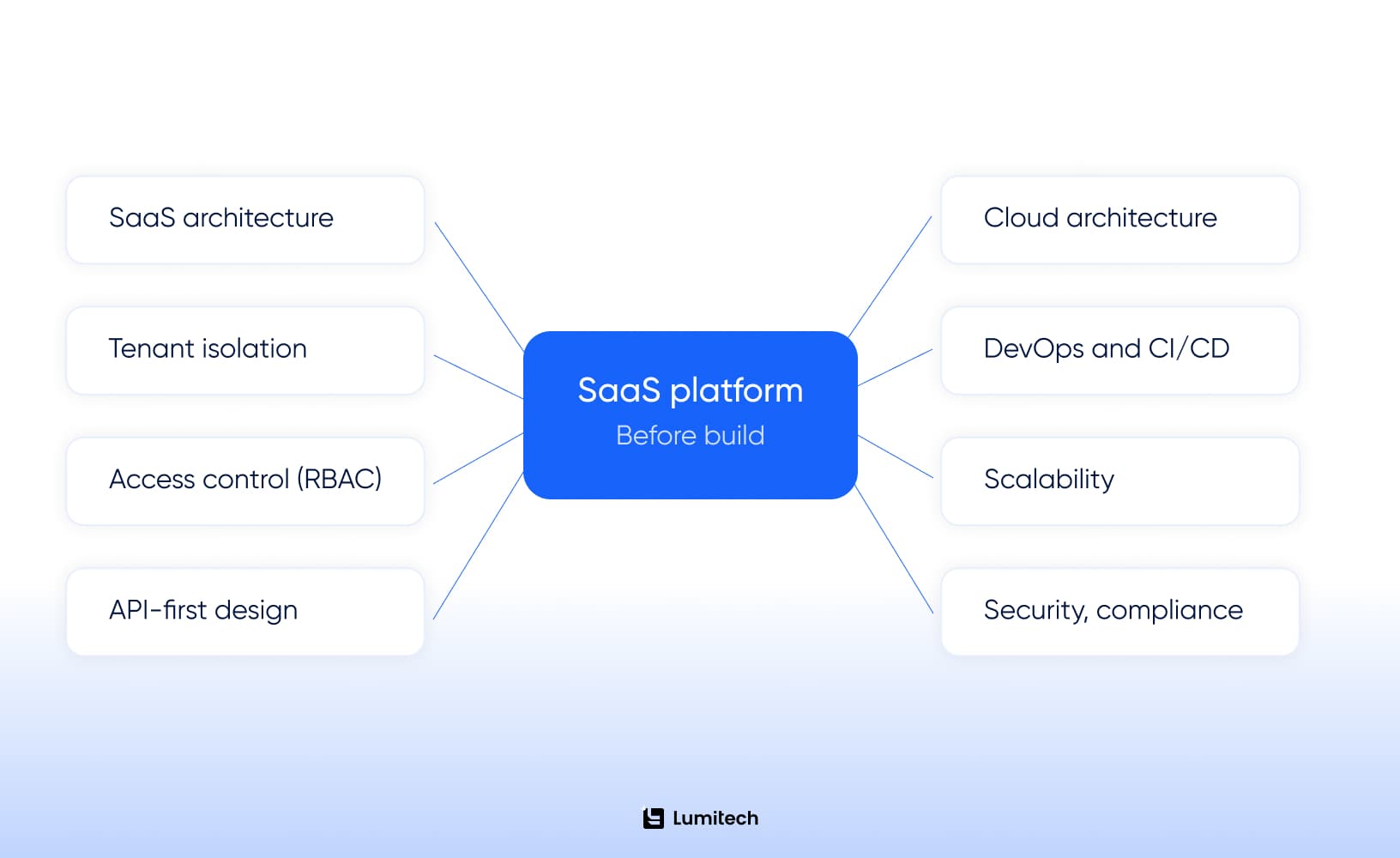
Technical depth shows in the decisions a team makes before implementation starts. Tenant structure, permissions, integrations, deployment, and expected growth all affect how easily the product can change after launch.
The eight areas below help assess whether a proposed technical approach fits the product and its likely next stages.
SaaS Architecture
A SaaS product rarely stays as simple as its initial architecture suggests. Billing rules, user roles, integrations, reporting, and administration add dependencies as the platform grows.
A vendor should be able to explain the proposed multi-tenant SaaS architecture, the data model behind it, and the assumptions that shape the design. The architecture does not need to anticipate every future scenario, but it should leave a clear path for changes that are already likely.
Tenant Isolation
Tenant isolation determines how one customer’s data and activity remain separate from another customer’s environment. The choice affects the database model, application logic, testing, monitoring, and security controls.
Some products need stronger physical separation; others can use shared infrastructure with enforced logical boundaries. The isolation model should match the sensitivity of the data, operational requirements, and the way tenants are expected to use the platform.
Role-Based Access Control
B2B SaaS products often move beyond a simple admin/user model early. Departments, managers, contractors, support teams, and external users may all need different levels of access.
Role-based access control needs a structure that can expand without turning every new permission into a special case. For products with more contextual rules, access may also depend on the customer account, location, resource type, or temporary conditions.
API-First Design
Integrations become difficult to maintain when every external connection is implemented as a separate workaround. A clear API layer gives the product a consistent way to exchange data with CRM, ERP, payment, analytics, support, and other systems.
The same discipline applies when evaluating an AI SaaS development company. An AI-powered SaaS platform needs clear rules for data access, model outputs, fallback behavior, and where AI results enter the workflow. Authentication, retries, and failed transactions still need defined handling when an external AI service becomes unavailable.
Cloud-Native Architecture
Cloud infrastructure should reflect the way the product is expected to operate. Storage, queues, backups, monitoring, scaling, and cost controls all change as usage and workloads grow.
For an existing platform, cloud migration services may also involve architecture changes rather than a simple infrastructure move. Legacy SaaS modernization can require data migration, API work, or replacement of components that limit deployment speed, tenant support, or future development.
DevOps and CI/CD Pipelines
A production SaaS platform needs a repeatable path from code change to release. Automated checks, CI/CD pipelines, monitoring, rollback, and infrastructure management reduce the amount of manual work involved in each deployment.
Database changes deserve particular attention because they cannot always be reversed cleanly. Production access, release ownership, and recovery procedures should be settled before handover rather than during the first incident.
Scalability
Scalable SaaS applications are built around explicit assumptions about usage, not around maximum theoretical load.
User volume, data growth, response times, background processing, and integration traffic provide a better basis for scaling decisions. Caching, microservices, or serverless architecture may become appropriate as those assumptions change, but adding them too early can introduce cost and operational complexity without solving a current problem.
Security and Compliance
Security needs to be built into the product from the start. Authentication, access controls, audit logs, encryption, data movement, and production permissions all depend on how the application is designed and operated.
The exact requirements vary by product. HIPAA, GDPR, SOC 2, PCI DSS, penetration testing, and other controls apply in different contexts. A health web platform can show experience with sensitive workflows, but buyers still need to understand which controls the vendor delivered and which remained with the client.
Technical strength narrows the shortlist. The next step is checking whether the same team also fits the product stage, delivery model, and level of ownership the client plans to retain.
How to Choose the Right SaaS Development Company
Relevant experience should reflect the type of product the team will actually be asked to build. A vendor that has handled comparable delivery constraints, integrations, user roles, or migration work gives the buyer more to evaluate than a broad technology list.
Match the Engagement to the Product Stage
A focused MVP does not always require a large custom architecture from day one. When the first release mainly tests a workflow, a comparison of low code vs. traditional development can show whether extensive custom engineering is justified at that stage.
Products with complex permissions, billing logic, sensitive data, or enterprise integrations usually require deeper technical planning earlier. In those cases, the development partner is being selected not only for execution, but also for decisions that will shape later releases.
Consider What the Vendor Actually Delivered
Relevant case studies are more informative when the vendor’s role in the project is clear. Building a SaaS product end to end, modernizing an existing platform, and supplying engineers to an internal team demonstrate different capabilities.
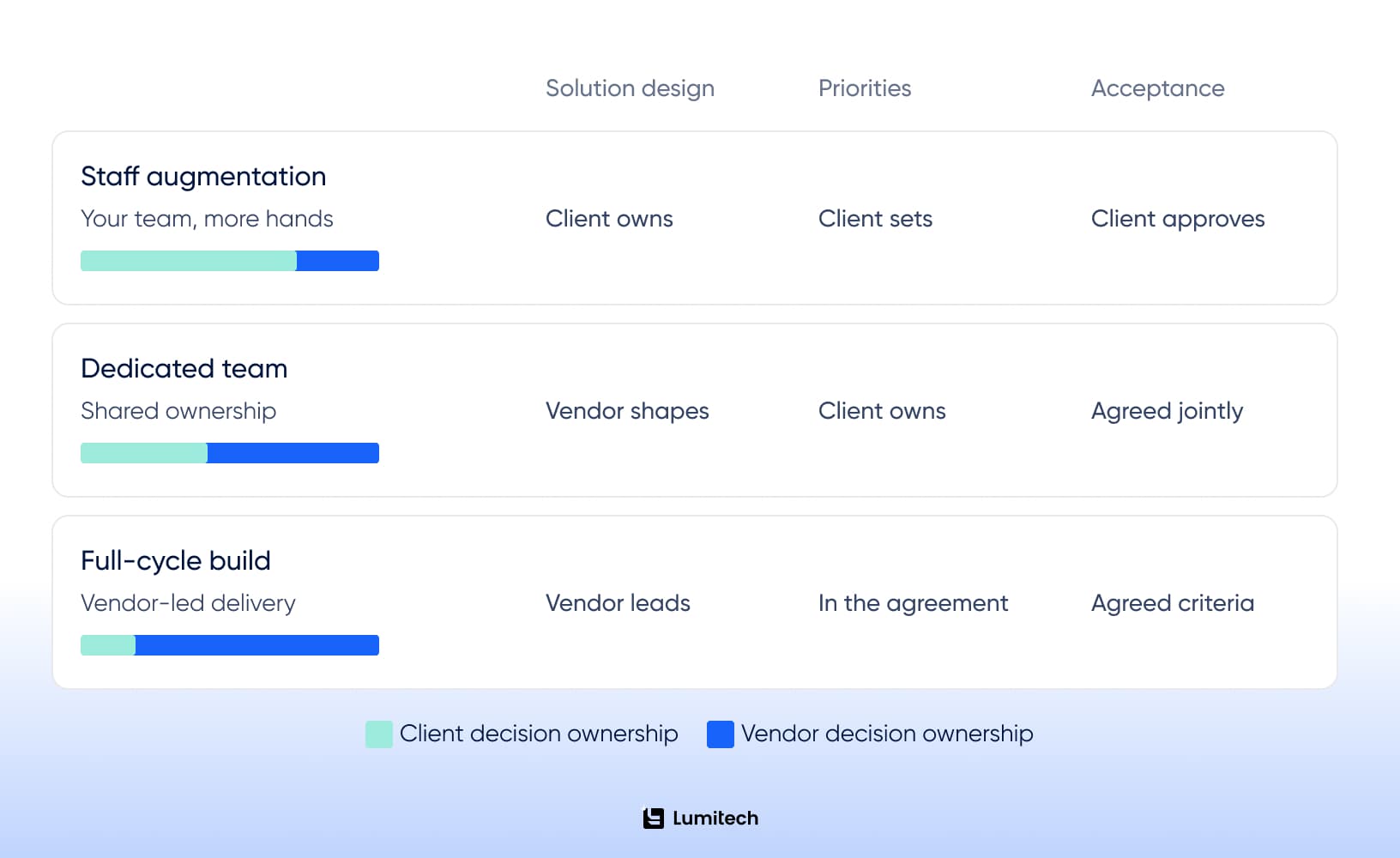
The delivery model also changes who makes the key decisions. With staff augmentation, the client usually keeps control of product priorities, architecture, and acceptance while the vendor adds engineering capacity. A dedicated team shares more responsibility for planning and execution, although product ownership normally remains with the client. In a full-cycle engagement, the vendor takes on more of the delivery, including discovery, technical planning, implementation, QA, and release preparation. That makes scope, acceptance criteria, and change handling more important to define before work begins.
Compare Proposals on the Same Scope
Two estimates can look similar while covering substantially different work. Design, QA, migration, cloud costs, integrations, and post-launch support may be included in one proposal and treated as separate work in another.
A fair comparison therefore depends on the same assumptions, exclusions, and responsibilities being visible across proposals. Price becomes much easier to interpret once those boundaries are clear.
Test the Proposed Sequence
A proposal should show why the work appears in that order. Authentication may need to precede customer-facing workflows; data preparation may need to come before AI functionality; migration may need its own release before older components can be retired. Sequence affects both the estimate and how much can realistically be delivered in the first release.
RAND’s 2024 AI project study cites estimates that more than 80% of AI projects fail and identifies unclear objectives, inadequate data, weak infrastructure, and poor problem selection among the recurring causes. The figure applies specifically to AI projects, not SaaS development as a whole.
Consider Maintainability Alongside Delivery Speed
A fast release can still create expensive work later if early technical decisions are difficult to maintain or extend. Atlassian’s 2024 developer experience research found that 69% of developers lose at least eight hours a week to inefficiencies, with technical debt among the issues linked to that lost time.
By this stage, the comparison should clarify what deserves priority now, what can wait, and which assumptions may change the estimate. Those points should carry into the proposal before the engagement is signed.
Questions to Ask Before You Sign
Before signing, the proposal should make the main technical and commercial assumptions clear.
What would you remove from our first release, and why?
Which architecture decisions would be difficult or expensive to change later?
How would you approach tenant isolation and role-based access control?
Which integrations create the most delivery risk?
Which security or compliance decisions are needed before development?
Who makes product and technical decisions when requirements change?
What is excluded from the estimate, and how are scope changes approved?
Who owns the code, cloud accounts, documentation, and production support after launch?
The answers should clarify cost, ownership, support, and acceptance before those points reach the contract. Evasive or vague responses are a reason to look more closely at the proposal.
Red Flags to Avoid
A fast timeline or low estimate is not automatically a warning sign. Concern starts when there is no clear explanation of what makes the timeline or price possible.
For a narrow workflow test, low-code or no-code may be entirely appropriate. A production SaaS platform carries a different set of responsibilities around integrations, permissions, reporting, security, deployment, and support.
Warning signs include:
A fixed-scope quote prepared before requirements and exclusions have been documented.
An aggressive MVP deadline with no explanation of what has been removed, deferred, or simplified.
Separate design and engineering teams with no clear owner for product decisions.
Multi-tenancy, billing, security, or compliance postponed until later without any discussion of the consequences.
Integrations priced without clarity around authentication, data ownership, failure handling, or third-party limitations.
Support described as “included” without defined hours, incident handling, infrastructure access, or handover responsibilities.
None of these points automatically rules out a vendor. They indicate areas where the proposal needs greater precision before a commitment is made.
Once the engagement risks are clear, the remaining question is which parts of the product lifecycle the vendor is expected to cover.
What Services Do SaaS Development Companies Offer?
SaaS application development services can cover a narrow technical task or most of the product lifecycle. The scope changes depending on whether the company is validating a new product, extending a live platform, or replacing older parts of the system.
Product Discovery and SaaS MVP Development
Discovery converts product assumptions into a buildable scope, with the core workflows, user roles, constraints, and unresolved technical decisions documented before engineering expands.
SaaS MVP development then tests those assumptions in a working product. The scope should be narrow enough to launch quickly, but complete enough to show whether the core workflow works for real users.
Custom SaaS Product Development
Custom SaaS development services are most relevant when the product carries business rules that standard software cannot support cleanly. Account-specific permissions, contract-based billing, approval chains, admin workflows, and specialized reporting can all shape how the system is built.
In these projects, those rules influence the data model, permissions, and implementation across the product.
Third-Party Integrations
Most B2B SaaS products exchange data with other systems. Payments, CRM, ERP, analytics, AI services, and internal tools all introduce dependencies that have to be handled inside the product.
That work covers authentication, synchronization, webhooks, retries, failed transactions, and data ownership. An Amazon seller reimbursement platform shows how external data and claims logic can become part of the main application workflow.
SaaS Modernization and Cloud Migration
Existing SaaS products often need targeted changes rather than a complete rebuild. The pressure may come from outdated components, slow releases, limited tenant support, or infrastructure that no longer fits current usage.
SaaS modernization and cloud migration can involve architecture changes, API work, data migration, infrastructure updates, and selective replacement of legacy components. Legacy modernization services can also support broader digital transformation services when the software change affects connected business processes.
SaaS Testing and Ongoing Support
A SaaS release has to work across different users, tenants, integrations, and production conditions. Testing therefore covers more than individual features; permissions, regression risks, performance, and connected systems also need to hold up.
Ongoing maintenance and support can include incident response, monitoring, security updates, infrastructure work, and release support. A web and mobile application for industrial sector adds another concern: reliability when the product is used in field conditions as well as through a standard web interface.
These services can be combined in one engagement or divided between an external vendor and the internal team.
Final Takeaways
The strongest SaaS development partner is rarely the company with the broadest service catalog. The better match is the team whose experience, delivery model, and technical judgment fit the decisions your product still has to make.
That is why the shortlist should only be the first filter. The real comparison starts when vendors respond to the same product scope and explain what they would build first, what they would postpone, where they see technical risk, and which decisions they expect your team to own.