

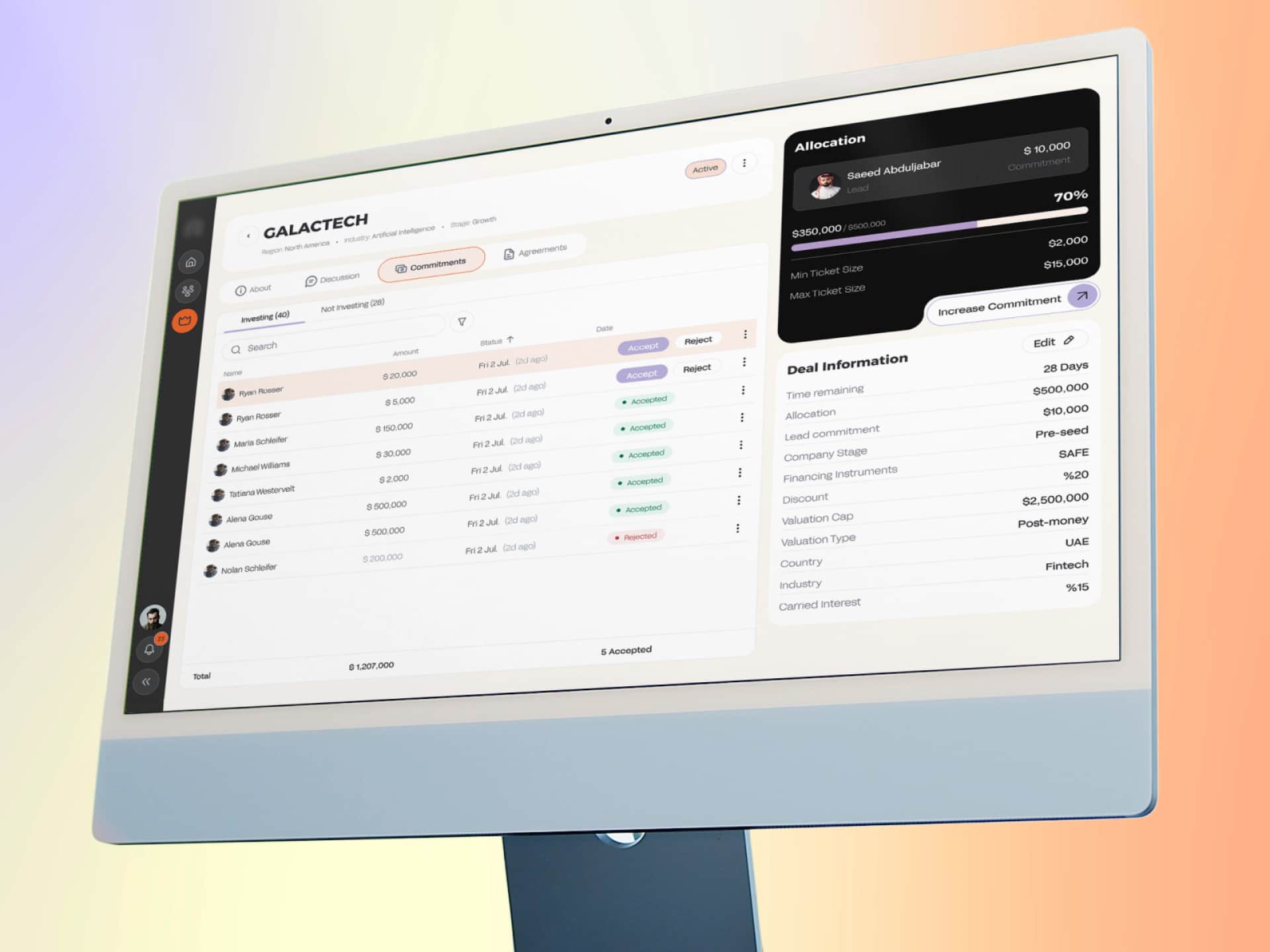


An angel investor from Jeddah, running a family‑backed investment fund, came to us with a familiar problem — active early‑stage and syndicate deals managed through messy spreadsheets, chats, and scattered documents instead of a single system.
Together with Lumitech, this turned into a focused brief: design and build an AI‑native investment platform that structures the full lifecycle end‑to‑end, from deal creation and allocation management to documents and terms, while laying a scalable SaaS foundation that can later power other investors, syndicates, and family offices.
About the Client
The client is a Saudi angel investor based in Jeddah, investing together with his family as a private family office. They focus on early‑stage startups, often join syndicates, and are comfortable working with modern instruments like SAFE, valuation caps, and structured co‑investment.
Despite this sophistication on the investment side, the operational layer was still very manual, with deals living in spreadsheets and legal documents in shared folders. Memo drafts were written by hand, again and again, often from scratch. Decision‑making logic mostly existed in people’s heads and message histories, not in a system.
So, the request was not to build a marketplace or another generic VC CRM. They needed a private, controlled investment infrastructure that fits how a family office and syndicate actually work. And at the same time, they wanted this platform to have the potential to become a product others could use — angel clubs, micro‑VCs, GCC investment clubs, and family offices.

Interesting Facts
The client is based in Jeddah, a coastal port city in Saudi Arabia that is turning into one of the focal points of economic activity in the region.
The family invests actively in early‑stage deals and syndicates, which makes them a good representative of the new private capital wave in the GCC.
The platform was intentionally designed to start as a closed internal system but with a clear path to become a public‑facing SaaS for other investors and clubs.
The project involved not only a classic product team, but also AI‑focused engineers — the goal was a real generative AI layer, not just a “ChatGPT plugin”.
The final product feels less like a simple dashboard and more like a Phase 2–3 investment platform: multi‑step deal creation, allocation control, SPV logic, and an AI layer across documents and data.
The Challenge
The problem was not deal flow. The problem was structure.
The family had a steady stream of opportunities, joined syndicates, negotiated terms, and participated in early‑stage deals. But the underlying process looked like this:
Deals tracked in spreadsheets.
SAFEs, term sheets, and agreements scattered across folders and email threads.
Investment memos written manually, with no consistent format.
No single source of truth for conditions, risks, and portfolio view.
They wanted to fix this in a way that would not slow them down. In other words, they did not want a heavy corporate system that kills speed. They wanted a platform that keeps their style of investing, while bringing discipline, transparency, and intelligence into the process.
And there was another strategic layer: from the beginning, the platform was seen as something that could go public later — a SaaS product for angel syndicates, investor clubs, and family offices. So whatever we designed had to work for one family first, but also make sense as a standalone product when it goes to market.
Finally, the most important point: they didn’t just want a nicer UI on top of the same chaos. Instead, they wanted intelligence. Generative AI had to be part of the core, not a checkbox feature.
Our Approach
We started with a deep design phase, without jumping into development. Together with the client we mapped:
How a deal appears and moves through the pipeline.
Who gets involved at which stage.
How decisions are made and approved inside the family.
How SPVs are structured and how allocations are managed.
Where exactly transparency is lost and where risks appear.
In parallel, we designed the AI layer. Instead of thinking “we build a system and then plug AI on top”, we approached it as “this is an AI‑native investment platform”. That meant we treated documents, financial models, notes, and historical deals as a unified knowledge base that generative AI could work with.
From our side, the project team included seven people: a product lead, a business analyst, a UI/UX designer, three engineers, and a QA. A significant part of the architecture was built around one question — how exactly AI will interact with data, documents, and user actions at every step of the investment lifecycle.
Only after aligning on the process logic and AI use‑cases we moved into development. We implemented modules for deal creation, allocation and commitment management, document storage, user roles, carried interest configuration, and financial instrument structuring. The entire backend was built as a multi‑tenant architecture to support a future public release where multiple independent syndicates and clubs can run on the same platform.
Generative AI was not a side panel here. It became the intelligence layer that connects everything: documents, metrics, deal history, and portfolio structure.
Technologies
We used a modern fintech / investment stack with a strong focus on AI and multi‑tenant design, consistent with Lumitech’s other finance products.
Web application layer. React and Next.js with TypeScript power a fast, component‑based interface for dashboards, deal tables, investment activity charts, and detailed deal room screens.
Core backend & data. Node.js and NestJS handle business logic for multi‑tenant operation, while PostgreSQL stores financial entities such as deals, allocations, SPVs, and carried interest. Redis is used for caching and fast access to frequently used records.
AI service layer. A separate Python (FastAPI) service manages all AI workloads, integrating with OpenAI / Azure OpenAI LLMs and Embeddings API as the core of the Generative AI features and the RAG pipeline.
Vector search & knowledge base. We use pgvector inside PostgreSQL or Pinecone as a vector database for semantic search across deals and documents, orchestrated through frameworks like LangChain or LlamaIndex.
Document parsing pipeline. Legal and financial documents (SAFE, term sheets, agreements) go through parsing with PyPDF, DOCX processing, and OCR when needed, so the AI layer can work with clean, structured data instead of raw files.
Prompting & structured outputs. Carefully designed prompt templates and structured output schemas keep AI‑generated memos, legal interpretations, scenario analysis, and risk signal explanations consistent and reliable enough for real investment decisions.
Features
This platform is, in simple words, a private operating system for an angel syndicate or family office. It covers everything from syndicate profiles to AI‑generated investment memos. Below are the most outstanding features of the solution.
Syndicate Profile & Deal Creation
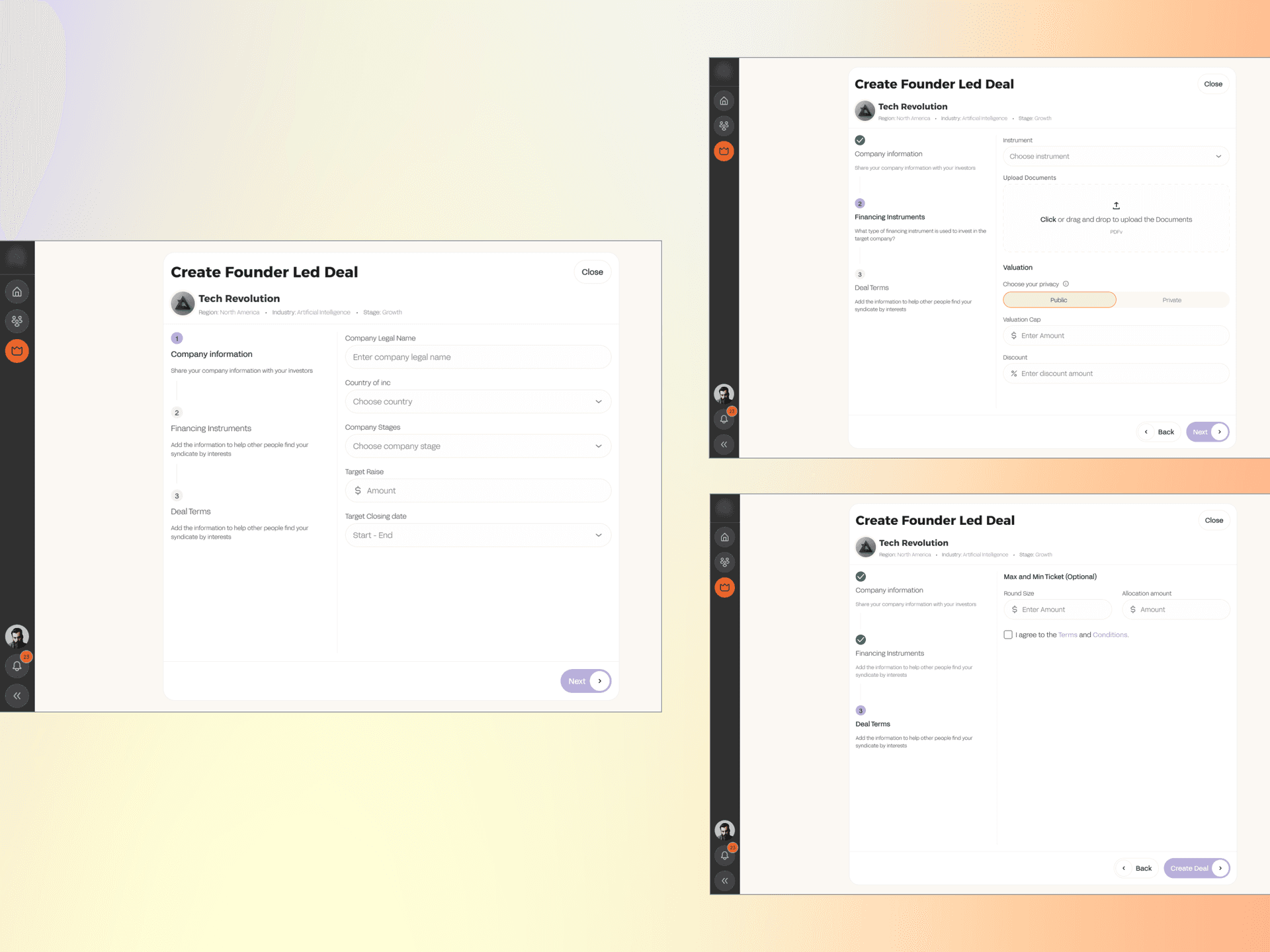
The platform includes a profile view for each syndicate or investment club, with region, industry focus, stages, investment thesis, track record, and the lead team. There is also an “apply to join” logic for the public version of the product in the future.
For deals, the lead investor can:
Create a new deal with company details, industry, and stage.
Choose the investment instrument (for example, SAFE).
Set key parameters like valuation cap, discount, min/max ticket, total allocation, and lead commitment.
Attach pitch decks, financial models, and additional documents.
All of this feeds into the AI layer and into the structured data model, so that later the system can analyze, compare, and explain deals instead of being just a static form.
Investment Pipeline & Allocation Management
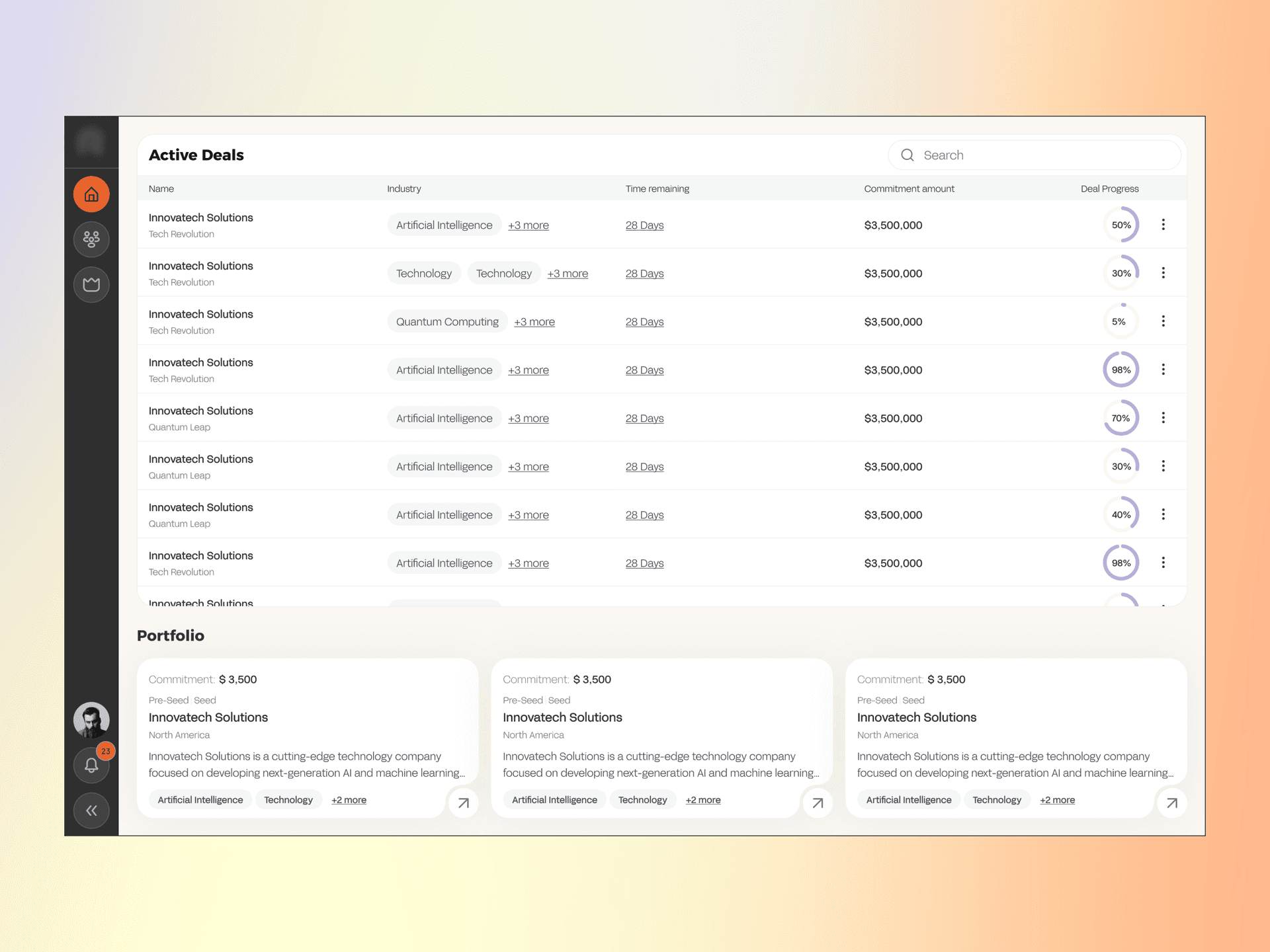
The deals dashboard shows a live investment pipeline:
Active and closed deals.
Stages such as pre‑seed, seed, and so on.
Tags like AI, Clean Energy, Technology.
Funding progress as both percentage and amount.
Filters by industry, stage, thesis, and more.
On top of that sits allocation management. The lead sees who committed how much, how close they are to filling the allocation, and where there is oversubscription. This is crucial for real syndicate operations where demand can easily exceed the available allocation.
Deal Room & Document Management
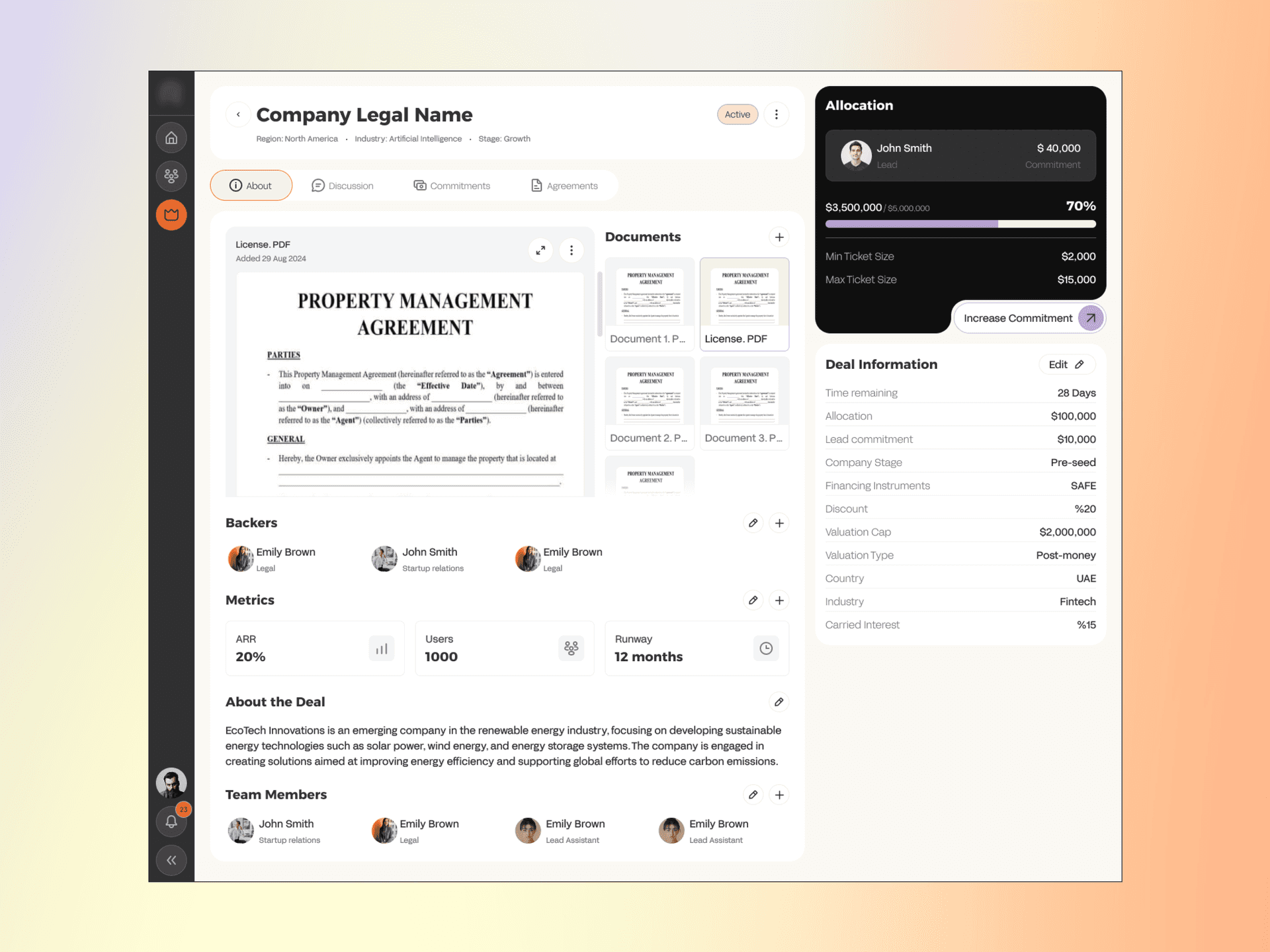
Each deal has its own deal room with:
Documents (SAFE, term sheet, pitch deck, financials).
Agreements and commitments.
Discussions and comments.
But the important part is that documents are not “dead” files here. They are parsed and interpreted by the AI engine. Key parameters are extracted, linked to the deal, and used across the rest of the system — from memo generation to risk analysis and Q&A.
Generative AI as the Core
This is where the platform becomes different from a typical investment CRM or dashboard. Generative AI is deeply integrated into five core blocks.
AI‑Generated Investment Memos
Instead of writing investment memos manually every time, the system:
Analyzes the pitch deck, financial models, notes, and market description.
Aggregates data across these sources.
Produces a structured investment memo.
The memo includes:
Company overview and business model.
Key metrics and traction.
Deal terms and high‑level structure.
Risks and potential red flags.
Possible exit scenarios and how they might play out.
This is not just a text summary. The AI removes duplication, aligns the format, and brings everything into a consistent structure. As a result, the preparation time before deal discussions drops significantly, and the quality of memos becomes stable across different deals and over time.
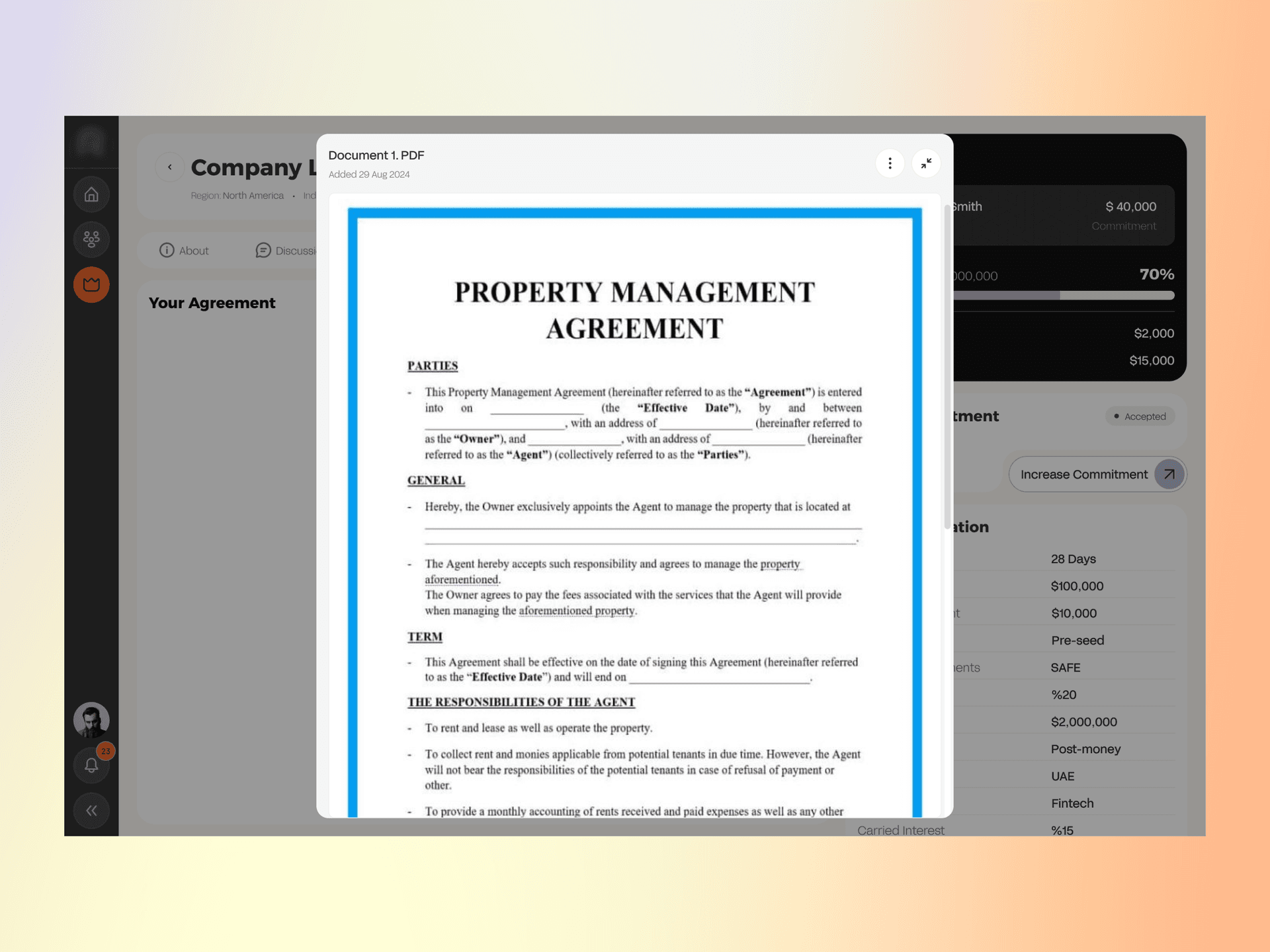
Generative Legal Document Analysis
When the family uploads SAFE, term sheets, or other agreements, the AI engine does much more than just pulling out numbers:
Extracts parameters like valuation cap, discount, liquidation preferences.
Interprets the economic meaning behind clauses.
Explains complex legal wording in plain language.
Compares terms with typical market practices and highlights unusual points.
So, instead of reading through dozens of pages line by line, the investor sees a clear, compact picture of what is actually being agreed. For a family office without a full‑time legal team on every deal, this is extremely valuable.
Intelligent Q&A Layer (RAG)
We implemented a RAG‑based conversational layer on top of the platform’s database and document store. A user can ask questions like:
“What are the main risks for this deal?”
“How do these terms compare to our previous AI investments?”
“What is our exposure by industry across the portfolio?”
Generative AI responds based only on real data inside the system — documents, metrics, and past deals. This turns the platform from a passive storage into an active analytical co‑pilot, available on demand.
AI‑Generated Investment Scenarios
The AI can simulate different “what if” scenarios, for example:
How does dilution change if the next round happens at a different valuation?
What happens to ownership if the SAFE converts under different conditions?
How do various exit scenarios impact returns for the syndicate participants?
The system not only calculates the numbers but also generates a text explanation of what those numbers mean. This is particularly helpful when the family discusses a deal collectively — everyone reads the same, clearly worded scenarios instead of staring at complex spreadsheets.
Signal‑Based Risk Analytics
We also implemented a signal layer that looks at:
Stage and industry of the company.
Deal terms and instrument structure.
Basic performance indicators and historical patterns.
Based on this, the AI produces a risk signal explanation. It does not say “invest” or “do not invest”. It highlights where attention is needed and why.
This is an important boundary: the AI is not an investment advisor and does not replace human judgment. It acts as an analytical co‑pilot that surfaces insights the investor might otherwise miss or spend hours uncovering.
Our Results
The result is not “another dashboard”, and not just an internal CRM. It is a private investment operating system with deeply embedded generative AI, first validated inside a single family office and now ready to evolve into a standalone product.
On a practical level, the client moved from a manual, fragmented process to a structured, AI‑supported workflow. Time to prepare for deal discussions has been reduced significantly thanks to auto‑generated memos and legal analysis. Information that used to live in scattered files and chats is now standardized, searchable, and explainable.
On a strategic level, the family now owns an asset that can scale — a multi‑tenant, AI‑native investment platform that can be offered to angel clubs, micro‑VCs, and family offices across the GCC and beyond. Generative AI is not there for the sake of a buzzword either. It accelerates analysis, standardizes information, interprets complex legal terms, and, most importantly, helps investors make better, more informed decisions while still remaining in full control.


