
AI App Development Cost: How Much Does It Cost to Build, Launch, and Maintain an AI App?
The traditional paradigms of software budgeting have fractured. Today, seasoned technology leaders aren’t losing sleep over the initial code construction price tag.
- AI Development
- Software Development
July 13, 2026
 AI Overview
This guide breaks down the true AI app development cost in 2026 — from build stages and key cost factors to hidden expenses that sink most budgets. Learn how to reduce costs through smart model choices and prompt optimization, what app maintenance really demands long-term, and when AI-powered features actually deliver ROI. Includes cost tables, a build-vs-API comparison, and a pre-estimate checklist.

Instead, they are kept awake by volatile inference expenditures, hidden platform architecture dependencies, complex data ingestion pipelines, and the terrifying prospect of an intelligent agent entering an infinite, recursive token-consuming loop over a holiday weekend. If you are asking how much does it cost to build an AI app, you are asking the wrong question.
The true financial narrative of modern software engineering is not found in the initial version. It is an ongoing story that encompasses the total cost of building, integrating, hosting, observing, tuning, and scaling intelligent features — a picture that only makes sense once you understand what modern AI an ML services actually deliver across the entire corporate lifecycle. Let’s peel back the curtain on what you are actually paying for when you invite machine intelligence into your software architecture.
How Much Does AI App Development Cost?
A realistic AI app development cost in 2026 ranges from roughly $25,000 for a simple API-wrapper MVP to $400,000+ for a custom, enterprise-grade system. Most mid-market AI products land between $80,000 and $250,000 for the first production version — and then add 15–30% of that figure per year to run and maintain it. The build is a one-time number. The total cost of ownership is what matters.
So when someone asks how much does it cost to develop an AI app, the only honest first answer is another question: for how long do you plan to keep it alive? Early AI prototyping costs almost nothing. A product serving 100,000 monthly users for three years is a different investment entirely.
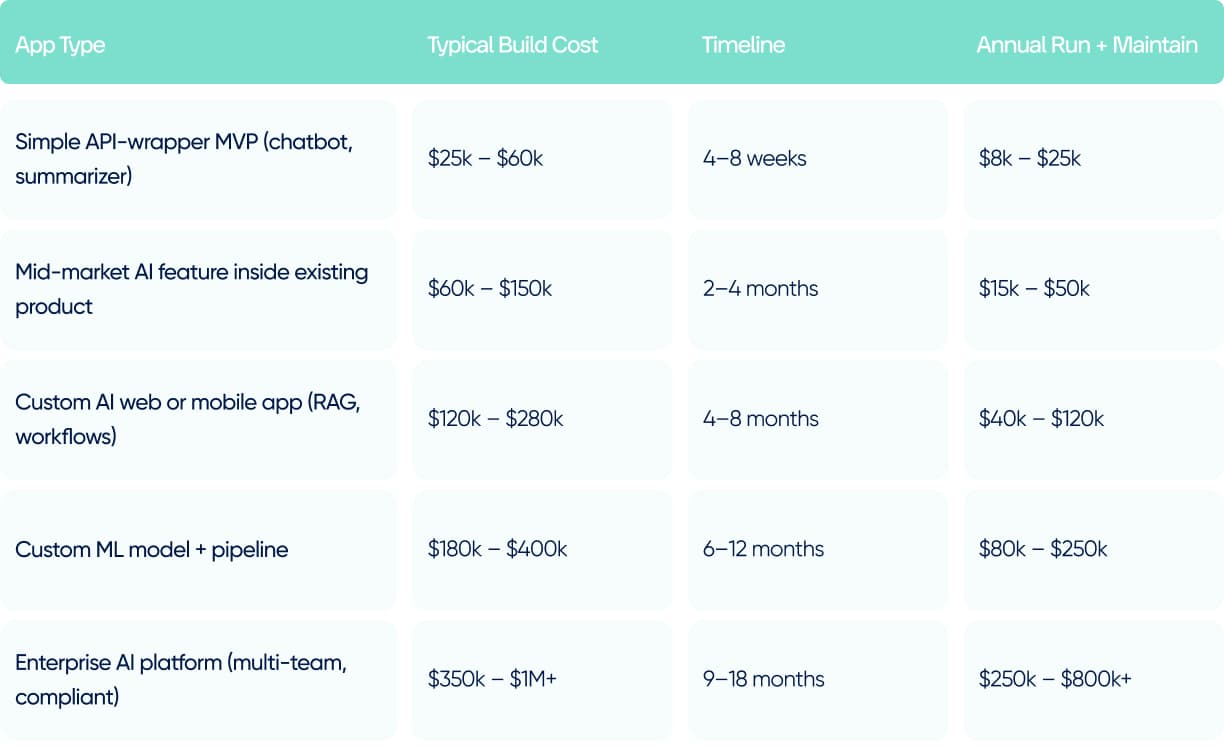
Not sure which row of that table you’re in?
Get a scoped estimate from Lumitech — we’ll tell you what your specific build actually costs, and what it’ll cost to run.

Why AI App Development Pricing Is So Hard to Pin Down
Traditional software has a fairly predictable cost curve: build it once, host it cheaply, fix the occasional bug. With AI app development pricing, a meaningful chunk of your cost is variable and usage-based: every user interaction can trigger a metered API call or burn GPU seconds.
That's why a single quoted number is almost meaningless without context — whether you're trying to pin down the cost to build an app in the UAE or comparing quotes from three continents. Honest AI app development pricing treats build cost and run cost as two separate budgets that must both be defended, and most surprises come from underestimating the second one.
Cost Breakdown by Stage: Where the Money Actually Goes
Here’s the stage-by-stage AI app development cost breakdown: roughly 10–15% goes to discovery and data, 35–45% to core development and integration, 10–15% to AI model work, 10% to testing and evaluation, and 15–20% to deployment plus the first stretch of running it. Notice that pure “writing code” is less than half the bill. The rest is the connective tissue that makes AI actually work in production.
Let us walk you through each stage of this AI app development cost breakdown, because this is where most budgets quietly leak.
Discovery, scoping, and data preparation (10–15%)
Average Cost: $8,000 – $45,000
Deliverables: A technical blueprint, model selection framework, cleaned and tokenized datasets, and optimized vector embeddings.
Everyone wants to skip this, while almost nobody should. If your AI feature depends on your own data (and good ones usually do), somebody has to find it, clean it, label it, and de-duplicate it. Data prep is the unglamorous plumbing of AI, and it routinely eats more hours than anyone scopes. A clever model fed messy data just produces confident nonsense.
Core development and integration (35–45%)
Average Cost: $35,000 – $135,000+
Deliverables: Complete frontend and backend software architecture, integrated API orchestration layers (e.g., LangChain, LlamaIndex), and functional user dashboards.
This is the big one: front end, back end, APIs, auth, databases, and crucially the glue connecting your AI layer to everything else. Integration is where projects quietly die over budget. Chatbots are easy. AI chatbots that read your CRM, respect permissions, log every interaction for audit, and fail gracefully when the model is down — that’s real engineering.
AI model work (10–15%)
Average Cost: $10,000 – $45,000
Deliverables: Fine-tuned weights, specialized prompt templates, semantic search vector databases, and dedicated custom model routing protocols.
Whether you’re prompting a hosted model, fine-tuning one, or training something custom, this is where the “AI” line item lives. Counterintuitively, it’s often not the highest cost — the surrounding software usually is.
Testing and evaluation (10%)
Average Cost: $10,000 – $30,000
Deliverables: Continuous automated benchmarking suites, guardrail implementation logs, vulnerability protection reports, and accuracy validation metrics.
Instead of asking “does the button work?”, AI QA asks “is the output correct, safe, unbiased, and not occasionally inventing a refund policy that doesn’t exist?” You need evaluation pipelines, and skipping that is how products end up as cautionary tweets.
Deployment and early operations (15–20%)
Average Cost: $15,000 – $60,000
Deliverables: Live cloud production environment, automated infrastructure scaling policies, active cost-tracking dashboards, and real-time model monitoring pipelines.
This covers infrastructure setup, monitoring, observability, and the first few months of keeping the lights on while you discover what real usage actually costs.
Understanding the AI application development cost at this granularity is what separates a defensible budget from a hopeful one.
Key AI App Development Cost Factors
The biggest AI app development cost factors are: model strategy (hosted API vs. fine-tuned vs. fully custom), expected usage volume, data complexity and quality, integration depth with existing systems, accuracy and latency requirements, and compliance obligations. Change any one of these and your budget can swing by six figures. They interact, too — high accuracy demands plus high volume is the most expensive combination.
Let’s unpack the AI app development cost factors that move the needle most.
Model strategy is the heaviest lever. Calling a hosted API is cheap to start and expensive to scale. Training a custom model is expensive to start and potentially cheap to scale. Choosing wrong is the costliest mistake on this list.
Usage volume is the factor everyone underestimates. AI costs scale with consumption in a way traditional software doesn’t — ten thousand happy users can be a celebration and a crisis on the same invoice.
Data quality and complexity quietly determine half your effort. Clean, well-structured, well-governed data is a gift. Sprawling, contradictory, privacy-laden data is a tax you pay every single sprint.
Integration depth matters because an AI feature is only as useful as the systems it can touch. The more it must connect to — legacy databases, third-party tools, internal APIs — the more the cost climbs.
Accuracy and latency requirements are sneaky. “Good enough” is affordable. “Must be 99% accurate and respond in under 300ms” can multiply your bill — bigger models, redundancy, relentless optimization.
Compliance and security obligations turn a fun project into a serious one. Healthcare, finance, and legal apps carry requirements that add real engineering and audit cost.
The main thing you should remember about the factors affecting AI app development cost: they multiply, they don’t add. A complex, high-volume, high-accuracy, heavily-regulated app isn’t four times the cost of a simple one. It’s more.
For a broader picture of how organizations are navigating digital transformation and weighing these tradeoffs, McKinsey’s annual State of AI survey is a useful reality check on where budgets and returns actually land.
API Integration vs Custom AI Model: What Costs More?
Building a custom AI model costs significantly more upfront — ranging from $100,000 to over $350,000 — compared to pre-built API integrations, which cost $10,000 to $50,000 initially. However, third-party APIs incur compounding token usage fees at scale, whereas a proprietary model yields lower marginal inference costs over time. The decision hinges on your long-term scaling metrics and the strategic uniqueness of your underlying data asset.
Here’s the trap. Founders fall in love with “our own AI” — a proprietary brain competitors can’t copy. The reality of machine learning app development cost for a genuinely custom model includes data acquisition, labeling, training compute, ML engineering talent (expensive and scarce), evaluation infrastructure, and ongoing retraining as the world changes underneath you.
By contrast, LLM app development costs, when you integrate a hosted model, front-load almost nothing. You pay per token, you ship in weeks — which is why SaaS platforms development teams favor this path — and you let someone else absorb the brutal cost of training frontier models. The downside is the meter never stops, and your unit economics are now partly in someone else’s pricing hands. Provider pricing pages like OpenAI’s and Anthropic’s are worth bookmarking, because those per-token numbers are the heartbeat of your run cost.
So which wins? A rough rule of thumb:
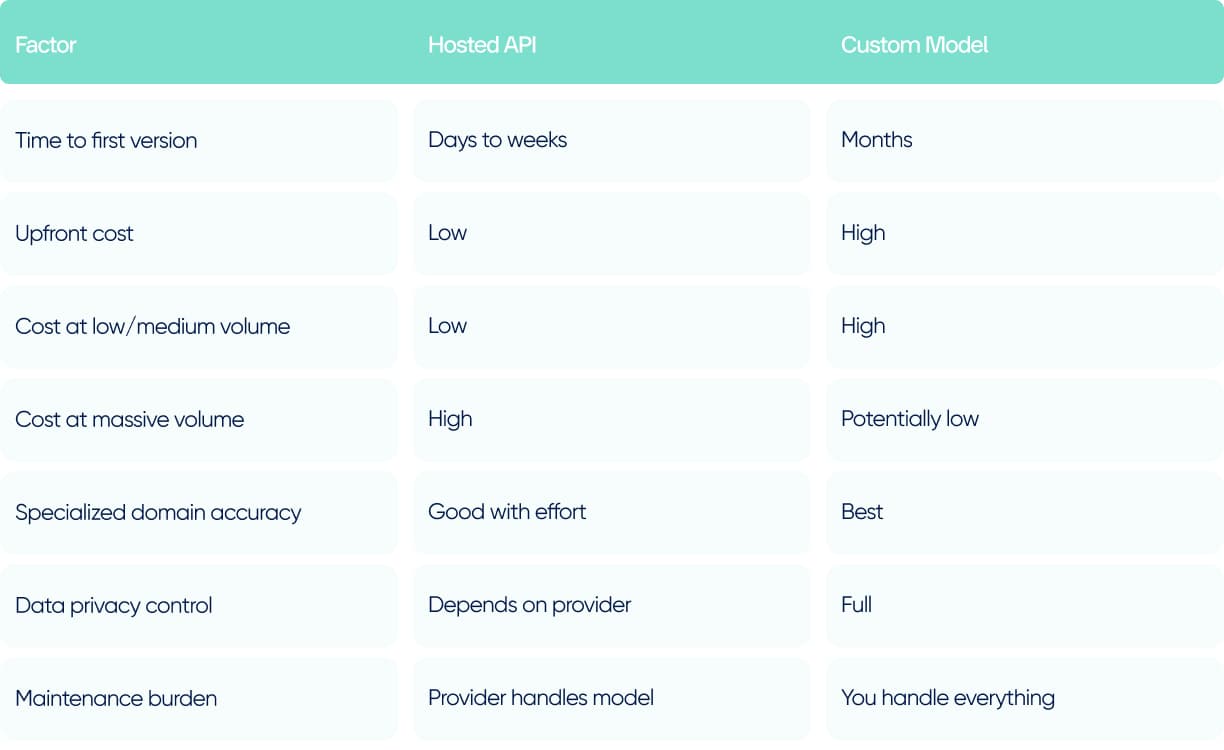
For the vast majority of teams, the smart move is to start with an API, prove the value, and only consider a custom AI app development cost investment once usage and economics justify it.
Hidden Costs of AI App Development
The hidden costs of AI app development often account for 40% to 60% of an enterprise’s actual year-one budget, completely overshadowing vendor quotes. These unbudgeted drains stem from data-quality remediation debt, regulatory-compliance engineering, token accumulation via multi-turn agentic loops, and model-drift observations. Failing to anticipate these operational layers causes catastrophic “pilot purgatory,” stalling deployment before the application can deliver real-world business value.

Inference and API costs that scale with adoption. The more successful your app is, the bigger this bill gets. A feature that costs $200/month in beta can cost $20,000/month at scale.
Re-engineering after model changes. Models get deprecated, repriced, or improved, and each time, your tuned prompts and evaluations may need to be reworked. It’s a recurring tax unique to AI: your software can break not because you changed something, but because your provider did.
Evaluation and monitoring tooling. Knowing whether your AI is still behaving — accuracy drift, hallucination rates, cost per request — requires real tooling and attention. It’s a permanent line item, not a one-off.
Security, privacy, and compliance. AI apps process data in new ways, creating new risks: prompt injection, data leakage, model misuse. Anyone building fintech app features knows this firsthand — doing it responsibly costs money, and doing it irresponsibly costs more, usually with a press release attached.
The human-in-the-loop tax. Many AI features need a human to review or correct the output, at least early on. That’s real ongoing labor that rarely makes it into the original estimate.
If your AI app development budget accounts only for building and not for these, it’s nothing more than wishful thinking. A credible budget sets aside an explicit reserve for running, watching, and fixing AI in the wild.
Many companies look at the software development quote and assume that represents 90% of their financial liability. In reality, that quote is just the tip of an iceberg. The real test of profitability happens below the surface.



AI App Infrastructure Cost: The Server Bill Nobody Forecasts
When setting up your recurring operational spreadsheets, you must account for specialized line items under the AI app infrastructure cost category. These are distinct from classic web servers and include:
The Agentic Loop Multiplier: Modern agentic systems do not just execute a single prompt turn. They operate in continuous reasoning loops, checking their own work and making multiple model calls per user query. A single user interaction can trigger 6 to 10 underlying model calls, causing token usage to grow rapidly.
Idle Compute Drain: If you choose to host your own model using provisioned throughput, you rent dedicated cloud GPUs (like NVIDIA H100 instances via AWS or Google Cloud Vertex AI) that charge you 24/7. Even when your application is idle, you are paying hundreds of dollars an hour for compute power.
Data Egress and Vector Databases: Moving massive datasets across cloud zones to connect with public AI models introduces high cloud data egress fees. Additionally, keeping managed vector databases synchronized requires a fixed monthly minimum fee that increases with your data volume.
The Regulatory Compliance Tax: According to Gartner studies, navigating new international regulatory environments like the EU AI Act or specialized HIPAA/GDPR frameworks can add 15% to 20% to your core engineering budget for necessary audit logs, security wrappers, and data-masking layers.

AI App Maintenance Cost: The Bill That Never Stops
Plan for AI app maintenance cost of roughly 15–30% of the original build cost, every single year — and sometimes more for AI-heavy products. That covers bug fixes, dependency updates, model migrations, prompt re-tuning, security patching, monitoring, and feature improvements. Unlike traditional software, AI apps also need ongoing behavioral maintenance: keeping outputs accurate and safe as models, data, and user behavior all drift over time.
The reason it runs higher than classic software upkeep is that word drift. A normal app does today what it did at launch. An AI app’s quality can erode silently: the model changes, the data shifts, users phrase things in new ways, and one day your beloved feature is confidently wrong. Catching that is continuous work.
There’s also the migration treadmill. Providers retire models on their schedule, not yours. When one you depend on reaches end of life, you migrate — retesting prompts, re-running evaluations, sometimes re-architecting. It’s the AI equivalent of your foundation politely announcing it’s relocating next quarter.
The takeaway: budgeting for the build but not the upkeep is how a “finished” AI app becomes a slowly rotting liability. App maintenance isn’t the cost of fixing failure. It’s the cost of staying successful
AI Mobile App vs AI Web App Development Cost
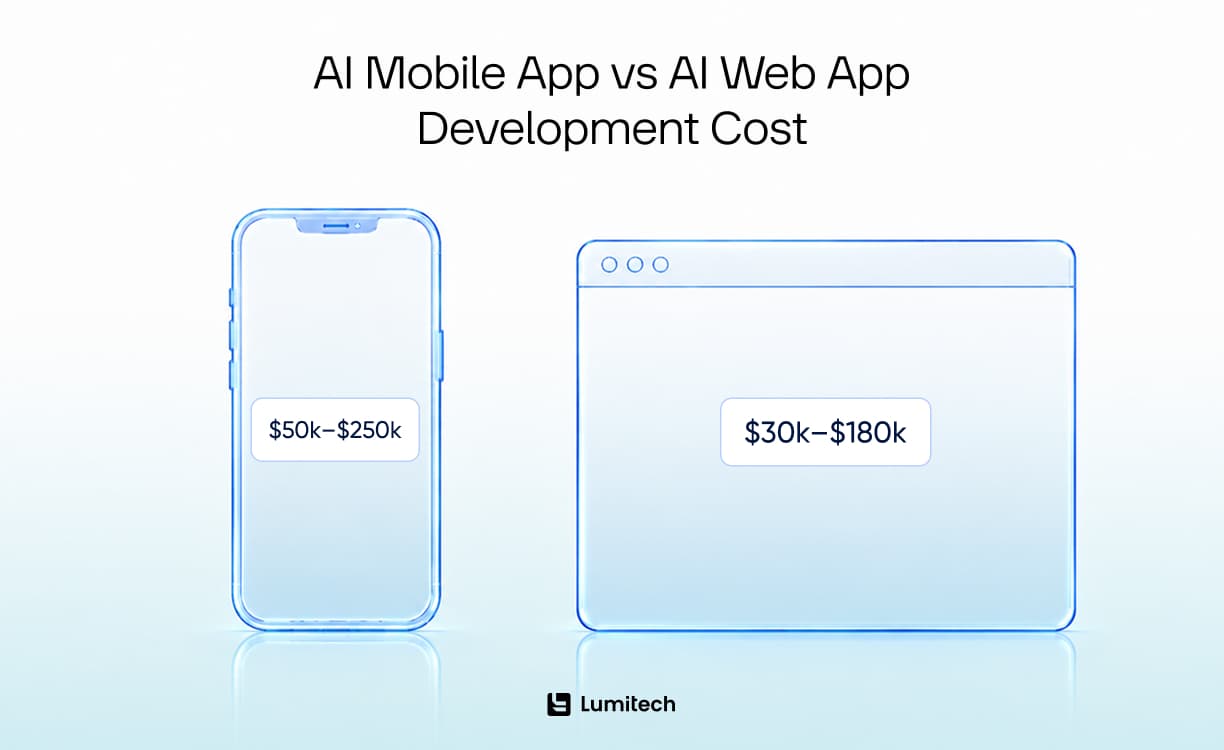
A dedicated AI mobile app development cost spans $50,000 to $250,000 because it requires platform-specific optimization, device-level memory management, and cross-platform syncing. Conversely, an AI web app development cost scales from $30,000 to $180,000 due to streamlined browser-based interfaces and centralized server processing. Choosing mobile introduces strict architectural limitations around edge AI execution, hardware chip compatibility, and application store governance protocols.
Mobile app development introduces unique complexities. If your technical vision involves running models locally on mobile devices (Edge AI) to eliminate server inference costs and allow offline access, your team must optimize weights to fit Apple’s CoreML or Google’s TensorFlow Lite frameworks for Android app development. This requires deep optimization to avoid draining user batteries or overheating their hardware.
Furthermore, any iOS app or Android release must comply with strict App Store and Google Play deployment guidelines, which are increasingly strict regarding data privacy and user-generated AI content.
Web applications, by comparison, offload the processing burden onto cloud infrastructure. Thoughtful web app design centralizes your maintenance, simplifies your deployment cycles, and lowers cross-platform development friction.
However, this shift means you carry the ongoing server-side computing costs, whereas an edge-based mobile app offloads that processing directly to the consumer’s pocket hardware.
AI App Cost by Business Goal: Match Spend to Stakes
Mapping your budget to your underlying business goal is vital for preventing systemic overspending on unnecessary technology. Aligning an AI app development cost estimate with targeted internal automation yields a predictable, localized scope averaging $40,000 to $100,000. Alternatively, customer-facing systems demanding real-time accuracy and extensive safety guardrails scale dramatically higher, while transformative multi-agent systems require significant platform re-engineering to deliver sustained competitive enterprise value.
Your business objectives dictate your final financial footprint. Let’s break down realistic targets based on strategic corporate intentions:
1. Internal Operational Optimization (e.g., Enterprise Knowledge Retrieval)
Strategic Objective: Reduce employee search times, summarize internal legal assets, and streamline onboarding.
Financial Profile: Modest and predictable. These systems typically use off-the-shelf RAG pipelines connected to internal wikis. Because user numbers are bounded by headcount, token consumption remains manageable.
Expected Allocation: $40,000 – $90,000 initial build; stable monthly operational run-rate.
2. Commercial Customer-Facing Enhancements (e.g., Intelligent Support Ecosystems)
Strategic Objective: Replace standard support queues with conversational agents that can autonomously handle returns, scheduling, and billing updates — or power personalized experiences where UX design for loyalty platform features drives retention.
Financial Profile: High initial validation costs coupled with strict security requirements. Because these systems are public-facing, they require comprehensive moderation guardrails to prevent brand damage or the creation of hallucinated policy commitments.
Expected Allocation: $90,000 – $250,000 initial build; scaling run-rates tied directly to user engagement.
Generative AI App Development Cost: Why It’s Its Own Category
The cost of developing a dedicated generative AI app is structurally distinct because it is heavily weighted toward continuous token consumption, prompt engineering, and context window optimization rather than a static database architecture. While building an MVP using modern foundation models may appear deceptively inexpensive — an AI-powered language learning platform, for instance, looks simple until every conversation branch triggers multi-turn feedback loops — scaling that application to thousands of concurrent users can lead to massive cloud bill shocks. Managing this modern stack requires sophisticated evaluation tooling and persistent memory infrastructure.
When managing a generative AI app development cost profile, you are dealing with a highly fluid technical stack. Traditional application costs are predictable: you provision a set number of web servers and scale them as user traffic grows.
With generative technology, however, cost is directly tied to user curiosity and engagement.
If a user prompts your application to analyze a 400-page legal document, that single interaction processes hundreds of thousands of tokens — but even a seemingly lightweight AI recipe app that generates personalized meal plans burns tokens fast once users start iterating on ingredients and substitutions. Without semantic caching layers (like GPTCache) to intercept duplicate queries, your operational bills will scale linearly with usage.
Furthermore, generative systems require ongoing prompt maintenance. As model providers release updates, prompt templates can change in behavior, requiring developers to continuously test and refine instructions to avoid broken workflows.
Enterprise AI App Development Cost: When Scale Changes Everything
The enterprise AI app development cost is in a different league — frequently $350k to well over $1M for the first version — because enterprises bring requirements that small projects never face: stringent security, regulatory compliance, single sign-on, audit logging, role-based access, data residency, integration with sprawling legacy systems, and uptime guarantees. The AI itself might be a small fraction of the work.
At enterprise scale, the boring requirements are the expensive ones. A startup ships a feature; an enterprise ships a feature that satisfies legal, security, procurement, and three VPs with veto power. Each of those gates adds engineering, documentation, and time — and time is money with a multiplier.
Compliance alone can dominate the budget. Operating in regulated sectors entails audit trails, certifications, and controls that a consumer app never has to consider. The NIST AI Risk Management Framework provides a sense of the governance scaffolding that large organizations are now expected to put in place — and scaffolding, as any builder knows, isn’t free.
Then there’s integration. Enterprises run on a tangle of systems accumulated over decades, and app modernization companies are frequently brought in to untangle that mess before your AI app can plug into it without breaking everything. That integration work, more than the AI itself, is frequently where the enterprise AI app development cost truly lies. The model is the easy part. The plumbing into a 15-year-old ERP is not.
AI App ROI: When Is the Cost Worth It?
An AI app is worth the cost when the value it creates — time saved, revenue gained, errors avoided, or customers retained — reliably exceeds its total cost of ownership. The strongest AI app development ROI comes from features that either eliminate expensive manual labor at scale or unlock revenue that wasn’t previously attainable. The weakest comes from “AI for AI’s sake” features bolted on because the board read an article.
To judge that return honestly, compare it against the full lifetime cost — build, run, and maintain — and against a real baseline.
A few patterns separate the winners from the expensive experiments:
Clear, measurable value. “Cut support handling time 40%” beats “improved customer experience” — you can put a currency sign in front of it.
Volume. AI shines when it touches many interactions. A feature that saves two minutes is transformative across a million users and pointless across ten.
Tolerance for imperfection. The best ROI comes from tasks where errors are cheap to catch and correct, letting you use efficient models without gold-plating.
Some prototypes won't earn back their cost — and teams from startups in London to those working with the best mobile app development company in Dubai have learned that the mature move is to kill them early rather than nurse them out of sentiment. Stanford HAI’s AI Index report gives a grounded view of where AI actually delivers measurable value versus where hype outpaces the receipts. Not every AI idea deserves to survive contact with a spreadsheet.
Know what your AI app needs to deliver to pay for itself?
Lumitech specializes in AI products that are scoped to perform — not just to impress in a demo.
How to Reduce AI App Development Cost Without Hurting Quality
To trim the bill without gutting quality: start with a hosted API instead of a custom model, scope a ruthlessly small MVP, use the cheapest model that’s good enough for each task, cache and batch requests, optimize prompts to cut token use, and build cost monitoring in from day one. Most savings come not from cutting corners on quality, but from cutting waste — and AI apps are gloriously wasteful by default.
Here’s where real AI app cost optimization lives, and it rarely means lowering your standards.
Right-size the model. You don’t need a frontier model to classify an email or extract a date. Use small, cheap models for simple tasks and reserve the expensive ones for hard work — routing by difficulty is one of the highest-leverage moves available.
Cache aggressively. If users ask similar things, don’t pay to generate the same answer twice. Caching responses and reusing embeddings can slash inference costs.
Optimize prompts. Every unnecessary token is a tiny tax paid on every single call, forever. Trimming bloated system prompts and verbose context is unglamorous and surprisingly profitable.
Batch and stream wisely. Where latency allows, batch requests. Streaming improves perceived speed without changing cost — happier users, same bill.
Build a small, sharp MVP. The cheapest feature is the one you didn’t over-build. Ship the smallest thing that proves value, then expand based on evidence rather than imagination.
Monitor cost from day one. You cannot optimize a bill you can’t see. Track cost per user, per request, and per feature from the start, so you can spot the expensive surprises before they spot your budget.
Done well, this kind of app performance optimization makes your product leaner, faster, and more economically sane.
When Should You Request a Custom AI App Development Cost Estimate?
Request a proper AI app development cost estimate the moment your AI idea moves from “wouldn’t it be cool if” to “we’re committing real money and a real timeline.” A serious one isn’t a single number — it’s a build figure, a running-cost projection, and a maintenance forecast, with assumptions you can challenge.
Use this checklist. If you can tick most of these boxes, you’re ready to ask for numbers — and ready to read them critically.
You can describe the core problem in one sentence. If you can’t, no estimate will save you.
You know the primary platform (web, mobile, or both) and roughly who the users are.
You have a sense of expected usage volume — even a rough range — because it drives your run cost more than anything else.
You know what data the AI needs and whether you actually have access to it in usable shape.
You’ve defined what “good enough” accuracy looks like and what a wrong answer costs you.
You understand your compliance and security obligations (or you’ve confirmed you have none).
You have a budget range in mind — including a reserve for running and maintenance, not just building.
You’ve asked the estimate to cover the full project in phases — build, run, and maintain — not a single lump figure.
You know how you’ll measure success, so you can judge ROI later rather than arguing about it.
Whether you’re evaluating app development companies in Saudi Arabia, local firms, or offshore teams, a vendor worth hiring will want to discuss the full AI app development timeline and cost, including the parts that make their number look bigger. The ones who quote fast and low tend to “discover” the unexpected costs later — with your money.


