Fintech Mobile App Development in 2026: Complete Guide to Features, Cost, Security & Process
Few industries have experienced digital transformation as rapidly as financial services. Both individual consumers and businesses of all sizes expect financial services to meet their needs within seconds. Otherwise, expect less-than-positive feedback.
- Mobile App Development
June 09, 2026
 AI Overview
Fintech mobile app development in 2026 combines security, regulatory compliance, and scalable engineering to serve digital banking, payments, lending, and investing use cases, since financial errors carry fraud and regulatory risk that social apps don't face. Core components include KYC/AML compliance workflows, secure transaction infrastructure, and multi-product integration across banking and payments. Global fintech revenues are projected to reach $1.5 trillion by 2030, driving sustained demand for trustworthy financial products.

Why Fintech App Development Is Booming in 2026
As a fintech software development service provider, Lumitech has seen growing demand for secure, scalable financial products across banking, payments, lending, and investment sectors.
Consumers now expect to open accounts from a smartphone, transfer money instantly, receive personalized financial advice, invest with a few taps, and manage their finances without visiting a branch.
Businesses expect the same level of speed and convenience from banking platforms, payment systems, lending solutions, and treasury management tools.
The numbers reflect this shift.
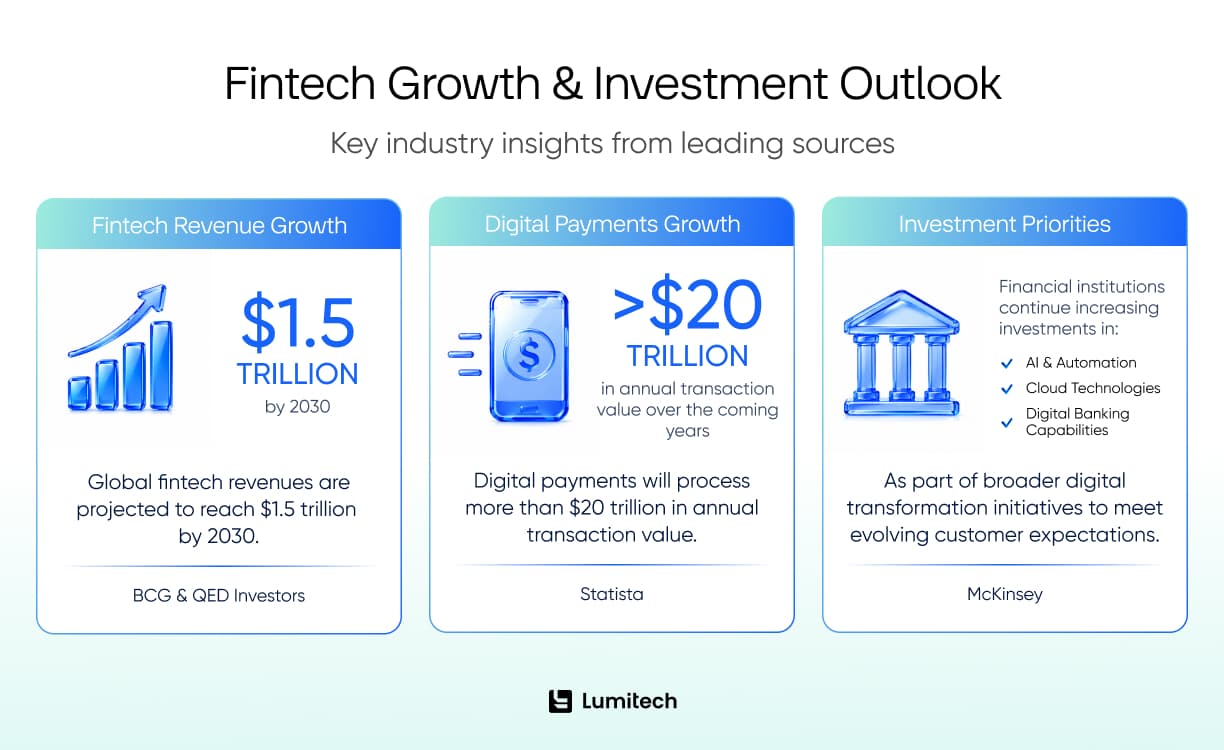
According to BCG and QED Investors, global fintech revenues are projected to reach $1.5 trillion by 2030. Meanwhile, Statista forecasts that digital payments will process more than $20 trillion in annual transaction value over the coming years. McKinsey also reports continued investment in AI, cloud technologies, and digital banking capabilities as financial institutions accelerate digital transformation initiatives.
For founders, banks, insurers, investment firms, and financial technology startups, this creates both opportunity and pressure.
A modern fintech application can:
Increase customer acquisition
Reduce operational fintech app development cost
Automate compliance workflows
Improve financial decision-making
Unlock new revenue streams
Enable entirely new business models
The challenge in creating a fintech mobile app is that such products operate in one of the most regulated and security-sensitive industries in the world. A simple error in a social media application may create frustration. A bug in a financial application can lead to fraud, regulatory penalties, financial losses, and reputational damage.
That is why successful fintech mobile app development combines product strategy, engineering, security, compliance, and business planning from day one.
Types of Fintech Mobile App Development
When people hear the phrase “fintech app,” most immediately think of mobile banking.
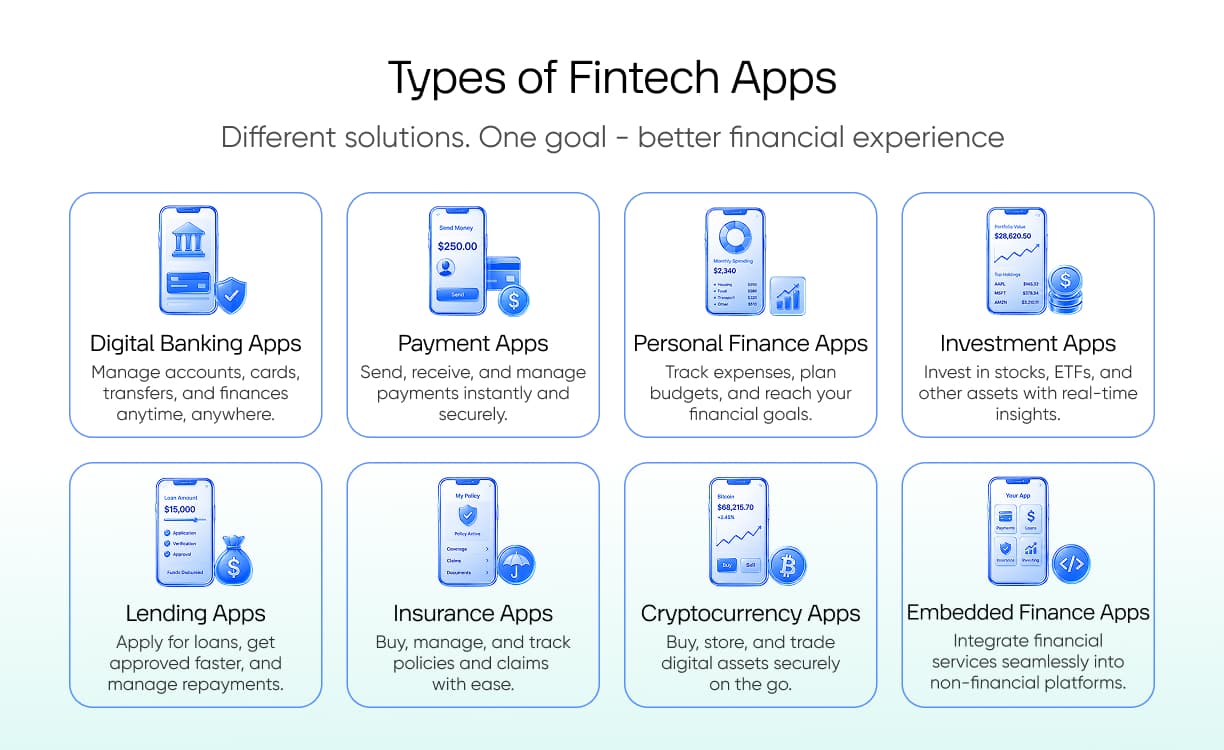
And that makes sense. Products such as Revolut, Monzo, or Nubank were the first to change user expectations regarding financial services. But modern fintech is much broader and includes multiple types of fintech mobile app development.
Today, mobile applications help not only to store money, but also to transfer it, invest, apply for loans, manage insurance, and even buy digital assets. That’s why engineering teams must understand not only how to make a fintech app, but also how to support multiple integrations.
Digital Banking Apps
A few years ago, opening a bank account meant visiting a branch, filling out paper forms, and waiting for confirmation. Today, users want to do all this from their smartphone in a few minutes.
This is exactly what digital banks do. Such applications allow you to open accounts, make transfers, manage cards, track expenses, and use financial services without physical contact with the bank.
Payment Apps
There are fintech products that people use every day without even thinking about it.
Transfer money to a friend, pay for a subscription, pay in an online store, or send money abroad. All this is the work of payment app development teams.
Look at PayPal, Wise, and Cash App. Due to these solutions, people expect to transfer money in seconds. However, the simplicity these companies provide hides a complex infrastructure of banks, payment gateways, risk-monitoring systems, and dozens of integrations.
Personal Finance App Development
Most people want better control over their finances. The problem is that no one wants to spend the evening poring over bank statements.
That is why applications for managing personal finances are gaining popularity. They help users analyze spending, plan a budget, set financial goals, and see where the money really goes at the end of the month.
Such products turn financial data into understandable tips and recommendations.
Investment Apps
Investing is no longer associated only with brokers and sophisticated trading terminals. Today, you can buy shares, ETFs, or other assets literally on the way to work.
Platforms like Robinhood and eToro have completely democratized investing for millions. Today’s investment apps do it all in a single interface — seamlessly blending asset trading and real-time analytics with smart portfolio management and AI-driven personalized recommendations.
Many modern wealth management products are evolving into analytics-driven investment platform solutions that combine portfolio tracking, predictive insights, and personalized recommendations.
Lending Apps
Obtaining a loan was traditionally associated with a large number of documents and lengthy inspections. Digital lending platforms are trying to change this scenario. They automate document collection, risk assessment, customer scoring, and decision-making. Thanks to this, applications can be processed not in days, but in minutes.
Insurance Apps
Most people only think about insurance when something in their lives doesn’t go as planned. Whether it’s a car accident or a flooded apartment, the last thing users want is to struggle with slow or complicated customer support. That’s exactly why a seamless user experience is so critical in InsurTech.
To buy insurance, a user had to go through endless paperwork. Today, we have smart apps that help you turn that headache into just a few-click process. People can buy and manage policies, file claims on the go, take photos of damage, and upload them right away. Moreover, they can track everything in real time. Technologies help avoid exhausting phone calls and provide peace of mind when customers need it most.
Cryptocurrency Apps
As recently as a decade ago, cryptocurrencies were a niche topic for enthusiasts. Today, digital assets have become a separate area of fintech. Crypto wallets, exchanges, and digital asset management platforms allow you to buy, sell, and store cryptocurrencies through mobile apps. At the same time, security here becomes not just an important function, but a key condition for the product’s existence.
Embedded Finance Apps
One of the most interesting trends in recent years is that many users do not even notice when they use financial services. For example, a marketplace can offer installment payments at the time of purchase, while a SaaS platform can offer built-in payment processing or business financing. In such cases, financial services become part of another product. This approach is gradually changing how financial services reach end users.
In the end, no matter what fintech solution you’re planning to build, partnering with a reliable and experienced company that provides mobile app development services can significantly reduce development risks and speed up time to market.
How to Develop a Fintech App Layer by Layer
From the user’s point of view, everything looks quite simple.
A person opens an app, checks a balance, sends a transfer, or buys an asset. The whole action takes a few seconds.
But behind this simplicity lies a whole network of systems, services, and integrations. And answering the question “how to develop a fintech app” is not that simple.
The moment a user logs in, a complex system comes to life — simultaneously verifying identity, assessing risk, analyzing the device, and confirming access rights. When money moves, a whole network of banks, payment gateways, fraud-monitoring tools, and compliance systems sync up instantly. Every single transaction then feeds directly into analytics, reporting, and internal risk management. It’s a massive, multi-layered choreography happening in milliseconds, entirely behind the scenes.
That is why a modern fintech application is not a single product, but an ecosystem of interconnected components.
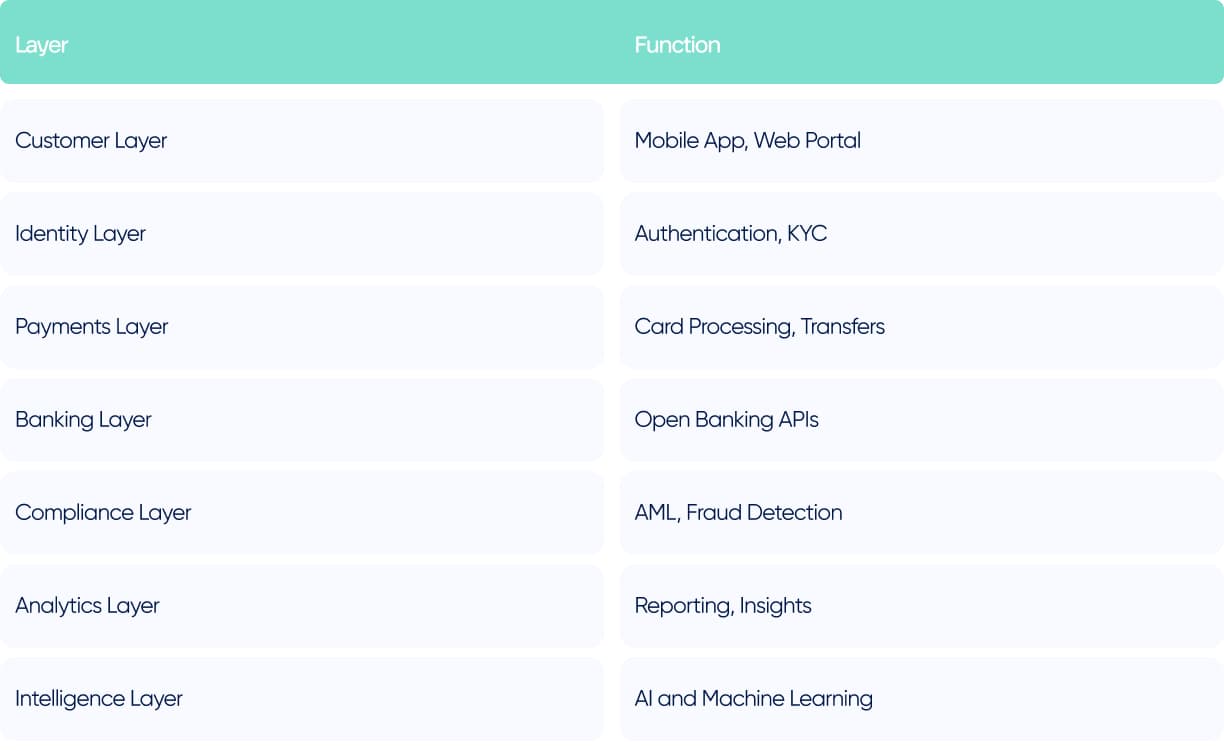
In most cases, it includes several key layers: user interface, identity and KYC systems, payment infrastructure, banking integrations, AML and fraud monitoring tools, and an analytical layer that helps businesses make data-driven decisions.
The more complex the financial product, the larger this ecosystem becomes. That is why architecture and integrations often influence the success of a fintech project as much as the features users see.
Understanding how to build a fintech app from this perspective and recognizing these relationships early prevents costly redesigns later in the project.
Essential Features in the Fintech App Development Process
Stunning visuals won’t save a fintech app if it fails at the basics — like letting users log in, verify identity, or transfer funds. In the financial sector, interface features aren’t just utilities; they are trust signals. The key in the fintech app development process is that every screen must actively reassure users that their assets and data are bulletproof.
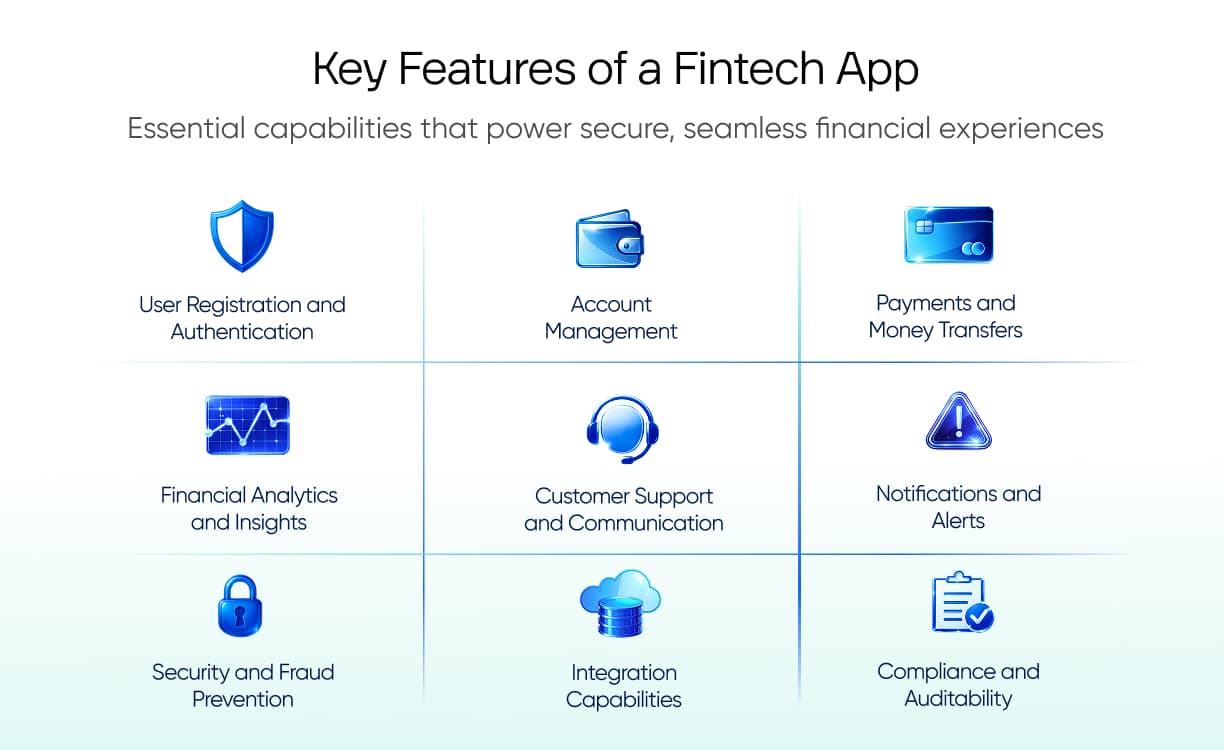
User Registration and Authentication
Nobody downloads a fintech app because they’re excited to upload identity documents and go through endless verification steps.
Users need apps to send money, invest, apply for a loan, or check their balance. Registration is simply the gate they have to pass through. If it feels slow, confusing, or suspicious, many users will leave before they ever reach the product’s real value.
That is why onboarding must be fast, easy, and controllable. A robust fintech application usually includes biometric login, multi-factor authentication, device recognition, session management, and identity verification. KYC automation is another method to verify users more quickly while still meeting compliance requirements.
Account Management
When users log in, they expect clarity. They want to see their balances, cards, recent transactions, loans, or investments at a glance. They do not want to dig through endless menus or tap the screen dozens of times.
Account management is where fintech products either feel simple or become exhausting. That is why good design is about displaying complex financial data in a way that people can easily understand. Strong UX design for fintech helps users notice what matters, act faster, and trust that the numbers they see are accurate.
For business users, account management can also include permissions, multiple roles, approval flows, and reporting. This is where the feature becomes part of daily financial operations.
Payments and Money Transfers
Payments are the ultimate moment of truth for any fintech app. If a transaction leaves a user in the dark, trust vanishes right away. Whether your platform handles simple peer-to-peer payments, e-wallets, or complex international wires, user expectations never change: money must move fast, safely, and predictably.
Behind that seemingly simple Pay button lies a massive labyrinth of payment gateways, banking integrations, fraud checks, compliance rules, and transaction statuses. Your job is to shield the user from this chaos — they should only ever experience a smooth, effortless click.
Financial Analytics and Insights
Most users do not need another dashboard full of charts.
They need to know why their spending increased this month or whether they can afford another purchase. They want to see whether their cash flow is stable, which investment is performing better, and where risks may arise.
This is where analytics bring real value. With AI in financial services, insights such as spending categorization, unusual behavior detection, cash flow forecasting, and portfolio performance can become more personalized and timely. Instead of showing users raw unstructured data, the app helps them see what the data means and what they can do next.
Customer Support and Communication
Imagine you get a strange transaction at 10 PM on a Friday. Would you feel comfortable waiting until Monday morning to contact the bank and clarify the situation?
Fast, reliable communication with customers is a priority for financial products. Integrating live chat, fast and secure messaging, round-the-clock help centers, automated dispute flows, and guided troubleshooting increases customer loyalty and trust. For this purpose, many businesses launch AI chatbots in banking. They are responsible for handling routine questions, explaining transactions, guiding users through onboarding, or collecting basic support details before a human agent steps in.
The rise of generative AI in banking is also enabling more personalized customer interactions, smarter financial assistants, and faster support resolution.
The best support experience is the one that eliminates panic, provides users with visibility and clarity, and, at the same time, enables the support team to resolve issues faster.
Notifications and Alerts
Notifications are easy to underestimate until they go wrong.
Too few alerts and users miss important activity. Too many alerts and they start ignoring them. A fintech app has to find the right balance.
Whether it’s a transaction confirmation, a fraud warning, or just a simple payment reminder, alerts are how your app talks to your users. When done right, these notifications build massive trust because people feel like they’re in total control of their money. The secret sauce here is relevance: every single alert must have a clear purpose, or it just becomes digital noise.
Security and Fraud Prevention
Security is not something users should only become aware of when it fails. In fintech, it must work quietly in the background while the experience remains smooth.
Encryption, secure APIs, fraud detection, behavioral analytics, risk scoring, access controls, and suspicious activity monitoring all work together to protect users and the business.
Fraud prevention systems shouldn’t block legitimate users every time an unusual activity occurs. It slowly kills trust and loyalty. A system that flags everything creates massive customer friction and heavy operational workloads. On the other hand, a system that misses too much creates unacceptable risk. The smart play for fintech apps is layered security that adapts seamlessly to user behavior, transaction context, and risk.
Integration Capabilities
No fintech app is an island. Under the hood, it’s a complex web of connections linking to banks, payment rails, ID verification tech, credit bureaus, accounting tools, and open banking APIs.
This is where the hidden complexity usually bites you. On paper, fintech app features might look like a weekend project, but beneath the surface lie multiple legacy systems, unpredictable failure scenarios, and strict compliance rules. Without a flexible integration layer, you’ll find yourself rewriting core code every time you want to ship something new.
Compliance and Auditability
Compliance is the core of a safe financial product. However, while being secure, it shouldn’t destroy the user experience.
The system must maintain audit trails, secure customer data, and manage consent entirely behind the scenes. Users should not see it; they should enjoy a friction-free experience. The business also should get exactly what it needs: clear, traceable, and audit-ready financial records.
Building compliance into the product early is much easier than adding it after launch. Retrofitting auditability later usually costs more, takes longer, and creates unnecessary risk.
Planning to build a digital bank, payment platform, lending solution, or investment app? The right technical foundation can save months of development time and significantly reduce future risks.

Fintech App Security: Where Most Mistakes Become Expensive
There is a saying in fintech:
Users only notice security when something goes wrong.
A smooth login, a successful transfer, or a payment completed in seconds rarely attracts attention. A security incident does.
And the costs can be high. According to IBM’s Cost of a Data Breach Report, the average cost of a breach in the financial sector exceeds $6 million, making it one of the most affected industries globally. This explains why security is rarely treated as a separate feature in fintech application development.
Founders usually make the same mistake, thinking that security can be added later. Implementing a security layer after app development and launch often means rebuilding the entire architecture, reconnecting APIs, and revisiting compliance controls that should have been in place from day one.
Authentication and Identity Protection
The first line of defense is user identity.
Apps protected just with passwords are no longer enough. Most successful fintech applications combine multi-factor authentication, biometric verification, device recognition, session monitoring, and behavioral analytics.
For example, if a customer typically logs in from Saudi Arabia and then tries to access an account from Canada on another device, the application would certainly require additional verification before granting access.
The user experiences a minor inconvenience.
The business potentially prevents a major fraud incident.
Data Encryption
Every fintech founder eventually asks a version of the same question: “Do we really need enterprise-grade encryption from the start?”
The short answer is yes.
Sensitive information should be protected both in transit and at rest. Financial records, personal information, payment details, and identity documents represent attractive targets for attackers.
Encryption helps ensure that even if data is intercepted or accessed improperly, it remains unusable without the appropriate keys.
Most modern fintech applications rely on:
TLS 1.3 for data transmission
AES-256 encryption for storage
Secure key management systems
Hardware security modules (HSMs)
Customers may never notice these protections.
Regulators certainly will.
Fraud Detection and Risk Monitoring
Attackers have become smarter and smarter. They improve their skills by using automation tools, stolen credentials, synthetic identities, or deepfakes to bypass traditional controls. As a result, modern fintech products should rely on AI-driven risk monitoring to deal with such crime.
Look at this example. A customer typically uses his US banking app to send $100 to his parents. But this time, he tries to transfer $3,000 from a new device in another part of the world. On their own, these factors may seem harmless. Combined, they tell a different story.
Modern AI-powered fraud detection systems focus on analyzing the nature of transactions, login activity, device information, and spending patterns. Such possibilities enable fintech companies to spot suspicious activity before their funds evaporate.
Similar approaches can be seen in modern ML in banking initiatives, where machine learning models help financial institutions detect fraud, assess risk, and automate decision-making.
Secure API Architecture
Most fintech applications depend on external services. A payment platform may communicate with banks, card processors, identity verification providers, AML vendors, credit bureaus, and open banking platforms. And with every new integration, the risks of attack grow.
Strong API security practices include token-based authentication, access controls, rate limiting, encryption, monitoring, and detailed audit logging. Fintechs continue to evolve, so API security has become just as important as application security.
Compliance Requirements
Founders create fintech app features; regulators check if they comply with the rules. When they meet at some point, the regulators always win. That’s why compliance must drive your product decisions as early as possible. Shifting it to second place will delay your launch, drain your budget, and put you in the legal crosshairs. No matter your geography or model, certain compliance frameworks are impossible to ignore.
Some organizations are also exploring solutions such as a legal AI assistant for fintech institutions to streamline regulatory research, documentation, and compliance workflows.
KYC and Identity Verification
You can’t do business with ghosts. That’s why digital identity verification has become a multi-billion-dollar playground. Today’s onboarding flows are a masterclass in hidden tech — combining document scans, AI facial recognition, liveness checks, sanction screening, and instant risk scoring into a few seamless steps.
The mission here is straightforward: kill fraud and keep friction low. It does not require much effort to design a quick five-minute signup to increase conversions. But if you can make that five-minute flow fully compliant? You’ve just unlocked a killer competitive advantage.
AML Compliance
Regulatory scrutiny across the fintech sector continues to increase. No one gets a free pass when it comes to Anti-Money Laundering (AML) requirements. Whether you’re running a payment gateway, a digital bank, a lending platform, an investment app, or a crypto startup — you are under a microscope.
This is why AML controls are often deeply built into the fintech application architecture rather than treated as standalone tools.
To survive in this regulatory climate, businesses have to deploy a whole arsenal of defenses. It’s no longer just about basic checks. Today, running a fintech means constantly screening customers, monitoring transactions in real time, checking sanction lists, filtering out politically exposed persons (PEPs), and instantly flagging suspicious activity to authorities.


Data Privacy Regulations
Financial institutions process some of the most sensitive customer data in existence. Data privacy regulations continue evolving worldwide. Depending on the market, companies must not only know how to create a fintech app, but also need to comply with:
GDPR
CCPA
UAE Data Protection Law
PDPL in Saudi Arabia
various banking-specific regulations
Customers may never ask where their data is stored. Regulators almost certainly will.
How Fintech Apps Integrate with Banks and Payment Systems
If the front end is what users see, integrations are what make the product useful.
Many fintech founders are surprised to discover that building the mobile application is often easier than connecting everything behind it.
A simple account balance displayed on screen may require simultaneous communication with core banking systems, payment processors, fraud-monitoring tools, compliance engines, and reporting services.
Open Banking APIs
Open banking has changed the approaches to building financial products.
Instead of developing all banking capabilities in-house, fintech companies can securely access banking services via APIs. This enables features such as account aggregation, payment initiation, access to transaction history, and financial analytics without requiring direct ownership of banking infrastructure.
The growth of open banking APIs continues to accelerate innovation throughout the fintech sector.
Core Banking Integrations
Many financial institutions are modernizing infrastructure that was originally built decades ago. Connecting new applications to legacy environments is rarely straightforward. This is one reason why core banking modernization has become a strategic priority for banks worldwide.
For many financial institutions, successful integration projects begin with legacy modernization, enabling new digital products to coexist with decades-old banking infrastructure.
Successful fintech products must often bridge two very different worlds: modern mobile experiences and legacy financial infrastructure. The complexity usually sits beneath the surface. Customers simply expect everything to work.
Payment Gateway Integration
Then come the payment gateways. Providers like Stripe, Adyen, Checkout.com, and Worldpay ensure money moves safely to its destination.
But you can’t just choose one based on a coin flip. Selecting the right provider is a massive business puzzle. It forces you to look closely at your geography, supported payment methods, local compliance, transaction volumes, and settlement models. In short, it’s a decision that shapes both your tech stack and your bottom line.
How to Build a Fintech App
Many fintech founders start with a feature list.
A few weeks later, they discover that payments, compliance, identity verification, fraud prevention, and banking integrations are all interconnected. What looked like a simple product becomes a much larger ecosystem.
That is why successful fintech app development always starts with a strategy.
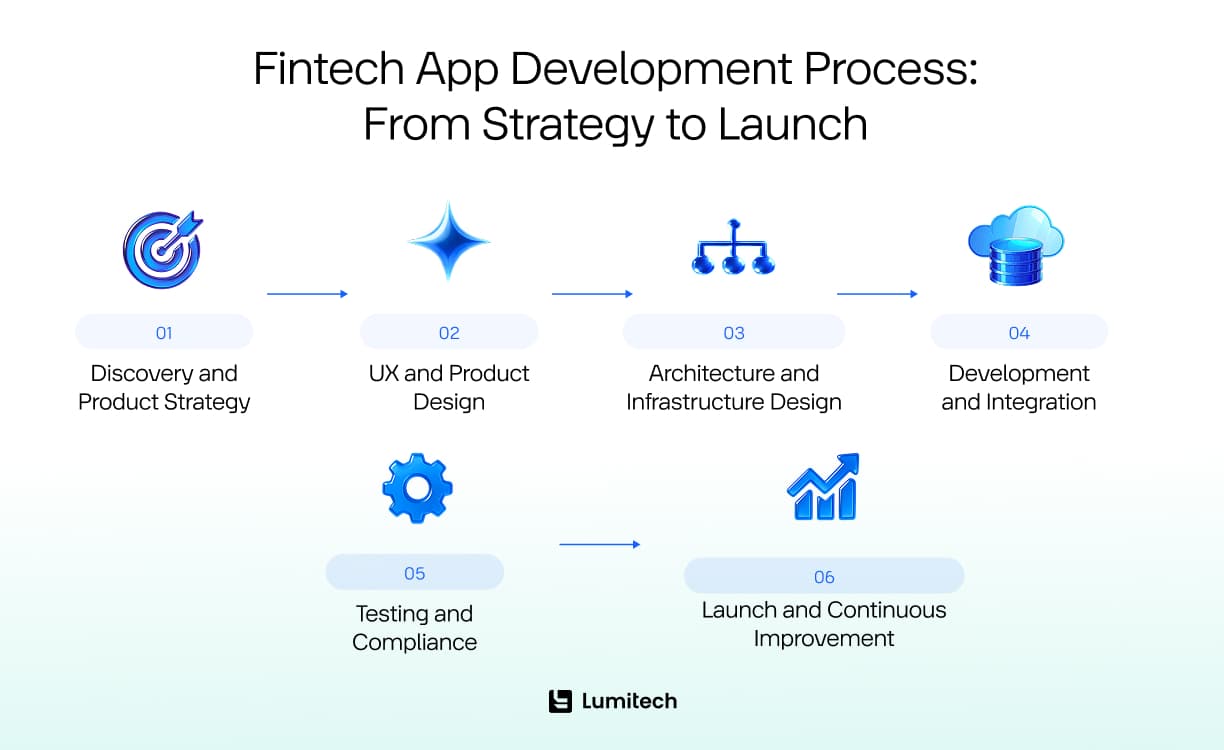
Discovery and Product Strategy
Before fintech mobile app development begins, teams define business goals, user needs, compliance requirements, integrations, and monetization models. This stage helps identify risks early and prevents costly changes later.
The most valuable outcome is often not a roadmap, but clarity on what should and should not be built.
UX and Product Design
Financial products can be complex, but the user experience should not feel that way.
People don’t compare fintech apps to other banks; they compare them to Uber, Instagram, or Spotify. They expect the exact same frictionless experience. A smart UX takes a mess of onboarding, payments, and compliance, and packs it into a clean, simple flow. The goal is to make all the heavy legal and security stuff completely invisible to the user.
Architecture and Infrastructure Planning
Architecture decisions influence everything that follows, from scalability and security to future fintech application development costs.
At this point, engineering teams plan all integrations with banks, payment gateways, KYC and AML systems, and other third-party services. Making the right decisions early will save months of rework as the product evolves.
Development and Integration
The real development begins only after the foundation is set. Engineers dive into crafting user features, business logic, and transaction flows. But here’s the kicker in fintech: linking up all those external systems and APIs often requires as much effort as developing the application itself.
The more financial services a product offers, the more important integration quality becomes.
Testing and Compliance Validation
Testing is particularly important in financial products because users trust the platform with their money and personal data.
Teams typically validate app functionality, performance, security level, integrations, and compliance requirements before going live. A small issue in a fintech application can quickly become a backlog item in customer support. Also, it can lead to financial loss or regulatory concerns.
Launch and Continuous Improvement
Launching a fintech application is not the end of the process.
The first months after release often reveal the most valuable insights about customer behavior, product adoption, and operational performance. The strongest fintech products continuously improve onboarding, payments, analytics, and security based on real-world usage rather than assumptions made during development.
Fintech MVP Development: Why Starting Smaller Often Wins
The biggest mistake you can make is building a fintech app covering all possible features at once. Look at today’s fintech giants — they didn’t start with dozens of features.
Revolut took off simply as a smart solution for cheap international money transfers. Monzo won over users by focusing purely on card management and showing people exactly where their money goes. And Chime built its early growth entirely on making everyday banking dead simple. They mastered one sharp pain point before scaling into larger product ecosystems.
They all had bigger ambitions, but they started by solving one problem exceptionally well.
That is the purpose of a fintech MVP. Instead of investing heavily in a full-scale platform, companies launch a smaller version of the product to validate demand, collect user feedback, and test business assumptions. This approach to custom fintech app development reduces risk, accelerates time to market, and helps teams prioritize features based on real user behavior rather than internal assumptions.
A strong fintech MVP typically includes only the functionality required to deliver the core value proposition. Everything else can come later.
In fintech, starting smaller is often the fastest path to building something bigger.
Don’t Spend $500K Validating a $50K Idea
The most successful fintech products rarely launch with every feature. They launch with the right ones. Let’s identify what your MVP actually needs — and what can wait until later.

Cost of Building a Fintech App in 2026
This is usually the second question founders ask after discussing features.
The honest answer is: it depends.
A budgeting app, a digital wallet, and a neobank may all fall under mobile fintech application development, but they require very different levels of engineering, compliance, security, and integration work.
If you want to know the cost of building a fintech app, consider such questions:
How complex will the product be?
How many integrations are planned?
What are the compliance requirements?
How will the security architecture be built?
How many AI capabilities will be required?
What platforms will the app support (iOS, Android, Web development)?
What is the location of the fintech app development team and its structure?
The table below provides typical market ranges for 2026.
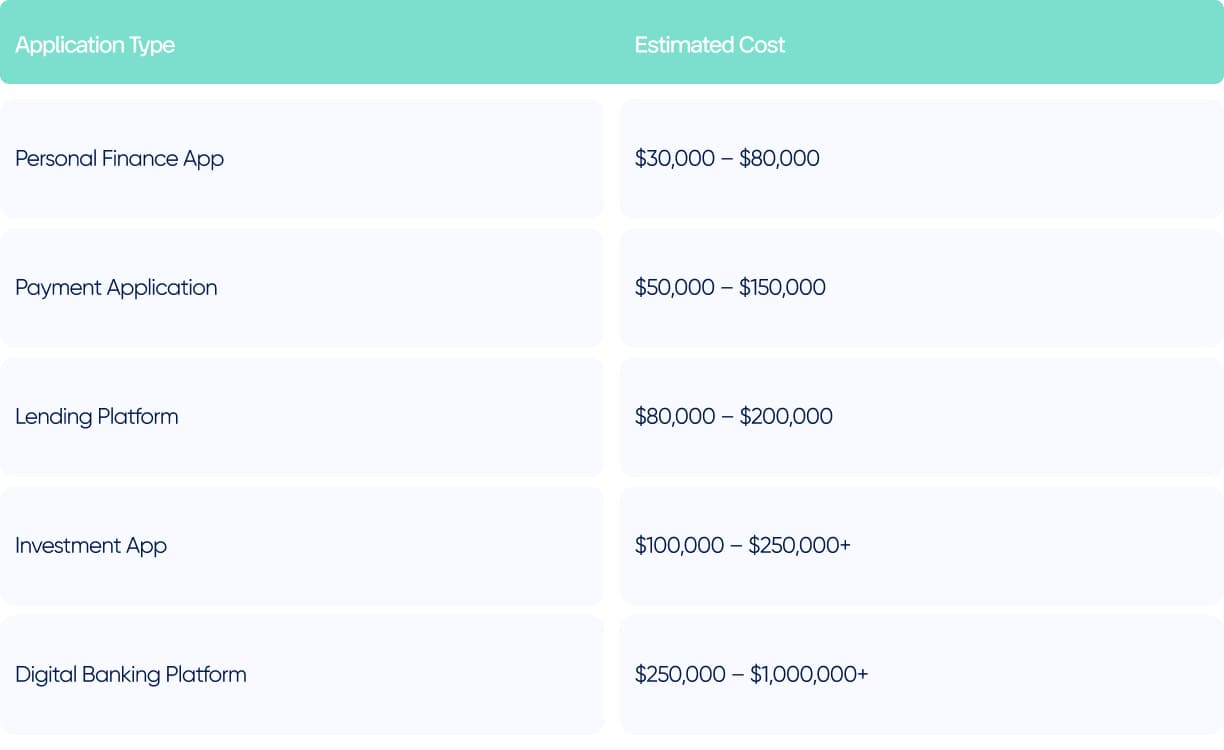
A significant portion of the fintech mobile application development cost often comes from integrations rather than the user interface itself. Connecting to banking systems, payment processors, KYC providers, AML platforms, and compliance tools requires substantial engineering effort.
Launch day is just the start. A financial app is never truly finished because it requires continuous funding to upgrade security, update features, and keep up with regulations.
For this reason, many companies work with a specialized fintech software development company that has tech expertise and understands regulatory requirements. The goal is not simply to build faster, but to avoid costly mistakes that can emerge months after launch.
Key Takeaways
Most fintech products do not fail because of missing features.
They fail because teams underestimate complexity.
Banking integrations, compliance requirements, security controls, payment infrastructure, and user trust become much harder to solve after development has started. The strongest fintech companies understand this early and build with scale, regulation, and long-term growth in mind.
If you’re planning to build a high-performing, user-friendly fintech app, start small and invest in the right foundation. Knowing how to create a fintech mobile application is just the tip of the iceberg. Building a fintech business is the real challenge.