
Mobile Banking App Development: A CEO’s Guide to UAE Costs
Dubai can build a new island in the sea. Your banking app won’t need dredgers, but it will need something almost as expensive: trust.
- For New Clients
January 15, 2026
 AI Overview
Developing a digital banking application in the UAE requires integrating complex systems, robust security protocols, and strict regulatory compliance. Because the region demands high-end user experiences and bank-grade security architectures, companies face significant development expenses. Launching a modern mobile banking platform typically costs between $250,000 and $700,000.

In the UAE, customers expect instant everything (opening an account, moving money, freezing a card, getting help at 2 a.m.), while regulators expect you to behave like a grown-up (security, audit trails, governance, and “please don’t accidentally launder anything”). That combination is exactly why the question “How much does a digital banking app cost in the UAE?” rarely has a neat, one-line answer.
Still, you’re not here for fortune-cookie wisdom. You want numbers, timelines, and the real cost drivers (especially for Dubai), and you want it in a format that doesn’t read like an insurance policy. Let’s do it.
The Big Picture: Why UAE is the Fintech Playground of 2026
Before we talk about Dirhams, let's talk context. The UAE isn't just “adapting” to digital banking; it is setting the pace. With the “Cashless Dubai” strategy aiming for 90% digital transactions by 2026, the government isn't just inviting you to build an app — they’re practically handing you the blueprints and a cup of Karak tea.
However, “easy to start” does not mean “cheap to finish.” The UAE consumer is notoriously demanding. If your app takes more than three seconds to load or has a clunky UI, they won't just delete it; they’ll tell their entire Majlis about it.
The Multi-Million Dirham Question: Average Cost to Develop a Banking App in UAE$220,000 – $550,000+
Let's get the numbers out of the way so you can breathe (or start sweating). In 2026, the cost of developing a digital banking app in the UAE typically falls into three buckets:
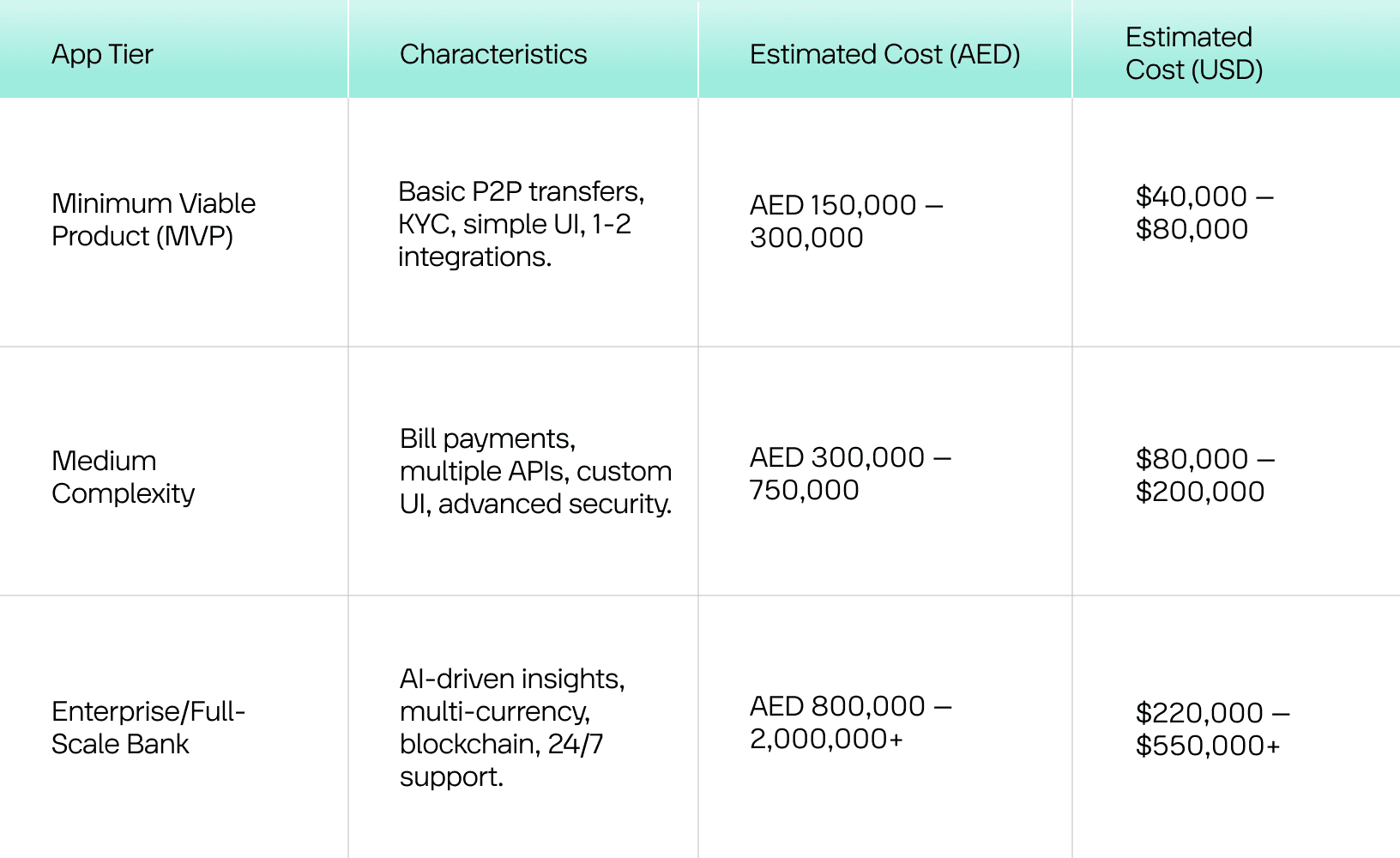
Note: These are development costs. If you want a celebrity influencer to launch it at the Burj Khalifa, add another zero.
Now, let’s talk detail.
Want a real estimate, not a range? Tell us your scope and licensing model — we’ll map features, integrations, and compliance into a clear budget and timeline.

What do you mean by “digital banking app”?
People say “banking app,” but they can mean three very different products, and the price tags differ by an order of magnitude. For example, if you’re building a multi-bank platform that centralizes high-yield savings, your cost drivers shift toward integrations, consent flows, and data reconciliation. Let’s make clear definitions, shall we?
1) A banking application development for an existing licensed bank
You already have a core banking system, compliance team, and licenses. You’re “just” building (or rebuilding) the mobile/web experience, plus integrations.
Cost: medium-high (because security + integrations), but you’re not building the entire bank.
2) A fintech wallet/payment app (neobank-style UX)
You might not be a bank; you might be a regulated payment services business. Your app still looks like a bank, but the regulatory category and backend can be different.
UAE licensing for payment services sits under the Central Bank’s Retail Payment Services and Card Schemes Regulation.
Cost: high (KYC, AML, fraud, payments rails, ledger), but sometimes faster than full banking.
3) A full “digital bank” (licensed bank)
This is the “we want to be a bank” option. You’re dealing with mobile banking app development and building/operating the bank-grade platform behind it (core banking/ledger, risk, reporting, governance, security, audits).
Also, the Central Bank’s minimum capital requirements for banks incorporated in the UAE are significant — AED 2,000,000,000 paid-up capital for banks (with different levels for specialized banks).
Cost: very high (software + operations + capital + long runway).
If you don’t separate these three cases early, you’ll end up budgeting for a bicycle and trying to cross the desert like it’s a Land Cruiser.
Digital Banking App Cost Breakdown: Average Numbers for the UAE
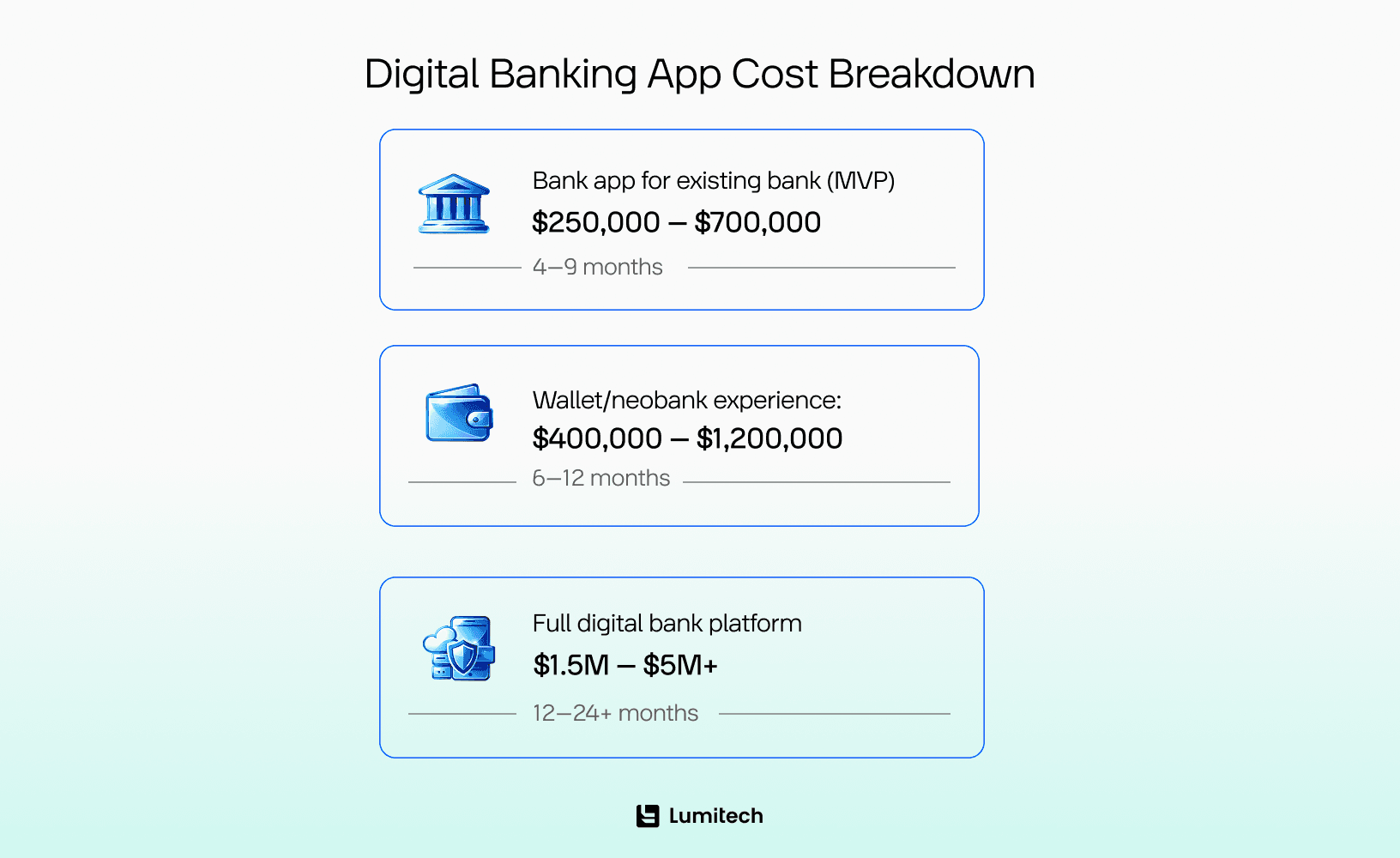
Let’s translate the chaos into realistic ranges. Below are typical build costs for the software product (design + engineering + QA + security work + release), excluding regulatory paid-up capital (which can dwarf the build cost if you’re becoming a bank).
Currency note: the AED is pegged to the USD, so budgets are commonly discussed in either, and the conversion is stable enough for planning.
Cost range benchmarks (UAE-focused)
“Modern banking app” for an existing bank (MVP)
If you’re working with something that already exists, the cost of developing a banking app includes:
secure onboarding + login
account overview + statements
transfers (domestic/international as relevant)
bill pay/beneficiaries
card management (freeze/unfreeze, limits)
notifications, support, basic analytics
Typical cost: $250,000 – $700,000 (≈ AED 918k – 2.57M) Timeline: 4–9 months (more on timelines below)
Why this range is wide: integration complexity, security controls, and the number of legacy systems you must wrestle.
Fintech wallet/“neobank experience” (payments + KYC + cards)
If you’re building everything from scratch, the cost to launch a digital bank in the UAE is significantly higher. Add the harder stuff:
full KYC onboarding (IDV, liveness, screening)
ledger/wallet balances card issuing/processing integrations
fraud monitoring
chargebacks/disputes flows AML reporting workflows and audit logs
Typical cost: $400,000 – $1,200,000 (≈ AED 1.47M – 4.40M) Timeline: 6–12 months
In the UAE, payment service providers must comply with AML/CFT laws and report suspicious activity to the FIU (via systems like goAML), depending on their category and obligations.
Full digital bank platform + apps (bank-grade)
If you’re building the bank-grade platform (not only the app), you are now paying for:
core banking/ledger architecture (or licensing it)
full reporting (regulatory + financial)
risk engines, limits, reconciliations
security programs, audits, governance processes
24/7 operations, incident response, DR
Typical cost: $1.5M – $5M+ (≈ AED 5.5M – 18.4M+) for software/product build Timeline: 12–24 months (often longer in real life)
And again: if you’re not just handling mobile banking application development, but actually licensing as a bank, the minimum paid-up capital requirement alone is AED 2 billion for banks incorporated in the UAE. That’s not “development cost,” but it’s part of the “what does it cost to build a digital bank” reality.
What Actually Drives the Cost to Launch a Digital Bank in UAE?
Why is a banking app more expensive than a food delivery app? Because if a food app glitches, someone gets a cold burger. If a banking app glitches, you’re in a legal nightmare that could involve the Central Bank of the UAE (CBUAE) and a very uncomfortable conversation about “Article 62.”
Regulatory Compliance (The "No-Negotiation" Zone)
You don’t “just build an app.” With banking application development, you build an app that fits a regulated activity. The UAE recently overhauled its financial laws with the Federal Decree-Law No. (6) of 2025. This isn't just some dusty legal document; it’s a high-tech framework that covers everything from Open Finance to the “Digital Dirham.”
Cost Impact: You need dedicated compliance officers and legal consultants who know the CBUAE and DFSA (Dubai Financial Services Authority) rules inside out.
Price Tag: Budget at least AED 50,000 – 150,000 just for legal “pre-flight” checks.
Security: The Digital Vault
In banking, “good enough” security is a death sentence. For mobile banking app development, you need:
Biometric Authentication: FaceID and fingerprint aren't “cool features” anymore; they are mandatory.
Encryption: End-to-end encryption that would make a spy sweat.
Fraud Detection: AI models that flag suspicious transactions in real-time.
Cost Impact: Security features alone can eat up 20-30% of your total budget.
Not every vendor can implement this cleanly, so mobile app development services for banking should be vetted on secure mobile patterns, not just UI speed.
Data protection rules: UAE PDPL vs. DIFC vs. ADGM
If you operate under the UAE federal jurisdiction, you need to design around the UAE’s Personal Data Protection Law (PDPL).
If you operate in DIFC or ADGM, you must follow their regimes:
DIFC Data Protection Law guidance and cross-border transfer requirements can shape how you store and move data.
ADGM has its own Data Protection Regulations (with updated overview materials).
Translation: privacy is not a footer link; it’s architecture, workflows, contracts, and sometimes localization of infrastructure. Naturally, all that increases banking application development costs compared to other apps.
The “Dubai Standard” UI/UX
In some markets, a “clean” design is enough. In the UAE, users expect “luxury” design. This means:
Bilingual Support: Perfect Arabic (RTL - Right to Left) and English integration is a non-starter if you mess it up.
Micro-interactions: Those tiny animations that make the app feel expensive.
Cost Impact: High-end UI/UX design in Dubai starts at AED 40,000 and can easily double.
Third-Party Integrations
Your app doesn't live in a vacuum. It needs to talk to:
Emirates ID (Federal Authority for Identity & Citizenship): For instant KYC.
UAEPASS: The national digital identity.
Payment Gateways: Stripe, Checkout.com, or local giants like Network International.
Cost Impact: Every API has a setup fee and a monthly “tax” on your sanity.
Get ready to face the fact that each necessary integration bumps up the mobile banking app development cost.
Your backend strategy: build, buy, or “assemble”
Your UAE digital banking app cost depends heavily on what sits behind it:
Build a custom core/ledger: expensive, slow, powerful, risky
Buy a core banking / BaaS/fintech platform: licensing fees + integration + vendor constraints
Hybrid (buy ledger + build differentiated layers): common and often sensible
This is where founders either save millions — or accidentally set them on fire. If your roadmap includes multiple vendors and strict SLAs, partnering with managed IT companies can keep infrastructure, access control, and incident response from becoming a second product.
Team composition and rates
In the UAE, you can build with:
an onshore UAE team
a hybrid team (UAE product/security + offshore engineering)
or mostly outsourced (with local compliance partners).
Market listings show that an average app development company in Dubai quotes hourly rates that often start around $25–$49/hr and up from there, with average mobile app project sizes frequently above $50k — but banking is far more complex than the “average app.”Most businesses opt for IT outsourcing companies in Dubai or Abu Dhabi that offer either full offshore development or a hybrid model.
The blunt truth: for regulated fintech, your “blended rate” is less important than your blended competence.
What Factors Determine the Cost of Mobile Banking App Development?
Let’s turn the main determinants into a clear mental model. In practice, your total budget for banking application development is shaped by four buckets:
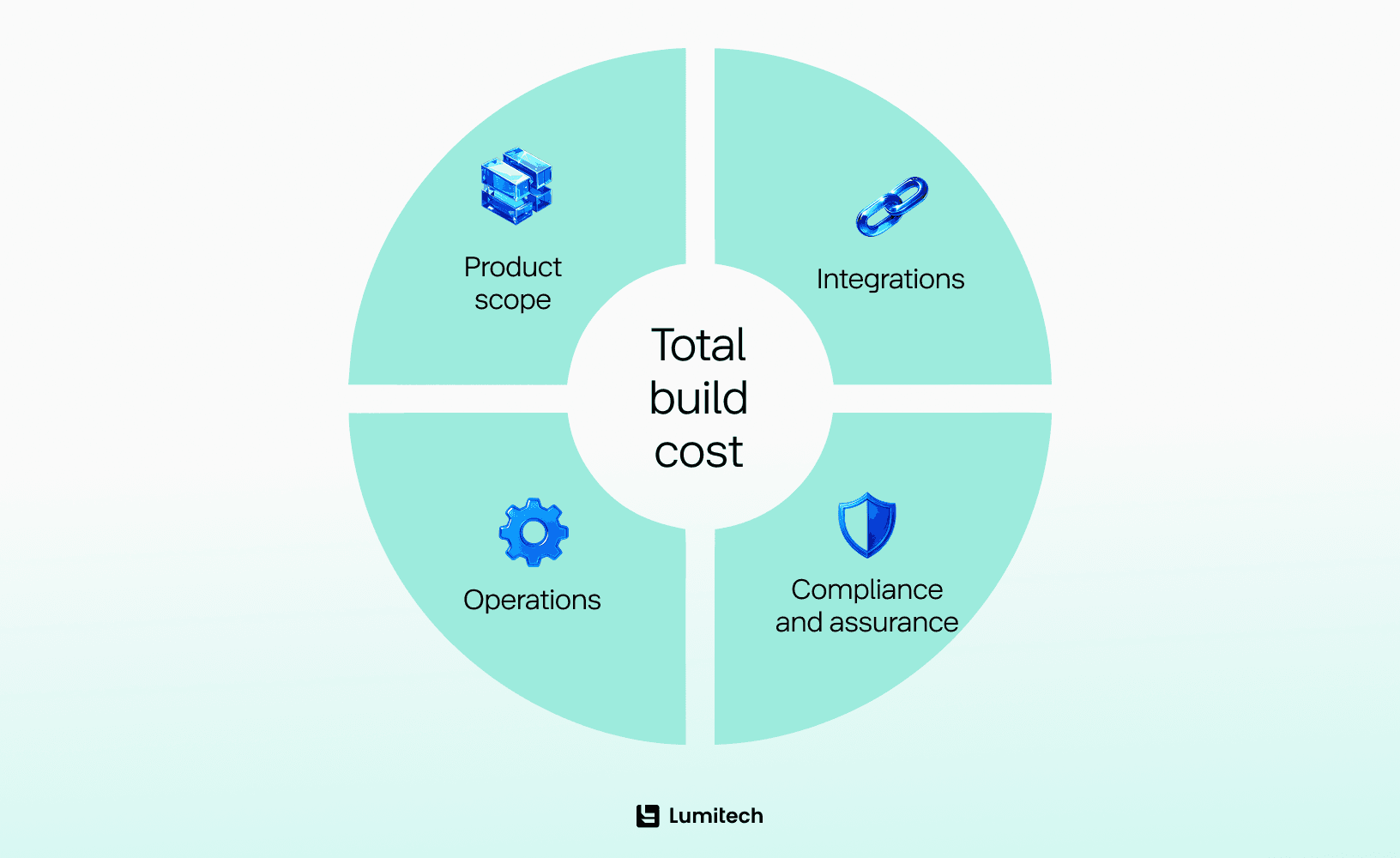
Bucket 1: Product scope (what you build)
More features = more cost, but feature type matters more than feature count. Features involving AI in financial services (like risk scoring, personalization, or fraud prediction) can lift UX and safety, but they also add data engineering and model governance costs.
A “nice UI upgrade” is cheaper than:
onboarding + KYC
payments orchestration
card lifecycle management
disputes
compliance tooling
fraud/risk engines
Bucket 2: Integrations (what you connect to)
Integrations are where timelines go to die.
Typical banking app integrations:
core banking/ledger
payment gateways/rails
card processor/issuer
KYC/ID verification vendors
sanctions/PEP screening
analytics/CRM
customer support/CCaaS
OTP/push providers
document signing/consent tooling
If you add machine learning vendors into the stack, AI companies in the Middle East can accelerate capabilities — but each one is still an integration you must test, secure, and monitor.
Every integration adds:
contract + vendor onboarding time
security review
environment setup
failure handling
monitoring + support paths
Bucket 3: Compliance and assurance (what you must prove)
For UAE banking software development, this includes:
policies + controls
audits/assessments
data protection requirements (PDPL/DIFC/ADGM depending on jurisdiction)
AML/CFT procedures and suspicious reporting readiness.
It’s not “extra.” It’s part of shipping something a regulator and a risk team will sign off.
Bucket 4: Operations (what you keep running)
Your build cost is only the cover charge. Inside the club you pay for:
cloud infrastructure and observability
24/7 monitoring
incident response
fraud ops
customer support workflows
ongoing security patching
feature iterations and compliance updates
A common rule of thumb: plan 15–25% of build cost per year for maintenance and ongoing improvements (often higher for financial products with heavy change and audit demands).
Mobile Banking Application Development Timeline: How Long Until Launch?
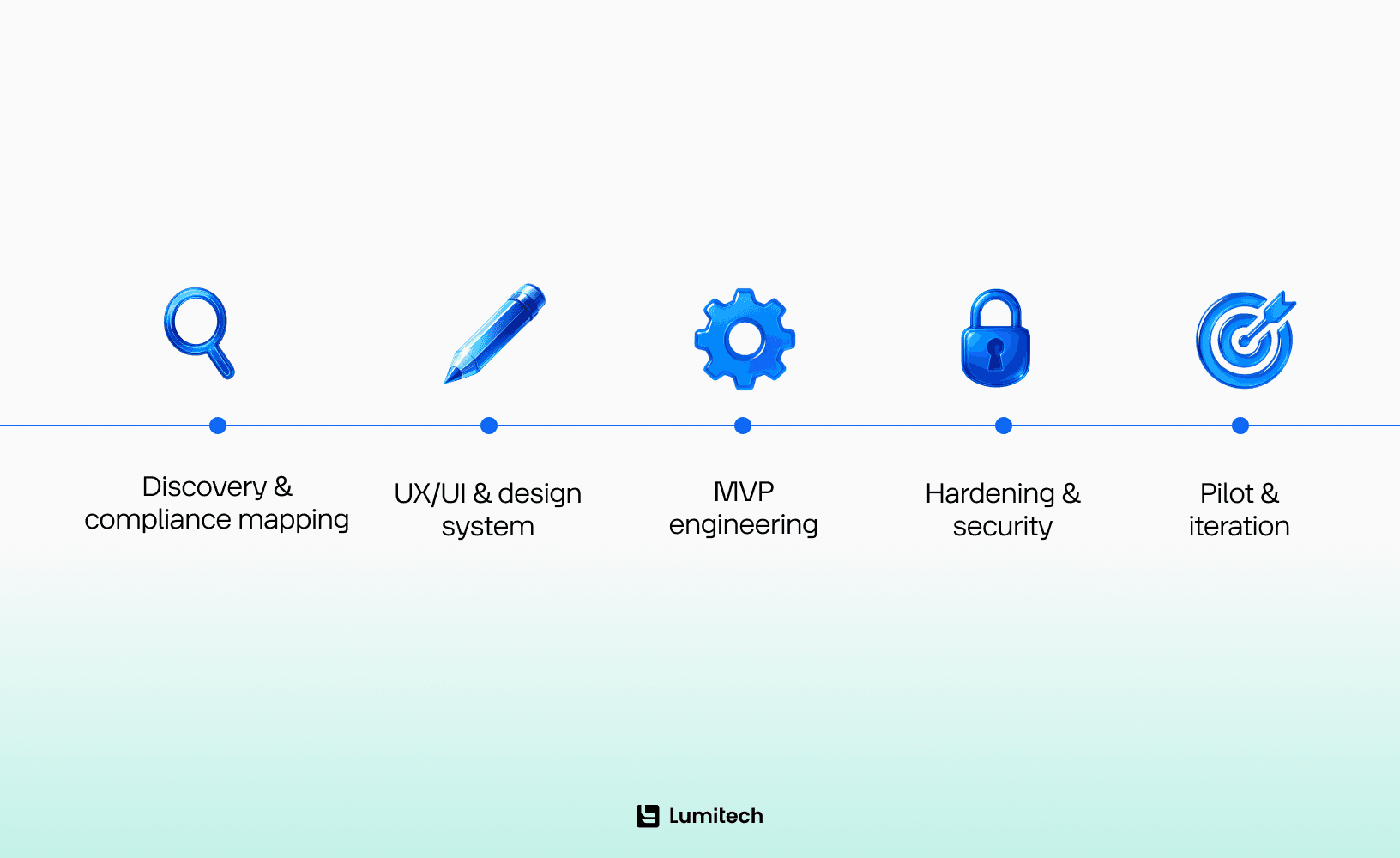
Timeline depends on your definition of “done.” If “done” means “in the App Store,” that’s one thing. If “done” means “live with real customers, compliant, monitored, support-ready, and not terrifying your risk team,” that’s another.
Here are realistic ranges:
Typical timeline by stage
1) Discovery + compliance mapping (3–6 weeks) You define scope, customer journeys, architecture direction, vendor shortlists, and regulatory model assumptions. This is the cheapest time to make the biggest decisions — so yes, you should actually do it.
2) UX/UI + design system (4–10 weeks, overlaps with engineering) Banking apps need a consistent design system and accessibility. “We’ll design as we go” is how you get screens that look like they were adopted from different families.
3) MVP engineering (12–20 weeks) For an existing bank, MVP can land here if integrations are cooperative and scope is disciplined. For a fintech wallet, MVP often stretches because KYC + ledger + fraud controls are not “small.” And if you’re starting from scratch and require both mobile and web development services, the timeline naturally stretches.
4) Hardening + security + release readiness (6–12 weeks) This is where teams discover that “logging and monitoring” are not the same thing as “we print errors in the console.”
5) Pilot + iteration (4–12 weeks) Real users find real issues. That’s not failure; that’s reality. Better to discover it in a controlled pilot than in a 1-star review tsunami.
Overall time ranges
Existing bank app rebuild/v1: 4–9 months
Wallet/neobank-style MVP: 6–12 months
Full digital bank platform + apps: 12–24 months+
The project length directly influences banking app development pricing because of specialists’ charges. If you also need licensing approval (payments/open finance/etc.), parallelize build + licensing work — but expect the overall calendar to expand, not shrink.
A Practical Cost Breakdown: Where the Money Actually Goes
Here’s a grounded way to think about a cost to develop a banking app in UAE, without turning budgeting into a spreadsheet novel.
Phase-based budget shares (typical fintech build)
Discovery & architecture: 5–10%
UX/UI: 10–15%
Core engineering (mobile + backend): 40–55%
Integrations: 15–25%
Security, QA, compliance readiness: 15–25%
Launch + early ops: 5–10%
If you plan for growth, budget for tooling like a real-time forecasting system — it’s cheaper than constantly reacting to emergencies.
These aren’t perfect, but they help you spot bad plans. Example: if someone budgets 2% for security in a banking app, they are either a magician… or a liar.
The cost drivers that surprise UAE founders (and how to plan for them)
If you are ready for these nuances of UAE banking software development, you may find yourself one step ahead of other business founders on a similar path.
“We’ll just add Arabic later”
If you want Arabic and English, design and UX writing should plan for:
right-to-left layouts
longer/shorter text expansion
numerals, date formats, address formats
bilingual customer support flows
Retrofitting this later costs more than doing it early.
“KYC is a vendor, so it’s cheap”
A vendor helps, but you still must build:
capture flows
error handling
manual review tooling
retry policies
risk scoring hooks
audit logs and case management
Even with KYC automation solutions, teams must build retries, fallback journeys, and human review tools — or onboarding becomes a churn engine. Plus: identity expectations and digital onboarding norms in the UAE are high — people won’t tolerate a signup flow that feels like a tax form.
“We only need transfers”
Transfers require:
beneficiary management
limits and approvals
fraud detection hooks
receipts and statements
reconciliation logic
customer support tooling for “my money is missing”
Payments are never “just a button”, and if you imagine them like that, the final cost to build a banking app in Dubai or elsewhere in the UAE may surprise you.
“Compliance is paperwork”
It’s also:
logging architecture
retention rules
access reviews
role-based permissions
suspicious activity workflows
reporting readiness
And in the UAE, suspicious transaction reporting is a real, operational process — not a theoretical slide deck.
Dubai vs. Abu Dhabi: do development costs differ for fintech apps?
If you’re asking “Is Dubai mobile banking application development more expensive than Abu Dhabi?” the honest answer is:
Sometimes slightly—but it’s rarely the main driver.
What tends to matter more is:
which ecosystem you’re building in (DIFC vs. ADGM vs. mainland)
the regulatory path and compliance expectations
office and hiring strategy (onshore vs. hybrid)
vendor availability and partnerships
Cost to build a banking app in Dubai and Abu Dhabi: The regulatory ecosystem difference
If you operate in DIFC, DFSA fee structures and regulatory processes apply; DFSA notes application fees that vary by the financial services and can range from $15,000 to $70,000.
In ADGM, licensing and fee structures differ, and ADGM announced fee revisions/reductions for commercial licenses effective January 1, 2025 (depending on category). ADGM also publishes detailed fee schedules (e.g., a “Schedule of Fees 2025” document).
So, “Dubai vs. Abu Dhabi” is often really “DIFC vs. ADGM vs. mainland”—a strategic decision that affects compliance scope, data protection regime, and cost structure.
Talent and cost-of-living influence on app development in Dubai and Abu Dhabi
Day-to-day cost differences exist, but they’re not a clean rule. Public cost-of-living indices show differences between Abu Dhabi and Dubai, depending on rent and assumptions. In practice, many fintech teams use hybrid staffing anyway, which smooths out city price gaps.
Bottom line: don’t pick a city based on a hoped-for 10% dev saving. Pick it based on regulatory fit, ecosystem, and GTM advantage. The “cheap” choice can become expensive fast.
Do UAE regulations increase the cost of building a banking app?
The short answer is: yes. UAE regulation almost always adds to banking app development cost, and not because someone wants to torture your product team for sport. It adds cost because the app isn’t just a pretty interface; it’s part of a regulated money system, and regulators expect you to be able to prove what happened, prevent what shouldn’t happen, and recover when something goes wrong.
In practice, that translates into extra engineering and operational work around AML/CFT obligations (monitoring, escalation workflows, audit trails, reporting readiness), stronger security controls (identity, access, encryption, incident response), and disciplined data handling under PDPL — or under DIFC/ADGM regimes if you operate there. If Open Finance is in scope, requirements around consent, API security, and operational controls can also shape architecture early and add build effort.
The important nuance: compliance isn’t a “tax” you pay after launch. In fintech, compliance becomes features, processes, and infrastructure. When you budget for it from day one, it’s predictable. When you treat it like a checkbox you’ll tick “later,” it becomes expensive, slow, and full of rework.
The hidden cost nobody budgets for: running the app after launch (TCO)
A digital banking app has two births. The first is when you ship it. The second is when you realize you now have to keep it alive — every day, including weekends, holidays, and that special moment when a customer tries to transfer money during a spotty airport Wi-Fi connection, and your system decides to experience personal growth.
This is the Total Cost of Ownership (TCO), and in the UAE, it matters because expectations are high: customers want instant answers, partners want stability, and regulators don’t love “we’ll fix it next sprint” as a risk-control strategy. TCO includes everything needed to operate safely at scale: infrastructure, monitoring, support workflows, security upkeep, compliance routines, and a constant stream of small improvements that prevent the product from turning into a museum exhibit.
After-launch digital banking app cost breakdown
Start with reliability and observability. Banking-grade doesn’t mean “it rarely crashes.” It means you can see issues before users do, understand impact quickly, and roll back or mitigate without drama. That requires logging that’s actually useful, metrics that reflect real user journeys (not just CPU), alerting that doesn’t cry wolf, and dashboards your operations team can use at 3 a.m. If you don’t want to build an internal NOC from scratch, IT infrastructure companies in Dubai can cover monitoring and escalation as you scale. Add incident response (on-call schedules, runbooks, escalation paths) and suddenly “launch” stops being a finish line and becomes a treadmill.
Then there’s security and fraud as ongoing work, not a one-time checkbox. You’ll patch dependencies, rotate keys, respond to new attack patterns, harden authentication flows, and tune fraud rules as criminals test your edges like they’re playing a very annoying video game. If you issue cards or touch payments at volume, you’ll also budget for recurring security assessments and periodic testing cycles — because security isn’t a feature you ship, it’s a habit you maintain.
And finally: customer support and disputes. Money is emotional. When a transfer is delayed or a card payment fails, users don’t want a push notification that says “Oops.” They want a clear status, a human path to resolution, and the ability to track progress. That means support tooling, internal admin panels with strict permissions, case management flows, dispute handling, and the operational muscle to investigate issues quickly. This is the part many teams skip in MVP planning — until they launch and discover their “support strategy” is basically “hope.”
If you decide to outsource, pay attention to what mobile banking application development companies offer in terms of post-launch support.
Build vs. buy shouldn’t be a coin toss. We’ll help you choose the fastest, safest stack for UAE fintech — then deliver it without surprise ‘integration tax’ later.
Is outsourcing digital banking app development cost-effective in the UAE?
It can be, but outsourcing only works when you outsource the right things. If you want to decrease the cost to develop a banking app in UAE through outsourcing, here’s what you should know.
A common cost-effective setup in the UAE is a hybrid model: keep product ownership, security leadership, and compliance interpretation close to home (often UAE-based), while using an outsourced team to deliver parts of the engineering execution — mobile screens, backend services, QA automation, and iterative feature development. That’s where outsourcing can genuinely reduce burn without lowering standards.
Where it gets risky is when companies try to outsource the “thinking” parts: regulatory interpretation, security architecture ownership, and production operations. Those areas rely heavily on context, accountability, and relationships with local stakeholders (banks, processors, regulators, auditors). If that knowledge is missing or fragmented, you don’t really save money — you just delay the bill until the redesign and remediation phase.
So yes, outsourcing can be cost-effective in the UAE — especially if you keep a tight core team that owns decisions, design quality, security posture, and compliance readiness, and you treat your outsourced team like an extension of your delivery engine, not a substitute for data governance in banking.
How to control cost without building a flimsy “fintech demo”
The control over the cost to build a digital banking app is less about cutting corners and more about cutting the right corners — meaning you reduce scope where it’s safe, and you refuse to compromise where it’s dangerous.
Start by defining an MVP that’s intentionally narrow but genuinely bank-grade. “MVP” shouldn’t mean “it kind of works if nobody looks closely.” It should mean the product does a limited set of jobs extremely well — secure onboarding, reliable money movement, clear customer communication, and support flows that can handle the inevitable “where is my transfer?” moment. Fewer features, stronger foundations.
Next, be honest about what deserves custom engineering. If your differentiation is experience — speed, clarity, transparency, delightful UX — then spend your budget on custom banking app development cost there. For everything else, reuse proven components and vendors where it doesn’t harm your competitive edge. Reinventing commodity plumbing (basic notifications, standard analytics wiring, generic CMS content) is a classic way to burn runway while building nothing customers will pay extra for.
Finally, design for compliance and scale early, even if you’re launching small. That doesn’t mean overbuilding. It means you bake in audit logs, role-based access, monitoring, and sensible data practices from day one so you don’t have to rip up your foundations later. In the UAE context — where expectations around identity, payments infrastructure, and risk controls are high — this approach is usually the cheapest long-term strategy. The “cheap now” approach often turns into the most expensive banking app development cost, just delayed.
Conclusion: what you should budget for (and what you shouldn’t lie to yourself about)
Building a digital banking app in the UAE isn’t “just another mobile app project.” The moment you touch onboarding, identity, payments, cards, or anything that smells like deposit-taking or lending, you’re not in lifestyle-app territory — you’re in trust infrastructure territory. And trust infrastructure costs money, whether you pay for it upfront in architecture and controls, or later in outages, fraud, rewrites, and emergency meetings where everyone suddenly loves the word “governance.”
If you want a clean takeaway on the cost to build a banking app in UAE, here it is:
The UAE doesn’t make banking apps expensive because development in Dubai is magically pricier. They’re expensive because regulated finance demands security, auditability, and operational maturity. Those aren’t “extras.” They’re the minimum entry ticket.
Your biggest cost lever is scope clarity, not optimism. A focused MVP with strong foundations is cheaper than a feature-stuffed “v1” that collapses under real usage.
Integrations and compliance are where budgets get ambushed. Every partner system adds time, testing, edge cases, and responsibility. Plan for it like an adult.
Outsourcing can lower burn, if you keep control of product, security, and compliance. Outsourcing those critical brains is how you save money short-term and spend it all later.
So, what is the cost to build a banking app in Dubai and UAE? Enough that you should treat it like a serious product business, not a quick app launch. The good news is: with the right MVP definition, a sensible build-vs-buy strategy, and compliance baked in from the start, you can ship something competitive without setting your budget on fire. The bad news is: if you try to “move fast and ignore banking realities,” the UAE market won’t punish you gently — it’ll punish you accurately.


