
Top 10 Mobile App Development Companies in Saudi Arabia for 2026
Saudi Arabia’s app market is booming under Vision 2030, but a good rating isn’t enough to pick a vendor. Here’s how 10 real mobile app development companies in Saudi Arabia compare on price, Arabic UX, compliance, and delivery — no guesswork.
- Mobile app development
- Saudi Arabia
September 24, 2026
 AI Overview
Saudi Arabia’s mobile app market includes local KSA teams, regional vendors, and distributed product partners. Compare them on verified KSA delivery evidence, Arabic and RTL UX, mobile and backend depth, payment and identity integrations (mada, Nafath, SAMA-licensed digital banks), pricing transparency, and post-launch support. For regulated or data-sensitive products, confirm PDPL and sector-specific compliance requirements before shortlisting a vendor.

Top 10 Mobile App Development Companies in Saudi Arabia at a Glance
Saudi Arabia is where MENA’s mobile-first economy is actually happening right now. Vision 2030 is pushing banking, retail, healthcare, and government services onto the phone first, and by 2026 most businesses have stopped debating whether to build an app — the real question is who should build it.
The digital foundation backs this up: per DataReportal’s Digital 2026 Saudi Arabia report, the country had 48.7 million cellular mobile connections active in late 2025 (140% of the population), and internet penetration stood at 99.0%.
So when a business goes looking for a mobile app development company in Saudi Arabia, the evaluation usually comes down to the same handful of things: how reliable is this vendor, what do they actually build, what does it cost, what’s included, and does any of it match what we actually need.
This guide skips the sales pitch. Below are 10 companies building mobile products for the Saudi market in 2026, compared side by side on price, focus, KSA presence, and delivery evidence — plus what things really cost, how long they take, and what to check before you sign anything.
How Is the Saudi Mobile App Market Evolving Under Vision 2030?
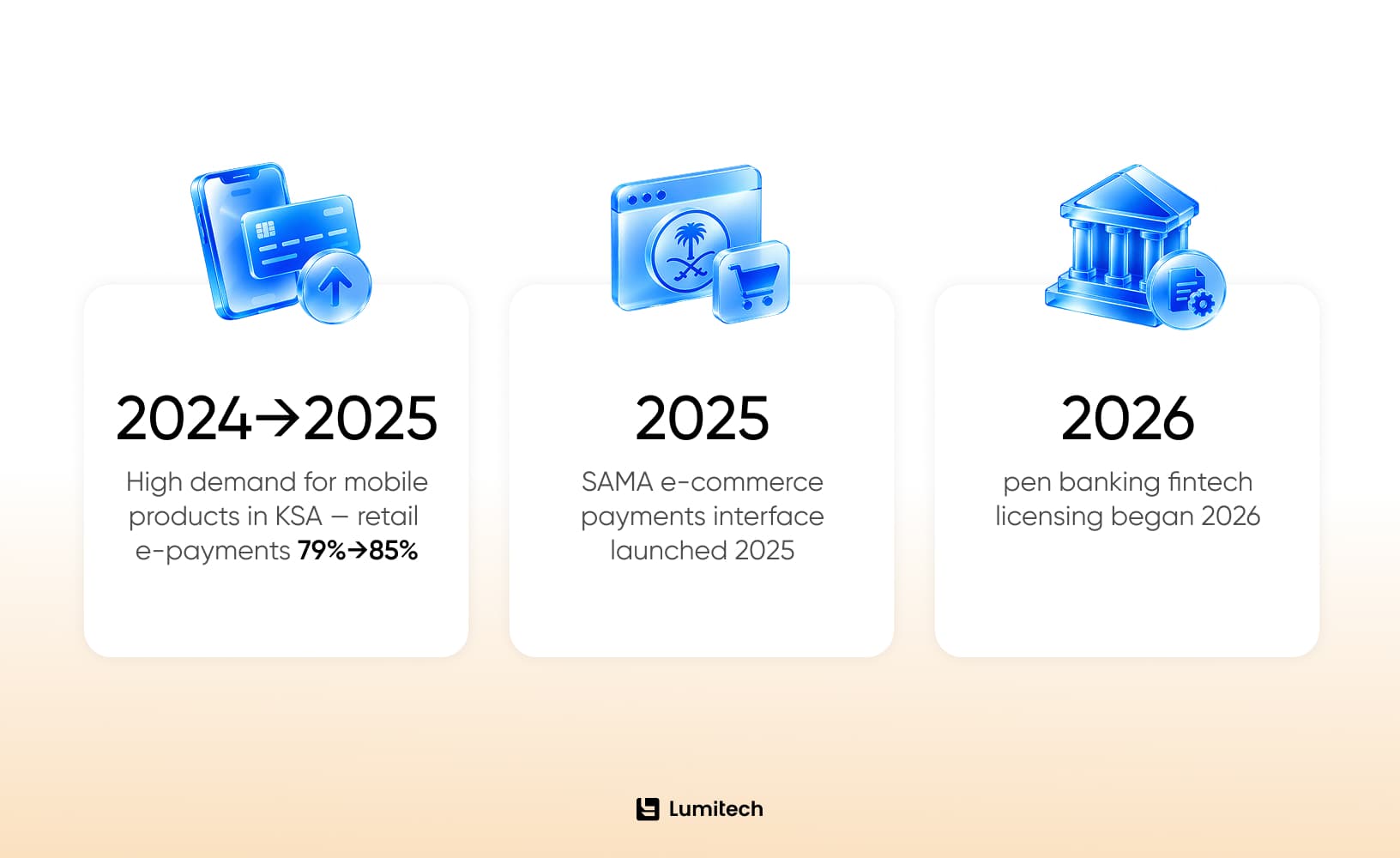
Two things explain why KSA has such an appetite for mobile products right now: payment behavior and government-backed infrastructure. The Saudi Central Bank reported that electronic payments made up 85% of all retail payment transactions by individuals in 2025, up from 79% in 2024. If your business sells anything through a phone, that single number tells you the user is already there, waiting for something fast, localized, and frictionless.
The second driver is infrastructure maturity. SAMA launched a new e-commerce payments interface in 2025 and has been licensing fintech companies for open banking services since 2026. STC Pay, the country’s largest digital wallet, completed its transition into STC Bank — a fully SAMA-licensed digital bank — which is a good indicator of where the market as a whole is heading: payments, banking, and mobile UX are converging fast. That opens the door for embedded finance, loyalty, and data-driven journeys, but it also raises the bar for what “good enough” development looks like.
You can see this in how clients brief projects today. They already know they want to launch in Riyadh, plug into local payments, ship a proper Arabic UX, plan for scale, stay compliant, and set up the next 12–24 months rather than just the next release. That’s the lens top app developers in Riyadh and app developers in Jeddah should genuinely be evaluated through — not just “can you build an app,” but “can you build this one, here, for these users.”
Selection Methodology: What to Compare Before Hiring a Mobile App Development Company in Saudi Arabia
A note on methodology, upfront: Lumitech publishes this comparison and is included. Every company on this list — Lumitech included — is measured against the same criteria below, with a “last checked” date, so you can judge for yourself instead of taking our word for it.
What We Looked At
proven presence or delivery practice in KSA;
verified client reviews and ratings (Clutch, GoodFirms, LinkedIn);
a clear service list, including mobile app development solutions;
real, checkable case studies;
willingness to work with local requirements (Arabic UX, local payments, on-site expectations);
pricing transparency: hourly rates or minimum project size, where public;
technical depth: mobile, backend, cloud, QA, AI, design;
experience in verticals active in KSA — fintech, retail, logistics, healthcare, enterprise.
Why This Actually Matters for Buyers
Nobody picks a vendor off a star rating alone. In practice, there’s a business goal, a deadline, a budget bracket, and a few internal risks nobody wants to say out loud. What you’re really deciding is who keeps control of scope after sprint one — which is also why it’s worth reviewing Lumitech’s broader software development services in Saudi Arabia if you’re weighing a KSA-based partner against a distributed one; the commercial page goes deeper into delivery models and local presence than this comparison can.
Best Mobile App Development Companies in Saudi Arabia
Here’s the full lineup, ranked and compared side by side.
Company | Location | Best for | Key services | Industries | Pricing/min project |
|---|---|---|---|---|---|
Apptunix | Serves Saudi Arabia / global delivery | Enterprise + AI-driven apps | Mobile apps, AI, blockchain, custom software | Fintech, logistics, enterprise, startups | From $25,000; $25–49/hr |
Wve Labs | Riyadh | Full-cycle mobile delivery | iOS, Android, UX/UI, web, AI | Multi-industry | From $10,000; $100–149/hr |
Eurisko | Saudi Arabia / MENA | Enterprise and innovation-heavy apps | Native, Flutter, React Native, AI, AR/VR | Telecom, media, enterprise, fintech | From $50,000; $50–99/hr |
Lumitech | Saudi Arabia practice / distributed delivery | Product-driven custom apps, mobile ecosystems | Mobile, custom software, UX/UI, AI-ready engineering | Fintech, healthtech, logistics, SaaS | Not public |
RunProf LLC | Egypt / Saudi Arabia delivery | Full-stack mobile & custom software | iOS, Android, hybrid apps, custom software, SaaS/ERP builds | E-commerce, healthcare (public sector), real estate, sports | From $10,000; $25–49/hr |
Developer Bazaar Technologies | Riyadh | MVP, SMB, faster launch | Mobile apps, AI, custom software | Healthcare, real estate, government, e-commerce | From $10,000; $25–49/hr |
Mobcoder Saudi Technology Co. | Riyadh | AI-oriented, transformation projects | Mobile, AI/ML, SaaS, IoT | Enterprise, digital transformation | Not fully public |
TechGropse | Riyadh | MVP + fast launch | Mobile apps, AI development, e-commerce | Tourism, e-learning, startups, gaming | From $25,000; $25–49/hr |
Ewaantech | Riyadh / Jeddah | Local business apps, e-commerce | Android, iOS, web apps, IT services | SME, retail, services | From $1,000; $25–49/hr |
Adox Arabia | Riyadh / Jeddah | Budget-friendly local app builds | iOS, Android, e-commerce dev, web design | SME, retail, e-commerce | Under $5,000 |

1. Apptunix
Location: Serves Saudi Arabia / global delivery
Best for: Enterprise + AI-driven apps
Key services: Mobile apps, AI, blockchain, custom software
Industries: Fintech, logistics, enterprise, startups
Pricing/min project size: From $25,000; $25–49/hr
Apptunix consistently ranks at the top of the 2026 KSA rankings, and the reason is scale: the company reports experience across 50+ countries and 2,500+ delivered products, backed by a strong Clutch review profile. That kind of footprint matters most when the product isn’t simple — think AI features, blockchain components, or a system that needs to talk to several other systems at once.
This is a good fit if your product has genuinely complex logic, is built to scale from day one, or needs to integrate with multiple platforms. It’s less necessary if you’re validating an idea with a lean MVP — in that case, the premium process may be more structure than you need right now.
Short verdict: the safest pick for complex, AI-heavy, or enterprise-scale mobile products.
2. Wve Labs
Location: Riyadh
Best for: Companies that need a full-cycle vendor with a heavy mobile focus
Key services: iOS, Android, UI/UX, web, and AI development
Industries: 17+ industries
Pricing/min project size: From $10,000; $100–149/hr
Wve Labs is one of the most consistently visible mobile app development companies in Riyadh. Clutch’s public data points to a 50% mobile-focus share and a strong review history — both of which carry real weight in procurement. Paying more here usually buys process: predictability, a proper management layer, and communication that doesn’t fall apart mid-project.
This format works especially well for brands, retail, and service platforms where the app quickly becomes a public-facing product. UX, app-store readiness, time-to-market, and post-release support quality all matter more than usual. If your internal product team is small, a full-cycle Saudi Arabia app development company like this one takes a lot of the load off you.
Short verdict: a strong choice for companies with a mature budget who want structured, full-cycle delivery out of Riyadh.

3. Eurisko
Location: Saudi Arabia / MENA presence
Best for: Enterprise apps, innovation-heavy products, omnichannel initiatives
Key services: Native apps, Flutter, React Native, enterprise web, AI, AR/VR
Industries: Enterprise, telecom, media, fintech, smart city
Pricing/min project size: From $50,000; $50–99/hr
Eurisko makes sense when the app is one piece of a much bigger digital program. Its site leans heavily into enterprise web, advanced mobile, AI, and Saudi-specific positioning, and its Clutch profile backs that up with experience in genuinely complex environments — multiple release iterations, several user types, microservice architecture, integrations with internal systems. That’s a fairly accurate description of how many KSA enterprise projects actually run.
Eurisko is also comfortable at the edge of mobile, AI, and richer digital experiences — personalization, smart content, AR/VR, data-heavy interactions. Not every project needs that, but for some enterprise and telco builds, it’s very real. If you’re evaluating an enterprise vendor, ask for a team layout and a phased delivery plan straight away — it tells you fast whether they can actually work at that distance.
Short verdict: a strong candidate for large digital products and more complex enterprise apps.

4. Lumitech
Location: Saudi Arabia practice / distributed team
Best for: Mid-market businesses, custom digital products, mobile ecosystems with backend and integrations, digital transformation.
Key services: Mobile application development, custom software development, UX/UI design services, AI-ready architecture, product discovery, support
Industries: Fintech, healthtech, logistics, SaaS, marketplaces
Pricing/min project size: Not public
Lumitech fits businesses that treat a mobile app as a growth tool rather than a checkbox — which matters if you want to hire app developers in Riyadh for something that lives inside a larger system: CRM, analytics, an admin panel, payments, cloud backend, internal workflows. The team takes a product-first approach: filtering out noise, phasing the release, and deciding which integrations need to ship on day one versus which can wait.
That filtering step often saves real money. A client will come in asking for a universal super app, and by the end of the first working session it’s usually clear that 20% of the planned features will cover 80% of the actual value in release one.
Lumitech also holds up well in messier scenarios — an AI layer, Arabic-market experience, a large number of user roles, or a cloud architecture that needs real engineering maturity rather than just more developers on the team. Public Clutch reviews point to responsiveness and solid delivery at MVP and product scope. For proof, see the AI cooking companion case study and the mobile app transformation case study.
Short verdict: a solid pick for companies that look for mobile app development companies in Dubai with an actual product mindset, not just execution.
Have a mobile product in mind for Saudi Arabia?
Let’s break it down together — from idea and scope to architecture, integrations, and launch plan.


5. RunProf LLC
Location: Alexandria, Egypt, with Saudi Arabia delivery
Best for: Full-stack mobile and custom software on a mid-range budget
Key services: iOS, Android, hybrid and native app development, custom software, SaaS/ERP builds, real-time booking systems
Industries: E-commerce, healthcare (public sector), real estate, sports, construction
Pricing/min project size: From $10,000; $25–49/hr
RunProf LLC is a good example of a regionally delivered vendor that shows up across several Clutch categories for Saudi Arabia — mobile, web, and custom software — with a consistently strong review record (100% positive on recent reviews) and a genuinely varied client list, including a project for the Ministry of Health in Saudi Arabia. That combination of public-sector experience and standard commercial builds (e-commerce, sports apps, real estate platforms) makes it a reasonable middle-ground option between the premium full-cycle vendors above and the budget-focused ones below.
Short verdict: solid value for mid-budget projects that need both mobile and backend/custom software work handled by one team.

6. Developer Bazaar Technologies
Location: Riyadh
Best for: MVP, SMB, cost-conscious launch
Key services: Mobile application development, AI development, custom software
Industries: Healthcare, real estate, government, e-commerce, education
Pricing/min project size: From $10,000; $25–49/hr
Developer Bazaar Technologies works for businesses that want to get into the market fast without front-loading the whole budget. That’s a very common brief in the region: a service app, marketplace, booking product, or internal tool idea, but no appetite for a bloated v1. Its Clutch profile matches that positioning — mobile plus AI, at moderate hourly rates.
The practical upside is shipping an MVP, watching real usage, reading retention and conversion, and only then deciding what to build next. If a Saudi Arabia mobile app development agency can hold that pace, the project doesn’t get over-engineered before anyone’s proven the idea works. For buyers, that’s often the whole point: not “who writes the best code” but “who stops us from spending on untested assumptions.”
Short verdict: a solid option for a quick launch on a controlled budget.
7. Mobcoder Saudi Technology Co.
Location: Riyadh
Best for: AI-enabled apps, transformation programs, data-driven products
Key services: Mobile, AI/ML, SaaS, IoT
Industries: Enterprise, digital transformation
Pricing/min project size: Not fully public
Mobcoder Saudi Technology Co. is worth a look if your roadmap already has an AI component, or you’re planning to add one soon — personalization, OCR, recommendations, an in-app assistant, predictive operations, whatever the use case is. There’s less publicly verified review volume here than for some others on this list, which makes the vetting step non-optional: ask for specific cases, check how AI actually moved a business metric, and understand how the team handles data governance and privacy-sensitive domains before committing.
Short verdict: a promising pick for AI-heavy mobile products, once you’ve checked the cases and delivery approach yourself.

8. TechGropse
Location: Riyadh
Best for: MVP + fast time-to-market
Key services: Mobile apps, AI development, e-commerce
Industries: Tourism, e-learning, startups, gaming
Pricing/min project size: From $25,000; $25–49/hr
TechGropse is one of the steadier names on Clutch’s KSA list, with a clear focus on fast product launches. It’s a reasonable fit for businesses that want to test an idea without the enterprise-scale process — a decent share of its portfolio is mobile app development in Saudi Arabia built around UX and scalability rather than deep enterprise integration.
Short verdict: a strong candidate for MVPs and products with a short runway to launch.

9. Ewaantech
Location: Riyadh / Jeddah
Best for: Local business apps, e-commerce, service platforms
Key services: Android, iOS, web/mobile app development, e-commerce
Industries: SME, retail
Pricing/min project size: From $1,000; $25–49/hr
Ewaantech solves local business problems without a lot of delivery overhead. It shows up regularly among mobile app development companies in Jeddah and Riyadh, and its Clutch profile points to one of the more affordable entry points on this list — a genuinely comfortable format for SMBs that need a working product, a normal launch timeline, and a team that actually understands local business realities, not a big process.
Typical use cases: retail, loyalty, booking, small e-commerce, B2B dashboards, internal office apps. The team that wins here is the one that gets the project to release calmly and doesn’t fall apart at the fixes-and-support stage. When picking a software partner in Riyadh, Saudi Arabia, at this price point, look hard at QA practice, release process, and support — a nice pitch deck matters a lot less than what happens after launch.
Short verdict: a practical, local-first choice for service platforms, retail, and e-commerce in KSA.

10. Adox Arabia
Location: Riyadh / Jeddah
Best for: Budget-conscious SMBs that want mobile + web + e-commerce from one team
Key services: iOS and Android app development, e-commerce development, web design and development, digital marketing
Industries: SME, retail, e-commerce
Pricing/min project size: Under $5,000
Adox Arabia has had dedicated Riyadh and Jeddah offices for close to a decade and shows up in local directory listings as one of the lower-cost options on this list, with a reported minimum project size under $5,000. It bundles mobile app development with e-commerce and web work, which suits small businesses that want one team handling the whole digital footprint rather than juggling separate vendors for app, site, and marketing.
The trade-off is the one you’d expect at this price point: less independent review depth than the Clutch-heavy names above, so lean harder on direct portfolio checks and reference calls before committing.
Short verdict: a workable low-budget option for SMBs bundling a simple app with e-commerce and web needs.
Cost of Mobile App Development in Saudi Arabia
When someone asks how much mobile app development costs in Saudi Arabia, the honest answer is: it depends on product complexity, number of integrations, level of compliance, domain, stack, and how much post-release support you’re buying.
What KSA Directory Data Shows
Current Clutch listings for Saudi mobile vendors show minimum project sizes starting around $10,000 (with some budget vendors accepting projects from $1,000–5,000) and hourly rates ranging from roughly $25–49/hr on the cost-efficient end to $100–149/hr in the premium segment (see the comparison table above). Treat this as a market rate benchmark, not a fixed price — actual project cost depends heavily on scope.
Illustrative Lumitech Planning Ranges (as of September 2026)
These are internal scoping estimates Lumitech uses when sizing a first conversation with a client — not a market average, and not sourced from a third-party benchmark:
App type | Illustrative planning range |
|---|---|
Simple MVP | $20,000–50,000 |
Mid-complexity business app | $50,000–120,000 |
Fintech, healthtech, or marketplace app | $120,000–250,000+ |
Enterprise ecosystem (backend, dashboards, integrations) | $250,000+ |
What Usually Pushes the Budget Up in KSA
Arabic localization and RTL layout;
local payment integrations (mada, bank APIs, open banking);
complex approval flows;
PDPL-related data handling;
higher cybersecurity requirements;
admin panels and role-based access models;
heavier analytics setups;
integrations with banks, ERP systems, CRM systems, or government platforms.
Regulated products — fintech in particular — typically need extra time for SAMA-related integration and certification work. Lumitech doesn’t have internal data to put a firm percentage on how much longer that adds, so treat any such figure you see elsewhere with some skepticism unless the source discloses its methodology; what’s certain is that it affects budget, planning, and team composition.
Timelines: How Long Projects Actually Take
In KSA, timelines only hold up when proper discovery happens first. Skip that step, and almost any estimate turns into a guess.
Stage | Typical duration |
|---|---|
Discovery and scoping | 2–5 weeks |
UX/UI design | 3–6 weeks |
MVP build | 3–5 months |
Mid-complexity product | 5–8 months |
Highly regulated or enterprise app | 8–12+ months |
The second layer of work rarely shows up on day one. At first it looks like design, mobile code, backend — then payments, security reviews, data flows, QA rounds, app-store requirements, localization, analytics, and a pilot rollout stack up on top. This is the stage that decides whether a project stays on track or hits a wall.
It’s plannable, though. A vendor with real KSA experience builds realistic buffers for compliance, localization, and integration work into the plan from the start — that’s arguably a better filter for a good partner than any single number in this table.
Mobile App Development Services and Tech Stack in Saudi Arabia
Businesses looking for top app developers in Saudi Arabia usually don’t need a list of programming languages — they need to know whether the contractor can own the full delivery lifecycle.
Core Services Buyers Usually Need
product discovery;
research and feature prioritization;
UX/UI design;
native iOS and Android development;
hybrid app development;
backend and API layer;
cloud infrastructure;
DevOps and release management;
analytics and support.
Common Tech Stack Saudi Arabia App Development Companies Use
Mobile: Swift, Kotlin, Flutter, React Native
Backend: Node.js, Python, Java, .NET
Cloud: AWS, Azure, GCP
Data: PostgreSQL, Firebase, analytics tools
AI layer: OCR, recommendations, assistants, forecasting
Security: encryption, RBAC, audit logs, secure API gateways
Hybrid development matters here for two reasons: faster time-to-market, and easier integration with local payment infrastructure. mada is Saudi Arabia’s national payment network — the domestic debit rail most retail transactions run through — while SAMA separately drives the e-commerce payments interface and the open banking framework, and STC Bank (the fully licensed digital bank that grew out of stc pay) is now part of the everyday payment landscape. The practical question for any contractor: have they actually shipped something that touches local payment or financial rails, or is this their first time?
Industries and Use Cases
Saudi Arabia covers a lot of very different mobile scenarios, and the right contractor depends heavily on the domain.
Fintech and Payments
One of the most active segments in the country. Local payment methods, SAMA-regulated workflows, open banking, fraud prevention, onboarding, identity flows, and clean payment-journey UX all matter here. With e-payments at 85% of retail transactions and open banking initiatives underway, a fintech app without real local context hits its ceiling fast. Fintech software development experience matters specifically because mobile UX here sits directly on top of identity, risk, data, and transaction logic. For a deeper look at the roadmap, see Lumitech’s article on core banking modernization.
Retail and E-commerce
E-commerce apps in KSA typically combine shopping, loyalty, personalization, order tracking, promo logic, fast checkout, and mobile wallet flows. As payment infrastructure has matured, the bar has gone up: fast checkout, stable payment integration, Arabic UX, and solid post-launch analytics are now table stakes, not nice-to-haves.
Healthcare
Privacy, access to sensitive data, consent management, action auditing, and secure information transfer are the priorities. Healthcare software development practice matters because sensitive data, access control, and auditability aren’t things you can bolt on after launch — a mobile agency working in this space needs to treat security-by-design as a first requirement, not an afterthought.
Logistics and Field Service
The country’s geography makes mobile apps for logistics, transportation, service trips, and field teams genuinely useful, not just nice to have. Offline modes, routing, statuses, geolocation, role-based access, and stability under patchy connectivity all matter, and logistics and transportation software experience is worth checking for specifically when the app needs to keep working without a signal. One concrete example: Lumitech rebuilt a bus booking platform for a client in Atlanta with exactly this kind of offline-first design.
Government and Enterprise Services
Here, the mobile app is usually the front layer for a much bigger operating system behind it. Teams with genuine backend and architecture depth tend to win these projects — a pretty UI doesn’t help if the system underneath can’t hold.
AI Use Cases That Actually Make Sense in Apps
Arabic-language assistants;
AI search inside catalogs;
OCR for documents and onboarding;
personalized recommendations;
support copilots;
fraud signals and anomaly detection;
demand and operations forecasting.
The test for any of these is ROI, not novelty. If AI speeds up support, improves onboarding, lifts average order value, or cuts manual work, it earns its place. If it’s just an extra layer of complexity with no clear business case, push it to phase two.
Whether you’re building a fintech app, a marketplace, or an internal platform, the right approach changes everything. We can help you map the smartest way forward.

PDPL and Cybersecurity for Mobile Apps in KSA
For Saudi Arabia, the legal and security stack needs to be part of the brief from day one — not a late-stage addition.
Saudi Arabia has its own personal data protection framework, and SDAIA publishes the applicable law and implementing regulations. If your app collects personal data, behavioral analytics, financial data, or health information, PDPL shapes consent design, data flows, purpose limitation, storage, user rights, and internal processes. Lumitech’s own in-person community app case study is a useful reference point for how consent and data-flow design plays out in a real product.
On the security side, the National Cybersecurity Authority (NCA) maintains the Essential Cybersecurity Controls (ECC) framework. It’s worth being precise here: ECC doesn’t automatically apply to every mobile app built in the Kingdom — it’s mandatory for government entities and for private-sector organizations that own, operate, or host critical national infrastructure.
Most consumer or commercial apps fall outside that mandatory scope, but the underlying practices (access controls, logging, encryption, secrets management, secure API design) are good security hygiene regardless, and any vendor should be conversant in them. If your product touches a regulated sector or government data, confirm with your legal team which specific NCA control set actually applies to you.



Compliance Checklist Before Signing
data flows map;
where data is stored;
who has access, and how that’s controlled;
security testing plan;
policy on third-party SDKs;
incident handling process;
approach to consent management;
logging and auditing;
backup and recovery logic.
How to Choose a Mobile App Development Company in Saudi Arabia
This is where “who’s rated highest” becomes an actual shortlist.
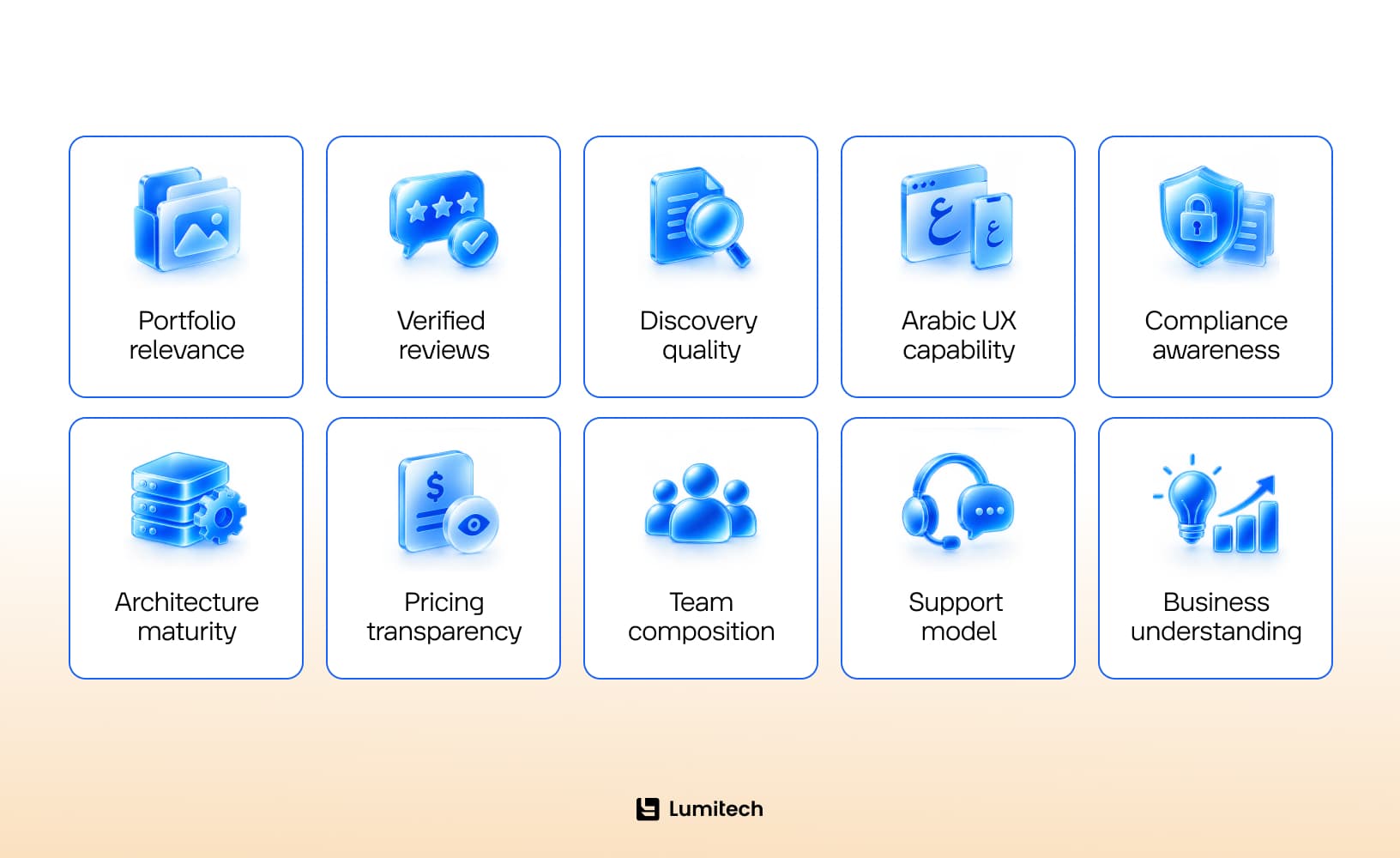
10-Point Checklist
1. Portfolio relevance. Don’t judge on aesthetics or portfolio size alone — look for a documented track record in your industry, your business model (subscription, marketplace, B2B), and roughly your level of complexity. Ask: “Have you done something similar in functionality and scale? What was hardest about it?”
2. Verified reviews. The details matter more than the star rating: how the team communicates, whether it hits deadlines, how it handles change requests, whether it sticks around after release. Check Clutch, GoodFirms, and LinkedIn cases directly. Ask: “What do clients usually want changed after the first release?”
3. Discovery quality. A strong vendor asks before it estimates: who’s your audience, how do you make money, what integrations do you need, what risks do you see. A blind estimate with no clarifying questions is a genuine red flag.
4. Arabic UX capability. Non-negotiable in this market — RTL layout, interface behavior, cultural patterns, local user expectations. Ask to see an app with real Arabic UX they’ve shipped.
5. Compliance awareness (PDPL, payments, security). The vendor needs to actually understand PDPL, local payment integrations (mada, licensed banks), and baseline cybersecurity requirements. “We’ll figure that out later” is a risk, not an answer. Ask: “How do you handle personal data and access control?”
6. Architecture maturity. Even for an MVP, ask how the product scales, whether the backend survives 6 months of growth without a rebuild, and how it holds up under real load. Ask: “What breaks first if we have 10x the users?”
7. Pricing transparency. A serious budget is broken down — design, development, QA, project management, support, third-party costs. One flat number with no detail is a warning sign. Ask: “What exactly is in this budget, and what falls outside it?”
8. Team composition. Know who’s actually building the product — seniority level, and whether there are dedicated QA, design, and DevOps people rather than one generalist wearing every hat. Often the team that sells isn’t the team that delivers. Ask directly who will be on it.
9. Support model. Launch is the beginning, not the finish line. Check for an SLA, bug-handling process, release cadence, and whether monitoring is actually in place. Ask: “What happens if something breaks in production at 2 a.m.?”
10. Business understanding. The strongest signal of all: does the vendor talk about retention, conversion, and rollout strategy before frameworks and sprint counts? Ask: “How does this product make or save money?”
After discovery clarifies scope, integrations, and risk — which is exactly what a proper product discovery phase is for — timelines stop being guesses and start being plans.
Key Takeaways on Top Mobile App Development Companies in Saudi Arabia
2026 is a genuinely strong environment for mobile products in KSA: high digital penetration, fast-maturing payment infrastructure, Vision 2030 momentum, and a fintech/data sector that isn’t slowing down. That’s real opportunity for any business building or scaling an app-based model here.
If you’re working out how to choose a mobile app development company in Saudi Arabia, the shortlist usually comes down to: real local market understanding, compliance readiness, solid mobile engineering, a delivery process that doesn’t fall apart under change, and a team that can talk business, not just sprints. Get those right and you get a realistic time-to-market and a budget you can actually plan around.
Before you shortlist a vendor to hire mobile app developers in Saudi Arabia, it’s worth reviewing relevant customer stories with comparable complexity and integrations — a portfolio link only tells you so much; a detailed case tells you how a team actually thinks.


