
Top Mobile App Development Companies in Dubai (2026): Buyer’s Guide
With 2026 guides ranging from AED 25,000 to AED 500,000+ for a Dubai app, there is no meaningful single average. We compare ten verified providers by team size, mobile focus, and public evidence, plus the cost factors that move the final quote.
- For New Clients
September 08, 2026
 AI Overview
Mobile app development companies in Dubai differ by delivery model, product depth, and platform expertise more than by headline rankings. A useful shortlist compares verified mobile cases, iOS/Android or cross-platform capability, backend and integration depth, security practices, and post-launch ownership. Published 2026 Dubai cost guides disagree by a factor of ten, so scope drives the budget rather than location. UAE buyers should also confirm Arabic/RTL requirements and the data-transfer regime that applies to their product before fixing architecture and hosting.

Top Mobile App Development Companies in Dubai at a Glance
Roughly 900 providers appear in the Clutch mobile app development category for the UAE, and the practical shortlist for any single product is closer to three. Choosing an app development company in Dubai is therefore a filtering exercise before it is a comparison exercise.
This guide gives you ten providers that meet the same screening criteria, realistic public cost references, a practical framework for choosing between iOS, Android, and cross-platform development, and the UAE data-transfer considerations to resolve before development starts.
The list runs from the largest delivery organizations to the smallest studios. That ordering signals size, not quality — a 600-person delivery organization and a 20-person studio can both be the right answer for different briefs.
If you are still deciding between a mobile build and a broader platform program, the overview of top tech companies in the UAE is the closest neighbor to this page.
How We Selected These Mobile App Development Companies in Dubai
Every profile below runs through the same eight checks, and every profile publishes the same eight fields. Claims that appear only in a provider’s own materials are marked company-reported.
Criterion | What we checked |
|---|---|
Dubai/UAE relevance | Registered Dubai presence or documented Dubai service coverage in a third-party directory. |
Mobile focus | Mobile app development accounts for at least a quarter of the provider’s published service mix. Large groups that treat mobile as a side capability are excluded, no matter how strong their overall engineering is. |
Public proof | Verified client reviews, published cases, or an official mobile portfolio. |
Delivery depth | Discovery, UX, mobile engineering, backend and integrations, QA, and post-launch support. |
Domain evidence | Confirmed vertical cases in fintech, logistics development, healthcare, government, commerce, or enterprise. |
Platform capability | Evidence of native iOS, native Android, React Native, or Flutter work. Silence is recorded as unverified rather than absent. |
Engagement fit | Product partner, enterprise vendor, design-led studio, staff augmentation, or execution-heavy outsourcing. |
Commercial signal | Published minimum project size and hourly band where a source allows it. |
Disclosure: Lumitech publishes this guide and appears in the comparison at position 06. The same inclusion criteria apply to Lumitech and to every other company on the list, and Lumitech claims are supported with published cases and third-party evidence wherever possible.
Why Dubai Shapes Mobile Products Differently
Mobile app development in Dubai comes with three scope-defining factors that need to be addressed upfront.
Dubai’s government experience raises the digital bar. On 1 April 2026, the Crown Prince of Dubai directed all Dubai government entities to integrate individual and business services into a unified digital ecosystem within one year, with Digital Dubai coordinating implementation across entities. That shift is also raising expectations for seamless digital experiences in the commercial sector.
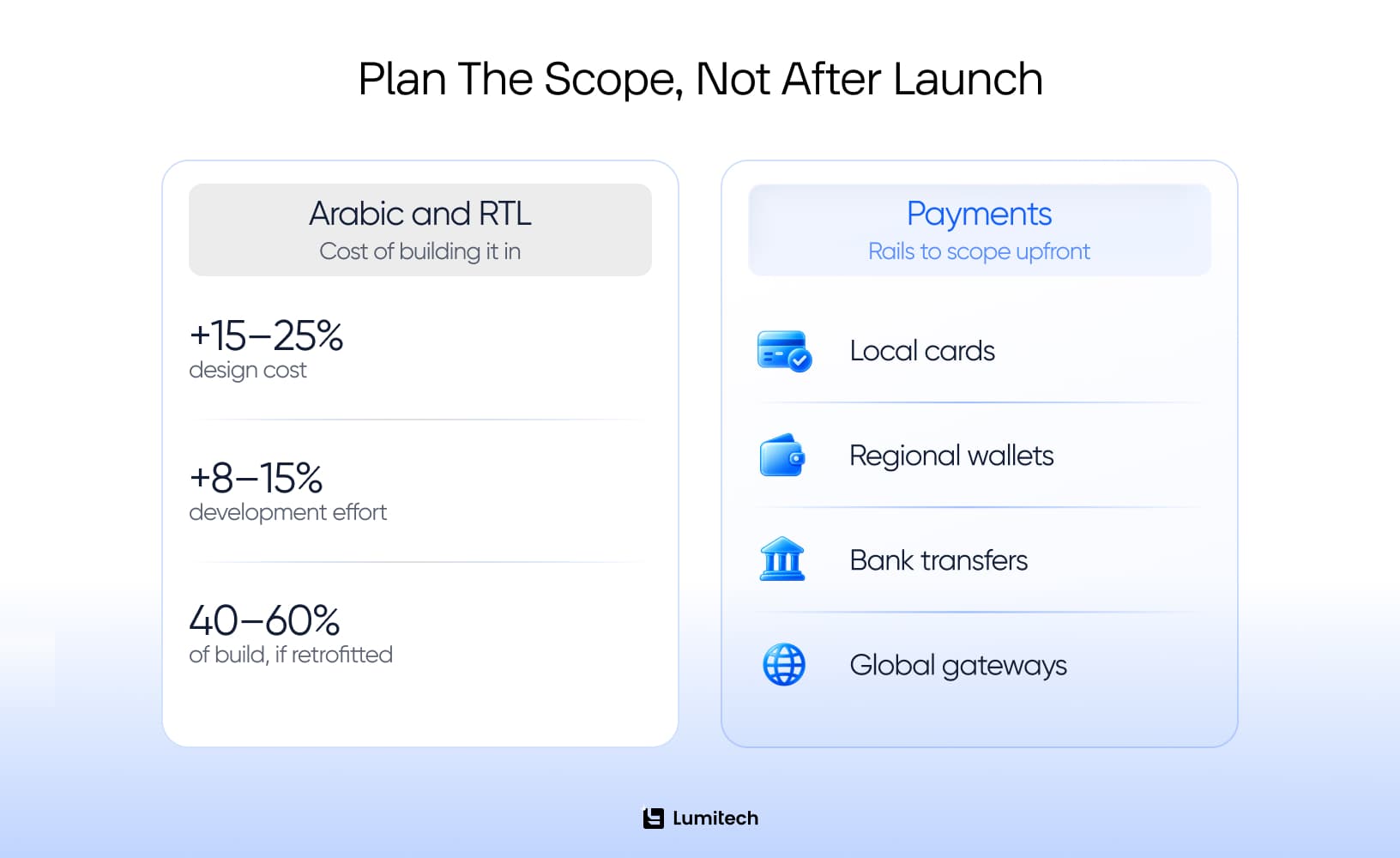
Language and payments need architectural planning. Arabic localization goes well beyond translation. The initial scope should account for RTL layouts, mirrored navigation, adapted form inputs, and a dedicated Arabic QA pass alongside English support. 2026 estimates suggest that RTL support can add 15–25% to design costs and 8–15% to development effort, while retrofitting Arabic later may cost 40–60% of the original build. Payments require the same upfront planning, with local cards, regional wallets, bank transfers, and global gateways potentially all part of the integration scope.
Compliance timing has changed. Under Federal Decree-Law No. 45 of 2021, the UAE PDPL is already in force, but its Executive Regulations had not yet been published as of 2026. Article 29 allows six months for organizations to bring their operations into compliance once the Regulations are issued, with a possible extension. Products that will remain in operation through 2027 should therefore make hosting and subprocessor choices that can accommodate the final data-transfer and compliance requirements as they come into force.
The most common mistake in this market is choosing a vendor that does not match the product’s needs. Even a technically strong app can underperform when pricing, language support, or core user flows fail to reflect local behavior.
Top Mobile App Development Companies in Dubai in 2026
Tier 1 — Large Delivery Organizations (250–999 people)
These providers offer mature delivery processes, procurement readiness, and multi-team capacity, but that scale comes with added overhead. They are generally a better fit for larger or more complex engagements than tightly scoped MVPs.

1. Brainvire Infotech
Company type: Development company focused on commerce, with a large mobile practice.
Core focus: E-commerce development, mobile app development, web development, search.
Why it’s included: A strong body of verified Dubai reviews, particularly for commerce and retail products where mobile apps and storefronts are delivered as one experience.
Evidence: 4.8 rating across 262 verified reviews — the highest review count on this list; 250–999 employees; $25,000+ minimum project; $25–49/hr band.
Best fit: Retail, marketplace, and D2C businesses building a mobile app alongside a commerce platform.
Availability as a vendor: Actively takes mid-market and enterprise commerce work.
Things to consider: Commerce is roughly half the service mix. For a fintech, healthcare, or industrial product, ask for cases from that specific vertical.

2. Konstant Infosolutions
Company type: Development provider specializing in mobile products.
Core focus: Mobile app development, AI development, UX/UI, web development.
Why it’s included: Around 60% of its published services are mobile-focused, placing it among the larger providers with the strongest mobile concentration and an established verified review record.
Evidence: 4.9 rating across 173 verified reviews; 250–999 employees; $5,000+ minimum project; $25–49/hr band. Verified client reviews include healthcare, insurance, and real-estate products.
Best fit: Companies that need mobile as the primary deliverable, backed by a larger delivery team and a relatively low entry point.
Availability as a vendor: Supports small and mid-market engagements, with a $5,000 minimum making it accessible for early-stage products.
Things to consider: A low minimum and a large bench point to a delivery-volume model. Ask which senior engineers stay on the account after kickoff.

3. TekRevol
Company type: Mobile development and staff-augmentation provider.
Core focus: Mobile app development, IT staff augmentation, AR/VR, custom software, web development, AI.
Why it’s included: It combines project delivery with staff augmentation, which fits companies that plan to bring the product in-house later.
Evidence: 4.8 rating across 83 verified reviews; 250–999 employees; $25,000+ minimum project; $25–49/hr band. Reviews credit collaborative delivery and adaptability to scope change.
Best fit: Product teams that need capacity now and a documented handover path afterward.
Availability as a vendor: Available for hire on both project and augmentation models.
Things to consider: Augmentation shifts product ownership to you. Confirm who writes the architecture decisions and who maintains them after the contract ends.
Tier 2 — Mid-Size Product and Mobile Specialists (50–249 people)
This band holds most of the practical answers for a funded product build: enough seniority for real architecture decisions, small enough to keep the same people on the account.

4. Apptunix
Company type: Custom mobile and AI development company.
Core focus: Mobile app development, AI development, custom software, digital strategy, staff augmentation, web development.
Why it’s included: The largest verified review base in the mid-size band, with consistent marketplace, on-demand, and subscription product patterns.
Evidence: 4.5 rating across 94 verified reviews; 50–249 employees; $10,000+ minimum project; $25–49/hr band. Reviews cite deep industry-specific understanding, with a minority flagging communication during complex phases.
Best fit: Marketplace, on-demand, and subscription products that pair a consumer app with an operations console.
Availability as a vendor: Actively takes startup and mid-market work.
Things to consider: The rating sits below others in this band, and schedule slips appear in a minority of reviews. Tighten milestones, acceptance criteria, and demo cadence in the contract.

5. Techgropse
Company type: Cross-platform mobile specialist.
Core focus: Mobile app development, AI development, e-commerce development, custom software.
Why it’s included: Mobile is roughly 55% of the published service mix, and the company publishes its own Dubai cost research, which makes its commercial assumptions easier to interrogate before a call.
Evidence: 4.8 rating across 93 verified reviews; 50–249 employees; $25,000+ minimum project; $25–49/hr band. Reviews consistently note project management and delivery timing.
Best fit: Startups and SMEs shipping iOS and Android from one codebase, with speed-to-market as the constraint.
Availability as a vendor: Actively takes on new startup and SME clients.
Things to consider: Speed-oriented delivery suits validation work. For a regulated product, ask specifically about security testing and compliance review within the timeline.

6. Lumitech
Company type: Product engineering partner with dedicated-team and staff-augmentation models.
Core focus: Custom software and mobile app development services, React Native delivery, backend and integrations, AI/ML, data-intensive platforms.
Why it’s included: Works with companies in complex, regulated environments such as fintech, industrial, and logistics, where the mobile app is part of workflows, integrations, and data.
Evidence: 5.0 rating across 53 verified reviews; 50–249 employees; $10,000+ minimum project; $25–49/hr band. Included in the Clutch 1000 list of top-rated B2B service providers for 2025. The company reports 850% growth since 2022.
Best fit: Companies whose mobile app sits on top of real operations — fintech products in the UAE, logistics and transportation apps, and industrial workflows where architecture, integrations, and post-launch behavior carry the risk.
Availability as a vendor: Available for hire through dedicated teams, staff augmentation, and full-cycle product development, serving startups through enterprise clients.
Things to consider: Mobile represents around 15% of the published service mix, with custom software and web development making up the larger share. A standalone brochure app is a poor fit for this model, and a design-led studio will move faster.
Weighing a mobile build against a broader platform program?
Start with product discovery — scope, risks, and architecture before commitments.


7. Synergy Labs
Company type: Mobile product studio.
Core focus: Mobile app development, AI development, custom software, generative AI, web development.
Why it’s included: Mobile accounts for roughly 60% of the published service mix at a higher hourly band, which typically indicates senior-weighted teams on mobile work specifically.
Evidence: 4.9 rating across 45 verified reviews; 50–249 employees; $25,000+ minimum project; $50–99/hr band. A minority of reviews raise concerns about contract adherence.
Best fit: Consumer and product-led apps where iOS and Android quality is the primary deliverable.
Availability as a vendor: Actively takes new product work.
Things to consider: Contract adherence appears in a small share of reviews. Fix change-request handling and write acceptance criteria before kickoff.

8. Blink22
Company type: Mobile and AI engineering studio.
Core focus: AI development, mobile app development, UX/UI design, web development.
Why it’s included: One of the highest-rated providers in the category, with an unusually even split between mobile engineering and AI development.
Evidence: 4.9 rating across 38 verified reviews; 50–249 employees; $25,000+ minimum project; $50–99/hr band. Reviews describe the team operating as an extension of the client’s own.
Best fit: Products that need AI features built into the app rather than bolted on afterward.
Availability as a vendor: Available for hire on product and embedded-team models.
Things to consider: A smaller review base than the volume providers in Tier 1. Ask for AI cases in production, with the measurement approach attached.
Tier 3 — Boutique Studios (10–49 people)
Small studios give direct access to the people doing the work. Bench depth is the trade-off: holidays, illness, and parallel projects show up faster.

9. Emirates Graphic
Company type: Design-led mobile agency.
Core focus: Mobile app development, web development, web design, search.
Why it’s included: Mobile is roughly 60% of the published service mix at the lowest entry point on this list, which suits brand-led apps with a defined scope.
Evidence: 4.9 rating across 32 verified reviews; 10–49 employees; $5,000+ minimum project; $25–49/hr band. Reviews emphasize deadlines and responsiveness.
Best fit: High-design branded apps, loyalty products, and campaign-driven builds where visual quality leads.
Availability as a vendor: Openly takes small and mid-size clients.
Things to consider: Backend and integration depth is thinner than in the engineering-led providers. For payment, identity, or core-system integration, ask who does that work and where.

10. Ewaantech
Company type: Boutique mobile and commerce studio.
Core focus: Mobile app development, custom software, e-commerce development, AI development.
Why it’s included: Documented delivery for a named Dubai client operation, which is stronger local proof than most studios of this size publish.
Evidence: 5.0 rating across 7 verified reviews; 10–49 employees; $1,000+ minimum project; $25–49/hr band. Reviews cover Dubai Autodrome digital platforms, loyalty programs, and education products, and note complex integration handling.
Best fit: Small and mid-size UAE businesses that want a hands-on team and a low-commitment start.
Availability as a vendor: Actively takes small clients, with the lowest published minimum on this list.
Things to consider: Seven reviews is not enough. Request references from organizations of your size and sector, and confirm bench depth for a multi-month build.
Mobile App Development Companies in Dubai Compared
Company | Provider type | Best fit | Mobile stack | Delivery scope | Commercial signal | Public proof |
|---|---|---|---|---|---|---|
Brainvire Infotech | Commerce-led delivery | Retail and marketplace apps with commerce platforms | iOS, Android; framework mix not independently verified | Full-cycle plus commerce platform work | $25,000+ min; $25–49/hr | 4.8 / 262 reviews |
Konstant Infosolutions | Mobile-first | Mobile as the primary deliverable | iOS, Android; ~60% mobile service mix | Discovery, UX, mobile, web, AI | $5,000+ min; $25–49/hr | 4.9 / 173 reviews |
TekRevol | Mobile plus augmentation | Capacity now, in-house handover later | iOS, Android; AR/VR capability published | Mobile, augmentation, web, AI | $25,000+ min; $25–49/hr | 4.8 / 83 reviews |
Apptunix | Custom mobile and AI | Marketplace, on-demand, subscription products | iOS, Android; framework mix not independently verified | Discovery, mobile, AI, backend, augmentation | $10,000+ min; $25–49/hr | 4.5 / 94 reviews |
Techgropse | Cross-platform specialist | iOS and Android from one codebase, fast | Cross-platform positioning published; native mix unverified | Concept-to-launch, commerce, AI app development company in Dubai | $25,000+ min; $25–49/hr | 4.8 / 93 reviews |
Lumitech | Product engineering partner | Regulated and operations-heavy products where mobile is one layer | React Native (published template); native via dedicated teams | Discovery, UX, mobile, backend, QA, post-launch | $10,000+ min; $25–49/hr | 5.0 / 53 reviews; Clutch 1000 2025; published mobile cases |
Synergy Labs | Mobile product studio | Consumer and product-led apps | iOS, Android; ~60% mobile service mix | Discovery, mobile, AI, web | $25,000+ min; $50–99/hr | 4.9 / 45 reviews |
Blink22 | Mobile and AI studio | AI features built into the product | iOS, Android; framework mix not independently verified | Mobile, AI, UX, web | $25,000+ min; $50–99/hr | 4.9 / 38 reviews |
Emirates Graphic | Design-led agency | Brand-led apps with defined scope | iOS, Android; ~60% mobile service mix | Design, mobile, web, search | $5,000+ min; $25–49/hr | 4.9 / 32 reviews |
Ewaantech | Boutique studio | Small UAE businesses, low starting commitment | iOS, Android; framework mix not independently verified | Mobile, commerce, custom software, AI | $1,000+ min; $25–49/hr | 5.0 / 7 reviews |
All ratings, review counts, team-size bands, hourly bands, and minimum project sizes come from the Clutch UAE mobile app development category, checked 25 August 2026. Hourly bands are the provider’s published band rather than a quoted rate.
How Much Does Mobile App Development Cost in Dubai?
No reliable single Dubai average exists. Published 2026 guides disagree by roughly a factor of ten for work described in similar language, because an MVP, a marketplace, and a regulated fintech app are different products carrying the same label.
Published 2026 Market References
Source | Source date | Scope described | Published range |
|---|---|---|---|
Updated 2 June 2026 | Basic / mid-level / enterprise app | AED 30,000–80,000 / AED 80,000–200,000 / AED 200,000–400,000+ | |
Updated 11 August 2026 | Global app development, based on a survey of 267 development companies | USD 15,000–500,000+, with hidden costs adding 25–35% | |
Published December 2025, quoting 2026 pricing | Simple to feature-rich apps | Two ranges appear on the same page: USD 25,000 to over USD 300,000, and simple apps from USD 40,000 with feature-rich builds above USD 400,000. Annual maintenance at 15–20% | |
Published 11 May 2026 | First production build for local businesses | From AED 10,000 for a focused MVP; AED 25,000–90,000 typical; AED 500,000+ for feature-rich consumer apps, plus 15–25% annually | |
Published 23 April 2026 | Simple / mid-level / enterprise app | AED 55,000–73,000 / AED 73,000–128,000 / AED 128,000–183,000+ |
Read these as a dispersion. Two guides covering the same market in the same year place an “enterprise” app at AED 183,000 and above AED 400,000, which shows the category labels doing the work rather than the numbers. The Netguru page carries two different ranges within a single article, which is worth noting before any one figure gets treated as a benchmark. Ask a provider for the source, date, and inclusions behind a quoted range before setting it against another quote.
Two figures recur across independent sources and are the safest planning assumptions on this page: hidden and post-launch costs add 25–35% to the build, and annual maintenance runs 15–25% of the original development cost (GoodFirms, August 2026).
What Actually Moves the Number
Cost driver | What it changes |
|---|---|
Product scope | MVP, single workflow, marketplace, enterprise mobile layer, or regulated product |
Platforms | Native iOS, native Android, two native codebases, or React Native and Flutter |
Backend | Auth, roles, real-time features, admin tooling, integrations, API and data architecture |
UX and localization | Arabic and English, RTL layout, accessibility, design system, research |
Payments and identity | Payment gateways, wallets, UAE Pass or other identity integrations where applicable |
Compliance and security | Privacy work, security testing, sector controls, audit and review cycles |
Data and integrations | ERP, CRM, core systems, KYC providers, logistics, maps, messaging, analytics |
Release and support | Store submission, monitoring, maintenance, OS and device updates, SLA |
Backend architecture consistently absorbs more budget than design work, which runs against most buyer expectations. When comparing quotes, interrogate the backend and integration plan first, because two estimates for the same feature list can differ entirely based on architecture assumptions.
Vendor-Level Commercial Signals
The most reliable public benchmarks for app development costs in Dubai are vendor-level rather than market-wide. Across Clutch’s Dubai mobile app category, published hourly rates cluster around $25–49/hr and $50–99/hr, while minimum project sizes range from $1,000 to $50,000+. A provider’s minimum project size tells you more accurately which buyer they are built for than any market average. For a worked example of how scope drives a regulated build, see the breakdown of the cost to build a banking app in the UAE.
An MVP or proof of concept development is the cheapest way to convert a disputed estimate into a real number.
iOS, Android, or Cross-Platform: Which Approach Fits Your Product?
Approach | When it fits | Trade-off to plan for |
|---|---|---|
Native iOS | Apple-specific UX, performance, or platform features; iOS-first products | A separate Swift codebase and platform-specific QA |
Native Android | Android-specific integrations or device requirements | A separate Kotlin codebase and broader device QA complexity |
React Native or Flutter | iOS and Android sharing most features, with shared product velocity | Shared code reduces duplication, and native modules plus performance edge cases still need specialist attention |
The decision depends on performance needs, native integrations, team skills, roadmap, and the maintenance model. A blanket rule that one approach is always cheaper does not survive contact with a real feature list. An iOS app development company in Dubai and an Android app development company in Dubai will each argue for their platform, and the useful question is which device your paying users actually hold.
Teams choosing cross-platform can shorten setup considerably with a documented foundation — the React Native template covers navigation, state, and build configuration before feature work starts.
Compliance and Data Transfers: What Actually Applies
Data localization in the UAE is contextual. The federal Personal Data Protection Law (PDPL) allows cross-border data processing provided adequate safeguards or contractual terms are in place. However, localized storage remains mandatory for specific verticals — such as health data under Federal Law No. 2 of 2019, financial records under Central Bank rules, or sovereign public-sector data.
Framework | What it governs |
|---|---|
UAE Federal PDPL (Federal Decree-Law No. 45 of 2021) | Articles 22–23 of the UAE PDPL restrict offshore data transfers unless adequate protections, standard contractual clauses, explicit consent, or contractual necessity are established. With the 1 January 2027 compliance deadline approaching and procedural regulations still awaiting publication, failing to architect compliant data pipelines early introduces substantial regulatory risk. |
DIFC data transfers are under tighter scrutiny. Amendment Law No. 1 requires mandatory documented adequacy assessments for offshore data and opens the door to direct litigation in DIFC Courts. Compliance isn't optional—it's risk management. | |
ADGM Data Protection Regulations 2021 apply to ADGM-registered entities and use adequacy decisions, standard contractual clauses, and binding corporate rules for transfers outside the ADGM. | |
Sectoral carve-outs | Navigating UAE regulation means building for the right jurisdiction. Healthcare platforms must comply with Federal Law No. 2 of 2019, banking and credit products fall under Central Bank mandates, and government data is subject to specialized federal and emirate laws. Always audit regulated financial solutions directly against current CBUAE, DFSA, or FSRA licensing requirements before deployment. |
Is There a Best Mobile App Development Company in Dubai?
No. A provider that is excellent for a government-backed program is often unavailable to No — there is no single best mobile app development company in Dubai, only the best fit for your app category, compliance exposure, and post-launch support horizon. A studio that ships consumer MVPs in 8–12 weeks is rarely equipped for a fintech app that must satisfy UAE PDPL requirements and pass a bank’s security review. The most common mistake is selecting a vendor based on portfolio visuals rather than asking who owns the codebase in month 13. At Lumitech, we assign a dedicated engineering team that stays through post-release maintenance, so product knowledge doesn’t leave with the launch.
How to Choose a Mobile App Development Company in Dubai
Match the partner to the stage. A validation project needs speed; an MVP needs solid foundations; a scaling product needs architecture, observability, and disciplined releases.
Match the provider to the scope. A large organization may be too heavy for a small MVP, while a small studio may be stretched by a national-scale program. Team size determines capacity, not quality.
Read cases as proof. Find out what the team actually built, what its role was, and whether similar products are still running in production.
Challenge the technical thinking. Ask how the team handles scaling, payment routing, offline behavior, integrations, and modernization. The quality of the trade-offs matters more than confident promises.
Price the product beyond launch. Maintenance, infrastructure, OS changes, store policies, and ongoing support can materially change the economics after launch.
Make accountability explicit. Confirm who owns architecture and product decisions, how risks are escalated, and what happens when milestones slip.
Dubai Agency, Offshore Team, or Hybrid?
Model | Where it works | What to watch |
|---|---|---|
Dubai-based agency | Stakeholder alignment, local discovery, Arabic UX research, regulator-facing work | Higher blended rates; verify the delivery team is local rather than the sales team |
Offshore delivery | Engineering cost efficiency at senior levels | Time-zone overlap, product ownership, and documentation discipline |
Hybrid — local product ownership plus offshore engineering | Local context with offshore capacity; published 2026 estimates put savings at 30–60% on development labor | Requires one accountable product owner; without that role, the model produces rework |
The delivery model should reflect who owns product decisions and how much local context the product requires. A dedicated-team approach lets companies hire mobile app developers in Dubai while keeping product governance in-house and scaling engineering capacity around a longer-term roadmap. The evaluation should cover governance, seniority, communication, IP ownership, and accountability, with hourly rate treated as only one part of the decision.
For GCC-wide rollouts, comparing mobile app development companies in Saudi Arabia is a useful cross-check, and regulated products benefit from a parallel review of fintech software development companies.
Questions to Ask Before You Sign
When the contract ends, who holds the source code, cloud accounts, signing certificates, Apple and Google developer accounts, and design files?
Which of your apps are live in the stores today, and which parts of them did this team build?
Who owns architecture decisions, and which senior engineer stays on the account after kickoff?
What does the estimate cover in full, and what triggers a change request?
How do analytics, crash monitoring, observability, backups, and incident response get set up, and who watches them once the app is live?
How do you test Arabic and RTL layout, along with accessibility and the rest of the localization work?
Which third parties and processors touch user data, and in which jurisdictions do they sit?
What does the first year after launch look like: SLA, maintenance, OS upgrades, store policy changes, and knowledge transfer?
Where Lumitech Fits on a Mobile Product
Seven paragraphs of positioning help nobody at this point in the page. The useful question is narrower: does this brief match this team? The table below answers it directly, and the last block answers the opposite case.
Fit by Situation
Your situation | What the engagement covers | Model |
|---|---|---|
Funded startup with strong product leadership and thin engineering capacity | Execution engine for the build, from discovery through release, including startup software development services | Full-cycle product development |
Enterprise with internal teams that need specialist depth | Specialist skills, modernization support, and enterprise software development services alongside your engineers | Staff augmentation |
Mobile app that has to sit over legacy systems, integrations, and real operations | Architecture, backend, integration work, and the mobile layer as one scope | Dedicated team |
Regulated or high-stakes product where failure is expensive | Security and compliance decisions taken at architecture stage, with audit-ready documentation | Dedicated team or full-cycle |
Four Things That Shape the Work
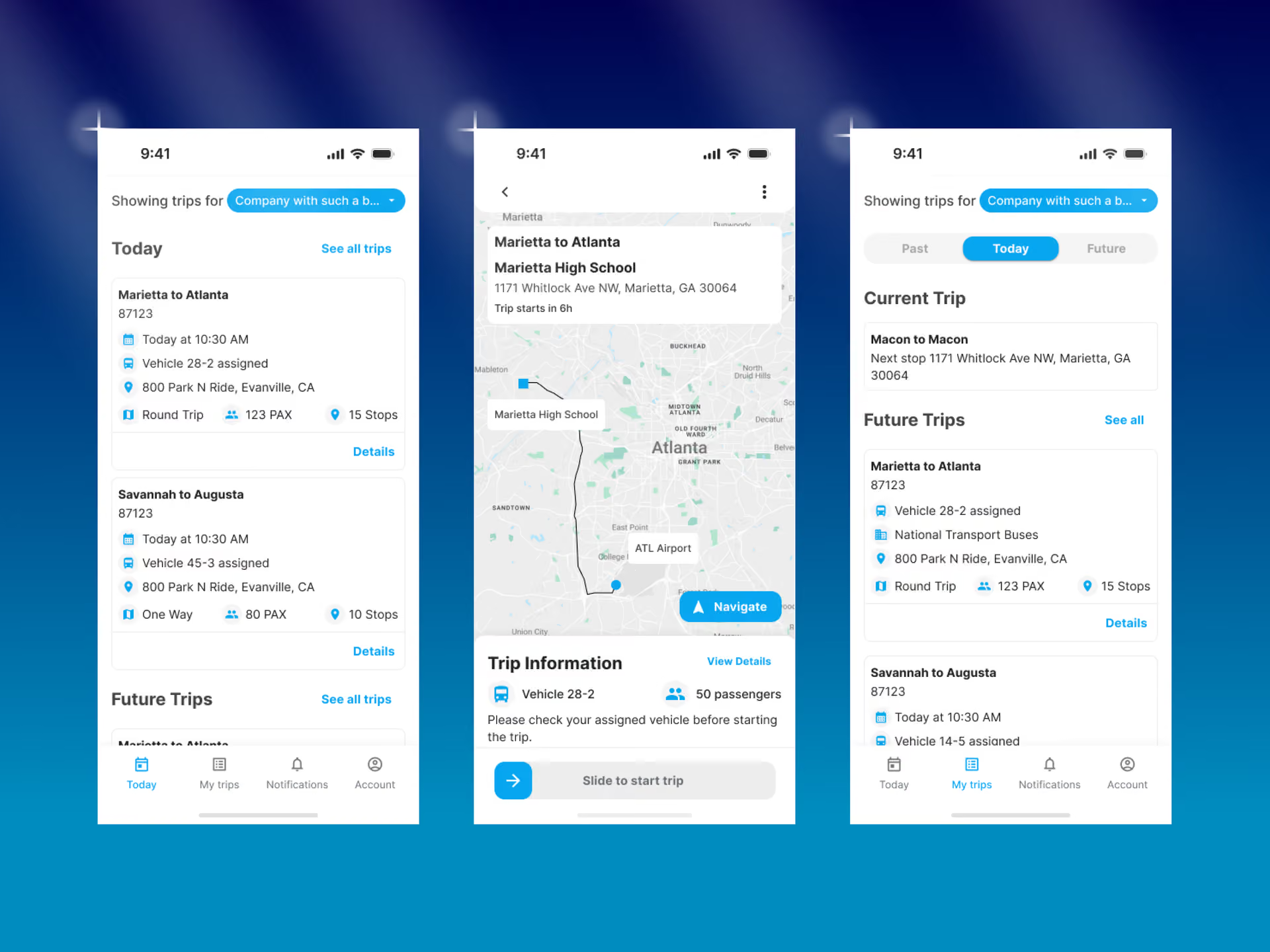
1. The app is one surface on a system. A mobile product usually sits alongside internal tools, customer portals, data pipelines, and automation. The bus booking and shuttle management platform shows the shape: a rider-facing app on one side, dispatch and tracking logic on the other, with the value concentrated in how data and processes connect. Fragmented processes underneath mean a new interface ends up solving problems deeper in the operating model.
2. Discovery comes before architecture. A common failure pattern in this market is development starting after a short call and a high-level brief. Product discovery establishes the business pain, the root causes, and the success metrics first. The early weeks move slower, and the total timeline usually comes out shorter.
3. Scope follows outcomes. Success gets measured in manual work removed, performance gained, and bottlenecks cleared. Roadmap priorities go to features that move revenue, cost, or customer satisfaction. Everything past that line adds complexity, bugs, and time to market.
4. Architecture is built for the scale that arrives later. Scale in this market often lands suddenly, through an enterprise or public-sector partnership. Robust architecture, observable systems, and long-term maintainability keep that moment from turning into instability, no matter which team holds the codebase by then.
Talk to Lumitech about your product, budget, and roadmap, and see whether it’s the right fit for your next build.

Summing Up
Mobile app development in Dubai rewards clarity more than budget. The same conditions that make the market attractive — strong digital adoption, high expectations, ambitious stakeholders — punish weak apps and misaligned scope quickly.
Choose your partner based on true alignment. Buyers comparing mobile app development services in Dubai get further with a scoped discovery than with a fourth vendor call.
The ten companies above span very different delivery models, from several-hundred-person organizations to twenty-person studios. A provider suited to regulated fintech products in the UAE is not necessarily the right choice for a branded loyalty app. Capabilities change, so verify the shortlist before signing and use any published cost figure to frame the conversation, not end it.


