
AI Governance in MENA: What Regulated Industries Should Know Before Launching AI Products
AI governance is the system of decision rights, controls, and records used to operate, monitor, and retire AI. In regulated industries, it links product ownership to legal duties, model risk, data protection, human oversight, and reviewable evidence.
- AI Development
August 27, 2026
 AI Overview
For regulated companies, artificial intelligence (AI) governance in the Middle East and North Africa (MENA) begins with the jurisdiction and use case. In practice, AI governance in MENA ties legal duties, sector guidance, model testing, and human oversight to named owners and records. Controls without a local source or evidence owner are harder to approve and defend after launch.


Launching AI for a regulated organization in MENA tests a development partner’s ability well beyond building a model. The United Arab Emirates (UAE), Saudi Arabia, and Qatar are separate jurisdictions, each with its own data rules, sector regulators, and approval expectations. An AI regulation Middle East review should therefore begin by identifying the jurisdiction, regulator, and sector involved. Organizations procuring government software development services need a team that can account for those differences before the product architecture is fixed.
The differences affect the product itself. They determine where data can be processed, who may access or change the model and its machine learning (ML) pipeline, when human review is required, and what evidence an approval committee must receive. A provider of AI and ML development services that identifies these conditions late may have to revise the architecture, controls, or vendor contracts.
Keeping one coherent product while applying different controls in each jurisdiction is a test of delivery maturity. This article covers the UAE, Saudi Arabia, and Qatar, as well as European Union (EU) rules that may affect MENA deployments. Other MENA markets require their own review. It explains which rules govern AI launches in the three markets, how an AI governance framework carries those rules into engineering, and which records buyers should require before approving a release.
AI Regulation Middle East: What Product Teams Must Map Before Design Freeze
In the UAE, Saudi Arabia, and Qatar, AI launch decisions draw on binding laws, sector rules, regulatory guidance, national ethics and risk documents, and internal controls. Those layers shape data use, accountability, human oversight, and evidence. The table shows how they combine in each jurisdiction and what should be resolved before the architecture and delivery plan are fixed.
Jurisdiction or market | Current instruments relevant to AI | Legal character | Immediate launch implication |
|---|---|---|---|
UAE federal market | Federal Decree-Law No. 45 of 2021, including Article 18 on decisions based solely on automated processing; the July 2024 UAE AI Charter; sector rules and guidance. | The data law is binding. The Charter states national principles; sector instruments vary. | Map processing roles, legal bases, transfers, security, notices, and sector duties. |
UAE financial services supervised by the Central Bank of the UAE (CBUAE) | 2021 Enabling Technologies Guidelines; February 2026 AI/ML consumer-protection guidance; Model Management Standards for banks | Supervisory guidance and standards for licensed financial institutions | Add board accountability, model inventory and validation, fairness, explainability, human review, and vendor controls. |
Dubai International Financial Centre (DIFC) | Regulation 10 of the DIFC Data Protection Regulations, in force since September 1, 2023 and under full enforcement from January 1, 2026. | Binding within the DIFC where autonomous or semi-autonomous systems process personal data | Determine deployer and operator roles, issue required notices, assess bias and high-risk processing, and meet oversight or certification conditions. |
Abu Dhabi Global Market (ADGM) | ADGM Data Protection Regulations 2021 and guidance on automated decision-making and profiling | Binding data-protection regime for processing within its scope; ADGM guidance explains its application | Check automated-decision rights, profiling, privacy by design, data protection impact assessments, controller and processor duties, and annual data-controller registration where applicable. |
Saudi Arabia | Personal Data Protection Law (PDPL) and Implementing Regulations; AI Ethics Principles; AI Adoption Framework; national AI risk framework; draft Responsible AI Policy | The PDPL and its regulations are binding. The AI documents guide unless separately mandated. | Record data sources, legal bases, risks, treatments, monitoring, and accountable owners. |
Qatar | Qatar Central Bank (QCB) Artificial Intelligence Guideline, effective September 4, 2024. Qatar’s Personal Data Privacy Protection Law applies more broadly outside the financial sector. | Supervisory requirements for QCB-licensed entities | Maintain an AI strategy and register, conduct risk assessments, retain human oversight, and obtain QCB approval where required. |
EU-linked activity | European Union Artificial Intelligence Act, including the 2026 Digital Omnibus amendments | Binding EU regulation with defined reach to some third-country providers and deployers | Check whether the product or model is placed on the EU market, or whether an AI system’s output is used in the EU. Apply transparency and phased high-risk obligations where in scope |
Review date for all regulatory statements: August 7, 2026
A group-wide policy standardizes approvals, documentation, vendor oversight, and monitoring. Each subsidiary adds an overlay for its entity, regulator, data flows, decision type, and deployment location. This keeps AI governance Middle East programs consistent across country, free-zone, and sector rules.
The AI regulation Middle East map should separate shared and local controls, name each decision owner, and show whether an AI governance Middle East program has the required release evidence.
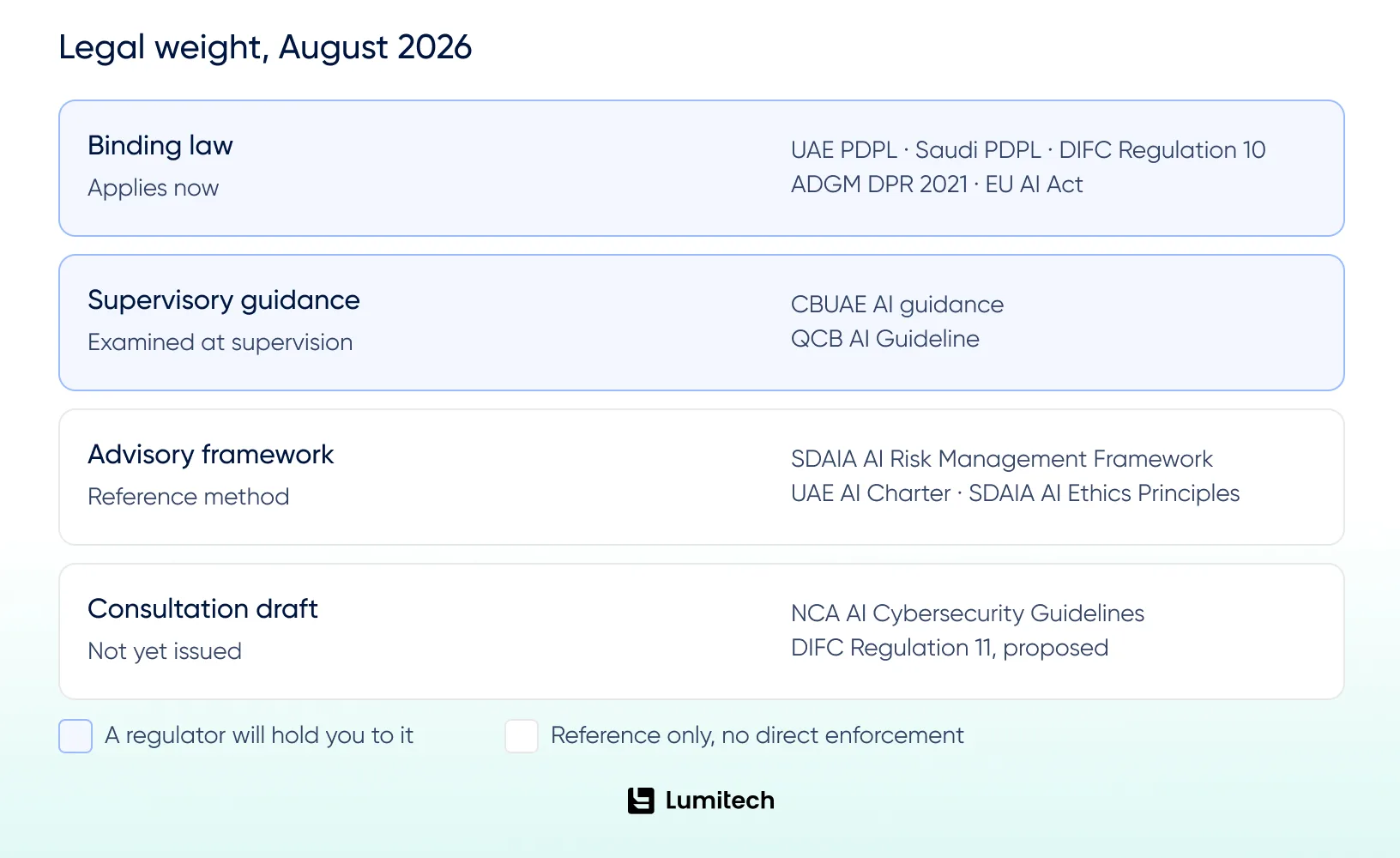
What Makes AI Governance Middle East Programs Ready for Approval
Approval depends on the evidence produced by each control. The committee needs to see how the system was tested, which thresholds were accepted, and who owns the remaining risk.
Fairness requires a test, an acceptance threshold, and results for relevant groups and languages. Vendor security requires audit rights, model-change notices, and exit terms. Human review requires a named reviewer with the authority to assess, pause, or reverse an output.
Buyers should ask a prospective partner to show the artifact produced by each control. These records make responsible AI governance verifiable and tie each decision to the correct jurisdiction, regulator, and legal status.
Planning a regulated AI product?
Choose a partner that understands the relevant jurisdiction and can translate its requirements into architecture, testing, contracts, and release evidence. Lumitech can establish these controls before model selection and procurement.

A Regional Release System for AI Governance MENA Programs
Six release gates organize the evidence expected at approval. For organizations running AI governance MENA programs across several markets, the model provides product, legal, privacy, security, and risk teams with a single record that accommodates country, free-zone, and sector requirements.
Gate | Decision | Minimum evidence | Accountable owner |
|---|---|---|---|
1. Scope | Is this an AI system, which entity provides or deploys it, and where will the outputs be used? | Use-case record, entity map, system boundary, intended users, affected people | Product owner with legal and compliance |
2. Data | May each dataset be collected, transferred, retained, and used for this purpose? | Data map, legal basis, source record, transfer analysis, retention rule, processor list | Data owner and privacy lead |
3. Impact | What harm can the system cause, to whom, and how can a decision be challenged? | AI risk assessment, affected-group analysis, risk rating, mitigation plan | Risk owner |
4. Validation | Does the system meet defined performance, fairness, security, and explainability thresholds? | Test protocol, results by relevant subgroup and language, red-team record, limitations | Independent validator or control function |
5. Approval | Have legal, risk, security, privacy, and business owners accepted the residual risk? | Signed decision, conditions, regulator approval where required, release checklist | Named approval body |
6. Operation | Can the organization detect drift, incidents, harmful outputs, and material vendor changes? | Monitoring thresholds, logs, incident route, complaint and appeal process, rollback plan | Service and model owners |
The gates create one record of approval evidence and conditions. AI governance MENA programs can use it as an AI compliance framework while preserving local approvals. AI risk management then checks whether the controls continue to work after launch.
AI Governance Framework: What a Release Committee Needs to Decide
A release committee needs one current record covering purpose and prohibited uses, model and provider version, hosting and data, affected groups, decision effects, human checkpoints, monitoring, retirement, and updates.
The AI governance framework should reopen review after material changes to the model, data, country, users, autonomy, decision consequences, or vendor. Annual review provides a baseline; event-triggered review keeps approval aligned with the deployed system.
In the UAE, the legal entity, sector, data, and deployment location determine which federal, sector, and free-zone rules apply.
UAE: Which Rules Apply to the Project?
Two UAE companies can deploy the same model and face different controls because scope depends on the legal entity, sector, data, and deployment location. As of August 7, 2026, the UAE had not enacted a horizontal federal AI statute, including any law titled UAE AI Act 2026.
For many private-sector projects, the federal UAE Personal Data Protection Law (UAE PDPL) provides the baseline. It excludes government data and authorities, certain health and banking data, and free-zone companies covered by separate privacy laws. Where applicable, Article 18 protects individuals from decisions made solely based on automated processing. Teams should confirm whether the law applies and record the legal basis, including any exception to consent.
As of August 7, 2026, the law’s executive regulations had not been published separately. In June, the UAE approved the Artificial Intelligence and Data Authority to oversee AI, public data, and digital government.
The 2024 UAE AI Charter supports responsible AI UAE practices but remains policy guidance. An AI regulation UAE analysis should distinguish such guidance from binding requirements.
What AI Governance UAE Means for Financial Institutions
The CBUAE gives banks and insurers a clearer set of expectations. Its February 2026 CBUAE AI guidance calls for board accountability, an AI inventory, risk ratings, model monitoring, explainability, and human review.
At release, the institution should be able to produce a model record, validation results, a customer notice, a complaints route, and a vendor file. For third-party models or cloud services, the file should add the selection rationale, pre-deployment checks, contract audit rights, and a periodic independent assessment of AI development and use, including third-party providers.
These records give AI governance UAE its operational meaning and serve as working evidence for AI compliance UAE. Existing data governance in banking practices covers ownership, lineage, quality, and access; AI review adds output behavior, explainability, and model-change risk.
DIFC and ADGM: Two Free-Zone Data Regimes
The Dubai International Financial Centre (DIFC) and Abu Dhabi Global Market (ADGM) operate separate data protection regimes. DIFC Regulation 10 applies when autonomous or semi-autonomous systems process personal data. In force since September 2023 and fully enforced since January 1, 2026, it requires notices and records covering the system’s purpose, outputs, safeguards, human intervention, and risks. High-risk processing may trigger audit, certification, or Autonomous Systems Officer conditions.
Consultation Paper No. 3 of 2026 proposed additional AI safety and certification measures. The proposals remained pending on August 7, 2026. Separate amendments, effective as of July 2025, introduced a private right of action and required documented transfer-adequacy assessments.
ADGM instead applies its Data Protection Regulations 2021 andautomated Decision guidance. These connect AI use to data protection principles, individual rights, impact assessments, and the duties of controllers or processors. ADGM has not adopted the DIFC rule.
Groups operating in both free zones need two legal mappings for the same model. Teams comparing top tech companies in the UAE should verify the legal entity. Teams evaluating software development in Dubai should also confirm the processing location.
Saudi Arabia: A National Privacy Base and Local AI Risk Method
Saudi Arabia combines the Saudi PDPL with frameworks from the Saudi Data and Artificial Intelligence Authority (SDAIA) for AI ethics, adoption, and risk management.
The Personal Data Protection Law covers processing in the Kingdom and overseas processing involving residents. Controllers must define data uses and transfers, assess risks, and select and monitor processors. An obligations register should connect the Saudi Personal Data Protection Law to data maps, retention, rights, and vendor controls.
SDAIA’s AI Ethics Principles cover fairness, privacy, safety, explainability, and accountability. The AI Adoption Framework guides implementation planning. Both provide guidance; the PDPL and sector rules establish binding duties. The draft Responsible AI Policy should be tracked separately.
AI Governance Saudi Arabia: A National Risk Method
SDAIA published a national method for identifying, assessing, treating, and monitoring AI risk in April 2026. Its July 14 announcement covers public and private entities and presents the SDAIA AI Risk Management Framework as an advisory reference. Teams can use it as an AI Risk Management Framework that connects model behavior, personal data, cybersecurity, operational resilience, and third-party dependence. Binding duties still come from the PDPL, sector rules, contracts, and regulator directions.
The National Cybersecurity Authority opened consultation in July 2026 on draft AI Cybersecurity Guidelines. The consultation covered governance, defense, resilience, and third-party cybersecurity and closed on August 5, 2026. Teams should track the final document separately from current requirements.
For AI governance Saudi Arabia programs, one risk register can bring these issues together. Teams evaluating software development services in Saudi Arabia should ask how a vendor will test Arabic-language performance, govern local data, support government integrations, and keep the register current. Evidence may support another rollout, but each jurisdiction retains control over approval.
Qatar: Where Local Approval Changes the Rollout
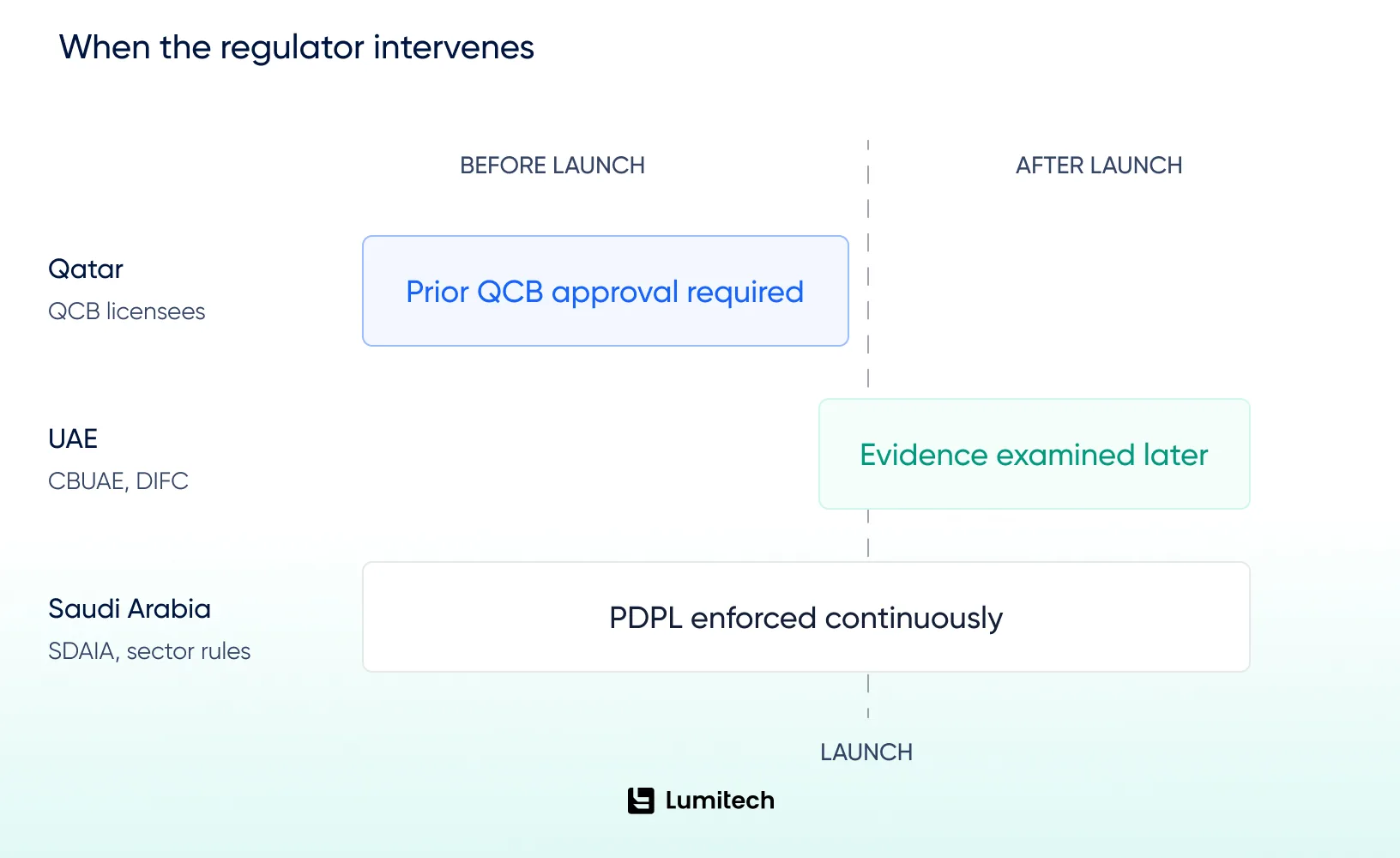
A Qatar deployment may reuse testing and vendor evidence prepared for Saudi Arabia, but an entity regulated by the Qatar Central Bank (QCB) must follow Qatar’s approval path. For groups operating across the Gulf Cooperation Council (GCC), this changes procurement timing and release ownership within AI governance GCC programs.
The QCB AI Guideline, effective since September 4, 2024, applies when a regulated entity builds, buys, or outsources an AI system. It expects an AI strategy linked to risk appetite, board accountability, a system register, risk classification, vendor controls, and human oversight. New systems require QCB approval before launch. High-risk purchase, licensing, or outsourcing agreements require approval before signing, and the QCB may first direct the system to sandbox evaluation.
Model documentation, test results, and vendor due diligence can support teams in Doha, Dubai, and Riyadh. A country annex should record the regulator, local approvals, evidence owner, language requirements, data-transfer position, and escalation route. It connects a shared, responsible AI governance model with an AI governance GCC program for each local decision.
When a MENA Rollout Also Reaches the EU
A regional product may acquire an EU regulatory overlay even when its provider has no European headquarters. The consolidated EU AI Act covers providers placing AI systems or general-purpose AI models on the EU market, deployers located in the EU, and third-country providers or deployers where an AI system’s output is used in the EU. Scope therefore follows the parties’ roles, market placement, and output use.
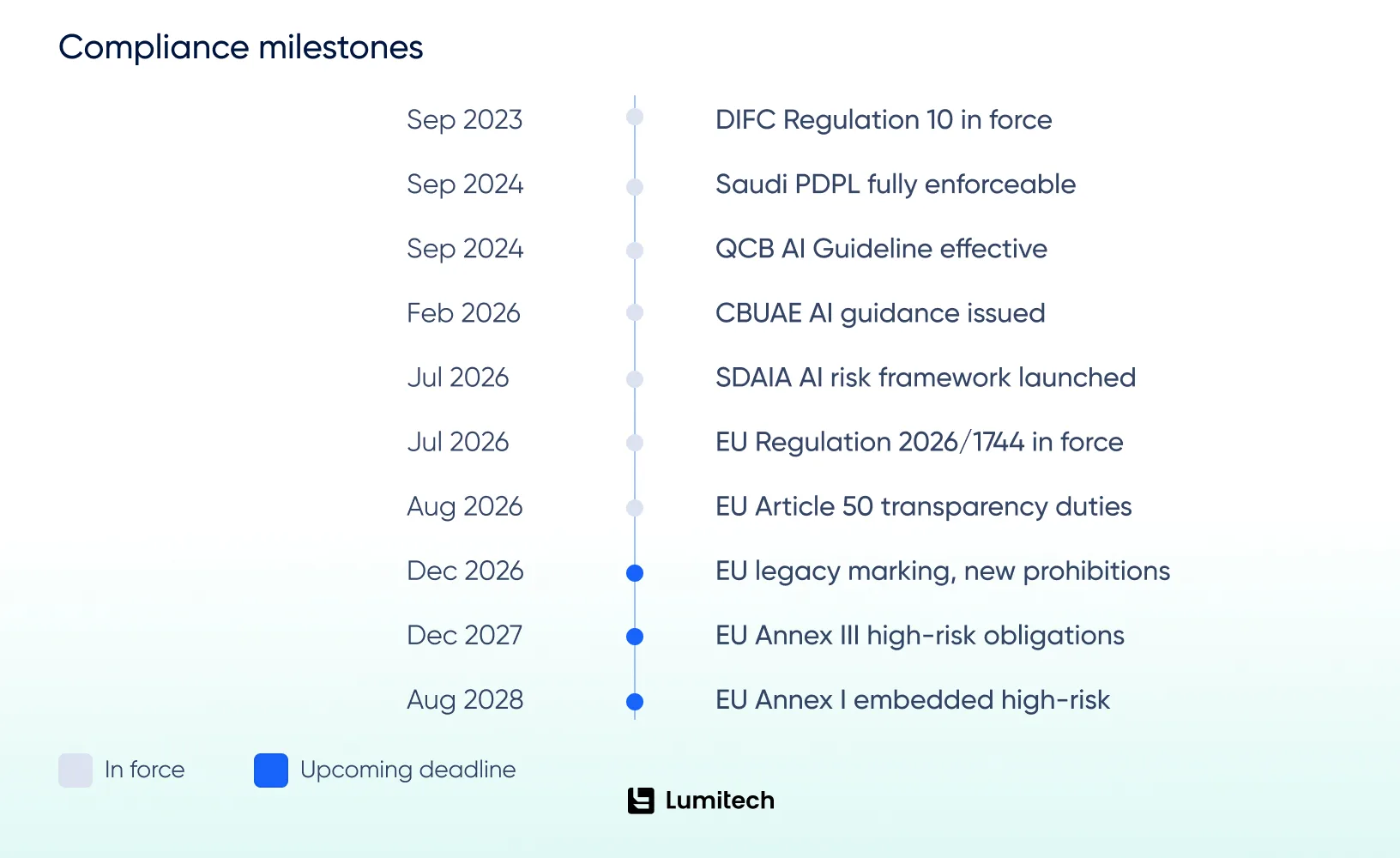
Record each applicable date in the release plan. Regulation (EU) 2026/1744 entered into force on July 27, 2026. Article 50 transparency duties applied from August 2, 2026; most Annex III high-risk requirements apply from December 2, 2027; and rules for high-risk systems embedded in Annex I products apply from August 2, 2028. Prohibited practices have applied since February 2, 2025; general-purpose AI duties since August 2, 2025; and two Digital Omnibus prohibitions have applied since December 2, 2026.
The country annex should record provider and deployer roles, EU market placement, output location, system classification, and the applicable date. The EU layer extends the local AI governance framework; UAE, Saudi, and Qatar requirements continue to govern their respective deployments.
Build One Control Base, Then Add Local Requirements
A common control base can support digital transformation in the Middle East across several markets, while each country annex records the local changes.
The International Organization for Standardization (ISO) and the International Electrotechnical Commission (IEC) have published ISO/IEC 42001:2023 for AI management systems. The National Institute of Standards and Technology (NIST) AI Risk Management Framework 1.0 organizes risk work around Govern, Map, Measure, and Manage. Its Generative AI Profile adds guidance for language and multimodal models. Both can support an AI risk management framework but do not replace local law or regulator approval.
A validation exercise may support CBUAE expectations, DIFC analysis, Saudi guidance, and an EU obligation. Each jurisdiction still sets the required wording, threshold, notice, and approval.
Ten Controls to Complete Before Release
Ten shared controls form the evidence base for the release. The country annex identifies where local requirements change them.
- 01
Maintain a system inventory covering models, wrappers, knowledge sources, agents, external tools, integrations, versions, and AI embedded in vendor products.
- 02
Map roles and jurisdictions by identifying the provider, deployer, operator, controller, processor, contracting entity, regulator, affected people, and output location in each market.
- 03
Classify use and impact by defining permitted and prohibited uses, affected groups, decision consequences, severity, likelihood, reversibility, and approval authority.
- 04
Document data controls for source, purpose, legal basis, quality, retention, access, residency, transfers, and deletion. Confirm whether the provider may use customer data for model training.
- 05
Validate the model in its intended task and operating environment. Regional testing should cover Arabic and English, relevant dialects, code-switching, names, document formats, and, where relevant, demographic performance.
- 06
Test security against prompt injection, data leakage, unsafe tool use, privilege escalation, poisoned content, denial-of-service attacks, and logging failures.
- 07
Provide human oversight and redress by giving reviewers the information, time, training, and authority to reject an output. Affected people also need a route to challenge consequential decisions.
- 08
Explain the use of AI and how material decisions are made to the extent required by the applicable rule.
- 09
Monitor performance and change by setting thresholds for fairness, safety, security, complaints, and drift. Reassess changes to models, data, prompts, tools, or vendor policies when they alter risk.
- 10
Prepare incident and retirement plans covering containment, rollback, notification, evidence preservation, customer remedies, data disposal, and vendor exit.
These controls depend on reliable data lineage, logs, access boundaries, and interfaces. Where older platforms cannot produce that evidence, legacy modernization services can add controlled application programming interfaces (APIs), event logging, and evidence capture before AI reaches sensitive processes.
Treat the Vendor as Part of the System
Third party AI risk management begins before production data is shared. A model provider, platform, or cloud service can change system behavior, data location, and the evidence available to the buyer.
Due diligence should examine security and privacy practices, model and data provenance, subprocessors, hosting locations, incident history, evaluation methods, and the use of customer data for training. Contracts should cover audit rights, model-change notices, service and safety thresholds, regulator access, data deletion, subcontracting, continuity, and exit support.
Lumitech’s comparison of how Middle East software companies adapted to the AI era provides regional context for the vendor shortlist.
The organization should be able to replace the vendor without losing decision records, regulatory evidence, or customer rights. Once that exit path is documented, the control base can move to the approval body for a release decision.
Customer Stories
Explore What We've Built

Legal AI Assistant for a Regional Fintech Institution
Discover how Lumitech designed an AI‑powered legal knowledge assistant that makes internal policies safe to use for a highly-regulated fintech organization.

Dubai
May '25 — Dec '25

Enterprise WhatsApp Commerce for GCC Retail
Helping a leading GCC pet retail and veterinary network trade scattered digital touchpoints for a single AI-powered WhatsApp experience tied into the systems that already run the business.
Abu Dhabi
Dec '25 - May '26
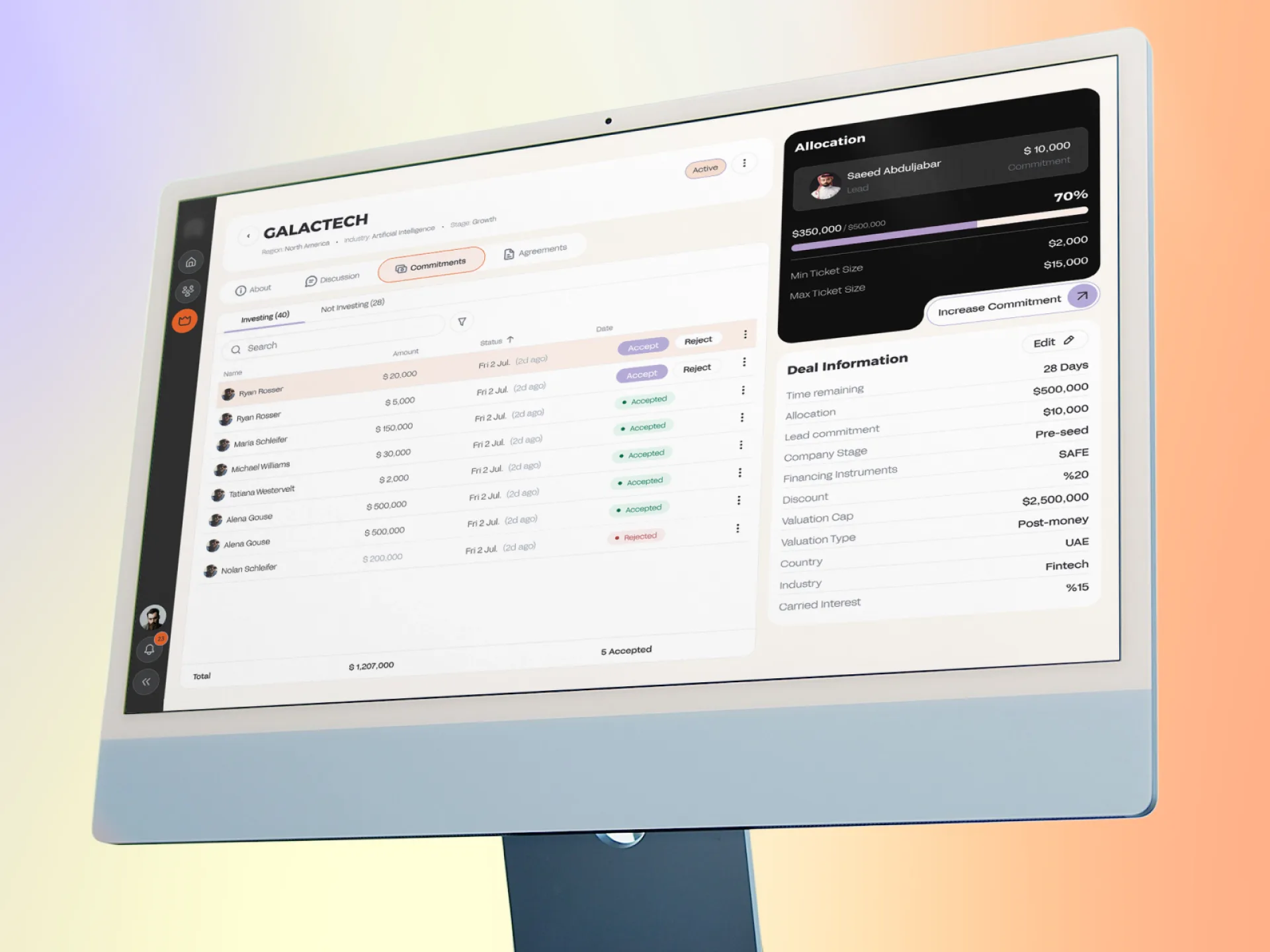
Angel Syndicate Investment Platform for a Saudi Family Office
Turning a fragmented angel investment workflow into a private, generative AI‑powered operating system for syndicates, family offices, and co‑investors.

Jeddah
May '25 - Nov '25
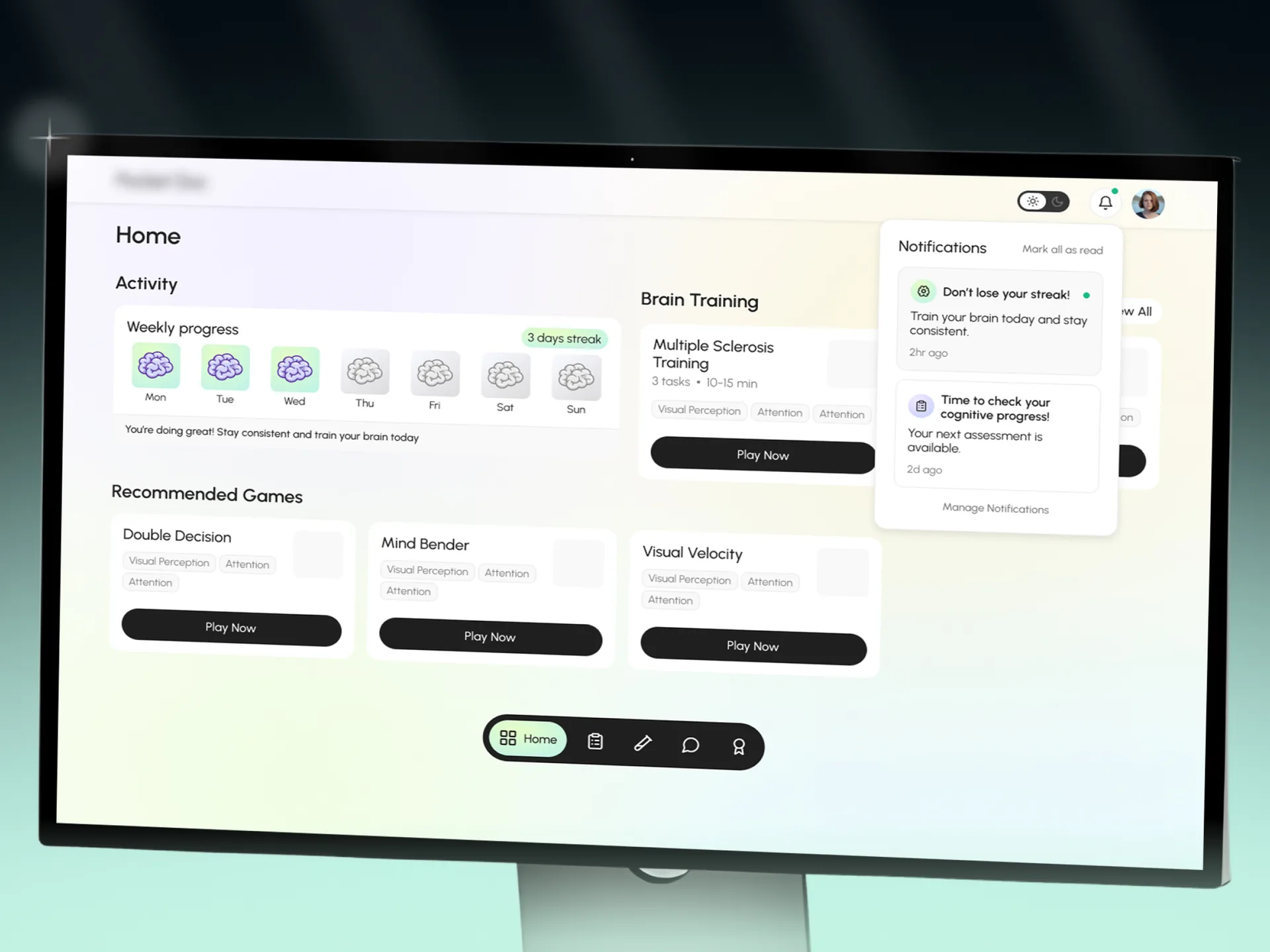
An AI‑Powered Cognitive Training and Brain Health Platform
Turning generic “brain games” into a personalized, data‑driven cognitive training experience – combining adaptive daily workouts, real health data insights, and a conversational AI assistant in one product.

Houston
Oct '25 — Mar '26
FinTech & Finance
Legal AI Assistant for a Regional Fintech Institution
Discover how Lumitech designed an AI‑powered legal knowledge assistant that makes internal policies safe to use for a highly-regulated fintech organization.
Client Location
Dubai
Duration
May '25 — Dec '25
Platform
Web
Enterprise WhatsApp Commerce for GCC Retail
Helping a leading GCC pet retail and veterinary network trade scattered digital touchpoints for a single AI-powered WhatsApp experience tied into the systems that already run the business.
Abu Dhabi
Dec '25 - May '26
Angel Syndicate Investment Platform for a Saudi Family Office
Turning a fragmented angel investment workflow into a private, generative AI‑powered operating system for syndicates, family offices, and co‑investors.
Jeddah
May '25 - Nov '25
An AI‑Powered Cognitive Training and Brain Health Platform
Turning generic “brain games” into a personalized, data‑driven cognitive training experience – combining adaptive daily workouts, real health data insights, and a conversational AI assistant in one product.
Houston
Oct '25 — Mar '26
Five Questions That Decide the Launch
A release decision requires five documented answers:
What is the system allowed to do, and which uses are prohibited?
Which legal entity is accountable for the system and its outputs in each jurisdiction?
What data enters the system, on what legal basis, and where is it stored or transferred?
Who may be affected, which tests passed, and who accepted the residual risk?
Who can intervene, and what triggers suspension, notification, remedy, or another review?
A release can proceed when every answer points to a current record and named owner. Because the UAE, Saudi Arabia, and Qatar use instruments with different legal weight, teams must settle the jurisdiction before finalizing the architecture. An AI governance framework then maps each requirement to a control, a test, and an owner. These records make responsible AI decisions reviewable and surface approval gaps before launch. An AI model governance process keeps them current as the model, data, vendor, or use case changes.
Planning a regulated AI product in MENA?
Lumitech can translate country- and sector-specific requirements into architecture, testing, contracts, and release evidence. Start with one priority use case and the approval record it will require.


