

Outcomes at a Glance
About the Project
This project involved a digital cognitive wellness application designed to help adults maintain and improve key cognitive abilities (memory, attention, and processing speed) over time. The product was created for users who wanted a more structured approach to brain health than traditional brain-training apps typically provide. It is designed as a guided cognitive‑fitness system: assess, train daily, and track measurable progress.
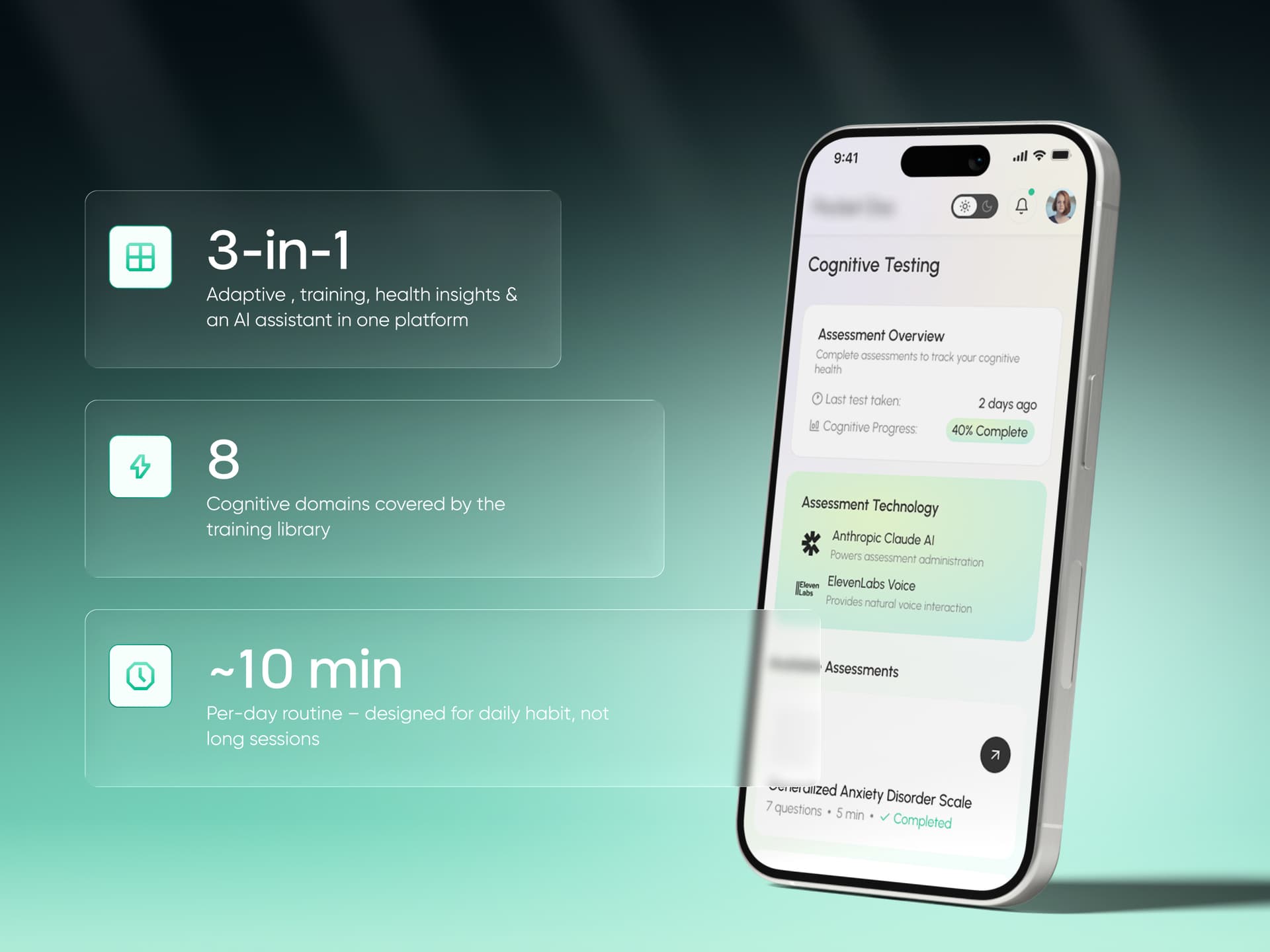
At its core, the platform combined three elements into a single experience: a personalized cognitive training program, access to broader health data, and an AI assistant available to guide users through their progress. Instead of treating cognitive training as a set of isolated exercises, the product was designed as a daily routine built around assessment, short training sessions, and measurable progress over time.
Interesting Facts
The platform organizes training across eight distinct cognitive domains – memory, attention, processing speed, coordination, executive function, perception, language, and auditory processing.
Instead of offering standalone “brain games,” the product combines personalized training, health data insights, and an AI assistant into a single experience.
The training system supports condition-specific programs, including tracks adapted to needs such as response time, task shifting, and visual perception.
The product was designed around short daily use, with routines built to fit into roughly ten minutes rather than long training sessions.
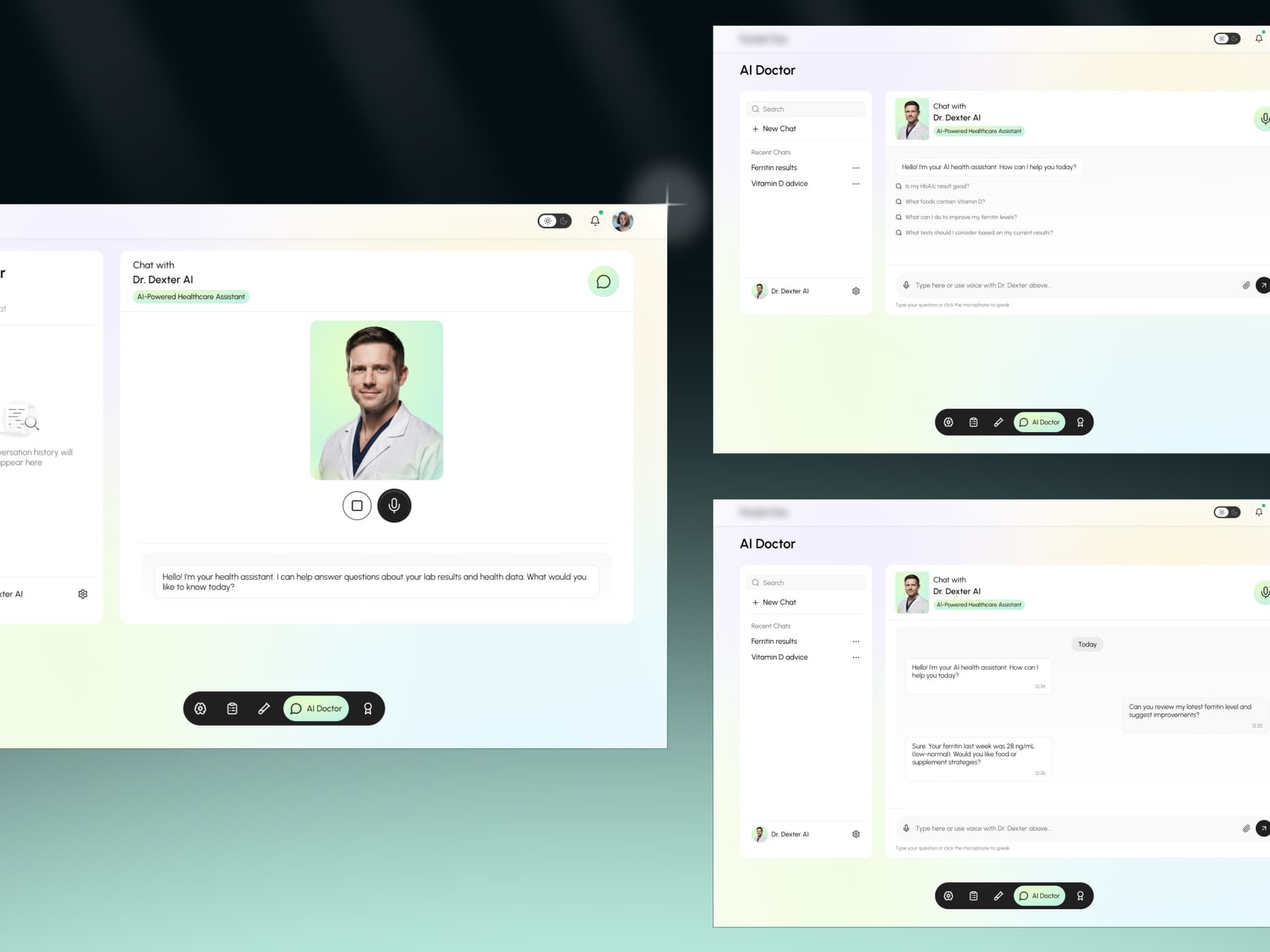
Users can interact with the AI assistant through both text and voice, making support and progress review more accessible within the product flow.
Client’s Request
The client approached Lumitech with a clear product hypothesis: many brain-training apps fail because the experience lacks structure, personalization and a meaningful sense of progress. The client was seeking to create a product that could still be competitive in a market filled with isolated “brain games” and felt less like casual entertainment and more like a guided cognitive training system.
The goal was to build a platform that both provided adaptive daily training and integrated it into the bigger picture of the user’s health. The idea was to move beyond disconnected exercises to a more coherent experience built around assessment, short daily sessions, and measurable progress over time.
Our Approach
Lumitech approached the project as the development of a single product experience built around the user journey: assessment, daily training, progress tracking, and support. The goal was to make cognitive training feel structured, personalized, and easy to maintain as a daily routine.
To accomplish this, we separated the adaptive training logic from the exercise library, enabling personalization of daily plans while keeping the system flexible for future growth. The AI assistant was designed as a guided support layer focused on clearly explaining progress and health data, with a strict boundary between educational support and medical advice.
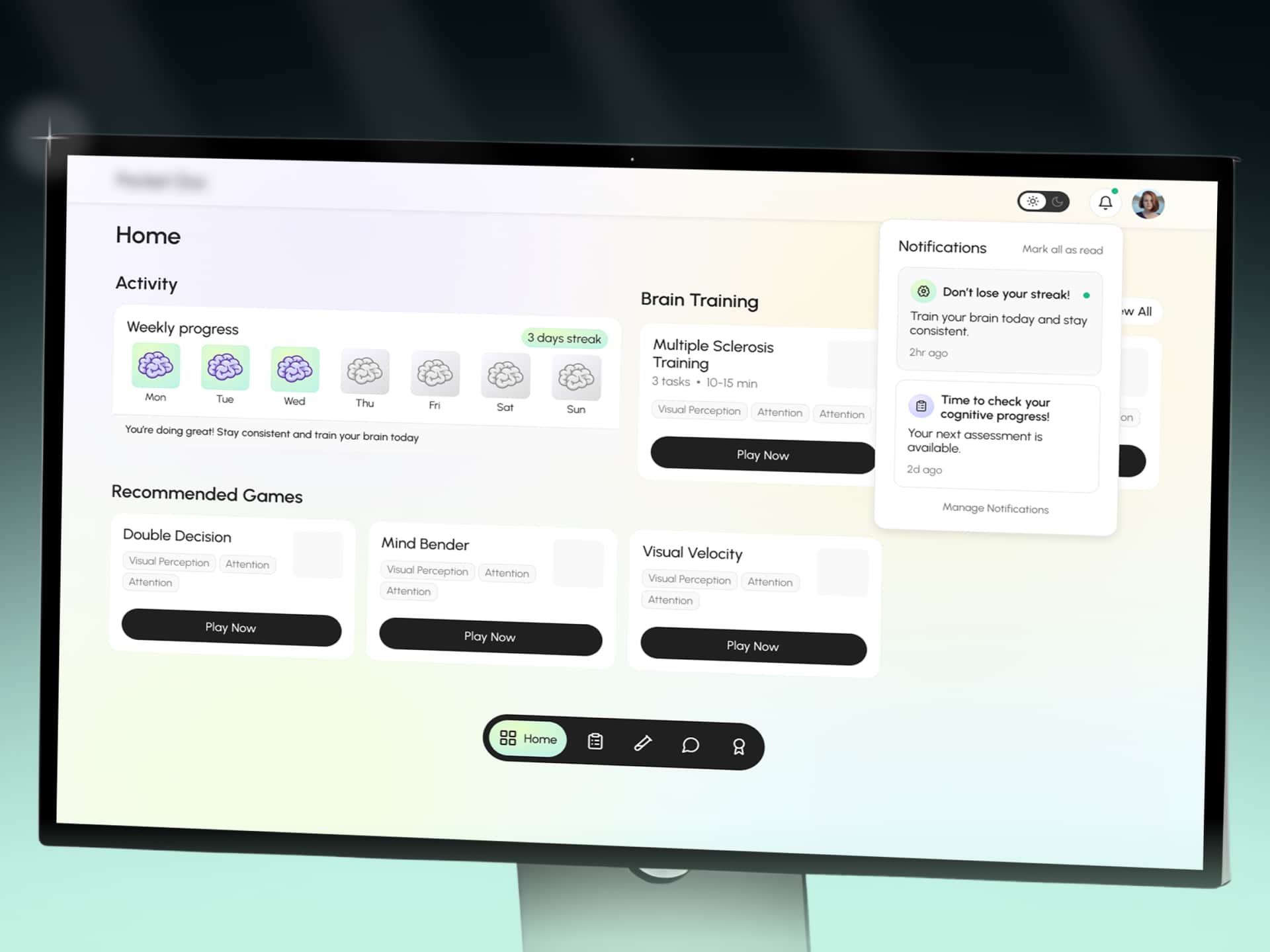
We also built engagement into the product itself through short daily sessions, visible progress, streaks, and weekly progression, helping turn cognitive training into a habit rather than a one-time activity.
Technologies & Architecture
The platform was built as a modern, API‑driven application designed for short, frequent sessions on both web and mobile. The core layers included:
Technology | Role in the platform |
|---|---|
Frontend framework | Responsive web & mobile interface with light and dark modes, optimized for quick daily sessions |
Backend / API | Core services, training logic, user profiles, and progress data |
Adaptive engine (AI/ML) | Maps exercises to cognitive domains and personalizes each user’s daily plan from baseline and ongoing performance |
LLM provider + RAG | Conversational AI assistant grounded in the user’s own data and approved health content |
Text‑to‑speech engine | Voice for the selectable, voice‑enabled assistants |
OCR / IDP engine | Intelligent document processing – parses uploaded lab reports into structured biomarker data |
Database | Stores cognitive scores, biomarkers, reference ranges, and history |
Stripe | Subscription billing, free‑trial funnel, and promo‑code handling |
The Challenges
Turning the product vision into a working platform created several product and engineering challenges.
The system had to deliver:
Real personalization — generating a daily training plan based on each user’s baseline, ongoing performance, and goals rather than offering a static set of exercises.
Meaningful engagement — using streaks, progression, and visible improvement to support long-term daily use.
Program coherence — making exercises across eight cognitive domains feel like parts of one connected training system rather than unrelated games.
A trustworthy AI layer — explaining progress and health data in plain language while staying clearly educational and not crossing into medical advice.
Responsible health-data handling — presenting biomarker and lab data clearly, with enough context to remain understandable and useful for users.
A production-ready product — launching not as a prototype, but as a complete platform with onboarding, training, AI chat, progress tracking, and billing across web and mobile.
The platform had to combine personalization, engagement, AI assistance, and health data interpretation into a single product experience that remained clear, reliable, and scalable.
Core Features
Cognitive Baseline Assessment
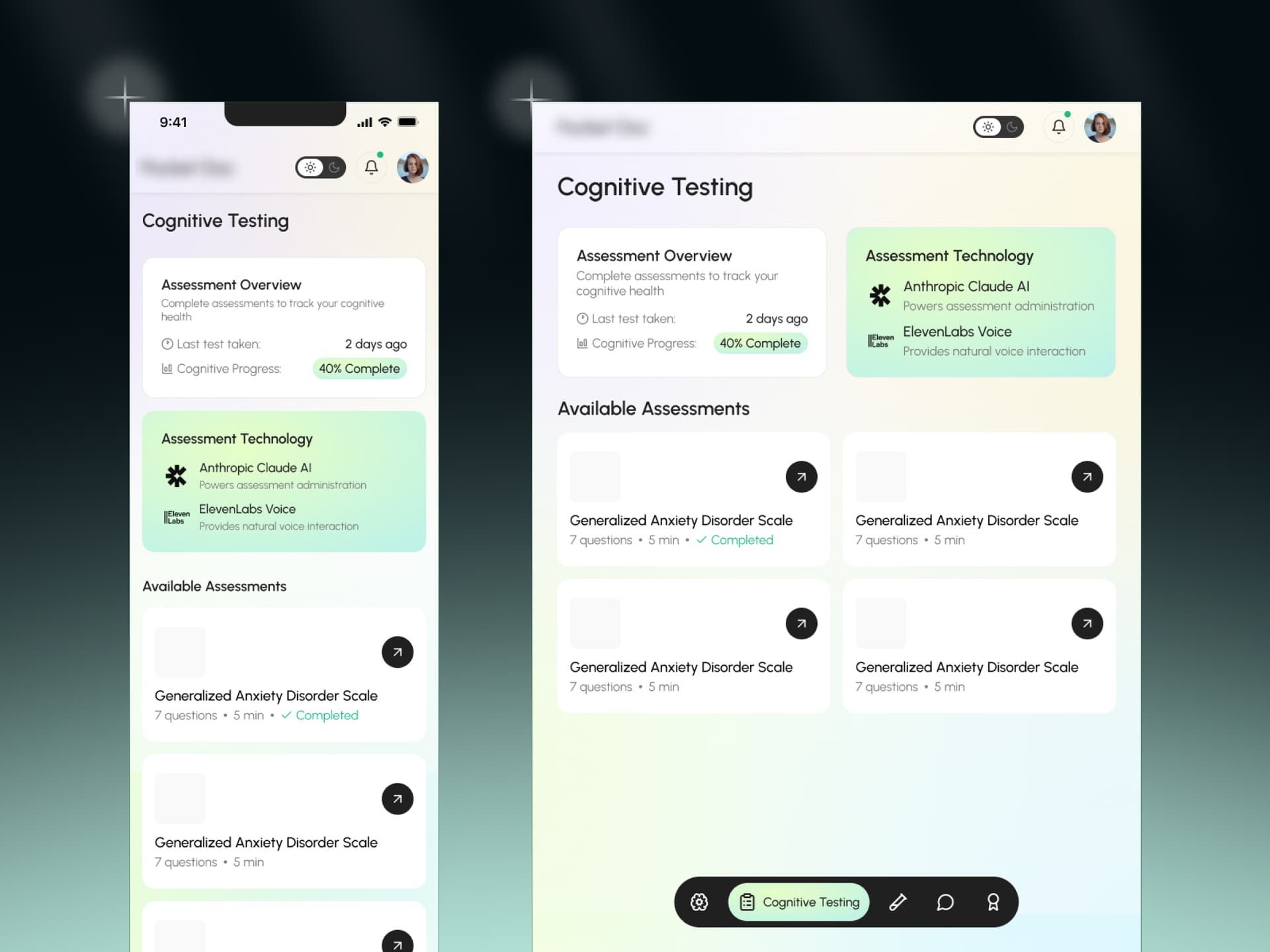
Onboarding starts with a short cognitive assessment across memory, attention, processing speed, and more, establishing a personal baseline. All subsequent assessments (difficulty, plan, and progress tracking) were tied to that established baseline.
Personalized Daily Training Plan
Instead of offering a static catalog of exercises, the platform generates a daily training plan tailored to each user’s baseline, goals, and ongoing performance. Sessions were developed to fit into a short daily routine, making the product easier to adopt consistently while keeping the experience adaptive over time.
Progression Model
To support long-term use, the platform includes a progression model built around daily goals, streaks, and weekly levels. Progress indicators and clear daily targets make improvement easier and help turn training into a repeatable habit rather than an occasional activity.
Training Library Across Eight Domains
The exercise library contains exercises and activities for memory, attention, processing speed, coordination, executive function, perception, language, and auditory analysis. Although users follow a guided plan, they can also explore the library more freely, while still keeping their results connected to the wider progress model.
Condition‑Specific Training
Beyond general cognitive wellness, the platform supports more targeted training programs designed around specific needs – for example, Parkinson’s‑related programs targeting response time, task shifting, and visual perception.
AI Health Assistant
A central part of the product is an AI assistant that helps users understand their progress and health-related data in clear, accessible language. Available through text and voice, it was designed as a guided support layer rather than an open-ended chatbot, with answers grounded in user data and approved content. This helped keep the experience useful and relevant while maintaining a clear educational boundary.
Health & Biomarker Insights
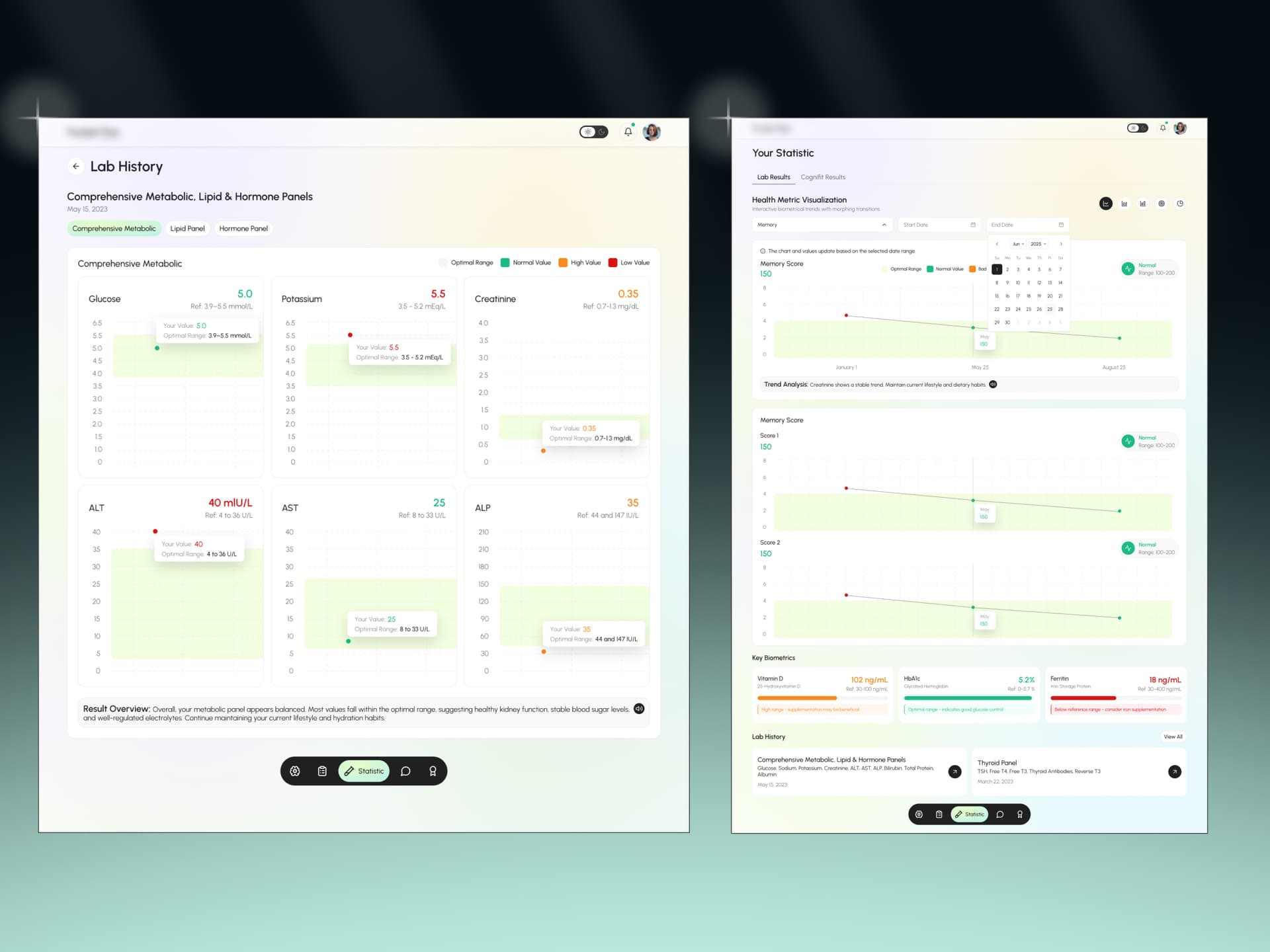
The platform also gives users a broader view of their health by incorporating biomarker data from uploaded lab reports. Extracted values such as Vitamin D, HbA1c, and Ferritin are displayed alongside cognitive progress, with reference ranges and plain-language context that make the information easier to understand.
Progress Tracking & Reporting
A custom-built dashboard applies data analytics to each user’s history, visualizing brain‑health progress over time with per‑domain trend indicators and interactive charts across selectable time ranges. This gives users a clearer view of how their training evolves and makes improvements more visible over the long term.
Subscription‑Ready Platform
The platform was built as a complete, monetizable product: onboarding, assessment, training, AI chat, and progress tracking, with secure subscription billing through Stripe, including free‑trial and promo‑code support.
Results
The project resulted in a working end-to-end product that took users from cognitive assessment to daily training, progress tracking, and AI-supported guidance within a single experience. Instead of treating brain training as a set of isolated exercises, the platform introduced a more structured model built around personalization, routine, and visible progress.
Key outcomes of the project included:
A more coherent training experience — with baseline assessment, adaptive daily plans, and progress tracking connected within one product flow
A clearer engagement model — using short daily sessions, streaks, and weekly progression to support habit formation over time
A more useful AI support layer — helping users review progress and health-related data in accessible language, while staying grounded in approved content and clear educational boundaries
A wider view of user health — by combining cognitive training with biomarker insights and lab data in the same platform
A product ready for launch and growth — with onboarding, training, AI chat, reporting, and subscription billing built into a single platform
More broadly, the project showed that cognitive wellness products can be made more useful when personalization, guidance, and health context are treated as part of one system rather than separate features. Lumitech’s role was to turn that idea into a real product that could support daily use and continue evolving over time.