





Walk into any GCC WhatsApp thread and you’ll see it: people aren’t just sharing memes and family photos. They’re asking the supermarket if delivery is late, checking a clinic slot, confirming a driver’s location. Businesses answer instinctively there, even when their “official” digital channels are somewhere else.
Our client was in that position. On paper, they had a website, an app, call centers, and SMS support. In reality, store teams were answering half the important questions on WhatsApp anyway — stock, grooming, prescriptions. Customers had quietly chosen the channel. The company now had to catch up, without throwing away years of work on ERP, CRM, and logistics systems. Lumitech’s job was to make that connection real.
About the Client
This client is one of the main names in pet retail and veterinary care across the UAE and Saudi Arabia. Dozens of physical locations, from high-traffic malls to neighborhood clinics, plus warehouses feeding them all.
A typical customer doesn’t just buy a toy once and disappear. They come back regularly for food, monthly for grooming, and whenever their pet needs medical attention. Some orders are simple, like a bag of kibble. Others involve prescriptions, dosage questions, and a vet’s approval. It’s closer to a health and services business than a basic retail shop.Interesting Facts
Interesting Facts
In GCC markets, WhatsApp often handles more customer interaction than branded websites or mobile apps, especially for everyday retail and services.
This pet network runs across the UAE and Saudi Arabia, with dozens of locations and a mix of products and services: food, accessories, medication, grooming, and vet care.
Pet ownership in the region is growing, which makes recurring essentials like food and medication a meaningful part of household spending and retailer planning.
Like many large retailers, the client already relied on ERP, CRM, and warehouse platforms built up over years; replacing them was never on the table.
The WhatsApp experience had to work naturally in both Arabic and English, which influences everything from how people type to how product names are understood.
Customer data was required to stay inside the company’s own infrastructure, so on-premise deployment and strict governance were built into the plan from the start.
The Challenge
From a pet owner’s point of view, everyday tasks felt more complicated than they should. Buying food meant one flow, booking grooming meant another, renewing a prescription could be a third with different contact details. None of it lived in the same place, and none of it matched how people were actually reaching out to the business.
To keep this moving, the company had already invested in serious backend systems: ERP for stock and orders, CRM for customer history, warehouse tools for fulfillment. Those systems did their job. The gap was on the surface, where a pet owner trying to do something straightforward — “more of the same food and a grooming slot on Saturday” — still had to hop through several channels that didn’t talk to each other.
Adding a new app or polishing the website wouldn’t change that. Customers already had phone screens full of retail and delivery apps. They were still sending a message when something really mattered or when they didn’t have time to learn yet another interface.
Generic “AI chat” tools also weren’t an answer; they could answer simple questions, but they didn’t know how to talk to ERP and CRM systems, work with regulated pharmacy flows, or deal with Arabic input that doesn’t look anything like textbook examples.
The enterprise constraints were non-negotiable. Orders, stock, pricing, and loyalty all ran through existing systems that had to stay in place. Any WhatsApp retail platform had to sit on top of them and respect their logic. On top of that, regional rules meant no customer data could leak into random third-party services. Whatever we built had to live fully inside the client’s environment and still feel like a modern, AI-powered WhatsApp commerce experience from the outside.
Our Approach
We didn’t start with “what kind of bot do we build?” We started with a map of how the business actually functions and how customers already behave. WhatsApp was the front door. ERP, CRM, inventory, and logistics were the building behind that door. The project was about connecting them cleanly.
The design settled into three layers.
First, a WhatsApp-based AI assistant where customers could ask for products, book services, share prescriptions, and check deliveries in one ongoing thread.
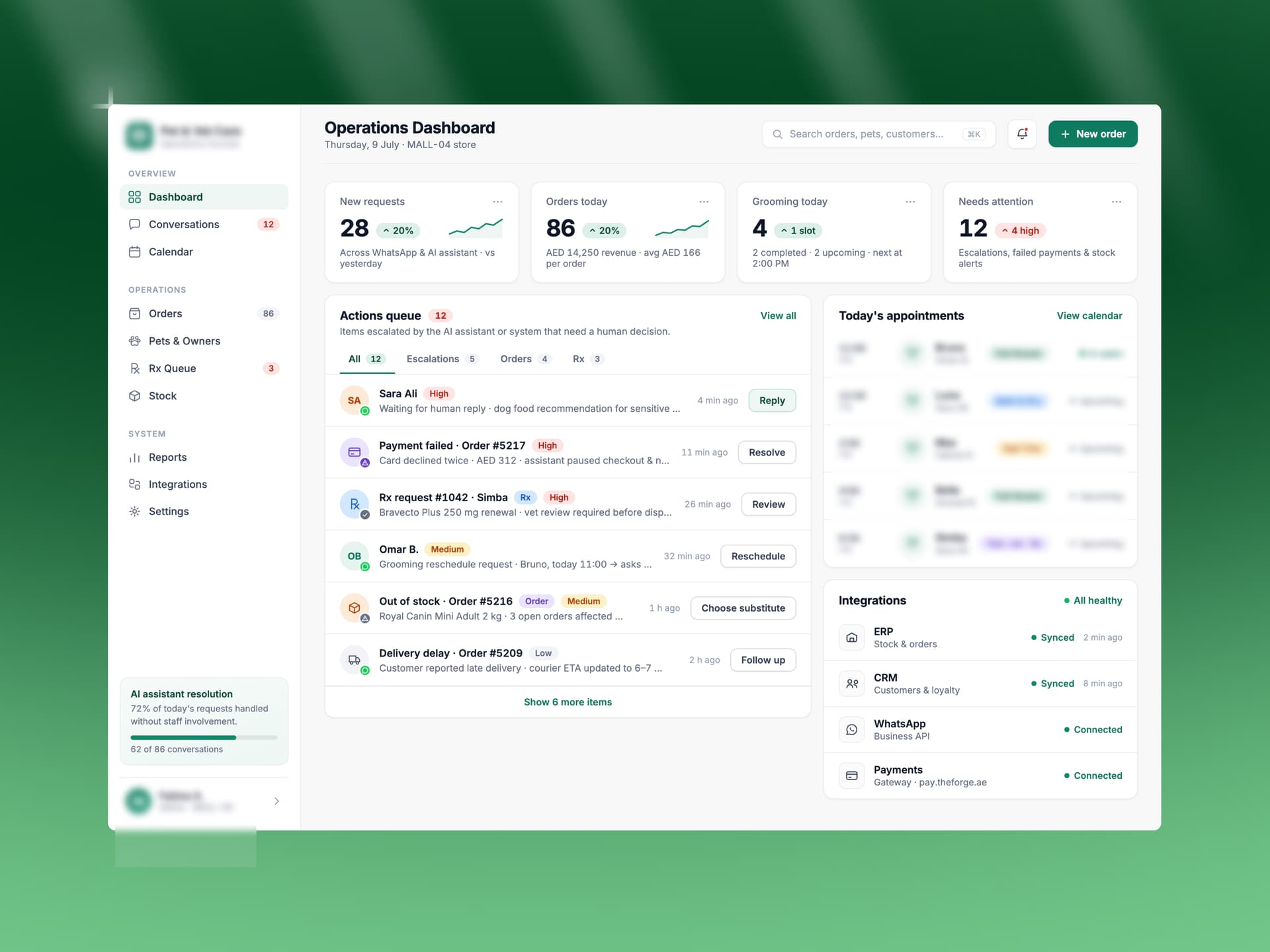
Second, mobile tools for staff — store teams, pharmacy teams — who need to see what’s coming in and what they have to do next.
Third, an integration layer that made sure every message translated into real actions and data in the existing ERP, CRM, and warehouse systems.
Running the platform on-premise was treated as a basic assumption, not a constraint we fought with at the end. The deployment model shaped our choices around messaging, AI services, and system boundaries. It also reassured the client that WhatsApp conversational commerce didn’t mean losing control of sensitive data.
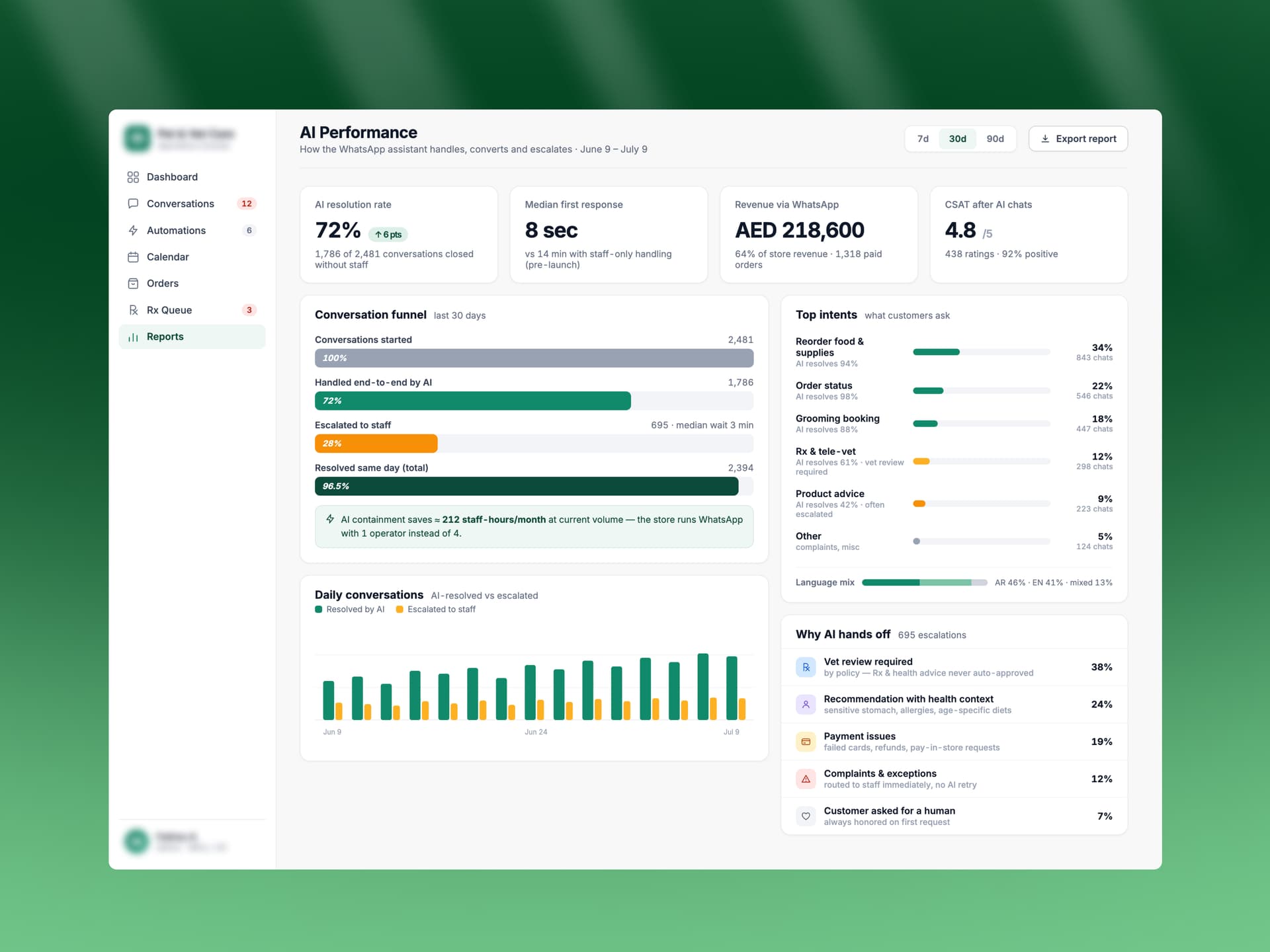
Language came next. Arabic and English support weren’t bolted on; they influenced how flows were written, how intent was detected, and how product information surfaced. AI helped with the messy parts — understanding casual text, guiding people toward what they meant, suggesting alternatives when something was out of stock. When conversations drifted into areas where a machine shouldn’t answer alone, such as complex medical questions, staff could step in and the handover felt natural.
Technologies
The platform runs on the client’s own infrastructure, with integration and bilingual support baked in. Specific frameworks and vendors stay under NDA, but the main building blocks are clear.
Technology / Integration | Role in the platform |
|---|---|
WhatsApp Business API | The main channel; customers do all their shopping, booking, and support in one thread |
Al conversation layer | Understands fre -textmeses, heles fine products, builds |
ERP integration | Shares live product catalog, availability, and order processing from the existing enterprise system |
CRM integration | Brings customer history, loyalty status, and account details into the conversation view |
Warehouse and logistics integration | Keeps order picking, delivery status, and driver updates connected to what customers see in WhatsApp |
Staff mobile application (Picker / Advisor) | Gives store and pharmacy teams a dashboard of incoming WhatsApp orders and tasks |
Payment link generation | Sends secure payment links inside the chat so customers can pay without leaving WhatsApp |
Prescription handling | Manages upload, review, and processing flows for products that require a valid prescription |
Arabic / English bilingual engine | Supports natural interaction in both languages throughout all conversation tows |
On-premise deployment layer | Ensures everything runs inside the client's infrastructure, keeping customer data under their control |
Features
The easiest way to understand the platform is through the kinds of conversations it handles every day.
AI Shopping Assistant
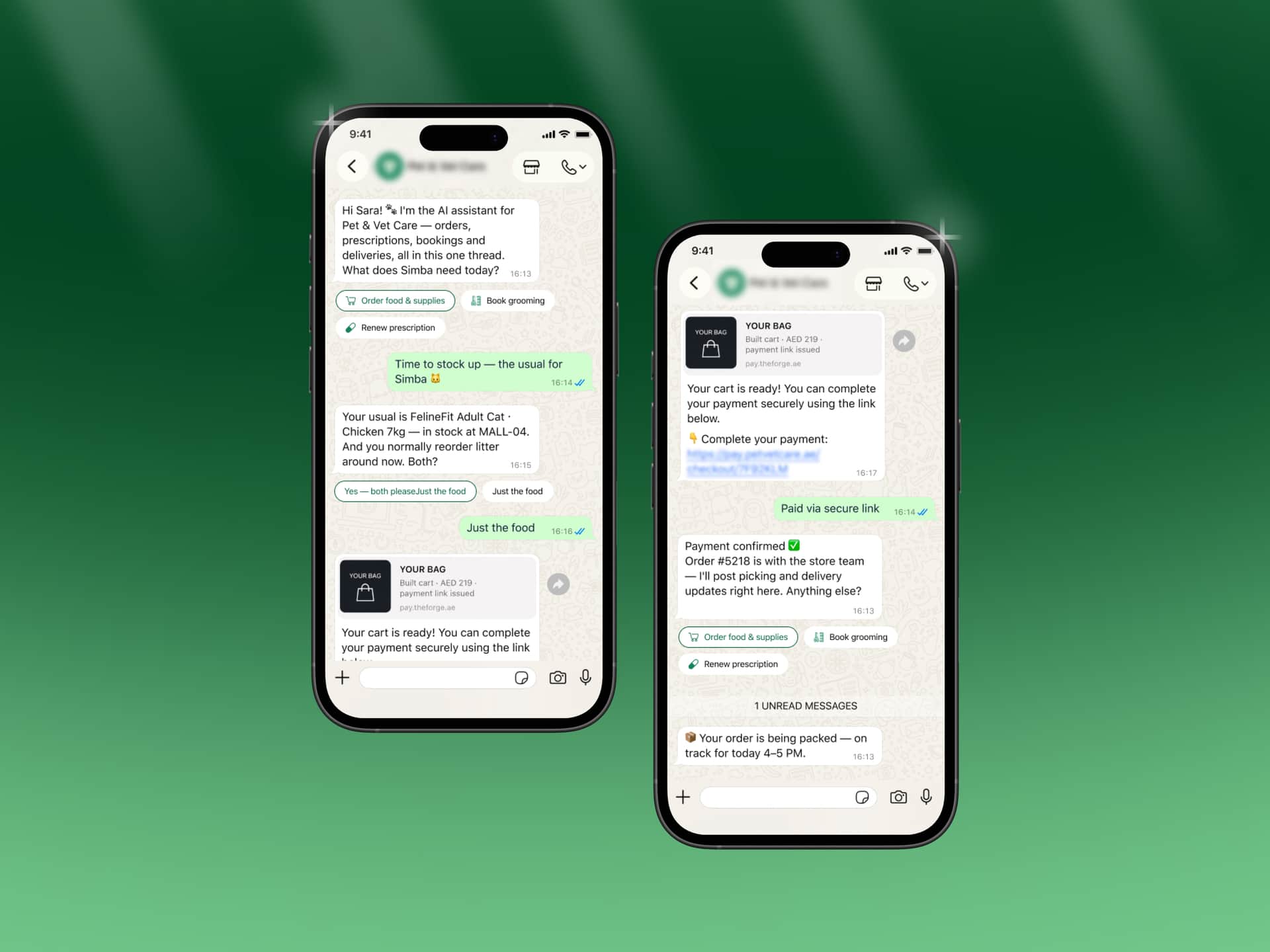
Customers write the way they speak: “I need dry food for a small cat,” “Is there a bigger bag of the brand I bought last time?” The AI shopping assistant responds with concrete suggestions, not a wall of filters. It adds items as the conversation continues, and the customer never has to switch context to make an order.
Health and Beauty / Pharmacy Assistant
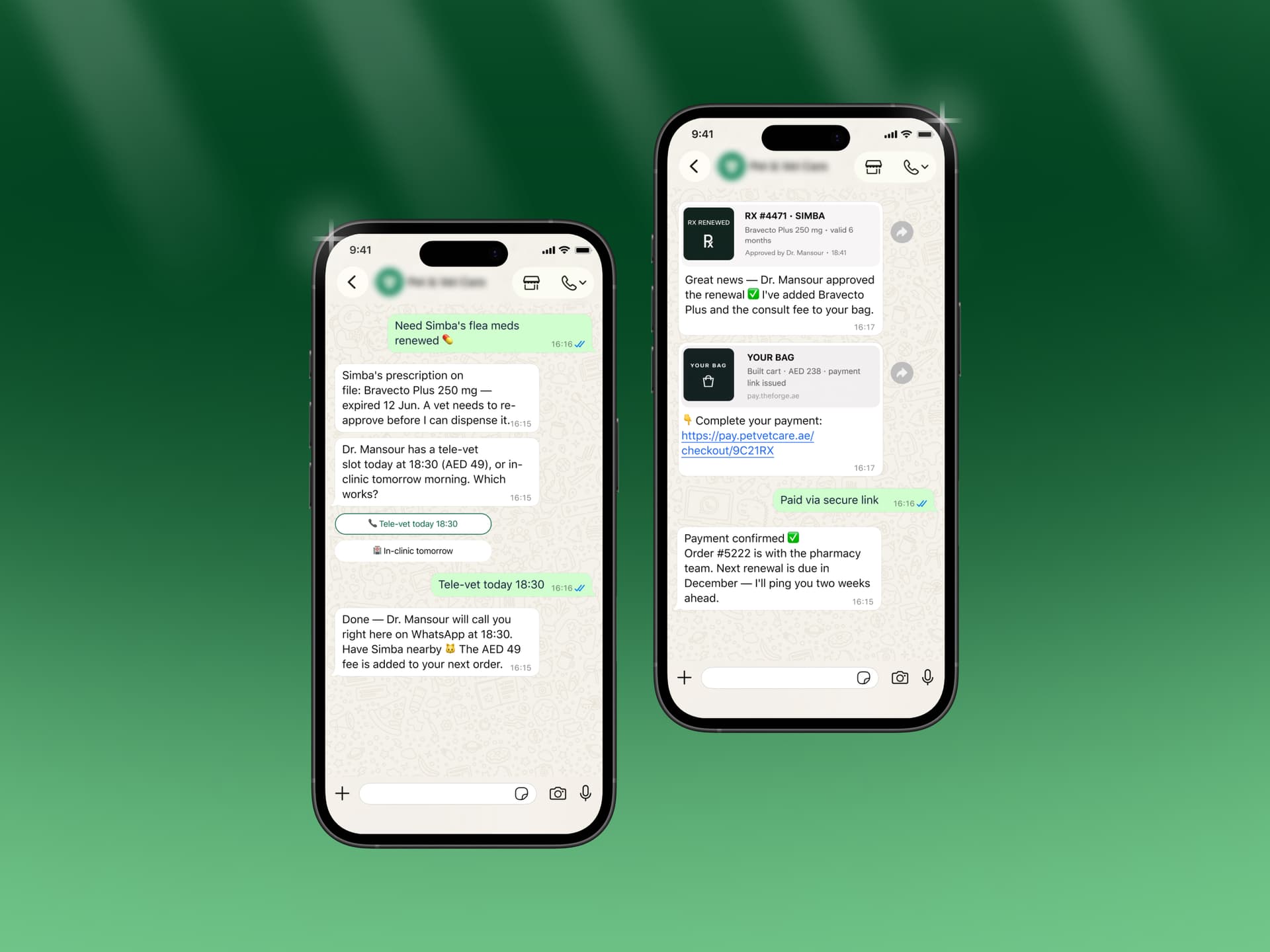
When the conversation moves into medication or health-related products, the tone changes. The assistant guides customers through sending a prescription photo, confirms what’s needed, and then routes the request through the pharmacy flow. Staff see a structured view of what came in and decide what can be dispensed, with the assistant handling the basic back-and-forth about timing and pickup or delivery.
Smart Cart and Payment Links
Instead of pushing clients to “add to cart” buttons, the cart grows out of the chat itself. Once the customer is ready, they receive a payment link right there. It’s a small detail, but it keeps the experience from feeling like two separate worlds stitched together.
Appointment and Service Booking
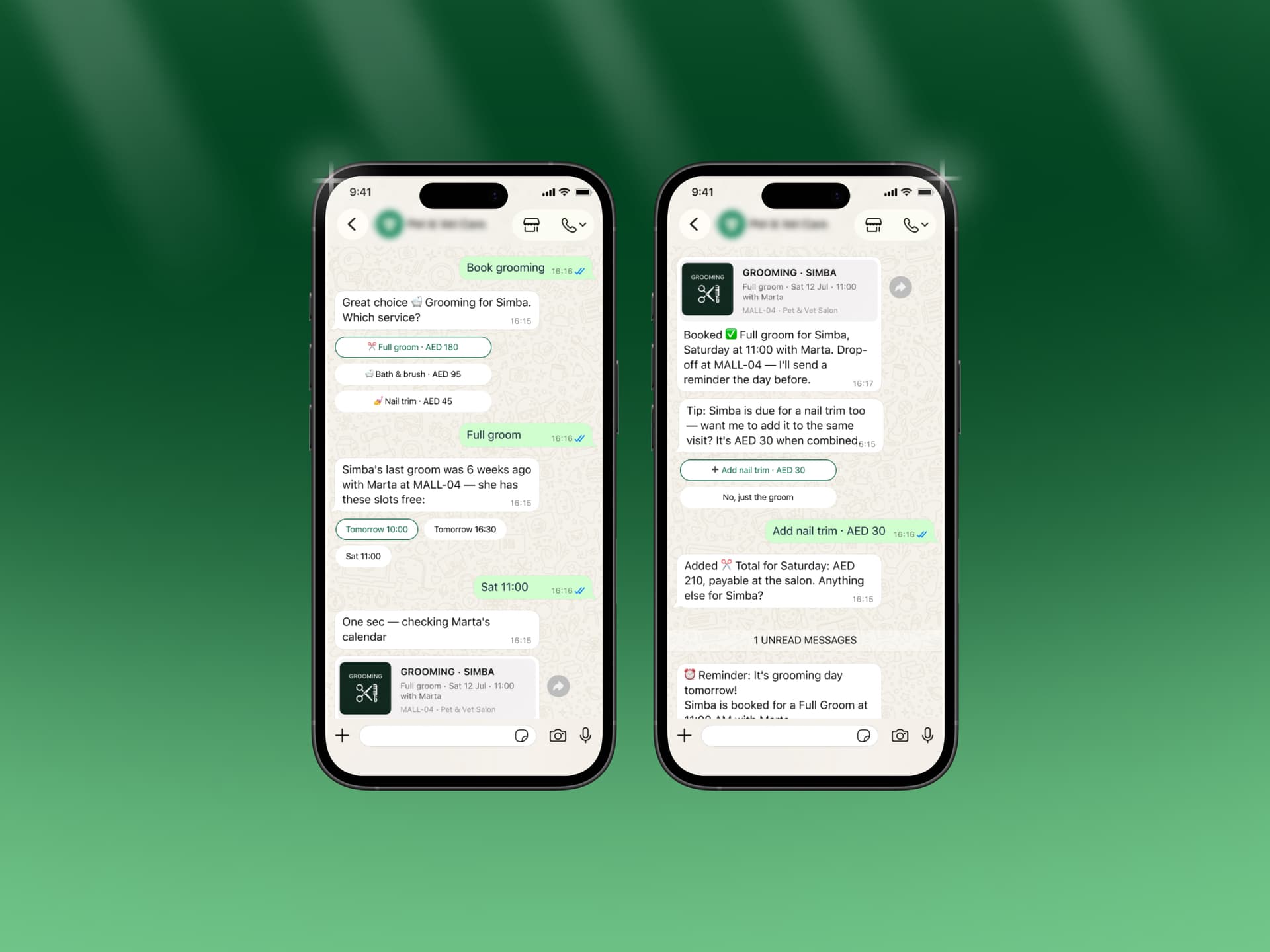
Grooming and vet visits often begin with simple questions: “Any slots on Friday?” or “Can I book a check-up for my dog?” The assistant can propose times, confirm location and type of service, and send a summary message. Reminders before the appointment also arrive in WhatsApp, which is where people are already checking their phone.
Delivery Tracking and Order Updates
After payment, the same thread becomes the source of truth for the order. Store teams mark orders as prepared and handed over to drivers; customers see those updates as messages, not as separate tracking codes they have to paste into other apps.
Loyalty and Promotions
Loyalty points and offers show up when they’re actually useful — during a purchase, not weeks later in a generic email. If an order qualifies for a promotion, the assistant can mention it and let the customer choose whether to use it now or later.
Staff Order Management
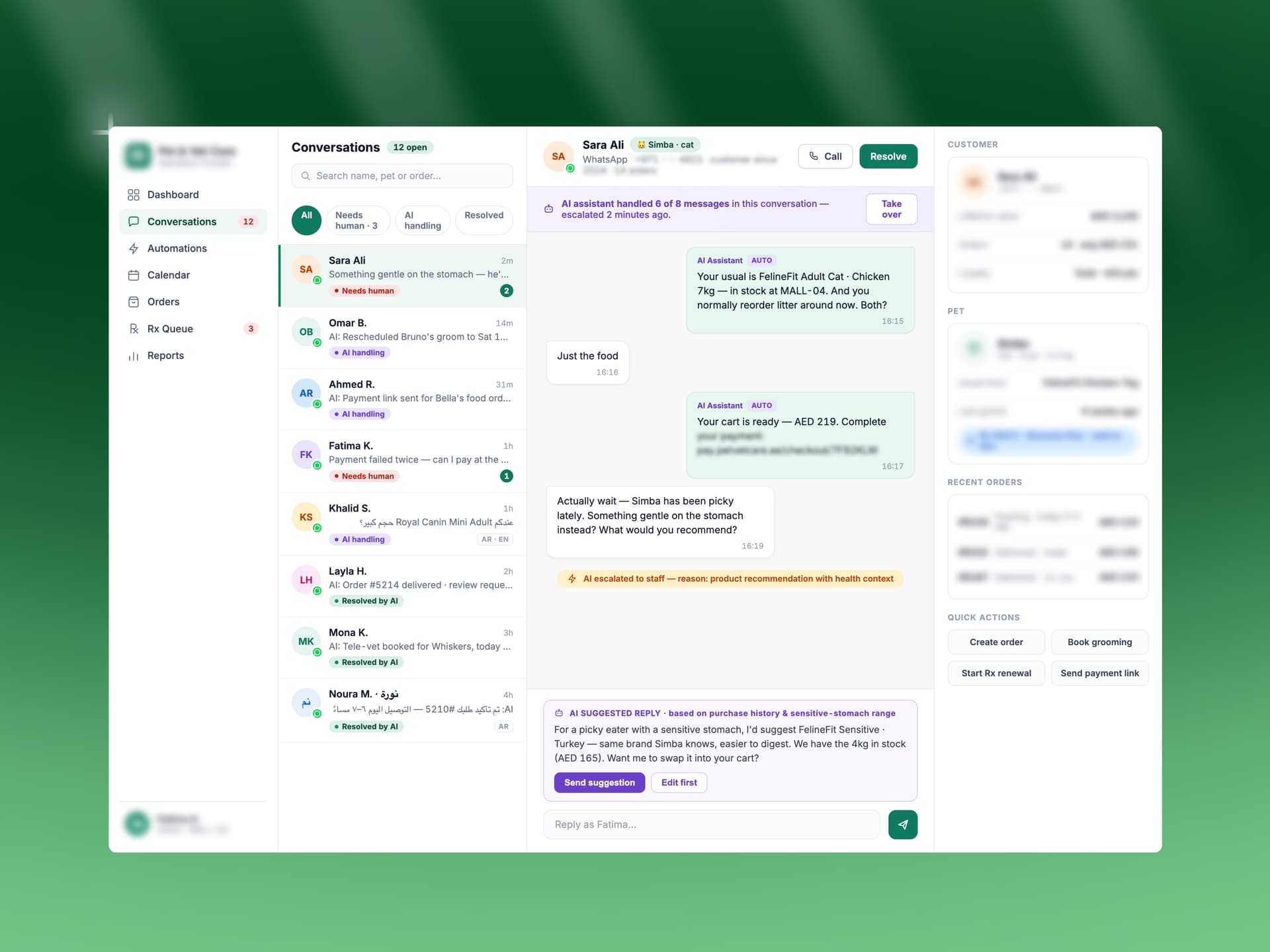
On the store side, the dedicated app puts a steady stream of incoming WhatsApp orders in front of staff with enough detail to act quickly: what was ordered, any notes from the customer, and current stock status. It turns WhatsApp from a noisy inbox into a workable task list.
Staff Advisor Application
Pharmacy and health-and-beauty staff use another tool to manage more sensitive requests. It shows prescriptions, associated chats, and current state at a glance, so staff don’t have to reconstruct context from scattered messages. From there, they can approve, clarify, or decline in a way that still feels conversational for the customer.
Human Escalation
When the AI assistant hits something it shouldn’t handle alone — a complaint, a nuanced health question, a complex delivery problem — a human steps in. Crucially, the person sees the conversation history and the order details, so they can respond as if they’ve been there from the start. The customer doesn’t have to explain themselves twice.
Arabic and English Bilingual Experience
Customers mix languages in daily life, so the platform has to tolerate that. Someone might ask in Arabic and refer to a product name in English, or switch halfway through. The assistant responds in a way that matches the customer’s choice and keeps the conversation feeling natural instead of forced.
Our Results
The client now has an enterprise WhatsApp conversational commerce platform up and running, not just a prototype. When a pet owner sends a message to the company’s WhatsApp number, they can handle almost everything in that one thread: finding products, placing orders, paying, booking services, sharing prescriptions, and following deliveries. The system does this while talking to the ERP, CRM, inventory, and logistics tools the business has depended on for years.
Inside the company, store and pharmacy teams see WhatsApp orders and requests as structured tasks instead of scattered messages. They can pick, advise, and escalate from tools built specifically for their role. The Arabic-English experience feels native to the region rather than imported, and the entire stack runs on the client’s own infrastructure in line with their data rules.
Looking at the bigger picture, this project points to where enterprise WhatsApp commerce is likely heading in the GCC. Large retailers won’t abandon their existing systems; they’ll extend them to meet customers where they already are. The work with this client showed that it’s possible to connect deep operational infrastructure with conversational channels in a way that feels natural on both sides — the pet owner’s screen and the enterprise backend — without pretending AI can run the business on its own.


