
Top 10 Software Development Companies in the Middle East That Adapted to the AI Era (2026)
Most “top software development companies in the Middle East” lists rank by headcount and years in business. This one ranks by what actually changed in 2026: outcome pricing, AI-native delivery, and verified results — not logo walls.
- AI Development Services
- IT Outsourcing
July 30, 2026
6 min read
 AI Overview
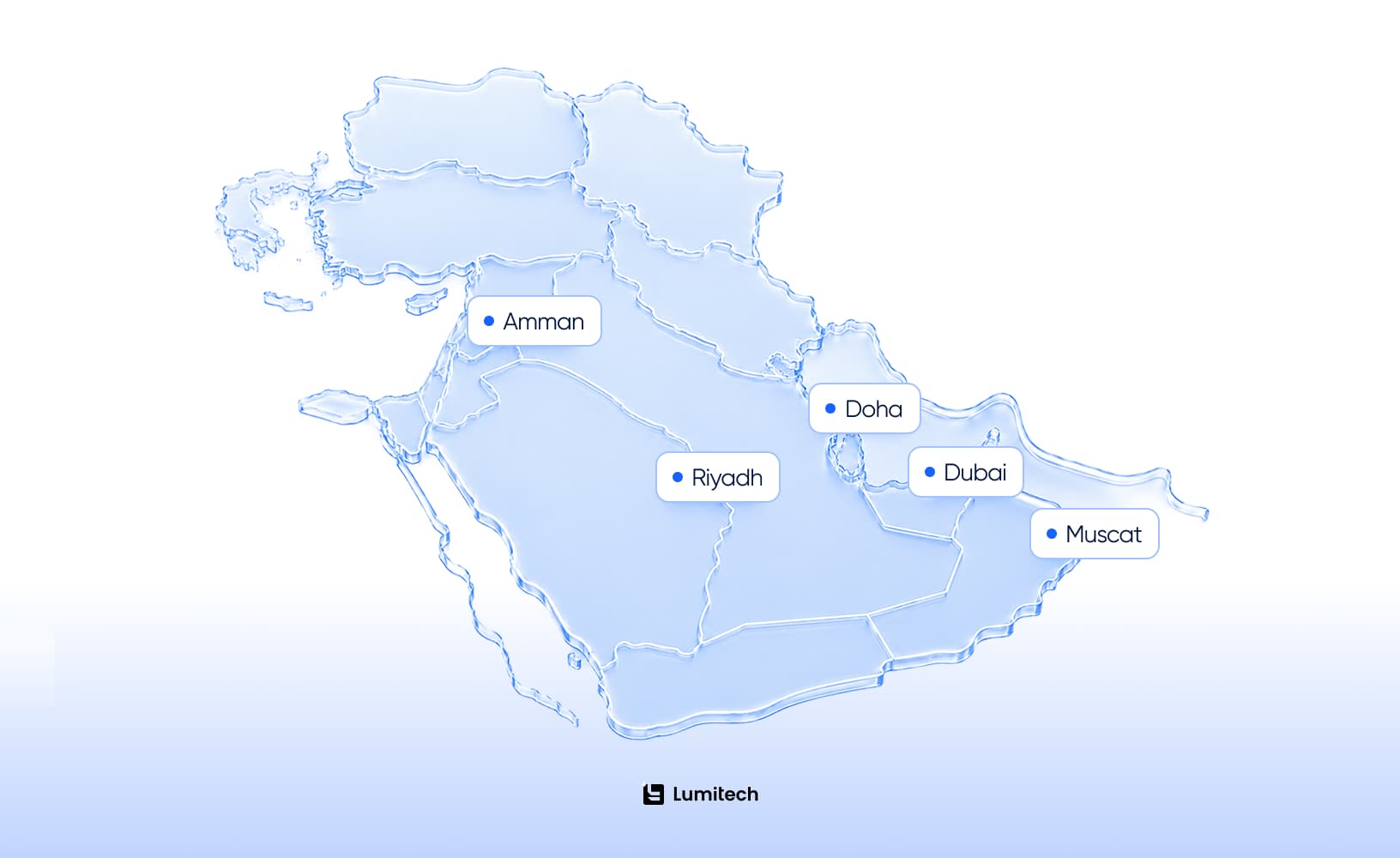
A top software development company in the Middle East in 2026 is defined by four criteria: outcome-based pricing, AI-native delivery, verifiable proof, and post-launch accountability. AI-assisted engineering compressed delivery timelines, shifting buyers from hourly billing to fixed-price milestones. This ranking covers ten vendors across the UAE, Saudi Arabia, Qatar, Oman, and Jordan.

Best Software Development Companies at a Glance
How We Ranked (Read This Before The List)
This list ranks custom software development companies in the Middle East differently: by whether they adapted to what actually changed the business in the last eighteen months, not by headcount or years in business. Full disclosure first: this is the Lumitech blog, and Lumitech is on this list. We’ve kept ourselves honest the only way possible — by publishing the methodology and making every claim checkable. Judge us by the same criteria we apply to everyone else — whether you’re evaluating software development services in Dubai or a vendor three borders away.
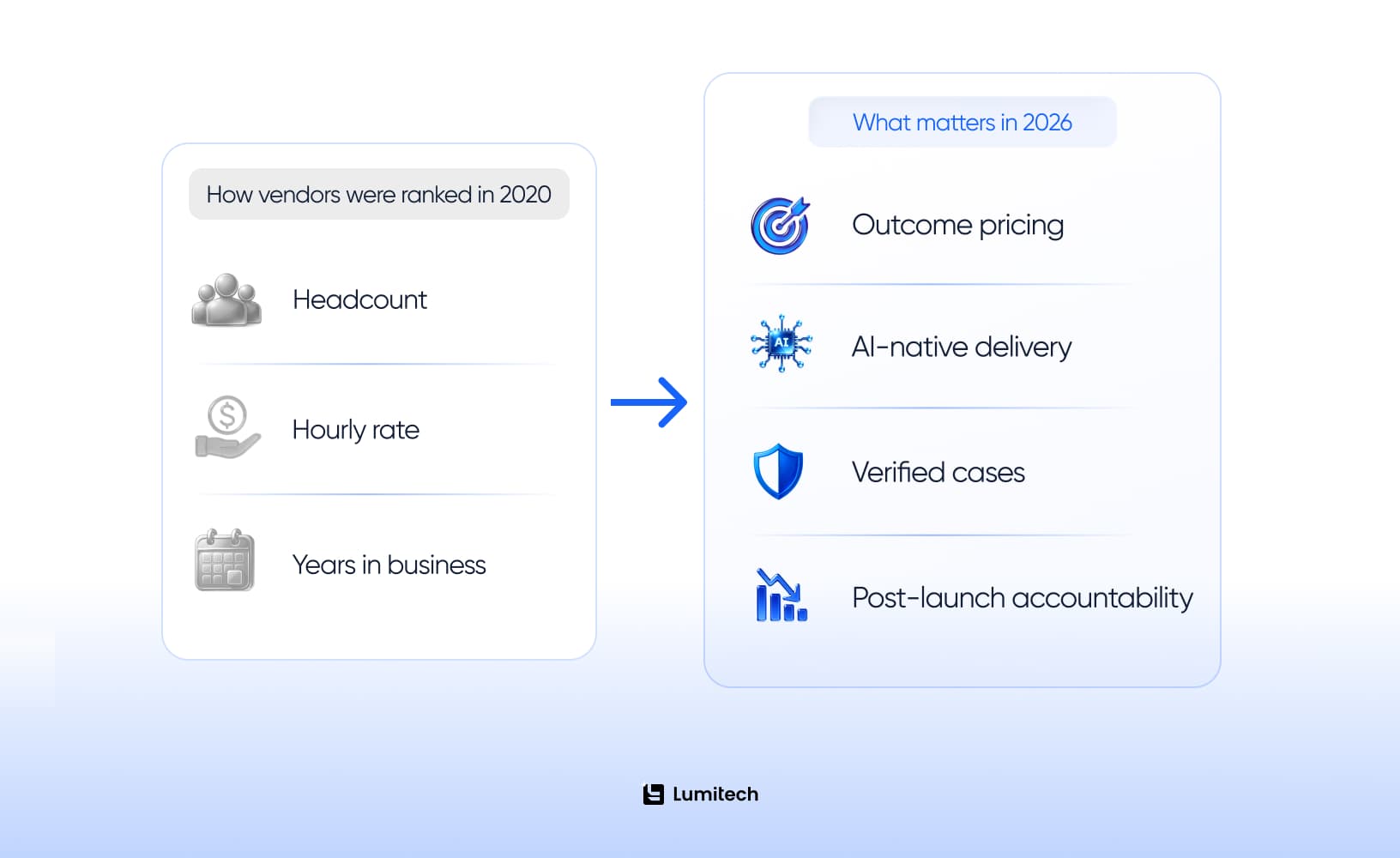
The economics behind this ranking are well-documented. AI-assisted engineering means a senior developer now ships in days what took a team weeks — Gartner projects that by the end of 2026, 40% of enterprise applications will embed task-specific AI agents, up from less than 5% in 2025. That shift is already collapsing the cost of writing code, and the region’s most sophisticated buyers, from Riyadh to Dubai, are moving procurement from time-and-materials to outcome-based contracts as a result. The classic body-shop model is quietly dying alongside it.
Four things define an adapted vendor in 2026:
Outcome-based commercial model. Does the vendor sell results at a fixed price with acceptance criteria, or on a rate card? In a world where AI makes delivery faster every quarter, an hourly model quietly pockets the productivity gain. An outcome model passes it to the client.
AI-native delivery, not AI-washing. Shipping AI agents, voice automation, and LLM-powered products to production — with monitoring and retraining after launch — is different from adding “AI” to a service page. We looked for production evidence.
Verifiable proof. Named clients, public review scores, case studies you can trace to a real product. “Under NDA” on every case is a red flag in 2026: the best clients agree to be referenced.
Accountability after launch. Does the engagement end at handover, or does the vendor operate what it built — model ops, monitoring, support SLAs?
Adapted doesn’t mean every vendor here has dropped hourly pricing. Two vendor types legitimately show up on this list: those competing on certainty — a fixed outcome, verified proof, post-launch accountability — and those competing on capacity — the ability to scale a large, well-specified program fast. Both are valid ways to buy software in 2026; they solve different problems. What would disqualify a vendor from this list isn’t an hourly rate card on its own — it’s showing no evidence of adapting any part of their delivery to 2026 realities.
Notably absent: headcount, office square footage, and years in business. A 2,000-person firm running a 2019 delivery model is a worse bet today than a 100-person firm running a 2026 one.
A note on ranking order: the numbers here aren’t a strict hierarchy — this isn’t a “#1 beats #10” ranking. The right vendor for you depends on your project type, budget model, and what you’re actually optimizing for — match the profile to your need rather than defaulting to the top of the list.
Top 10 Software Development Companies in the Middle East in 2026

1. Lumitech
The outcome-based benchmark
Locations: Dubai, UAE, Saudi Arabia, United States
Focus: AI product engineering, HealthTech, FinTech
Model: fixed-price milestones
Yes, our list, our first place — here’s the case, and every point of it is verifiable.
Lumitech is one of the more visible software development companies in Dubai to drop the hourly model entirely. The commercial unit is a milestone with acceptance criteria: a fixed price, paid upon acceptance, with a contractual guarantee that a milestone that fails acceptance is not invoiced. Before any contract, clients get a working prototype — a productized two-week sprint — instead of a proposal deck.
The AI delivery is production-grade, not conceptual: AI agents, voice automation, intelligent document processing, and ML systems shipped for healthcare, fintech, and retail clients, with post-launch model ops on retainers. Case studies are public and verified — named clients, Clutch reviews at 5.0, and an option to request an intro with a past client before signing.
We didn’t rank ourselves first because we’re the biggest name in this list — we’re not. We ranked first because we were willing to publish exactly how we price, and dare every other vendor here to do the same.



Adaptation evidence: the entire commercial model is built for the AI era — the company publishes how it prices and openly passes AI productivity gains into fixed quotes.
Best for: companies that want budget certainty and a vendor who carries the estimation risk.
Six questions, five reports, two weeks. We run these checkpoints against the reports your supervisor looks at first and hand back the gaps — no platform commitment.


2. Desert Lab Studio
Product-centric Saudi digital engineering
Location: Saudi Arabia
Focus: Enterprise software, AI automation, Vision 2030 digital products
Operating directly out of Riyadh, Desert Lab Studio is a product-first software firm tailored to the Kingdom’s aggressive Vision 2030 technology expansion. Rather than acting as a standard offshore body shop, they deploy dedicated digital product squads that work directly alongside Saudi enterprise and public-sector stakeholders.
Their delivery model incorporates AI-assisted engineering and local data governance standards (NDMO compliance), helping clients modernize legacy workflows into cloud-native platforms and custom automated systems. Their engineering teams rely on AI-assisted code review and testing tools to shorten build cycles for public-sector platforms — though, as a newer entrant, their track record of named, verifiable AI production case studies is still building.
Best for: Saudi enterprises and public-sector initiatives seeking a localized engineering partner aligned with Vision 2030 goals.

3. Appinventiv
Offshore scale, evolving model
Locations: Dubai, UAE, India
Focus: large digital programs, enterprise apps
Appinventiv is the region’s reference point for offshore scale: thousands of engineers, fast ramp-up of large teams, and a portfolio spanning banking, retail, and government programs across the GCC. Their AI services arm has grown visibly, with dedicated agentic AI and GenAI practices.
The model remains blended-rate offshore delivery — competitive on price, strong on throughput. For large, well-specified programs where internal PMO capacity is strong, that trade-off works well. This is a capacity-model choice, not a lapse — exactly the kind of vendor the "capacity" side of this list is built to represent.
Best for: enterprises that need big delivery capacity fast and can manage scope themselves.

4. Tezeract
Enterprise AI & intelligent automation in Qatar
Location: Qatar
Focus: Custom AI systems, machine learning models, enterprise automation
Tezeract is a Doha-based software firm specializing in production-grade artificial intelligence and automated decision systems. They bring dedicated AI capabilities—from predictive analytics to enterprise agentic workflows—built specifically around Qatar’s digital infrastructure and compliance requirements.
Rather than selling generic web builds, Tezeract focuses on delivering measurable operational gains for Qatari enterprises and scaleups by integrating custom ML models and computer vision directly into clients’ tech stacks.
Best for: Qatar-based organizations looking for specialized, local-first AI development and workflow automation.

5. Simform
Engineering depth and cloud maturity
Locations: Dubai, UAE, offices globally
Focus: custom web and mobile, system integration, cloud
Simform consistently earns high marks for communication and technical depth, with over 90% of reviews citing responsiveness and expertise. Their strength is engineering maturity: solid architecture practices, DevOps discipline, and honest technical advisory.
Simform has also moved into applied AI work — AI-assisted testing and data-pipeline automation layered onto their cloud and integration projects — though their core reputation still rests on engineering discipline rather than AI-first delivery.
Best for: product teams that want a strong engineering partner to extend their own capability.

6. CodeNinja
AI integration for the enterprise
Locations: Dubai, UAE, Pakistan
Focus: AI integration, custom SaaS, staff augmentation
CodeNinja has leaned into enterprise AI integration — embedding AI into existing systems rather than only greenfield builds — which is exactly where much of 2026 demand sits. Client feedback is strongly positive on project management and business alignment.
Best for: organizations that need AI capabilities added to systems they already run.

7. Phaedra Solutions
AI focus, strong reviews
Locations: Dubai, UAE, Pakistan
Focus: AI development, custom software
An AI-focused shop with a 4.9 Clutch rating across dozens of reviews — evidence of consistent delivery in a segment where many vendors overpromise. Scope is broad, from ML models to full products.
Best for: mid-size AI projects where verified client satisfaction matters more than brand size.

8. Incubix
Enterprise cloud & modernization for Oman
Location: Oman
Focus: Custom software, cloud modernization, enterprise ERP/CRM systems
Incubix is a key technical delivery partner in Muscat, building modern enterprise software and custom workflow solutions aligned with Oman Vision 2040. They specialize in replacing legacy, disconnected software with cloud-native, API-first architectures.
By applying agile engineering and modern cloud practices, Incubix helps mid-market and enterprise clients across logistics, retail, and healthcare transition from legacy, manual processes to automated digital platforms. Their ERP/CRM modernization work increasingly incorporates AI-assisted workflow automation to reduce manual steps during migration — an early, if modest, AI-adjacent angle on top of their core cloud-modernization focus.
Best for: Omani enterprises needing to modernize legacy systems with a reliable local technology partner.

9. Blink22
Agile engineering from the Levant talent hub
Location: Jordan
Focus: Web & mobile product engineering, custom AI integrations
Operating out of Amman—one of the Middle East’s strongest technical talent hubs—Blink22 delivers custom product engineering with embedded AI capabilities for clients across the GCC and internationally.
Known for strict milestone discipline and high transparency, Blink22 operates as an extended engineering team for regional clients. They consistently earn high client satisfaction scores for technical execution and rapid software iteration.
Beyond feature-level AI integrations, Blink22 applies AI-assisted development tooling internally to compress MVP timelines — giving their speed claims some AI-native backing rather than resting on process discipline alone.
Best for: Regional product teams seeking high-quality engineering talent and fast MVP-to-scale delivery from Jordan.

10. Brainstation-23
Regional enterprise workhorse
Locations: Dubai, UAE, Bangladesh
Focus: enterprise development, banking software
One of South Asia’s largest development firms with an established Gulf presence and deep banking-sector experience. The commercial model is traditional outsourcing; the enterprise process maturity is real. Like Appinventiv, this is a deliberate capacity play rather than an AI-adaptation story — and a legitimate one for buyers who value process maturity over commercial-model innovation.
Best for: banks and large enterprises that want an established, process-heavy partner.
Two Questions that Sort Any Shortlist
You don’t need this article — or any ranking — to evaluate a vendor, whether you’re comparing software development solutions in Saudi Arabia or elsewhere in the Gulf. Ask every candidate the same two questions:
“Will you show me something working before I sign?” Adapted vendors say yes, because AI made prototyping cheap. Unadapted vendors send a longer proposal.
“What happens to your invoice if you miss?” Outcome vendors have a contractual answer. Hourly vendors explain why estimation is hard.
The answers will sort the market for you faster than any listicle — for Bahrain software development services just as much as anywhere else in the Gulf.
Shortlisting vendors for an AI or custom software project? Send us your brief — we’ll respond with a working prototype plan and a fixed milestone quote, so you have a real benchmark to compare everyone else against.
Best Software Development Companies by Project Type
Not every project needs the same kind of vendor. Here’s how to match your specific need to the right company on this list.
For AI product development
If you’re building AI agents, ML models, or intelligent automation from the ground up, Lumitech and Tezeract are the strongest fits — both ship production AI rather than bolt-on features, with Tezeract specifically tuned to Qatar’s compliance and infrastructure requirements. Together they’re a good starting point if you’re comparing AI development companies in the Middle East rather than generalist shops.
For enterprise software and modernization
Replacing legacy systems or building large-scale enterprise platforms calls for process maturity as much as engineering skill. Desert Lab Studio (Riyadh), Incubix (Muscat), and Brainstation-23 (Dubai/Dhaka) all specialize here — each an enterprise software development company built around compliance, ERP/CRM modernization, or banking-grade delivery for their respective markets.
For offshore scale and large digital programs
When the priority is throughput — standing up a large team fast for a well-specified program — Appinventiv and Brainstation-23 are the reference points. Both represent the offshore/outsourcing model at real scale, useful if you’re evaluating software outsourcing companies in the GCC for a big, multi-workstream build.
For mobile-first products
If the deliverable is a consumer or on-demand mobile app, look at Simform, CodeNinja, Phaedra Solutions, or Blink22 — among the more established mobile app development companies in Dubai and the wider region, with Blink22 bringing Levant engineering talent into the mix alongside the more established Dubai names.
For Saudi-market and Vision 2030 project
If your project is tied to Saudi public-sector or Vision 2030 initiatives, Desert Lab Studio is the clearest fit — a Riyadh-based team built specifically around that mandate, and one of the few software development companies in Saudi Arabia with the local compliance context (NDMO) baked into delivery. It’s a solid starting point if you’re specifically shortlisting software development companies in Riyadh rather than the wider GCC pool.
Software Development Costs in the Middle East
Pricing varies more across the region than most buyers expect — and the engagement model matters as much as the country.
By market
The UAE and Saudi Arabia sit at the top of the regional pricing band, reflecting higher local demand and delivery costs. Software development companies in Qatar increasingly justify that premium with sector-specific compliance expertise built into delivery. Jordan and Oman tend to run more cost-efficiently, without a meaningful drop in engineering quality — part of why Levant and Omani vendors increasingly compete on delivery capability rather than price alone.
As a rough directional benchmark: custom software projects in the UAE typically range from around AED 150K to AED 1.8M (roughly $40K–$490K), depending on scope and complexity. AI-specific builds run anywhere from about AED 80K for a scoped chatbot to AED 1.5M+ for a full ML platform. Expect comparable or slightly lower bands in Saudi Arabia and Qatar, and more cost-efficient rates from Jordan and Oman for an equivalent scope — though exact numbers should always be confirmed against a current, project-specific quote rather than a published range.
By engagement model
The bigger cost driver for GCC software development companies isn’t country — it’s contract structure:
Hourly / time-and-materials. You pay for hours logged, regardless of outcome. Efficient when scope is genuinely fluid, and you have strong internal PM capacity to manage it. Risky when scope is fixed but priced this way — that mismatch is where budgets quietly double.
Fixed-price milestones. You pay on acceptance of a defined deliverable. Puts estimation risk on the vendor, not you — increasingly the default among adapted vendors in this list, and worth insisting on for any AI or product build with a clear scope.
Staff augmentation / dedicated team. You pay a monthly rate for embedded engineers under your own management — common among IT outsourcing companies in Dubai and other GCC hubs serving enterprises with mature internal delivery processes that just need extra capacity.
Retainer / post-launch. A recurring fee for ongoing model ops, monitoring, or support after go-live — increasingly standard for AI products that need retraining and upkeep, not just a one-time handover.
The practical takeaway: don’t shop by country-average rate card. Shop by matching the engagement model to what you’re actually buying — a fixed outcome, embedded capacity, or ongoing operation — then use location as a secondary filter for cost efficiency and market-specific expertise.
How to Choose a Reliable Software Development Company
Use this checklist before you sign anything — it’s built from the same criteria used to rank this list.
Define what you’re buying before you shop
Is this a fixed outcome (a defined product or feature) or ongoing capacity (a dedicated team)? Match the contract model to the answer — buying an outcome through an hourly contract is where most budgets double.
Write down your must-haves (compliance, industry vertical, timezone overlap) before you start comparing IT companies in KSA, the UAE, or elsewhere in the region, not after.
Test the commercial model
Ask directly: “What happens to your invoice if you miss the milestone?” A vendor with outcome-based pricing has a contractual answer. One without will explain why estimation is hard.
Ask for a working prototype or scoped pilot before signing a full contract. Adapted vendors can do this cheaply now; vendors still pricing by the hour usually can’t.
Verify the proof, don’t just read it
Confirm named clients are real — ask for an introduction or check the product is live (site, app store listing).
Cross-check review scores on a third-party platform (Clutch or similar) with the reviewer’s role attached, not just testimonials on the vendor’s own site.
Treat “under NDA” as a yellow flag if it covers every single case study with no exceptions.
Check what happens after launch
Ask who owns monitoring, retraining, and support once the product ships — handover-and-done is a red flag for anything AI-powered, since these systems need upkeep to keep performing.
Confirm SLA terms in writing, not as a verbal assurance.
Match location to your actual need
If your project has local regulatory or data-residency requirements (e.g., Saudi NDMO, Qatari compliance frameworks), prioritize a software partner in Oman or Qatar, or a vendor headquartered in the relevant market, over a generalist offshore team.
For large-scale, well-specified programs, offshore capacity can be the more efficient choice — just make sure your internal PM capacity can manage the scope.
Run any shortlisted vendor through this list, and you’ll have a clearer basis for a decision than any ranking — including this one.
Conclusion
The business reality in Dubai and across the wider Gulf is that the software market isn’t “cheap” — it’s bipolar. Execution capacity is abundant and getting cheaper every quarter, thanks to AI. Certainty — fixed outcomes, verified results, post-launch accountability — is scarce and commands a premium.
Every company on this list can write good software. The ranking measures something else: whose business model puts the risk on the vendor’s side of the table. In 2026, that’s the only durable definition of a “top” software development company in the UAE — or anywhere else in the region.


