
Legacy System Modernization in Saudi Arabia: Vision 2030 and Beyond
There is a point in every company’s life when the old system stops being reliable and starts being the reason nothing new ships on time. In Saudi Arabia, that moment is arriving faster.
- Digital Transformation
- Software Development
April 10, 2026
 AI Overview
Legacy system modernization in Saudi Arabia replaces monolithic, decades-old software with scalable, compliant architecture aligned with Vision 2030 and PDPL data-sovereignty rules. Key drivers include reducing technical debt, adopting zero-trust cybersecurity design, and enabling faster integration with mobile apps and AI systems. Data sovereignty requirements shape hosting, access, and vendor choices from the earliest architecture decisions.

The Kingdom’s digital agenda is moving quickly, regulators are more demanding, customer expectations are higher, and enterprises are under pressure to modernize without breaking what already works.
That is why software modernization in Saudi Arabia is now a board-level issue for banks, healthcare providers, logistics operators, manufacturers, insurers, telecoms, and government-linked organizations. Saudi Vision 2030 positions transformation as a national blueprint for economic diversification, stronger services, investment, and global competitiveness, with major realization programs driving implementation across sectors.
The catch is that legacy systems do not retire politely. In the Saudi market, those technical problems are sharpened by local hosting expectations, privacy obligations, cybersecurity controls, and industry-specific compliance obligations. The result is a modernization agenda that must be equally ambitious and careful.
Why Saudi Companies Should Modernize Legacy Systems?
To understand the reasons behind this, one must look at the speed of the local market. Saudi Arabia isn't just adopting technology; it is leapfrogging entire generations of it. That shift is changing the role of IT companies in Saudi Arabia, pushing them past traditional implementation work and toward architecture, modernization strategy, and industry-specific transformation support.
The reasons behind modernization in the Kingdom are strategic. The Kingdom of Saudi Arabia is developing a more digitally driven economy, and such an economy needs software that is scalable, integrated, and compliant. Vision 2030 outlines extensive long-term changes to diversify the economy, empower citizens, enhance the way business is conducted, and create an overall image of the Kingdom as a world leader. The National Transformation Program will be one of the main vehicles for implementing this transformation across public services and the overall economy.
Why is software modernization important in Saudi Arabia?
The importance of this transition can be categorized into three distinct pillars: hidden costs of using outdated software, cybersecurity risks that legacy systems can’t keep up with, and the regional market’s demand for flexibility and refined systems.
1. The cost of technical debt
Many Saudi organizations are still running core operations on monolithic systems built decades ago. These systems are expensive to maintain, impossible to scale, and act as an innovation tax. Modernizing these systems allows companies to redirect funds from “keeping the lights on” to developing new digital products, advanced automation, and partnerships with AI companies in MENA region that depend on clean data flows and modern integration layers. This is the most practical and obvious answer to why Saudi companies should modernize legacy systems.
2. Cybersecurity resilience
Legacy systems were built for an era before sophisticated cyber-warfare. In a region that is a major target for digital threats, secure software modernization in Saudi Arabia is a matter of national security. Modern architectures allow for “Security by Design,” incorporating zero-trust protocols that old systems simply cannot support.
3. Agility in a hyper-growth market
With the launch of giga-projects like NEOM and the Red Sea Project, the demand for integrated digital services is skyrocketing. If an enterprise cannot connect its backend to a mobile app or an AI assistant within weeks, it loses its strategic advantage. This is the primary driver for enterprise software modernization in Saudi Arabia.
How Data Sovereignty Requirements Affect Software Modernization in Saudi Arabia
Modernization in Saudi Arabia is not only a technology choice but also a jurisdictional, compliance, and operational model; thus, companies cannot rely on a global cloud standard to align with their local laws or regulatory standards. With respect to personal data, government-related data, or regulated workloads, the Saudi Arabian PDPL framework establishes rules for the processing of personal information and the transfer of data across borders.
Why this matters
Data sovereignty affects some of the biggest choices in a modernization program:
Where systems and data should be hosted
Who can access sensitive information
Whether support or operations can be handled from outside the Kingdom
How backups and disaster recovery should be designed
Which vendors are actually suitable for the target architecture.
In other words, sovereignty requirements shape the architecture from the beginning. That is especially true when the target state includes a modern data platform architecture, because data location, access controls, lineage, and processing boundaries must be designed around Saudi compliance requirements from the start.
What changes in practice
For Saudi enterprises, data governance in software modernization in Saudi Arabia has to be built in early. All team members need to establish a classification for all data; explain how data will be processed; identify who will have access to what data; review how/to whom they share data, and confirm whether any transfer, remote service delivery model, or reliance on third-party service providers creates non-compliance risks. Postponing these items until the end of the project often results in higher redesign costs.
The hosting model matters too. Saudi Arabia’s Cloud First policy requires government entities to prioritize cloud solutions for new IT investments, with SaaS first, then PaaS, then IaaS. At the same time, the policy sets stricter expectations for handling higher-security data, meaning modernization programs cannot treat all workloads equally.
What does this mean for software modernization services in Saudi Arabia
This is why security and compliant software modernization in Saudi Arabia usually go hand in hand. The target platform must support privacy obligations, cybersecurity controls, access governance, and data-location requirements simultaneously. Saudi Arabia’s National Cybersecurity Authority has also updated its Essential Cybersecurity Controls to strengthen the protection of national entities’ information and technology assets, which raises the importance of building security into modernization rather than adding it later.
For regulated sectors, this becomes even more important. Enterprise software compliance in Saudi Arabia can influence cloud design, encryption choices, API exposure, vendor selection, backup architecture, and incident response planning. That is why data sovereignty is a design constraint that affects the entire roadmap.

How Software Modernization Supports Saudi Arabia's Vision 2030
Software modernization supports Vision 2030 by giving Saudi organizations the technology foundation they need to scale digital services, integrate systems, automate operations, and launch new business models faster. Vision 2030 is being delivered through realization programs, national strategies, and sector initiatives, all of which depend on organizations operating with greater agility, efficiency, and interoperability than legacy systems usually allow.
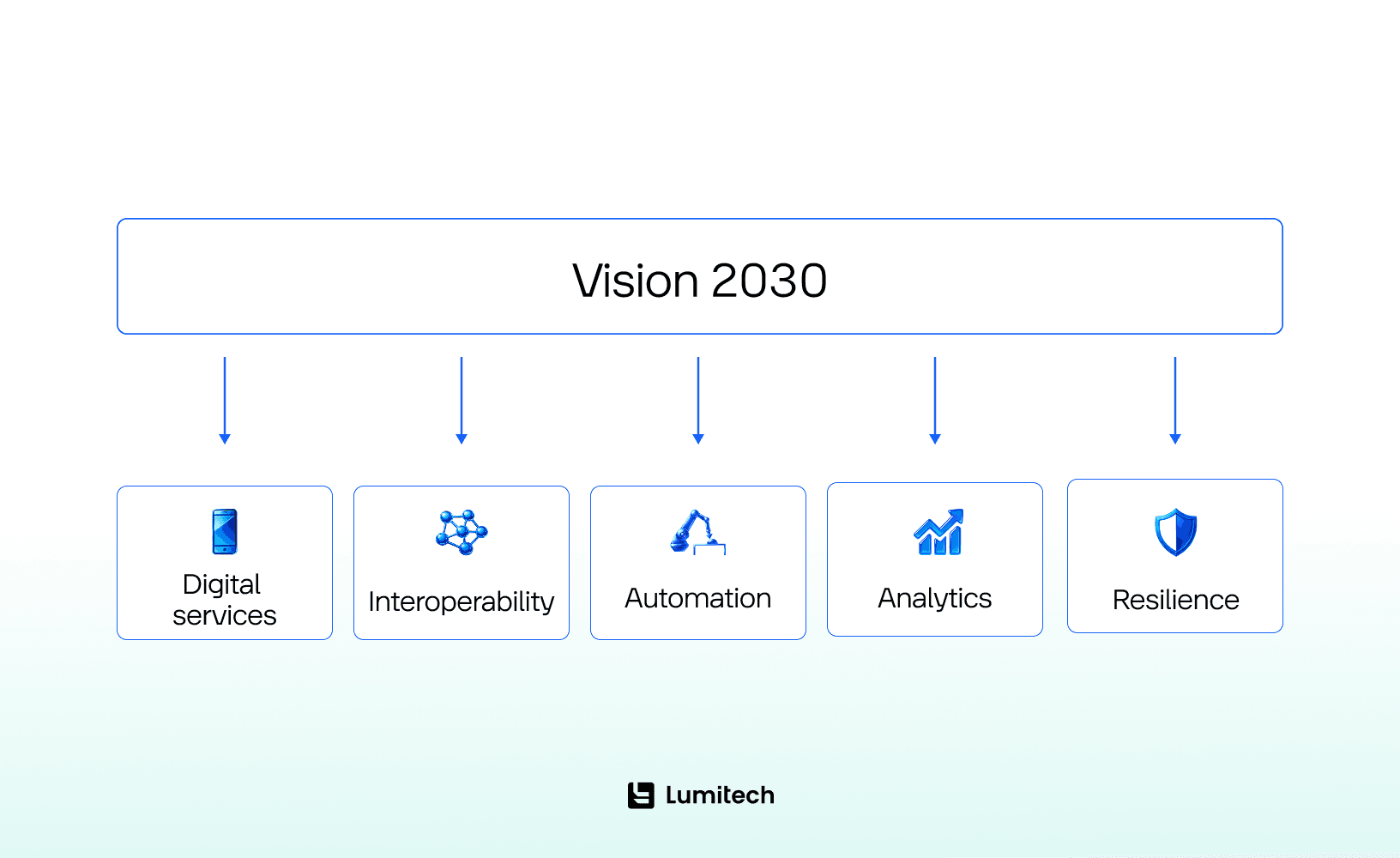
Software modernization in Saudi Arabia’s Vision 2030
Modernization helps turn national strategy into operational reality. It allows enterprises and public-sector entities to:
Digitize slow, manual workflows
Improve customer and citizen experiences
Connect legacy platforms to newer services
Support evidence-based decision-making
Respond faster to transforming market and regulatory demands.
That is why software modernization in Saudi Arabia's Vision 2030 is not only about upgrading old applications. It is about making software capable of supporting the Kingdom’s broader economic and institutional transformation.
Where the impact is most visible
Some of the clearest examples appear in sectors already moving through Vision 2030 programs.
In financial services, Saudi Arabia’s Open Banking Program is one of the key fintech initiatives under the Financial Sector Development Program, itself part of Vision 2030. That kind of ecosystem depends on secure, API-ready, modern platforms rather than rigid legacy cores.
In healthcare, the Health Sector Transformation Program focuses on innovation, digital solutions, expanded e-health services, and better service quality. Those goals are much easier to achieve when hospitals, providers, and health platforms are not trapped inside outdated software stacks.
What modernization enables in practice
Modernization helps Saudi organizations to:
Create reliable digital channels
Enhance interoperability between systems
Enable automation and analytical capabilities
Improve resilience and continuity of service
Build infrastructure that can evolve as new demands arise in the sector.
Simply speaking, modernization is where strategy meets execution. Without modernization, the digital ambition remains in the presentation, and operational delivery is delayed by slow delivery, fragile integration, and treating all change requests as personal attacks.
The bigger takeaway
Modernization and Vision 2030 are closely related because both require software to be agile in its operations and secure, enabling the organization to meet its transformation goals outlined in the vision document. Although classic systems (legacy systems) operate correctly, they rarely enable customers to conduct their business at the speeds envisioned by the Vision 2030 program.
What Challenges Do Saudi Enterprises Face When Modernizing Legacy Systems?
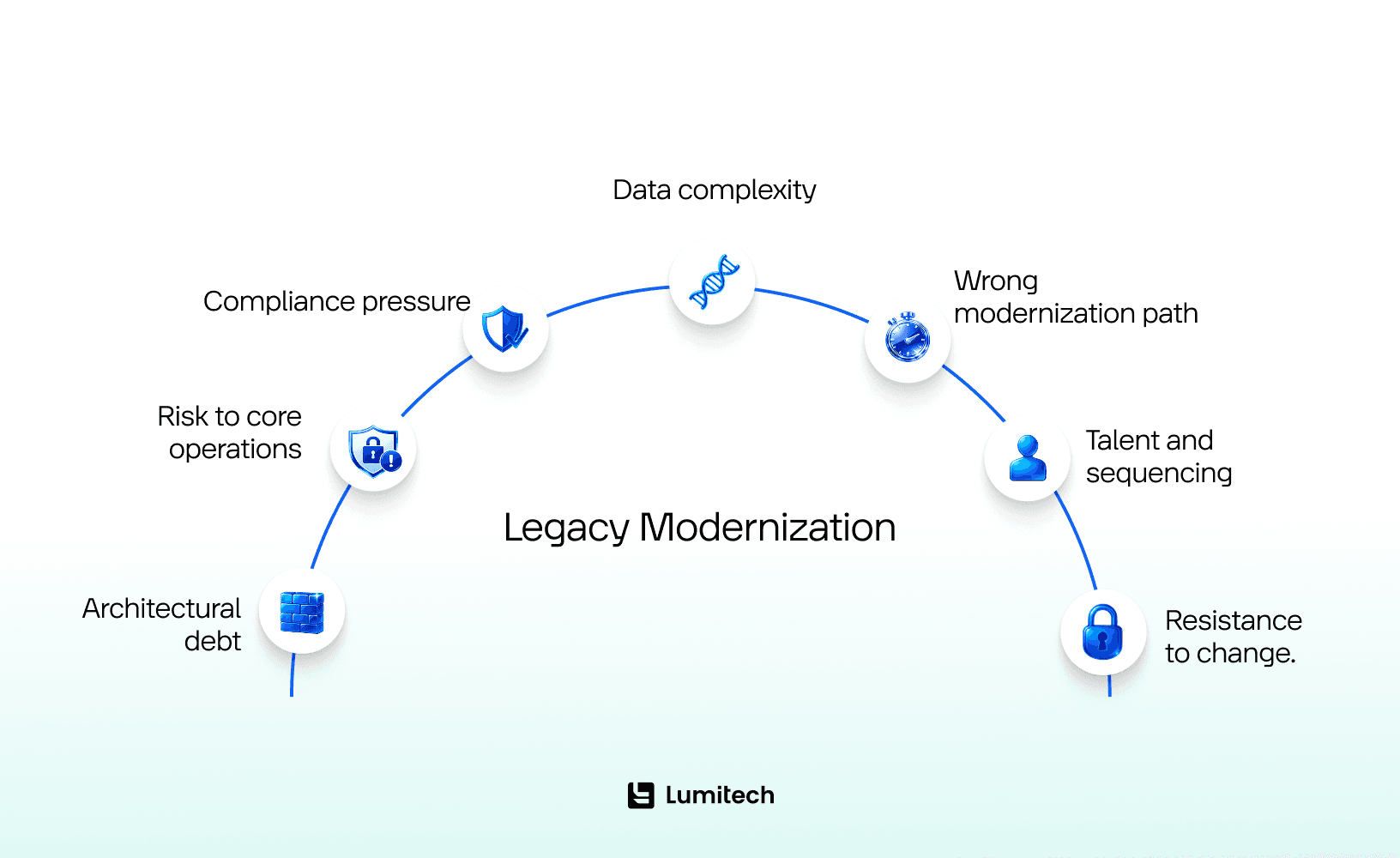
For most businesses, updating old systems is a balancing act between keeping the business running, meeting regulatory requirements, dealing with old architecture, and the need to show progress without disrupting important operations.
1. Architectural debt
The first challenge is the legacy stack itself. Older systems are often tightly coupled, poorly documented, and full of custom integrations that have been patched over for years. That makes even simple changes harder to estimate and riskier to execute.
This is one of the biggest obstacles to legacy system modernization in Saudi Arabia: companies are not replacing a single application, but untangling an entire ecosystem of dependencies.
2. Risk to key operations
Many Saudi enterprises run platforms that support daily operations, customer service, payments, internal workflows, or regulated transactions. In financial services, that challenge often takes the form of core banking modernization, where even small architectural changes can affect transaction processing, compliance controls, and customer-facing channels simultaneously. These systems cannot simply be switched off for a redesign.
That is why modernizing mission-critical systems in Saudi Arabia requires staged rollouts, fallback plans, coexistence models, and heavy testing. The technical challenge is not only building the new environment, but doing it while the old one is still carrying a real business load.
3. Compliance and regulatory pressure
In Saudi Arabia, modernization must often follow privacy laws, cybersecurity rules, rules that are specific to certain industries, and local expectations about how to handle data and control it. That makes delivery more complicated, especially for companies in the financial services, healthcare, insurance, telecom, and government sectors.
4. Data complexity and governance
Legacy systems usually come with messy data: duplicate records, inconsistent structures, missing ownership, weak lineage, and business rules hidden inside old forms or manual processes. If that data is moved or integrated without proper review, modernization can simply transfer old havoc into a newer interface.
That is why data governance matters so much. The more critical the data, the less room there is for vague ownership and “we’ll clean it up later” thinking.
5. Choosing the wrong modernization path
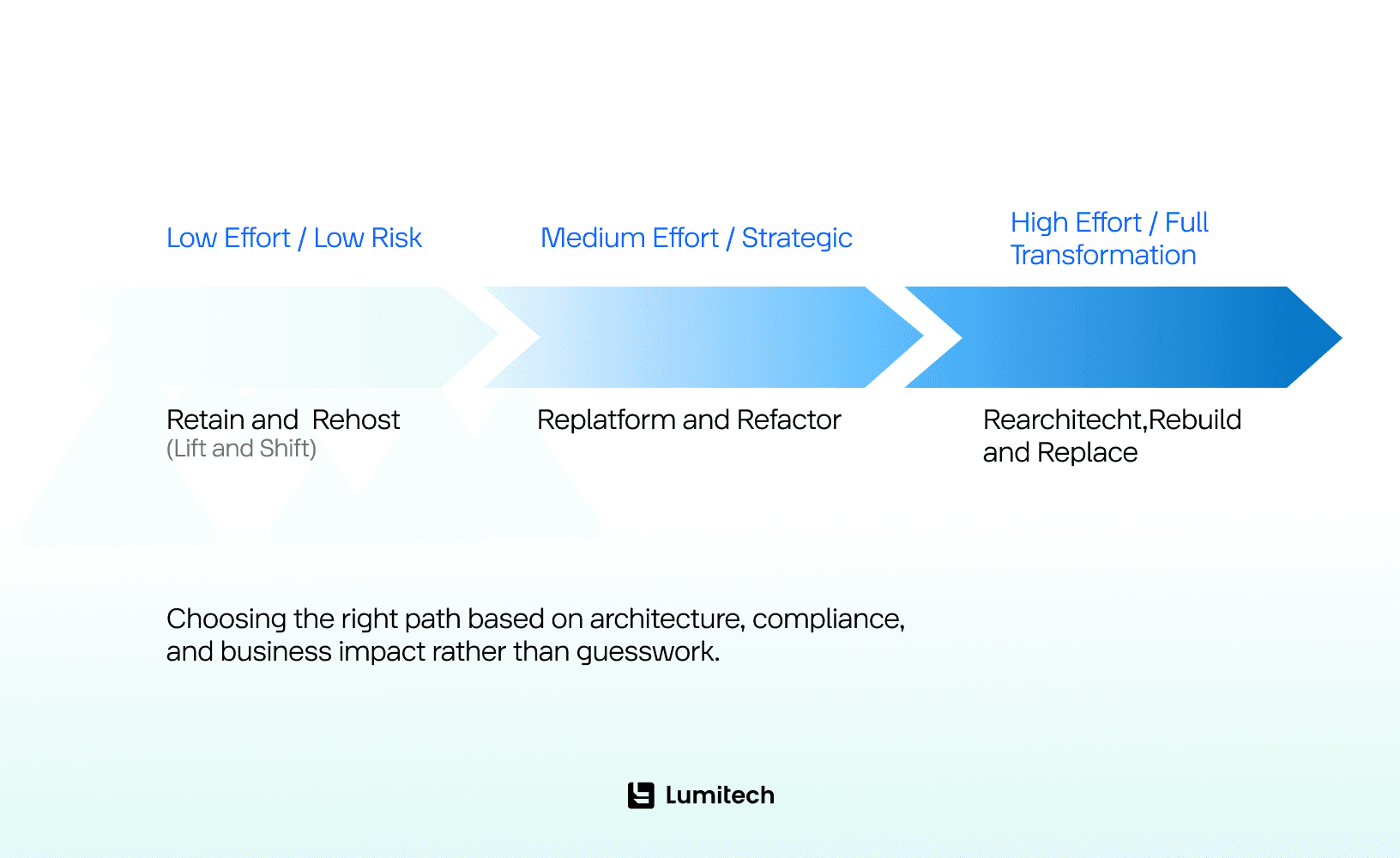
Rebuilding legacy systems from ground zero isn't always the best solution. While some may warrant rehosting, re-platforming, refactoring or replacing, the biggest challenge lies in determining which option best fits which workload.
This is where application modernization consultants in Saudi Arabia are often brought in to help enterprises make those decisions based on architecture, compliance, cost, and business impact rather than guesswork or internal politics.
6. Talent, sequencing, and delivery discipline
Although organizations are aware of their need to improve their technologies frequently, they regularly struggle with execution. Teams may lack modernization-specific experience, underestimate integration risks, or try to transform too much at once. This is one reason enterprises often carefully compare the best app modernization companies: the real differentiator is usually execution discipline, not presentation quality. That usually leads to delays, overspending, and programs that look impressive on paper but are fragile in practice.
Enterprise software modernization efforts will be successful for large companies when the development of the roadmap is done in stages, is realistic, and is based on the business priorities of the company rather than on abstract goals.
7. Resistance to change
Some of the hardest problems are not in the code. They are in the habits built around it. Legacy systems usually survive because users know their workarounds, teams trust familiar processes, and every odd exception has someone ready to defend it.
This is one reason why companies should modernize legacy systems sooner rather than later: the longer outdated platforms remain in place, the more organizational behavior hardens around them, and the harder significant change becomes.
The bottom line
The biggest challenge of software modernization services in Saudi Arabia is not agreeing that change is necessary. Most enterprises already know that. The real challenge is modernizing carefully enough to reduce risk, meet compliance expectations, and improve the business without creating a larger mess than the legacy system they started with.
The Blueprint: How to Handle Legacy System Modernization in Saudi Arabia
So, how to modernize legacy software in Saudi Arabia? Moving from a monolithic architecture to a modern, microservices-based environment is not a weekend project. In the context of enterprise software, success requires a surgical approach rather than a “rip and replace” mentality. That usually starts with a clear data migration strategy so the organization knows what data moves, what stays, what must be transformed, and how risk will be controlled during the transition.
1. Assessment and “The 7 Rs”
Before you touch a single line of code, you must categorize your legacy assets. Legacy modernization services typically use the “7 Rs” framework:
Retain: Leave it unchanged if it still provides value and isn't a security risk.
Rehost: The “Lift and Shift” to a local Saudi cloud provider.
Replatform: Move to the cloud but swap out the underlying OS or database for a managed service.
Refactor: Rewrite parts of the code to take advantage of cloud-based features like auto-scaling.
Rearchitect: Completely change the architecture (e.g., moving to microservices).
Rebuild: Start from scratch. Often necessary for crucial legacy system modernization in Saudi Arabia.
Replace: Scrapping the custom legacy app for a modern SaaS solution.
2. Choosing the Right Partner
The “Saudi-First” requirement means you can't just hire any global firm. You need providers that offer software development in Saudi Arabia, understand the details of the Vision 2030 digital framework, and have established relationships with local data centers to ensure enterprise software compliance in Saudi Arabia.
Modernization for Regulated Industries in Saudi Arabia
Not all businesses in the Kingdom are the same. Regulatory heat is much higher in fields like Finance, Healthcare, and Energy. The same goes for legacy modernization for insurance firm environments, where policy systems, claims workflows, customer data, and reporting requirements are often very intertwined and hard to change without careful planning.
Banking and Fintech
Open Banking is now possible thanks to SAMA (the Saudi Central Bank). But old Core Banking Systems are known for being very hard to change. Modernization for regulated industries in Saudi Arabia means putting an "API-first" layer on top of old systems. This lets traditional banks offer fintech-like speed while keeping the hard work in their secure, compliant backends.
Healthcare and Seha Virtual Hospital
As telemedicine becomes more popular, healthcare providers are making it a priority to update their secure software. We are moving old patient records to new systems that follow HL7/FHIR standards and can connect to national platforms. This makes sure that a patient's data is always available, no matter where they are in Riyadh or Jeddah, while still keeping strong data sovereignty.
What “Good” Looks Like in the Saudi Context
The modernization in the Kingdom assumes software applications designed to run quickly and work in the local context.
The product provides an ability to support compliance with local regulations, maintain respect for data sovereignty where applicable, meet security requirements, and connect to sector community ecosystems. Modernization gives the organization access to cloud computing technology, APIs, data analytics, and process automation while maintaining the trust of the organization’s operational systems.
That kind of flexibility matters whether the organization is running a national-scale enterprise platform or something more specialized, such as an angel syndicate investment platform for a Saudi family office, where security, governance, and speed must coexist.
That is why to get the real benefits of software modernization in Saudi Arabia, don't just think of technical upgrades. Think about how you're redesigning your business processes and how software can support that. In Saudi Arabia, this generally means aligning innovation with jurisdictional requirements, speed with compliance, and cloud advantages with local accountability.
The winners are usually not the companies that modernize everything at once. They are the ones that modernize the right things in the right order, with compliance along with resilience treated as design inputs rather than unpleasant surprises.
Conclusion
The rapid development of Saudi Arabia has changed the technological scene. For software providers to thrive over the next few years, they must be flexible. Traditional heavyweight software applications have been classified as stable. Providers who will succeed in this market will be those that treat modernization as an integral part of their overall business strategies (architecture, risk management, compliance, and business acceleration).
That is the real value of software modernization in Saudi Arabia. It allows them to evolve and transition away from their legacy limitations and towards operational effectiveness, and to also go from a culture of "work-around" solutions to scalable execution and from being patchwork integrated to being able to take advantage of true platforms that can support the digital future of the Kingdom.


