
The Insider’s Advantage: How to Choose a Software Vendor in Saudi Arabia
In Saudi Arabia, vendor choice depends on market fit as much as delivery. Your product has to work for Arabic users, local payments, PDPL, data residency, and post-launch pressure. A good team builds software. The right one builds for Saudi reality.
- Digital transformation
May 11, 2026
 AI Overview
Choosing a software vendor in Saudi Arabia affects far more than delivery timelines and development costs. The right partner should understand local regulations, data residency requirements, Arabic-first user experiences, and the realities of operating in the Saudi market. A structured evaluation process helps businesses compare vendors objectively, avoid costly mistakes, identify red flags early, and select a team capable of supporting long-term growth rather than simply delivering a project.

How do you choose a partner in a market where digital expectations are already high? In 2026, Saudi Arabia’s Digital Government Authority launched the fifth edition of the Digital Experience Maturity Index, with 61 selected digital platforms participating in the assessment across beneficiary satisfaction, user experience, complaint handling, and technology use. For any new app in KSA, this sets the benchmark: users are well-accustomed to fast, bilingual, and reliable digital services.
So the real question is not, “Can this vendor build it?” It is, “Can they build it properly for Saudi Arabia?”
This guide explains how to choose a vendor for software development services in Saudi Arabia using practical selection criteria, contract checks, pricing signals, and red flags - so you can avoid teams that learn the Saudi context at your expense.
What Saudi Arabia’s Digital Ambitions Mean for Your Vendor Decision
Saudi Arabia is not quietly modernizing; it is building at scale and on a deadline. Vision 2030 technology initiatives have already produced national digital identity infrastructure, government super-apps, and smart city programs across Riyadh, Jeddah, and NEOM. These market trends in software development are not aspirational; they are part of the daily user experience.
This creates a higher baseline for any new product. Whether you are building enterprise software, generative AI solutions, or government-grade systems, your work will be measured against the digital transformation services users already trust, such as Absher, Nafath, and Tier-1 banking apps.
In this environment, vendor choice becomes a direct product risk. An inexperienced team may write functional code but miss the vital conditions around it: Arabic UX designed as an afterthought, payment flows that fail in local edge cases, or compliance gaps that force costly architecture changes. In fintech, healthcare, and government software development services, these factors are not refinements; they define whether the product can survive in Saudi reality.
Define Your Project Goals Before Contacting Vendors
Most evaluations fail before they begin. Vague briefs force vendors to fill gaps with assumptions, leading to costly change requests and missed expectations later. Before seeking quotes, define the specific change the software must enable: Are you ready for the next wave of Saudi digital sovereignty, or are you still dealing with legacy system modernization in Saudi Arabia that can’t talk to modern government APIs?
This context matters because delivery partners cannot estimate properly from a feature list alone. They need to understand the business process behind the product, who will use it, what systems it must connect to, and which constraints cannot be ignored.
Your brief or RFP (Request for Proposal) should explicitly cover:
Business outcome: The core problem and expected results.
Target users: Roles, bilingual requirements, and RTL (Right-to-Left) UX.
Scope: Must-have features for the first release versus future phases.
Constraints: Data residency, security compliance, and budget range.
Specific preparation filters out unqualified providers early. The clearer your goals, the more honest and accurate the proposals you will receive from the best IT companies in Saudi Arabia.
Planning a software project in Saudi Arabia? Lumitech helps you choose the right delivery model, avoid vendor lock-in, and build for Arabic users, local integrations, and long-term growth.

Criteria for Choosing a Software Vendor in Saudi Arabia
A structured vendor screening process helps you move beyond price and presentation. The criteria below serve as a practical software vendor evaluation checklist (Saudi Arabia) to help compare the factors that separate reliable partners from costly ones.
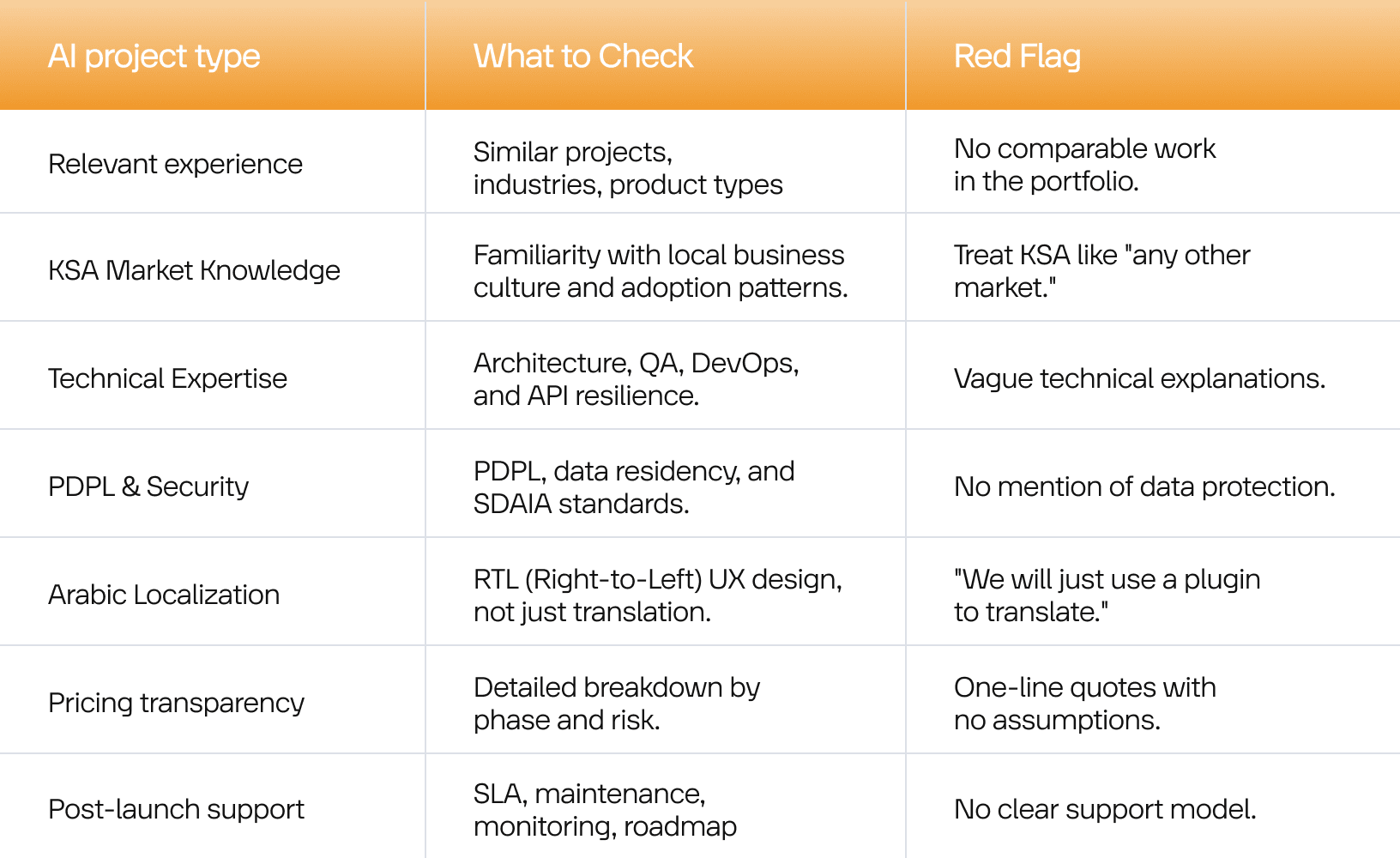
What to verify: While checklists cover the basics, the real challenge is context. Knowing how to choose a software vendor in Saudi Arabia means looking beyond code to how a partner navigates the Kingdom’s unique regulatory and cultural demands. Market experience and compliance awareness are the most common omissions in proposals - and the costliest to discover late.
How to Verify Saudi Market Experience?
Saudi market experience is difficult to fake; it reveals itself in how a team discusses approval cycles, RTL (Right-to-Left) UX, and local procurement. A company with real KSA history won’t just talk about code; they will ask about your ZATCA phase, your Nafath sandbox access, and your SDAIA data classification. In Riyadh, projects require formal governance and patience for multi-stakeholder approvals, which differ significantly from those in other regional hubs.
Do not accept a general “Middle East” portfolio as proof. When comparing software companies in Riyadh or evaluating a software outsourcing company in Saudi Arabia, demand KSA-specific examples. Verify their experience with local data residency laws and their understanding of business culture in Saudi Arabia - particularly how enterprise decision-making, stakeholder approvals, and procurement processes differ from other markets.
Local presence helps for workshops, but a hybrid model often works better: local strategy paired with strong technical execution. The top companies in Riyadh will not just have a plan; they will have stories — real ones — about navigating the regulatory and cultural realities that shape software development in the Kingdom
How to Evaluate a Software Vendor’s Technical Expertise
A long list of frameworks does not prove the technical expertise of software companies in Saudi Arabia. Real competence shows in how a team explains architecture, scalability, and risk. A capable partner won’t hide behind buzzwords; they will explain why a setup fits your product, where integrations might fail under pressure, and which decisions are expensive to reverse. In the Saudi market, practical resilience is key: ask about traffic spikes, failed API calls, and compliance traceability.
The delivery process is as vital as the code. A reliable company has a clear path from discovery to backlog, with QA integrated into the workflow. Verify their CI/CD setup, secure development practices, and handover structure. Documentation, environment access, and code ownership must be settled before signing, not at the end of the project.
A strong team won’t simply agree to everything. They challenge weak assumptions, explain trade-offs, and prioritize critical security and compliance over cosmetic “nice-to-haves.” The right partner for custom software development Saudi Arabia builds what actually works in a regulated, business-critical environment — not just what you asked for.
What Should a Vendor Know About PDPL and Data Security?
PDPL must shape the project from the discovery phase. A team working in KSA should understand how the Saudi Personal Data Protection Law affects hosting, access, logging, and backups.
Experience shows in the questions they raise: Where will data live? Are backups in-region? A competent provider understands SDAIA licensing and data sensitivity levels (Public, Restricted, Secret) and aligns technical design with your DPO’s requirements.
Data residency in Saudi Arabia involves strict cross-border restrictions, even for logs. This dictates cloud selection and architecture early on. PDPL also requires deep audit logging from the start to prove who accessed data and when.
A vendor should recognize when data protection becomes a technical decision — and raise it before you do. The questions they ask early reveal their compliance capabilities more clearly than any assurance they give later.
“If an external team has not raised these points before you did, that is already an answer about how they will handle compliance during the project.”



How Important Is Arabic Localization for Saudi Software?
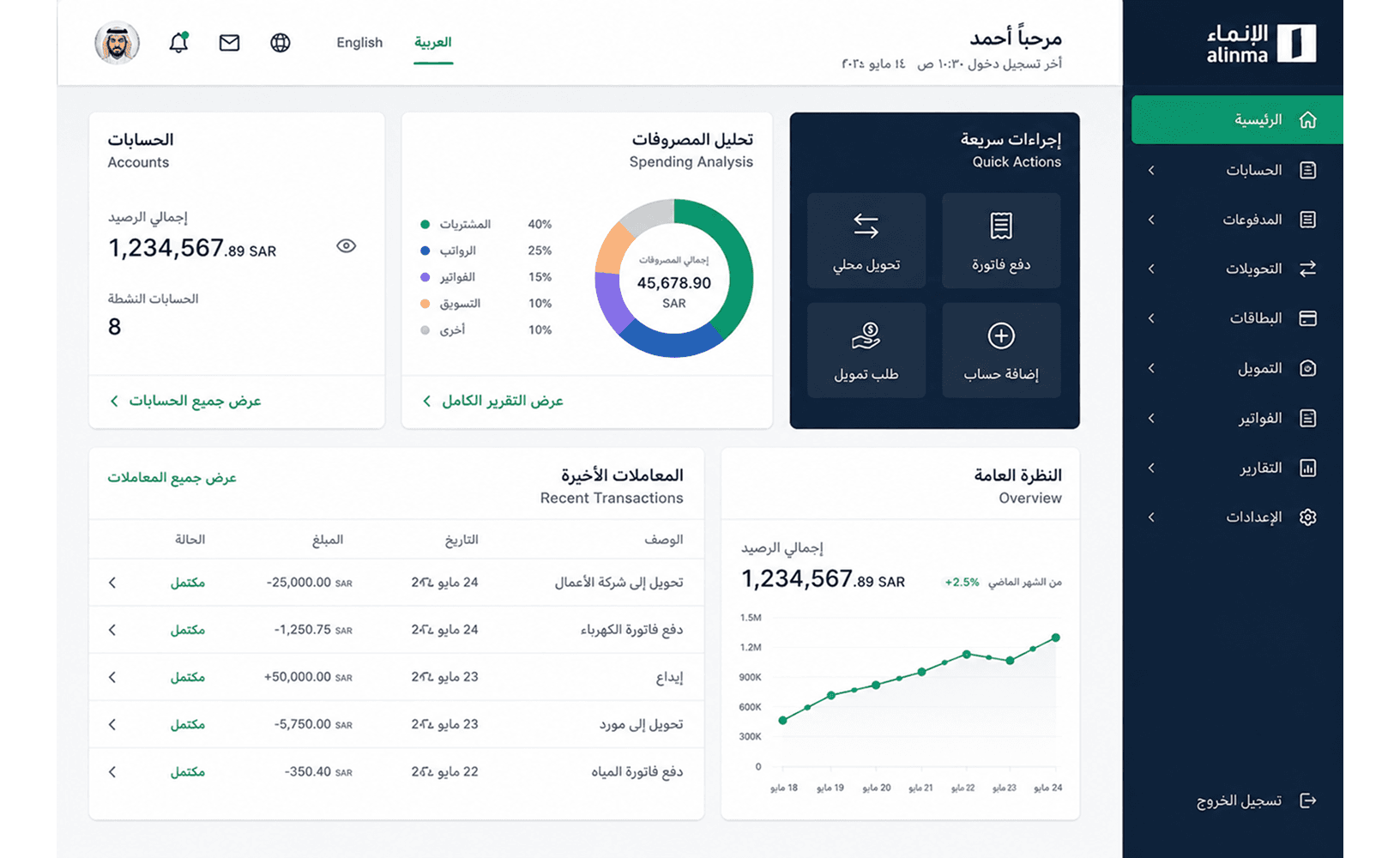
Software localization for Saudi Arabia operates at the structural level, not the linguistic level. A functional bilingual software interface requires RTL layout logic built into the architecture, typography adjusted for Arabic character rendering, mirrored navigation patterns, and validation by Arabic-speaking users during design—not after development.
Quality erosion typically starts here. Arabic content gets retrofitted into left-aligned layouts, breaking form structure and data grid alignment. Date and currency formatting follow English conventions. Bilingual labels appear without consistent directional logic. QA often treats Arabic as optional, leaving these issues undetected until launch.
The vendor’s approach reveals itself early. A capable team discusses localization during discovery, not as a final-sprint task. For mobile products, this becomes critical — RTL layout errors surface immediately on constrained screens and compound under real user behavior. When evaluating mobile app development companies in Saudi Arabia, verify they can demonstrate shipped Arabic-first or bilingual interfaces from production environments, not design artifacts.
Check Local Integrations and Infrastructure Requirements
Saudi integrations test both technical skill and local experience. A company unfamiliar with Nafath, Mada, ZATCA, or government platforms may underestimate the effort required for documentation gaps, restricted test environments, and production-only edge cases.
The main integration areas cover payments, invoicing, identity, and government data. That often includes Mada, STC Pay, ZATCA FATOORA, Nafath, Absher, Muqeem, and SDAIA APIs. Combined with legacy systems and local hosting, the scope becomes significantly more complex than a standard API connection.
Consider, for example, an angel syndicate investment platform: what appears as a focused product quickly requires investor verification, payment logic, compliance checks, and government identity flows. In projects like this, data migration challenges need early discussion — especially when migrating financial data, user permissions, or audit trails to a new system without losing accuracy.
What to verify: Ask which Saudi integrations the company has completed and what sandbox or certification issues they faced. A partner with real experience will provide specific examples; one without will stay vague.
Compare Pricing Models and Software Development Cost in Saudi Arabia
Software development costs in KSA are easier to compare when estimates are broken down by phase, risk, and compliance scope. A low quote may look appealing, but it typically signals incomplete scoping — especially around PDPL implementation, Arabic localization depth, or local integration complexity. Before choosing a partner, understand which factors actually shape the budget and where hidden costs tend to surface.
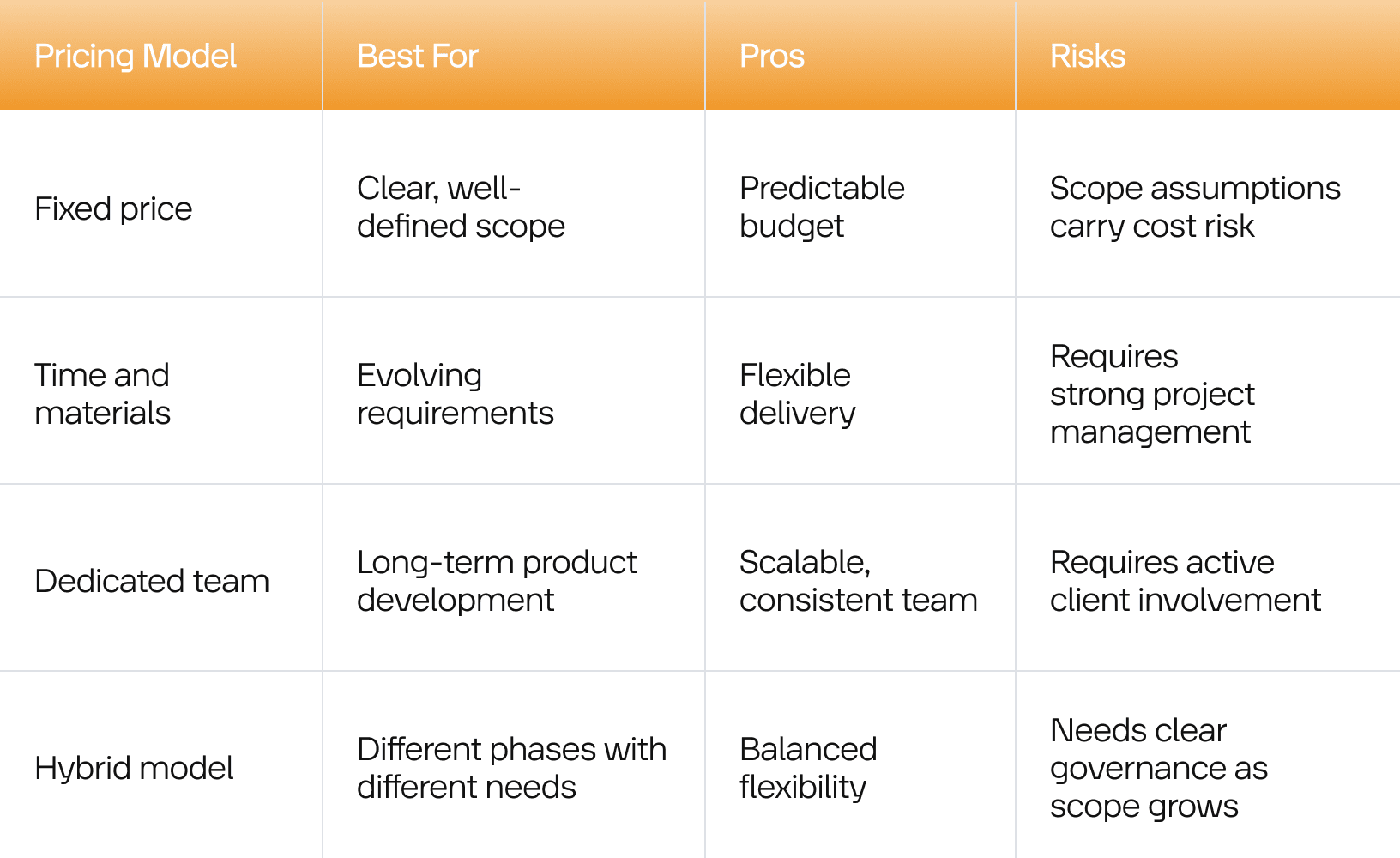
Time and materials means you pay for actual hours worked: the scope can evolve, but so can the invoice. A dedicated team is a group of engineers assigned exclusively to your product, typically for several months or longer. A hybrid model combines a fixed scope for the initial phase with flexible delivery as the product grows.
What to verify: MVP costs vary significantly from those of complex enterprise AI or legacy modernization solutions. Final pricing depends on discovery: scope, integrations, and compliance. In any software development proposal evaluation, a detailed breakdown reveals process, while a one-line quote reveals risk. If a Riyadh software development vendor cannot itemize costs by phase and function, they haven’t planned the project - they’ve only planned the sale.
Clarify Contract Terms, IP Ownership, and Source Code Access
Bad contract terms can turn a software project into a serious business problem. Before you sign with a software development company in Saudi Arabia, make sure there is no gray area around source code ownership, IP rights, what happens when ownership moves to you, and what happens if the cooperation stops.
The agreement should clearly describe the scope of work, payment milestones, deliverables, acceptance criteria, responsibilities, confidentiality, warranties, support terms, security obligations, and termination rules. Use an NDA (Non-Disclosure Agreement) when you share sensitive business information, product plans, customer data, or internal workflows.
If the company supports production software, include an SLA (Service Level Agreement) that defines response times, support hours, and what happens when something breaks in production.
Do not treat source code access as a minor detail. Your company should have access to repositories, documentation, deployment instructions, infrastructure diagrams, and credential handover procedures. Avoid a setup where the provider keeps all the control, and you cannot move the product without them.
What to verify: Ensure the contract answers one question: if the relationship ends, can you own, access, and maintain the product without being locked in? Ultimately, knowing how to choose a software vendor in Saudi Arabia is about shielding your business from technical debt and aligning with the Kingdom’s digital future.
What Should Post-Launch Support Include?
Post-launch support is where a vendor’s responsibility becomes visible. Once the product is live, real users, real traffic, and live integrations start to test the system in ways staging environments never fully can. That is why support terms should be agreed upon before the contract is signed.
A reliable team should define what happens after release: maintenance, SLA terms, monitoring, bug fixes, security updates, incident response, and minor product improvements. For business-critical systems such as payments, customer accounts, booking flows, or operational dashboards, response times and escalation rules need to be clear.
What to verify: Ask how the vendor handles production issues, version updates, cloud costs, dependency upgrades, and feature requests after launch. A mature team will have a support model with clear terms. Without it, support usually depends on informal promises.
How to Choose a Software Development Company in Saudi Arabia: Red Flags to Avoid
A polished proposal can tell you a lot, but the smaller details often tell you more. During vendor evaluation, pay attention to how clearly the team explains scope, pricing, ownership, QA, PDPL, Arabic UX, and post-launch support. These signals help you understand whether the vendor is ready for a serious Saudi software project.
So, what are the red flags when choosing a software vendor? The most important warning signs are:
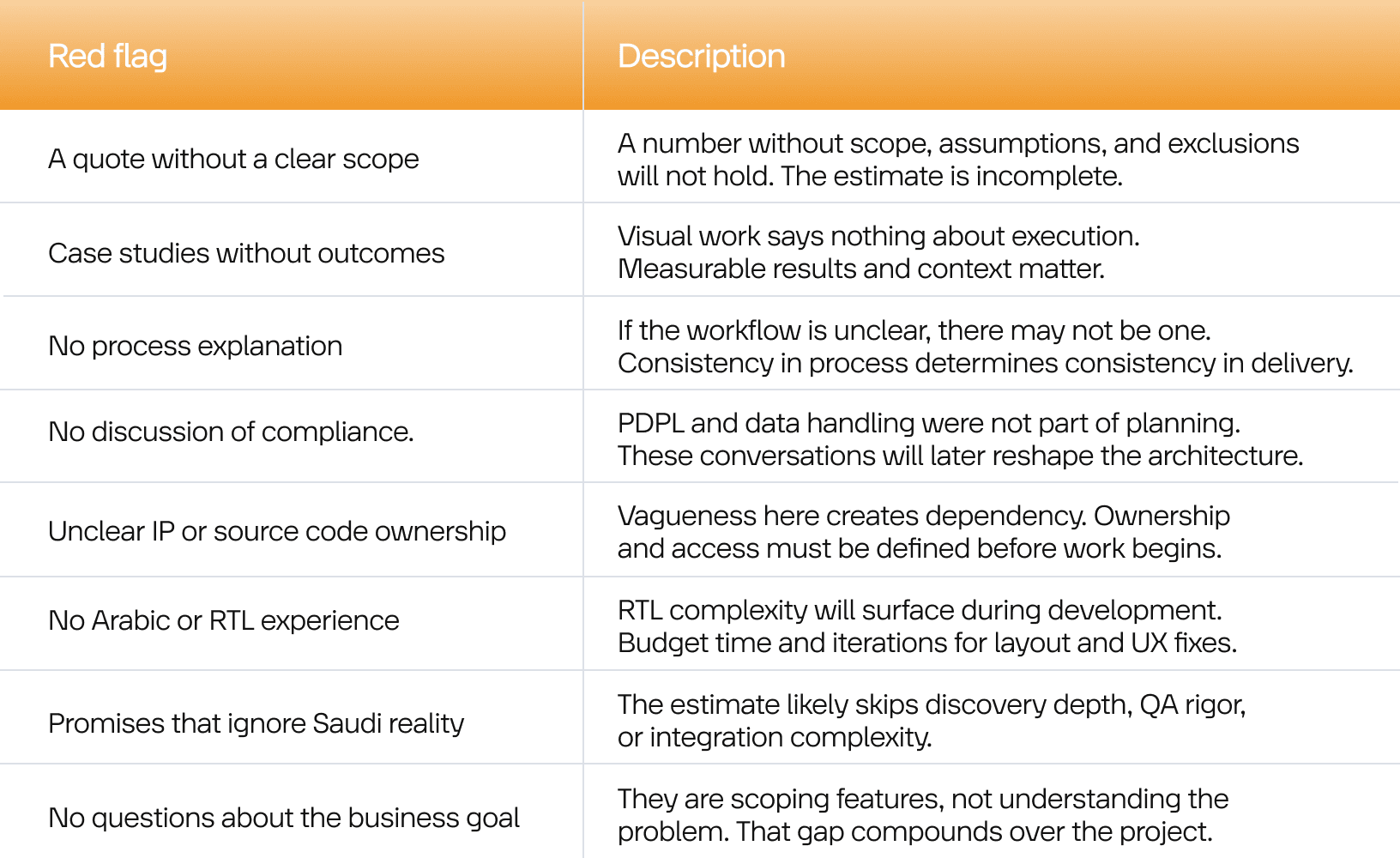
One red flag may be manageable. Several together usually indicate high delivery risk. If a team is unclear before the contract, they are unlikely to become clearer after payment begins.
Software Vendor Selection Checklist for Saudi Arabia
If you are deciding how to evaluate software development company in Saudi Arabia, a portfolio alone will not tell you much. The stronger signal is how the IT partner handles scope, Arabic UX, PDPL, integrations, ownership, and support after launch. Use this checklist to compare software vendors in Saudi Arabia before the project becomes expensive to change.
1. Start with the business goal: The more defined your goals, the more effectively you can apply vendor shortlist criteria, and the more accurately the team can respond.
2. Check relevant experience: Ask for case studies close to your industry, product type, or technical complexity with outcomes and client reviews.
3. Test Saudi market knowledge: They should understand KSA users, business culture, regulations, and local adoption patterns.
4. Review Arabic and RTL capability: Arabic localization needs proper UX planning, not just translated interface text.
5. Discuss PDPL early: Ask about data protection, hosting, access control, consent, and data residency before development starts.
6. Verify pricing transparency: The estimate should include scope, milestones, assumptions, and exclusions. A one-line quote is not a quote.
7. Understand how they deliver: The team should be able to explain discovery, design, development, QA, DevOps, security practices, demos, reporting, and handover without hiding behind jargon.
8. Clarify ownership: Confirm IP rights, source code access, documentation, and handover terms before signing.
9. Ask about support after launch: Check SLA options, bug fixing, monitoring, updates, and emergency response.
10. Check integration experience: Make sure the IT partner has handled local payments, identity platforms, ERP, CRM, and reporting systems, and can explain what went wrong and how they handled it.
11. Verify scalability planning: The team should have a clear approach to how the product grows after launch - infrastructure, performance optimization, feature roadmap, and support scaling.
Working through this checklist takes time. But it is time that saves you months of frustration later. The partner who understands your project, your market, and your concerns before you start is the one worth working with.
Final Words
Vendor selection is ultimately about judgment. The best choice is rarely the company with the longest pitch deck or the lowest estimate. It is the team that helps you understand the project more clearly before any work begins.
In Saudi Arabia, this decision matters because software is increasingly tied to the KSA’s digital transformation, operational quality, and long-term growth. A strong partner should bring both technical skill and real Saudi market expertise, including an understanding of users, business expectations, and the conditions the product will face after launch.
If you are comparing vendors for software development or AI development services, choose the team you would trust when the project becomes difficult - because every serious software project eventually does.


