Data Processing in Healthcare: Transforming Patient Care and Medical Research
Healthcare has never been more data-rich—or more overwhelmed by it. EHRs, labs, imaging, wearables, remote monitors, and apps generate constant data streams, yet clinicians and researchers still say: “I can’t get what I need when I need it.”
- Big Data & Analytics
- Health & Wellness
April 01, 2026
 AI Overview
As healthcare organizations manage growing volumes of structured and unstructured data, efficient processing becomes essential for improving care quality, supporting clinical decisions, ensuring regulatory compliance, and optimizing operations. The ability to process healthcare data accurately, securely, and at scale is increasingly shaping the future of connected and data-driven healthcare systems.

Data processing in healthcare is supposed to solve this problem. When it works, it turns noisy, fragmented inputs into clear, reliable signals that actually support patient care and medical research. When it does not, you just get more dashboards and more exports to Excel.
At Lumitech, we see this from the inside. For example, when we worked with Reputable Health — a company that runs real-world clinical wellness studies at scale — our job was to rebuild their AI engine, web platform, and mobile app while live studies continued running. It was a very concrete test of what automation in healthcare data processing looks like in production, not on a whiteboard.
In this article, we will look at:
the benefits of data processing in healthcare for patients, clinicians, and researchers;
why data processing in the healthcare sector is fundamentally different from other domains;
how real pipelines work, step by step;
and what it takes to turn healthcare data processing services into decision systems rather than just storage and charts.
Benefits of Data Processing in Healthcare
Data alone does not change care. But when it is processed and delivered properly, it unlocks a different way of working — more complete patient views, faster decisions, earlier interventions, smoother operations, and stronger research.
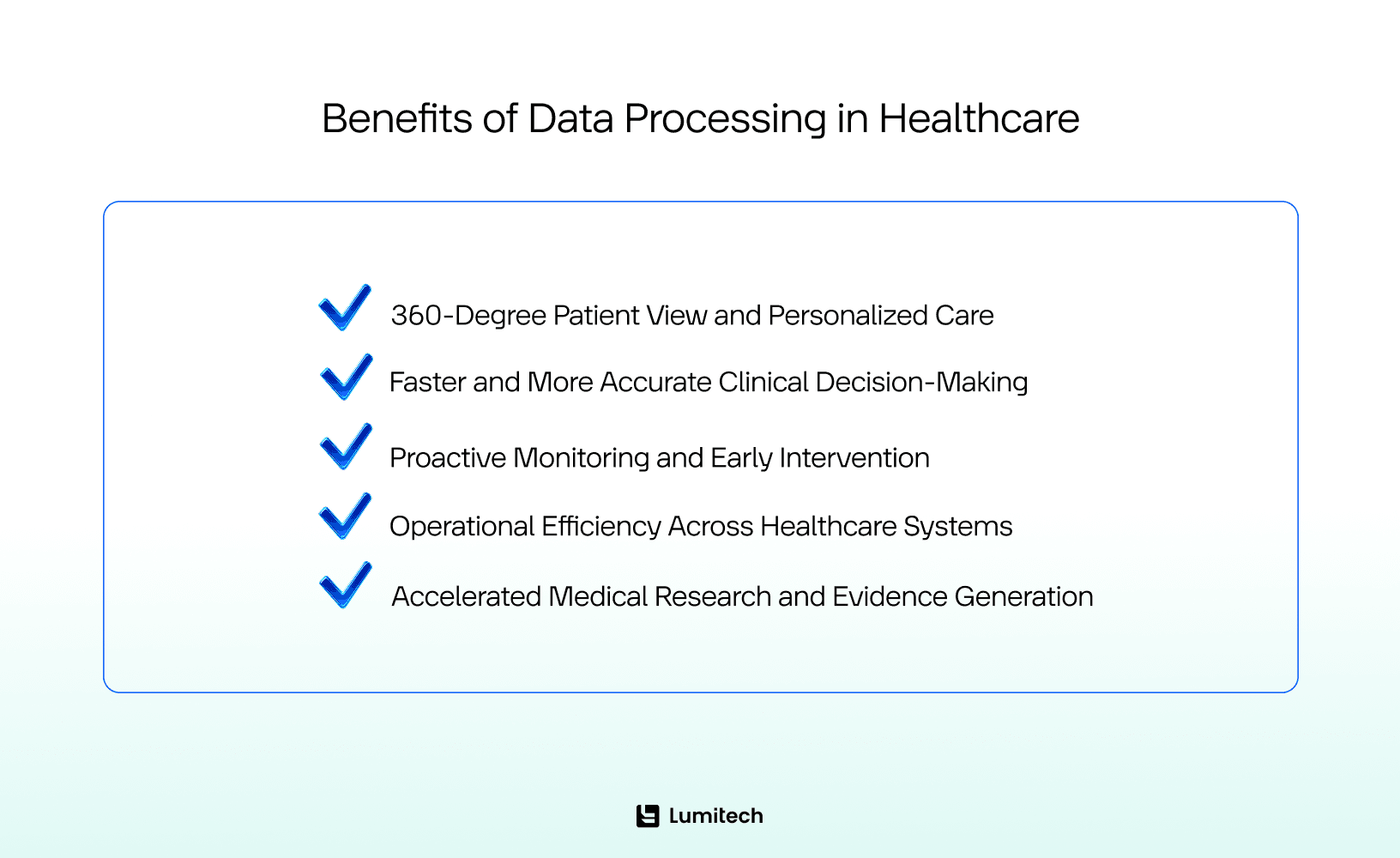
360-Degree Patient View and Personalized Care
A 360-degree patient view is not just a nicer UI; it fundamentally changes how clinicians reason about a case. Instead of jumping between tabs and systems, they can see:
medical history from the EHR;
current and recent lab results;
continuous streams from wearables and home devices;
subjective inputs from surveys or notes.
When these sources are processed and linked, medical data processing stops being an internal IT topic and becomes visible in daily decisions. A cardiologist can see how a patient is sleeping and moving between visits. A diabetes team can combine glucose measurements, activity, and medication adherence in one place.
For example, we, at Lumitech, build an AI-driven research platform where unified profiles combine time-series signals with structured study data so clinicians and wellness teams can understand how people actually respond to interventions, not just what they report in a single visit.
This is where healthcare data processing begins to support personalized care — not one global protocol, but adjustments based on each individual’s patterns.
Faster and More Accurate Clinical Decision-Making
Clinical decisions are made under time pressure. If the system makes it slower or more confusing to find relevant information, people will avoid it, no matter how “advanced” it is.
Well-designed data processing in healthcare helps by:
aggregating new data quickly instead of once per day;
highlighting changes compared to baselines;
and presenting information in a way that matches clinical thinking (problems, trends, risk).
In practice, this might look like a clinician dashboard that shows key vitals and metrics with clear indicators of what changed since the last review, or a decision support view that surfaces only the most relevant findings from long records. As for the practical piece of evidence, in platforms like Reputable Health, the AI engine processes large volumes of wearable and survey data and updates outcomes dashboards frequently, so study teams can see how sleep or HRV evolves while interventions are still ongoing, not months later.
Proactive Monitoring and Early Intervention
Remote and continuous monitoring is a perfect example of why health data processing solutions matter. Without proper processing, you just create another firehose of raw signals that no one can reasonably watch. With the right pipeline, you get early-warning capabilities.
Data processing in the healthcare industry can:
transform continuous sequences into meaningful metrics;
detect early deterioration patterns (for example, trends in HRV or sleep fragmentation);
and surface those changes before a crisis happens.
In Reputable Health’s context, the platform ingests data from multiple devices (Apple Watch, Garmin, Oura, Whoop, etc.), processes more than 20,000 data points per user per day, and converts them into summarized health metrics that show whether a protocol is working or not. That same logic applies to clinical remote patient monitoring: you want systems that catch problems early and give clinicians enough time to act, not just tell them when it is already too late.
Operational Efficiency Across Healthcare Systems
The best practices for data processing in healthcare are not limited to clinical outcomes. There is also a very practical operational side: fewer manual steps, less duplication, more predictable workflows.
When data flows are automated and standardized:
administrative teams spend less time cleaning and merging exports;
research coordinators can launch and monitor studies without writing custom queries for each one;
compliance and reporting become more predictable rather than a last-minute rush.
For instance, Reputable Health’s rebuilt AI engine not only calculates metrics but also generates standardized outputs that support regulatory submissions (FDA, FTC, Health Canada) and internal reporting. That reduces the number of manual transformations needed and helps make operational efficiency in healthcare data processing visible in day-to-day work, not only in slide decks.
Accelerated Medical Research and Evidence Generation
Medical research is moving toward real-world data — not only controlled, small-scale trials. This shift is only possible if healthcare data processing is capable of managing large volumes of healthcare data and varied inputs in a reliable way.
In the Reputable Health ecosystem:
millions of data points from wearables and surveys are processed for each study;
the system translates them into clear outcomes, like changes in sleep performance or HRV;
and researchers and brands use these results to assess whether wellness products have measurable effects.
One of their studies, for example, demonstrated a 51% improvement in sleep and a 6.79% increase in HRV for participants using circadian lighting products, based on more than 12M data points processed by the platform. That is a concrete example of healthcare data processing accelerating evidence generation and making real-world validation practical, not just aspirational.
While these benefits are compelling, they come with a catch: healthcare is not just another analytics-heavy sector. It has its own rules.
Data Processing in Healthcare: What Makes It Fundamentally Different
From an engineering perspective, you might be tempted to say, “This is just ETL and analytics.” But data processing in the healthcare sector is woven into regulation, culture, risk, and workflow patterns that make it fundamentally different from, say, ecommerce or marketing.
Definition of Data Processing in Healthcare
Before we go deeper, it is helpful to define data processing in healthcare properly. It is not just “running queries on a database” or “putting data in the cloud”. It is an end-to-end system that:
collects data from multiple clinical and non-clinical sources;
stores and secures it under strict regulatory requirements;
cleans and standardizes it so that different sources can be compared;
analyzes it with statistical and AI methods;
and delivers results in forms that support clinical and research decisions.
The goal is not data itself — it is the decisions that follow. In Reputable Health’s case, the system exists to show whether wellness interventions actually move objective health metrics, and to do so reliably enough that regulators, clinicians, and businesses can trust the outcomes.
Data Types in Medical Data Processing
Medical data processing has to live with a mix of:
Structured data — lab results, vitals, diagnosis and procedure codes, medication lists;
Semi-structured data — FHIR resources, JSON responses from external APIs, device payloads;
Unstructured data — clinical notes, scanned documents, imaging reports, messages.
In reality, a lot of clinical context is still locked inside unstructured content, creating healthcare data standardization issues. Systems that only handle structured fields leave a lot of value on the table. In our projects we often see the need to merge structured metrics (like HRV, sleep scores) with unstructured or semi-structured inputs (like surveys or annotations) to get a full picture.
This is where healthcare data management becomes more than a database exercise. It touches NLP, signal processing, and sometimes computer vision or audio processing, depending on the data sources and chosen data processing strategies.
The Layered Nature of Health Data Processing Solutions
Health data processing solutions are usually built as layered systems. A typical structure includes:
a data collection layer that pulls data from devices, EHRs, and external services;
a preprocessing layer for cleaning, validation, and normalization;
an analysis layer where models and business rules run;
a presentation layer for dashboards, reports, and integrations back into clinical tools;
and a governance layer that ensures security, auditing, and compliance.
These layers are tightly coupled. If the collection layer is unreliable, the analysis layer will constantly “fix” issues instead of focusing on insights. If governance is weak, you may build an impressive prototype that cannot ever leave the sandbox. When we redesigned Reputable Health’s AI engine, we had to address several layers at once, because the bottlenecks — performance, integration stability, consistency of outputs — were spread across the stack.
Specific Examples of Data Processing in Healthcare
To ground this, here are some specific examples of data processing in healthcare that we see again and again:
Wearable data processing — ingesting continuous streams (often tens of thousands of points per user per day) and turning them into metrics like sleep efficiency, HRV, and activity indexes.
Medical imaging analysis — using algorithms and AI models to detect anomalies or measure structures, and feeding those results back into radiology workflows.
Clinical text processing — extracting key entities (diagnoses, medications, measurements) from unstructured notes to enrich structured records.
Real-time remote monitoring — combining device signals, alerts, and patient-reported outcomes into prioritized views for clinical teams.
Platforms like Reputable Health combine several of these aspects: wearable processing, survey analysis, and real-time monitoring of how people respond to wellness interventions. They show how different pieces of data processing can come together into one coherent system.
A closely related example is Lumitech’s work on conversational AI for wellness coaching, where user signals, check-ins, and behavioral patterns are processed behind the scenes and then surfaced through a coaching dialogue that adapts goals, nudges, and support in real time — turning the same data foundations into a more interactive, guidance-focused experience.
The Specific Challenges of Healthcare Data Processing
There are also clear challenges of healthcare data processing that explain why many projects stall:
Data silos and fragmentation — different departments and vendors keep their own systems and standards.
Data quality issues — missing values, inconsistent units, incorrect coding, interrupted streams.
Integration complexity — multiple EHRs, device providers, and third-party tools, each with their own formats and quirks.
Security and compliance constraints — HIPAA, GDPR, national regulations, and internal policies.
At Reputable Health, for example, the legacy AI engine had grown over several years, with changing requirements, partial documentation, and performance issues. Integrations with multiple device ecosystems made things even more fragile. That combination is very typical: systems that “kind of work” but cannot scale to more users, more devices, or more complex studies without serious refactoring.
These challenges in processing healthcare data are not edge cases — they are what you get by default unless you design around them.
Medical Data Processing Is Not the Problem—Usable Decisions Are
It is tempting to frame everything as a data pipeline issue. But if you look at failing or underused systems, the problem is rarely the absence of pipelines. It is the absence of usable decisions.
Healthcare systems already collect vast amounts of data. The core issue is that much of it never reaches the people who need it in a usable form. Raw data streams sit in databases. Dashboards do not match mental models of clinicians. Alerts are noisy or irrelevant, so people learn to ignore them.
In Reputable Health’s situation before the rebuild:
the platform was processing data, but results were slow and sometimes inconsistent;
the user experience on both web and mobile created friction;
internal teams had to do extra work to make sense of outputs and prepare reports.
It was a classic example of “data ≠ decisions”. The solution was not to simply add more processing, but to rethink how data flows, what gets computed, and how those results are presented to humans who have limited time.
This is a good lens for any organization. When you look at data processing in healthcare, ask yourself: are we building more plumbing, or are we making it easier for clinicians and researchers to decide what to do?
How Data Processing Works in Healthcare in Practice
Now, let’s connect the conceptual layers with how data processing works in healthcare day to day.
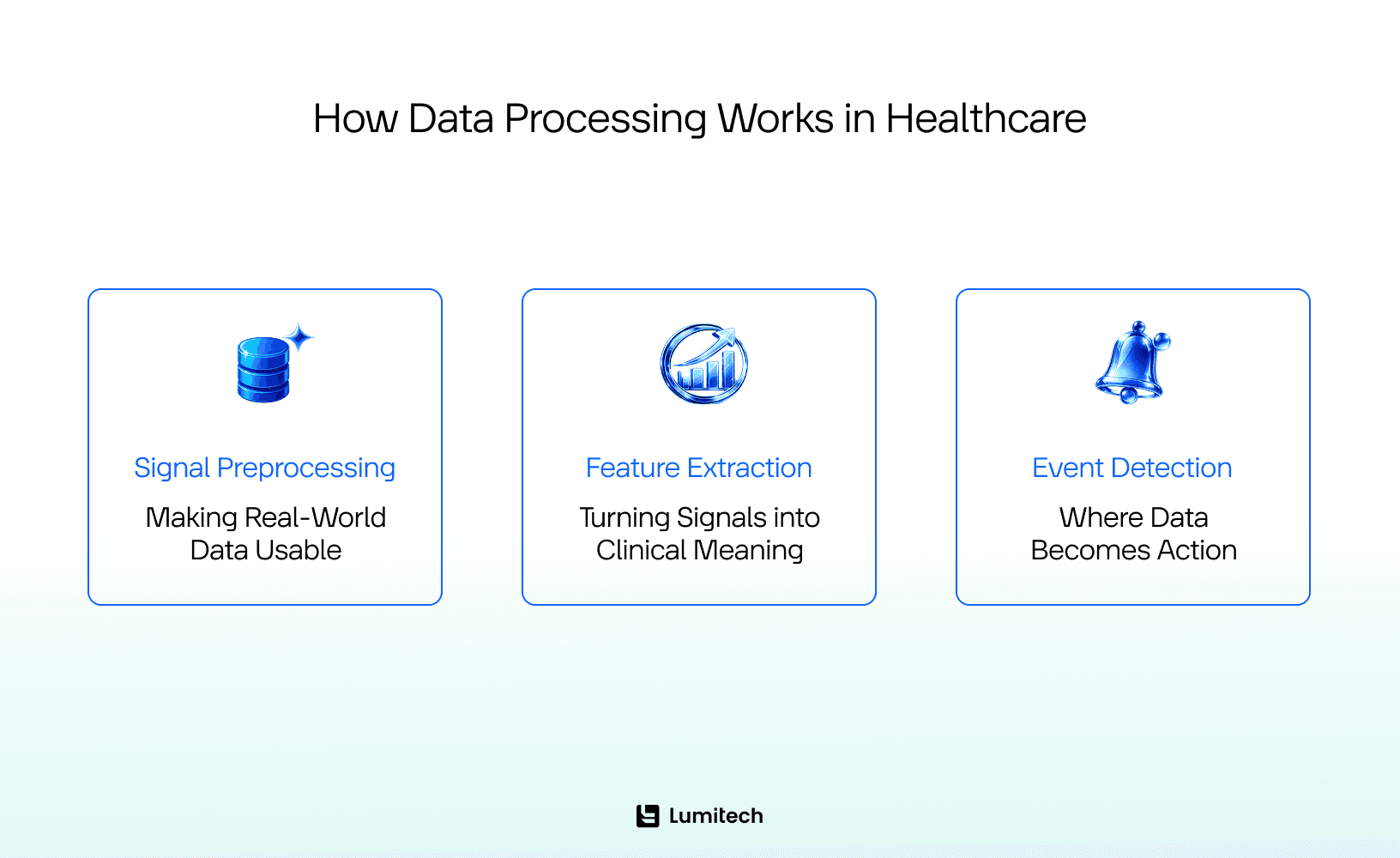
Signal Preprocessing — Making Real-World Data Usable
Real-world healthcare data — especially from wearables and remote monitors — is far from clean. Devices disconnect, people change routines, networks fail. Signal preprocessing is the stage where we make this data usable.
It typically includes:
filtering obvious artifacts;
handling missing data and partial sessions;
aligning time zones and sampling rates;
normalizing values from different device vendors.
In the Reputable Health AI engine, we had to design this layer for a multi-device ecosystem: Apple Watch, Garmin, Oura, Whoop, Fitbit, and others all sending data with their own logic and formats. Without solid preprocessing, everything built on top would have produced noisy, unreliable metrics.
Feature Extraction — Turning Signals into Clinical Meaning
Once the raw signals are cleaned, the system can move to feature extraction. This is where we transform noise into something that carries clinical meaning.
Depending on the use case, this may include:
computing HRV indices;
deriving sleep stages and sleep quality scores;
summarizing daily activity;
detecting patterns that align with specific conditions or interventions.
In Reputable Health, this step is critical: the engine converts continuous wearable streams into metrics that researchers and clinicians actually use to judge the effect of wellness products. This is a very concrete example of health data processing solutions turning low-level signals into high-level health indicators.
Event Detection — Where Data Becomes Action
Feature extraction on its own still leaves the question: what should we do with this information? Event detection is the layer where data becomes a candidate for action.
Event logic can be:
threshold-based (crossing specific limits for certain metrics);
model-based (anomaly detection or risk prediction using machine learning);
context-aware (combining several signals and clinical rules).
In remote monitoring or research setups, event detection might mark sustained deterioration in sleep or HRV as something to investigate, or flag participants who deviate significantly from expected patterns. In Reputable Health’s environment, the engine helps identify measurable outcomes and protocol effects instead of forcing analysts to compute everything manually.
However, even well-designed pipelines fail if they do not align with real workflows. Events need to appear in the right place (for example, a clinician dashboard or a study management view), at the right time, and at the right level of detail for effective healthcare workflow optimization with data.
Challenges of Healthcare Data Processing in Real-World Systems
Once you move from prototypes to production, theoretical pipelines meet real constraints.
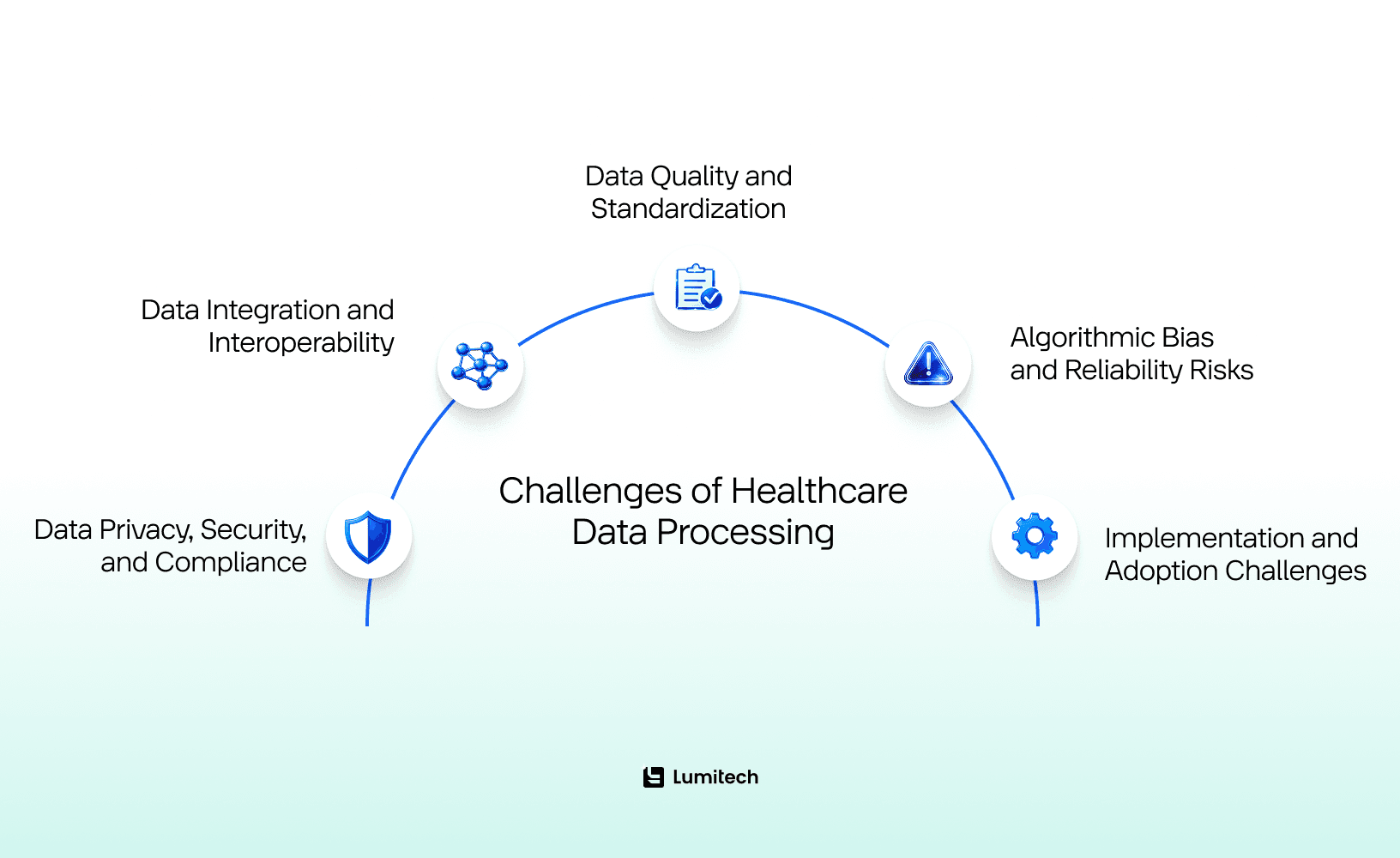
Data Privacy, Security, and Compliance
Healthcare data is heavily regulated for good reasons. HIPAA, GDPR, and local laws specify:
how data should be stored and encrypted;
who can access it and under which conditions;
what kind of auditing and reporting is required.
For solutions that deal with clinical or quasi-clinical data, HIPAA compliant data processing is a non-negotiable requirement. It affects architecture at every level: from cloud setup and network design to how logs are stored and who can query them. For platforms like Reputable Health, which help companies build regulatory-grade evidence, this is part of the core, not a “nice-to-have”.
Data Integration and Interoperability
Integration challenges are a daily reality:
EHRs and lab systems often have legacy interfaces.
Device vendors change APIs or data structures.
External services may fail or deliver inconsistent payloads.
In the Reputable Health AI engine, integrating multiple wearable ecosystems and keeping those integrations robust under load was a central task. We had to choose between building custom adapters, using vendor SDKs, and designing internal schemas that could survive inevitable changes in upstream systems.
Data Quality and Standardization
Data quality issues can quietly erode trust. Examples include:
missing or incomplete records;
inconsistent units and scales;
historical data that does not match current conventions.
In our work, we usually treat data quality as an ongoing process rather than a one-time cleanup. In Reputable Health, the preprocessing and feature extraction steps include checks and normalization logic that improve over time as more edge cases are discovered. This reduces surprises when new studies or device types are added.
Algorithmic Bias and Reliability Risks
When you add AI models, you also introduce new kinds of risks. Models trained on non-representative data may perform poorly for certain groups. Overly sensitive models may create alert fatigue; insensitive ones may miss important events.
Our approach is to keep clinicians and domain experts in the loop, especially for high-stakes outputs. AI suggestions and scores should be transparent and explainable enough that people can question them.
Implementation and Adoption Challenges
Finally, there are human and organizational factors. Even the best-designed pipelines can fail if:
interfaces are slow or confusing;
systems do not match existing workflows;
or change management is neglected.
Reputable Health felt this when their legacy mobile app became slow and unreliable. Participants dropped off, ratings suffered, and internal teams had to compensate manually. Rebuilding the app with a focus on speed and reliable synchronization, and aligning it with the new backend, was essential for adoption — not just a cosmetic update.
These challenges in processing healthcare data are not exotic problems. They are the baseline reality you should plan for.
Healthcare Data Processing Across Systems: From Devices to Clinical Workflows
Data in healthcare rarely lives in one place. Understanding how it moves across systems is essential for designing solutions that actually work.
In a typical setup:
mobile apps handle patient-facing tasks (onboarding, consent, daily questionnaires, device pairing);
wearables and home devices send continuous data via vendor APIs;
backend engines carry out cleaning, aggregation, and analysis;
web platforms act as control centers for clinicians and researchers, providing dashboards and healthcare data management solutions.
Reputable Health is a good illustration of this end-to-end flow. Their mobile app is the participant touchpoint, their AI engine is the central processing hub, and their web platform is where teams design and monitor studies. When these components work together, the system behaves like an enterprise healthcare data platform rather than a collection of isolated tools.
The key idea is simple: value comes from orchestration, not just from having each part in isolation.
Examples of Data Processing in Healthcare in Real-World Systems
To tie it all together, let’s briefly revisit a few examples of data processing in the healthcare industry that we have touched on:
remote patient monitoring pipelines that transform continuous signals into early-warning indicators and prioritized patient lists;
wearable-based research platforms that process millions of data points to quantify sleep and HRV changes under real-world conditions;
AI-driven engines that not only compute metrics but also generate compliance-ready reports for regulators;
and modernized mobile and web applications that surface this information in ways clinicians, researchers, and participants can actually work with day to day.
All of these IT solutions for mid-size companies in healthcare share a common thread: data processing is not a standalone goal. It is a means to build systems that support decisions, reduce manual work, and make it easier to run complex healthcare operations under real-world constraints.
Healthcare Data Processing That Supports Clinical Decision-Making
At some point, all the talk about pipelines and models has to converge into one question: does this help clinicians and researchers make better decisions?
Prioritized Alerts Instead of Data Overload
Healthcare teams are already dealing with alert fatigue from multiple systems. Adding one more stream of notifications is not a solution. Systems that work well:
prioritize alerts based on risk and context;
suppress noise and artifacts;
and present attention-worthy cases in a concise way.
This is exactly the direction Lumitech takes in AI in remote patient monitoring project, where AI models analyze time-series data to predict potential deterioration and surface high-risk patients at the top of the list instead of flooding dashboards with low-importance events.
Trend Summaries That Support Decisions
Clinicians and researchers think in terms of trajectories: “Is this patient getting better or worse?”, “Is this intervention working?”, “What changed after we adjusted the protocol?”.
Best practices for data processing in healthcare emphasize:
longitudinal analysis over single snapshots;
clear visualization of trends and inflection points;
and alignment of metrics with clinical or research objectives.
Reputable Health’s web platform follows this logic by showing how outcomes like sleep performance and HRV evolve over the course of a study, tied to specific interventions. It is easier to make decisions when trends are visible at a glance.
Safety Gating and Validation Layers
For systems that feed into clinical or regulatory decisions, safety and validation are critical. That usually means:
human-in-the-loop checks for sensitive outputs;
controlled testing environments for new models;
comprehensive logging and auditability.
Reputable Health’s AI engine, for instance, is built to produce evidence and reports that can be used in submissions to regulators. That requires not only correct calculations, but also transparency in how data was collected, processed, and interpreted.
Effective healthcare data processing tools combine AI, validation, and workflow integration. Without that combination, even accurate models may remain unused.
From Healthcare Data Processing to Scalable Decision Systems
For Lumitech, healthcare data processing is part of a larger mission: building decision systems that hold under pressure, not just prototypes or isolated tools. We design and implement:
pipelines that can handle messy, multi-source inputs;
AI and analytics layers that generate clinically meaningful metrics;
and interfaces that fit into existing workflows rather than fight them.
Our experience in software development for the healthcare industry has made one thing very clear: if you start from the core problem and the decisions you want to support, data processing becomes a powerful lever. If you start from tools, you usually end up with more dashboards and the same old complaints.
Whether you need to modernize a clinical platform, build an AI-driven research platform, or explore AI in healthcare applications in the UAE market, the fundamentals stay the same. Clarify what “better decisions” means for you, then design your data processing engine and surrounding systems with that outcome in mind.
Conclusion
Modern healthcare does not lack data — it lacks systems that can turn that data into reliable, timely decisions. Data processing in healthcare only creates value when it is end‑to‑end: from noisy, multi-source inputs, through robust pipelines and AI layers, to interfaces that clinicians and researchers can actually use in their daily workflows. When those pieces are aligned, you get earlier detection, clearer trends, less manual work, and faster, more credible evidence for treatments and products.
At the same time, real-world systems must live inside tight constraints: HIPAA and other regulations, fragmented infrastructures, legacy platforms, and teams already under pressure. That is why the differentiator is not “who has the fanciest model”, but who can design healthcare data processing that is compliant, stable under load, and realistic about how people work — whether it’s remote monitoring, wellness research, or clinical applications.
At Lumitech, we specialize in taking complex, regulated environments and turning them into scalable decision systems: compliant data pipelines, AI engines that generate clinically meaningful metrics, and web and mobile products that fit existing workflows instead of fighting them. If you are thinking about modernizing a clinical platform, building an AI‑driven research solution, or launching a new healthcare product and want to be sure the underlying data and compliance foundations are solid, let’s talk.