Government Chatbots: Building Arabic-English Citizen Services in the GCC
Arabic-first government assistants need to understand local dialects, deliver reliable answers from official sources, and follow country-specific data rules. Explore how to build and deploy them in the UAE and Saudi Arabia.
- AI Development
- Chatbots
- GCC
November 13, 2026
 AI Overview
Citizens can use a government chatbot in the GCC to find service information, understand application requirements, and complete routine procedures. With access to identity and case management systems, the assistant can go beyond answering questions and process renewals or payments. Delivering this experience requires support for regional Arabic dialects, a bilingual RTL interface, reliable answers backed by official sources, and a way to reach human representatives. Privacy rules differ between markets: the UAE PDPL excludes government data, whereas Saudi Arabia’s PDPL covers public entities.

A government chatbot is a conversational assistant that answers questions about public services and, once connected to back-office systems, helps people complete tasks such as renewals, payments and application tracking. In the GCC, a production-ready assistant has to understand Arabic in its formal and dialectal forms, answer only from approved official content, and follow data rules that differ by jurisdiction.
The UAE has the deepest public record of deployments across the GCC. Here are the examples that show the range: U-Ask, the federal government’s bilingual hub for service information, launched in May 2023; Abu Dhabi’s TAMM AI Assistant gained conversational voice capabilities in Arabic and English in 2024; and Dubai’s DEWA Rammas handled more than 1.6 million inquiries in 2025.
Published figures for government chatbots mostly cover interaction volumes and self-reported resolution rates. Abu Dhabi’s Department of Government Enablement reports that TAMM resolves 95% of requests through AI, but has not defined what “resolved” means. Limited independent accuracy data makes it especially important to get the design right before government chatbots go live.
For the wider market context behind these programs, see Lumitech's analysis of digital transformation in the Middle East.
What a Government Chatbot Does for Citizens and Agencies
Use cases for chatbots in government fall into three levels of capability, each with different data exposure and risk.
Level | What the assistant does | Data it touches | Main risk |
|---|---|---|---|
Informational | Explains eligibility, fees, required documents and procedures | Published service content | Outdated or invented answers |
Personalized | Checks application status, flags expiring documents, explains the user's own case | Authenticated personal records | Exposure of personal data |
Transactional | Starts, completes or pays for a service on the user’s behalf | Case management, payment and identity systems | A wrong action with legal or financial effect |
U-Ask sits at the first level, giving users service requirements and direct links to applications. TAMM has moved further. At GITEX Global 2025, Abu Dhabi said the TAMM AI Assistant can complete many services on the customer's behalf and introduced TAMM AutoGov to manage recurring tasks such as license renewals in the background. Both belong to the Abu Dhabi Government Digital Strategy 2025–2027, which aims to make Abu Dhabi the world's first fully AI-native government by 2027. At the federal level, the UAE Cabinet set a target in April 2026 to move 50% of government sectors, services and operations to agentic AI within two years. Both are stated targets, and their outcomes can only be measured after the deadlines.
Residents can benefit from citizen self-service at any time, selecting the language they prefer, and without the need to search several portals. For agencies, citizen service automation pays off when the assistant resolves the request. A public sector chatbot that answers fluently yet hands every second conversation to an agent adds a channel without reducing workload. Where the underlying digital government services already have forms and apps, the assistant’s value lies in shortening the path to them.
A complete measurement plan tracks successful resolution by intent, escalations to human support, language-by-language accuracy against a fixed test set, and how many responses cite or rely on approved sources.
What Makes Arabic Different to Engineer For
Providing AI chatbot development services for the GCC means accounting for Arabic across four layers: language understanding, content retrieval, interface rendering, and content management across Arabic and English. Adding it only at the translation stage leaves critical issues to be discovered during acceptance testing.
Modern Standard Arabic, Gulf Dialects and Code-Switching
Official content is written in Modern Standard Arabic (MSA), while citizens type and speak in Gulf Arabic dialects, mix in English terms, and sometimes write Arabic in Latin script with numerals standing in for letters (often called Arabizi). This limitation is reflected in research. The AraDiCE benchmark, led by the Qatar Computing Research Institute and presented at COLING 2025, found that Arabic-focused models were better at handling dialects than general multilingual models. However, their results still fell below their MSA and English performance. The benchmark covers Levantine and Egyptian Arabic, leaving Emirati and Saudi speech untested. Agencies need to fill this gap with local data.
One more factor is how people mix languages in real life. A 2025 survey of code-switched Arabic research covers switches between Arabic varieties, as well as combinations of Arabic and foreign languages, such as English words carrying Arabic affixes. Because public datasets rarely mirror the mix found in government channels, local logs provide a more relevant basis for evaluation.
Effective Arabic NLP in citizen services starts with consistent text normalization that includes alef variants, taa marbuta, and optional diacritics. Also, systems must accept Latin-script input and build intent recognition based on real-world call transcripts and chat data. Testing on clean MSA input captures only one side of the picture. An Arabic chatbot may perform well on clean MSA test questions but still struggle with a voice note in Gulf Arabic dialects. Make sure the evaluation set reflects how people communicate in everyday life: include dialectal, code-switched, and misspelled examples for each high-volume intent.
Model choice goes next. Options include general multilingual conversational AI models, Arabic-centric models such as ALLaM, whose HUMAIN Chat app accepts Arabic speech input across dialects, or a hybrid that routes by detected language and intent. A multilingual government chatbot may also need languages beyond Arabic and English: Dubai’s digital services law allows entities to add other languages based on their customers’ preferences.
Designing the Bilingual Experience
In Dubai, Law No. 9 of 2022 requires entities within its scope to provide digital services in Arabic and English and to make them accessible to People of Determination. At the federal level, the UAE Design System used for federal government websites states that all of its components support RTL layouts.
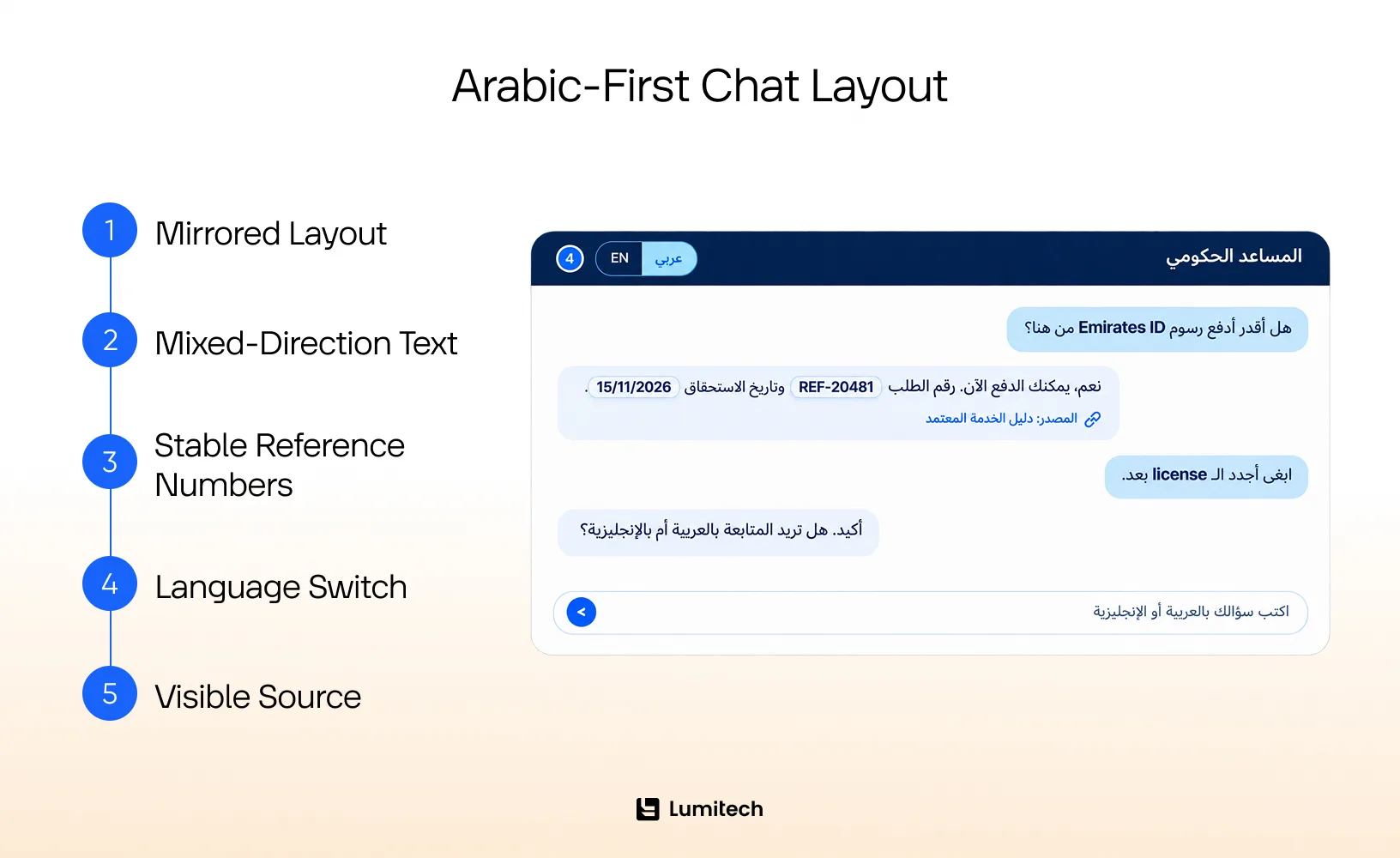
A chat-based right-to-left (RTL) interface requires a mirrored layout, proper bidirectional text handling, and fonts that display Arabic clearly. It must also render English service names, ID numbers, and URLs correctly within Arabic sentences. An Arabic-English chatbot should track language across conversation turns, respond in the language of each question, allow users to switch languages at any point, and keep dates and reference numbers clear in both.
Reliable bilingual citizen services depend just as much on content parity. Lumitech's guide to government software development in the GCC describes bilingual scope across five layers (interface, content, data, domain material, and documentation and training), and a chatbot inherits every one of them.
How to Ground Answers in Official Sources
A citizen who acts on a wrong answer about a fee, deadline or eligibility rule may lose money or a right, and the agency owns that outcome. Retrieval-augmented generation (RAG) reduces this risk by retrieving passages from approved documents and instructing the model to answer only from them, with a citation the user can open. For the architecture trade-offs, see Lumitech's comparison of RAG and fine-tuning.
The quality of retrieval depends on four design decisions:
A curated government knowledge base. Service cards, fee schedules, regulations and approved FAQs, each with an owner, an effective date, a language tag and a link to its other-language counterpart.
Clear rules for managing language versions. When Arabic and English content gets out of sync after an update, the assistant may give different answers to the same question. Dubai’s official English translation of Law No. 9 of 2022 illustrates this: it states that the Arabic text prevails. Retrieval logic should reflect this priority.
Clear abstention and escalation rules. If confidence falls below a defined threshold or a request falls outside the assistant’s scope — including complaints, appeals, and individual legal interpretation — the conversation is transferred to a human agent with its history attached.
Separate layers for policy and procedure. “What the rule says” and “what you should do next” draw on different sources and fail in different ways, so they are designed and tested separately.
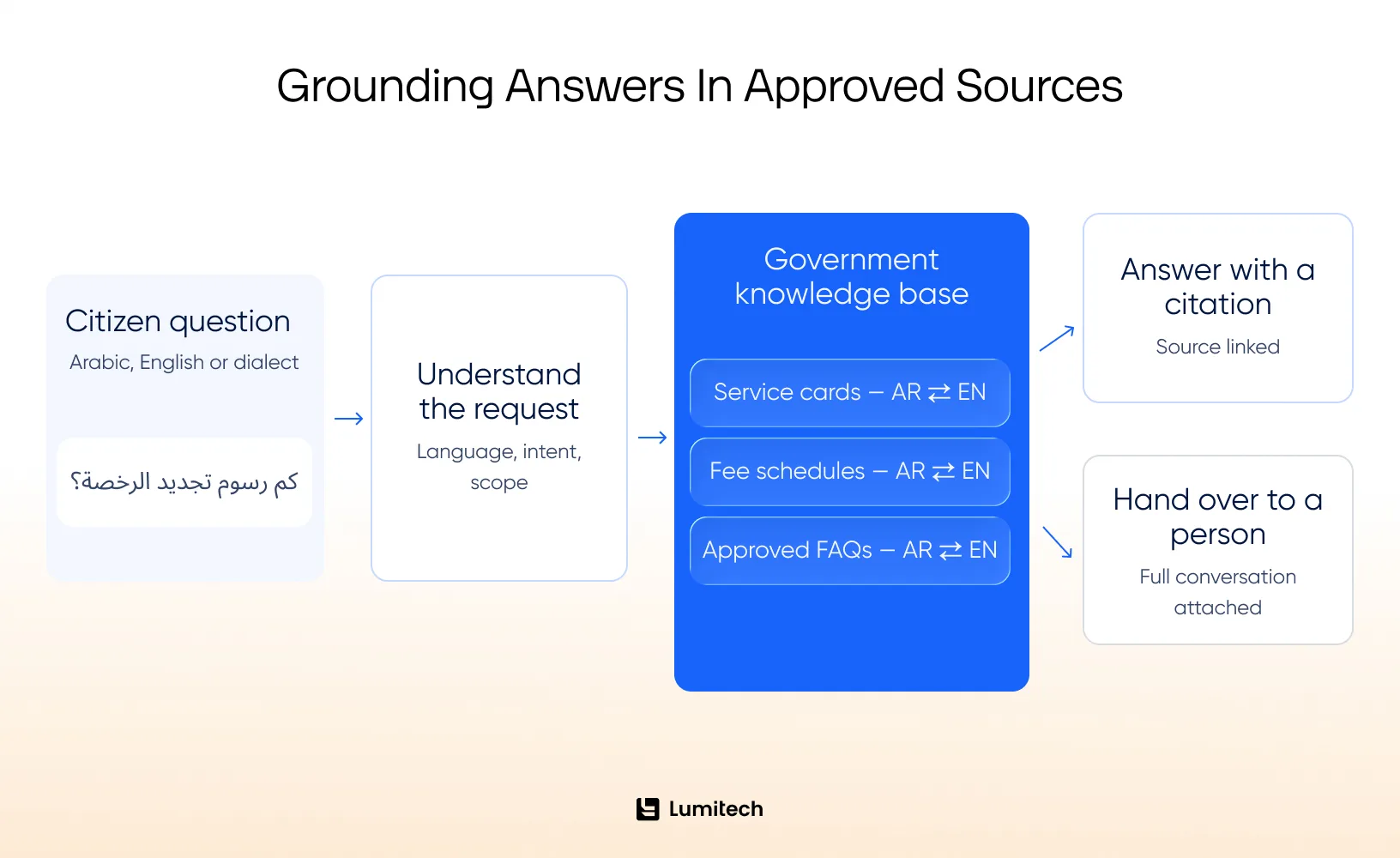
A government chatbot built this way can still make mistakes, but each mistake can be traced to a document and corrected by its owner.
Lumitech applied this pattern in a legal AI assistant for a regional fintech institution in the MENA region. The constraints will be familiar to public-sector teams: no public AI models could process the organization’s data, every answer had to link back to approved documents, access followed role-based permissions, and policy explanations were separated from process guidance. The project started as a pilot to validate answer quality before scaling. The same discipline sits at the core of Lumitech's RAG development services.
When Government Chatbots Get the Law Wrong
The launch of New York City’s MyCity chatbot in late 2023 was intended to give business owners easier access to city information. However, a 2024 investigation by The Markup revealed serious errors in its guidance. The chatbot told users that employers could take a share of workers’ tips and that stores could go cashless, although both practices conflicted with local or state regulations. Following a change in administration, the city took the service offline in early 2026. The page now states that its beta test has ended.
The lesson for GCC agencies is to treat accuracy as something that must be tested and managed. Include legal edge cases and adversarial questions in Arabic and English in the evaluation set, and assign responsibility for every source document. A disclaimer alone offers no substitute for these controls.
Want an Arabic-English assistant for a public service?
Map out the services it will cover and the most frequent contact center queries. Lumitech's AI chatbot development services can turn this input into a practical pilot with approved knowledge sources and a clear route to human support.

Building a Chatbot for Government Services That Completes Tasks
Moving from answers to actions turns the assistant into a front end for existing systems. Government API integration for this purpose covers four groups: identity, case management, payments and notifications.
Identity comes first. The UAE’s federal Digital Customer and Digital Government Service Policy, approved by the Cabinet in March 2021, relies on shared enablers such as UAE PASS, the Government Service Bus and the national CRM, and includes a principle of requesting personal information only once. In Saudi Arabia, the Government Service Bus is managed by SDAIA, and Nafath serves as the national single sign-on platform.
For a chatbot for government services to handle transactions safely, it must confirm actions with users, rely on idempotent API calls to avoid duplicate fee payments, maintain audit trails tied to authenticated accounts, and pass full conversation history to human agents when escalating. The UAE’s guide to agentic AI in government services, launched in August 2026, reflects the same approach: explain the process, get approval before acting, and let customers object or request corrections. Where government software development services rely on legacy systems, an API layer may be needed before the assistant can interact with them.
In Lumitech's enterprise WhatsApp commerce project for a GCC retail and veterinary network, one Arabic-English WhatsApp conversation covers product discovery, payments, bookings, delivery tracking and escalation to staff for a client operating in the UAE and Saudi Arabia. The platform runs inside the client’s own infrastructure and connects to its existing ERP, CRM and warehouse systems. The sector differs, but the integration problem matches what agencies face: one conversational front end over several systems of record. Lumitech's AI integration services address that layer.
UAE and Saudi Arabia: Different Data and AI Rules
Requirements for an AI chatbot for government use depend on the market. This guide examines the UAE and Saudi Arabia, excluding other GCC countries.
UAE: Federal Law, Emirate Law and Policy
The UAE’s federal Personal Data Protection Law (Federal Decree-Law No. 45 of 2021) excludes government data and government entities involved in collecting or processing personal data from its scope. However, the exemption has limits. Companies wholly owned by federal or local governments may still qualify as establishments under the law, so vendors should consult legal counsel to determine whether the exclusion applies to them. As of October 2026, the law’s Executive Regulations had yet to be issued.
Other rules include data sharing, security and accessibility. In Dubai, Law No. 26 of 2015 governs how government entities classify and exchange data. Law No. 9 of 2022 adds requirements for Arabic and English content, accessibility, DESC security standards and approval to outsource digital services. At the federal level, government entities must apply the security controls in the UAE Information Assurance Regulation. The National Policy for Digital Accessibility, issued in March 2024, sets WCAG 2.1 Level AA as the target for federal entities.
For AI, the UAE Charter for the Development and Use of Artificial Intelligence sets principles such as transparency and human oversight. It is a policy framework with no statutory penalties. In June 2026, the UAE also approved a new Artificial Intelligence and Data Authority. It brings together the AI Office, TDRA’s digital government sector and the UAE Data Office, so teams should check which body now owns each policy they rely on.
Saudi Arabia: PDPL, SDAIA Guidance and NCA Controls
Saudi Arabia’s Personal Data Protection Law (PDPL) covers both public and private entities and has been fully enforceable since September 2024. Public entities are also required to register with SDAIA. Published in January 2024, SDAIA’s Generative AI Guidelines explain how government employees should use government data with generative AI tools. Meanwhile, the National Cybersecurity Authority’s ECC-2:2024 controls are mandatory for government entities. The 2024 edition also revised data localization requirements, moving these controls to SDAIA’s National Data Management Office. For a government AI chatbot, hosting decisions in Saudi Arabia should therefore be checked against NDMO data rules as well as ECC.
Dimension | UAE | Saudi Arabia |
|---|---|---|
Federal or national data protection law | PDPL excludes government data and governmental entities | PDPL applies to public entities, which must register with SDAIA |
Language requirement | Arabic and English mandatory for digital services in Dubai (Law No. 9 of 2022) | Arabic is the official language; English provision follows entity and service requirements |
AI-specific instruments | UAE AI Charter (policy); August 2026 agentic AI service design guide | SDAIA Generative AI Guidelines for Government (guidance) |
Security baseline | UAE IA Regulation; DESC standards in Dubai | NCA ECC-2:2024 |
Data residency source | Entity policies, emirate-level rules and contracts | NDMO data rules |
The practical consequence is that one government chatbot design cannot simply be copied from Abu Dhabi to Riyadh. Data classification, hosting, logging and the legal basis for processing need a separate review in each market, and Lumitech's AI governance consulting covers this kind of risk and controls review.
A Delivery Roadmap for Government Conversational AI
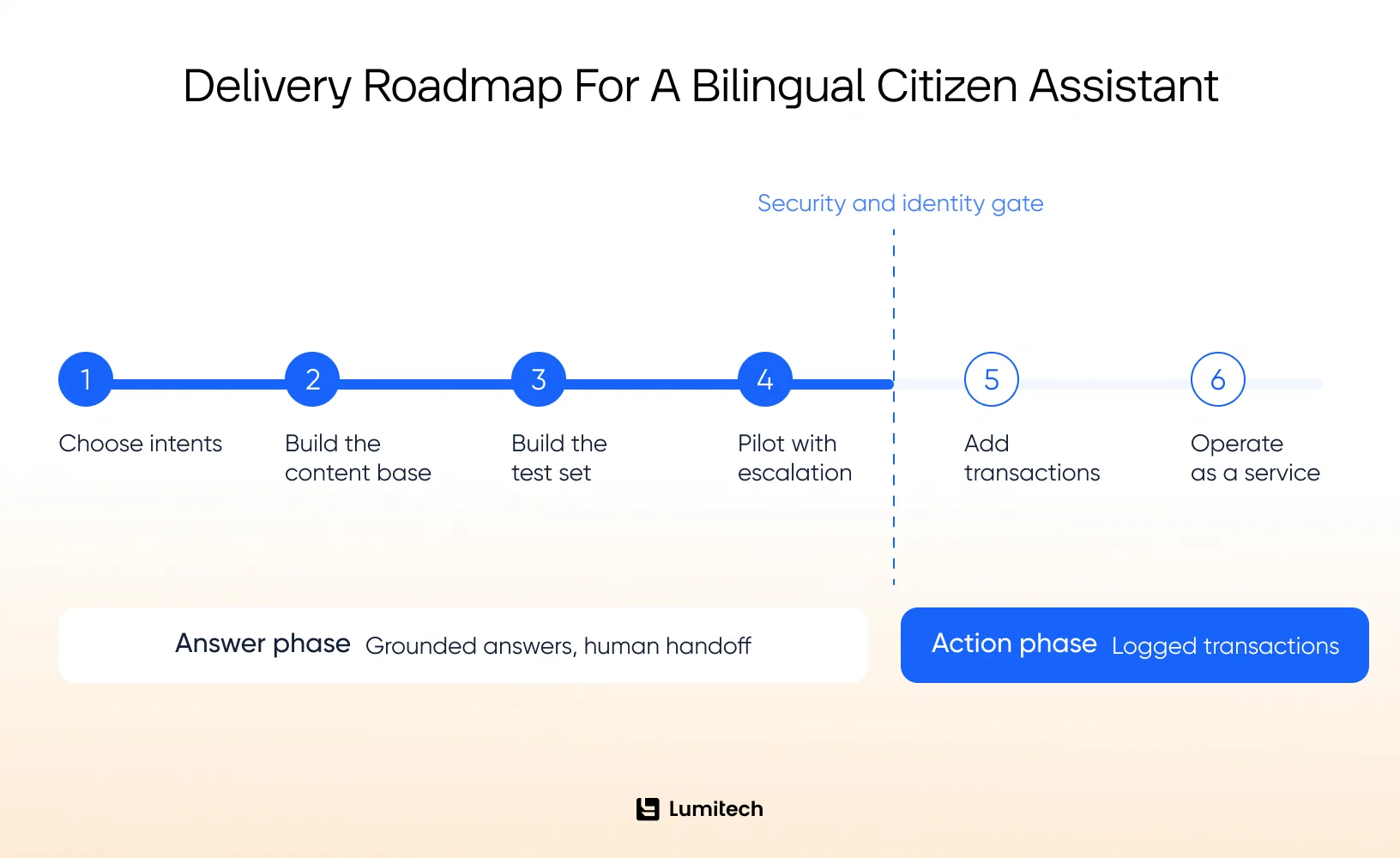
The transition from demo to deployment can expose issues in government conversational AI projects, including dialect recognition, missing knowledge sources, and security requirements. A structured roadmap helps teams work through these challenges systematically.
- 01
Select intents using contact-center data. Rank incoming questions by frequency and risk, and address the most common informational requests first.
- 02
Set up a bilingual knowledge base. Define ownership for every source document and support connections between its Arabic and English versions.
- 03
Build an evaluation set first. Test dialects, code-switched messages, misspelled queries, and adversarial inputs against language-specific accuracy goals.
- 04
Pilot the chatbot with a human fallback in place. Track verified outcomes, citation completeness, and the quality of transfers to support team employees.
- 05
Add authenticated and transactional journeys only after identity integration, audit logging and security review are complete.
- 06
Operate it as a service. Content owners, monitoring and a review cycle keep answers current as fees and rules change.
Procurement requirements influence the timeline just as much as engineering. A chatbot for government projects may need to stay within the scope and budget defined in the tender, making it essential to specify the pilot boundaries and evaluation criteria in the bid.
In a commercial project, you find out what’s actually needed during discovery. In a government tender, you don’t get that phase — you price the unknowns before you’ve even won the work. That’s the single biggest mindset shift we had to make.


A government chatbot that ships with a measured pilot, an owned knowledge base and a tested Arabic-English chatbot experience gives an agency evidence to scale on, and a clear basis for expanding bilingual citizen services to new journeys.