
RAG vs Fine-Tuning: Choosing an Architecture for Enterprise AI
RAG keeps knowledge in a searchable index and fetches it per query. Fine-tuning writes it into the weights. The architecture choice depends less on accuracy than on how often knowledge changes, who can see it, and whether answers must cite a source.
- AI Development
- AI Integration
October 29, 2026
 AI Overview
RAG vs. fine-tuning is an architecture choice for enterprise AI. Retrieval-augmented generation keeps knowledge in an external index, so documents stay current, access-controlled, and citable. Fine-tuning writes behavior into model weights, so every knowledge update requires retraining. Retrieval-based legal research tools still hallucinate 17–33% of the time, making evaluation sets essential.

Retrieval-augmented generation keeps your knowledge outside the model. Documents sit in a searchable index, and the passages most relevant to each question are retrieved and passed to the model at query time. Fine-tuning does the opposite: it trains the model further on your own examples, writing patterns into its weights. Retrieval changes what the model can see. Fine-tuning changes how it behaves.
When it comes to the issue of fine-tuning vs RAG, most teams ask which of the two is more accurate. However, both can be made accurate enough, and accuracy is rarely what breaks the system a year after launch. The questions that decide an enterprise AI architecture are more straightforward: how often the knowledge changes, who can see which parts of it, whether an answer must cite its source, and what happens when a document is withdrawn.
In brief
Retrieval suits knowledge that changes, needs per-user access control, or has to be cited, which is why most enterprise AI chat interfaces over company documents are built on it. Updating it is an indexing operation.
Fine-tuning suits stable requirements about format, tone, and task behavior the base model handles poorly. Updating it means training again.
The published evidence supports no blanket winner in RAG vs fine-tuning, and none of it supports assuming that combining the two is automatically better. Neither removes the need for an evaluation set.
What Each Approach Actually Does
The two methods act at different times. Retrieval works while a request is being answered, so its behavior can change from one question to the next. Fine-tuning happens before the model is deployed, and whatever it learned is fixed by the time a question arrives.
How a RAG Architecture Works
The system has four components. It divides source documents into chunks, transforms them into vectors using an embedding model, and saves them in a vector database. When the system processes a query, it embeds the question the same way; it retrieves the most similar chunks, usually re-ranks them, and includes them in the prompt.
The commercial result is based on a single fact: the knowledge never gets into the model. Revoking a document means deleting rows, restricting it to one department means filtering at retrieval, and showing where an answer came from means returning the chunk’s source.
What Fine-Tuning Changes
Fine-tuning continues training a model on examples of the behavior you want. Supervised fine-tuning teaches input–output patterns; preference methods such as DPO teach it which of two answers is better. Parameter-efficient methods train a small set of additional weights instead of the whole network: against fine-tuning GPT-3 175B with Adam, the original LoRA paper reported that the method “can reduce the number of trainable parameters by 10,000 times and the GPU memory requirement by 3 times”, with no additional inference latency (Hu et al., 2021).
This is not domain pretraining: BloombergGPT drew on “a 363 billion token dataset based on Bloomberg’s extensive data sources” within a roughly 708-billion-token corpus. No mid-sized company replicates that.
What the Evidence Shows on Retrieval-Augmented Generation vs. Fine-Tuning
Published comparisons of retrieval-augmented generation vs. fine-tuning are narrower than their headlines suggest, and scope matters more than result.
The most direct controlled study comes from a Microsoft team in Israel, testing three 7-billion-parameter open models on questions drawn from Wikipedia: “while unsupervised fine-tuning offers some improvement, RAG consistently outperforms it, both for existing knowledge encountered during training and entirely new knowledge”. On US current-events questions, Mistral-7B scored 0.481 at baseline, 0.875 with retrieval, and 0.504 after fine-tuning on the original documents; Llama2-7B went backwards under the same treatment, from 0.353 to 0.219, though paraphrase fine-tuning recovered it to 0.392. Two caveats: the method was unsupervised continued pretraining, not supervised fine-tuning, and every source document was Wikipedia.
A RAG vs fine-tuning comparison in another domain reached a different conclusion. Microsoft researchers working on an agricultural corpus from the US, Brazil, and India reported “an accuracy increase of over 6 p.p. when fine-tuning the model, and this is cumulative with RAG, which increases accuracy by 5 p.p. further”.
Will combining the two methods help? Anyone presenting LLM RAG vs fine-tuning as settled overstates the evidence. On their current-events task, the Ovadia team found the combination worse than retrieval alone; on their MMLU tasks, a fine-tuned generator sometimes helped. RAFT, which fine-tunes a model to reason over retrieved documents including irrelevant ones, posts large gains on some benchmarks, a near-exact tie on another, and a HotpotQA result that trails a GPT-3.5 retrieval baseline. A reasonable summary is that retrieval is the more reliable way to get information into an answer, and fine-tuning is the more reliable way to shape the answer.
RAG vs Fine-Tuning: Cost Comparison
The two architectures cost money in different ways, so a single comparative figure is misleading.
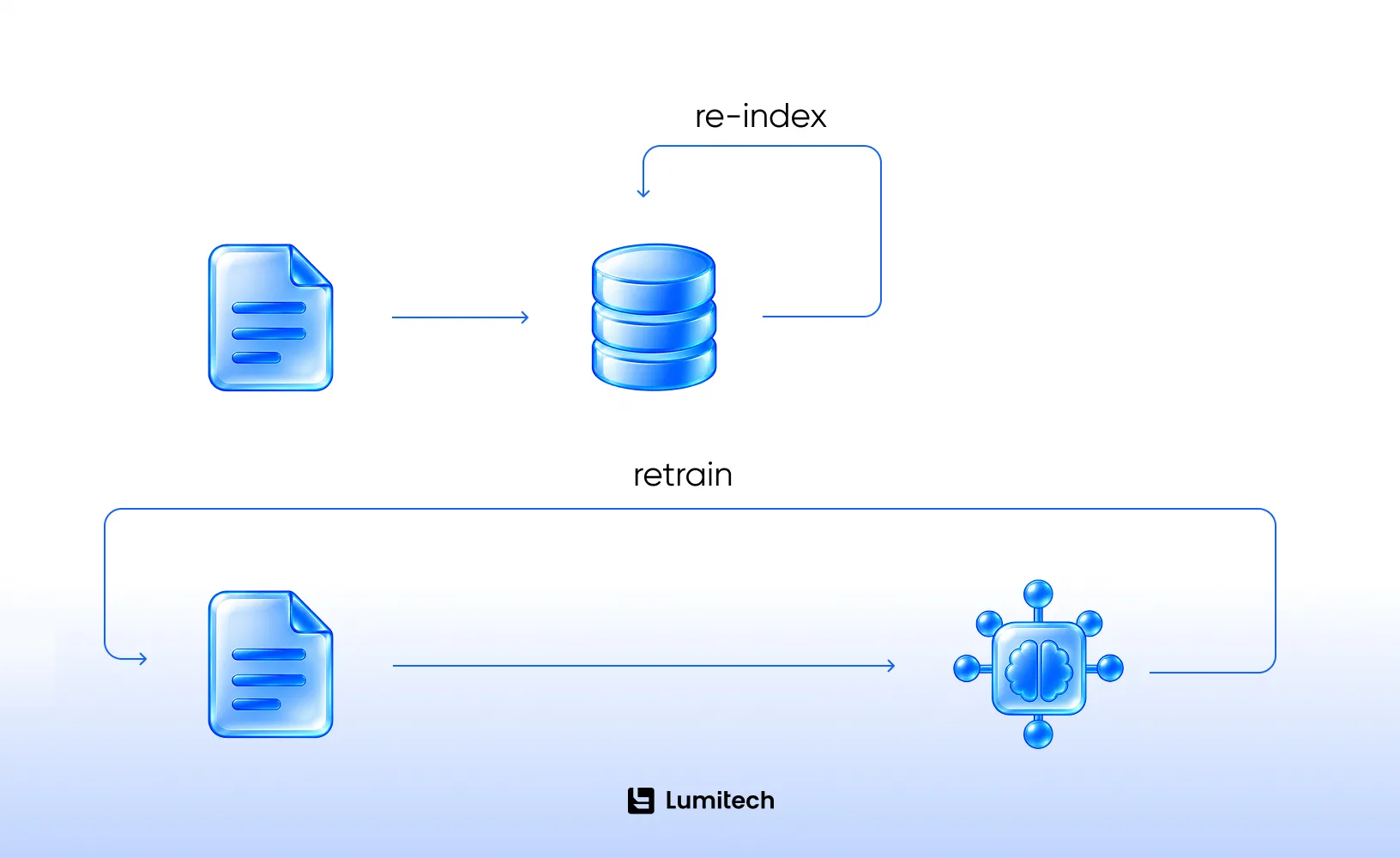
Fine-tuning cost is front-loaded and recurs on every refresh. Vertex AI prices supervised fine-tuning at $25 per million training tokens for Gemini 2.5 Pro, $5 for Gemini 2.5 Flash, and $6.72 for Llama 3.3 70B, where training tokens are “the total number of tokens in your training dataset, multiplied by your number of epochs”. There is no serving premium: “a Gemini tuned model endpoint has the same prediction price as the base model”. On AWS, reinforcement fine-tuning in Bedrock costs $80.00 per training hour, currently for gpt-oss-20b and Qwen3 32B. The actual expense rarely comes from compute; it comes from creating the training set and then having to redo that work whenever the knowledge changes.
Retrieval cost is ongoing and scales with volume. Embedding is cheap: Vertex AI lists Gemini Embedding at $0.00015 per 1,000 input tokens for online requests, or $0.15 per million. Managed retrieval is priced per call: $2.50 per 1,000 requests for Grounding with your data on Vertex AI, and on Bedrock managed Knowledge Bases $1.00 per 1,000 standard Retrieve API calls plus $5.00 per GB of raw data per month for index storage. Vector database costs grow with the index.
Our AI development cost breakdown covers the surrounding engineering, which usually dominates either figure. On the patent analysis platform we built for Amunet IP, NLP models pre-filter and score content before the LLM is involved at all, which “cut LLM costs from 200$ to just 20$ per run”. That is Lumitech’s own measurement on one platform, not an independent benchmark, and the savings came from retrieval design, not the model.
Pricing pages do not answer this question.
Bring us your corpus size, update frequency, and query volume, and we will model both architectures against your numbers instead of a vendor’s.

Does a Long Context Window Remove the Need for Enterprise RAG?
A fair question, since current models accept hundreds of thousands of tokens, and one that turns RAG vs. fine-tuning into a three-way choice. The research answers: partly, expensively, not reliably.
A Google DeepMind and University of Michigan team found long-context models beat retrieval on average across nine datasets, by 7.6% for Gemini-1.5-Pro and 13.1% for GPT-4o, while noting that “RAG’s significantly lower cost remains a distinct advantage”. Their hybrid routing method held quality close while cutting input tokens by roughly 60–65% for Gemini-1.5-Pro and 39% for GPT-4o.
Accuracy also does not rise smoothly with length. Databricks researchers testing 20 models reported that “using longer context does not uniformly increase RAG performance”, and that most of the open-source models they evaluated first increased and then decreased in performance as context grew. Both studies ran on 2024-generation models, but the structural point survives: pushing a whole corpus through the context window on every query is a pricing decision as much as an architectural one, and one worth testing on your own volumes in a scoped AI proof of concept before it becomes a standing bill.
Where RAG vs Fine-Tuning Becomes a Governance Question
Under the EU AI Act, Article 10’s data governance obligations attach specifically to high-risk systems that train models with data. The Digital Omnibus on AI, Regulation (EU) 2026/1744 of 8 July 2026, which entered into force on 27 July 2026, replaced Article 10(1) and 10(6) and moved the provision on special categories of personal data into a new Article 4a. In the consolidated text, Article 10(1) covers systems “which make use of techniques involving the training of AI models with data”, while for systems that don’t, the data-quality paragraphs “shall apply only to the testing data sets”. The implication is architectural rather than legal: where you put enterprise knowledge determines which obligations attach to it. That is not a claim that retrieval avoids the AI Act, and it is not legal advice.
Timing matters. The Act entered into force on 1 August 2024 and “became applicable on 2 August 2026, with some exceptions”. Following the Omnibus, the Commission states that the rules for Annex III high-risk use cases “have been extended to 2 December 2027”, and that Annex I systems embedded in regulated products have “an extended transition period until 2 August 2028”. The amended Article 10 is in force but not yet applicable to those categories.
Two further points are cheaper to build for than to retrofit. NIST’s Generative AI Profile describes high-integrity information as information that “can be verified and authenticated, has a clear chain of custody” — something retrieval supports natively, and weights do not. The same document warns that “indirect prompt injection attacks occur when adversaries remotely (i.e., without a direct interface) exploit LLM-integrated applications by injecting prompts into data likely to be retrieved”, so retrieval’s openness is also its attack surface. ISO/IEC 42001:2023 frames the management system around either choice.
We met these constraints on a legal AI assistant for a regional fintech institution, where “access to information had to strictly follow roles and clearance levels,” and answers had to be “traceable and anchored in approved documents”. Within a broader platform, our enterprise AI solutions practice handles the integration and operations around it.
What Breaks in Production
A RAG vs fine-tuning decision is only as good as what survives production. While retrieval reduces fabrication, it does not eliminate it altogether, and the best evidence is provided by a peer-reviewed study of the products that have actually been shipped.
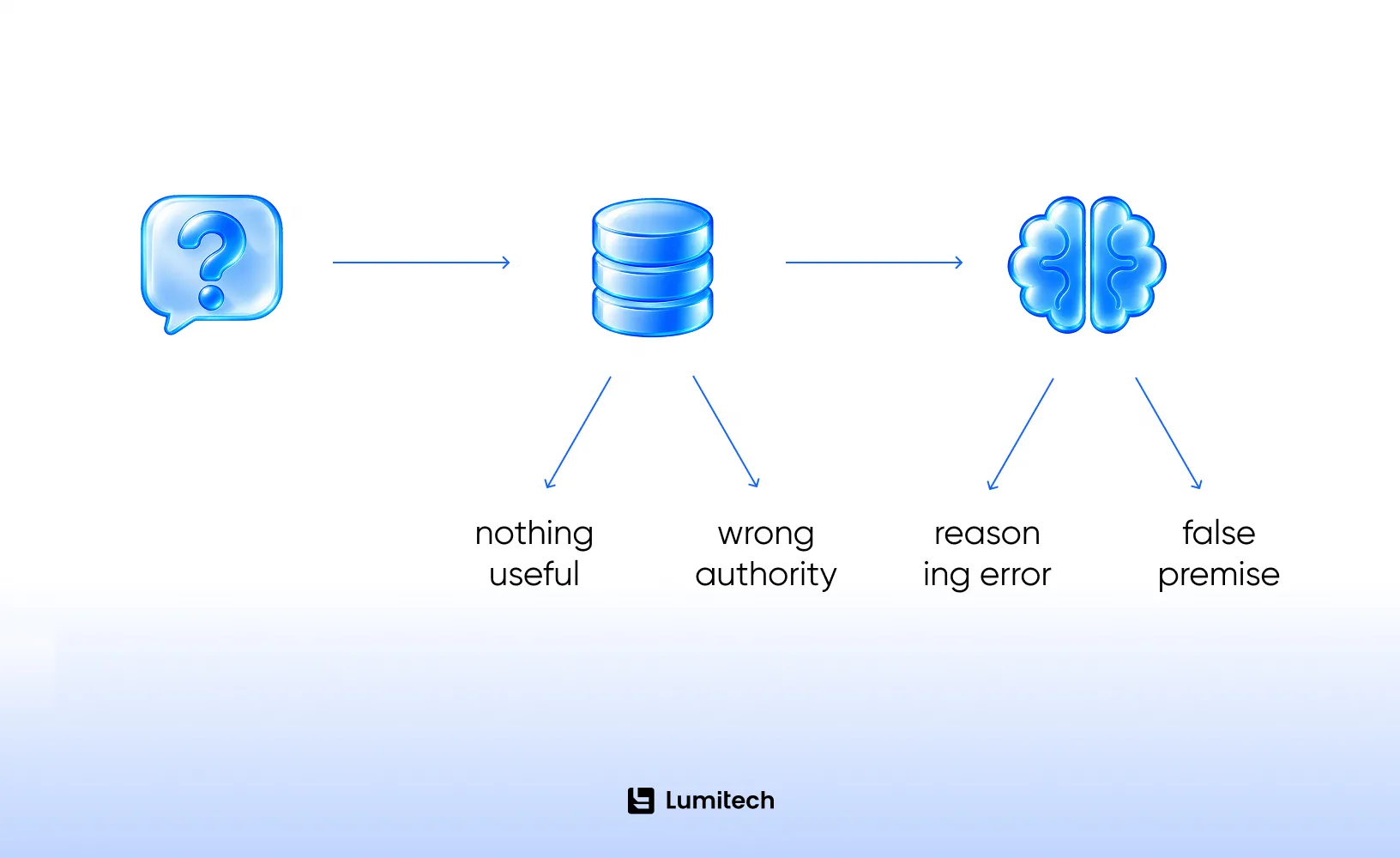
Stanford researchers tested three retrieval-based US legal research tools against 202 preregistered queries, with GPT-4 as a comparison, between 22 March and 22 April 2024, and Westlaw AI-Assisted Research separately in May. The tools “each hallucinate between 17% and 33% of the time”: Lexis+ AI answered 65% of queries accurately, Westlaw 41%, Ask Practical Law AI 19%. The authors conclude that “legal RAG can reduce hallucinations compared to general-purpose AI systems (here, GPT-4), but hallucinations remain substantial, wide-ranging, and potentially insidious”.
The study’s value lies in its failure taxonomy: naive retrieval, quoting irrelevant authorities, making reasoning errors even when the correct text is retrieved, and showing sycophancy toward a false premise. The mix differs by product, with retrieval failures dominant for Lexis+ AI and reasoning errors for Westlaw. These are three products at one moment, not a general error rate for RAG for enterprise AI, but the failure modes generalize.
The decision we most often revisit after a proof of concept is not retrieval versus fine-tuning. It is chunking. Teams size chunks for the documents they have rather than for the questions people ask, and the retriever returns technically relevant passages that do not answer anything. Changing that is cheap in week three and expensive in month six.


The factor that typically affects the results is retrieval quality. LinkedIn’s engineering team restructured customer service retrieval around a knowledge graph instead of flat text chunks and reported a 28.6% reduction in median per-issue resolution time over roughly six months in production — a change of retrieval structure, not of model. Once the new system launches, we put monitoring, evaluation sets, guardrails, and cost-control measures in place to ensure the architecture continues to function properly, as outlined in our LLMOps for enterprises guide.
A Decision Framework: Fine-Tuning vs RAG by Condition
A good enterprise RAG architecture decision follows the constraints, rather than focusing on technology.
Condition | Points toward | Why |
|---|---|---|
Knowledge changes weekly or faster | Retrieval | Updating an index is a write; updating weights is a training run |
Different users may see different documents | Retrieval | Weights cannot be filtered per user |
Answers must cite their source | Retrieval | Provenance returns with the chunk |
A document may have to be withdrawn | Retrieval | Deletion is a row operation, not a retrain |
Output must follow a strict format or schema | Fine-tuning | Format is behavior, and behavior lives in the weights |
The base model handles the task poorly even with perfect context | Fine-tuning | Retrieved text cannot fix a capability gap |
Latency or token budget is tight at high volume | Fine-tuning | A tuned small model can replace a long prompt |
Domain language is unusual | Test both | Embeddings may be the bottleneck |
Where LLM Fine-Tuning vs RAG Gets Decided in Practice
Two conditions override the table. If you cannot describe a correct answer well enough to build an evaluation set, neither architecture converges. When the knowledge is spread across systems that don’t communicate with each other, the first problem is AI integration, not model selection. Sector context shifts the weighting: our guide to LLMs in finance works through the same choice in financial services.
There is one counter-case: in an OpenAI customer story, the legal AI company Harvey describes hitting retrieval limits on open-ended legal questions and building a custom-trained case law model, adding “the equivalent of 10 billion tokens worth of data” — a figure provided by the vendor and representing a scale that goes beyond that of a typical enterprise project.
What Changed in 2026
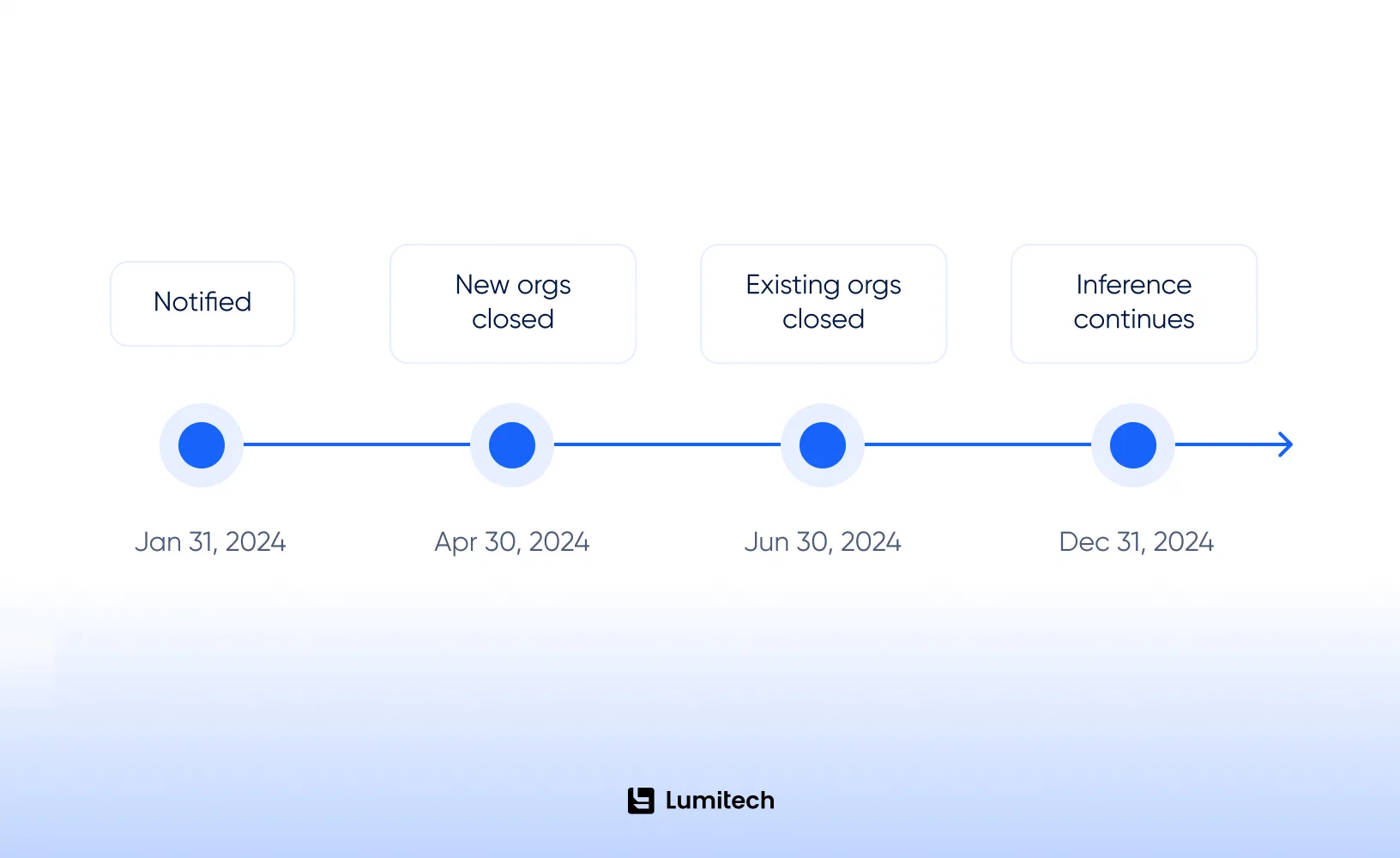
OpenAI’s model optimization guide now opens with a notice: “OpenAI is winding down the fine-tuning platform. The platform is no longer accessible to new users, but existing users of the fine-tuning platform will be able to create training jobs for the coming months”. Its deprecation page dates the sequence: developers were notified on 7 May 2026; from 2 July 2026, creating jobs became unavailable to organizations “that have not run inference on a fine-tuned model in the past 60 days”; and on 6 January 2027, “active existing customers will no longer be able to create new fine-tuning jobs on this date”. Models already tuned remain available for inference until their base models are deprecated.
The documentation sets out no migration path; what it places ahead of tuning is prompt work measured by evaluations, with relevant context supplied in the request. For a team weighing AI RAG vs fine-tuning on that platform, the options have narrowed to retrieval, post-training an open-weight model, or tuning on another cloud. Weighing those three against a real workload, rather than against each other in the abstract, is where our generative AI solutions work begins. That last route is capable and not cheap: Harvey’s August 2026 research preview describes post-training a Kimi K3 base, with Fireworks, on “approximately 150 NVIDIA B300 GPUs over the course of 2 months”.
Where Lumitech Fits
Most engagements begin with a problem rather than an architecture: knowledge nobody can search, answers that have to be defensible, a governance requirement that arrived before the use case. Our RAG development services cover the retrieval path from ingestion and chunking through evaluation sets and access control, including the engagements where the honest recommendation turns out to be fine-tuning, a hybrid, or no custom model at all.


